From ARPANET packets and Ethernet LANs to TCP/IP, the World Wide Web, Wi-Fi, mobile 5G, and software-defined networks, networking linked the planet.
1960s -> PresentARPANET -> InternetLAN -> 5G
Networking Invention and Foundations
Modern computer networking began when researchers asked how to connect machines that might be far apart, owned by different organizations, and built by different vendors. Paul Baran and Donald Davies independently developed packet switching ideas; the U.S. ARPANET demonstrated that small computers could share resources over leased lines. Bob Metcalfe's Ethernet then solved the office problem—how to wire a building cheaply—while Vint Cerf and Bob Kahn's TCP/IP gave the world a common language for internetworking.
Each layer of the stack solved a different job: physical cables and radios move bits, switches and routers forward frames and packets, protocols guarantee delivery or names, and applications like email, the web, and video calls ride on top. Understanding that stack helps explain why Wi-Fi, 5G, cloud data centers, and home routers are all part of one continuous story rather than separate inventions.
Big picture
Computer networking evolution in one view
Networks layered from physical cables to protocols, routing, applications, and now virtual overlays inside cloud data centers. A home laptop opening a website triggers DNS lookup, TCP connections across continents, TLS encryption, HTTP requests, and CDN caching—all in seconds because decades of standards made diverse hardware interoperable.
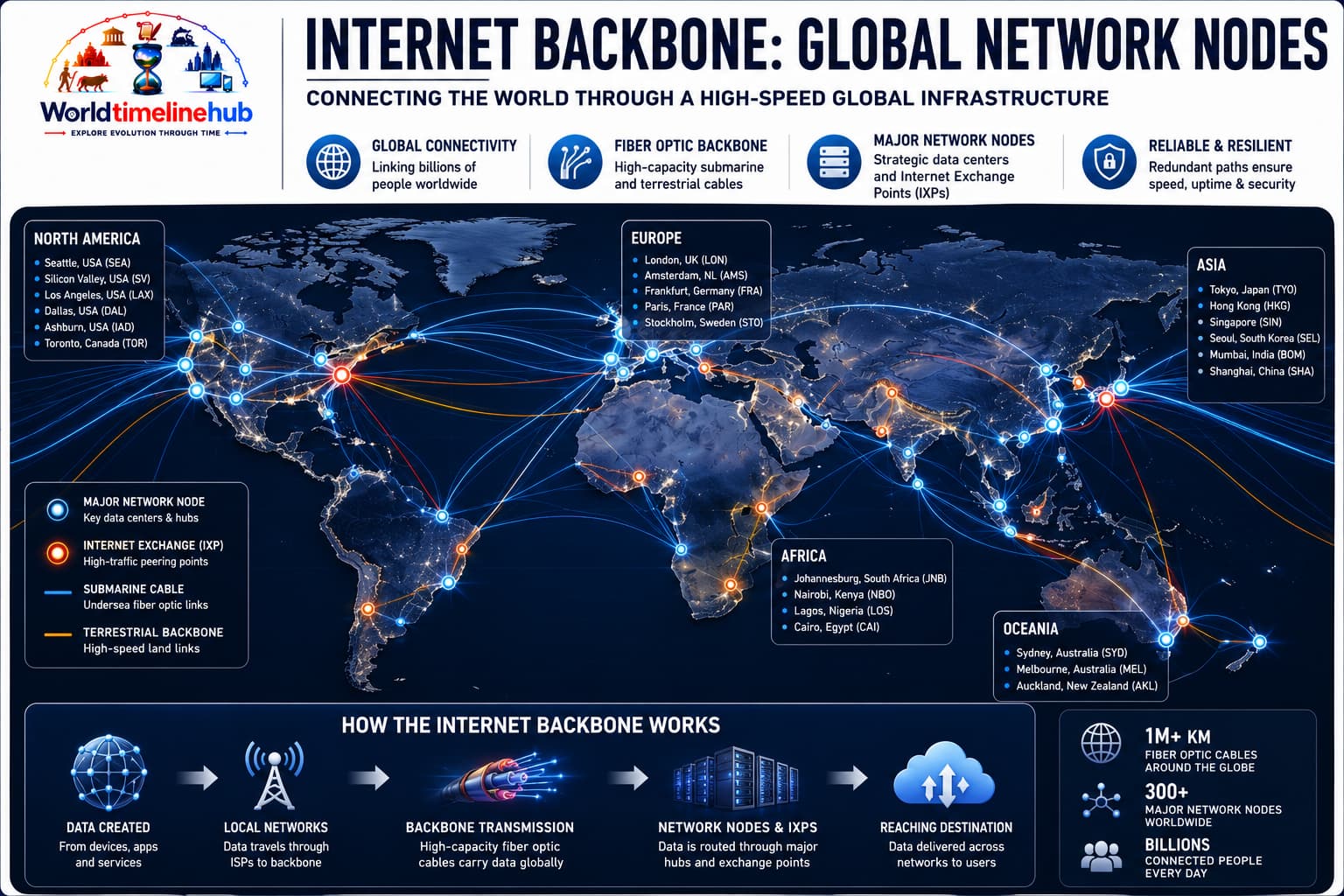
Internet backbone: long-haul links that tied universities and labs into ARPANET.
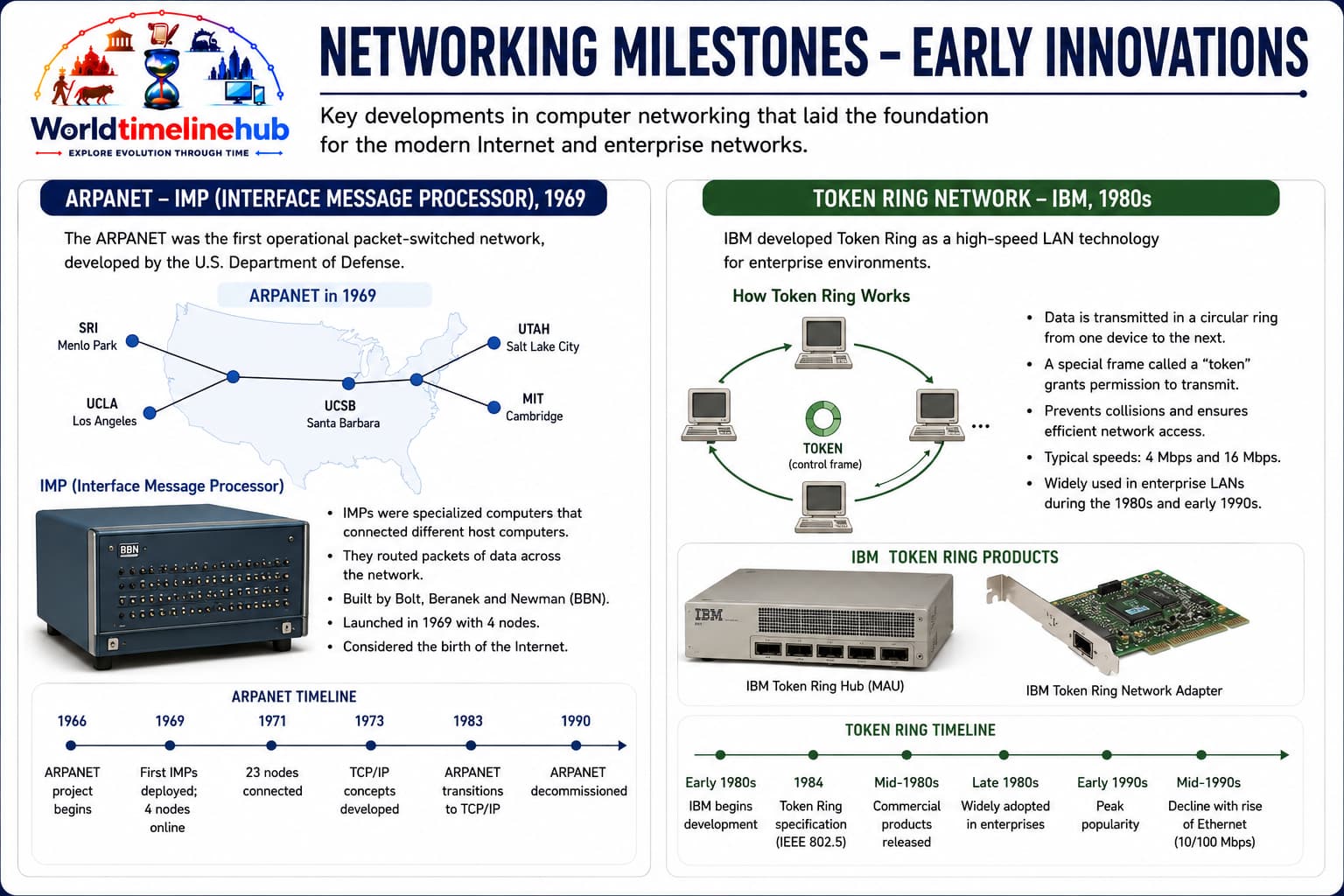
Network milestones: from IMP nodes and email to today’s global internet.
1961: Leonard Kleinrock publishes early queueing theory for packet networks.
1969: First ARPANET nodes at UCLA, SRI, UCSB, and Utah connect.
1971: Ray Tomlinson sends networked email using @ addressing.
Packet switching shares links efficiently instead of reserving fixed circuits.
Interface Message Processors (IMPs) act as early routers between hosts.
Researchers proved that breaking messages into routed packets could survive link failures better than fixed circuits for computer data.
Technology Used
IMP nodes: Early routers.
Packet switches: Store-and-forward.
NCP protocol: Precursor to TCP/IP.
Features
Research network: Universities and labs.
Resilience: Multiple paths.
Limited bandwidth: Text era.
LAN Era1970s - 1980s
LANs, Ethernet, and Corporate Networks
1973: Bob Metcalfe and colleagues propose Ethernet at Xerox PARC.
1980: IEEE begins standardizing 802 LAN technologies.
1983: Novell NetWare popularizes PC file and print sharing on LANs.
Token Ring and Ethernet compete in corporate offices.
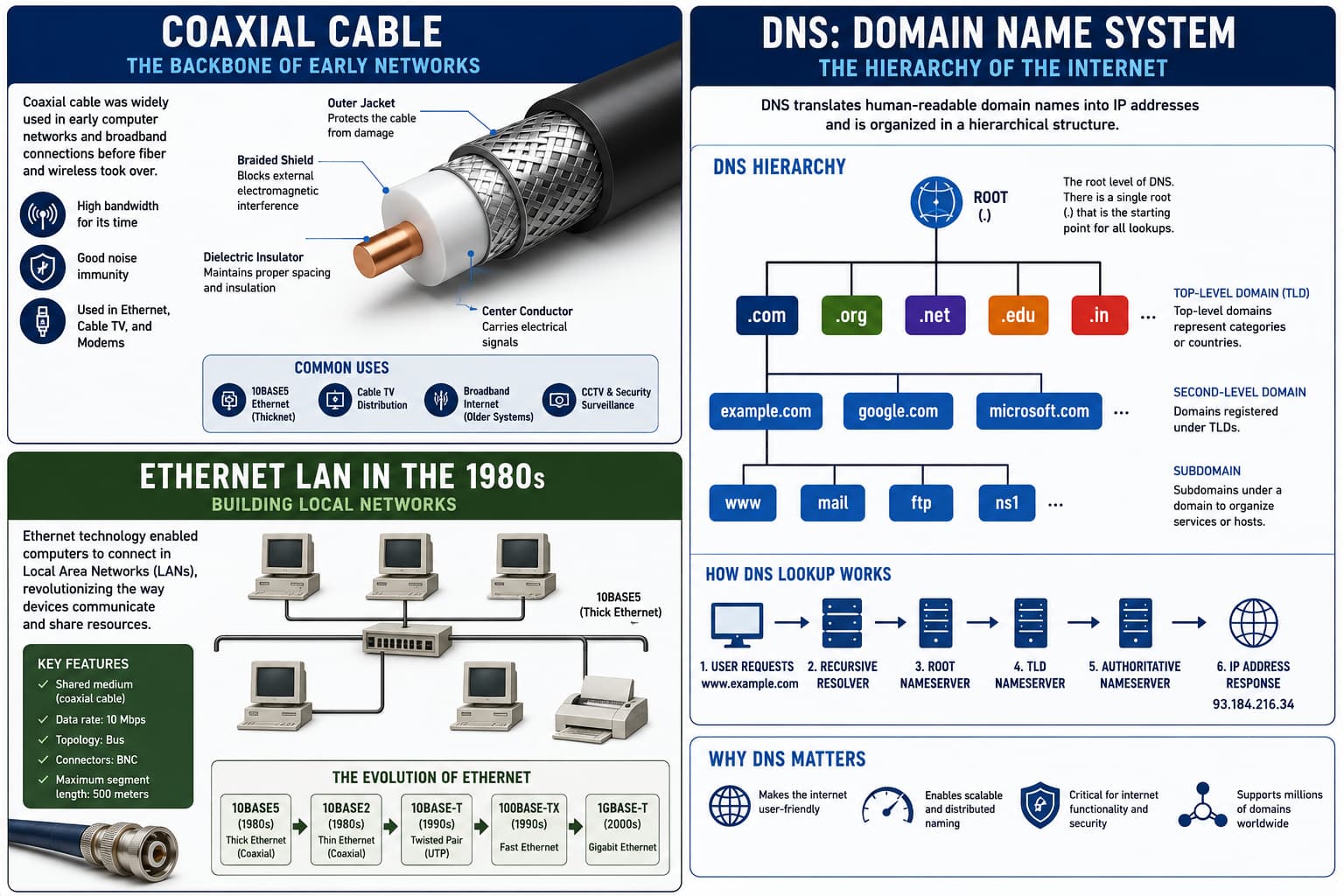
Thin coax “yellow cable” later gives way to twisted-pair hubs and switches.
Local area networks wired buildings with coax and twisted pair, letting departments share printers and files before wide-area internet was common.
Technology Used
Ethernet frames: MAC addresses.
Coax / twisted pair: Physical media.
Bridges: Segment collision domains.
Features
Office sharing: Printers and drives.
Admin roles: Net admins born.
Vendor wars: Standards battles.
Internet1980s - 1990s
TCP/IP and the Global Internet
DNS and physical media: naming hosts while coax and leased lines carried early internet traffic.
1983: ARPANET transitions from NCP to TCP/IP (flag day).
1984: DNS introduced by Paul Mockapetris for human-readable names.
1986: NSFNET backbone expands academic connectivity in the U.S.
1990s: Commercial ISPs and dial-up modems bring households online.
A universal protocol stack and domain name system let diverse networks interconnect, while modems and routers put households online.
Technology Used
TCP/IP: Reliable delivery + routing.
DNS: Distributed naming.
BGP: Inter-provider routing.
Features
Email & FTP: Early civilian uses.
Web later: HTTP on same pipes.
Standards bodies: IETF documents.
Web Scale1990s - 2005
World Wide Web and Broadband
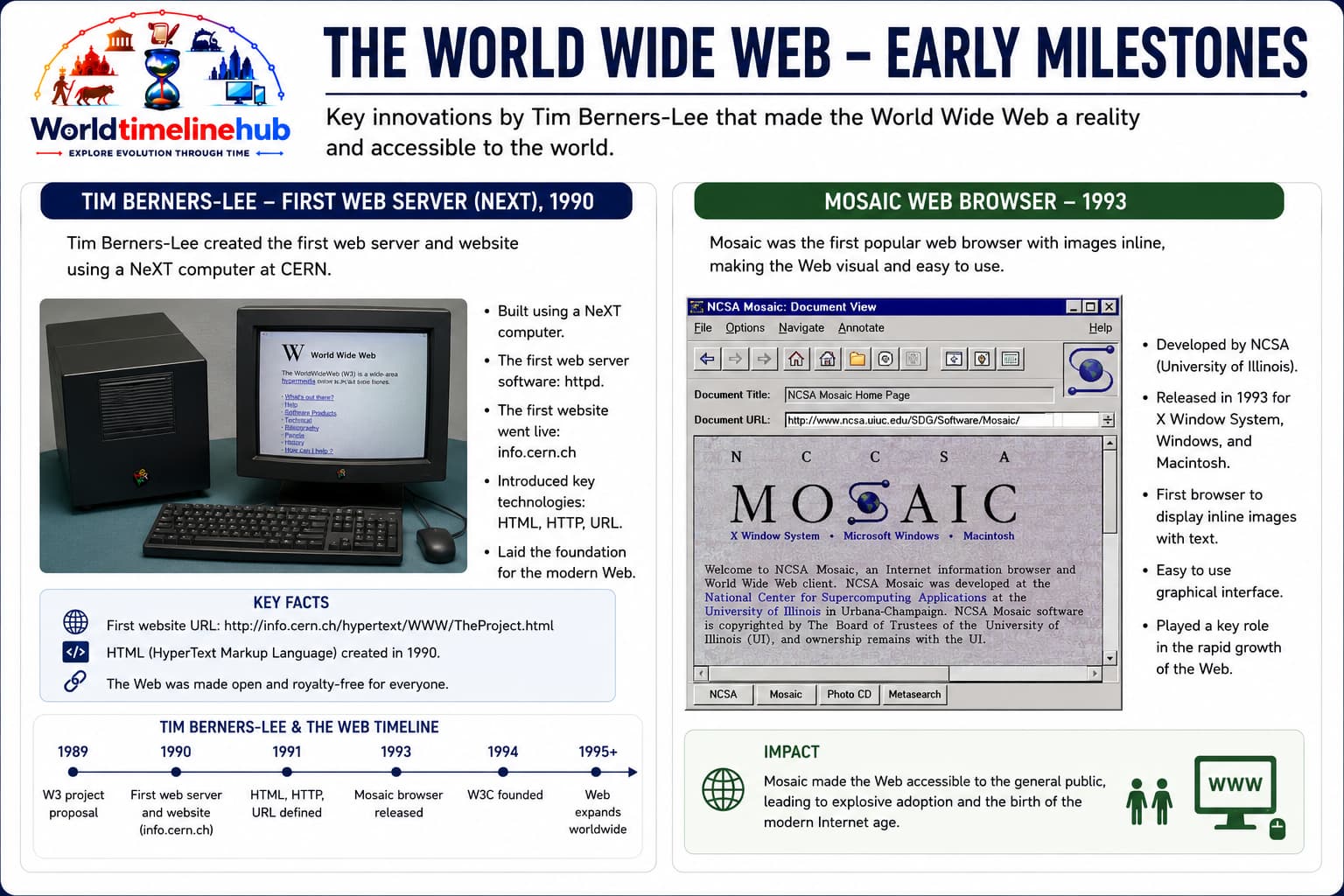
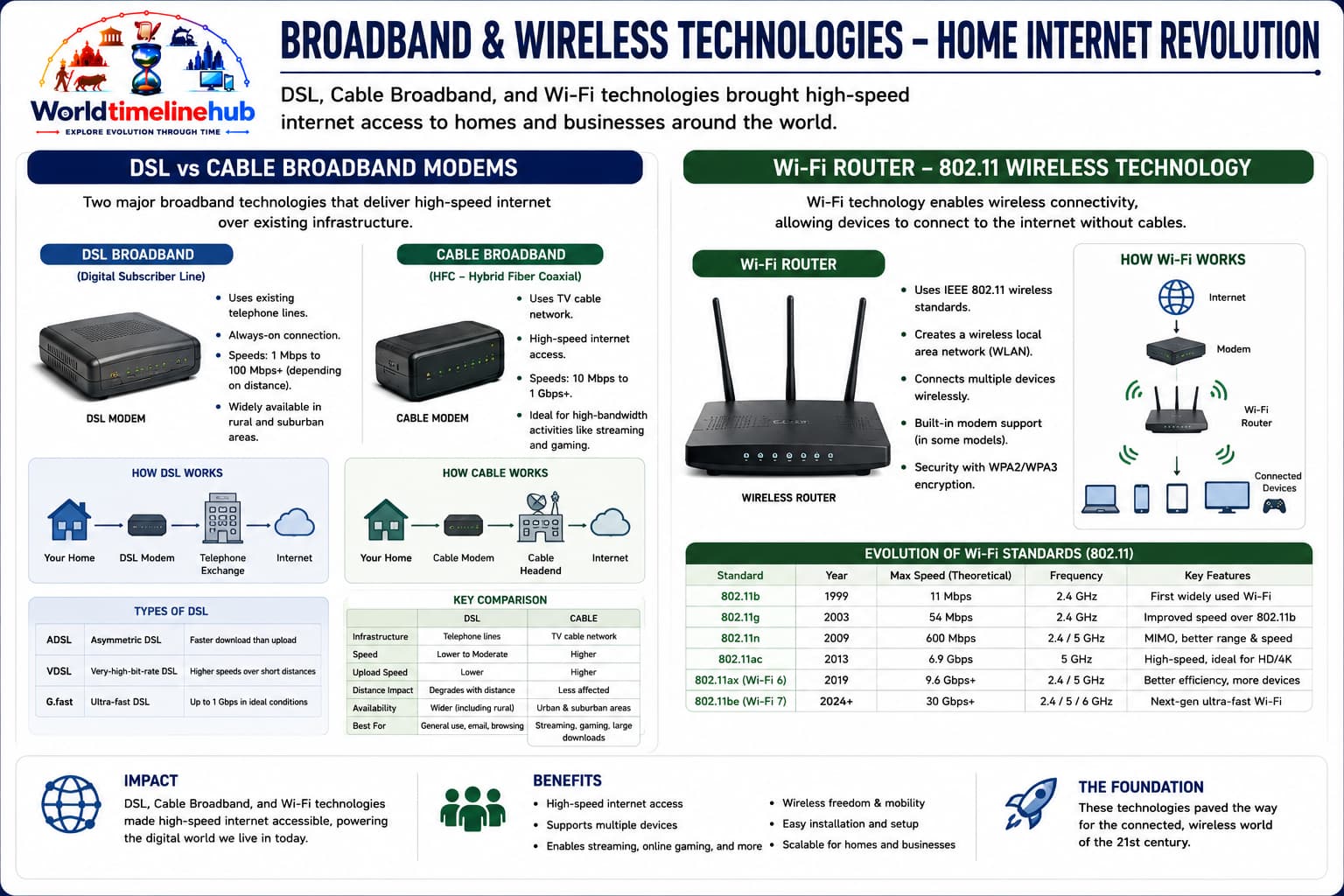
The web and broadband: hyperlinked pages and always-on DSL/cable links reached mainstream users.
1990: Tim Berners-Lee proposes the World Wide Web at CERN.
1991: Web opened to the public; Mosaic browser follows in 1993.
1994: Netscape Navigator fuels the dot-com boom.
1990s–2000s: DSL and cable modems replace many dial-up connections.
HTTP/HTML browsers turn the internet into a mainstream publishing platform.
Hyperlinked documents over HTTP turned the internet into a mainstream media and commerce platform, demanding faster always-on links.
Technology Used
HTTP/SSL: Web and security.
CDN: Cached content.
NAT: IPv4 address sharing.
Features
Dot-com growth: New businesses online.
Always-on: Less dial-up.
IPv6 planning: Larger address space.
Wireless2006 - 2018
Wi-Fi, Mobile Data, and Social Scale
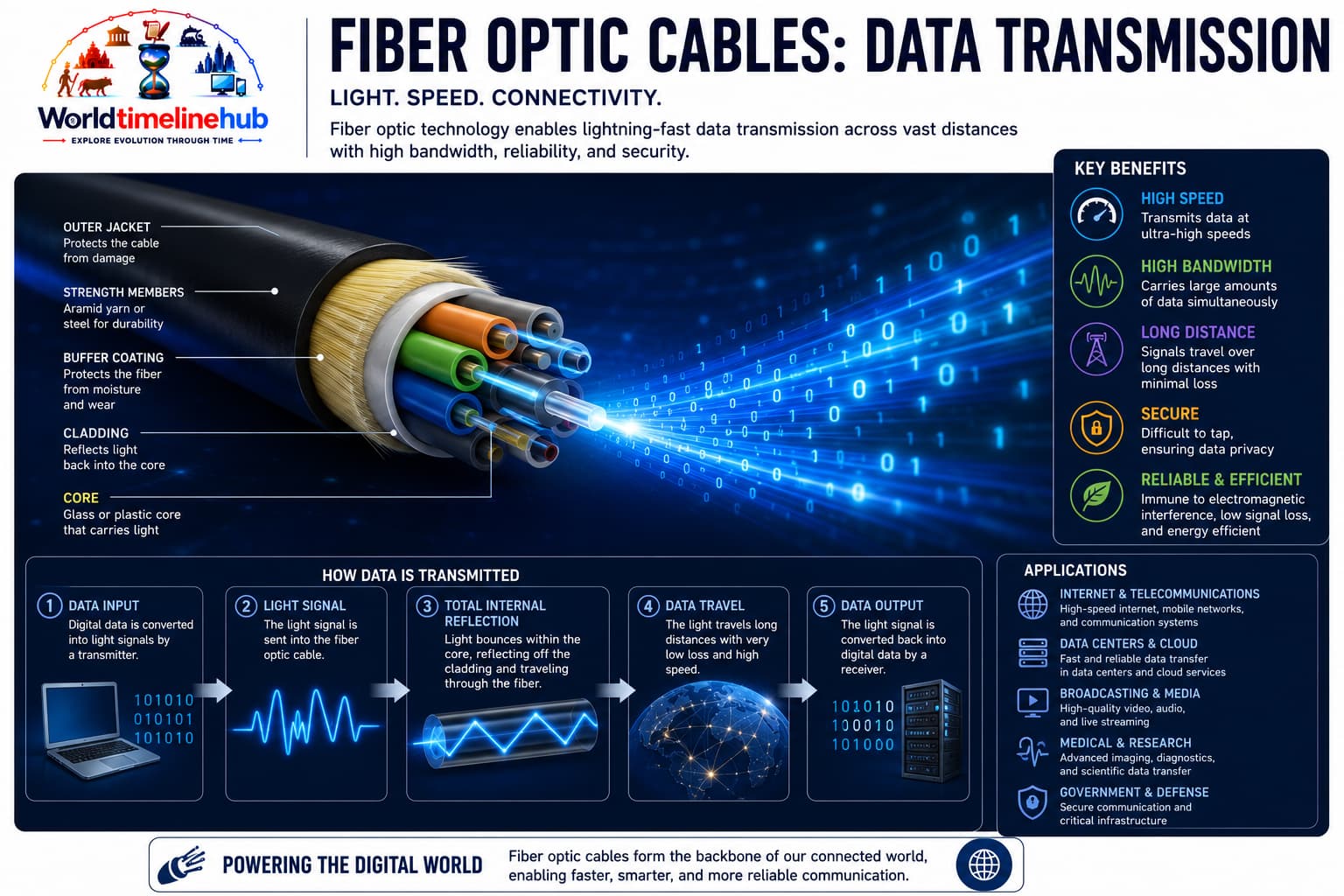
Fiber-optic backhaul: glass strands carry terabits for 4G/5G cores and data centers.
1997: IEEE 802.11 (Wi-Fi) family gains traction for wireless LANs.
2007: iPhone era accelerates mobile-first internet use.
2010s: 4G LTE carries HD video, messaging, and app ecosystems.
Wi-Fi in homes, schools, and cafes untethers laptops from Ethernet jacks.
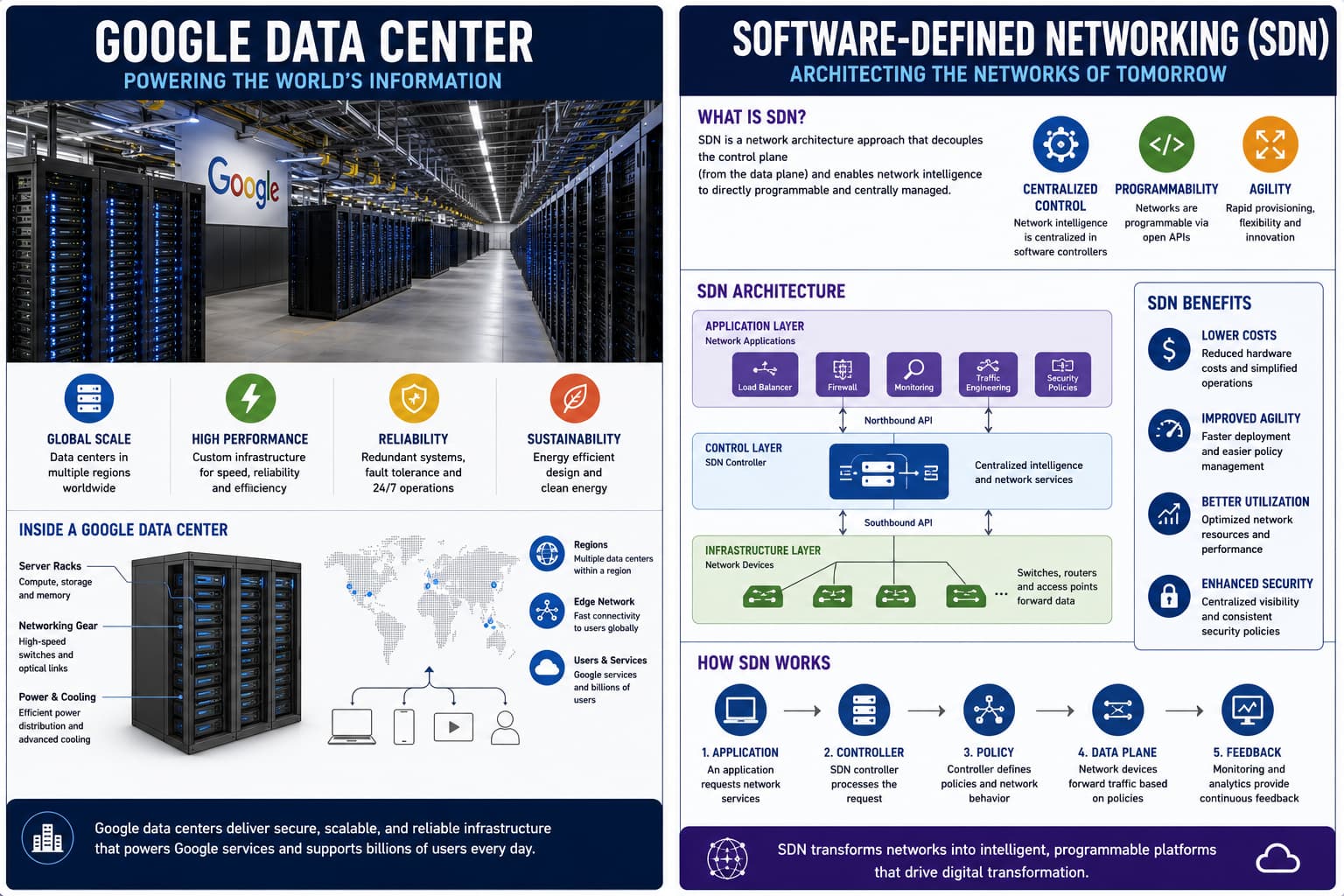
Hyperscale data centers and fiber backhaul support cloud and social platforms.
Wireless access points untethered laptops while mobile carriers carried video and messaging at national scale, pushing core networks toward fiber backhaul.
Technology Used
802.11 Wi-Fi: Wireless LAN.
LTE: Mobile broadband.
Fiber backhaul: Core capacity.
Features
Mobile-first users: Phones primary.
HD video: Bandwidth hunger.
Cloud DCs: Hyperscale networks.
Programmable2019 - Present
SDN, 5G, and Edge Networks
Data-center SDN: centralized controllers program switches for cloud scale, 5G cores, and edge sites.
2010s: Software-defined networking (SDN) separates control and data planes.
2019+: 5G NR rolls out with higher capacity and lower latency targets.
2020s: SASE and zero-trust architectures secure remote work.
Edge compute moves inference and caching closer to users and IoT devices.
IPv6 adoption grows as address space and routing policies mature.
Operators virtualize routers and place compute at cell edges while enterprises adopt zero-trust access and encrypted overlays for hybrid work.
Technology Used
SDN/OpenFlow: Programmable forwarding.
5G NR: New radio standards.
Zero trust: Identity-centric access.
Features
IoT scale: Billions of devices.
Private 5G: Factory networks.
Encrypted overlays: VPN and SASE.
Key Historical Events
Beyond the main era cards, these moments shaped how people communicate, search, share files, and stream video across networks.
Event
Year
Why it matters
First email sent
1971
Ray Tomlinson; introduced @ symbol for addresses
USENET
1979
First large-scale online discussion forums
First .com domain
1985
symbolics.com registered
First web browser (WorldWideWeb)
1990
Tim Berners-Lee on NeXT at CERN
Mosaic browser
1993
Made the web graphical and widely popular
Google goes online
1998
Changed how the world finds information
Napster / P2P file sharing
1999
Reshaped bandwidth usage and copyright debates
YouTube launch
2005
Video streaming explosion on the web
IPv6 World Launch Day
2012
Global push to solve IPv4 address exhaustion
Starlink first launches
2019
Satellite internet constellation at scale
Quantum networking experiments
2020s
Research toward future secure communications
Networking “Firsts” at a Glance
First
Year
Achievement
First computer network
1965
TX-2 to Q-32 link (MIT Lincoln Lab)
First email
1971
Ray Tomlinson on ARPANET
First .com domain
1985
Symbolics.com
First web page
1991
info.cern.ch
First online transaction
1994
NetMarket (Sting CD)
First social network
1997
SixDegrees.com
First YouTube video
2005
“Me at the zoo”
Bandwidth and Speed Timeline
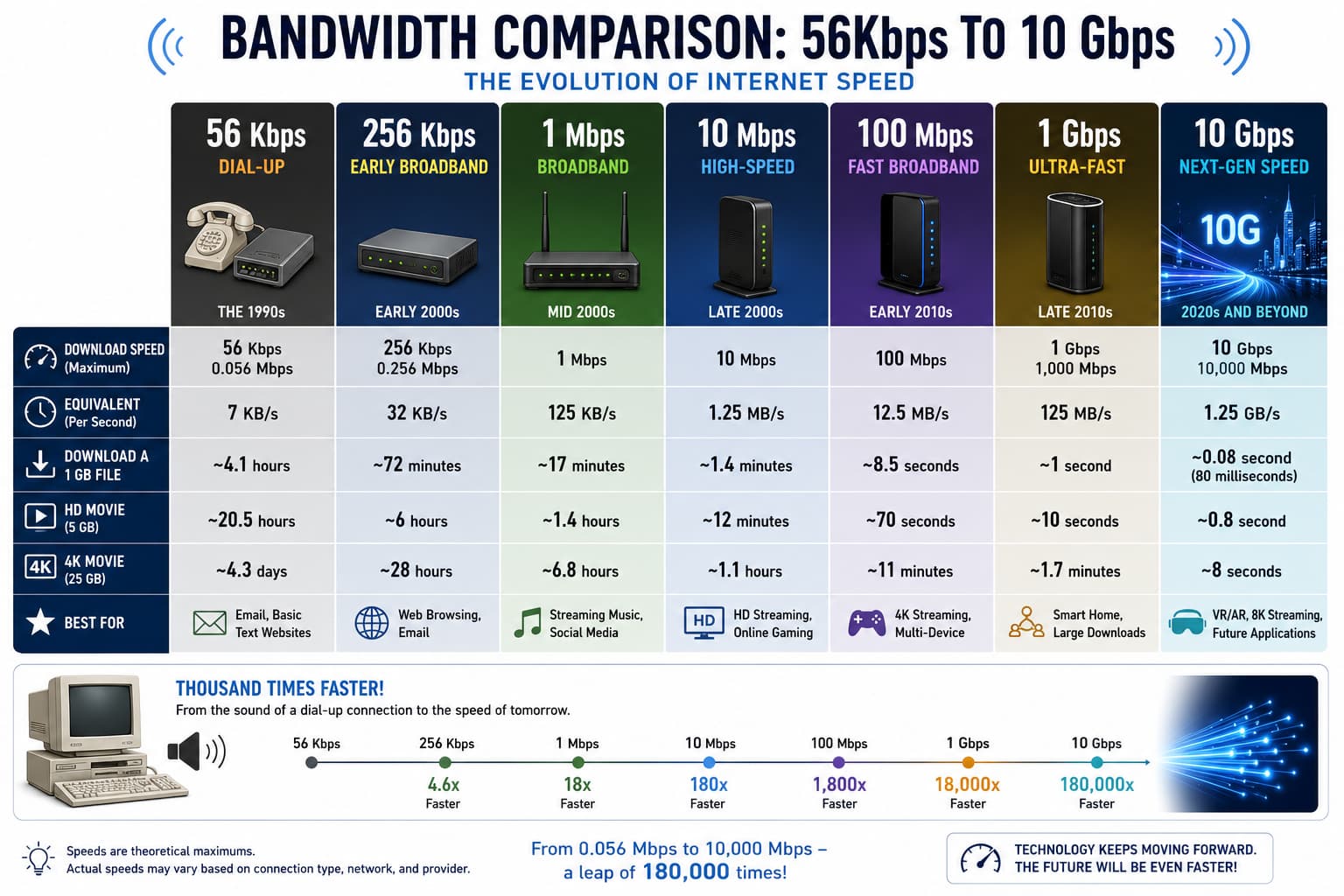
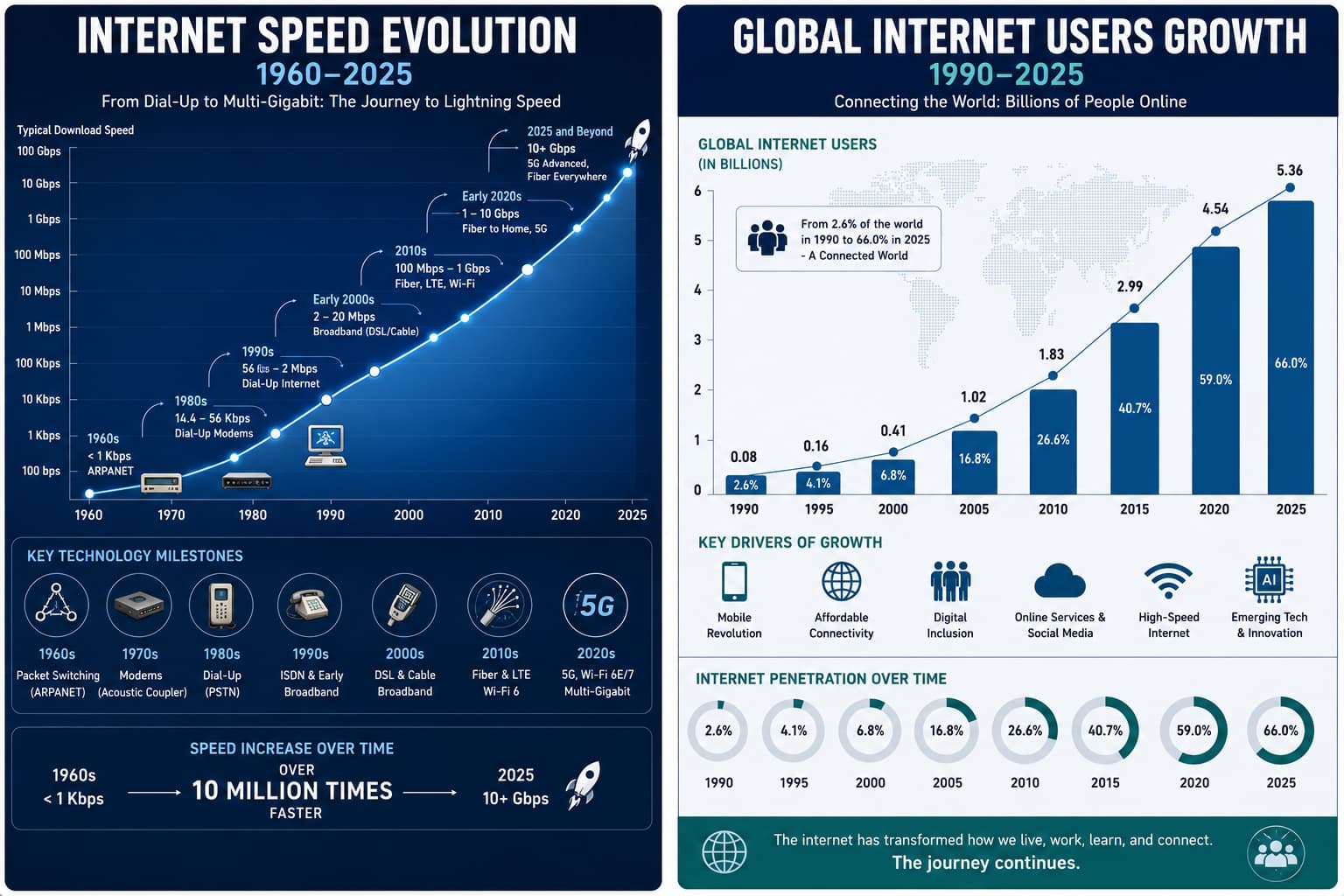
Networking history is also a story of speed—from kilobits on leased lines to gigabits in homes and data centers. Each era's applications (email, web, video, cloud) demanded faster links.
Bandwidth compared: how typical speeds climbed decade by decade.
Broadband and wireless: fixed-line and mobile links that power today’s internet.
Era
Typical speed
Technology
1960s–70s
~50 kbps
ARPANET (56k leased lines)
1980s
9.6–56 kbps
Dial-up modems
1990s
56k–1.5 Mbps
56k modem, ISDN, early DSL
2000s
1.5–50 Mbps
DSL, cable, early fiber
2010s
50 Mbps–1 Gbps
4G LTE, fiber to the home
2020s
100 Mbps–10 Gbps
5G, Wi-Fi 6/7, 10G fiber
OSI Model (7 Layers)
The OSI reference model groups networking functions into seven layers. Real networks often blend layers (for example TLS spans presentation and session), but the model helps troubleshoot where a problem occurs.
Layer
Name
Example protocols
7
Application
HTTP, FTP, SMTP, DNS
6
Presentation
SSL/TLS, JPEG, MPEG
5
Session
NetBIOS, RPC
4
Transport
TCP, UDP
3
Network
IP, ICMP, BGP
2
Data Link
Ethernet, Wi-Fi (802.11)
1
Physical
Fiber, copper, radio
Wi-Fi Generations Timeline
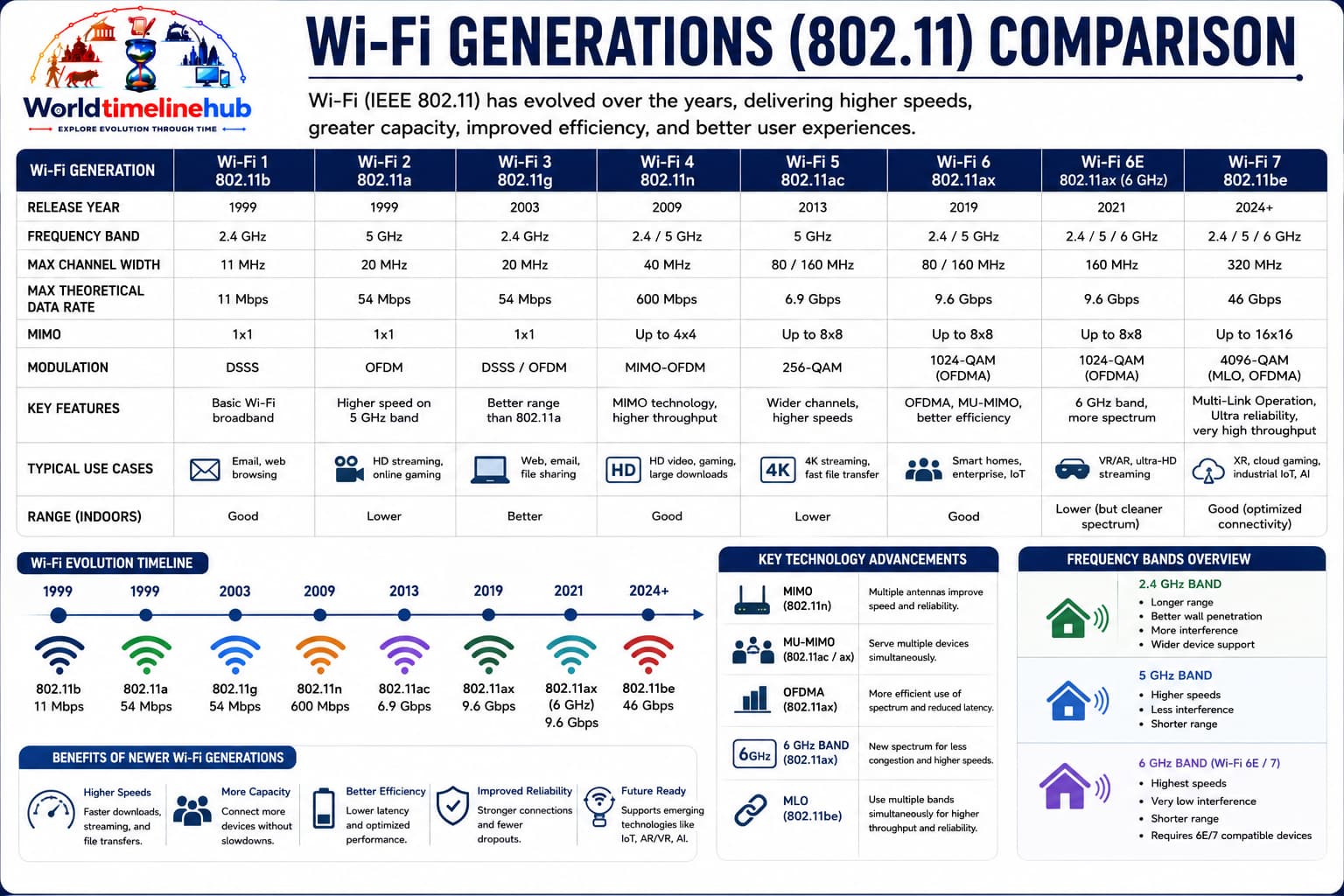
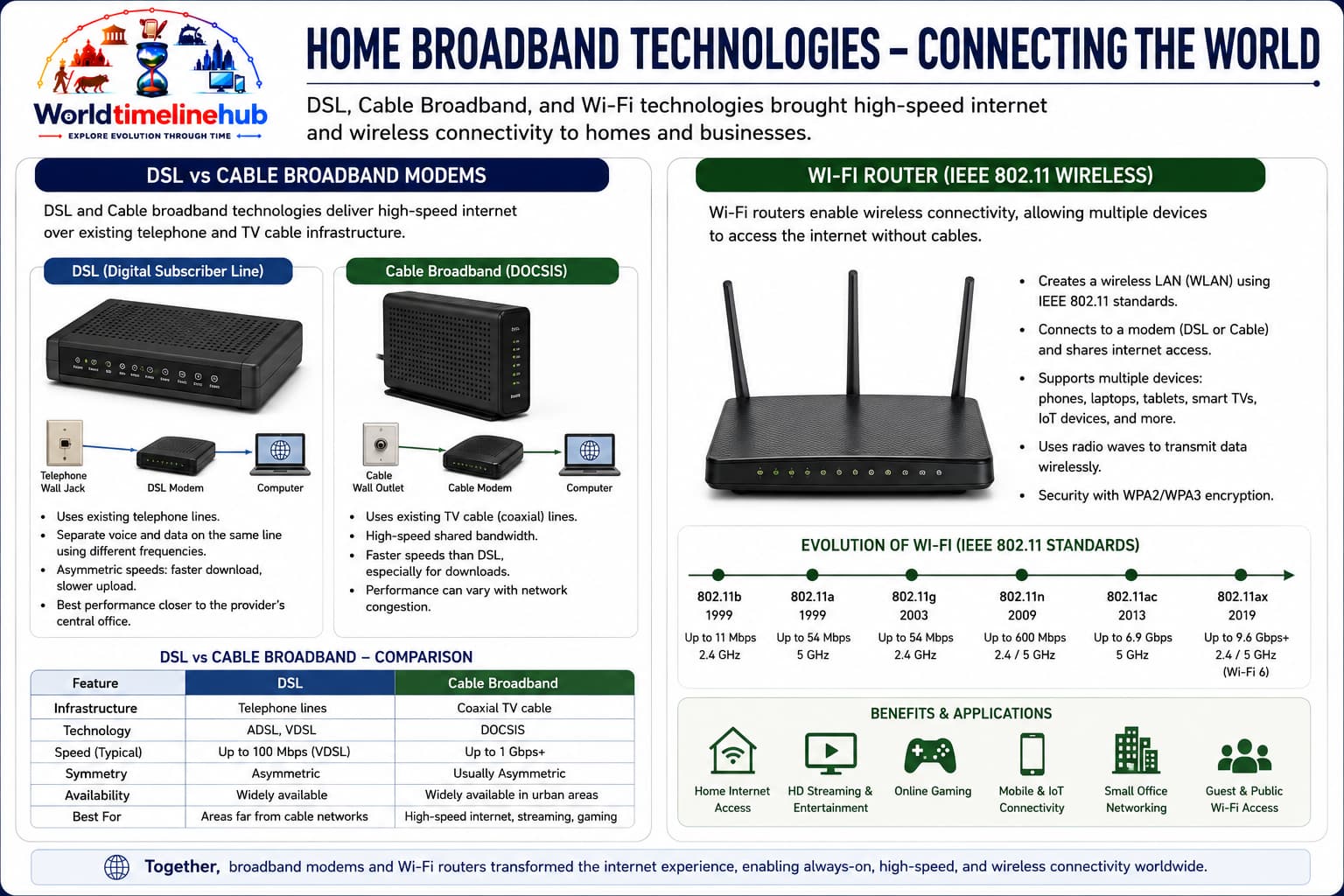
Wi-Fi freed LANs from cables. Marketing names (Wi-Fi 4, 5, 6, 7) map to IEEE 802.11 standards with rising speeds and better handling of crowded airwaves.
Wi-Fi 1 through Wi-Fi 7: from 11 Mbps on 2.4 GHz to multi-gigabit tri-band routers.
Generation
Standard
Year
Speed (max)
Band
Wi-Fi 1
802.11b
1999
11 Mbps
2.4 GHz
Wi-Fi 2
802.11a
1999
54 Mbps
5 GHz
Wi-Fi 3
802.11g
2003
54 Mbps
2.4 GHz
Wi-Fi 4
802.11n
2009
600 Mbps
2.4 / 5 GHz
Wi-Fi 5
802.11ac
2013
3.5 Gbps
5 GHz
Wi-Fi 6
802.11ax
2019
9.6 Gbps
2.4 / 5 GHz
Wi-Fi 7
802.11be
2024
46 Gbps
2.4 / 5 / 6 GHz
Mobile Network Generations (1G to 6G)
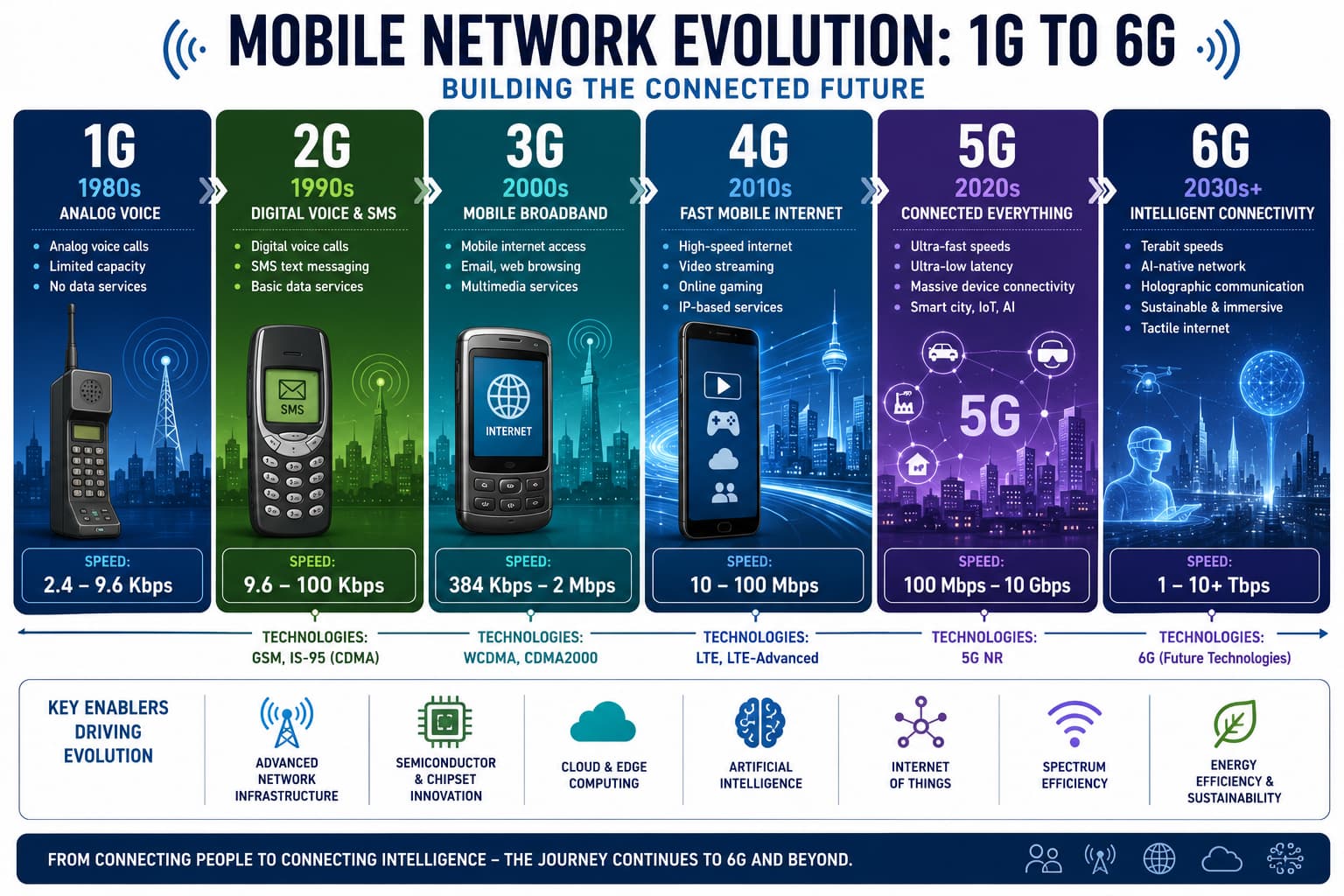
Cellular networks evolved from analog voice to digital data, mobile broadband, and low-latency 5G. 6G research targets terahertz bands and AI-native network control.
1G through 6G: each generation added data, speed, and new use cases from SMS to IoT.
Generation
Year
Key feature
Typical speed
1G
1980s
Analog voice
~2.4 kbps
2G
1991
Digital voice, SMS
50–100 kbps
3G
2001
Mobile data, video calls
0.2–2 Mbps
4G / LTE
2009
Mobile broadband
10–100 Mbps
5G
2019
Low latency, IoT scale
100 Mbps–10 Gbps
6G (future)
~2030
Terahertz, AI-native networks
1 Tbps+ (research targets)
Networking Pioneers
Person
Contribution
Paul Baran
Packet switching research (RAND)
Donald Davies
Packet switching (UK); coined the term
Bob Kahn & Vint Cerf
TCP/IP protocol design
Robert Metcalfe
Ethernet at Xerox PARC
Tim Berners-Lee
World Wide Web, HTTP, HTML
Marc Andreessen
Mosaic browser (with NCSA team)
Ray Tomlinson
Networked email and @ addressing
Elizabeth Feinler
Managed early ARPANET host directory (pre-DNS)
Famous Networking Inventions Timeline
Year, inventor, and impact at a glance.
Email
1971 · Ray Tomlinson
First person-to-person messages across ARPANET.
DNS
1983 · Paul Mockapetris
Human-readable names instead of numeric IPs.
Ethernet
1973 · Robert Metcalfe
Cheap, standard LANs for offices worldwide.
Browser
1990 · Tim Berners-Lee
Made the web clickable for everyone.
Wi-Fi
1997 · IEEE 802.11
Untethered LAN access in homes and public spaces.
VPN
1996 · IPsec / PPTP era
Encrypted tunnels for remote work.
Fiber optics
1970s–80s · Telecom pioneers
Long-distance links at light speed.
Cloud networking
2006+ · AWS and hyperscalers
Virtual networks scaled with compute.
5G
2019 · 3GPP / carriers
Low-latency mobile broadband and IoT.
Evolution of Network Hardware
How forwarding gear evolved from ARPANET IMPs to programmable data-center switches.
1969IMP router
→
1970sCoaxial LAN
→
1980sHub
→
1990sSwitch
→
1990sModem
→
2000sWi-Fi router
→
2010sData center switch
→
2010s+SDN switch
Networking Devices Through Time
Chronological gallery of gear that connected the world.
1969IMP
1980sModem
1980sEthernet hub
1990sRouter
2000sWi-Fi router
2010sFiber ONT
2019+5G tower
2020sEdge servers
Internet Milestones Around the World
WorldTimelineHub view: how connectivity spread across regions and infrastructures.
Milestone
Region
Era
Impact
ARPANET
USA
1969
First packet-switched research network
CERN Web
Europe
1991
World Wide Web born in Switzerland
Broadband expansion
Global
2000s
DSL and cable reach mass households
India public internet
India
1990s
VSNL gateway and ERNET open access paths
Undersea cables
Global
Ongoing
Carry most intercontinental internet traffic
Satellite internet
Global
2019+
Starlink and rivals connect rural and mobile users
Network Topologies
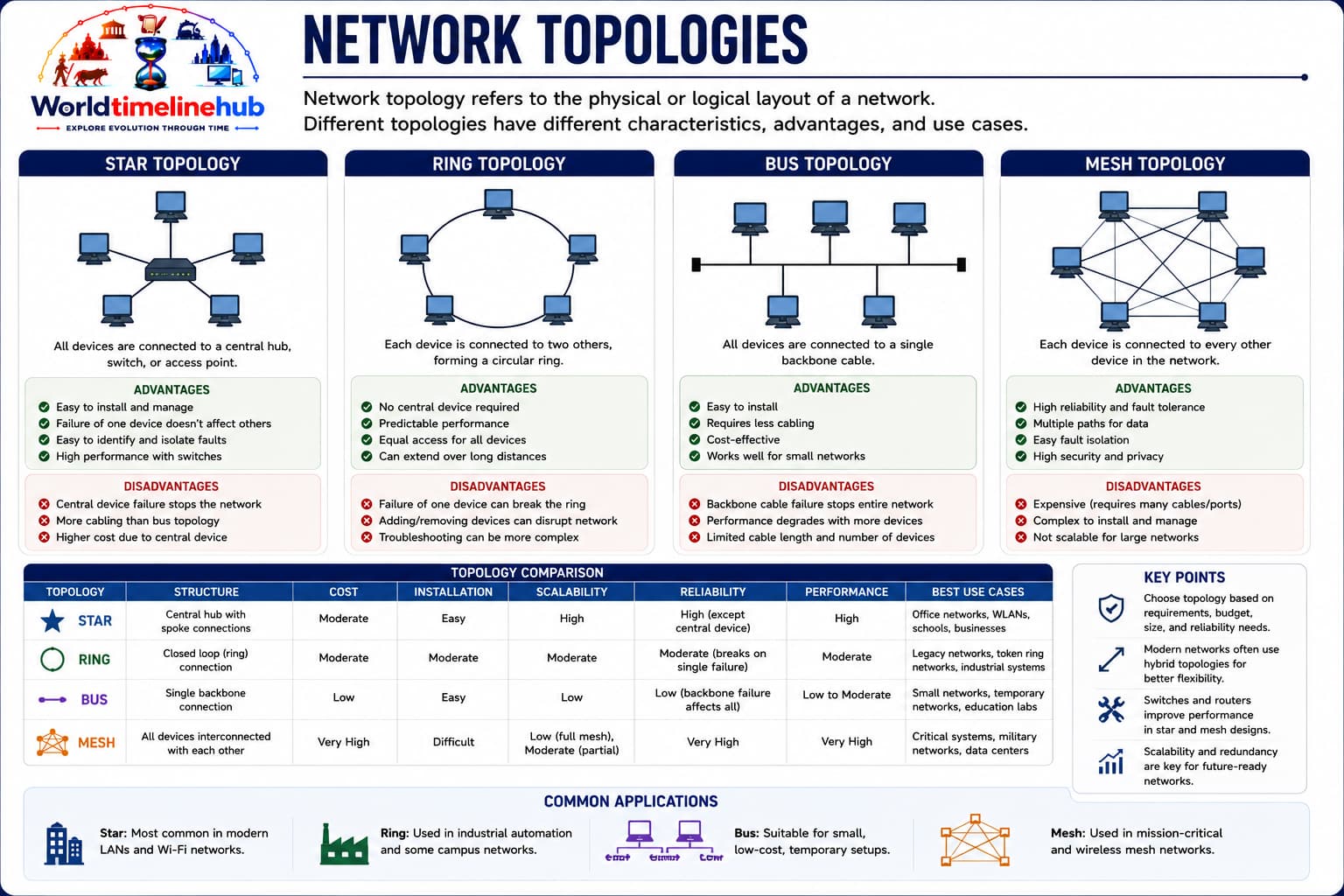
Topology describes how devices are physically or logically connected. Choice affects cost, fault tolerance, and how traffic flows when a link fails.
Common topologies: star (home LAN), mesh (carrier core), and tree (ISP hierarchy).
Star●——●All devices connect to a central switch or hub; most home and office LANs today.
Ring●——●——●Devices form a circular loop; classic Token Ring; failure can break the loop unless dual rings.
Bus——●——Single shared cable backbone; early Ethernet on coax (“thinnet”).
Mesh●║●║●Multiple redundant paths; used in data centers, wireless meshes, and carrier cores.
Tree●——├——●Hierarchical parent-child links; common in ISP and enterprise WAN designs.
Cybersecurity Milestones
Networking and security evolved together—every new connectivity feature created new risks, and standards responded with firewalls, encryption, and zero-trust design.
Year
Event
1988
Morris Worm—first major internet worm
1990s
Firewalls become standard in enterprises
2000s
SSL/TLS widespread; HTTPS protects the web
2010s
Let’s Encrypt offers free TLS certificates
2013
Edward Snowden revelations accelerate encryption adoption
2020s
Zero Trust Architecture gains enterprise adoption
Future of Networking Timeline
Speculative roadmap—not certainties, but directions researchers and industry are pursuing.
2025→Wi-Fi 7 mainstream
2028→Early 6G deployments
2030→Quantum internet prototypes
2035→AI-managed networks
2040→Space internet mesh
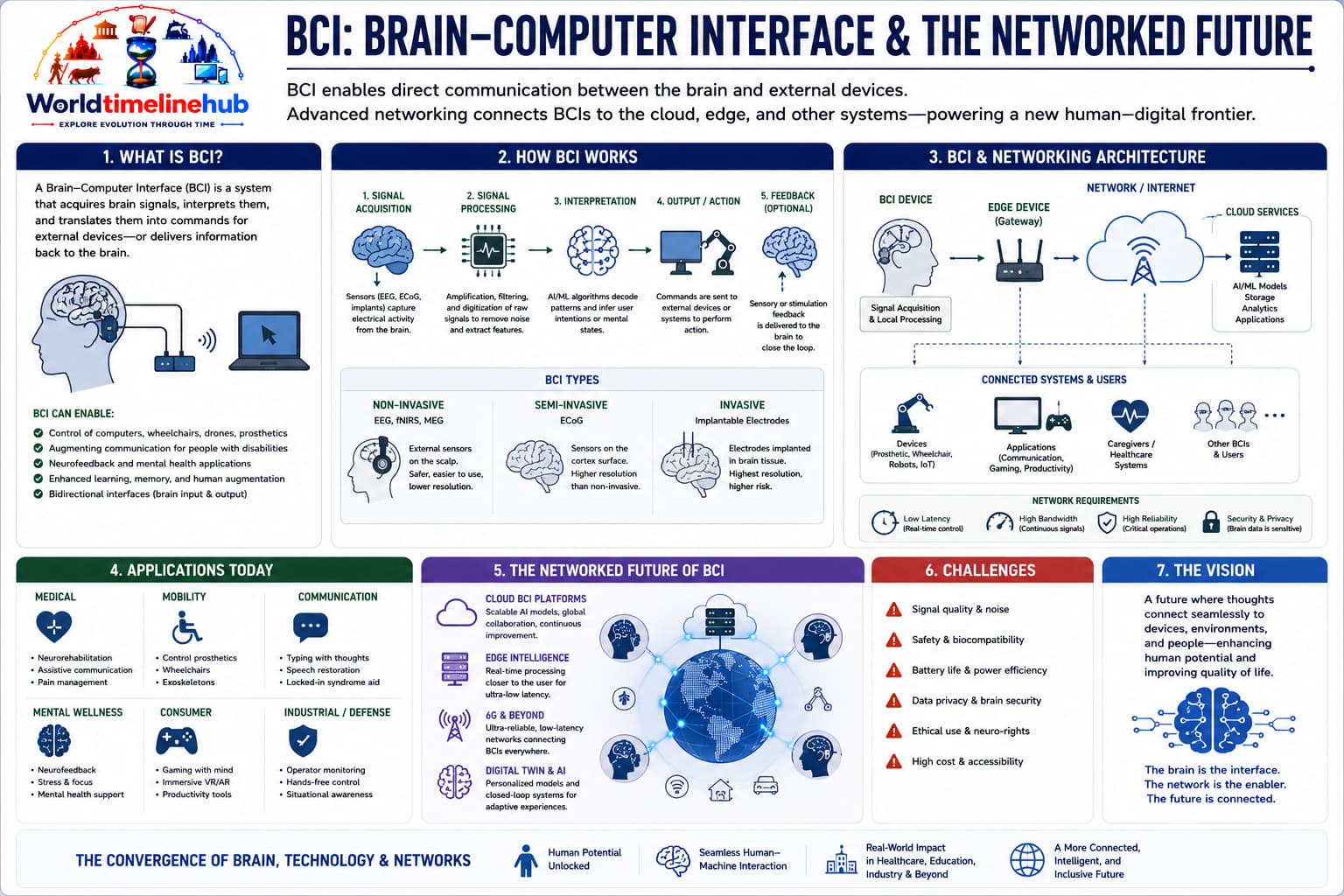
Beyond 2040: experimental brain-computer and neural networking research.
Then vs Now: Home Networking
Compare a typical 1990s dial-up household with a 2020s fiber or cable home—the same wall jack idea, radically different experience.
Today’s home broadband: always-on fiber or cable feeding a Wi-Fi router for dozens of devices.
Internet speed then and now: from ~56 kbps dial-up to 100 Mbps–1 Gbps broadband.
Metric
Then (1990s)
Now (2020s)
Home internet speed
~56 kbps
100 Mbps–1 Gbps
Monthly cost
$20–30 (dial-up)
$50–100 (broadband)
Connection type
Phone line (busy signal)
Fiber / cable (always on)
Wi-Fi in home
Rare
Universal
Devices connected
1 PC
10–20+ (phones, TVs, IoT)
Video calls
Not practical
4K Zoom / Teams
Cloud storage
None (floppy disks)
Terabytes online
Glossary of Networking Terms
Term
Definition
Bandwidth
Maximum data transfer rate (Mbps / Gbps)
Latency
Delay in data transmission (milliseconds)
Packet
Unit of data transmitted over a network
Router
Forwards packets between networks
Switch
Forwards frames within a LAN
Gateway
Connects different network architectures
Firewall
Filters traffic based on security rules
NAT
Network Address Translation; shares public IPs
How Computer Networking Works
Data moves in layers. At the bottom, Ethernet or Wi-Fi frames carry bits across a local link. IP packets add source and destination addresses so routers can forward traffic across the internet. TCP (or UDP) at the transport layer decides whether delivery must be reliable and in order. Finally, application protocols such as HTTP, SMTP, or DNS define what the bytes mean to programs and users.
When you visit a website, your device asks DNS which server hosts the name, opens a TCP connection (often protected by TLS), sends an HTTP request, and receives HTML, images, and scripts. Routers along the path consult routing tables learned via BGP between ISPs. At home, NAT lets many devices share one public IPv4 address. See the OSI model table above for all seven layers.
Computer Networking Timeline Summary
From research packet networks to the always-on global internet, mobile broadband, and programmable cloud networks—these milestones mark how connectivity became infrastructure for modern life.
Year / Era
Milestone
1965
Early computer network (TX-2 to Q-32)
1969
ARPANET first nodes online
1971
First networked email (@ symbol)
1973
Ethernet invented at Xerox PARC
1983
TCP/IP becomes ARPANET standard
1985
First .com domain (Symbolics)
1991
World Wide Web; first web page
1993
Mosaic graphical browser
1998
Google search goes online
2005
YouTube launch
2012
IPv6 World Launch Day
2019
Starlink; 5G rollout
2020s
Wi-Fi 7, zero trust, quantum networking research
Key Protocols
Protocols are agreed rules so different vendors' hardware and software can interoperate. The table below lists core building blocks you will meet in networking courses, certifications, and troubleshooting.
Protocol
Layer
Role
TCP
Transport
Reliable, ordered byte streams (web, email)
UDP
Transport
Fast datagrams without guaranteed delivery (video, DNS queries)
IP
Network
Logical addressing and routing between networks
ICMP
Network
Diagnostics such as ping and error messages
HTTP / HTTPS
Application
Web pages and APIs; HTTPS adds TLS encryption
DNS
Application
Translates domain names to IP addresses
DHCP
Application
Automatically assigns IP addresses on LANs
BGP
Routing
Exchanges routes between internet providers
TLS
Security
Encrypts traffic above TCP (used by HTTPS)
Networking Hardware
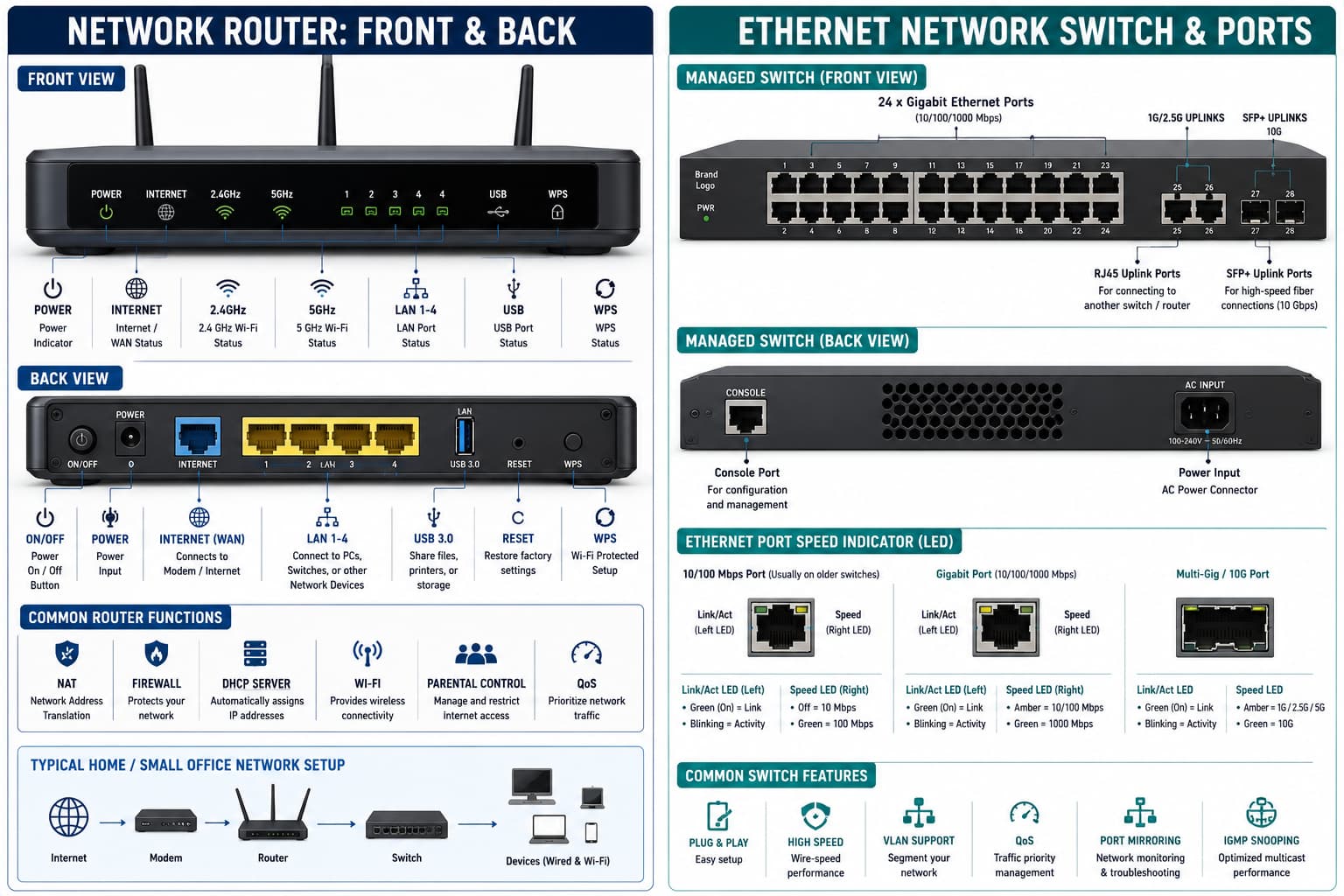
Devices at the edge and in the core perform different jobs. Home users mostly see a Wi-Fi router; enterprises add managed switches, firewalls, and load balancers; carriers run fiber, microwave links, and cell towers tied to packet core networks.
Routers and switches: forward traffic between your LAN and the internet.
Router: Forwards IP packets between subnets and the internet; runs routing protocols and often NAT.
Switch: Forwards Ethernet frames inside a LAN using MAC addresses; reduces collisions vs old hubs.
Access point (AP): Bridges Wi-Fi clients to a wired LAN; may include guest networks and WPA3 security.
Firewall: Filters traffic by rules; modern firewalls inspect application data and VPN tunnels.
Modem / ONT: Converts ISP line signals (cable, DSL, fiber) into Ethernet for your router.
Load balancer: Distributes requests across many servers in data centers for reliability and scale.
NIC: Network interface card in PCs and servers; connects hosts to switches or Wi-Fi.
India spotlight
Networking in India
India's networking story moved from university research links to commercial gateways, a competitive mobile market, and some of the world's lowest mobile data prices. ERNET connected campuses; VSNL opened international internet access; private ISPs and later 4G/5G carriers put connectivity in hundreds of millions of pockets.
1986
ERNET academic network
Education and Research Network linked IITs and research labs with email and file transfer long before mass public internet.
1990s
Commercial internet gateways
VSNL and private ISPs introduced dial-up and leased-line access; cyber cafés became entry points for many first-time users.
2000s
Telecom reform and broadband
Mobile competition grew; DSL and cable reached cities; India's IT services sector depended on reliable global links.
2016+
Reliance Jio 4G disruption
Affordable 4G data and voice shifted hundreds of millions to smartphones, video, and UPI-driven digital payments.
2020s
5G and fiber expansion
5G rollout, BharatNet rural fiber goals, and data-center growth support streaming, edtech, and government digital services.
Test Your Knowledge
20 quick questions from the computer networking timeline. Click each question to reveal the answer.
Answer: 1969.
Answer: Efficient shared links and resilience.
Answer: Xerox PARC (Metcalfe).
Answer: TCP and IP.
Answer: IP addresses.
Answer: Web resources.
Answer: IEEE 802.11.
Answer: Internet service providers.
Answer: IPv4 address shortage.
Answer: Encryption on transport.
Answer: Users.
Answer: 4G mobile broadband.
Answer: Latency (also higher capacity).
Answer: Data plane.
Answer: High bandwidth core traffic.
Answer: ARPANET.
Answer: ERNET.
Answer: Jio (Reliance Jio).
Answer: No implicit trust by location.
Answer: More wireless, programmable, and edge-distributed.
Classroom activity
Students Tasks
Use these 10 prompts for discussion, projects, or classroom presentations.
ProtocolsLAN/WANWirelessIndia net
Explain packet vs circuit switching.
Draw home network with router and Wi-Fi.
What is an IP address?
Describe DNS lookup steps.
Compare 4G and 5G goals.
Why is TCP reliable?
What does a switch do?
Research ERNET history.
Explain CDN with an example.
Predict India's 6G use cases.
Continue exploring
Browse related technology timelines and compare how input devices, software, and networks evolved together.
Jump to any other technology timeline on WorldTimelineHub.
Disclaimer: This content is AI-generated for educational purposes and may contain errors or outdated details. For correct and authoritative information, please refer to official and reliable sources such as government publications, manufacturers, museums, and academic references.