From mechanical calculators and room-sized vacuum-tube systems to personal computers, cloud platforms,
and AI accelerators, computers transformed science, business, communication, and everyday life.
1820s → PresentMechanical → DigitalPC → Cloud → AI
Computer Invention
Computers evolved through many milestones. Charles Babbage designed programmable mechanical engines in
the 1800s, and Ada Lovelace wrote early algorithmic notes. In the 1940s, programmable electronic systems
like Colossus and ENIAC proved large-scale digital computing, paving the way for modern architectures.
Big picture
Computer evolution in one view
Computing moved from mechanical arithmetic machines to programmable electronic systems, then to
inexpensive personal devices connected through the internet. Today, cloud-scale infrastructure and
AI acceleration redefine what computers can solve.
1930s–40s: Electromechanical calculators and codebreaking machines appear.
1941: Konrad Zuse's Z3 demonstrates programmable operation.
Before electronic computers existed, calculation meant precision mechanics and electromechanical parts—gears turned numbers, punched media stored programs, and relays flipped states without vacuum tubes or silicon chips.
Technology Used
Gears and cams: Mechanical arithmetic mechanisms.
Punched cards/tape: Program and data input formats.
Relays: Electromechanical switching before full electronics.
Features
Specialized use: Scientific tables, accounting, and military calculations.
Slow operation: Limited speed and memory by modern standards.
Human-heavy workflows: Manual setup and operation.
💡 Electronic Leap1940s – 1950s
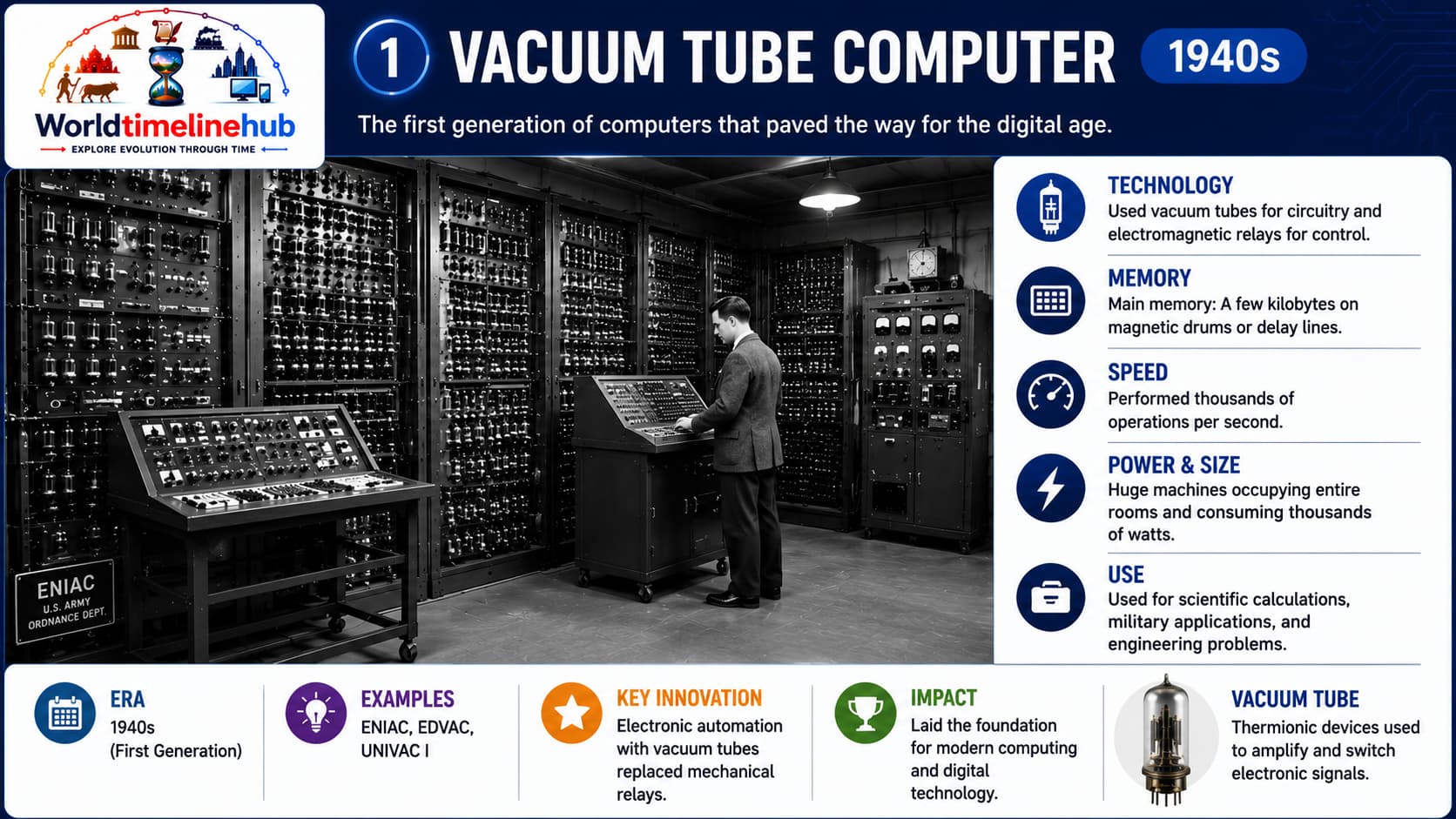
Vacuum Tube Computer Generation
Vacuum tube machines: room-sized electronic computers that switched from mechanical relays to high-speed calculation.
1949: EDSAC introduces stored-program architecture in practice.
The first electronic computers replaced moving parts with glowing vacuum tubes, early magnetic memory, and punched media—room-sized machines that could recalculate in seconds what took humans hours or days.
Technology Used
Vacuum tubes: Active switching and amplification.
Magnetic drums/mercury delay lines: Early memory systems.
Punched input: Cards and paper tape for programs/data.
Features
Room-sized systems: Massive power and cooling needs.
Higher speed: Big jump over electromechanical devices.
Frequent maintenance: Tube failures and downtime were common.
🔬 Miniaturization1956 – 1970s
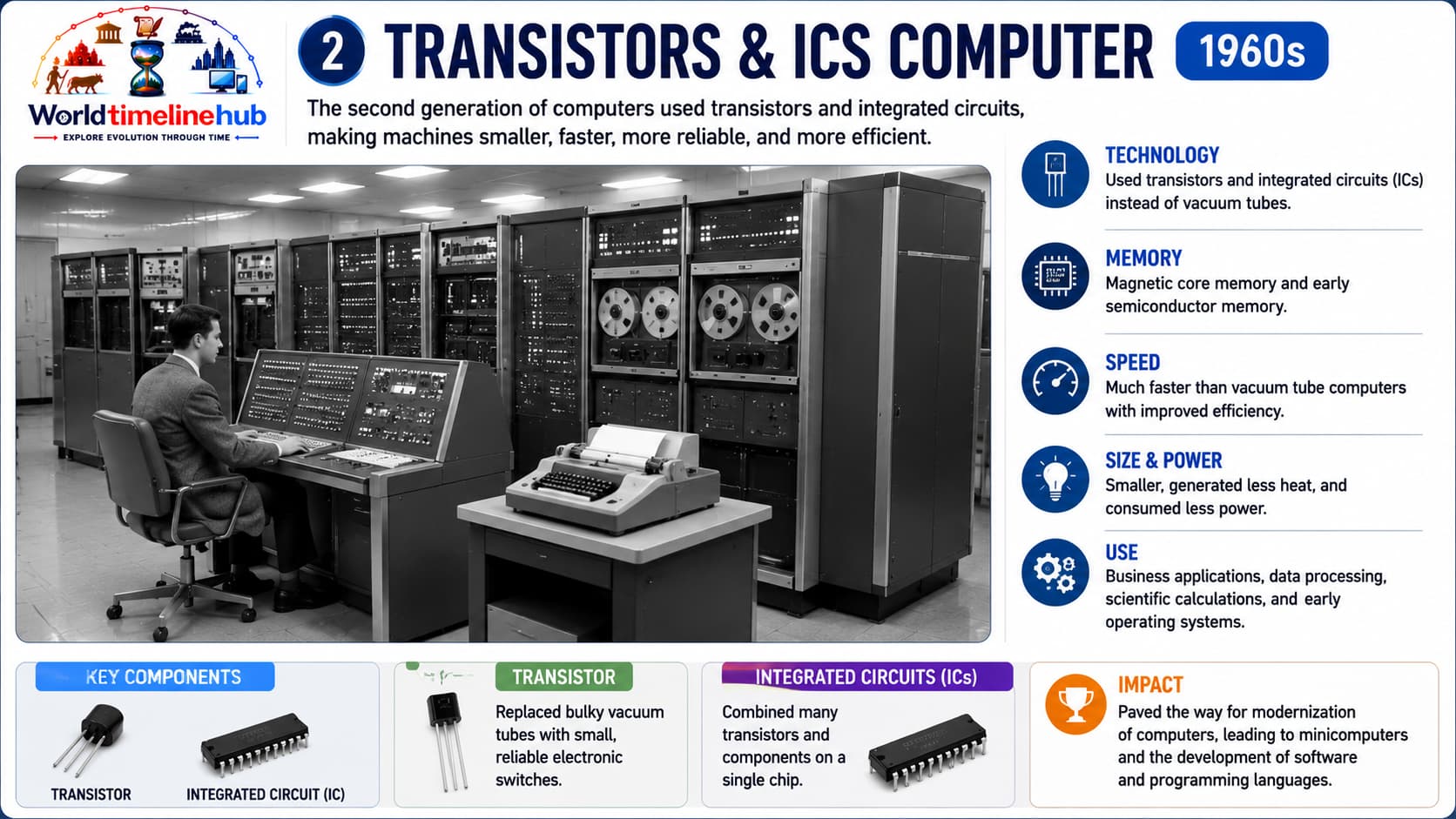
Transistors and Integrated Circuits
Integrated circuits: logic packed onto silicon chips, making computers smaller, cooler, and more reliable.
Transistors replace tubes, improving reliability and reducing size.
Integrated circuits (ICs) pack more logic onto chips.
Mainframes and minicomputers spread in universities and enterprises.
Solid-state transistors and early integrated circuits shrank logic onto chips, cut heat and power use, and paired with magnetic core memory to make multi-user mainframes practical for business and research.
Technology Used
Semiconductor transistors: Lower power and heat generation.
SSI/MSI chips: Early integrated logic families.
Magnetic core memory: Durable and non-volatile state retention.
Features
Better reliability: Less frequent hardware failure.
Batch and timesharing: Multi-user computing models emerge.
Broader adoption: Government, banking, and research expansion.
🖥️ Personal Computing1970s – 1990s
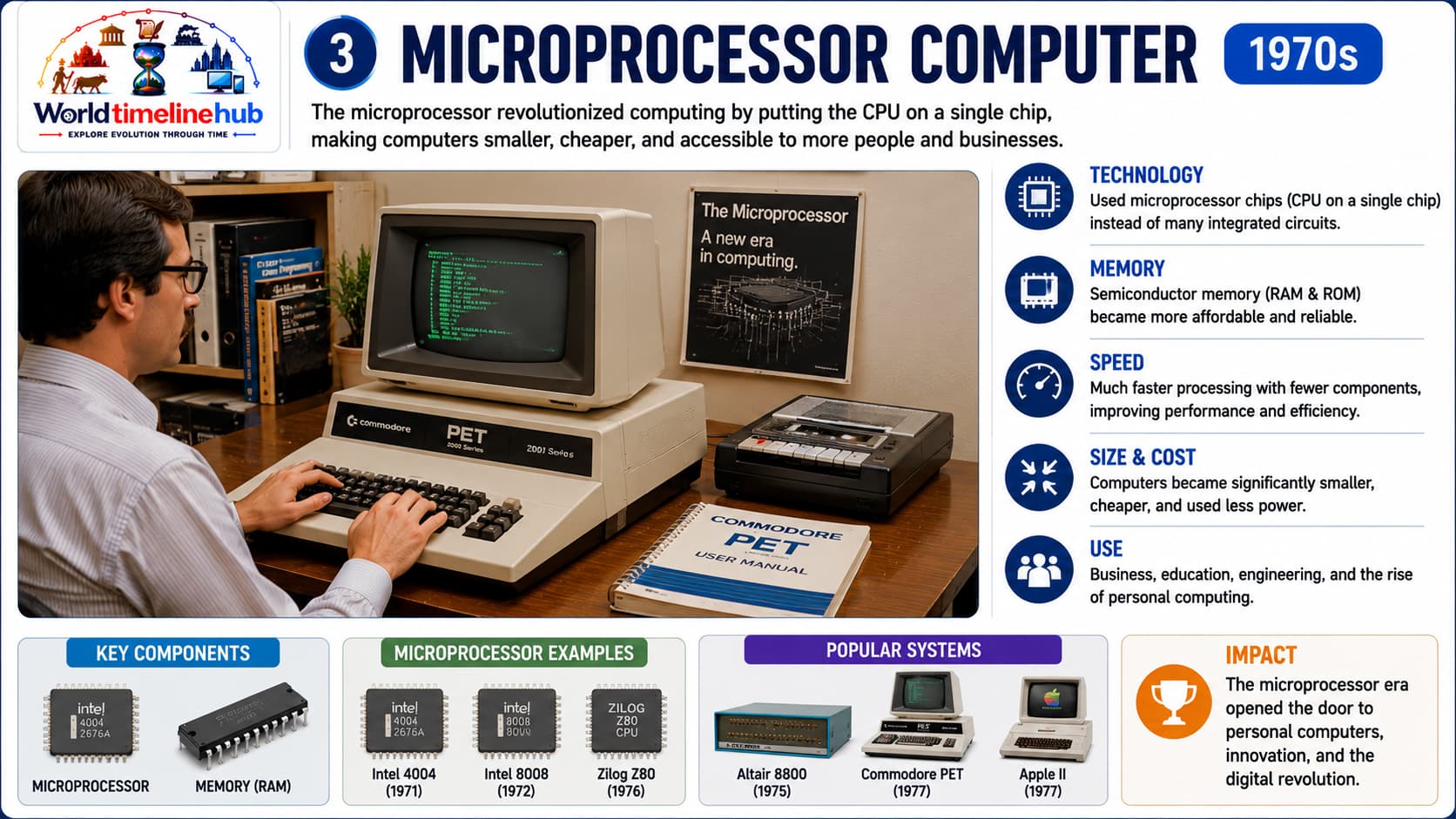
Microprocessor and PC Revolution
Microprocessor era: a complete CPU on one chip enabled affordable PCs for homes, schools, and offices.
1971: Intel 4004 starts microprocessor era.
1970s: Altair 8800 and early hobbyist kits appear.
1981: IBM PC standardizes business desktop ecosystem.
1984+: GUI-based personal computing grows rapidly.
A full CPU on one microprocessor chip, affordable floppy and hard drives, and graphical desktops turned computing from specialist mainframes into machines ordinary people could buy, learn, and use at home or work.
Technology Used
Microprocessors: CPU on a single chip.
Floppy and hard drives: Practical local storage systems.
Home and office adoption: Computing reaches non-specialists.
Productivity software: Word processing, spreadsheets, and desktop publishing.
Gaming and multimedia: New consumer computing culture.
🌐 Connected World2000 – 2015
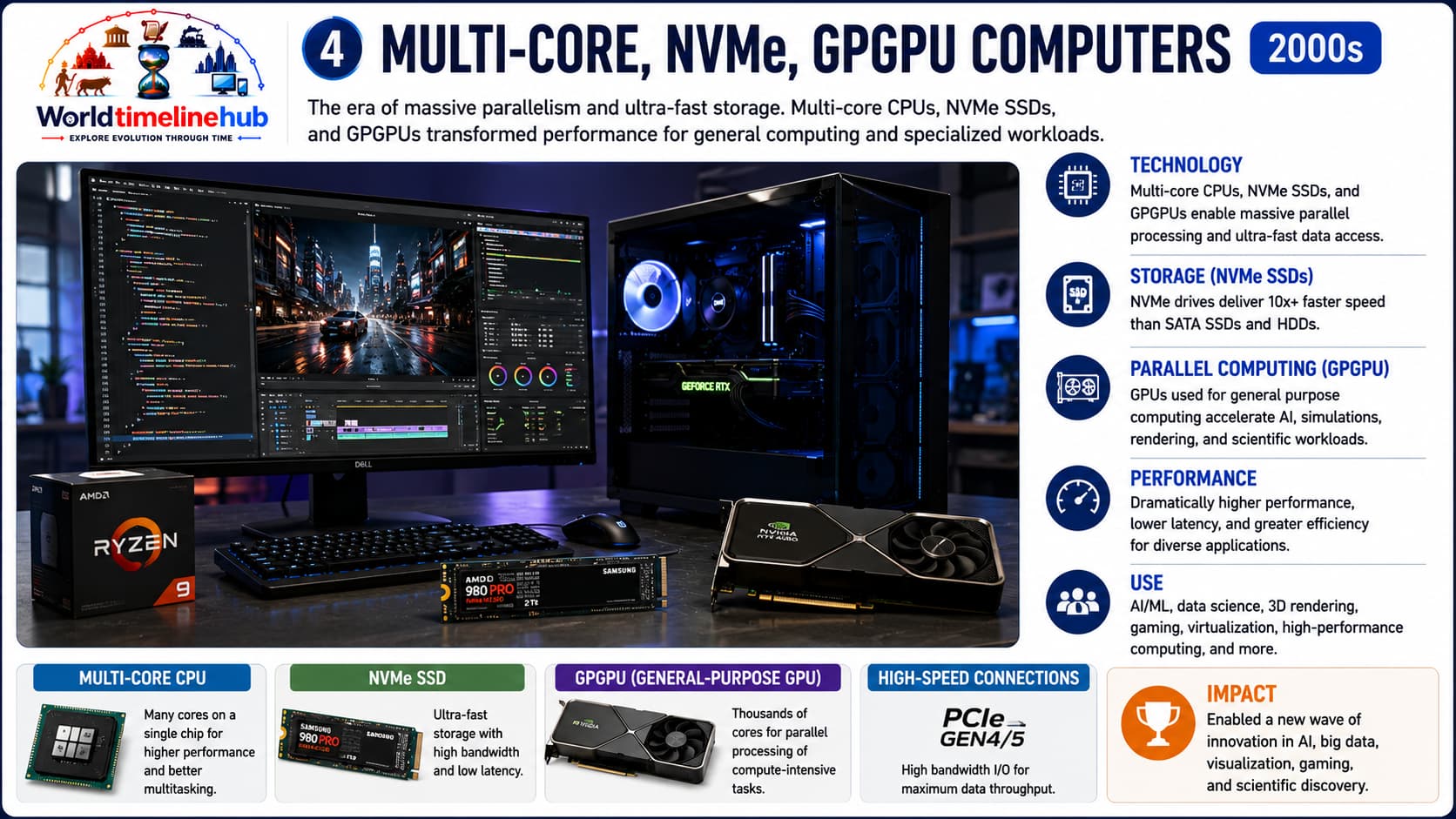
Internet, Mobile, and Cloud Expansion
Connected computing: multi-core chips, mobile devices, and cloud data centers power always-on digital life.
Broadband internet and web apps become mainstream.
Laptops and smartphones reshape where and how computing happens.
Cloud platforms provide on-demand storage and compute.
Broadband networks, multi-core processors, virtualization, and fast SSDs moved much of everyday computing online—laptops and phones became windows into services running in distant data centers.
Technology Used
Multi-core CPUs: Better parallel performance.
Virtualization: Efficient server consolidation for cloud providers.
SSD storage: Faster boot and application load times.
Features
Always-connected workflows: Email, docs, and collaboration online.
App ecosystems: Web and mobile software distribution scales.
Remote services: Backup, streaming, and SaaS tools grow fast.
🚀 Intelligent Systems2016 – Present
AI Acceleration and Future Computing
Future computing: AI accelerators and quantum research push beyond classical processors and data centers.
AI models scale rapidly with specialized accelerators.
Edge computing brings inference closer to users and devices.
Quantum and neuromorphic research explores post-classical paradigms.
Today's stack layers general-purpose CPUs with GPUs, TPUs, and NPUs in massive cloud clusters, while advanced chip fabrication and experimental quantum and neuromorphic hardware push beyond classical limits.
Technology Used
GPUs/TPUs/NPUs: Parallel compute for machine learning workloads.
Distributed cloud clusters: Training and inference at large scale.
Advanced process nodes: Better performance-per-watt.
Features
Generative AI tools: Text, code, audio, and image assistance.
Automation: Copilots and intelligent workflows in daily tasks.
Major turning points from mechanical engines to AI-native computing.
Year / Era
Milestone
1822
Difference Engine proposal
1837
Analytical Engine concepts
1940s
Electronic programmable computers appear
1950s–60s
Transistor adoption and core memory
1971
First commercial microprocessor
1980s
Personal computer mainstream adoption
1990s–2000s
Internet and client-server expansion
2010s
Cloud-first and mobile-first computing
2020s
AI acceleration and large models
Key Computer Pioneers
Charles Babbage: Designed early programmable engine concepts.
Ada Lovelace: Early algorithmic thinking for general-purpose machines.
Alan Turing: Foundational computation theory and cryptanalysis work.
John von Neumann: Influential stored-program architecture model.
Grace Hopper: Compiler and programming language development pioneer.
Computer Generations at a Glance
Generation
Core Hardware
Typical Period
1st
Vacuum tubes
1940s–1950s
2nd
Transistors
1950s–1960s
3rd
Integrated circuits
1960s–1970s
4th
Microprocessors
1970s onward
5th+
AI accelerators, distributed systems
Modern era
Operating System Evolution
Batch era: Jobs executed sequentially with minimal interaction.
Timesharing: Multiple users share one machine interactively.
Desktop GUI: Personal interfaces simplify everyday computing.
Mobile and cloud-native: App ecosystems and distributed backends dominate modern computing.
Memory and Storage Evolution
Era
Typical Storage/Memory
Trend
Early electronic
Delay lines, magnetic drums
Low capacity, high physical footprint
Mainframe era
Core memory, tapes, disks
Improved persistence and reliability
PC era
Floppies, HDDs, DRAM
Affordable local storage growth
Modern era
SSD/NVMe, cloud object storage
High speed + elastic remote capacity
India spotlight
Indian computing evolution
India moved from early public-sector computing and academic institutions to a global software powerhouse,
with strong IT services, startup ecosystems, and digital public infrastructure.
1950s–60s
Early institutional computing
Academic labs and government departments begin computational work.
1967
ECIL era
Electronics Corporation of India supports strategic electronics growth.
1980s–90s
PC and software wave
Computer education, private software firms, and exports scale rapidly.
2000s
IT services leadership
India becomes a global hub for software development and outsourcing.
2010s+
Digital public platforms
Aadhaar, UPI, and cloud-first governance accelerate large-scale digital adoption.
Computer Advertising and Market Shift
1980s: Personal computer marketing focuses on productivity and office adoption.
1990s: Internet-ready PCs are promoted for communication and learning.
Modern: Messaging shifts to cloud subscriptions, AI features, and ecosystem integration.
Test Your Knowledge
20 quick questions from the computer timeline. Click each question to reveal the answer.
Jump to any other technology timeline on WorldTimelineHub.
Disclaimer: This content is AI-generated for educational purposes and may contain errors or outdated details. For correct and authoritative information, please refer to official and reliable sources such as government publications, manufacturers, museums, and academic references.