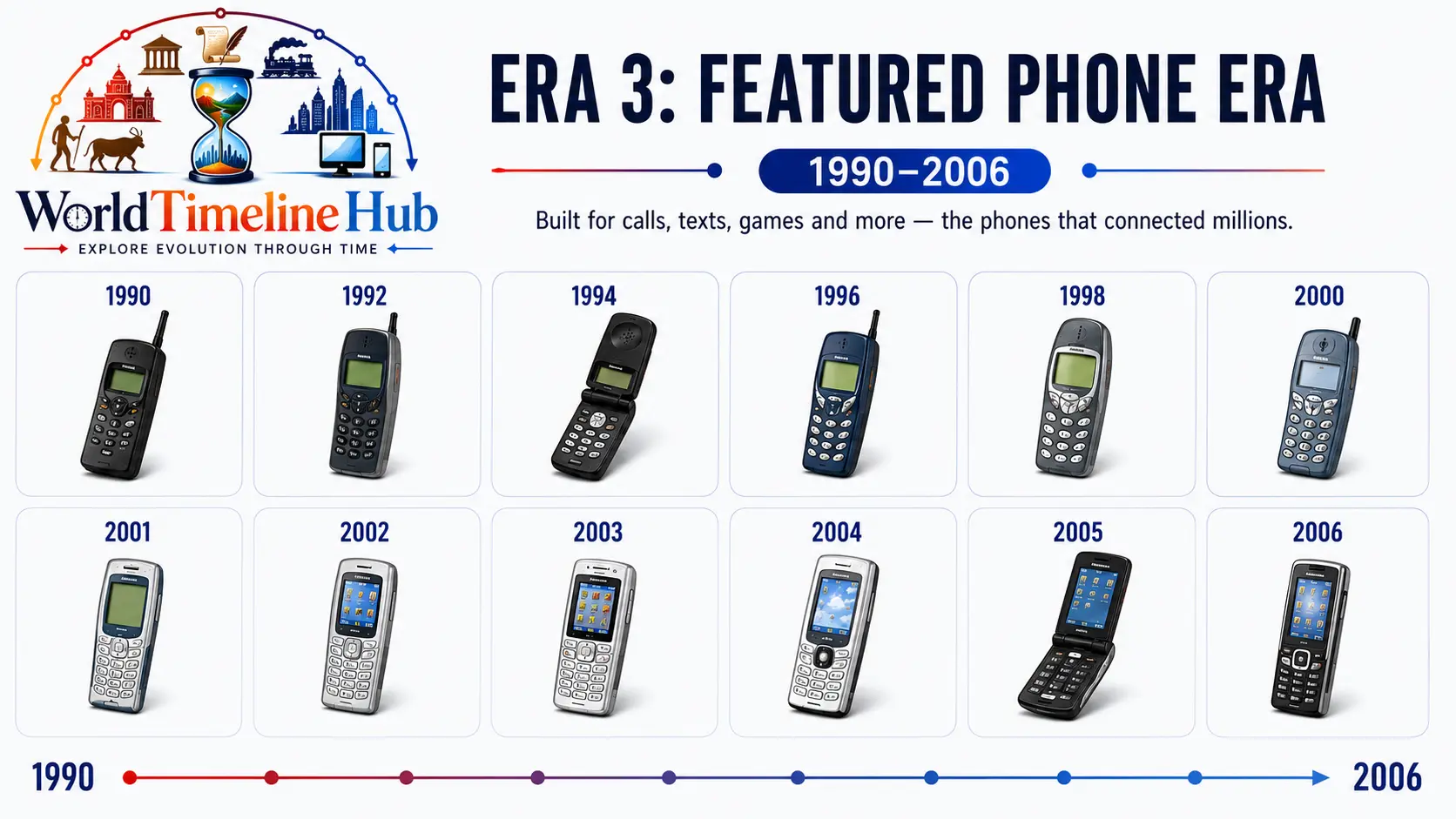
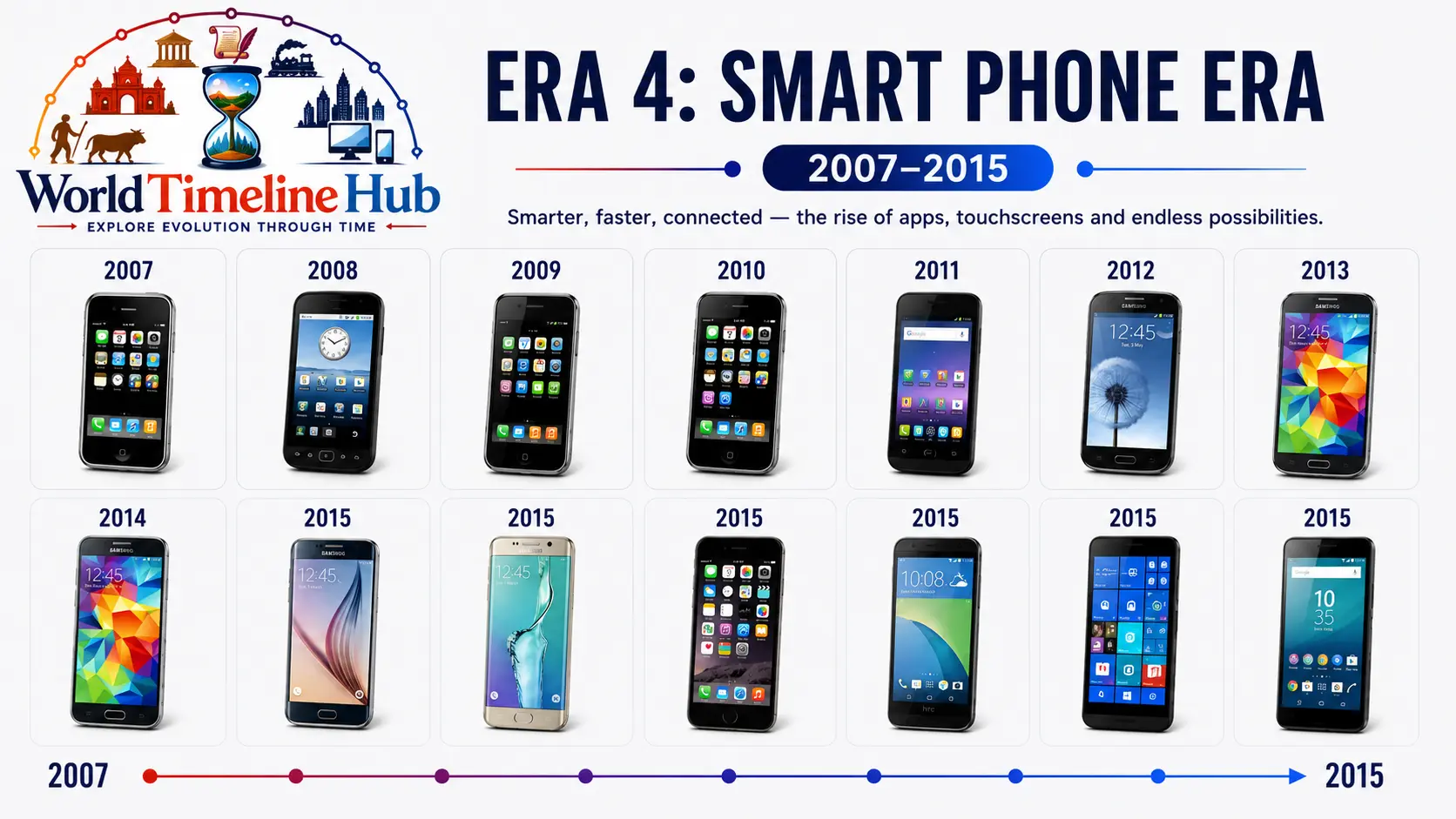
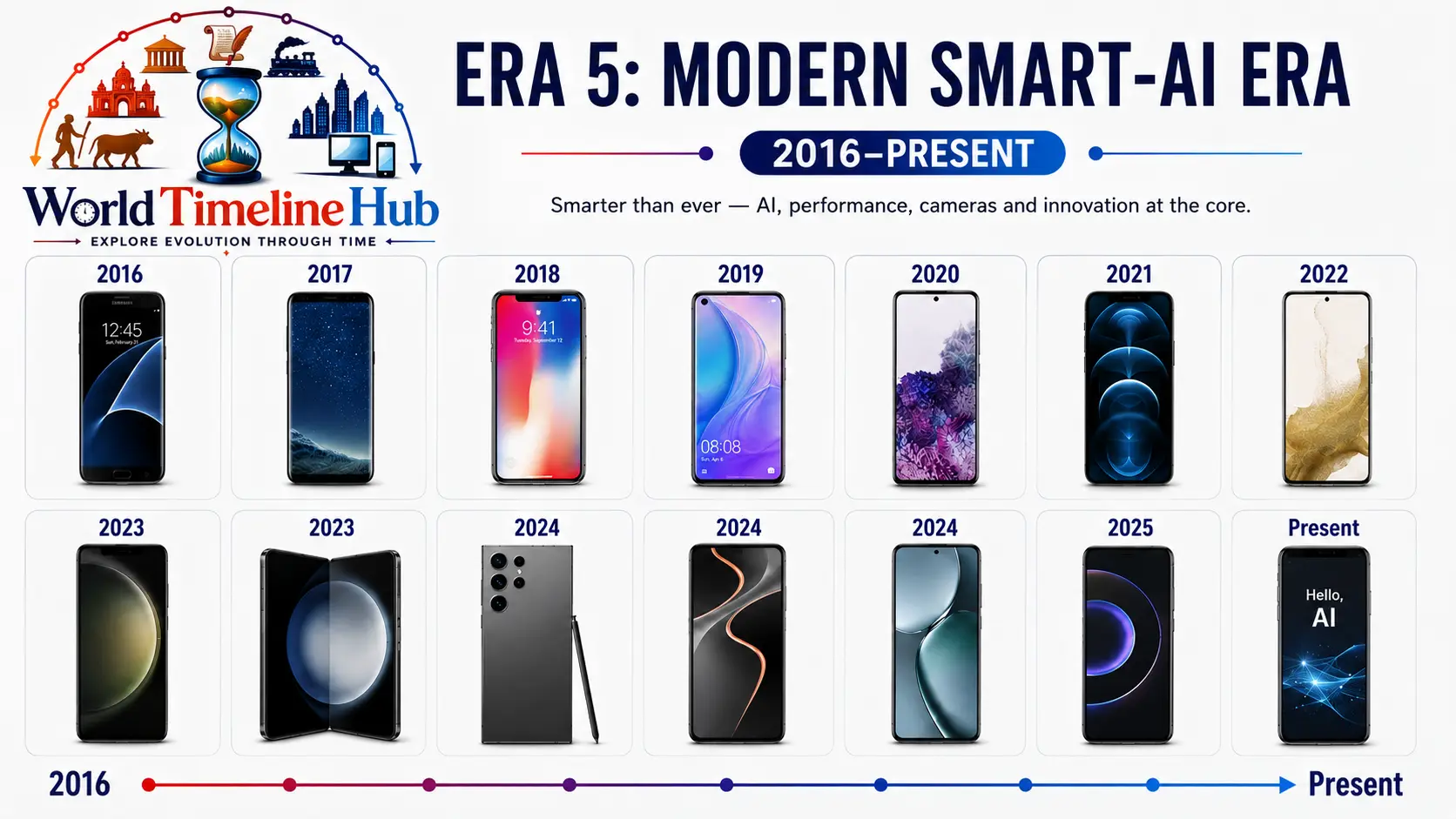
From Alexander Graham Bell’s wired telephone to foldables and on-device AI — trace how voice, mobility, apps, and
intelligence reshaped communication, work, and everyday life across nearly 150 years.
Before the brick phone, there was the telephone. The journey from Bell’s patent in 1876 to the first wireless
handset took nearly a century — but once it started, mobile technology never stopped evolving.
📞 1876 → Today🌍 5G + AI Era📱 7B+ smartphones
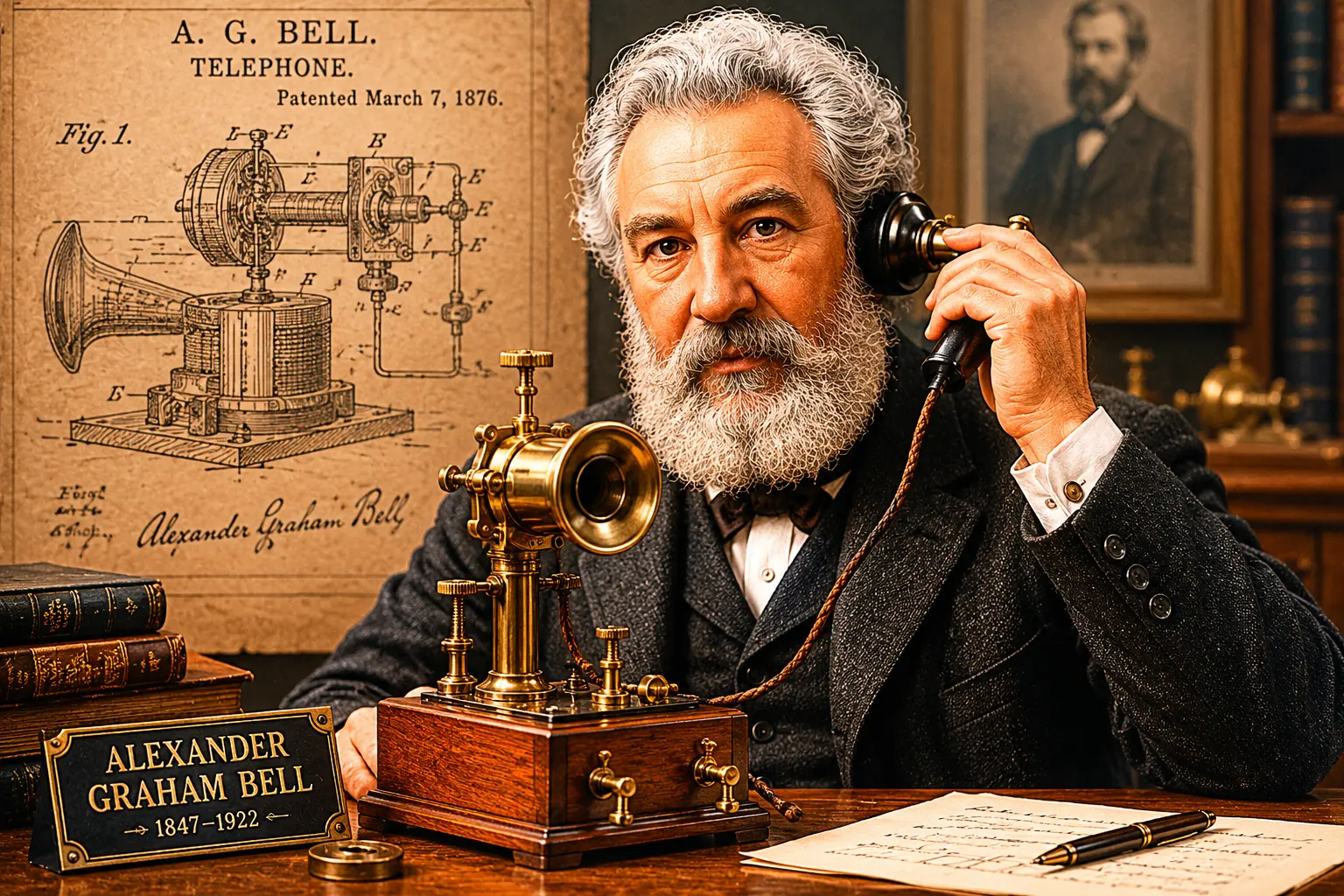
Inventor of the Telephone
Alexander Graham Bell
Alexander Graham Bell (1847–1922) is widely credited with inventing the first practical telephone in 1876. His breakthrough transformed long-distance communication and laid the foundation for the global telecom systems that eventually evolved into today’s mobile networks.
Big picture
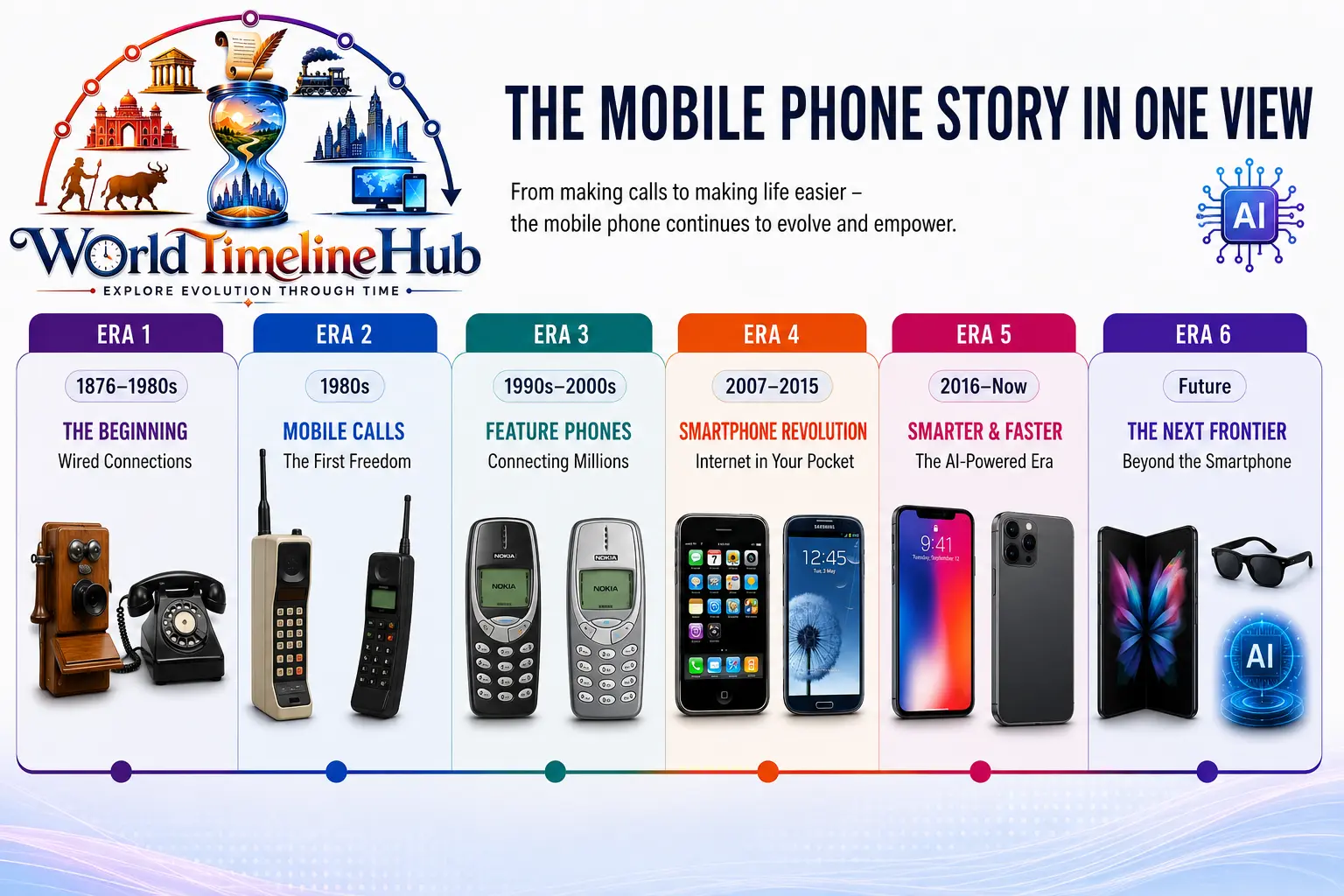
The mobile phone story in one view
What began as a wired voice experiment in 1876 became a pocket-sized computer used by billions. This timeline
walks through six turning points — from switchboards and brick phones to touchscreens, 5G, and AI — so you can
see how each era built on the last.
In India, the same arc moved faster: prepaid SIMs opened access, affordable handsets spread nationwide, cheap
mobile data fueled video and social apps, and UPI turned every smartphone into a digital wallet.
AI cameras, foldables, and ambient computing ahead
India spotlight
1995: First mobile call — telecom opens up
2000s: Prepaid plans reach beyond metros
2016+: Cheap data, UPI, and the smartphone boom
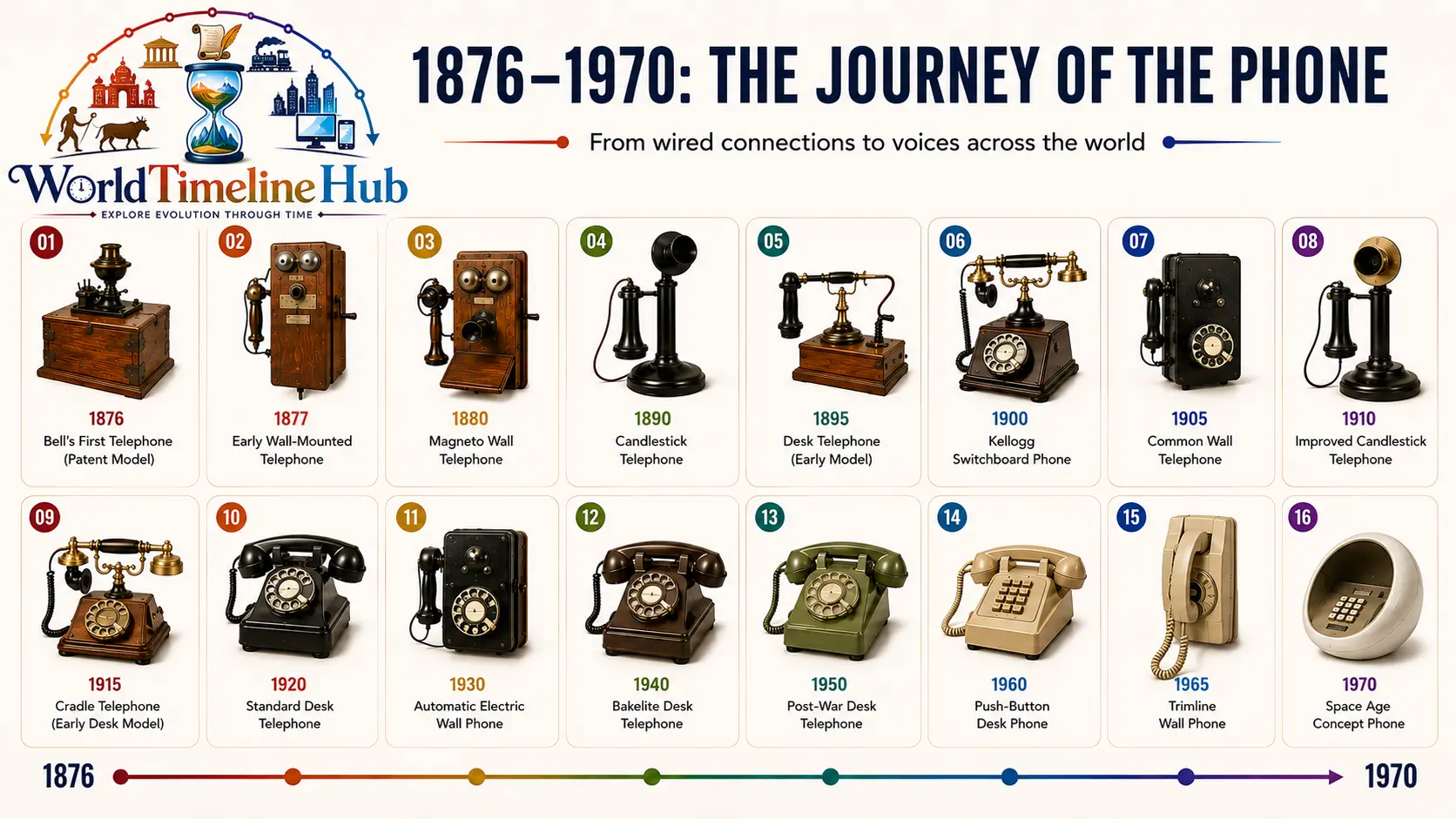
🧵 Wired Beginnings1876 – 1970
The Telephone: From Wires to Voice
Communication timeline: wired telephony to mobile innovation.
Early Telephone Era (1876-1970): fixed wired voice communication.
1876 – Invention of the Telephone
1876: Alexander Graham Bell invents the first telephone — voice transmitted over wires for the first time.
People could talk over long distances using wires instead of letters or telegrams alone.
Early telephones were large, fixed in one place, and connected by physical cables.
Technology Used
Mobile phones did not exist in this era — communication meant
fixed landline telephones linked by physical wires. Here is how the technology worked:
Analog voice signals: Sound was converted into electrical waves and sent through copper telephone lines — no digital chips or data networks.
Copper wire pairs: Each call traveled over dedicated (or shared) wires from your home or office to a local exchange building.
Manual switchboards (1870s–mid 1900s): Operators plugged cables by hand to connect one caller to another; you spoke to the operator first, then they linked your line.
Carbon microphone & electromagnetic receiver: Early handsets used simple parts to turn voice into electricity and back into sound — rugged but limited range and clarity.
Rotary dial & pulse dialing (1920s onward): Turning the dial sent electrical pulses (one pulse per digit) so the exchange knew which number you wanted without an operator.
Electromechanical exchanges: Relays, switches, and later automated equipment routed calls inside telephone offices — still mechanical, not computerized.
Line-powered phones: Electricity for the handset often came from the telephone line itself; many desk phones had no separate power plug.
How people typically operated a call:
Lift the handset (or turn a crank on very early phones) to get the operator’s attention or open the line.
Ask the operator for a person or number, or dial digits yourself once rotary phones became common.
Wait while switches connect; long-distance calls could take minutes and cost much more than local calls.
Speak into the mouthpiece, listen through the earpiece — one conversation at a time, no hold music or voicemail on most home lines until later decades.
Features
Voice only: No screen, camera, texting, apps, or internet — only real-time talking.
Fixed to one place: Phones were mounted on walls or sat on desks; you could not carry them in a pocket.
Handset design: Separate earpiece and mouthpiece (or later a single combined handset) connected by cord to the phone body.
Mechanical bell ringer: Incoming calls triggered a loud bell — no vibration mode or custom ringtones.
Rotary dial face: Numbers 0–9 on a spinning dial; dialing took several seconds compared to instant touch keys today.
Party lines (shared service): In some rural areas, several households shared one line and had to recognize their own ring pattern.
No privacy features: No call ID, blocking, or encryption — operators and shared lines could mean less privacy than modern mobiles.
Durable, simple build: Heavy metal or bakelite bodies built to last decades with minimal electronics inside.
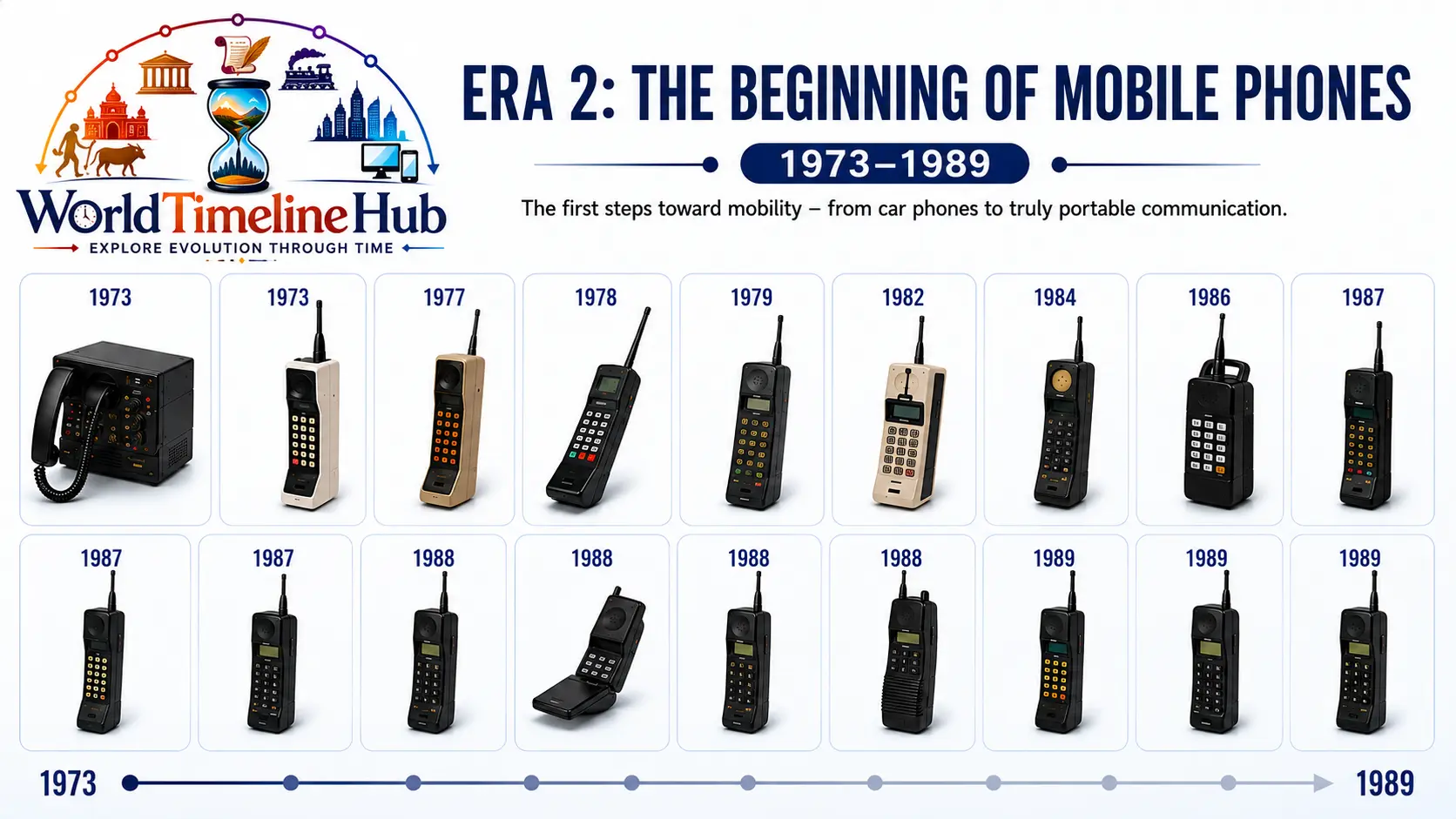
📟 The Brick Era1973 – 1989
Birth of Mobile Telephony
Brick-era mobile phones: heavy, analog handsets that started wireless calling.
1973: Martin Cooper (Motorola) makes the first public mobile phone call — a 2-pound prototype.
1983: Motorola DynaTAC 8000X becomes the first commercial mobile phone.
Portable communication without wires; large batteries and limited talk time.
2019: First foldable phones (Samsung Galaxy Fold, Huawei Mate X).
2020–present: 5G connectivity becomes mainstream. On-device AI for real-time translation, photo editing, and voice assistants.
Security: Hardware security chips, satellite SOS (iPhone 14/15).
Companies: Apple, Samsung, Xiaomi, OnePlus, Google Pixel.
Technology Used
Today’s phones combine 5G radios, AI chips, and advanced sensors in thin glass slabs.
5G NR networks: Faster downloads, lower latency — supports cloud gaming, live streaming, and dense cities.
On-device AI (NPUs): Dedicated neural processors for photo enhancement, voice assistants, and real-time translation.
OLED / high-refresh displays: Deep blacks, HDR video, and 90–120 Hz scrolling for smooth UI.
Biometric security: Face recognition, in-display fingerprint, and secure enclave chips protect data.
Computational photography: Multiple lenses + software produce night mode, portraits, and HDR in seconds.
eSIM & dual-SIM: Digital SIM profiles and two lines on one phone — common for travel and work/personal split.
Features
AI cameras & editing: Auto scene detection, object removal, and live filters powered by on-phone models.
Foldable displays: Phones that open into small tablets (Samsung, others) with hinge engineering.
Fast & wireless charging: 30W–100W wired and Qi pads — less time tethered to a cable.
Digital payments: NFC, UPI, and wallet apps — pay merchants without cash or cards.
Satellite SOS & emergency: Text or alert via satellite when cellular signal is absent (select flagships).
Voice & chat assistants: Siri, Google Assistant, and others control smart home and answer queries hands-free.
🚀 Next DecadeFuture
What Comes After the Smartphone?
Rollable displays that expand from phone to tablet size.
Hologram calling using light field technology.
AI personal assistants that act as proactive copilots.
Satellite communication for global coverage without cellular towers.
AR and VR integration — phones as mixed-reality hubs.
Battery-free charging (ambient RF / solar integration).
Technology Used
Next-generation research points to flexible displays, ambient AI, and connectivity beyond traditional towers.
Rollable / stretchable OLED: Screens that expand or roll out for larger canvas without a thick fold hinge.
6G & advanced satellite: Faster, lower-latency networks plus direct phone-to-satellite for global coverage.
On-device large language models: Smarter assistants that understand context while keeping more data private on the phone.
Light-field & holographic displays: Research into 3D visuals without glasses for calls and content.
AR / VR fusion (spatial computing): Phones paired with glasses pass sensors, tracking, and apps into mixed reality.
Solid-state & ambient charging: Safer batteries and harvesting RF/solar energy to reduce plug-in time.
Features
Rollable form factors: Phone-sized device that becomes tablet-width when unrolled.
Proactive AI copilots: Systems that schedule, summarize, and act across apps with your permission.
Hologram-style calling: More natural remote presence using advanced cameras and displays.
Global connectivity: Fewer dead zones via satellite backup and mesh-style networks.
Mixed-reality hub: One device orchestrates AR navigation, training, and entertainment in glasses or headsets.
Invisible interface: Voice, gesture, and context — less staring at a flat screen for every task.
The phone is becoming an invisible interface — ambient, intelligent, and always with you.
Data deep dive
Specifications & comparisons
Side-by-side tables track how processors, cameras, and connectivity evolved from feature phones to AI flagships — and where the industry is heading next.
1
Core Specifications Across Generations
Feature phones → early smartphones → modern flagships → future trends.
Scroll horizontally on small screens
Component
Feature Phone (2000–2006)
Early Smartphone (2007–2012)
Modern Smartphone (2018–2026)
Future (2027+)
Processor
Single-core, 50–200 MHz
Dual-core, 500 MHz–1.5 GHz
Octa-core, 3–4 nm chips, AI engine
Quantum-inspired / Neuromorphic
RAM
4–16 MB
256 MB – 1 GB
8–24 GB LPDDR5X
32–64 GB + CXL integration
Storage
16–256 MB (expandable)
8–64 GB
128 GB – 1 TB UFS 4.0
2 TB+ / cloud-native
Display
1.5–2.4" LCD, 128×160 px
3.5–4.7" 480×320 px
6.7–7.0" AMOLED, 120 Hz, 1440×3200 px
Rollable 8–10", under-display camera
Battery
800–1500 mAh (removable)
1400–2000 mAh
4500–6000 mAh, 65W+ fast charge
Graphene / solid-state, 100W wireless
Rear Camera
0.3–1.3 MP (VGA)
2–8 MP single
50–200 MP triple/quad, 8K video
Computational + light field
Front Camera
None
0.3–1.2 MP
12–50 MP + 3D depth sensor
Under-display, 4K HDR
Connectivity
2G (GPRS/EDGE), Bluetooth 1.2
3G, Wi-Fi 4, Bluetooth 2.1
5G, Wi-Fi 7, Bluetooth 5.4, NFC, UWB
6G, satellite direct, Li-Fi
Security
PIN / no biometrics
Pattern / basic face unlock
Fingerprint (in-display), Face ID 3D
Palm vein / on-device AI behavioral
Operating System
Proprietary RTOS
iOS (iPhone OS 1–6), Android 1.5–4.1
iOS 17–18, Android 14–16, HarmonyOS
Fuchsia / post-OS AI interface
2
Key Features Introduced by Decade
A compact summary of defining capabilities and iconic devices per era.
Scroll horizontally on small screens
Decade
Defining Features
Example Devices
1990s
SMS texting, digital (2G), monochrome screen, Snake game, removable antenna
Nokia 3210, 6110, Motorola StarTAC
2000–2006
Color screen, polyphonic ringtones, VGA camera, Java games, MP3 playback
Eye strain — Hours of screen time can cause dryness, headaches, and blurred vision.
Addiction — Notifications and endless feeds make it hard to disconnect.
Reduced physical activity — More sitting and scrolling, less movement and outdoor time.
Privacy concerns — Apps, ads, and trackers collect location, contacts, and usage data.
Distraction — Studies, work, and sleep suffer when phones demand constant attention.
Healthy habit: Set screen-time limits, use focus modes, and keep phones out of the bedroom for better rest.
India spotlight
India mobile milestones
From a single metro call to the world’s largest mobile-data market — India’s telecom journey shows how policy, competition, and affordable tech can connect a billion people.
1.1B+
Mobile connections
2B+
UPI txns / month
₹6
Per GB (post-Jio era)
1995
First mobile call
India’s first mobile telephone service launches in Kolkata — opening a new chapter beyond fixed landlines.
2000s
Prepaid revolution
Affordable prepaid SIMs and fierce competition spread mobile access beyond metros into towns and villages.
2016
Jio & cheap data
Reliance Jio’s 4G rollout triggers a data price war — video, social media, and mobile commerce explode nationwide.
UPI
Digital payments era
UPI turns every smartphone into a wallet — QR payments at chai stalls, autos, and malls become everyday life.
2023+
5G rollout
Faster networks lay groundwork for cloud gaming, HD streaming, and on-device AI across major cities.
Battery and Charging Evolution
Area
Key Evolution
Impact
Battery chemistry
NiCd → NiMH → Li-Ion → Li-Polymer → solid-state/graphene research
Higher energy density and longer practical battery life.
Charging connectors
Barrel pins → USB Mini/Micro → USB-C
Standardization and easier cable compatibility.
Charging speed
Basic 5W → Quick Charge / USB PD / VOOC / 100W+ fast charging
Much lower charge downtime.
Wireless charging
Qi ecosystem adoption
Cable-free convenience and accessory growth.
Mobile Operating Systems and Keyboard Era
Before iOS/Android dominance, multiple platforms and keyboard-first phones shaped mobile computing.
Legacy OS platforms: Symbian, Windows Mobile, BlackBerry OS, Palm OS, Bada, Firefox OS, KaiOS.
Keyboard-first phones: BlackBerry (1999–2010s), Nokia Communicator line, Sidekick era devices.
Why it matters: Email, enterprise messaging, and mobile productivity patterns started here.
Durability, Glass, SIM, and Safety Features
Water resistance milestones: Sony Xperia Z (2013) and later IP67/IP68 mainstream adoption.
Screen protection: Plastic screens to Gorilla Glass (2008 onward) and Ceramic Shield-class materials.
Dual SIM and eSIM: Dual-SIM growth in the 2000s; eSIM mainstream momentum from 2017–2018.
Emergency features: Basic SOS tools in earlier phones to satellite Emergency SOS (iPhone 14, 2022).
Radiation/safety awareness: SAR values and responsible use remain common user concerns.
Gaming and Device Convergence
Gaming progression: Snake → Java games → App Store era → PUBG Mobile / Genshin Impact → cloud gaming.
Jump to any other technology timeline on WorldTimelineHub.
Disclaimer: This content is AI-generated for educational purposes and may contain errors or outdated details. For correct and authoritative information, please refer to official and reliable sources such as government publications, manufacturers, museums, and academic references.