From a Cold War research network to a planet-wide platform for communication, commerce, education, and culture —
trace how the internet grew from ARPANET packets into today’s always-connected digital world.
The internet is not only the web. It is a layered system of cables, protocols, addresses, servers, and applications
that together move trillions of packets every day.
🌐 1960s → Future📡 ARPANET → 5G🔗 Billions online
Internet Invention and Foundations
The internet grew from Cold War–era research that asked how to keep communication working even if parts of a network were damaged. Paul Baran and Donald Davies developed packet switching independently; ARPANET proved the idea on university and defense computers. Vint Cerf and Bob Kahn’s TCP/IP then gave every connected network a shared language for addressing and delivery.
What began as email and file sharing among scientists became the World Wide Web, broadband homes, smartphones, cloud services, and AI-assisted applications used by billions. The sections below trace that path era by era, then summarize key events, speeds, pioneers, protocols, and where the network may head next.
Big picture
Internet evolution in one view
The internet began as a resilient research network, then standardized on TCP/IP, gained human-readable
names through DNS, exploded with the web and browsers, and finally became mobile, social, cloud-based,
and AI-driven for billions of users worldwide.
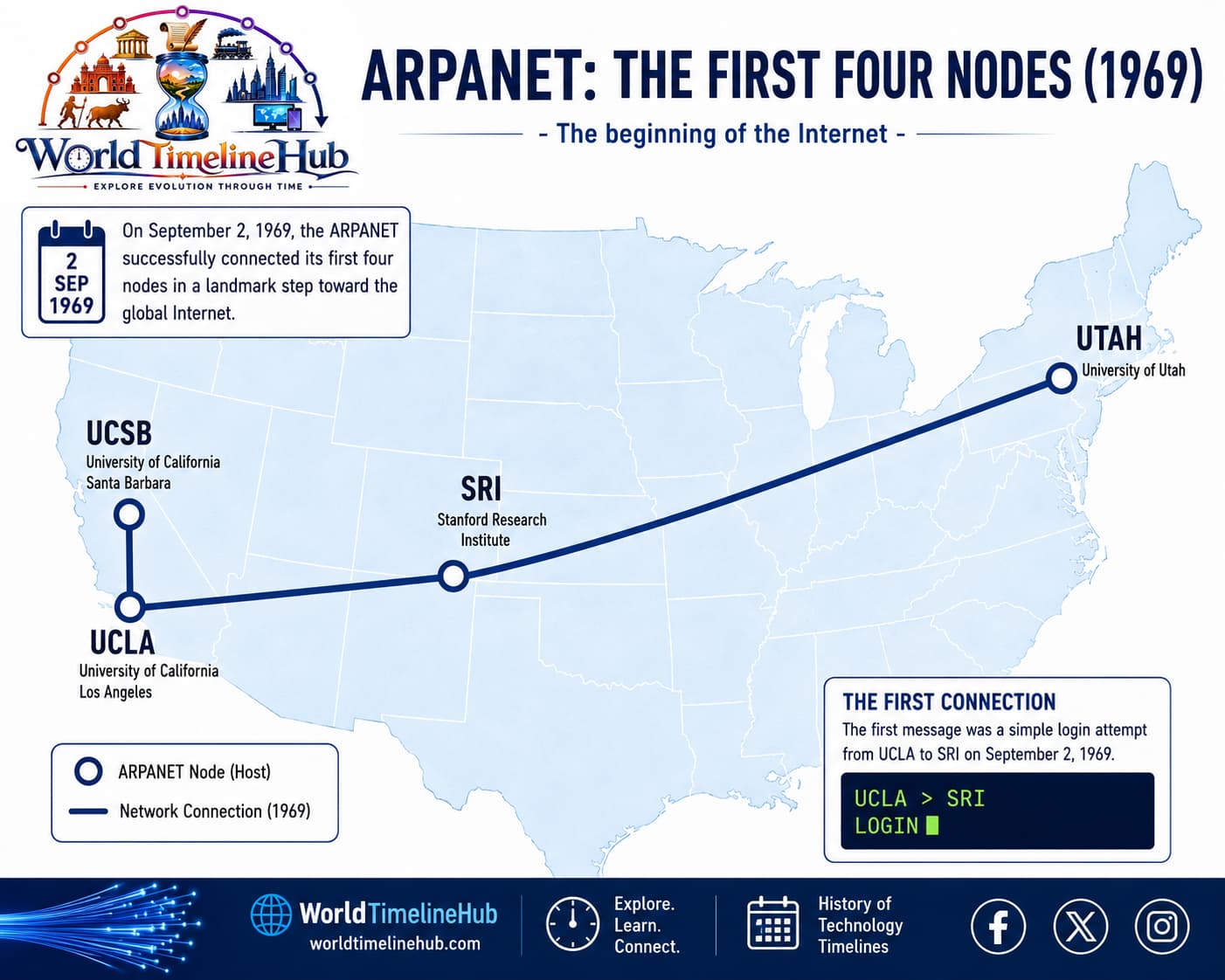
Before the public internet existed, ARPANET linked research computers using packet switching—breaking data into small pieces that could reroute around failures instead of holding a single telephone-style circuit open.
ARPANET: the research network that demonstrated packet switching and remote resource sharing.
1969: First ARPANET link between UCLA and Stanford Research Institute.
Packet switching breaks messages into small chunks routed independently.
Goal: build a survivable communication network for research and defense projects.
Technology Used
Packet switching: Alternative to circuit-switched telephone lines.
Interface Message Processors (IMPs): Early network nodes.
NCP protocol: Precursor to later internet standards.
Features
Small user base: Universities and government labs.
Resilience focus: No single point of failure.
Research collaboration: Shared computing resources remotely.
🔗 Common Language1970s
TCP/IP and Internet Standards
The 1970s turned isolated experiments into a growing internet by standardizing TCP/IP—rules for addressing, routing, and reliable delivery that let different networks speak the same language.
1974: Vint Cerf and Bob Kahn describe TCP in foundational work.
1983: ARPANET transitions to TCP/IP (flag day).
Email becomes an early killer application across connected hosts.
Interoperability: Different networks can interconnect.
Features
End-to-end design: Intelligence at the edges, simple core.
Scalable addressing: Foundation for global growth.
Academic expansion: More institutions join the network.
📛 Names & Routes1980s
DNS and Network Expansion
As more campuses and companies joined, remembering numeric IP addresses became impractical. DNS and expanding LAN/WAN infrastructure made networks easier to use and set the stage for commercial ISPs.
1983: DNS (Domain Name System) introduced by Paul Mockapetris.
Users can type names like example.edu instead of numeric IP addresses.
LANs, WANs, and routers spread in businesses and campuses.
Technology Used
DNS hierarchy: Root, TLD, and domain servers.
Ethernet + TCP/IP: Corporate and campus networking.
Usenet and BBS culture: Early distributed discussions.
Features
Easier access: Human-readable hostnames.
Global coordination: Shared naming and address policies.
Commercial seeds: ISPs and private networks begin forming.
🌍 The Web Arrives1990s
World Wide Web and Browser Era
The 1990s brought the web—linked documents over HTTP—and graphical browsers that made the internet approachable for non-specialists, alongside dial-up ISPs connecting homes for the first time.
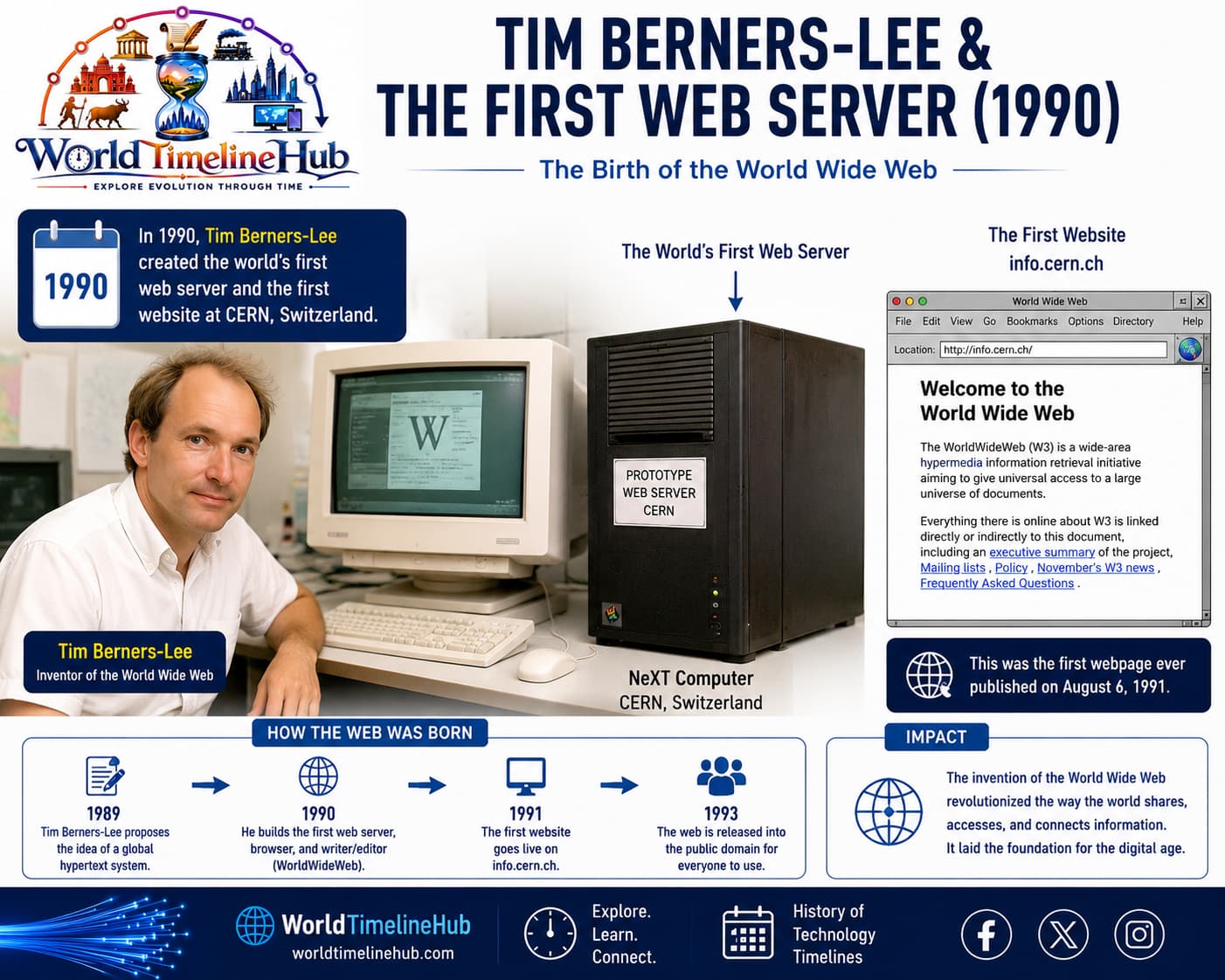
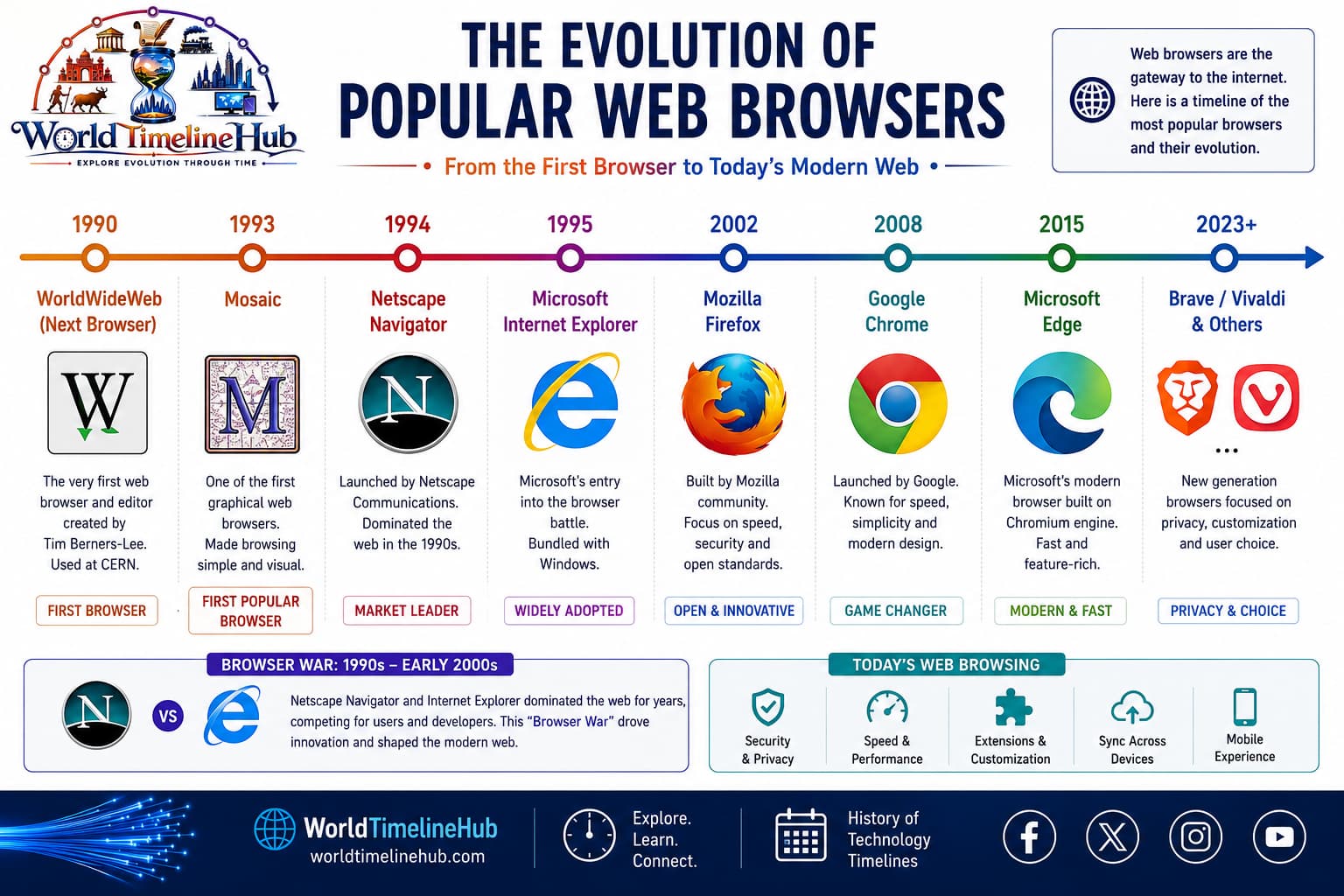
The first web browsers turned hypertext links into a clickable, visual experience for everyday users.
Web browsers timeline: from Mosaic and Netscape to today’s multi-engine competition.
1989: Tim Berners-Lee proposes the World Wide Web at CERN.
1991: First website and HTTP/HTML foundations go public.
1990s: Mosaic, Netscape, and Internet Explorer popularize browsing.
Commercial ISPs bring dial-up internet into homes.
Technology Used
HTTP + HTML: Linked hypertext documents.
URLs: Standard way to locate web resources.
Web servers: Host sites and deliver pages to browsers.
Features
Clickable navigation: Non-technical users can explore content.
Dot-com growth: E-commerce and portals emerge.
Search engines: Yahoo!, AltaVista, later Google (1998).
📜 Web Standards1990s–2020s
Web Protocols Era
Once the web existed, a stack of protocols and formats turned hypertext into interactive applications—HTTP for requests, HTML/CSS/JavaScript for pages, then APIs, real-time channels, and faster HTTP versions built on encryption and multiplexing.
1990–91: HTTP/0.9 and HTML define the first request-and-document model.
1996–97: HTTP/1.0 and HTTP/1.1 add headers, caching, and persistent connections.
1990s: CSS and JavaScript separate style and behavior from markup.
2000s: AJAX and REST APIs let web apps update without full page reloads.
2010s: WebSocket, HTTP/2, and TLS-by-default reshape performance and security.
2020s: HTTP/3 over QUIC improves speed on mobile and lossy networks.
Technology Used
HTTP / HTTPS: Client–server requests for pages, images, and APIs.
HTML, CSS, JavaScript: Structure, presentation, and interactivity in browsers.
URI / URL: Standard addresses for web resources.
REST & JSON: Machine-readable services behind modern apps.
WebSocket & HTTP/2 / HTTP/3: Real-time and high-efficiency transport.
Features
Open standards: W3C and IETF documents keep the web interoperable.
Browser engines: Vendors implement the same specs differently but compatibly.
Security shift: HTTPS and modern headers protect users by default.
Web Protocols Evolution
The web is more than browsers showing pages—it is a family of protocols that evolved from simple document retrieval to encrypted, multiplexed, API-driven applications. This table tracks major milestones in that stack.
Year
Protocol / standard
Why it matters
1990
HTTP/0.9
One-line GET requests for hypertext documents
1991
HTML
Structured, linkable web pages
1996
HTTP/1.0
Headers, status codes, content types
1997
HTTP/1.1
Persistent connections and improved caching
1996
CSS
Separates visual design from HTML structure
1995
JavaScript
Interactive behavior inside browsers
2005
AJAX pattern
Partial page updates without full reloads
2000s
REST + JSON APIs
Web backends power mobile and SPA apps
2011
WebSocket
Full-duplex real-time chat, games, and feeds
2015
HTTP/2
Multiplexing and header compression
2022
HTTP/3 (QUIC)
Faster setup and better performance on lossy links
2010s+
HTTPS everywhere
TLS encryption becomes the norm for web traffic
⚡ Always On2000s
Broadband and Web 2.0
Always-on broadband and interactive “Web 2.0” sites shifted the internet from static pages to video, user participation, and services that expected a fast, continuous connection.
DSL and cable modems replace slow dial-up for many households.
Always-on connections enable richer media and continuous use.
“Web 2.0” emphasizes user-generated content and interactive platforms.
Wi‑Fi routers make home wireless networking common.
Technology Used
Broadband access: Higher bandwidth, lower latency than dial-up.
AJAX techniques: Smoother web apps without full page reloads.
XML/JSON APIs: Machine-readable data exchange.
Features
Video and music online: YouTube (2005) changes media habits.
Remote work seeds: Email, chat, and web tools in offices.
Global participation: More countries join the broadband wave.
👥 Connected Society2000s
Social Platforms and User-Generated Content
Social networks turned the internet into a daily public square where people publish, debate, and share media—raising new questions about privacy, moderation, and who controls attention.
2004: Facebook launches; social networking scales globally.
2006: Twitter popularizes short public posts.
Blogs, forums, and sharing reshape news, politics, and culture.
Technology Used
Large-scale web platforms: Data centers and load balancing.
Recommendation feeds: Algorithms rank content for each user.
Media uploads: Photos and video sharing at scale.
Features
Network effects: Value grows as more people join.
Real-time conversation: News and trends spread instantly.
New challenges: Privacy, misinformation, and moderation.
📱 Internet in Your Pocket2010s
Mobile Internet and App Economy
Smartphones and 3G/4G moved the internet off the desktop into pockets worldwide, with app stores distributing software and mobile-first services reaching users who never owned a PC.
Smartphones make the internet portable and always nearby.
3G/4G LTE networks support mobile video, maps, and payments.
App stores distribute software outside traditional desktop PCs.
Responsive web design: Sites adapt to small screens.
Features
Location-based services: Maps, rides, and local search.
Mobile payments: Wallets and in-app purchases.
Global reach: Internet access expands in developing regions.
☁️ Services Everywhere2010s
Cloud Computing and Streaming
Massive data centers and content delivery networks let software, video, and files live online instead of on local disks—powering streaming entertainment and startups that rent compute by the hour.
Software moves from installed discs to browser and app subscriptions.
Netflix-style streaming dominates entertainment delivery.
Hyperscale data centers power search, email, and enterprise SaaS.
Technology Used
Virtualization + containers: Elastic compute at massive scale.
CDN networks: Cache content closer to users.
Adaptive streaming: Video quality adjusts to bandwidth.
Features
Anywhere access: Files and apps follow your account.
Creator economy: Platforms monetize video, code, and design.
Business transformation: Startups scale without owning all hardware.
🤖 Intelligent Network2020s
5G, Remote Everything, and AI on the Web
Faster mobile and fiber links, encrypted web by default, and generative AI embedded in search and productivity tools define today’s internet—always on, data-rich, and increasingly intelligent.
5G and fiber expand bandwidth for video calls, gaming, and IoT.
Remote work, learning, and telehealth accelerate during global disruptions.
Generative AI tools integrate into search, browsers, and productivity apps.
Technology Used
5G NR: Higher speeds and lower latency for mobile networks.
HTTPS everywhere: Encryption becomes default for web traffic.
Large language models: AI assistants embedded in websites and apps.
Features
Real-time collaboration: Docs, design, and meetings online.
Smart devices: Homes, cars, and cities connect to the cloud.
Policy debates: Privacy, AI safety, and digital sovereignty.
🔮 Next HorizonFuture
Future of the Internet
Tomorrow’s internet may combine satellite coverage, IPv6 at scale, quantum-safe security, edge computing, and immersive interfaces—while societies debate access, governance, and trust online.
Satellite constellations aim to connect remote regions globally.
IPv6 adoption continues to address address exhaustion.
Decentralized protocols, quantum-safe cryptography, and immersive web (XR) evolve.
Technology Used
LEO satellites: Low-latency global coverage projects.
Post-quantum crypto: Long-term secure communication standards.
Edge computing: Processing closer to users and devices.
Features
More inclusive access: Closing digital divides worldwide.
Immersive interfaces: Spatial web and mixed-reality services.
Governance questions: Who controls identity, data, and truth online?
Internet Timeline Summary
Major eras from research networks to the modern global internet—use this table as a quick map before exploring detailed events, speeds, and pioneers below.
Era
Milestone
1960s
ARPANET and packet switching
1970s
TCP/IP becomes core protocol
1980s
DNS and network expansion
1990s
World Wide Web and browsers
1990s–2020s
Web protocols (HTTP, HTML, APIs)
2000s
Broadband and Web 2.0
2000s
Social platforms rise
2010s
Mobile internet and apps
2010s
Cloud and streaming services
2020s
5G, remote life, AI-powered web
Future
Satellite, secure, decentralized internet
Key Internet Historical Events
Beyond the main era cards, these moments shaped how people communicate, search, share files, and stream video across the global internet.
Event
Year
Why it matters
First email sent
1971
Ray Tomlinson; introduced @ symbol
First .com domain
1985
Symbolics.com registered
First web page
1991
info.cern.ch goes live
Mosaic browser
1993
Made the web graphical
Google founded
1998
Changed search forever
Napster / P2P
1999
Reshaped bandwidth and copyright
YouTube launch
2005
Video streaming explosion
First iPhone
2007
Mobile internet becomes mainstream
IPv6 launch day
2012
Global push for larger address space
Starlink first launch
2019
Satellite internet constellation
Internet Speed Evolution
Internet history is also a story of speed—from kilobits on leased lines to gigabits in homes and data centers. Each era’s applications (email, web, video, cloud) demanded faster links.
Era
Typical Speed
Technology
1960s–70s
~50 kbps
ARPANET leased lines
1980s
9.6–56 kbps
Dial-up modems
1990s
56k–1.5 Mbps
56k modem, ISDN, early DSL
2000s
1.5–50 Mbps
DSL, cable broadband
2010s
50 Mbps–1 Gbps
4G LTE, fiber to home
2020s
100 Mbps–10 Gbps
5G, Wi-Fi 6/7, 10G fiber
Internet Pioneers
No single inventor built the internet alone. Researchers, engineers, and standards authors contributed packet switching, protocols, naming, browsers, and email—the building blocks of today’s connected world.
Person
Contribution
Paul Baran
Packet switching research (RAND)
Donald Davies
Packet switching (UK); coined term
Bob Kahn & Vint Cerf
TCP/IP protocol design
Robert Metcalfe
Ethernet at Xerox PARC
Tim Berners-Lee
World Wide Web, HTTP, HTML
Marc Andreessen
Mosaic browser
Ray Tomlinson
Networked email and @ addressing
Paul Mockapetris
DNS (Domain Name System)
Then vs Now: Internet Experience
Compare a typical 1990s dial-up household with a 2020s fiber or cable home—the same idea of getting online, but radically different speed, devices, and daily habits.
Metric
Then (1990s)
Now (2020s)
Home internet speed
~56 kbps
100 Mbps–1 Gbps
Connection type
Dial-up (busy signal)
Fiber/cable (always on)
Monthly cost
$20–30
$50–100
Devices connected
1 PC
10–20+ (phones, TVs, IoT)
Video calls
Not possible
4K Zoom/Teams
Cloud storage
None (floppy disks)
Terabytes online
Search
Yahoo!/AltaVista
Google AI-powered
Key Internet Protocols
Protocols are agreed rules so different vendors’ hardware and software can interoperate. The table below lists core building blocks you will meet when learning how data moves from your device to servers worldwide.
Protocol
Role
IP
Addressing and routing packets
TCP / UDP
Reliable or lightweight transport
DNS
Maps domain names to IP addresses
HTTP/HTTPS
Web page request and delivery
SMTP / IMAP
Send and retrieve email
Internet vs World Wide Web
People often say “the internet” when they mean websites, but the internet is the underlying network; the web is one popular service running on top of it alongside email, streaming, gaming, and voice calls.
Internet: Global network of networks (infrastructure + protocols).
World Wide Web: One service on the internet using HTTP and browsers.
Email, streaming, gaming, and VoIP also run on the internet — not only websites.
Future Internet Predictions
Speculative roadmap—not certainties, but directions researchers and industry are pursuing for coverage, speed, security, and how humans may interact with networks in the decades ahead.
2025–2027: Starlink and Project Kuiper achieve global coverage
2026–2028: 6G standards finalized with terahertz frequencies
2028–2030: Quantum internet prototypes for secure communication
2030s: AI-native networks self-optimize without human configuration
2035+: Brain-computer interfaces enable direct neural internet access
India spotlight
Internet in India
India’s internet journey includes early academic networks, the dot-com wave, mobile-first growth,
affordable data plans, and digital public infrastructure that now reaches hundreds of millions.
1980s–90s
ERNET and early links
Academic and research connectivity begins.
1995
Public internet services
Commercial ISP access opens to broader users.
2000s
IT and outsourcing boom
India becomes a major global software and services hub.
2016+
Mobile data revolution
Cheap 4G drives mass smartphone adoption.
2020s
UPI & digital India
Payments, governance, and services move online at scale.
Internet Glossary
Quick definitions for terms that appear throughout this timeline and in news about connectivity, performance, and who provides your access.
Term
Definition
Bandwidth
Maximum data transfer rate (Mbps/Gbps)
Latency
Delay in data transmission (milliseconds)
Packet
Unit of data transmitted over network
Router
Forwards packets between networks
ISP
Internet Service Provider
Test Your Knowledge
20 quick questions from the internet timeline. Click each question to reveal the answer and check what you remember from the eras, tables, and India spotlight above.
Answer: 1969.
Answer: TCP/IP.
Answer: Domain Name System.
Answer: Tim Berners-Lee.
Answer: HTTP (often HTTPS).
Answer: Broadband (DSL/cable/fiber).
Answer: Facebook.
Answer: User-generated and interactive content.
Answer: 4G LTE.
Answer: CDN (Content Delivery Network).
Answer: Internet is the network; web is a service on it.
Answer: SMTP.
Answer: Encryption (TLS/SSL).
Answer: UPI.
Answer: DNS.
Answer: Breaking data into packets routed independently.
Answer: Scale without buying all hardware upfront.
Answer: AI / large language models.
Answer: LEO satellite internet constellations.
Answer: Faster, more mobile, more social, and more intelligent over time.
Classroom activity
Students Tasks
Use these 10 prompts for discussion, homework, or presentations.
Jump to any other technology timeline on WorldTimelineHub.
Disclaimer: This content is AI-generated for educational purposes and may contain errors or outdated details. For correct and authoritative information, please refer to official and reliable sources such as government publications, manufacturers, museums, and academic references.