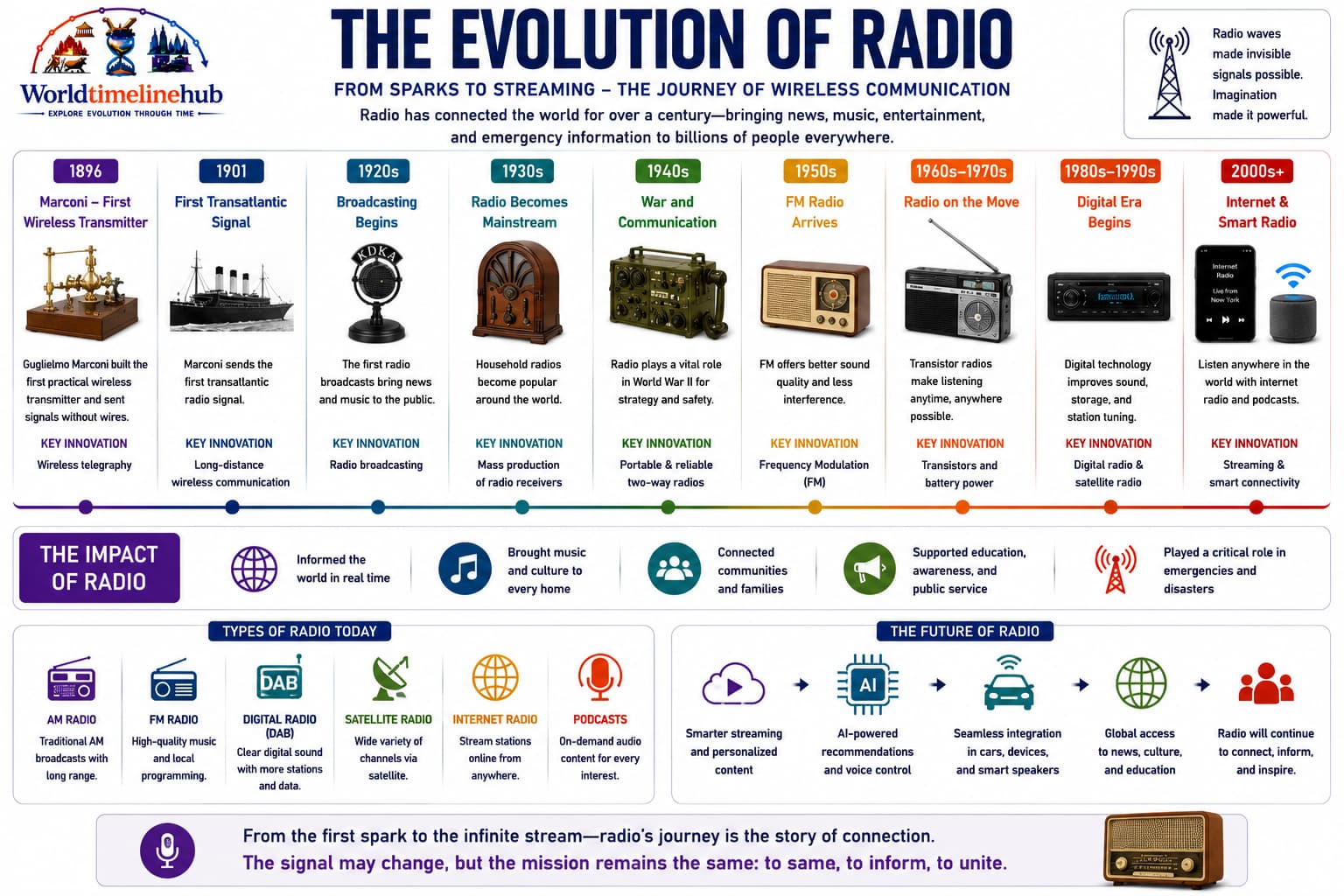
From spark-gap wireless telegraphy to FM stereo, transistor radios, digital broadcasting, podcasts, and
smart speakers — radio shaped news, music, culture, and emergency communication for more than a century.
This timeline traces how invisible electromagnetic waves became a mass medium, then split into AM talk, FM music, digital bands, and today’s algorithmic streams—still vital when the internet goes down.
1890s → PresentAM → FM → DigitalBroadcast → Streaming
Radio Invention
Radio grew from experiments in electromagnetic waves. Heinrich Hertz proved radio waves in the 1880s.
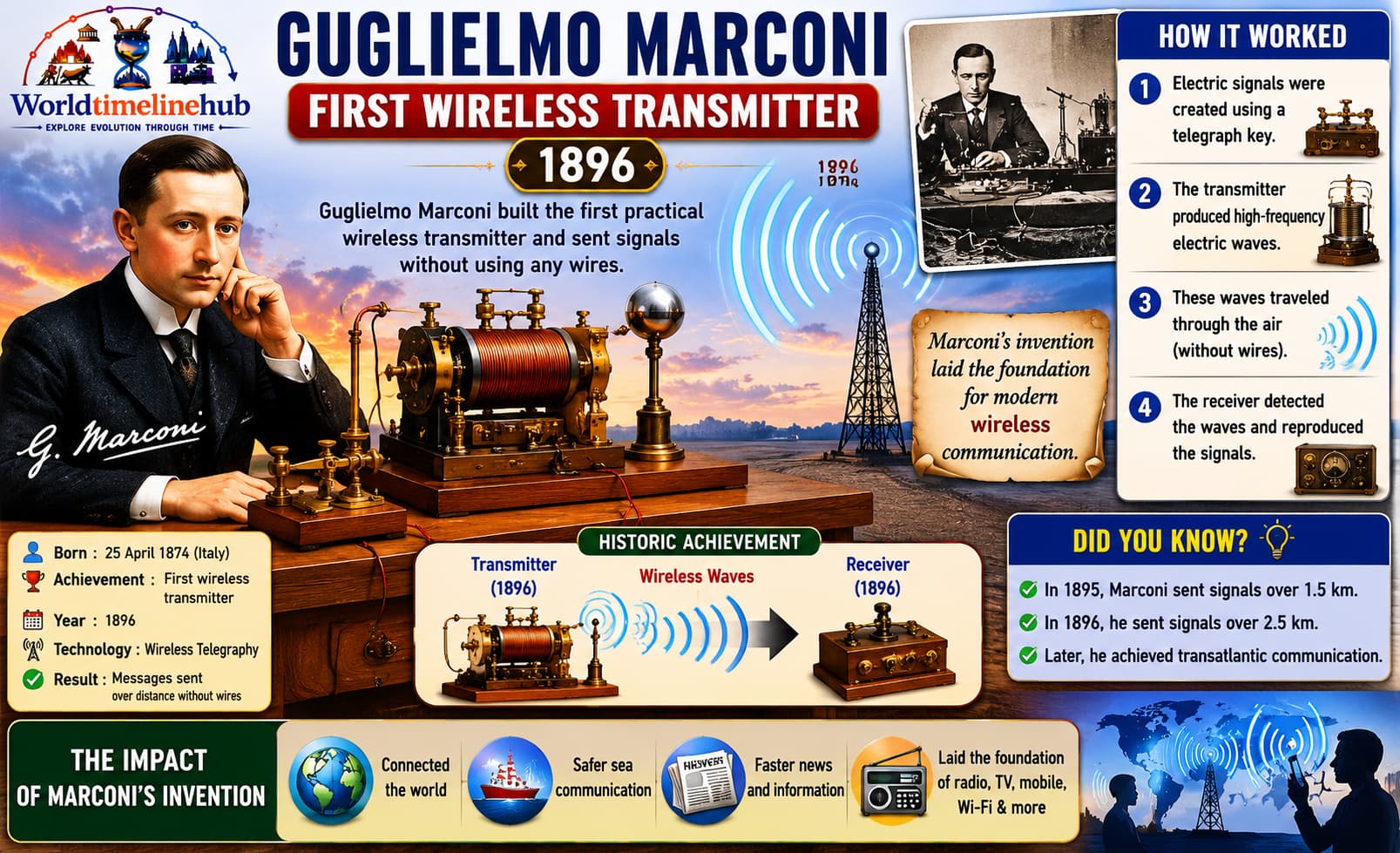
Guglielmo Marconi demonstrated long-distance wireless telegraphy in the 1890s. Reginald Fessenden made
early voice and music broadcasts around 1906. Edwin H. Armstrong later pioneered FM and superheterodyne
receivers that made modern broadcasting practical.
The era cards and reference tables below cover spark transmitters through smart speakers, plus how India’s public and private broadcasters fit into the global story.
Big picture
Radio evolution in one view
Radio began as coded wireless telegraph signals, became a mass medium for news and entertainment,
then diversified into FM music, portable sets, satellite and digital formats, and today’s on-demand
podcasts and streaming audio everywhere. The stats below anchor that arc to Marconi, licensed broadcasting, FM, and streaming.
Radio evolution: from spark-gap wireless and living-room consoles to FM stereo, podcasts, and smart speakers.
⚡ Wireless Begins1890s – 1920
Wireless Telegraphy and Spark Era
Before voices on the air, radio meant Morse code over the ether. Spark-gap transmitters and crystal sets proved that ships, armies, and eventually nations could communicate without wires—laying the foundation for broadcast culture.
Wireless telegraphy era: Marconi and spark-gap transmitters brought Morse over the air to ships and coast stations.
1895: Marconi sends wireless signals over increasing distances.
1901: First transatlantic wireless signal demonstration.
1906: Fessenden broadcasts voice and music on Christmas Eve.
World War I accelerates radio equipment for ships and military communication.
Technology Used
Spark-gap transmitters: High-voltage arcs generate damped radio waves.
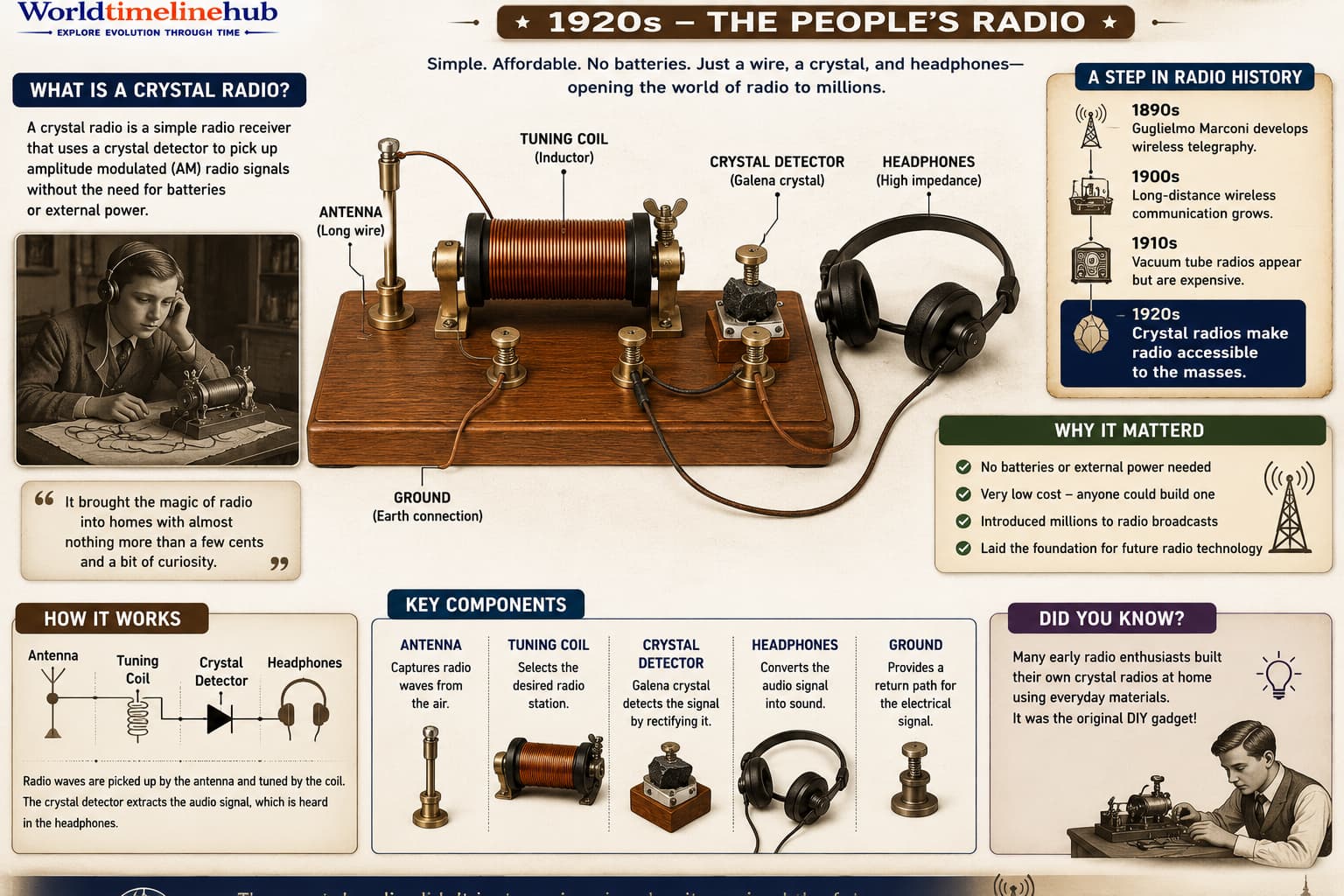
Crystal detectors: Simple receivers without vacuum tubes.
Morse code: Dots and dashes carry messages across oceans.
Features
Point-to-point links: Ship-to-shore and telegraph replacement.
Limited audio quality: Early voice experiments are rare and fragile.
Skilled operators: Trained users needed to send and receive code.
📻 Voices in the Home1920 – 1945
AM Radio Golden Age
Licensed AM stations turned radio into appointment listening at home. Networks linked cities, serial dramas and live news created shared national moments, and the living-room console became as central as television would be decades later.
AM golden age: licensed stations and console radios made broadcast news and entertainment a daily household ritual.
1920: KDKA (Pittsburgh) among the first licensed broadcast stations in the US.
Networks like NBC and CBS connect cities with shared programming.
Radio becomes the primary real-time news and entertainment medium before TV dominance.
Soap operas, serial dramas, sports, and live music define household listening.
Technology Used
AM modulation: Amplitude varies with audio on medium-wave bands.
Vacuum tubes: Amplify weak signals in home receivers.
Superheterodyne receivers: Armstrong’s design improves tuning and sensitivity.
Features
Scheduled programming: Families gather for evening shows.
National personalities: Orson Welles, Jack Benny, and news voices become famous.
Console radios: Large wooden cabinets as living-room furniture.
🎵 Clearer Sound1945 – 1970
FM Broadcasting and Post-War Expansion
After World War II, FM delivered hi-fi music and transistor portability reshaped who could listen where. Car radios, Top 40 formats, and shortwave international services expanded radio’s reach and genres.
FM offers lower noise and better music reproduction than AM.
Transistor radios shrink receivers and boost portability after the 1950s.
Car radios and drive-time formats grow with suburban commuting.
Shortwave and international broadcasting reach global audiences.
Technology Used
FM modulation: Frequency varies with audio; less static on music.
Transistors: Replace bulky tubes in portable and auto sets.
Printed circuit boards: Lower cost mass production.
Features
Hi-fi listening: Classical and pop stations emphasize sound quality.
Portable culture: Beach, park, and bedside radios everywhere.
Top 40 formats: Chart-driven music programming dominates youth radio.
🎧 Stereo Everywhere1970 – 1990
Stereo FM and Portable Audio Boom
Stereo multiplexing brought concert-hall width to FM; Walkman culture made audio personal; talk radio and drive-time blocks became advertising gold. Emergency alert systems on broadcast bands added a public-safety role beyond entertainment.
Stereo FM becomes standard for music stations.
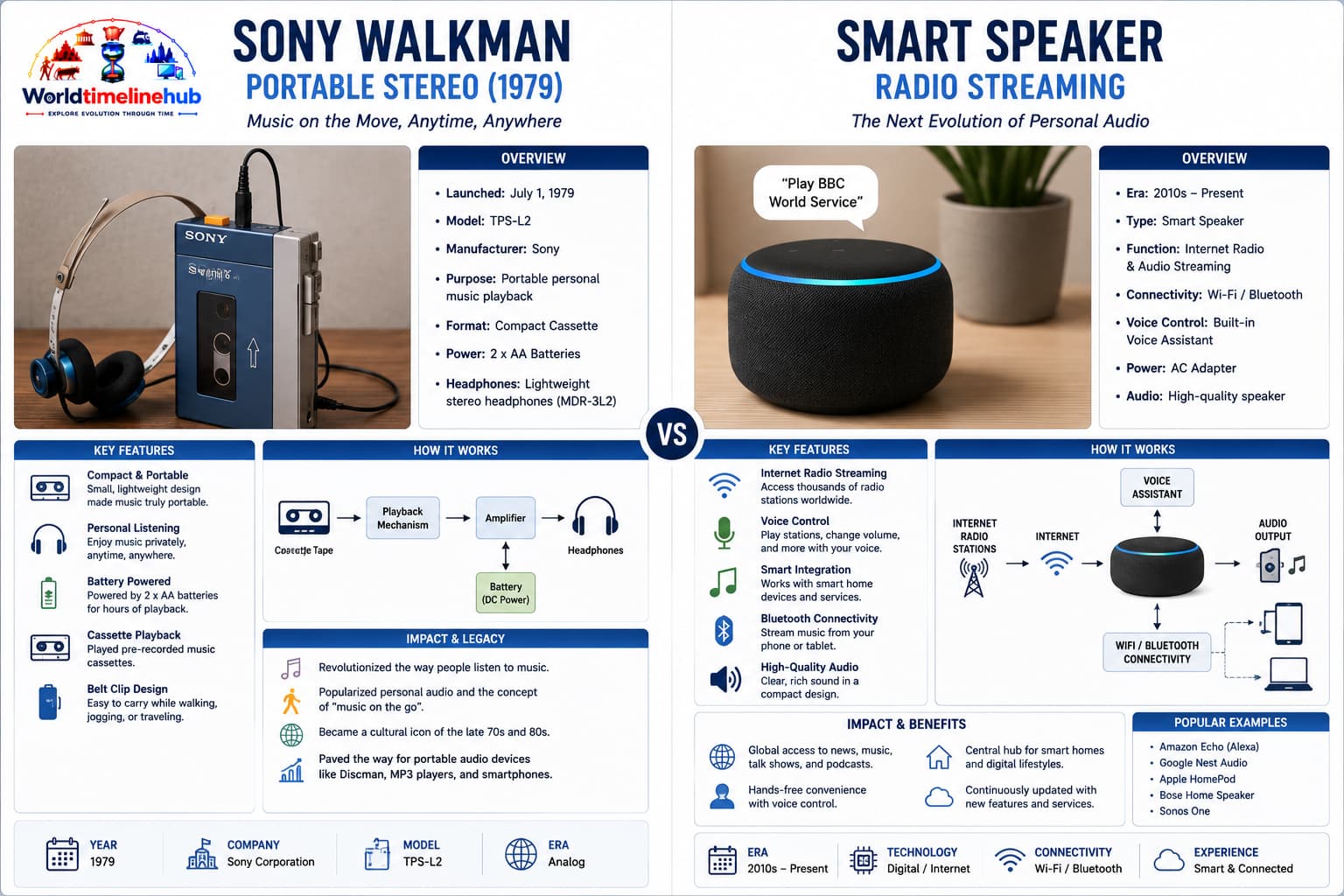
Walkman-style personal listening changes how people use radio and tapes.
Talk radio, news/talk formats, and niche community stations expand.
Satellite radio experiments and clearer car audio systems spread.
Technology Used
Stereo multiplexing: Left/right channels on one FM carrier.
PLL digital tuning: More stable station selection.
Cassette integration: Boomboxes combine radio with record/playback.
Features
Personal headphones: Private listening in public spaces.
Emergency alerts: EAS-style public warning systems on broadcast bands.
📡 Digital Airwaves1990 – 2015
Digital Radio and the Podcast Era
Digital transmission (DAB, HD Radio) and internet streams added metadata and efficiency; podcasts let anyone publish episodic audio on demand. Many listeners kept FM in the car while phones and PCs took over discovery and binge listening.
Digital and podcast era: DAB/HD Radio, internet streams, and phones turned radio into on-demand audio anywhere.
Digital Audio Broadcasting (DAB) and HD Radio improve efficiency and metadata.
Internet radio streams bypass traditional geographic license limits.
Podcasts (term popularized ~2004) bring on-demand spoken audio to mass audiences.
Satellite radio (e.g. SiriusXM) offers national subscription channels.
Technology Used
Compressed digital audio: MP3, AAC, and later codecs for streaming.
RSS enclosures: Subscribe and auto-download episodic shows.
Software tuners: PC and phone apps replace standalone receivers for many users.
Features
On-demand episodes: Pause, rewind, and binge educational series.
Global niche audiences: Small creators reach listeners worldwide.
Hybrid listening: FM in the car, streams and podcasts at home.
🔊 Smart Audio Future2015 – Present
Streaming, Smart Speakers, and the Future of Radio
Music apps, voice-controlled smart speakers, and creator tools blur the line between “radio station” and personalized feed. Broadcast towers still matter for local news and emergencies, but algorithms and global catalogs define daily listening for many people.
Spotify, Apple Music, YouTube Music, and regional apps compete with broadcast.
Smart speakers (Alexa, Google, Siri) make voice-controlled radio routine.
Podcast networks, audiobooks, and live social audio blur format boundaries.
5G and low-latency codecs enable higher-quality mobile listening.
Technology Used
Adaptive streaming: Bitrate adjusts to network conditions.
Voice assistants: Natural-language station and playlist requests.
IP + broadcast hybrids: FM/DAB chips plus Wi‑Fi/cellular fallbacks in cars.
Features
Algorithmic discovery: Personalized stations and recommendations.
Creator tools: Anyone can publish from a phone or laptop.
Ambient audio: Background listening during work, travel, and smart homes.
Radio Timeline Summary
Major turning points from wireless telegraphy to streaming audio—each row ties a decade to the dominant radio style and why it mattered for news, music, emergencies, and who could listen where. Use this table as a map before the key events, firsts, frequency bands, pioneers, and India spotlight sections below.
Year / Era
Milestone
Why it matters
1880s
Hertz proves electromagnetic radio waves
Established that invisible waves could carry energy—the scientific basis for all later wireless telegraphy and broadcasting.
1895
Marconi wireless telegraphy
Turned lab experiments into practical ship-to-shore and long-distance Morse links, launching the wireless industry.
1906
Fessenden voice/music broadcast experiment
Showed radio could carry speech and music, not only dots and dashes—previewing entertainment broadcasting.
1920
Licensed AM broadcasting era begins
Regulated stations and sponsored programs made radio a household medium for news, sports, and serial drama.
1933
Armstrong patents FM
Frequency modulation delivered cleaner audio for music and laid groundwork for stereo FM decades later.
1950s
Transistor radios go mainstream
Pocket sets made listening personal—youth culture, travel, and battery-powered news anywhere.
1960s
Stereo FM adoption
Multiplex stereo widened the soundstage; FM became the default band for hi-fi music radio.
1990s–2000s
Digital radio + internet streams
DAB/HD Radio and web streams added metadata and global reach beyond tower coverage maps.
2000s+
Podcast boom
On-demand episodic audio let creators bypass gatekeepers; RSS and apps turned phones into personal radio networks.
2010s+
Smart speakers and music streaming
Voice assistants and subscription catalogs compete with FM while broadcast still anchors local alerts and drive-time listening.
Key Radio Historical Events
Beyond the main era cards, these milestones shaped how radio moved from laboratory waves to licensed broadcasting, FM stereo, portable sets, and on-demand podcasts. Each row highlights a turning point—scientific proof, maritime safety, or a product that still influences how we listen today.
Event
Year
Significance
Hertz proves radio waves
1886–88
Foundation of electromagnetic wireless theory—confirmed that energy could radiate through space without wires.
Marconi’s first wireless patent
1896
Practical wireless telegraphy—turned experiments into a commercial and military communications industry.
First transatlantic wireless signal
1901
Radio signals cross the ocean for the first time—proved long-range wireless was not limited to coastal links.
Fessenden voice broadcast
1906
First AM voice and music transmission—showed broadcast entertainment was possible, not only Morse code.
Titanic distress calls
1912
Radio proves maritime safety value—led to stronger ship-radio requirements and international wireless rules.
First licensed US station (KDKA)
1920
Commercial broadcasting begins—scheduled programmes and advertising models spread worldwide.
Armstrong patents FM
1933
Static-free, high-fidelity sound—FM became the preferred band for music and later stereo multiplexing.
First transistor radio (Regency TR-1)
1954
Portable radio revolution—pocket listening reshaped youth culture, travel, and sports away from home.
FM stereo broadcasting begins
1961
High-quality music on FM—stereo multiplexing widened the soundstage for concerts and albums on air.
First podcast (Dave Winer)
2003
On-demand audio era begins—RSS enclosures let anyone publish episodic shows outside broadcast schedules.
Radio “Firsts” at a Glance
Landmark “first” achievements in wireless signaling, broadcasting, advertising, FM, portability, and on-demand audio. When you hear a station ID, jingle, or podcast feed, it often traces back to one of these pioneering moments.
First
Year
Achievement
First wireless transmission
1895
Marconi (brief distance)
First transatlantic signal
1901
Marconi (Poldhu to Newfoundland)
First voice broadcast
1906
Reginald Fessenden (Christmas Eve)
First licensed broadcast station
1920
KDKA Pittsburgh
First radio commercial
1922
WEAF New York (real estate ad)
First FM station
1939
W2XMN (Armstrong experimental)
First transistor radio
1954
Regency TR-1
First portable radio with headset
1979
Sony Walkman
First podcast
2003
Dave Winer’s “Morning Coffee Notes”
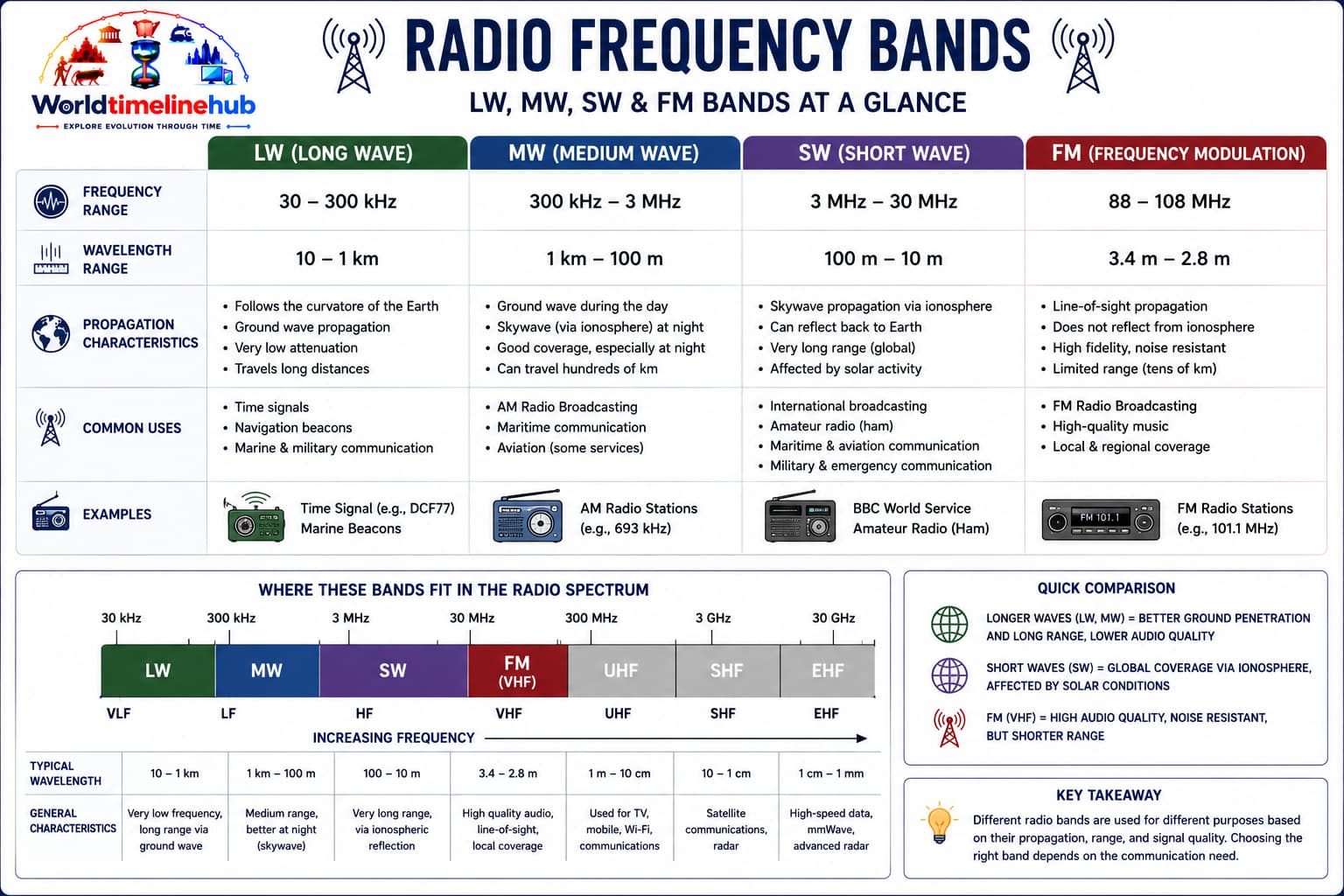
Radio Frequency Bands (LW, MW, SW, VHF)
Different radio services use different frequency ranges based on coverage, noise behavior, and bandwidth needs. Long waves hug the ground; short waves bounce off the ionosphere; VHF FM favors local music with less hiss than AM. Understanding bands explains why you hear foreign stations at night on MW but not on your car’s FM dial.
Frequency bands: LW, MW (AM), SW, and VHF FM each trade reach, noise, and bandwidth for different services.
Band
Approx. Range
Typical Use
Characteristics
LW
~150-285 kHz
Long-range broadcasting in some regions
Ground-wave coverage over large distances; fewer modern services.
MW (AM)
~530-1700 kHz
News, talk, sports, regional AM stations
Long reach, especially at night; more susceptible to noise.
Cleaner audio and stereo quality, usually line-of-sight coverage.
Key Pioneers and Contributors
Radio’s history spans many inventors, engineers, and broadcasters—from proving waves exist to making receivers sensitive enough for millions of listeners. No single name owns “radio,” but these figures connect laboratory physics to the stations and apps you use today.
Heinrich Hertz: Demonstrated electromagnetic waves experimentally (1880s)—confirmed Maxwell’s theory and gave the unit of frequency his name.
Guglielmo Marconi: Practical wireless telegraphy and long-distance signaling; commercialized ship-to-shore and transatlantic links.
Nikola Tesla: Key work on wireless energy, resonant circuits, and high-frequency apparatus that influenced early RF engineering.
Reginald Fessenden: Early amplitude-modulated voice and music broadcasts around 1906—bridge from Morse to entertainment radio.
Edwin H. Armstrong: FM radio and the superheterodyne receiver—two inventions that still define how tuners work worldwide.
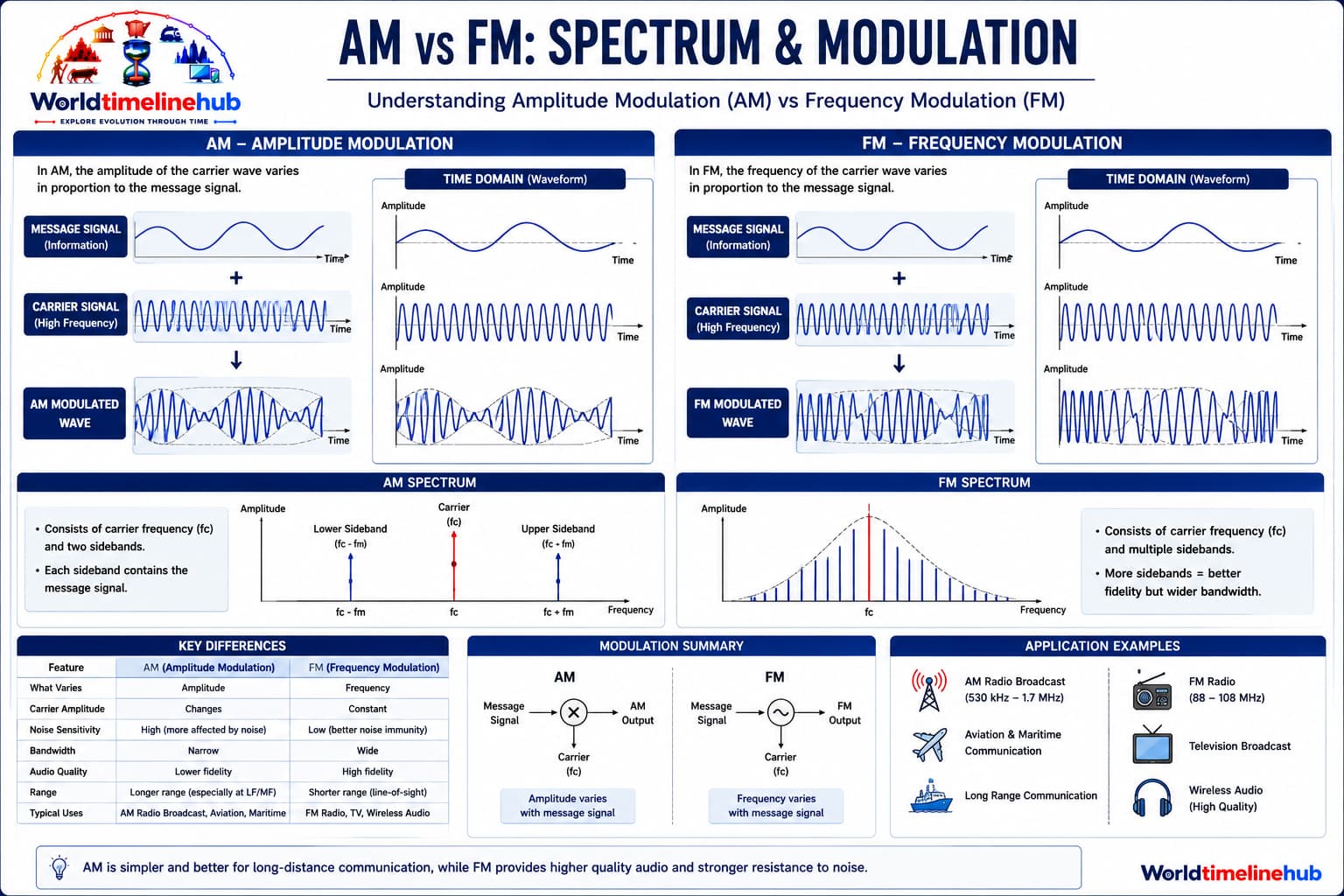
AM vs FM: Why Both Matter
AM and FM are not rivals so much as complementary tools. AM’s longer reach and simpler receivers keep talk, news, and emergency alerts viable; FM’s resistance to static made it the music band. Many countries still license both because audiences and advertisers want different strengths.
AM and FM: amplitude modulation for reach and talk; frequency modulation for cleaner music on local bands.
Aspect
AM
FM
Modulation
Amplitude varies with signal
Frequency varies with signal
Typical use
Talk, news, long-distance at night
Music, hi-fi local stations
Noise
More interference on weak signals
Generally cleaner for music
Reach
Can travel farther (especially at night)
More localized coverage
Internet Radio vs Traditional Radio
Terrestrial towers and internet streams both deliver audio, but they optimize for different situations. FM still wins in the car with no data plan; streaming wins for niche genres and global stations. During outages, battery radios often remain the last link for public warnings.
Factor
Traditional Radio (AM/FM)
Internet Radio
Coverage
Strong for local/regional audiences
Global reach where internet is available
Latency
Very low delay for live events
Usually delayed by buffering and network path
Reliability in disasters
Often resilient with battery receivers
Depends on power, ISP, and data network availability
Content style
Local news, traffic, regional language relevance
Niche global stations, podcasts, personalized streams
Data cost
No data plan required
Requires internet data or broadband subscription
Radio Receiver Evolution
Receiver technology evolved from passive circuits to flexible software-based systems. Each generation traded size, power, and sensitivity—from one-earphone crystal sets to car stereos with digital PLL tuning and laptop SDR dongles that decode dozens of modes in software.
Crystal radio: Passive diode detector sets with no batteries—proved anyone could hear broadcasts with wire, a crystal, and headphones.
Tube radio: Vacuum-tube amplification improved sensitivity and loudspeaker output for living-room consoles and wartime news.
Transistor radio: Smaller, lower-power portable receivers became affordable worldwide; the TR-1 era made radio truly pocket-sized.
Digital tuner: PLL and DSP-based tuning improved stability, presets, and RDS station names on car and bedside radios.
SDR receiver: RF front-end plus software demodulation enables many modes on one device—from FM to digital voice and spectrum plots.
Transistor Radio Revolution
The transistor shrank radios from furniture to pocket companions. Lower voltage and heat meant AA batteries could power hours of listening—changing where people heard ballgames, pop hits, and election night results.
1947: Bell Labs invents the transistor—solid-state amplification replaces fragile vacuum tubes in many circuits.
1954: Regency TR-1 among the first pocket transistor radios sold in the US; Japanese makers soon dominated affordable portables.
Portable radios made music and news personal—youth culture, beach listening, sports away from home, and travel companions before the Walkman.
Software-Defined Radio (SDR)
Software-defined radio (SDR) shifts signal processing from dedicated hardware into software. With low-cost USB dongles and open-source tools,
hobbyists can monitor spectrum, decode digital modes, and learn modern RF concepts on a laptop—the same flexibility that professional labs use for prototyping, at student-budget prices.
Low entry cost: Affordable RTL-SDR style dongles make experimentation easy.
Multi-mode flexibility: AM/FM, digital voice, weather, ADS-B, and spectrum visualization.
Education and research: Useful for students, amateur operators, and signal analysis practice.
Amateur (Ham) Radio
Amateur radio is a licensed hobby where operators build skills in antennas, propagation, and etiquette on reserved bands. Hams pioneered many techniques later used in broadcast and mobile networks, and still provide backup links when storms or earthquakes knock out commercial infrastructure.
Licensed hobbyists experiment on allocated bands with voice, Morse code (CW), and digital packet modes after passing exams.
Ham operators often assist during disasters when cellular towers overload—relaying health-and-welfare messages and coordinating relief.
Modern hams use software-defined radio (SDR), moonbounce, and amateur satellites for worldwide contacts beyond line of sight.
Emergency Alert Systems (EAS)
Emergency Alert Systems (EAS) and similar schemes use broadcast radio’s one-to-many reach to break into normal programming with urgent tones and messages. Because towers cover whole regions and receivers need no login, radio remains one of the fastest ways to warn populations during hurricanes, earthquakes, and civil emergencies.
Public warnings: Weather alerts, disaster advisories, evacuation notices, and civil emergency messages interrupt all participating stations at once.
AMBER alerts: Broadcasters can quickly interrupt regular programming for child-abduction alerts, reaching drivers and households immediately.
Resilience: Battery-powered receivers often work when mobile data and internet are disrupted; crank and solar radios extend that advantage off-grid.
Radio Spectrum Allocation and Regulation
Radio frequencies are limited public resources—only so many signals can occupy the spectrum without drowning each other out. Regulators allocate bands to avoid interference and protect aviation, maritime, military, mobile, Wi-Fi, and broadcast services. Licensing also funds enforcement against pirate transmitters and illegal jammers.
ITU (global): Coordinates international spectrum frameworks and cross-border harmonization.
FCC (United States): Licenses and regulates US spectrum use, including AM/FM broadcasting.
Why it matters: Proper allocation reduces interference and enables safe aviation, maritime, emergency, and broadcast operation.
Satellite Radio (SiriusXM and Similar Models)
Satellite radio uses space-based repeaters and terrestrial gap-fillers to deliver wide-area subscription audio services,
especially in cars and long-distance travel contexts where FM station lists change every few miles. The model trades local news for national channel brands and premium sports rights behind a monthly fee.
Coverage model: National footprint with fewer local dead zones on major travel routes.
Content model: Curated ad-light music channels, live sports rights, talk shows, and exclusive hosts.
Subscriber scale: SiriusXM has historically served tens of millions of subscribers in North America.
Technical difference: Distinct from terrestrial AM/FM towers, with satellite delivery plus rebroadcast infrastructure.
India spotlight
Indian radio evolution
India’s radio story spans colonial broadcasting, All India Radio’s public service role, commercial FM
expansion, and today’s digital streams and podcasts in many languages. From Bombay’s first licensed stations to smartphone apps, radio remained a low-cost way to reach villages, cities, and diaspora audiences alike.
1927
Indian Broadcasting Company
Early licensed broadcasting begins in Bombay and Calcutta under colonial-era rules—proving that scheduled audio programming could serve urban elites before AIR unified national policy.
1936
All India Radio (AIR)
State broadcaster becomes the backbone of national radio, carrying news, classical music, rural programmes, and independence-era voices into millions of homes.
1957
Vividh Bharati
Popular film music and entertainment service reaches mass audiences on medium wave—making Bollywood songs and sponsored shows part of daily life.
1990s+
Private FM growth
City-centric music, talk, and regional language stations expand after licensing reforms; brands compete on RJs, contests, and local traffic news.
2010s+
Digital & podcasts
Apps, streaming, and podcast creators complement traditional broadcast—Hindi, English, and regional shows on demand alongside FM in the car.
Private FM brands: Radio Mirchi, Red FM, Radio City, Big FM, and Fever FM built city-focused formats with film music, celebrity interviews, and hyperlocal advertising.
Community radio: Universities, NGOs, and local groups operate hyperlocal language services for farming tips, health campaigns, and women’s programmes where commercial FM rarely reaches.
Digital initiatives: Prasar Bharati News Services and station apps expanded accessibility on smartphones, letting listeners catch news bulletins and archived shows outside live broadcast hours.
Radio Advertising History
Radio was among the first mass media sold by the minute. Sponsors underwrote entire programmes before spot advertising became standard; catchy jingles and daily serials (“soap operas”) turned brands into household names. Today, broadcast spots coexist with host-read podcast ads and targeted streaming audio.
1922: Early sponsored programs and spot ads on US stations prove that free-to-air listening can be funded by advertisers.
“Soap operas” and jingles build brand loyalty through daily serial listening—housewives became a prized demographic for consumer goods.
Today, radio ads blend broadcast reach with digital attribution on streaming platforms, dynamic ad insertion, and coupon codes read on air.
Test Your Knowledge
20 quick questions from the radio timeline—eras, tables, India spotlight, and reference sections. Click each question to reveal the answer and check what you remember about Marconi, AM/FM, transistors, AIR, podcasts, and smart speakers.
Answer: Guglielmo Marconi.
Answer: Electromagnetic radio waves.
Answer: Reginald Fessenden.
Answer: Amplitude Modulation.
Answer: KDKA.
Answer: Edwin H. Armstrong.
Answer: Transistors.
Answer: Frequency Modulation.
Answer: All India Radio (AIR).
Answer: Vividh Bharati.
Answer: Ham (amateur) radio equipment.
Answer: The transistor (Bell Labs).
Answer: FM.
Answer: Podcasts (often via RSS feeds).
Answer: DAB (Digital Audio Broadcasting) or HD Radio.
Answer: Spark-gap transmitters.
Answer: Superheterodyne receiver.
Answer: Voice assistants (e.g. Alexa, Google Assistant, Siri).
Answer: Marconi’s transatlantic wireless signal.
Answer: Hybrid broadcast plus on-demand streaming and smart audio everywhere.
Classroom activity
Students Tasks
Use these 10 prompts for group discussion, homework, or short classroom presentations. Each task ties to a section on this page—wireless origins, AM/FM comparison, Indian broadcasting, emergencies, and the shift to streaming. Encourage students to cite dates and inventors from the timeline tables.
Jump to any other technology timeline on WorldTimelineHub.
Disclaimer: This content is AI-generated for educational purposes and may contain errors or outdated details. For correct and authoritative information, please refer to official and reliable sources such as government publications, manufacturers, museums, and academic references.