From Gutenberg’s movable-type press to office laser printers, home inkjets, multifunction devices, and
cloud-connected 3D fabrication — printing turned ideas into mass communication, then into everyday personal output.
1450s → PresentPress → 3DLaser + inkjet
Printing Invention
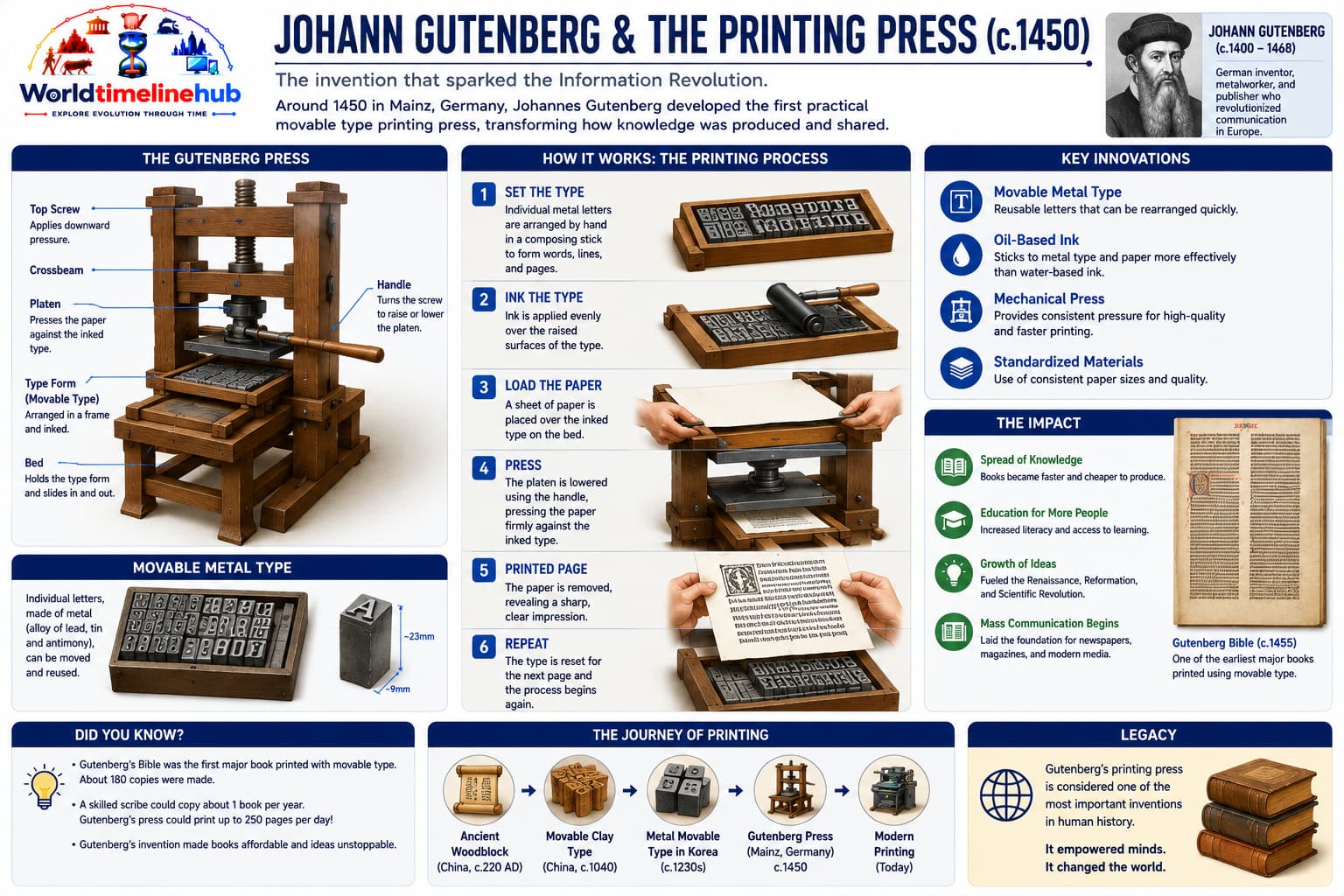
Printing began as a way to duplicate text and images faster than scribes could write by hand. Johannes
Gutenberg’s movable metal type (~1450) made books reproducible at scale. Centuries later, industrial
presses and computer printers brought the same idea to newspapers, offices, homes, and factories.
Big picture
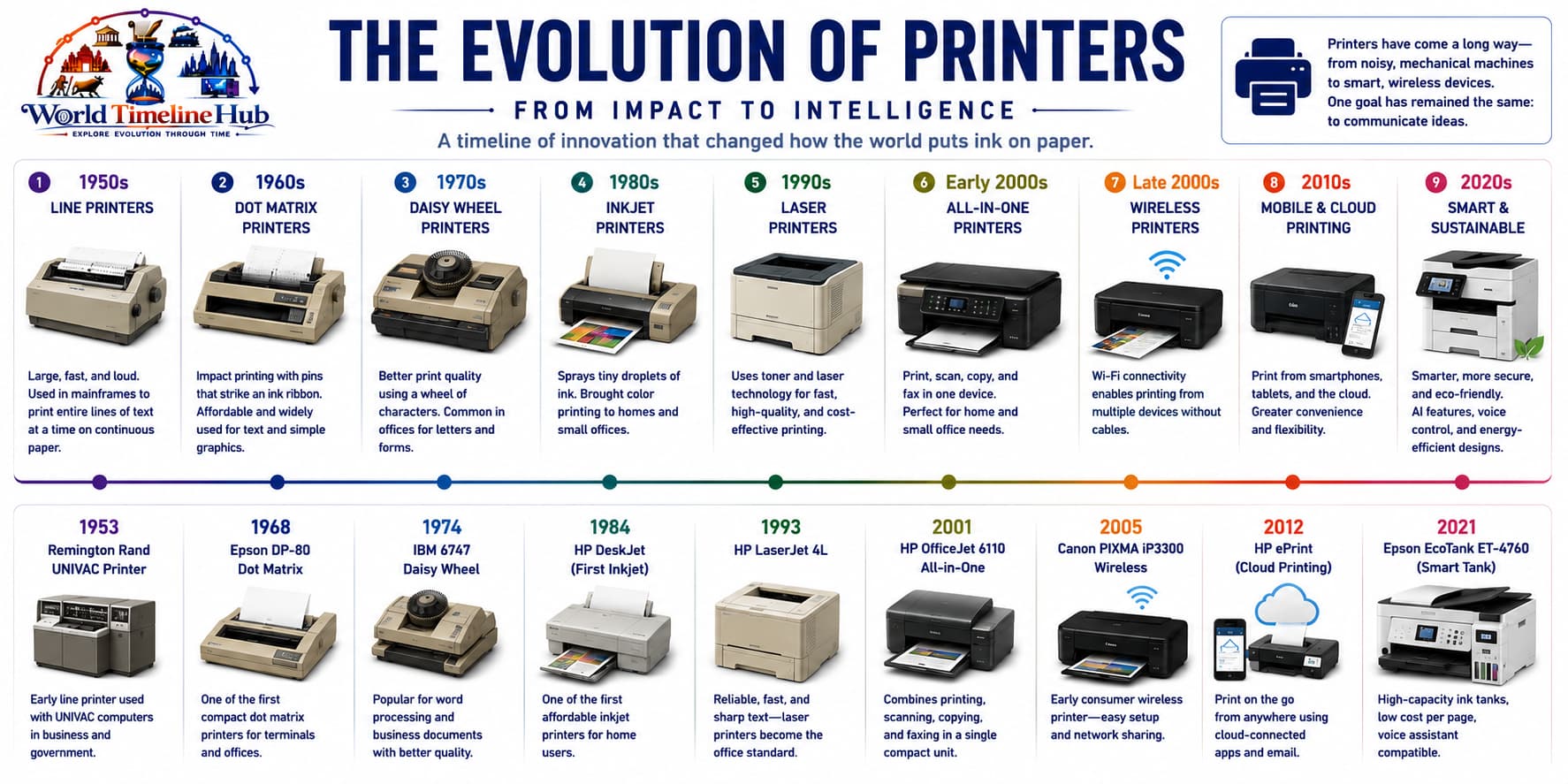
Printer evolution in one view
Mechanical presses spread literacy; impact printers linked paper to early computers; laser and
inkjet brought quality to desks; multifunction devices merged scan and copy; today’s cloud and 3D
systems extend “printing” beyond flat pages.
Mobile printing: Phones print homework and tickets without cables.
🧊 Beyond Paper2016 – Present
Cloud Print & 3D Fabrication
AirPrint, Mopria, and vendor apps make wireless printing default on phones.
3D printers (FDM, SLA) build objects layer by layer for prototypes and tools.
Subscription ink tank printers and managed print services change cost models.
Technology Used
Cloud job queues: PDF rendering on device, sent over HTTPS.
FDM/SLA 3D: Filament extrusion or resin curing per layer.
High-capacity ink tanks: Refill bottles vs small cartridges.
Features
Print from anywhere: Email-to-print and remote office release.
Rapid prototyping: Designers test parts in hours.
Hybrid future: Flat documents plus volumetric fabrication coexist.
Printer Timeline Summary
Major turning points from the printing press to cloud and 3D output—use this table as a quick map before the detailed events, laser and inkjet timelines, and comparisons below.
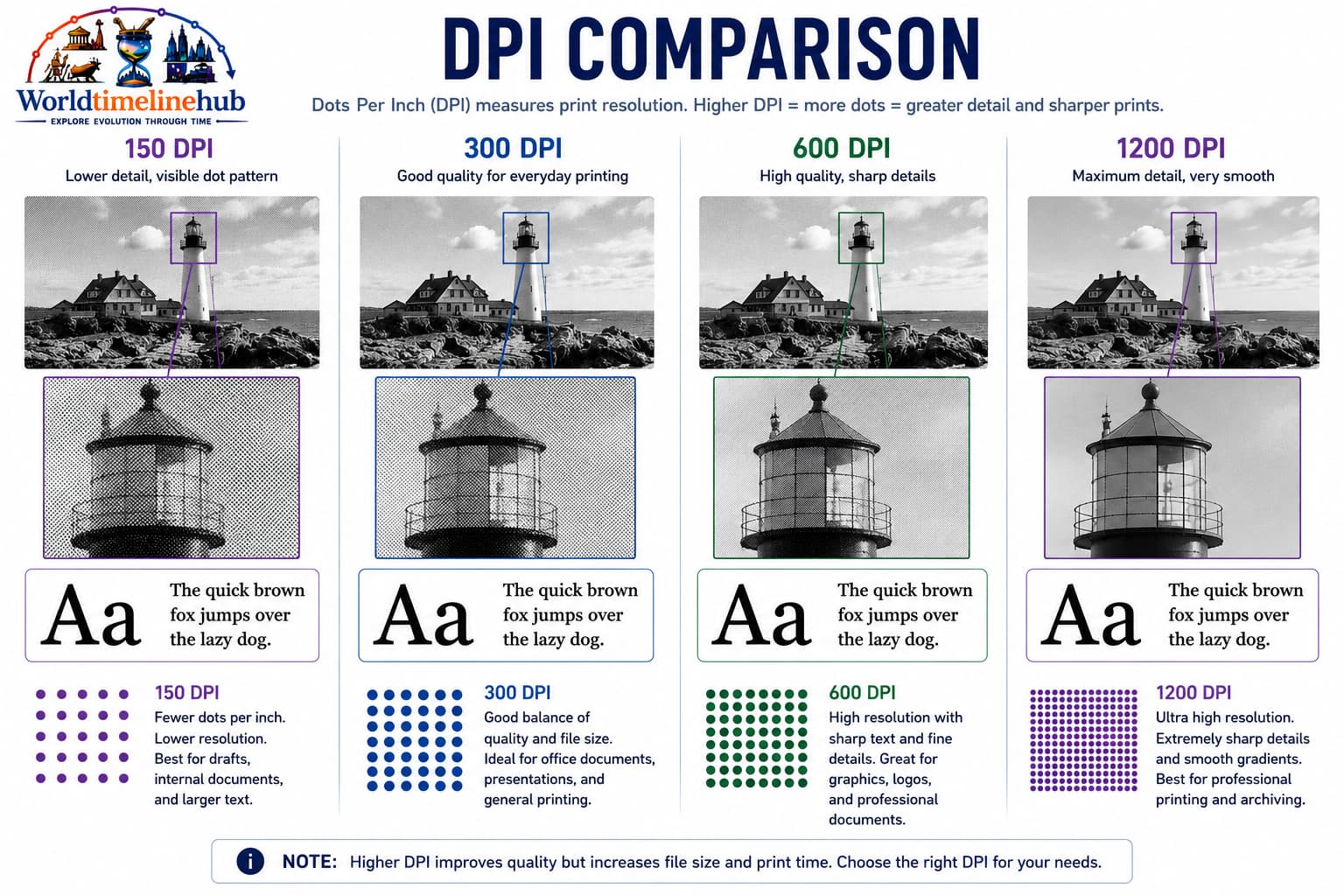
Print DPI compared: how resolution and sharpness differ across printer technologies and eras.
Year / Era
Milestone
~1450
Gutenberg movable-type press
1843
Rotary press accelerates newspapers
1960s–70s
Dot matrix and daisy wheel computer printers
1984
HP LaserJet — office laser mainstream
1988
HP DeskJet — home inkjet era
2000s
Multifunction print/scan/copy devices
2010s+
Wireless and cloud printing
2020s
3D printing and tank-style ink systems
Key Printing Historical Events
Beyond the main era cards, these milestones shaped how text and images moved from hand-set type to office lasers, home inkjets, and affordable 3D fabrication.
Event
Year
Why it matters
Gutenberg Bible printed
1454–55
First mass-produced book in Europe
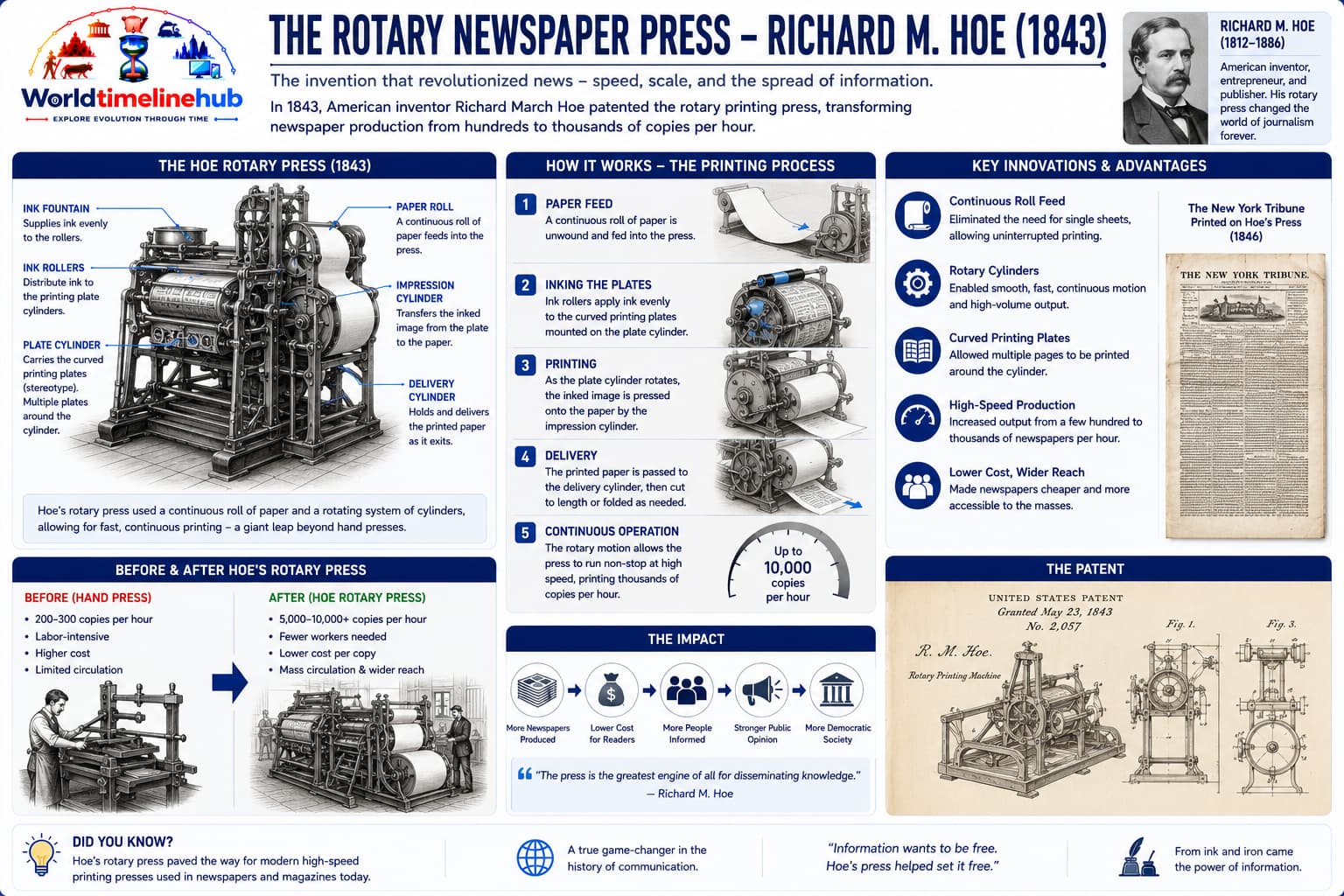
Rotary press patent
1843
Richard Hoe — high-speed newspaper printing
First dot matrix printer
1968
Epson EP-101 (predecessor to legendary line)
First laser printer (Xerox PARC)
1971
Gary Starkweather’s invention
Xerox 9700 laser printer
1977
First commercial laser printer (~$350k)
HP LaserJet
1984
First desktop laser printer ($3,500)
Chuck Hull files 3D printing patent
1984
Stereolithography (SLA) — foundation of 3D
HP DeskJet
1988
Popularized home inkjet printing
First consumer 3D printer (RepRap)
2008
Open-source self-replicating 3D printer
First tank/refillable printer
2015+
Epson EcoTank, Canon MegaTank
Printer “Firsts” at a Glance
Quick reference for landmark “first” achievements in printing hardware, color output, connectivity, and additive manufacturing.
First
Year
Achievement
First movable type printing in Europe
~1450
Johannes Gutenberg
First rotary press
1843
Richard Hoe
First dot matrix printer
1968
Epson EP-101
First laser printer (lab)
1971
Xerox PARC (Starkweather)
First color laser printer
1993
Xerox Majestik Color Series
First photo inkjet printer
1994
Epson Stylus Color (color inkjet)
First all-in-one printer
1990s
Scan/copy/print combination
First Wi-Fi printer
2000s
No cable needed
First sub-$100 3D printer
2010s
Monoprice, Creality
Laser Printer Evolution
From room-sized Xerox machines to sub-$200 home lasers—how resolution, speed, and price changed the office print market.
Model/Era
Year
Resolution
Speed (ppm)
Price (new)
Xerox 9700
1977
300 DPI
120 ppm
~$350,000
HP LaserJet
1984
300 DPI
8 ppm
$3,500
Apple LaserWriter
1985
300 DPI
8 ppm
$7,000
HP LaserJet 4
1992
600 DPI
8–16 ppm
~$1,500
HP LaserJet 1200
2000
1200 DPI
15 ppm
~$300
Consumer laser printers
2010s
600–1200 DPI
20–30 ppm
$100–200
Inkjet Printer Evolution
Inkjet moved from lab thermal prototypes to color photo printers and refillable tank systems that cut per-page ink cost for homes and small offices.
Model/Era
Year
Technology
Color
Price (new)
HP ThinkJet
1984
Thermal inkjet
Black only
~$500
HP DeskJet
1988
Thermal inkjet
Black only
$1,000
Epson Stylus Color
1994
Piezoelectric
Color
~$600
HP DeskJet (home)
1990s
Thermal
Color
$200–300
Photo printers (6+ colors)
2000s
Dye-based inks
Photo quality
$100–300
Tank printers (EcoTank)
2015+
Refillable bottles
Color
$200–400
3D Printing Technologies Compared
Additive manufacturing uses different materials and energy sources—from hobby FDM filament to metal powder sintering for aerospace parts.
Technology
Full Name
Material
Resolution
Typical Use
FDM
Fused Deposition Modeling
PLA, ABS, PETG
0.1–0.4 mm
Prototypes, hobby
SLA
Stereolithography
Resin
25–100 microns
Jewelry, dental, miniatures
SLS
Selective Laser Sintering
Nylon powder
80–120 microns
Functional parts
DMLS
Direct Metal Laser Sintering
Metal powder
30–50 microns
Aerospace, medical implants
PolyJet
Photopolymer jetting
Liquid resin
16–30 microns
Multi-material, full color
Print Speed & Resolution Evolution
How fast printers run and how sharp they look changed by technology—from characters-per-second impact machines to high-DPI inkjets marketed for photos.
Printer Type
Era
Typical Speed
Typical DPI
Dot matrix
1970s–80s
50–200 cps
72–144 DPI
Daisy wheel
1970s–80s
10–40 cps
Letter quality (not dots)
Early laser
1980s
4–8 ppm
300 DPI
1990s laser
1990s
12–20 ppm
600–1200 DPI
Modern laser
2020s
25–70 ppm
600–2400 DPI
Early inkjet
1980s–90s
1–4 ppm
300–720 DPI
Modern inkjet
2020s
10–20 ppm
1200–9600 DPI
Printer Glossary
Terms common in printer specs, driver settings, and 3D printing forums when comparing speed, quality, and running costs.
Term
Definition
DPI (Dots Per Inch)
Print resolution — higher DPI = sharper detail
PPM (Pages Per Minute)
Print speed — pages printed per minute
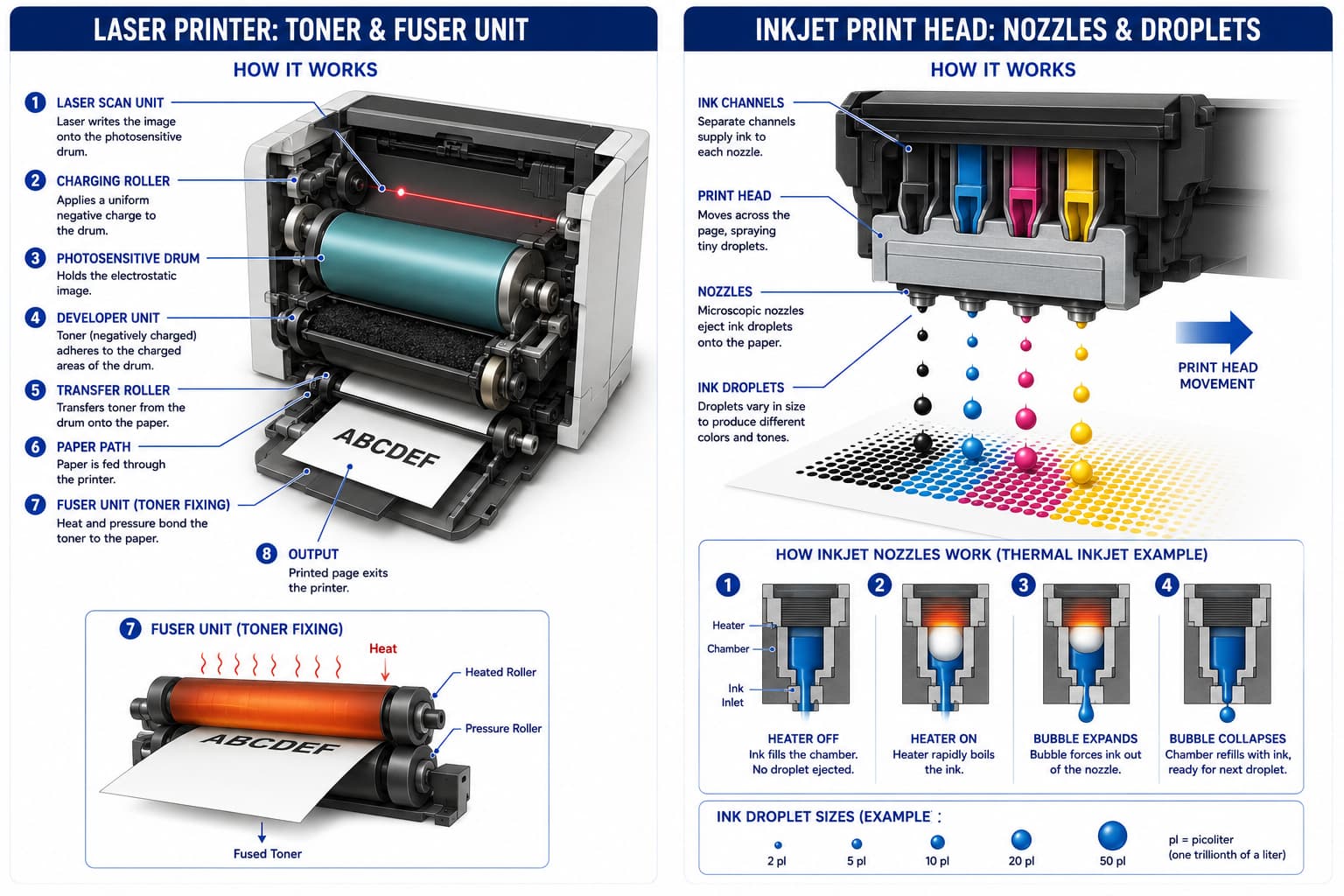
Toner
Plastic powder fused by heat in laser printers
Thermal inkjet
Bubbles created by heating ink, ejecting droplets
Piezoelectric
Voltage applied to crystal to eject ink (Epson)
FDM
Extrudes melted plastic filament to build objects
SLA
Resin cured by UV laser layer by layer
Duplex printing
Printing on both sides of paper
Key Printing Pioneers
Johannes Gutenberg: Movable-type press in Europe (~1450).
Richard Hoe: Rotary press patent (1843) for high-speed newspapers.
Gary Starkweather: Laser printer concept at Xerox PARC (1971).
HP LaserJet team: Mainstream office laser printing (1984).
Chuck Hull: Stereolithography (1984) — foundation of 3D printing.
Printer Types at a Glance
Type
Technology
Typical use
Letterpress / offset
Raised type or plates
Books, newspapers, packaging
Dot matrix
Impact pins + ribbon
Receipts, forms, early PC output
Laser
Toner + laser drum
Office documents, high volume
Inkjet
Liquid ink droplets
Home photos, color graphics
3D printer
Layered material
Prototypes, tools, medical models
Impact vs Non-Impact vs Additive
Category
Examples
How marks are made
Impact
Dot matrix, daisy wheel
Strike through ribbon onto paper
Non-impact
Laser, inkjet, thermal
Toner, ink, or heat — no hammer
Mechanical press
Gutenberg, rotary, offset
Ink transferred under pressure
Additive (3D)
FDM, SLA
Material deposited layer by layer
India spotlight
Printing in India
India’s print story spans colonial presses, regional-language publishing, street-side Xerox shops,
cybercafé printouts, and today’s home inkjets plus commercial offset for books and packaging.
1800s
Mission & colonial presses
Early presses print gazettes and books in English and regional languages.
1990s
Cybercafé printouts
Dot matrix and inkjet printers serve forms, résumés, and train tickets by the page.
2000s
Xerox & DTP lanes
Neighborhood shops offer copy, lamination, and color laser for weddings and exams.
2010s+
Mobile-first documents
UPI receipts and e-docs reduce printing, but offices still rely on networked MFPs.
Printer Market Shifts
1980s: PC bundles and office laser adoption drive printer sales.
2000s: All-in-one devices target homes and small businesses.
2010s: Smartphone printing and cloud queues reduce cable dependency.
2020s: Tank printers, 3D makers, and “print less” digital habits reshape the market.
Test Your Knowledge
20 quick questions from the printer timeline. Click each question to reveal the answer.
Answer: Johannes Gutenberg.
Answer: Rotary press (Richard Hoe).
Answer: A grid of impact pins striking a ribbon.
Answer: A raised character on a rotating wheel, struck through ribbon.
Answer: Toner (plastic powder).
Answer: HP DeskJet.
Answer: Black (Key).
Answer: Multifunction Printer.
Answer: AirPrint.
Answer: Layer by layer (additive manufacturing).
Answer: Impact printer (e.g., dot matrix).
Answer: A rubber blanket.
Answer: Non-impact.
Answer: Chuck Hull (1984).
Answer: Xerox / print shop lanes.
Answer: Describing page layout to printers (and publishing).
Answer: Molten plastic filament.
Answer: UEFI — printers use firmware too for setup.
Answer: Continuous tones and color gradients.
Answer: From mechanical mass press to personal digital printers, then cloud and 3D fabrication.
Classroom activity
Students Tasks
Use these 10 prompts for discussion, projects, or classroom presentations.
Explain how Gutenberg’s press changed access to books in Europe.
Compare impact vs non-impact printers with two examples each.
Draw a simple diagram of how a laser printer applies toner.
Why did dot matrix printers stay useful after daisy wheel printers?
List three differences between inkjet and laser for a home buyer.
What tasks does a multifunction printer combine?
Research one 3D printing use in medicine or education.
Describe India’s Xerox shop culture and what services they offer.
Debate: Will offices still need paper printers in 2035?
Predict one printer technology common in 2040 and justify it.
Continue exploring
Printing pairs naturally with scanning and PCs. See the
scanner timeline for digitization and the
computer timeline for how output devices joined desktops.
Jump to any other technology timeline on WorldTimelineHub.
Disclaimer: This content is AI-generated for educational purposes and may contain errors or outdated details. For correct and authoritative information, please refer to official and reliable sources such as government publications, manufacturers, museums, and academic references.