From FORTRAN and COBOL through C, object-oriented languages, scripting, managed runtimes, and modern safe systems languages, code expresses human intent to machines.
Each era traded a little machine control for readability, safety, or speed of development—then built ecosystems of compilers, libraries, package managers, and IDEs around the winning languages.
1950s -> PresentFortran -> PythonLow level -> High level
Programming Language Origins
Before high-level languages, programmers wrote assembly tied to each CPU’s opcodes. FORTRAN and LISP proved that compilers could translate human-friendly notation into machine instructions, opening software to scientists, businesses, and eventually millions of developers.
C unified systems programming for decades; Java and Python broadened who could ship apps; Rust and TypeScript now push safety and maintainability while AI assistants change how code gets written.
Big picture
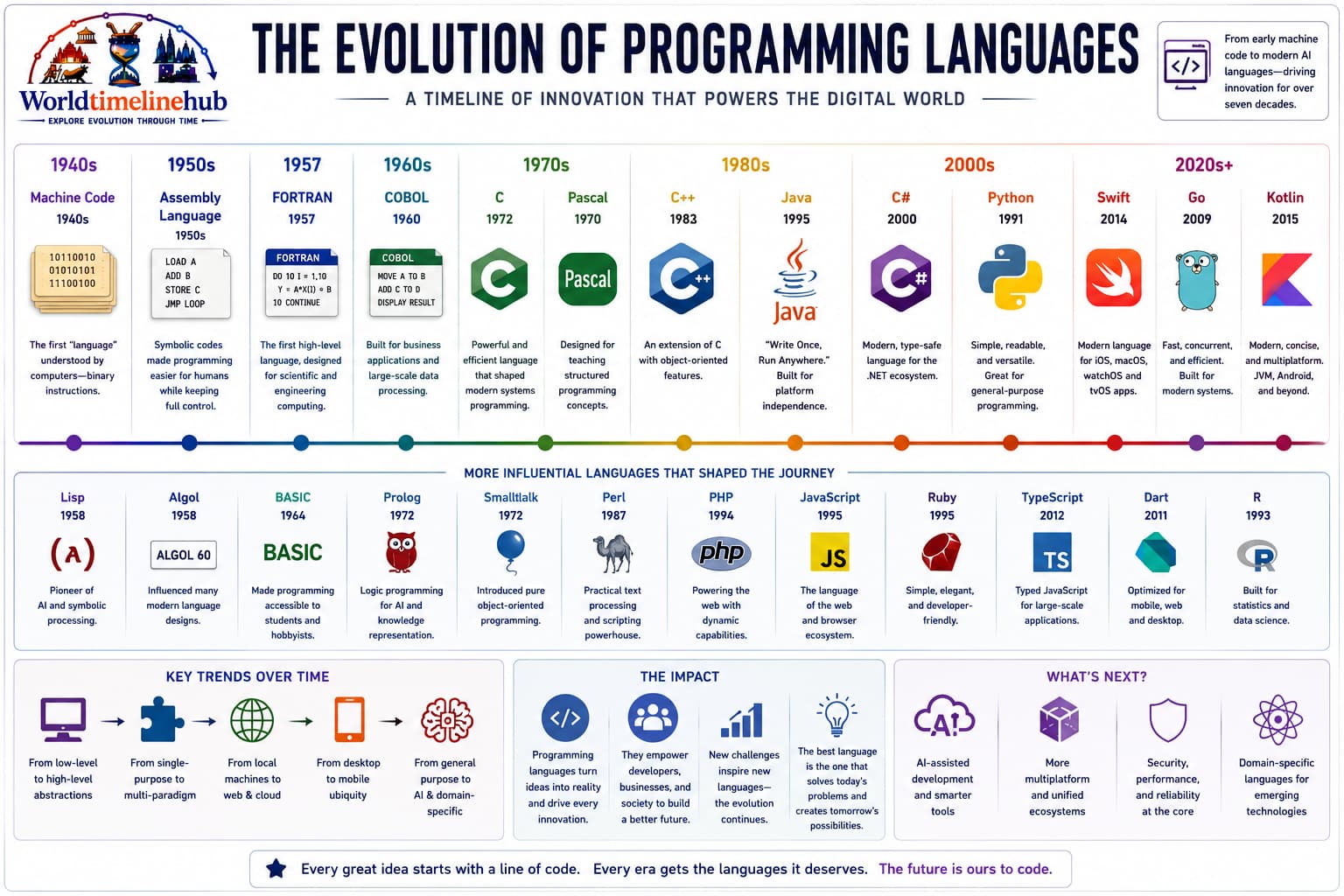
Programming language evolution in one view
Languages traded machine control for readability, safety, and productivity, then added ecosystems of libraries, package managers, and runtimes. The milestones below—FORTRAN, C, Java, and today’s Python and Rust—mark turning points where new ideas became industry defaults.
Programming language evolution: from first compilers and business COBOL to scripting, managed runtimes, and memory-safe systems languages.
First Compilers1950s - 1960s
FORTRAN, COBOL, and ALGOL
FORTRAN let scientists write formulas in code closer to mathematics; COBOL described business records in English-like syntax; ALGOL and LISP introduced structured control flow and symbolic computing—language design became a field of its own.
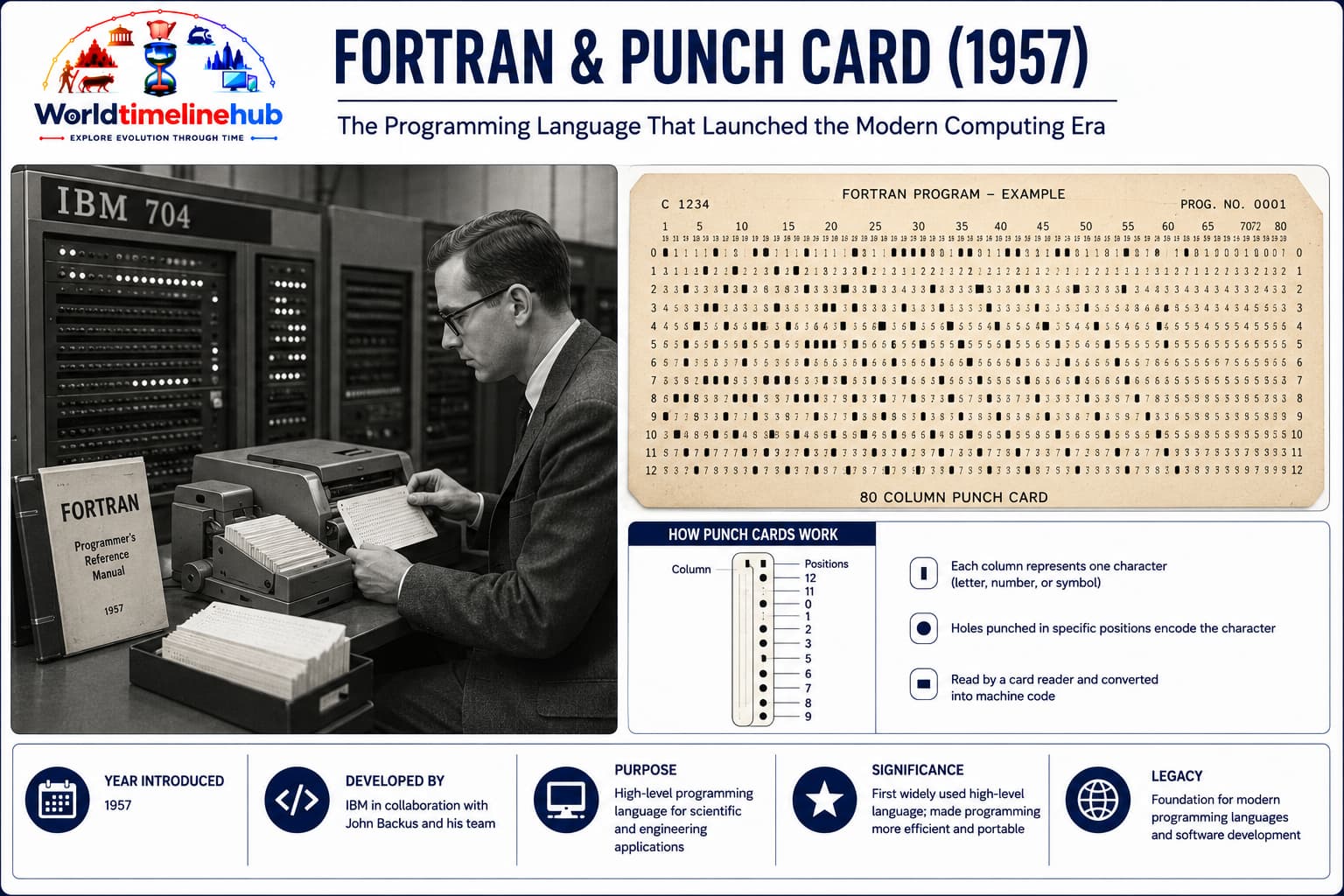
FORTRAN era: compilers translated formulas and business records into machine code, beginning the high-level language age.
1957: FORTRAN for scientific computing.
COBOL targets business data processing.
ALGOL influences structured programming ideas.
Technology Used
Compilers: Batch translation to machine code.
Punched cards: Source input.
Optimized math: Scientific libraries.
Features
Domain focus: Science vs business.
Portability begins: Less hardware tied.
Standardization: Language committees form.
Systems Code1970s - 1980s
C, Pascal, and Structured Programming
Structured programming discouraged tangled goto spaghetti; C gave UNIX a portable systems language; Pascal taught discipline in universities; C++ later added classes without abandoning C’s performance habits.
1972: C supports UNIX systems work.
Pascal teaches structured style in schools.
C++ adds object-oriented extensions to C.
Technology Used
Pointers: Direct memory access.
stdio libraries: Portable I/O.
OOP extensions: Classes in C++.
Features
UNIX glue: Kernel and toolchains.
Performance: Near-hardware speed.
Manual memory: malloc/free discipline.
GUI Apps1990s
Java, Delphi, and Visual Basic Boom
The 1990s GUI and web boom favored languages with garbage collection, rich class libraries, and visual form designers—teams shipped line-of-business and early e-commerce apps faster, even if bytecode or interpreters added overhead.
1995: Java promises write-once run-anywhere.
Visual Basic rapid-forms for Windows.
Perl and PHP power early web scripts.
Technology Used
JVM: Bytecode virtual machine.
Garbage collection: Automatic memory.
RAD tools: Drag-drop UI builders.
Features
Enterprise apps: Line-of-business software.
Web backends: CGI to app servers.
Cross-platform Java: Applets and servers.
Web Stack2000 - 2012
Python, Ruby, PHP, and JavaScript Everywhere
Dynamic languages with batteries-included libraries and fast edit-run cycles dominated web startups, sysadmin glue, and data science—JavaScript escaped the browser with Node.js so one syntax could span front end and back end.
Python rises in science and automation.
Ruby on Rails simplifies web MVC.
JavaScript runs in browsers and Node.js servers.
Technology Used
Interpreters/VMs: Flexible runtimes.
Package indexes: PyPI, npm.
JSON APIs: Lightweight services.
Features
Rapid iteration: Startup-friendly.
Full-stack JS: One language many tiers.
Data science: NumPy ecosystem.
Mobile + DSL2013 - 2020
Swift, Kotlin, Go, and Domain Languages
Apple and Google endorsed modern languages for mobile apps; cloud teams adopted Go for simple concurrency and small deployable binaries; domain-specific languages (SQL, regex, Terraform/HCL) handled narrow jobs better than general-purpose code alone.
Modern language landscape: mobile-first Swift and Kotlin, cloud-friendly Go, and specialized DSLs for config and data.
Swift modernizes Apple development.
Kotlin becomes preferred on Android.
Go targets cloud microservices concurrency.
Technology Used
LLVM/Swift: Safer Apple APIs.
JVM Kotlin: Android interop.
Go routines: Lightweight threads.
Features
Platform mandated: Store policies.
Microservices: Small binaries.
Config languages: HCL, YAML tools.
Safety + AI2021 - Present
Rust, TypeScript, and AI-Assisted Coding
Rust proves systems code can be memory-safe without a garbage collector; TypeScript adds static types to JavaScript at scale; AI coding assistants draft boilerplate in many languages—raising new questions about review, licensing, and who owns generated code.
Rust memory safety without garbage collection.
TypeScript types large JavaScript codebases.
Copilots assist authoring in many languages.
Technology Used
Ownership model: Rust borrow checker.
Structural types: TypeScript.
LLM assistants: Code completion.
Features
Systems revival: Rust in kernels.
Web typing: Safer frontends.
Human+AI: Faster prototyping.
Programming Languages Timeline Summary
Language milestones from FORTRAN to Rust and TypeScript—use this table as a quick map before the detailed events, comprehensive timeline, typing comparison, and paradigm notes below.
Year / Era
Milestone
1957
FORTRAN — first widely used compiled high-level language for science
1959
COBOL — business data processing in English-like syntax
1972
C — portable systems language behind UNIX and later OSes
1983
C++ — object-oriented extensions on C for application software
1991
Python — readable scripting adopted for web, automation, and data science
1995
Java — bytecode JVM for cross-platform enterprise and applets
1995
JavaScript — browser scripting, later full-stack with Node.js
2010
Rust 1.0 — memory safety without garbage collection
2012
TypeScript — gradual typing for large JavaScript codebases
2020s
AI-assisted coding — copilots and LLMs in mainstream IDEs
Key Programming Language Historical Events
Beyond the main era cards, these milestones shaped how software moved from punched-card FORTRAN to managed runtimes, dynamic web stacks, and AI-assisted authoring in the IDE.
Event
Year
Significance
FORTRAN released
1957
First high-level language; scientific computing
COBOL standardized
1959
Business data processing; US Dept of Defense
ALGOL 60 published
1960
Structured programming foundation
C language created
1972
UNIX kernel; systems programming standard
C++ first released
1985
Object-oriented extensions to C
Python first released
1991
Readable, dynamic, beginner-friendly
Java 1.0 released
1996
Write once, run anywhere; enterprise adoption
JavaScript standardized (ECMAScript)
1997
Browser scripting language standard
C# announced
2000
Microsoft’s .NET answer to Java
TypeScript 1.0
2012
Static types for large JavaScript codebases
Rust 1.0 stable
2015
Memory safety without garbage collection
GitHub Copilot launched
2021
AI-assisted coding mainstream
Programming Language “Firsts” at a Glance
Landmark “first” achievements in language design—from the first compiled high-level language to the first browser script and ownership-based memory safety.
First
Year
Achievement
First high-level language
1957
FORTRAN
First object-oriented language
1960s
Simula (influenced C++ and Smalltalk)
First functional language
1958
LISP (still used in AI research)
First structured programming language
1960
ALGOL 60
First language with garbage collection
1959
LISP
First language for web browsers
1995
JavaScript (Brendan Eich, ~10 days)
First language designed for concurrency
1990s
Erlang
First language with ownership model
2015
Rust (1.0)
Comprehensive Language Timeline (1950s–2020s)
A decade-by-decade map of influential languages—who created them, what paradigm they popularized, and where they still matter in education, industry, or research.
Year
Language
Creator(s)
Paradigm
Main use
1957
FORTRAN
John Backus (IBM)
Imperative
Scientific, numerical
1958
LISP
John McCarthy
Functional
AI research, symbolic
1959
COBOL
Grace Hopper et al.
Imperative
Business data processing
1960
ALGOL 60
International committee
Structured
Algorithm description
1964
BASIC
John Kemeny, Thomas Kurtz
Imperative
Education, beginners
1972
C
Dennis Ritchie
Imperative
Systems programming
1980
Smalltalk-80
Alan Kay, Xerox PARC
OOP
Learning, GUI apps
1983
C++
Bjarne Stroustrup
Multi-paradigm
Systems, games
1987
Perl
Larry Wall
Scripting
Text processing, CGI
1990
Haskell
Committee
Functional
Research, academia
1991
Python
Guido van Rossum
Multi-paradigm
Scripting, data science, web
1995
Java
James Gosling (Sun)
OOP, JVM
Enterprise, Android
1995
JavaScript
Brendan Eich
Scripting
Web browsers
1995
PHP
Rasmus Lerdorf
Scripting
Server-side web
2000
C#
Anders Hejlsberg (Microsoft)
OOP, .NET
Windows apps, games
2003
Scala
Martin Odersky
Functional + OOP
JVM, data processing
2009
Go
Google (Pike, Thompson)
Concurrent
Cloud microservices
2012
TypeScript
Microsoft (Anders Hejlsberg)
Typed superset
Large JavaScript codebases
2014
Swift
Apple (Chris Lattner)
Multi-paradigm
Apple ecosystem
2015
Rust 1.0
Mozilla (Graydon Hoare)
Systems-safe
Safe systems, WebAssembly
Typing Discipline & Execution Model Comparison
How a language checks types, compiles or interprets, and manages memory explains performance, bug classes, and deployment style—compare classics side by side.
Language
Typing
Compilation
Memory management
Main paradigm
C
Static
Native compiled
Manual (malloc/free)
Imperative
C++
Static
Native compiled
Manual + RAII
Multi-paradigm
Java
Static
JVM bytecode (JIT)
Garbage collected
OOP
C#
Static
CLR bytecode (JIT)
Garbage collected
OOP
Python
Dynamic
Interpreted (bytecode)
Garbage collected
Multi-paradigm
JavaScript
Dynamic
JIT compiled (V8)
Garbage collected
Event-driven
Rust
Static
Native compiled
Ownership system
Systems-safe
Go
Static
Native compiled
Garbage collected
Concurrent
TypeScript
Static (superset)
Transpiles to JS
Garbage collected
Typed JavaScript
Language Creators and Pioneers
Behind each major language is a designer or small team whose choices—syntax, runtime, and libraries—still influence what millions of developers write today.
Creator
Language
Year
Contribution
John Backus
FORTRAN
1957
First high-level compiled language
Grace Hopper
COBOL, FLOW-MATIC
1959
Business data processing, compiler pioneer
John McCarthy
LISP
1958
Functional programming, AI foundations
Dennis Ritchie
C
1972
Systems programming, UNIX portability
Bjarne Stroustrup
C++
1985
Object-oriented extensions to C
Guido van Rossum
Python
1991
Readable, beginner-friendly design
James Gosling
Java
1995
JVM, write once run anywhere
Brendan Eich
JavaScript
1995
Web browser scripting
Anders Hejlsberg
C#, TypeScript
2000, 2012
Microsoft’s Java alternative, typed JS
Graydon Hoare
Rust
2010+
Memory safety without garbage collection
Rob Pike, Ken Thompson
Go
2009
Cloud concurrency simplicity
Then vs Now: Language Development
Compare how people learned and shipped code in the 1970s–80s with today’s package managers, IDEs, and AI assistants—same goal (working software), very different daily workflow.
Metric
Then (1970s–80s)
Now (2020s)
Popular entry language
BASIC or Pascal
Python or JavaScript
Typical paradigm
Procedural
Multi-paradigm
Compilation speed
Minutes
Seconds (incremental)
Memory safety
Manual (buffer overflows common)
Ownership or GC
Package management
Manual (copy headers/libraries)
npm, pip, cargo, etc.
IDE features
Text editor, syntax highlight
Autocomplete, refactoring, AI assistants
Target devices
Mainframes, minicomputers, PCs
Cloud, mobile, IoT, browsers, AI accelerators
Documentation
Manuals, books
Online docs, MDN, Stack Overflow, AI-generated help
Future Programming Language Predictions
Speculative roadmap—not certainties, but directions researchers and tool vendors are exploring as AI, quantum hardware, and new chips change what “programming” means.
2025–2027: AI-assisted code review and bug detection integrated into language toolchains
2026–2028: Natural language programming for low-code applications becomes viable
2028–2030: Quantum language extensions for hybrid classical-quantum computing
2030s: Domain-specific languages for neuromorphic and analog computing chips
2035+: Visual and neural programming interfaces for some domains (spoken language + gestures)
Programming Paradigms
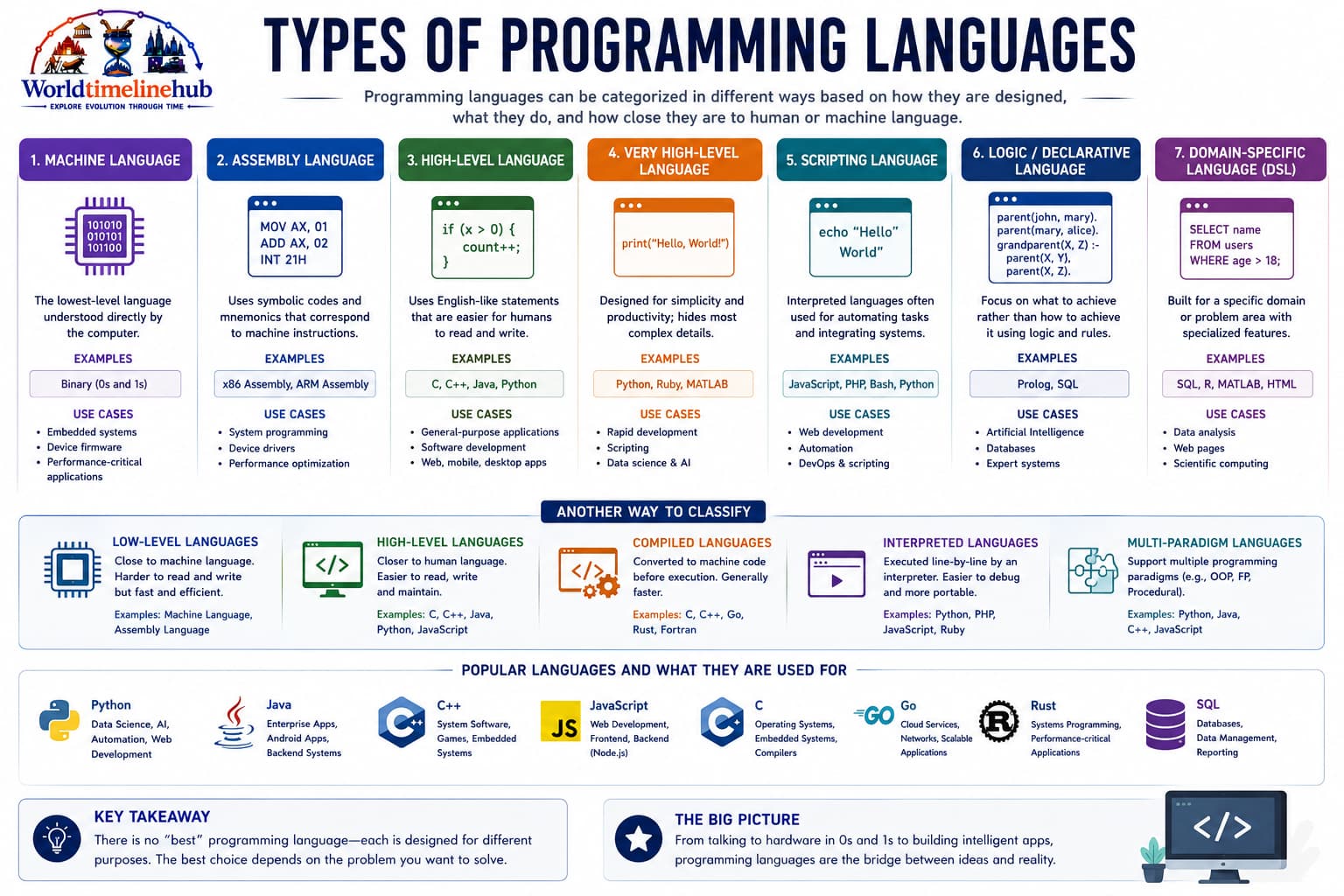
Most popular languages mix paradigms—a Java class is object-oriented, but its methods are procedural; Python supports functional helpers while staying imperative day to day. The table maps classic styles to languages you will meet on this timeline.
Paradigm
Example languages
Core idea
Procedural
C, Pascal, early FORTRAN
Step-by-step procedures and structured control flow
Object-oriented
Java, C++, C#, Swift
Data and behavior bundled in classes with inheritance
Functional
Haskell, Lisp, ML family
Functions as values; immutability and recursion emphasized
Scripting / dynamic
Python, Ruby, JavaScript
Rapid development, often interpreted, flexible typing
Logic / declarative
Prolog, SQL
Describe what you want; engine finds how to compute it
Systems-safe
Rust, (partially) Swift
Compile-time checks prevent memory and data races
Language Runtimes and Toolchains
A language is not only syntax—it is the compiler or interpreter, standard library, package manager, and debugger that developers rely on. These runtimes explain why the same source file behaves differently on Windows, Linux, or a phone.
JVM (Java/Kotlin): Compiles to bytecode; JVM provides garbage collection, JIT optimization, and cross-platform class libraries.
CPython: Reference Python interpreter; C extensions and pip packages extend the standard library for web, data, and automation.
Node.js (V8): Google’s JavaScript engine on servers; npm hosts millions of packages for APIs and front-end tooling.
.NET CLR: Managed runtime for C#, F#, and Visual Basic on Windows and cross-platform .NET Core.
LLVM backend: Swift, Rust, and Clang/C++ share optimization passes and target many CPU architectures from one toolchain.
WebAssembly (Wasm): Portable binary format letting C, Rust, and others run in browsers and edge hosts at near-native speed.
India spotlight
Programming languages in India
India’s software story tracks global language trends—COBOL-era banking, C/C++ training institutes, Java enterprise outsourcing, Python data careers, and today’s JavaScript and cloud-native stacks. Millions learned programming through English-based languages tied to export markets and local startups alike.
1980s–90s
COBOL and mainframe skills
Banks and government systems ran COBOL on mainframes; early IT education often emphasized batch processing and record layouts.
1990s
C/C++ engineering institutes
Training centers and engineering colleges taught C and C++ as the default path into systems and embedded software roles.
2000s
Java enterprise services
Outsourcing firms scaled JVM-based backends for global clients; Spring and J2EE skills dominated hiring ads.
2010s
Python for data and ML
Analytics, machine learning, and automation jobs adopted Python’s NumPy/pandas ecosystem in Bangalore, Hyderabad, and Pune.
2020s
Full-stack JavaScript
Startups and product companies hired React/Node developers; TypeScript grew for maintainable front-end codebases.
Ongoing
Rust, Go, and AI tooling
Cloud and infra teams experiment with Go and Rust; AI copilots change how Indian developers learn and ship code daily.
Test Your Knowledge
20 quick questions from the programming languages timeline—eras, paradigms, runtimes, and India spotlight. Click each question to reveal the answer and check what you remember about FORTRAN, C, Java, Python, Rust, and modern AI-assisted coding.
Answer: FORTRAN.
Answer: C.
Answer: JVM.
Answer: Indentation (significant whitespace).
Answer: Browsers / web pages.
Answer: Memory safety via ownership.
Answer: Static types.
Answer: Business data processing.
Answer: True.
Answer: Google.
Answer: Android apps.
Answer: Apple platforms.
Answer: Functional / symbolic lists.
Answer: Text processing / early web.
Answer: Server-side web.
Answer: PyPI.
Answer: Node.js / JavaScript.
Answer: Structured programming.
Answer: Writing / completing code.
Answer: Safer, more productive, polyglot ecosystems.
Classroom activity
Students Tasks
Use these 10 prompts for discussion, projects, or classroom presentations. They connect era cards, paradigm and runtime sections, and real hiring trends in India and worldwide.
ParadigmsSyntaxRuntimesCareers
Compare compiled vs interpreted languages.
Write hello world pseudocode in two paradigms.
Why did C dominate systems programming?
Explain garbage collection benefits.
What problem does Rust address?
Map one language to an Indian industry use case (banking, e-commerce, or agriculture tech).
Describe Java's role in enterprise IT.
How did JavaScript become full-stack?
Ethics of AI-generated code?
Pick a language to learn in 2026 and justify.
Continue exploring
Browse related technology timelines and compare how programming languages, operating systems, processors, and networks evolved together—each layer enabled the software stacks we use today.
Jump to any other technology timeline on WorldTimelineHub.
Disclaimer: This content is AI-generated for educational purposes and may contain errors or outdated details. For correct and authoritative information, please refer to official and reliable sources such as government publications, manufacturers, museums, and academic references.