From logic theorists and perceptrons to expert systems, statistical learning, deep neural networks, transformers, and generative AI, machines learned to perceive and create.
1950s -> PresentSymbolic -> NeuralGenerative AI
AI Invention and Ideas
Alan Turing posed machine intelligence tests; Dartmouth workshops named AI; cycles of symbolic reasoning, knowledge engines, and neural networks led to today's large language models.
Big picture
Artificial intelligence evolution in one view
AI alternated between rule-based systems and data-driven learning until scale, GPUs, and big data made deep networks practical for vision, speech, and language.
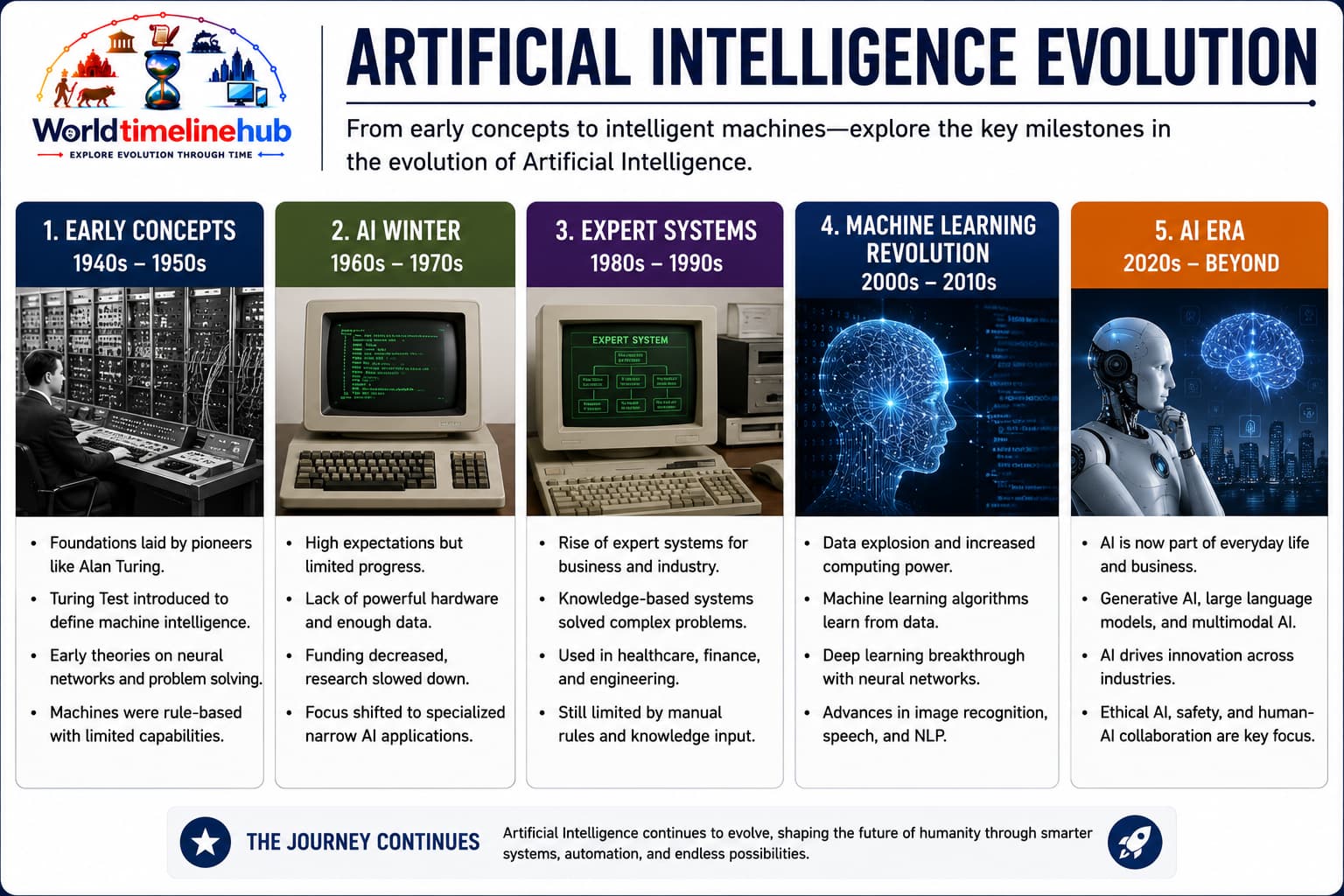
AI evolution: how the field grew from theory into programmable intelligent systems.
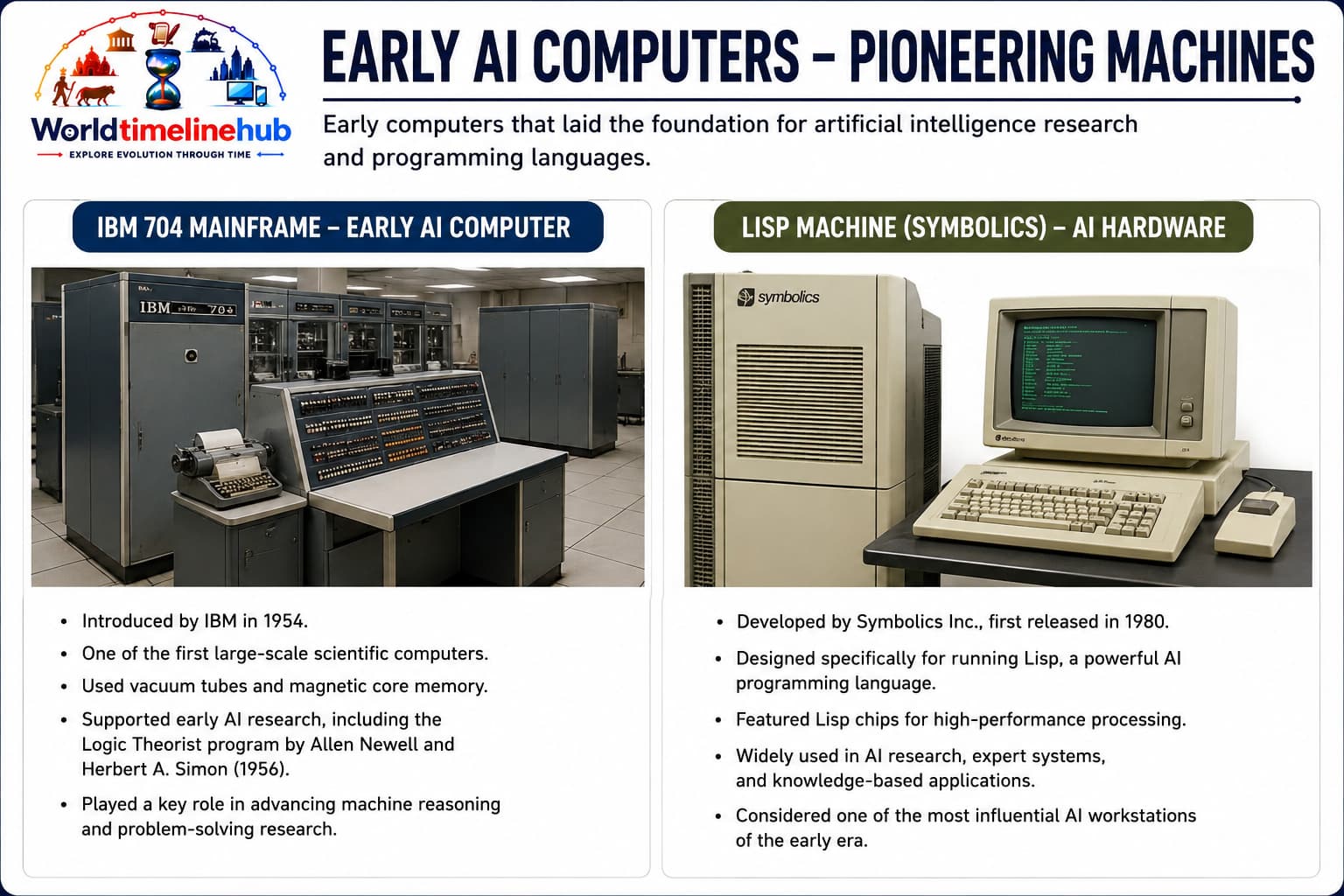
The AI beginning: Dartmouth optimism, Lisp, and rule-based problem solvers.
1943: McCulloch-Pitts neuron — first mathematical model of a neural network.
1950: Turing asks Can machines think?
1951: Strachey's checkers program — among the first AI game programs.
1956: Dartmouth conference coins AI.
1966: ELIZA — first chatbot simulating conversation.
Logic Theorist proves theorems.
Researchers believed human reasoning could be encoded with symbols and rules, inspiring optimism about general problem solvers on early computers.
Technology Used
Symbolic rules: If-then systems.
Search algorithms: State spaces.
Lisp: AI-friendly language.
Features
Lab prototypes: Tiny problems only.
High hopes: AI summer begins.
Limited data: No big datasets.
Expert Systems1970s - 1980s
Expert Systems and AI Winters
MYCIN diagnoses bacterial infections.
1980: XCON (R1) — first major commercial expert system success at DEC.
Japan fifth-generation computer project.
Expert systems commercialized then plateau.
Encoded human expertise in rule bases for narrow domains, but maintenance costs and brittleness led to funding pullbacks known as AI winters (see detailed winter timeline below).
Technology Used
Rule engines: Knowledge bases.
Inference: Forward/backward chaining.
Specialized Lisp machines: AI hardware.
Features
Narrow success: Medicine, configuration.
Expensive updates: Rules stale fast.
Winter cycles: Reduced investment.
ML Rise1990s - 2005
Machine Learning and Statistical Methods
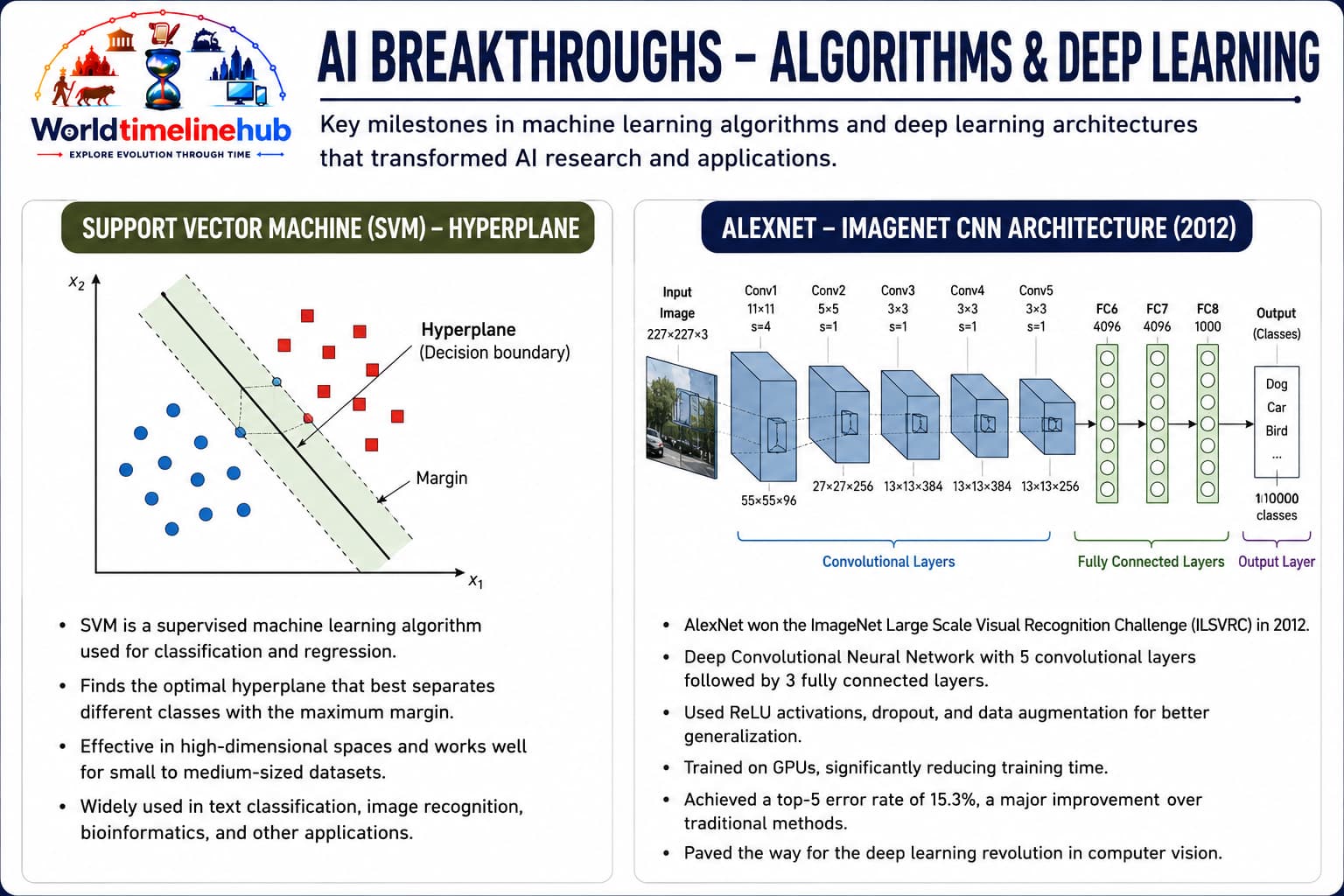
Support vector machines excel on data.
Spam filters use naive Bayes.
1989: ALVINN — neural network steers an autonomous van.
1997: IBM Deep Blue beats chess champion.
Cheaper disks and sensors made data-driven pattern recognition practical, shifting many tasks from hand-written rules to trained models.
Technology Used
SVMs: Kernel methods.
Ensembles: Random forests later.
Feature engineering: Human-crafted inputs.
Features
Real products: Search ranking, finance.
Competitions: Kaggle culture later.
Hybrid AI: Rules plus models.
Neural Return2006 - 2017
Deep Learning Revolution
Deep learning algorithms: layered networks trained on big data with parallel GPUs.
ImageNet 2012 breakthrough with CNNs.
GPUs accelerate matrix training.
2011: Watson wins Jeopardy! against human champions.
2015: AlphaGo defeats Go champion (Fan Hui 5-0 earlier).
2017: AlphaZero masters chess, Go, and shogi from scratch.
Deep convolutional and recurrent networks learned hierarchies from pixels and sequences, beating classical features on vision and speech benchmarks.
Technology Used
CNNs: Vision layers.
GPUs: Parallel training.
Frameworks: TensorFlow, PyTorch.
Features
Big data: Labeled datasets scale.
Assistants: Voice on phones.
Auto translation: Neural MT.
Transformers2018 - 2022
Transformers and Large Language Models
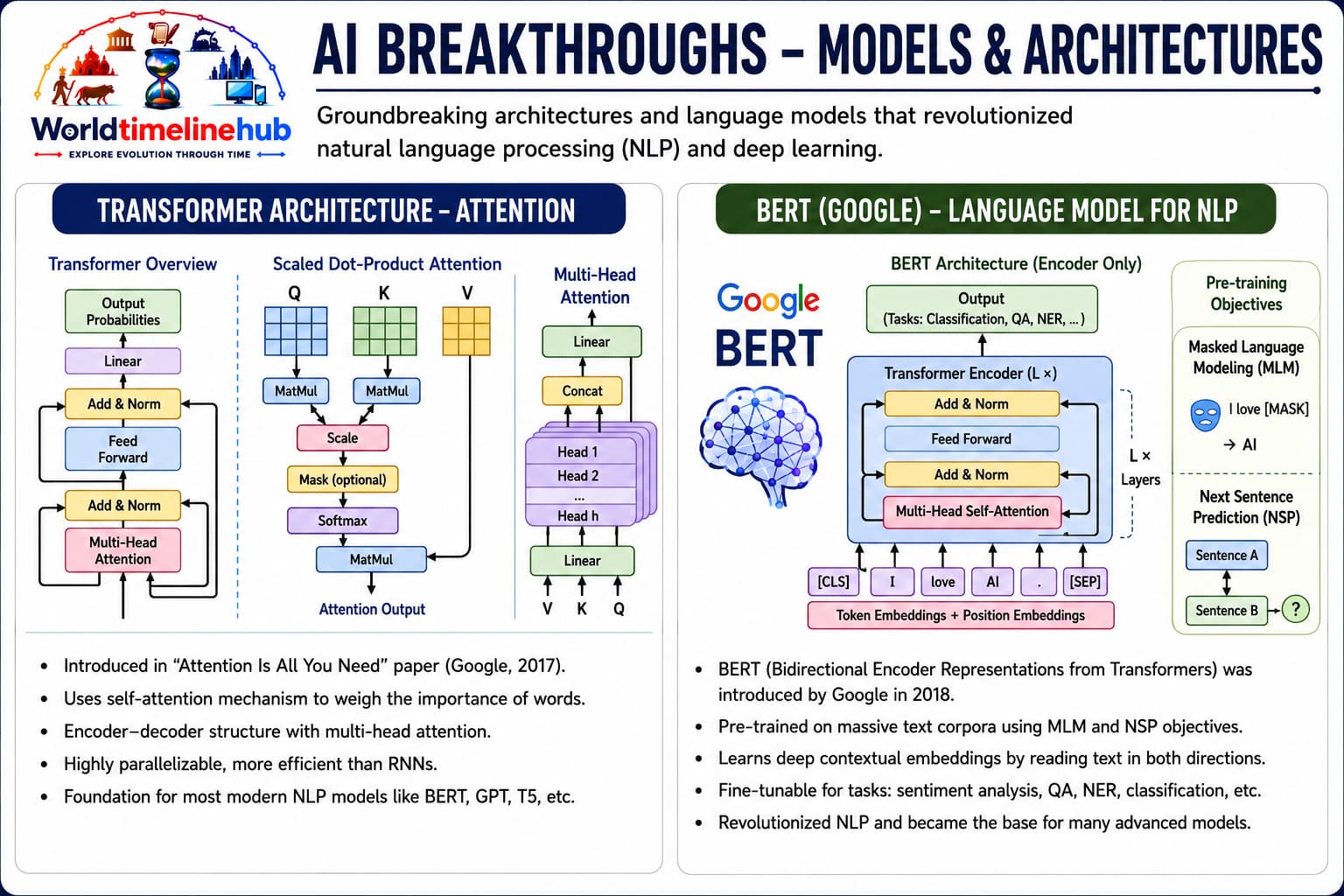
Transformer LLMs: self-attention models pretrained on massive text corpora.
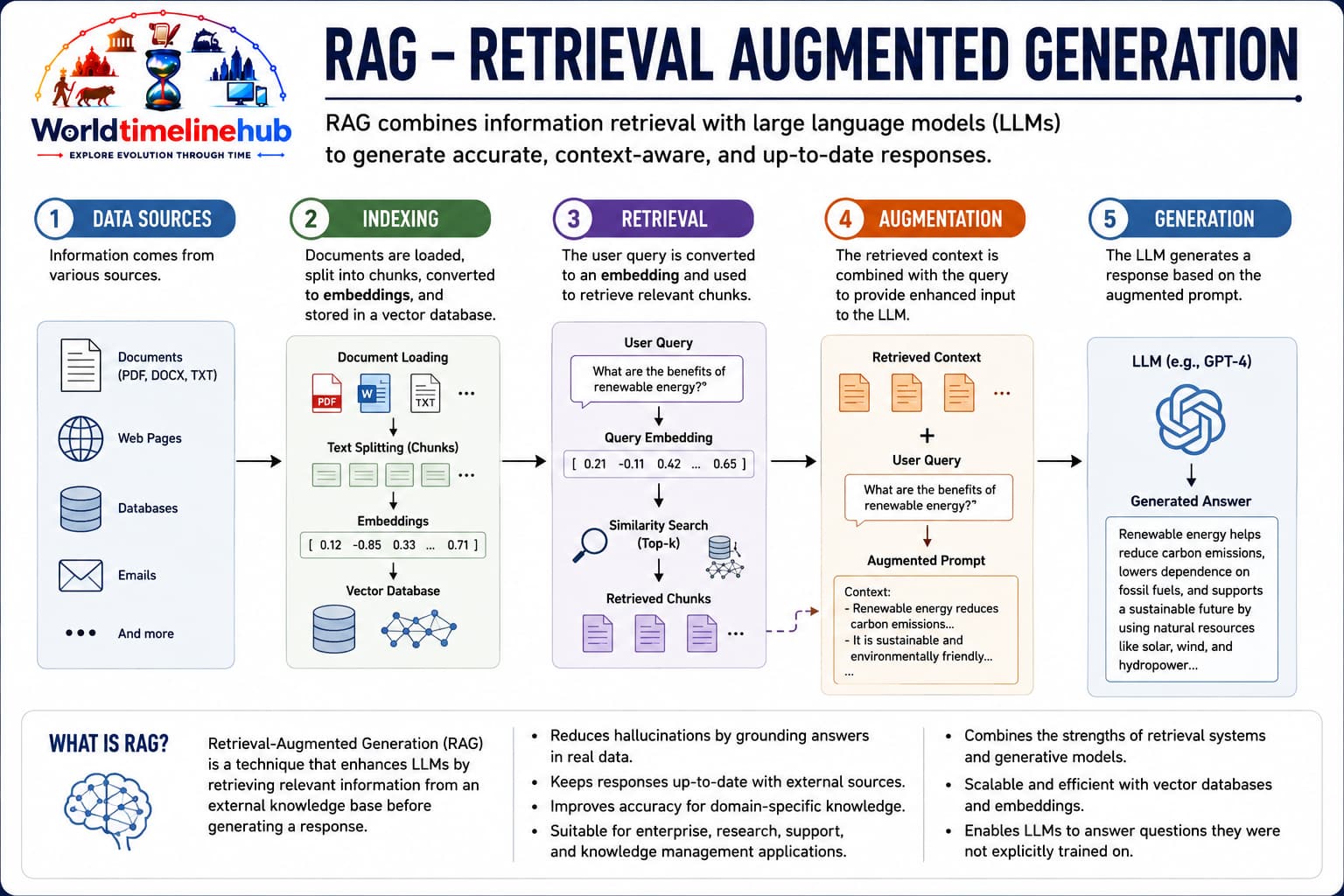
RAG: retrieve trusted sources, then generate answers grounded in real data.
Transformer architecture (2017) scales.
BERT and GPT families emerge.
2021-2022: DALL-E and Stable Diffusion spark text-to-image generation.
ChatGPT popularizes conversational AI.
Self-attention models trained on web-scale text enabled few-shot learning and fluent generation, sparking global debate on jobs, truth, and safety.
Technology Used
Self-attention: Token relationships.
Pretrain + finetune: Transfer learning.
RLHF: Human preference tuning.
Features
Copilots: Code and writing help.
Multimodal: Text+image models.
Policy focus: Safety guidelines.
Governance2023 - Present
Generative AI at Scale and Governance
2023: GPT-4 and Gemini advance multimodal LLMs.
Open models and on-device inference grow.
EU AI Act and global standards debated.
Agents combine tools, memory, and planning.
Enterprises deploy retrieval-augmented generation while regulators demand transparency, copyright clarity, and evaluations for bias and hallucination risk.
Technology Used
RAG: Grounding with documents.
Small models: Edge inference.
Agent frameworks: Tool use loops.
Features
Enterprise adoption: Support bots.
Watermarking debates: Content authenticity.
Human oversight: Review remains critical.
Key Historical Events
Landmark moments that shaped AI beyond the main era cards — foundations, commercial breakthroughs, and modern generative systems.
Event
Year
Why it matters
McCulloch-Pitts neuron
1943
First mathematical model of a neural network (predates Turing)
ELIZA
1966
First chatbot; demonstrated human-like conversation
XCON (R1)
1980
First successful commercial expert system (saved DEC millions)
ALVINN autonomous van
1989
Early neural network for self-driving
Watson wins Jeopardy!
2011
IBM AI beats human champions in open-domain Q&A
AlphaZero
2017
Mastered chess, Go, and shogi without human game data
DALL-E / Stable Diffusion
2021-2022
Text-to-image generation explosion
GPT-4 / Gemini
2023
Multimodal large language models at scale
AI Winters Explained
Periods when hype, funding, and research interest in AI fell sharply after ambitious promises outpaced results.
AI Winter 1 (1974-1980)
UK Lighthill Report criticized AI progress and cut government funding.
Minsky and Papert exposed perceptron limits (e.g., XOR problem).
Research grants and corporate enthusiasm dropped across the field.
AI Winter 2 (1987-1993)
Collapse of the specialized Lisp machine market.
Japan's Fifth Generation Computer Project failed to meet expectations.
Expert systems proved too expensive to maintain at scale.
AI “Firsts” at a Glance
First
Year
Achievement
First AI program
1951
Checkers-playing program (Strachey)
First industrial robot
1961
Unimate at GM plant
First autonomous car
1986
Mercedes-Benz van (~80 mph on empty roads)
First AI to beat human pro at Go
2015
AlphaGo Fan (5-0 vs Fan Hui)
First AI-generated art sold at auction
2018
“Edmond de Belamy” ($432,500)
Decade-by-Decade Visual Timeline
A quick scan of how AI milestones cluster across decades.
1940s1950s1960s1970s1980s1990s2000s2010s2020s
1940s McCulloch-Pitts neuron
1950s Turing test, Dartmouth AI
1960s ELIZA chatbot
1970s AI Winter 1 begins
1980s XCON expert system
1990s AI Winter 2, Deep Blue
2000s Statistical ML rise
2010s ImageNet, AlphaGo
2020s ChatGPT, GPT-4, EU AI Act
AI Pioneers and Contributors
Person
Contribution
Alan Turing
Turing Test; theoretical foundations of computation
John McCarthy
Coined “Artificial Intelligence”; Lisp
Marvin Minsky
Neural networks; Society of Mind
Frank Rosenblatt
Perceptron
Geoffrey Hinton
Backpropagation; deep learning revival
Yann LeCun
Convolutional neural networks
Yoshua Bengio
Deep learning sequence modeling
Fei-Fei Li
ImageNet dataset
Ilya Sutskever
Sequence-to-sequence learning; GPT development
Funding and Investment Waves
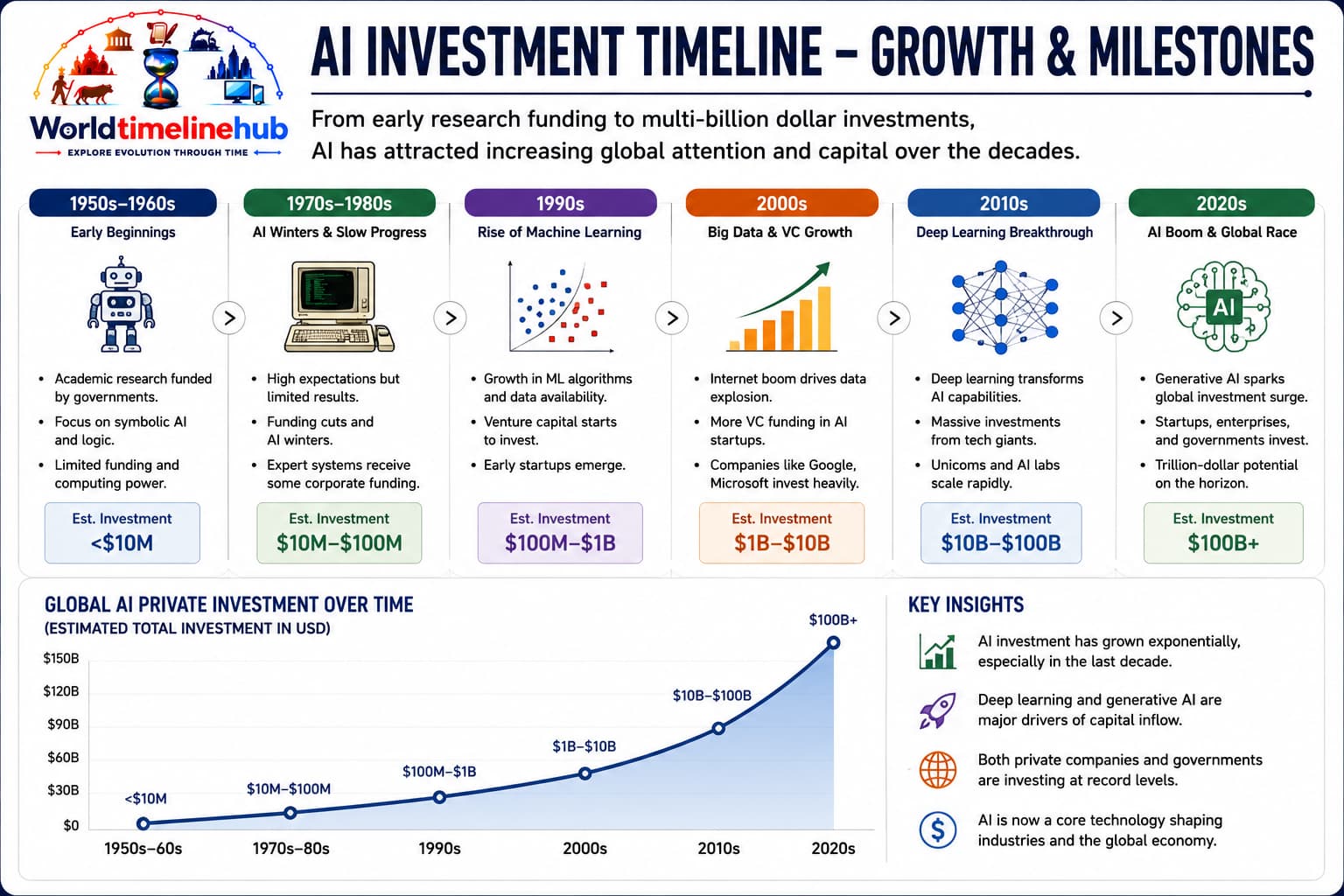
AI progress often tracks capital available for research, startups, and infrastructure — winters align with downturns.
AI investment waves: booms, winters, and the surge in venture and corporate AI spending.
Period
Global AI investment (approx.)
1980s
$1B+ (expert systems boom)
1990s
Decline (AI winter)
2010
~$2B
2015
~$12B
2020
~$68B
2023
$200B+
Hardware Evolution for AI
Breakthroughs in AI required matching gains in compute — from vacuum tubes to GPUs built for parallel math.
Era
Hardware
Compute power (approx.)
1950s
Vacuum tubes
~1,000 FLOPS
1960s
Transistors
~1M FLOPS
1970s
Microprocessors
~10M FLOPS
1990s
Early GPUs
~1B FLOPS
2012
GTX 580 (AlexNet era)
~1.5 TFLOPS
2024
NVIDIA H100 GPU
~1,979 TFLOPS
Ethics and Regulatory Timeline
Year
Event
2016
Asilomar AI Principles drafted
2018
GDPR includes “right to explanation”
2021
UNESCO AI ethics recommendation
2023
EU AI Act passes
2024
US Executive Order on AI Safety
2025
China deep synthesis regulations strengthened
Future Predictions (Speculative)
Forward-looking themes discussed by researchers and industry — not certainties, but directions the field is exploring.
2025-2027: AI agents with long-term memory and tool orchestration.
2028-2030: First controversial AGI capability claims.
Jump to any other technology timeline on WorldTimelineHub.
Disclaimer: This content is AI-generated for educational purposes and may contain errors or outdated details. For correct and authoritative information, please refer to official and reliable sources such as government publications, manufacturers, museums, and academic references.