From spinning mechanical discs to 8K smart displays, television reshaped news, entertainment, education, and
culture across the world. Explore each era and the technologies that powered this transformation.
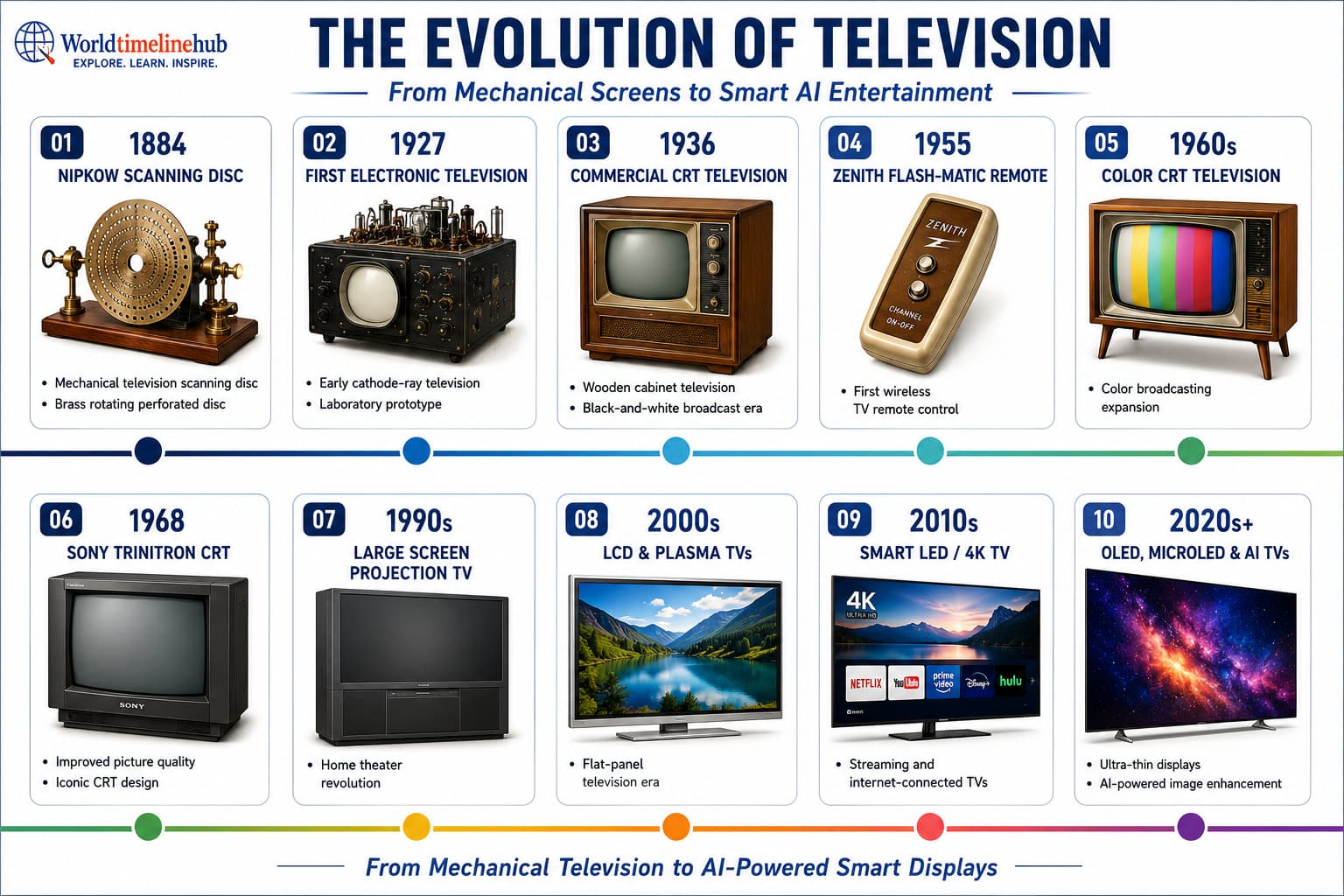
This timeline traces how moving images moved from lab demos to living-room fixtures, then to flat panels, smart apps, and streaming libraries you browse on demand.
1920s → PresentBroadcast → StreamingB&W → 8K + AI
Television Invention
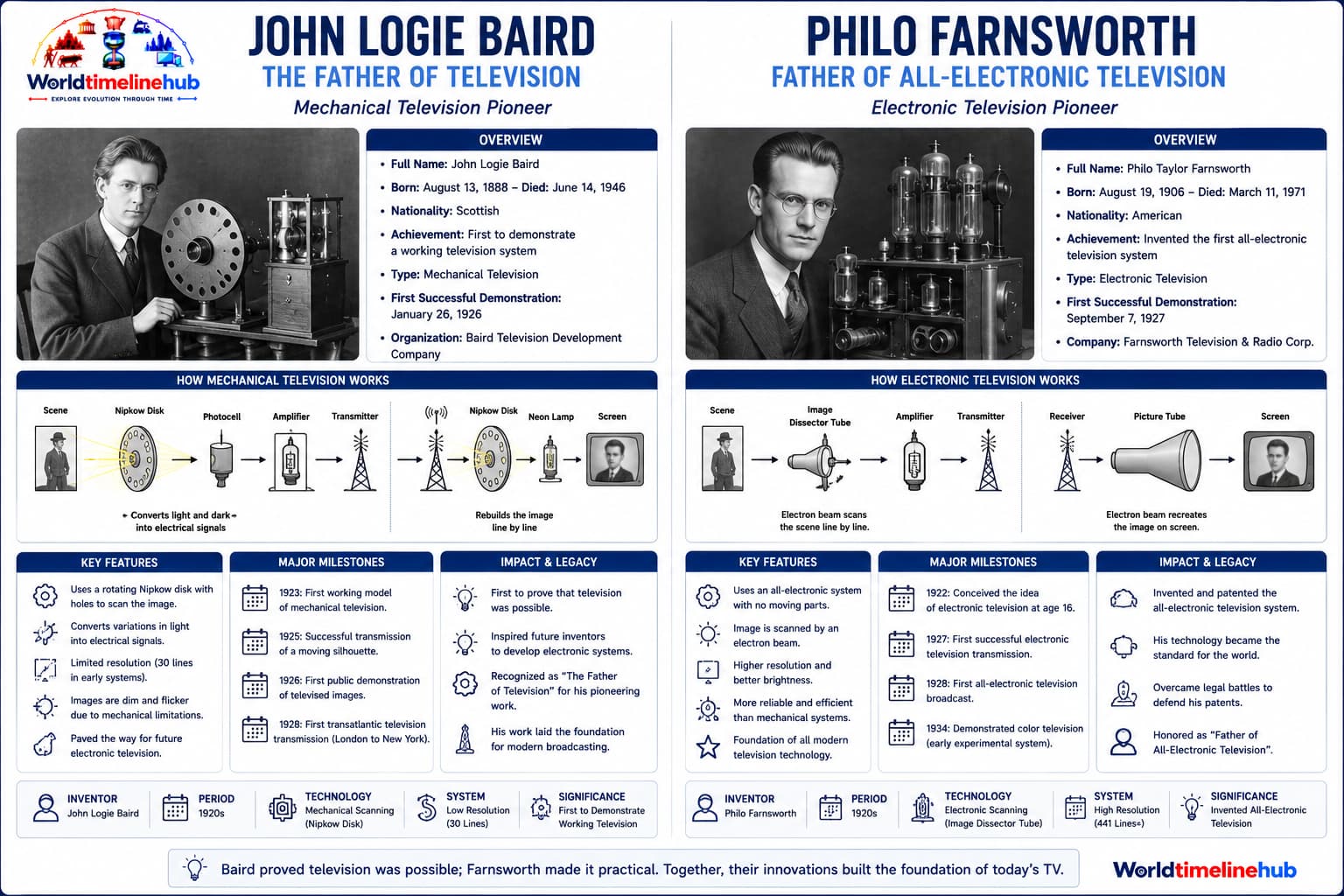
Television evolved through contributions from multiple inventors. In 1884, Paul Nipkow proposed the mechanical
scanning disc. In the 1920s, John Logie Baird demonstrated working television transmissions. By the 1930s, fully
electronic systems advanced by pioneers like Philo Farnsworth and Vladimir Zworykin made modern broadcast television practical.
The era cards and reference tables below cover mechanical TV through smart streaming, plus how India’s broadcasters and OTT platforms fit the global story.
Big picture
Television evolution in one view
Television began as low-resolution mechanical scanning experiments, matured into mass broadcast media, and then
shifted to digital, on-demand, and connected screens. Each era changed what people watched and how families consumed content. The stats below anchor that arc to Nipkow, household adoption, color TV, and streaming-first viewing today.
Television evolution: from Nipkow’s scanning disc and CRT living-room sets to smart TVs and on-demand streaming.
⚙️ Experiments Begin1880s – 1939
Mechanical and Early Electronic Television
Before CRT sets in every home, inventors split images into scanning lines with spinning discs and early tubes. Picture quality was crude, but the idea of transmitting sight—not just sound—was proved in labs and first public demos.
Early television era: from mechanical scanning discs to cathode-ray tube receivers in labs and first broadcasts.
Electronic TV: Farnsworth and Zworykin’s pickup tubes made all-electronic cameras and broadcasts practical by the 1930s.
1884: Paul Nipkow patents the scanning disc concept.
1920s: John Logie Baird demonstrates mechanical television.
1930s: Electronic CRT systems begin replacing mechanical approaches.
Technology Used
Mechanical scanning: Rotating discs split images into lines.
Low-bandwidth radio transmission: Early broadcast experiments carried primitive video signals.
CRT receivers: Cathode-ray tubes displayed the image on phosphor screens.
Features
Very low resolution: Rough image quality and small picture size.
Limited audience: Mostly labs and demonstration venues.
Single-channel broadcasts: Early schedules with experimental programming.
📺 TV in Every Home1940 – 1969
Post-War Broadcast Boom
After World War II, affordable black-and-white sets turned TV into a national hearth. Live news, sitcoms, and sports created shared moments—and advertising funded the expansion of broadcast networks.
Television ownership surges in North America and Europe.
News, sports, and entertainment become mass shared experiences.
Color television standards begin rollout in the 1950s/60s.
Technology Used
Analog terrestrial broadcast: VHF/UHF transmission becomes mainstream.
Black-and-white CRT sets: Vacuum-tube electronics dominate early home TVs.
Color encoding systems: NTSC/PAL/SECAM standards emerge globally.
Features
Scheduled programming: Families watch at fixed broadcast times.
Live event coverage: Politics, sports, and moon landing moments.
Knob-based controls: Manual channel tuning and volume control.
🌈 More Channels, Better Picture1970 – 1999
Color TV and Cable Expansion
Color standards (NTSC, PAL, SECAM) brought vivid programs to the screen; cable and satellite multiplied channels beyond what antennas could catch. Remotes and VCRs gave viewers control over when they watched, not only what was on now.
Color television becomes standard in many regions.
Cable and satellite services multiply available channels.
Remote controls and VCRs change viewing habits.
Technology Used
Color CRT improvements: Better brightness and reliability.
Cable coaxial networks: Multi-channel distribution to homes.
Satellite broadcasting: Wider geographic coverage with dish receivers.
Features
Channel abundance: News, sports, movies, cartoons, and music channels.
Remote control convenience: Faster channel switching.
Home recording: VCRs enable time-shifted viewing.
🖥️ Flat Screens Take Over2000 – 2014
Digital Transition and HD Era
Analog switch-off and MPEG compression freed spectrum while improving picture quality. Flat LCD and plasma panels replaced heavy CRT cabinets, and HDMI carried HD from set-top boxes and disc players to large widescreen TVs.
Many countries switch from analog to digital terrestrial TV.
LCD and plasma displays replace bulky CRT sets.
HD broadcasts and HDMI become common household standards.
Technology Used
Digital compression: MPEG standards improve channel efficiency.
LCD/Plasma panels: Thin displays with larger screen sizes.
HD signal chains: 720p/1080i/1080p formats and HDMI inputs.
Features
Sharpened picture quality: Clearer sports and movie playback.
Digital set-top boxes: Electronic program guides and better audio.
Home theater integration: DVD/Blu-ray and surround systems.
🌐 Apps + Streaming2015 – Present
Smart TV and Streaming Dominance
The TV became a connected screen with apps, 4K HDR panels, and voice search. Netflix-style OTT services compete with broadcast for prime time, while algorithms suggest the next episode before you reach for the remote.
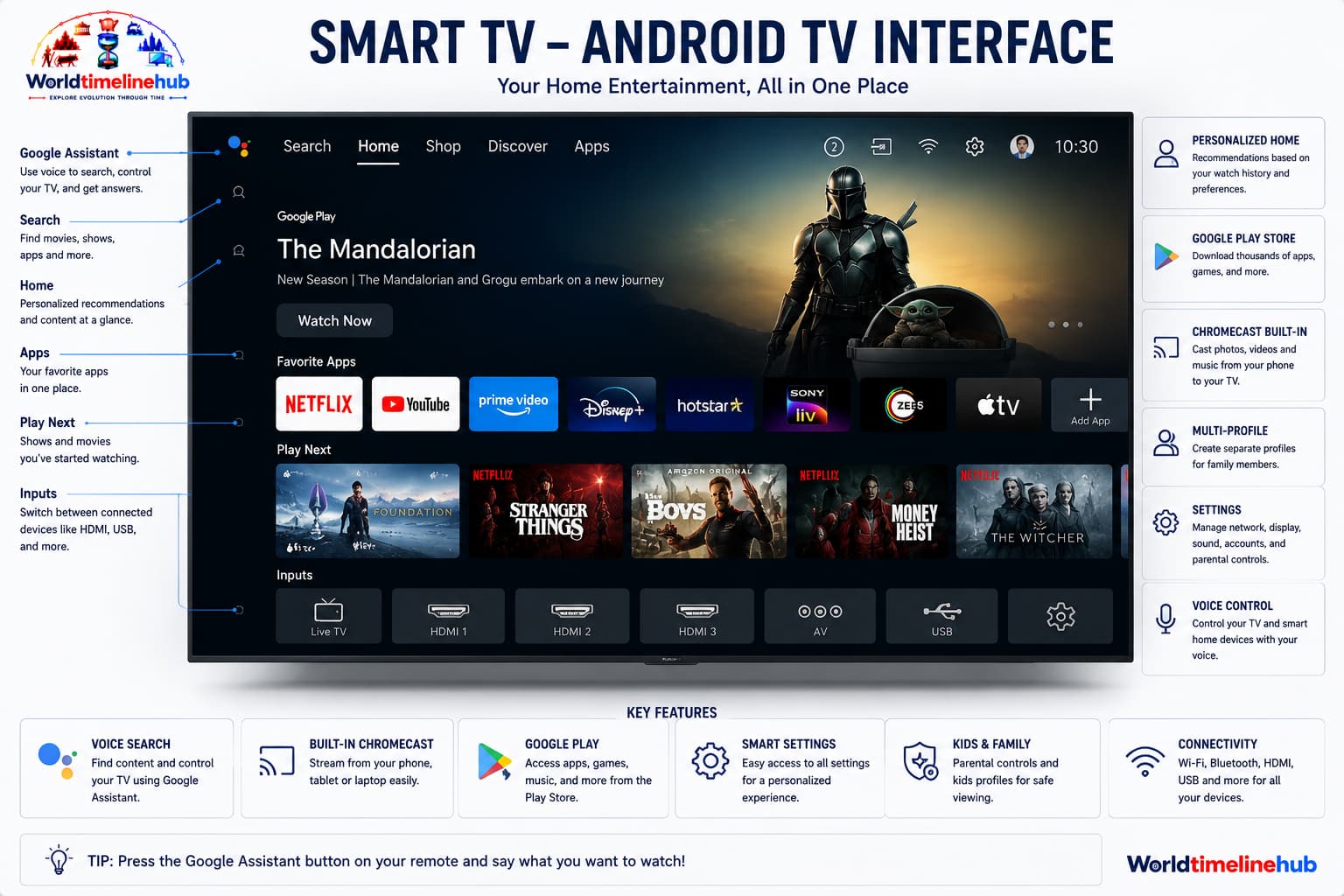
Smart TV era: built-in apps, 4K HDR panels, and streaming services compete with traditional broadcast schedules.
Streaming platforms become primary entertainment sources for many users.
4K and HDR displays move into mainstream price ranges.
Voice assistants and AI recommendations guide viewing choices.
Technology Used
Smart TV operating systems: Android TV, webOS, Tizen, Roku.
OTT delivery: Internet-based streaming with adaptive bitrates.
On-demand viewing: Watch anytime, not only by schedule.
App ecosystem: Streaming, gaming, casting, and media tools.
Personalization: Profiles, recommendations, and watchlists.
🚀 Immersive FutureFuture
What Comes Next for Television?
Tomorrow’s TV may blend wall-sized MicroLED, AI upscaling, cloud gaming, and ambient displays that show information without a traditional “watching session.” The living-room screen remains a hub even as phones and headsets compete for attention.
8K and high-refresh panels continue maturing.
Cloud gaming and interactive programming expand.
Mixed-reality and ambient displays blur lines between TV and computing.
Technology Used
MicroLED and advanced OLED: Brighter and more efficient panels.
AI upscaling engines: Real-time enhancement of lower-resolution content.
Next-gen codecs: Better quality at lower bandwidth.
Features
Immersive formats: Spatial audio and wider dynamic range experiences.
Interactive content: Choose-your-path stories and synchronized second screens.
Energy-aware operation: Smarter power optimization by ambient context.
Television Timeline Summary
Major turning points from early TV experiments to modern streaming—use this table as a map before the key events, display and resolution tables, streaming timeline, and then-vs-now comparison below.
Year / Era
Milestone
Why it matters
1884
Nipkow scanning disc concept
First practical way to divide an image into lines for transmission—ancestor of all TV scanning.
1920s
Mechanical TV demonstrations
Proved television could work outside the laboratory before electronic cameras matured.
1940s–50s
Mass household television adoption
TV became a fixture in living rooms and a primary news and entertainment medium.
1960s+
Color TV standardization
NTSC, PAL, and SECAM let regions broadcast color with compatible receivers.
1970s–90s
Cable and satellite boom
Hundreds of channels and time-shifting with VCRs changed viewing habits.
2000s
Digital transition + flat panels
Sharper HD pictures on thin screens; analog towers switched off in many countries.
2010s
Smart TV and app platforms
Internet apps on the TV itself—streaming without a separate box for many users.
2020s
4K/HDR mainstream, streaming-first
On-demand catalogs and voice remotes rival scheduled broadcast for daily viewing.
Future
AI-enhanced, immersive television
Brighter panels, interactive shows, and ambient displays extend the medium beyond traditional sit-down viewing.
Key Television Historical Events
Beyond the main era cards, these milestones shaped how television moved from mechanical scanning discs to electronic CRT broadcasts, color standards, home recording, digital switch-off, and Ultra HD discs.
Event
Year
Significance
Nipkow disc patented
1884
First mechanical scanning concept for dividing images into lines
Baird mechanical TV demo
1926
First working television system demonstrated to the public
Farnsworth electronic TV patent
1930
All-electronic image pickup tube—foundation of modern cameras
BBC begins regular TV service
1936
World’s first scheduled public television broadcasts
NTSC color standard approved
1953
Color TV enters the US market on compatible sets
First remote control (Zenith)
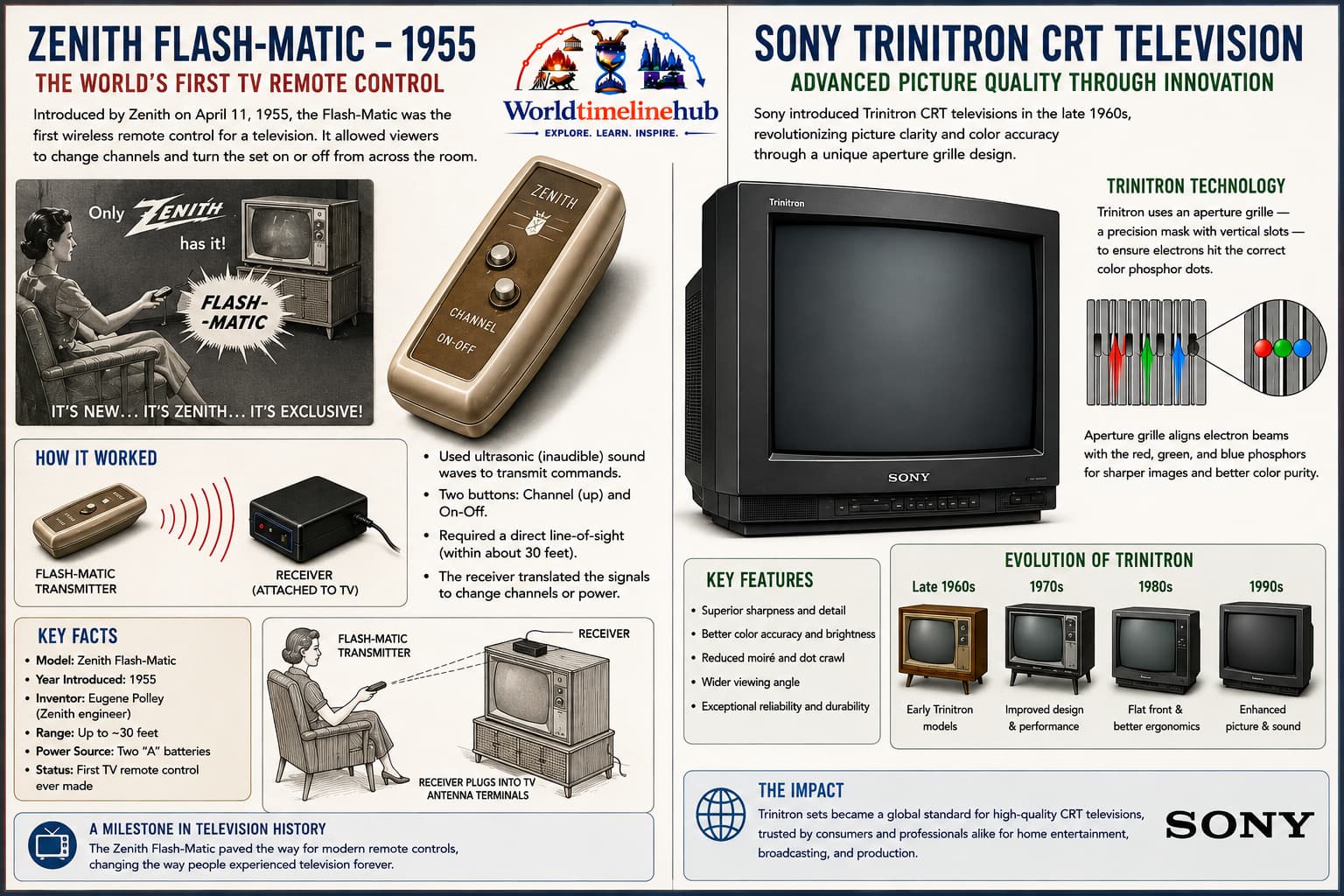
1955
Flash-Matic wireless remote—viewers could change channels from the sofa
PAL color standard introduced
1967
European color TV standard adopted in UK, Germany, India, and more
First VCR (Sony Betamax)
1975
Time-shifted viewing begins—record shows to watch later
VHS vs Betamax war ends
1980s
VHS dominates home recording and rental stores
First DVD player
1997
Digital disc replaces VHS for movies and TV box sets
US analog switch-off
2009
Full-power analog terrestrial TV ends in the United States
First 4K Blu-ray players
2015
Ultra HD physical media for home theaters
Display Technology Evolution
Living-room screens evolved from bulky CRT tubes to flat plasma and LCD panels, then OLED and quantum-dot LED for deeper blacks and higher brightness. Each technology traded size, cost, burn-in risk, and power use.
Technology
Era
Pros
Cons
CRT (Cathode Ray Tube)
1930s–2000s
Good contrast, fast response, affordable
Bulky, heavy, limited screen size
Plasma
2000s–2010s
Deep blacks, wide viewing angles
Burn-in risk, power hungry
LCD (Liquid Crystal Display)
2000s–present
Thin, energy efficient, bright
Poorer blacks on early models; limited viewing angles (early)
LED (LCD with LED backlight)
2010s–present
Thinner, better contrast, longer life
Edge-lit uniformity issues on some sets
OLED (Organic LED)
2010s–present
Perfect blacks, infinite contrast
Burn-in potential, higher cost
QLED (Quantum Dot LED)
2010s–present
Very bright, wide color gamut
Backlight can still leak on dark scenes
MicroLED
2020s–future
Excellent brightness, no OLED burn-in
Very expensive; manufacturing still scaling
Resolution Evolution
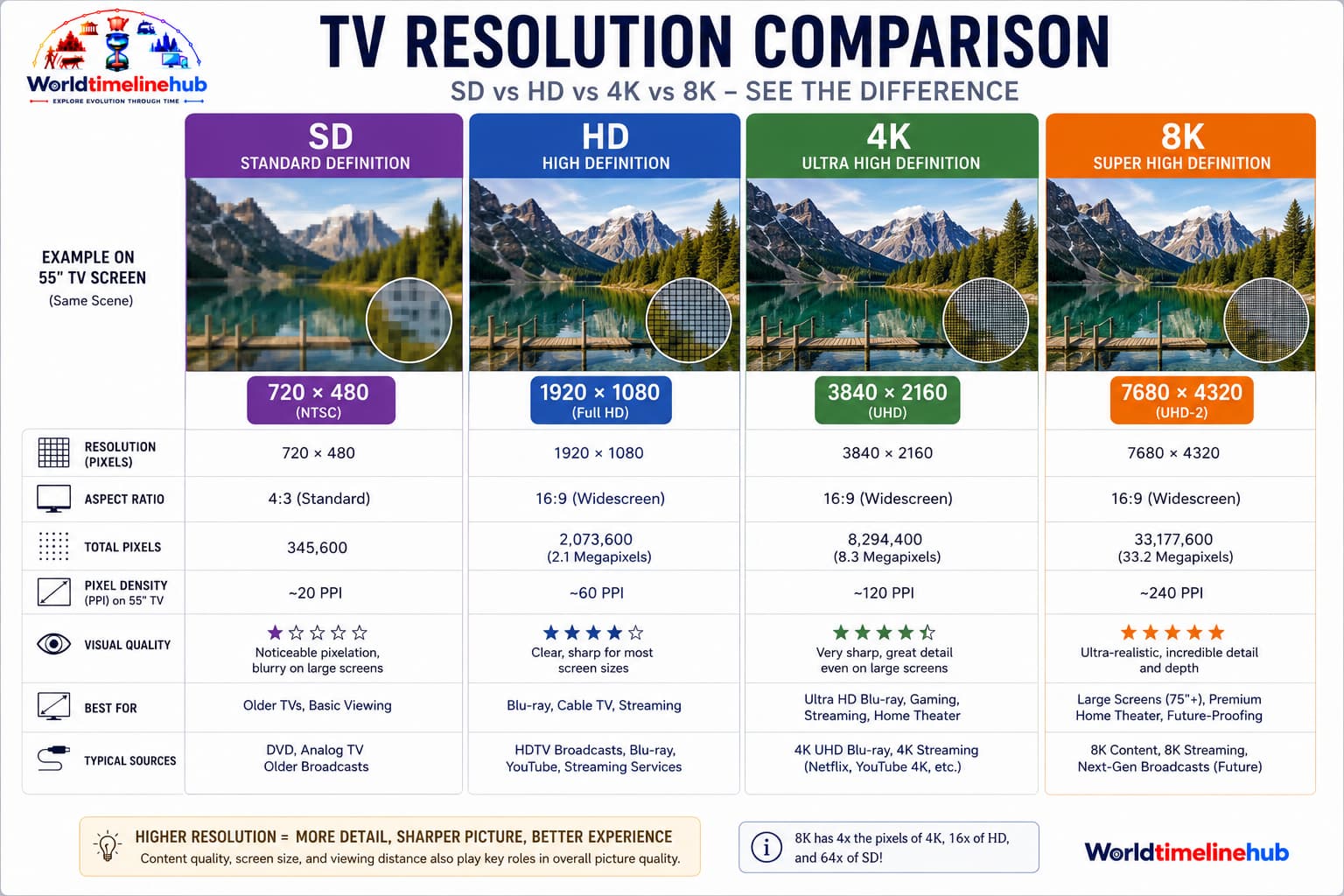
Resolution names (SD, HD, 4K, 8K) describe how many pixels fill the screen. More pixels sharpen fine detail on large TVs, but the source signal and seating distance matter as much as the panel spec on the box.
Resolution compared: SD and HD gave way to 4K and 8K Ultra HD on larger living-room screens.
Resolution
Common name
Pixel count
Era
240p / 480i
Standard Definition (SD)
~640 × 480
1950s–1990s
480p / 576p
Enhanced Definition (ED)
720 × 480 / 720 × 576
1990s–2000s
720p
HD Ready
1280 × 720
2000s
1080i / 1080p
Full HD
1920 × 1080
2000s–2010s
2160p
4K Ultra HD
3840 × 2160
2010s–present
4320p
8K Ultra HD
7680 × 4320
2020s–future
Streaming Platform Timeline
On-demand apps reshaped television from fixed broadcast schedules to libraries you browse anytime. Global giants and India-focused services now compete for sports rights, originals, and regional language catalogs on smart TVs.
Platform
Launch year
Region
Key feature
Netflix (streaming)
2007
Global
From DVD rental to streaming giant
Hulu
2007
US
Current-season TV shows next-day
Amazon Prime Video
2006 (Prime); streaming expanded later
Global
Part of Amazon Prime subscription bundle
Disney+
2019
Global
Disney, Marvel, Star Wars, Pixar franchises
Apple TV+
2019
Global
Original content focus
HBO Max / Max
2020
Global
Warner Bros content library
JioCinema (India)
2016
India
Major sports streaming including IPL
Hotstar (Disney+ Hotstar)
2015
India
Indian sports and regional entertainment
Then vs Now: Television Experience
Compare a typical living room of the 1950s–80s with a smart TV setup today—same couch, different screen technology, channel count, and control over when you watch.
Metric
Then (1950s–80s)
Now (2020s)
Display
CRT (14–27 inch)
OLED / LED (55–85+ inch)
Resolution
480i (standard)
4K to 8K Ultra HD
Aspect ratio
4:3 (square)
16:9 (widescreen)
Channels
5–12 broadcast channels
Hundreds via cable/satellite plus streaming apps
Remote
Wired, then IR remote
Voice control + phone apps
Recording
VCR tapes (rewind to watch)
Cloud DVR + on-demand streaming
Schedule
Fixed broadcast times
On-demand anytime
Cost (flagship)
$1,000+ (1950s dollars)
$1,500–3,000 for large premium sets
Key Inventors and Contributors
Television was not invented by one person alone; multiple pioneers contributed core breakthroughs in scanning, electronic pickup, and broadcast engineering. Their work converged in the 1930s–40s into systems that networks could scale to millions of homes.
Paul Nipkow: Patented the mechanical scanning disc (1884)—an early method to break images into transmittable lines.
John Logie Baird: Demonstrated practical mechanical television and early broadcast experiments in the UK.
Philo Farnsworth: Built a fully electronic television image system and key camera tube concepts (image dissector).
Vladimir Zworykin: Advanced electronic TV through iconoscope and kinescope work at RCA, shaping US broadcast equipment.
Broadcast Standards and Global Adoption
Countries adopted different color-encoding and refresh-rate standards so TVs and transmitters stayed compatible. Traveling with a DVD or game console still reminds you that NTSC, PAL, and SECAM divided the world for decades.
Standard
Typical Regions
Notes
NTSC
US, Japan, parts of Americas
~60Hz system; first major color standard.
PAL
India, UK, Germany, Australia, many others
~50Hz system; improved color stability.
SECAM
France, Russia, parts of Eastern Europe/Africa
Alternative color encoding approach.
Analog Switch-Off Milestones
Digital television (DTV) reclaimed radio spectrum and delivered more channels with better compression. Governments ran public information campaigns so viewers bought converters or new sets before analog transmitters went dark.
United States (2009): Full-power analog TV broadcasts ended—antennas needed digital tuners or converter boxes.
United Kingdom (2012): Nationwide digital switchover completed region by region with Freeview HD options.
India (2015): Major analog cable digitization phases completed—set-top boxes became standard in urban markets.
Home Viewing Shifts: VCR, DVD, and DVR
Before streaming, viewers used tapes and discs to own movies and pause live TV. Each format improved picture quality and convenience until broadband made renting files from the cloud the default.
VCR era (1970s–1980s): Recording on tape enabled time-shifting—VHS won the format war over Betamax for rental stores.
DVD launch (1997): Better picture quality, chapter navigation, and compact movie libraries replaced worn VHS cassettes.
TiVo and DVR (1999+): Hard-disk recording without tapes—pause live TV and season passes for series.
Lessons from TV Experiments
Not every headline feature becomes a lasting standard. These waves show how manufacturers test novelty against everyday comfort, content availability, and price.
3D TV wave (2010–2013): Interest faded due to glasses fatigue, limited content, and weak daily-use value in living rooms.
Curved TVs (2014–2017): Offered visual novelty but limited practical benefit over high-quality flat panels at the same price.
Display, Size, Aspect Ratio, and Audio Evolution
TVs grew wider and louder as content moved from square 4:3 broadcasts to cinematic 16:9 and surround sound. Today a soundbar or AV receiver often matters as much as the panel for sports and films.
Category
Then
Now
Aspect ratio
4:3 standard TV
16:9 widescreen mainstream
Typical sizes
14–21 inch CRT
32–85+ inch flat panels
Audio
Mono
Stereo, surround, Dolby Atmos
First remote: Zenith Flash-Matic (1955) used light beams; later ultrasonic and IR remotes became universal.
Screen size: Average diagonal grew from under 20 inches in the CRT era to 55+ inches for mainstream flat panels.
India spotlight
Indian television evolution
India’s TV journey moved from limited public broadcasting to a large satellite-and-streaming ecosystem serving diverse languages and regions. Doordarshan once dominated; today private channels and OTT apps compete for cricket, serials, and regional cinema audiences nationwide.
1959
Doordarshan begins
Early public television transmissions start in Delhi—national news and cultural programs reach a tiny TV-owning audience at first.
1971+
Expansion phase
Transmission networks and programming gradually expand beyond the capital to more cities and states.
1982
Color TV launch
Asian Games coverage accelerates nationwide color television adoption and set sales.
1990s
Satellite era
Zee TV, Star TV, and private channels reshape content, advertising, and prime-time competition with Doordarshan.
2010s+
Digital and OTT
Digitization, DTH, and streaming platforms (Hotstar, JioCinema, and others) transform how audiences watch sports and serials on any screen.
Regional languages: Channels in Hindi, Tamil, Telugu, Bengali, and more built loyal regional prime-time blocks.
Cricket rights: Live matches on TV and OTT drive subscription and advertising revenue spikes.
Cable & DTH: Millions of homes moved from antenna-only to pay-TV packs before apps added another layer.
Television Advertising History
TV advertising turned mass attention into a product you could buy by the second. Sponsored programs, jingles, and prime-time slots funded free-to-air networks long before targeted streaming ads measured every click.
1941: Bulova airs one of the first TV commercials in the US during a baseball game broadcast.
Advertising evolves from short sponsor spots to prime-time brand storytelling and multi-crore cricket ad breaks in India.
Modern TV ads blend broadcast reach with digital targeting, addressable TV, and measurement on connected sets.
Test Your Knowledge
20 quick questions from the television timeline—eras, key events, display tech, streaming, and India spotlight. Click each question to reveal the answer.
Answer: Paul Nipkow.
Answer: John Logie Baird.
Answer: Philo Farnsworth.
Answer: Cathode Ray Tube.
Answer: NTSC.
Answer: UK, Germany, Australia, India.
Answer: 1982 (Asian Games).
Answer: VCR (Video Cassette Recorder).
Answer: Digital television (DTV).
Answer: OLED.
Answer: Resolution of approximately 3840 × 2160 pixels.
Use these 10 prompts for group discussion, homework, or short classroom presentations. Each task ties to a section on this page—inventors, color standards, streaming, and India’s broadcast story. Encourage students to cite dates and technologies from the tables above.
Jump to any other technology timeline on WorldTimelineHub.
Disclaimer: This content is AI-generated for educational purposes and may contain errors or outdated details. For correct and authoritative information, please refer to official and reliable sources such as government publications, manufacturers, museums, and academic references.