Long before modern banks, Indian shroffs and sahukars accepted deposits, lent money, and moved funds across the country with hundis.
Today more than 50 crore Jan Dhan accounts and billions of UPI payments a month show how far banking has spread — from merchants’ ledgers to every mobile phone.
This timeline covers indigenous bankers, the Bank of Hindostan, the presidency banks, swadeshi banks, the Imperial Bank, the Reserve Bank of India,
the State Bank of India, bank nationalisation, Regional Rural Banks, private bank reforms, ATMs, NEFT and RTGS, Jan Dhan, UPI, and the bank mergers of 2019–2020.
A bank keeps people’s savings safe as deposits, lends money to farmers, businesses, and families, and moves money from one person to another through
cheques, cards, and digital payments. In India this work was first done by family banking houses. Colonial rule brought joint-stock banks, and after
independence the government used banks to spread credit to villages. Since 1991, competition, technology, and financial inclusion have reshaped banking,
all under the supervision of the Reserve Bank of India.
Big picture
Indian banking in one view
Indian banking moved from trusted merchant families, to city banks serving trade and government, to state-owned banks reaching villages, and finally
to a mix of public, private, small finance, and payments banks connected by digital rails. Related timelines:
Indian currency — coins & notes,
rupee history & exchange rate,
mobile phones & UPI.
1770
Bank of Hindostan founded
14
Banks nationalised in 1969
12
Public sector banks after 2020
50 crore+
Jan Dhan accounts (2023)
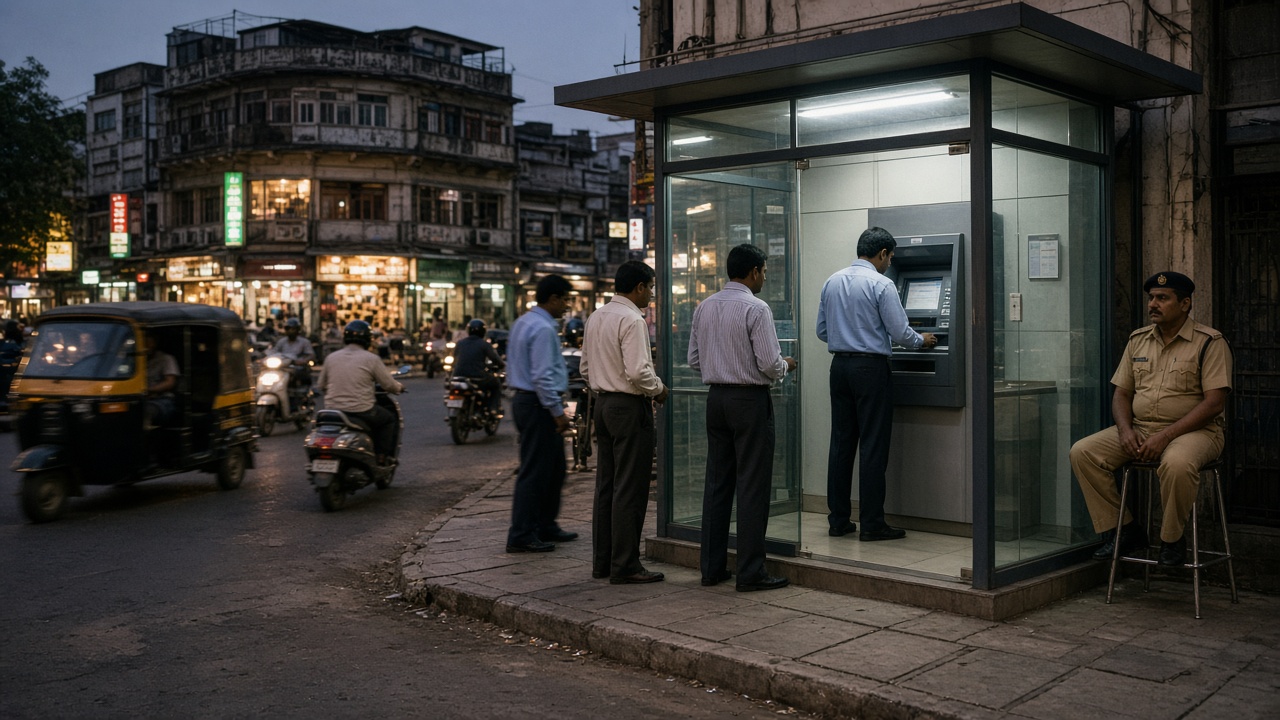
Today’s branches mix self-service kiosks, passbook printers, and QR payments with personal help (artistic illustration).
📜 Shroffs & HundisAncient – 1770
Indigenous Bankers & Hundis
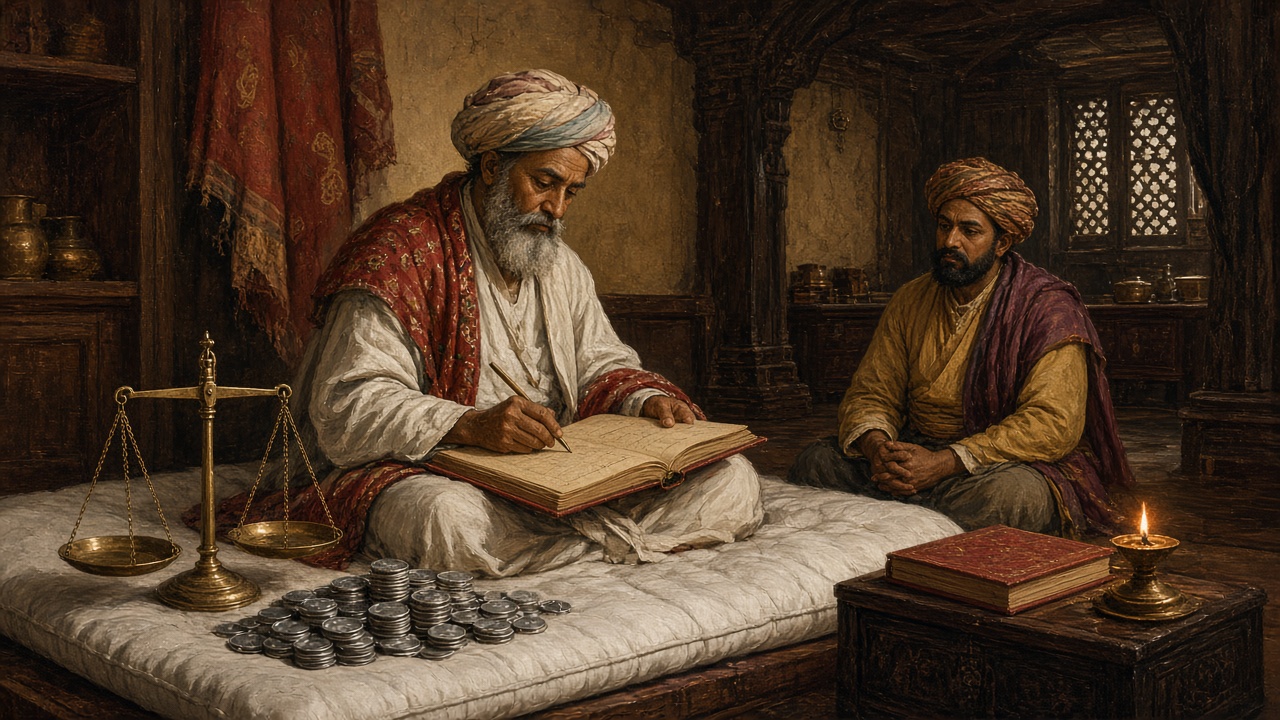
For centuries, moneylenders, shroffs, and great banking houses accepted deposits, gave loans, changed coins, and sent money across India using hundis. Their networks financed traders, farmers, and even kings, long before any bank of the European type existed.
Shroffs kept careful ledgers and wrote hundis that could be cashed in distant cities (artistic illustration).
Ancient texts: The Manusmriti and Kautilya’s Arthashastra mention deposits, loans, pledges, and interest rates.
Medieval period: Hundis (bills of exchange) let merchants transfer money between cities without carrying coins.
Banking castes and houses: Marwari, Chettiar, Multani, Gujarati, and other communities built trading and lending networks across India and beyond.
18th century: The Jagat Seth house of Murshidabad became one of the most powerful banking families, handling revenue and minting for Bengal’s rulers.
Banking tools
Hundi: Written order to pay money at another place.
Bahi-khata: Red cloth-bound account ledgers.
Pledge loans: Gold, jewellery, or crops as security.
Features
Trust-based: Built on family reputation and community ties.
High interest: Village moneylenders often charged steep rates.
Wide reach: Networks linked India with Central Asia and Southeast Asia.
🏛️ Presidency Banks1770 – 1920
Agency Houses, Presidency & Swadeshi Banks
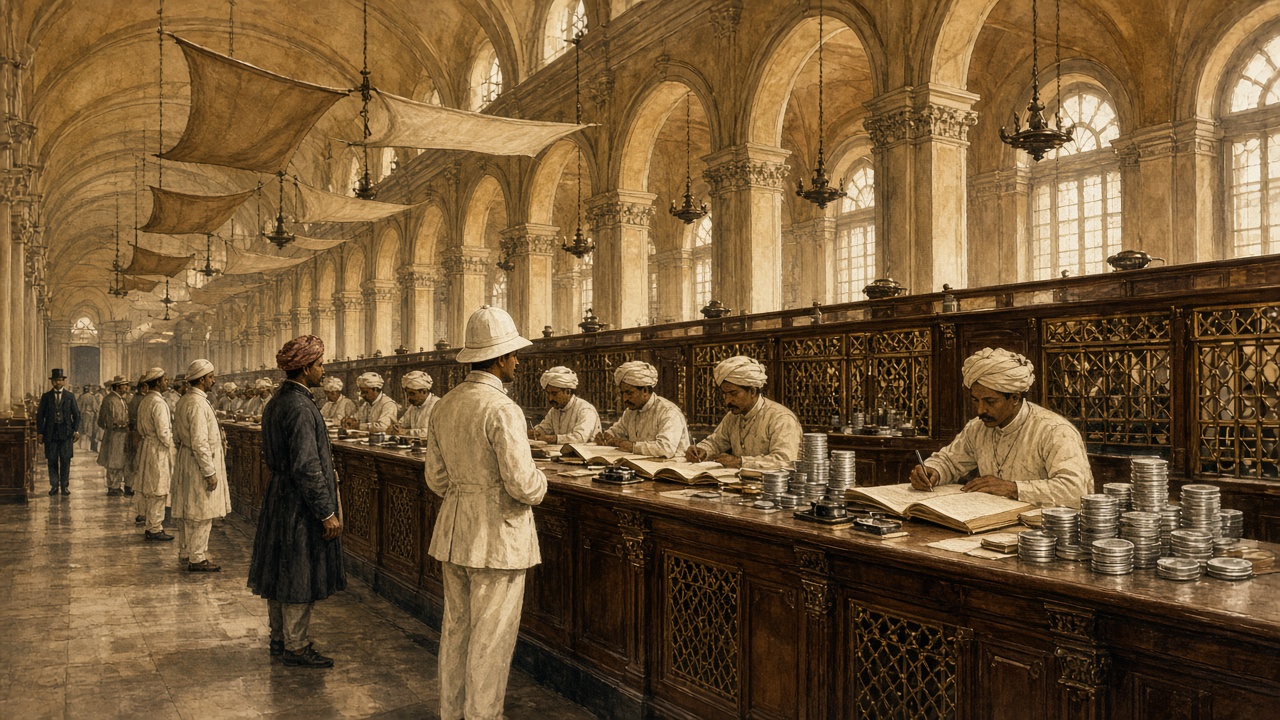
European agency houses started the first joint-stock banks in Calcutta. Three presidency banks became the backbone of colonial finance, and later the swadeshi movement inspired Indians to found their own banks — many of which are still among India’s biggest today.
Presidency banks in Calcutta, Bombay, and Madras handled government and trade business (artistic illustration).
1770–1791: The Bank of Hindostan opens in Calcutta (1770); the General Bank of India follows (1786) but fails within a few years.
1806–1843: The Bank of Calcutta (1806, renamed Bank of Bengal in 1809), the Bank of Bombay (1840), and the Bank of Madras (1843) become the three presidency banks.
1865–1895: Allahabad Bank (1865) is founded; the Oudh Commercial Bank (1881) is run by Indians; the Post Office Savings Bank opens (1882); Punjab National Bank starts in Lahore (1895).
1904–1919: The Co-operative Credit Societies Act (1904); swadeshi banks such as Bank of India and Canara Bank (1906), Indian Bank (1907), Bank of Baroda (1908), Central Bank of India (1911), and Union Bank of India (1919).
Banking tools
Joint-stock banks: Owned by many shareholders.
Bank notes: Presidency banks issued notes until 1861.
Cheques: Used by traders and firms in port cities.
Features
Urban focus: Banks served ports, trade, and government.
Frequent failures: Many small banks collapsed without regulation.
National pride: Swadeshi banks mobilised Indian savings.
🏦 Central Bank1921 – 1954
Imperial Bank, RBI & Banking Laws
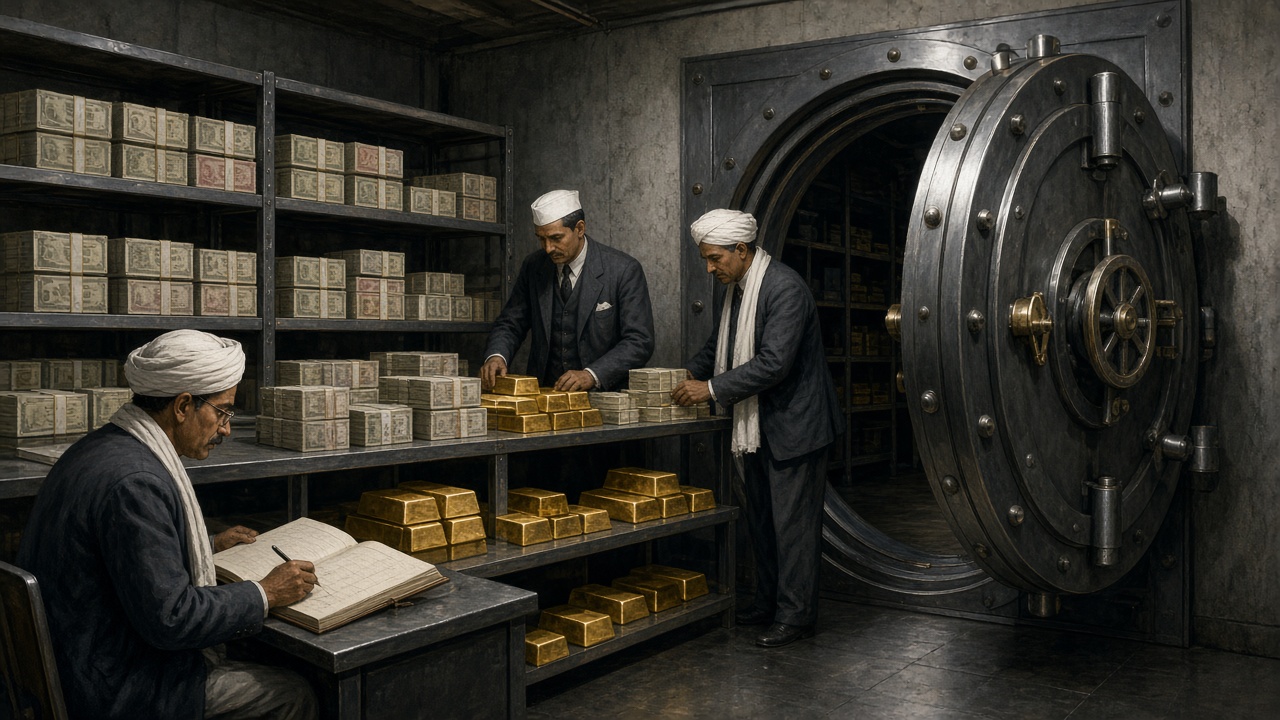
The three presidency banks merged into the Imperial Bank of India. A central bank — the Reserve Bank of India — was created to issue currency and regulate credit, and after independence a strong banking law gave the RBI power to supervise banks after waves of bank failures.
The central bank held gold and currency reserves and issued the nation’s notes (artistic illustration).
27 January 1921: The Bank of Bengal, Bank of Bombay, and Bank of Madras merge to form the Imperial Bank of India.
1926–1931: The Hilton Young Commission recommends a central bank; the Central Banking Enquiry Committee (1929–31) studies banking across India.
1934–1937: The RBI Act (1934); the RBI begins on 1 April 1935 in Calcutta and moves its central office to Bombay in 1937.
1949–1954: The RBI is nationalised (1 January 1949); the Banking Companies Act, 1949 (later the Banking Regulation Act) gives it licensing and inspection powers; the All India Rural Credit Survey (1954) recommends a state-owned bank.
Banking tools
Bank rate: RBI’s lending rate to guide credit.
Cash reserves: Banks keep a share of deposits with the RBI.
Licensing: Banks need RBI permission to operate.
Features
Banker’s bank: RBI lends to and supervises banks.
Government’s bank: RBI manages public debt.
Safer banking: Weak banks merged or closed.
🌾 Banks for the Masses1955 – 1990
SBI, Nationalisation & Rural Banking
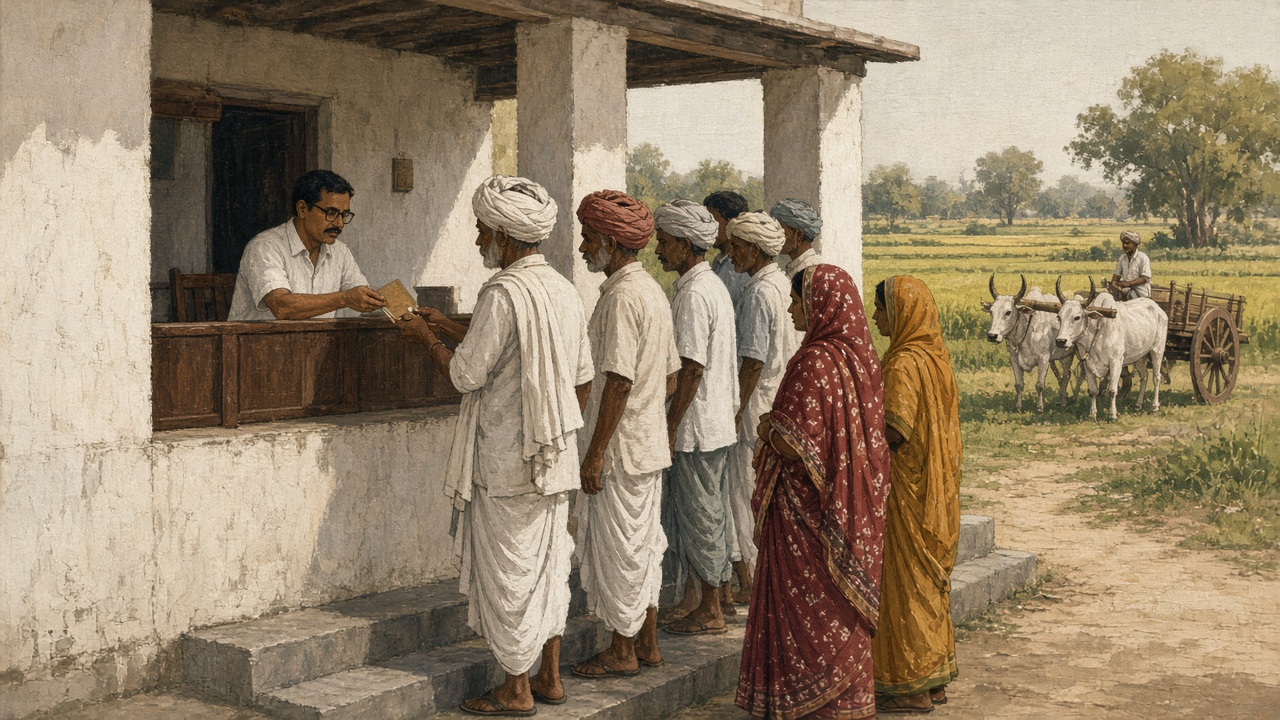
To take banking to villages, the government created the State Bank of India and later nationalised major commercial banks. Thousands of rural branches opened, priority sector lending was introduced, and new institutions served farmers, small industry, and exports.
After 1969, bank branches spread rapidly into villages and small towns (artistic illustration).
1955–1962: The State Bank of India is formed on 1 July 1955; SBI subsidiary banks are set up (1959); deposit insurance begins (1962).
19 July 1969: Fourteen large banks with deposits over ₹50 crore are nationalised; the Lead Bank Scheme assigns districts to banks.
1975–1982: Regional Rural Banks start on 2 October 1975; six more banks are nationalised on 15 April 1980; NABARD and EXIM Bank are set up (1982).
1984–1990: The Rangarajan Committee recommends computerisation (1984); the first ATM in India opens in Mumbai (1987); SIDBI is created (1990).
Banking tools
Priority sector lending: Set share of loans for farms and small units.
Branch licensing: Banks opened rural branches for city ones.
MICR cheques: Machine-readable cheques speed up clearing.
Features
Mass banking: Branches grew many times over.
Social goals: Credit to farmers, artisans, and weaker sections.
Low profits: Controls and bad loans hurt efficiency.
💳 Reforms & ATMs1991 – 2009
Reforms, Private Banks & Electronic Payments
The 1991 reforms opened banking to competition. New private banks brought ATMs, computerised branches, and phone and internet banking. Stronger capital rules, recovery laws, and electronic payment systems helped Indian banks stay stable during the 2008 global crisis.
ATMs spread quickly after new private banks entered the market (artistic illustration).
1991–1993: The Narasimham Committee recommends reforms (1991); capital adequacy norms are introduced; Debt Recovery Tribunals are set up (1993); RBI issues guidelines for new private banks (1993).
1994–1998: UTI Bank (now Axis Bank), ICICI Bank, HDFC Bank, and IndusInd Bank start; the Banking Ombudsman Scheme (1995); SHG–bank linkage grows; the Kisan Credit Card is launched (1998).
2002–2005: The SARFAESI Act (2002) helps banks recover bad loans; Kotak Mahindra Bank (2003) and Yes Bank (2004) begin; RTGS (2004) and NEFT (2005) start.
2008–2009: NPCI is formed (2008); cheque truncation begins; core banking lets customers bank at any branch; Indian banks withstand the global financial crisis.
Banking tools
Core banking: All branches linked to one central system.
ATMs & debit cards: Cash any time, anywhere.
RTGS & NEFT: Electronic bank-to-bank transfers.
Features
Competition: Better service and new products.
Deregulation: Freer interest rates.
Stability: Capital and prudential norms.
📱 Digital & Inclusive2010 – Present
Inclusion, UPI & Bank Mergers
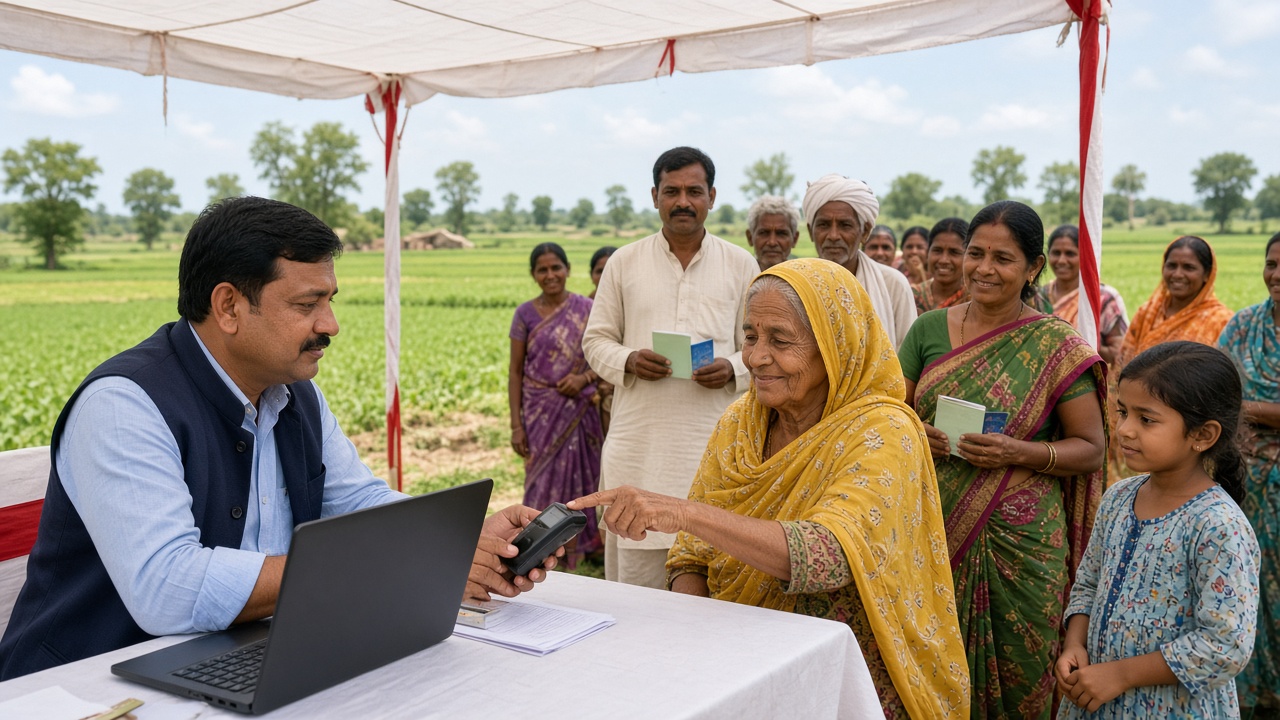
India brought hundreds of millions of people into the banking system through Jan Dhan accounts, Aadhaar, and mobile phones. UPI made instant payments free and simple, new kinds of banks were licensed, and public sector banks were merged into fewer, larger banks.
Banking correspondents use biometric devices to open accounts in villages (artistic illustration).
2010–2014: IMPS offers 24×7 instant transfers (2010); RuPay cards launch (2012); PM Jan Dhan Yojana begins on 28 August 2014.
2015–2016: MUDRA loans for small businesses (2015); licences for payments banks and small finance banks (2015); UPI launches (2016); the Insolvency and Bankruptcy Code (2016).
2017–2020: SBI merges its associate banks (2017); India Post Payments Bank (2018); Bank of Baroda absorbs Vijaya and Dena Banks (2019); 10 public sector banks merge into 4 on 1 April 2020; deposit insurance rises to ₹5 lakh (2020).
2022–present: RBI pilots the digital rupee e₹ (2022); HDFC merges with HDFC Bank (2023); Jan Dhan accounts cross 50 crore (2023); UPI handles billions of transactions every month.
Banking tools
UPI: Instant phone-to-phone bank payments.
Aadhaar e-KYC: Quick paperless account opening.
Banking correspondents: Agents serve villages.
Features
Financial inclusion: Accounts for the unbanked.
Direct Benefit Transfer: Subsidies paid straight into accounts.
Cyber safety: New focus on fraud and data protection.
Landmark Banks & When They Began
Year
Bank
Note
1770
Bank of Hindostan
Early European-style bank in Calcutta; closed 1832
1806
Bank of Calcutta / Bank of Bengal
First presidency bank; renamed in 1809
1840
Bank of Bombay
Presidency bank
1843
Bank of Madras
Presidency bank
1865
Allahabad Bank
One of the oldest joint-stock banks; merged into Indian Bank (2020)
1881
Oudh Commercial Bank
Early bank managed by Indians
1895
Punjab National Bank
Started in Lahore with Indian capital
1906
Bank of India; Canara Bank
Swadeshi-era banks
1907
Indian Bank
Founded in Madras
1908
Bank of Baroda
Founded by Maharaja Sayajirao Gaekwad III
1911
Central Bank of India
Fully Indian-owned and managed
1921
Imperial Bank of India
Merger of the three presidency banks
1935
Reserve Bank of India
Central bank
1955
State Bank of India
Took over the Imperial Bank
1994
ICICI Bank, HDFC Bank, UTI (Axis) Bank
New private sector banks
2018
India Post Payments Bank
Banking through post offices
Bank Nationalisation: 1969 and 1980
In 1969, banks with deposits above ₹50 crore were nationalised; in 1980, banks with deposits above ₹200 crore.
Date
Banks nationalised
19 July 1969 (14 banks)
Allahabad Bank, Bank of Baroda, Bank of India, Bank of Maharashtra, Canara Bank, Central Bank of India, Dena Bank, Indian Bank, Indian Overseas Bank, Punjab National Bank, Syndicate Bank, UCO Bank, Union Bank of India, United Bank of India
15 April 1980 (6 banks)
Andhra Bank, Corporation Bank, New Bank of India, Oriental Bank of Commerce, Punjab & Sind Bank, Vijaya Bank
Public Sector Bank Mergers
Year
Merged into
Banks merged
1993
Punjab National Bank
New Bank of India
2008–2010
State Bank of India
State Bank of Saurashtra, State Bank of Indore
2017
State Bank of India
Five associate banks and Bharatiya Mahila Bank
2019
Bank of Baroda
Vijaya Bank, Dena Bank
2020
Punjab National Bank
Oriental Bank of Commerce, United Bank of India
2020
Canara Bank
Syndicate Bank
2020
Union Bank of India
Andhra Bank, Corporation Bank
2020
Indian Bank
Allahabad Bank
From Cheques to UPI: Payment Milestones
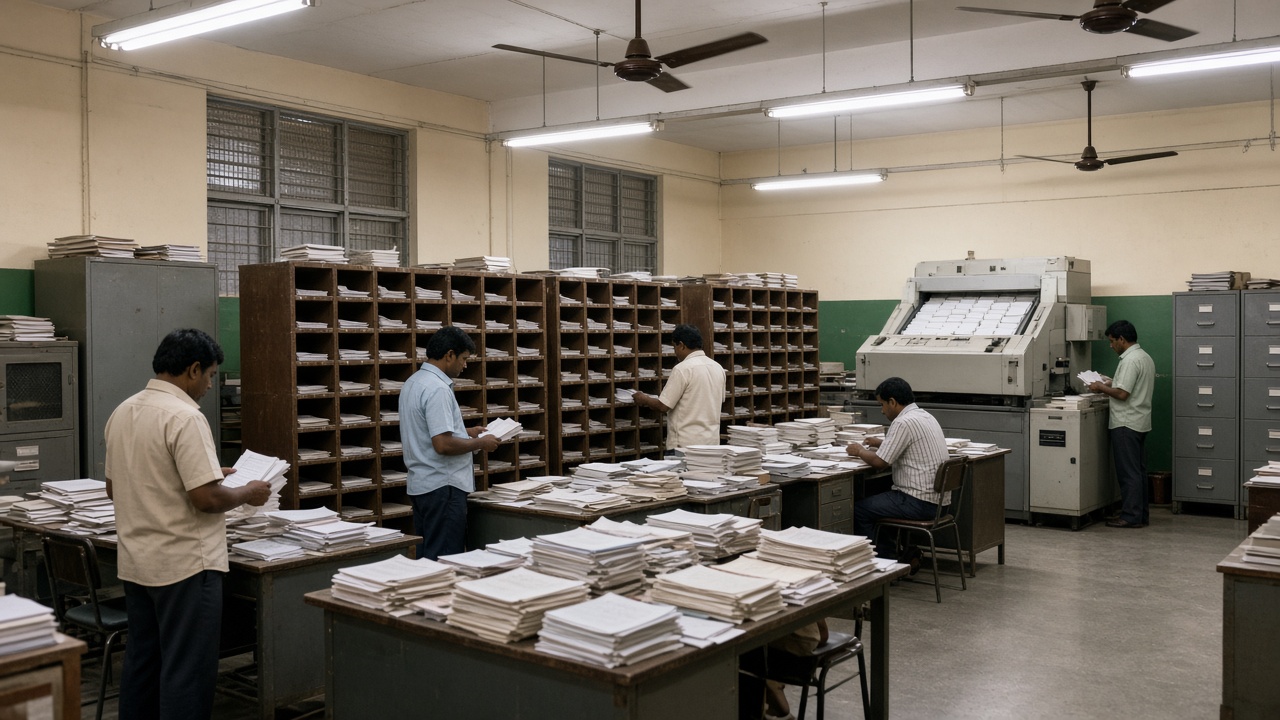
Before electronic payments, clearing houses sorted millions of paper cheques by hand and by machine (artistic illustration).
Click any panel to expand and explore the visual mood.
Indian banking in pictures — shroffs and hundis, presidency banks, central bank vaults, village branches, cheque clearing, ATMs, Jan Dhan camps, and modern digital branches.
Shroffs & Hundis
Indigenous banking
Presidency Banks
1806–1921
Central Bank
RBI from 1935
Village Branches
After 1969
Cheque Clearing
MICR era
ATMs
Cash any time
Financial Inclusion
Jan Dhan from 2014
Digital Banking
UPI & kiosks
Explore all economy timelines
Jump to any other economy timeline on WorldTimelineHub.
Disclaimer: This content is AI-generated for educational purposes and may contain errors or outdated details. For correct and authoritative information, please refer to official and reliable sources such as government publications, manufacturers, museums, and academic references.