The rupee began as a silver coin of about 178 grains in the 1540s. Over nearly 500 years it has been tied to silver, gold, the British pound,
and a basket of currencies — and today its value is set in the foreign exchange market, watched daily by traders, businesses, and families.
This timeline follows the rupee’s value and management — the Company rupee, the fall of silver, the gold exchange standard, the sterling link,
devaluations in 1949, 1966, and 1991, the Gulf rupee, convertibility, inflation targeting, the ₹ symbol, and the push to use the rupee in global trade.
A currency’s value depends on what backs it and how it is managed. The early rupee was worth its silver content. Later it was fixed to gold or to
the British pound, and after independence to the US dollar system and then a basket of currencies. Since 1993 the rupee’s exchange rate is mainly
decided by demand and supply in the foreign exchange market, with the Reserve Bank of India stepping in to calm sharp swings. Inflation, trade,
foreign investment, oil prices, and global interest rates all move the rupee.
Big picture
The rupee’s journey in one view
The rupee moved from a trusted silver coin used across the Indian Ocean, to a colonial currency managed from London, to a planned-economy
currency with fixed rates, and finally to a market-traded currency of one of the world’s largest economies. Related timelines:
Indian currency — coins & notes,
mobile phones & UPI.
1540s
Silver rupiya introduced
₹7.50
Per US$ after 1966 devaluation
1991
Balance of payments crisis
$700 bn+
Forex reserves (2024)
India now encourages international trade to be settled in rupees (artistic illustration).
🪙 Rupiya is Born1540 – 1757
Birth of the Silver Rupee
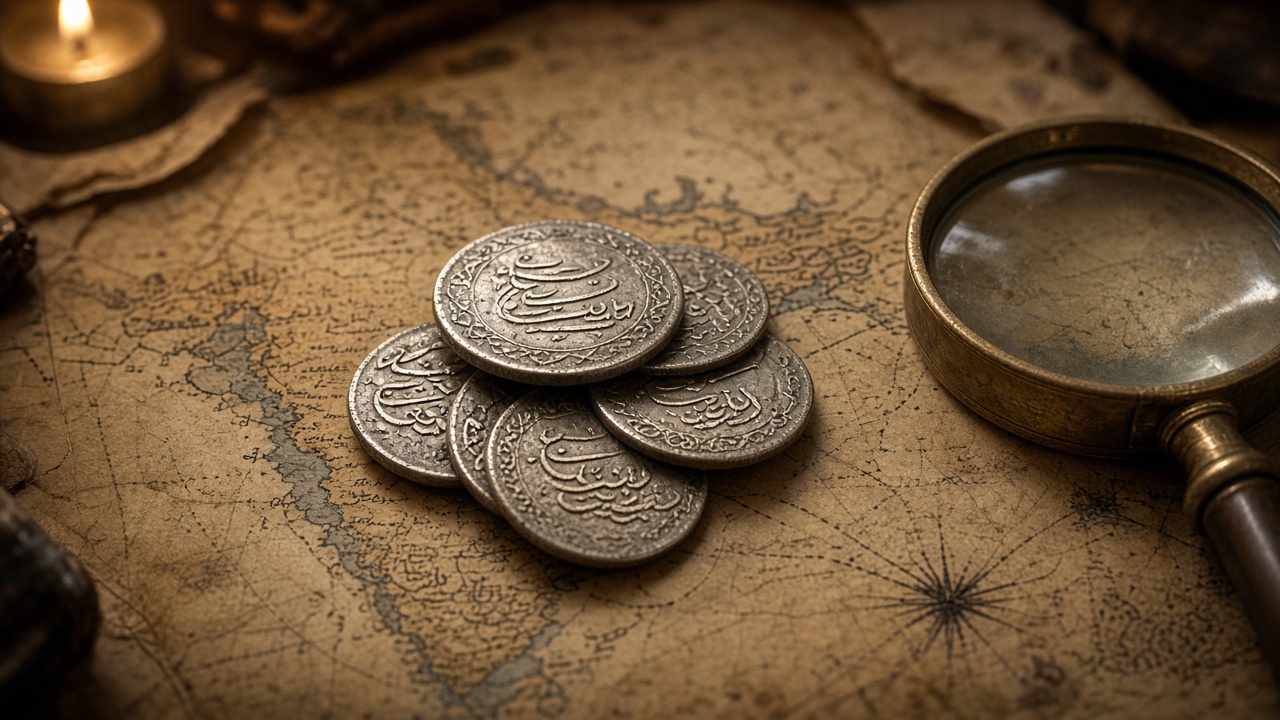
Sher Shah Suri’s pure silver rupiya set a standard that the Mughals kept for two centuries. Because its weight and purity were reliable, the rupee became a trusted trade coin used by merchants across India, the Persian Gulf, and the Indian Ocean.
Silver rupees with Persian inscriptions were trusted across India’s trade routes (artistic illustration).
Name: “Rupee” comes from the Sanskrit rupya, meaning wrought or stamped silver.
1540–1545: Sher Shah Suri issues the silver rupiya of about 178 grains, alongside the copper dam and gold mohur.
1556–1707: Mughal emperors keep the rupee standard; silver from the Americas flows into India through trade, and rupees are struck at many mints.
18th century: As Mughal power weakens, regional rulers and the East India Company strike their own rupees, such as the Arcot and Surat rupees.
Value basis
Silver content: A rupee was worth its weight in silver.
Assaying: Sarrafs tested purity and charged a discount on worn coins.
Free coinage: Merchants could bring silver to mints to be coined.
Features
High purity: Nearly pure silver coins.
Trade currency: Accepted in ports across the Indian Ocean.
Many varieties: Value differed by mint and age of coin.
⚓ Company Rupee1757 – 1892
Company Rupee & Silver Standard
The East India Company replaced many local rupees with one uniform rupee. India stayed on a silver standard — but when major countries moved to gold, silver prices crashed and the rupee lost value steeply against the British pound, hurting India’s finances.
Merchants weighed and exchanged different local rupees at busy ports (artistic illustration).
1757–1830s: Many rupees circulate — the Sicca rupee in Bengal, the Arcot rupee in Madras, and the Surat rupee in Bombay — each with slightly different value.
1835: The Coinage Act creates a uniform Company rupee of 180 grains (one tola) of 11/12 fine silver across British India.
1858–1872: The Crown takes over from the Company; the silver rupee remains India’s standard of value.
1873–1892: After Germany and the USA move away from silver, its price falls; the rupee slides from about 2 shillings towards about 1 shilling 1 penny, raising India’s costs of paying debts in London.
Value basis
Silver standard: Rupee value moved with world silver prices.
Machine minting: Uniform coins from Calcutta and Bombay mints.
Paper currency: Government notes backed by silver reserves from 1861.
Features
One rupee for India: An end to confusing local rupees.
“Home charges”: India paid pensions and debts to Britain in pounds.
Falling rupee: Silver crash made those payments costlier.
🏦 Gold & Sterling1893 – 1947
Gold Exchange Standard, Sterling & RBI
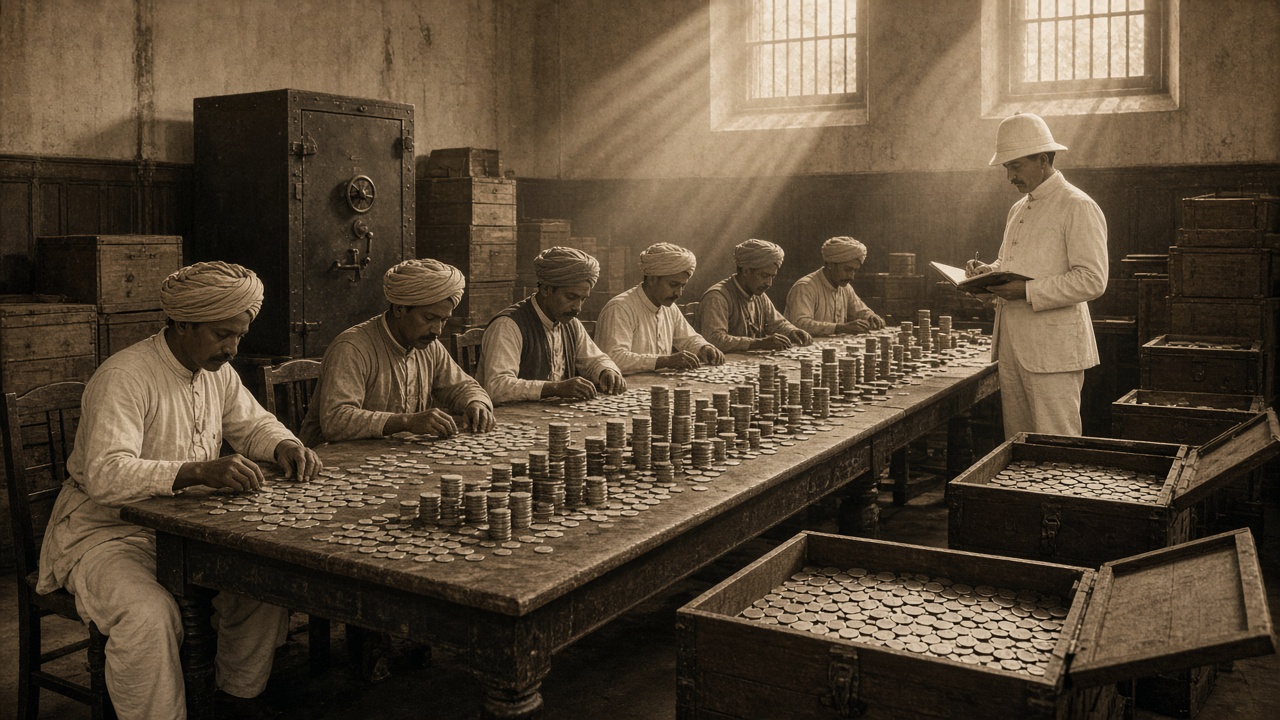
To stop the fall, India closed its mints to free silver coinage and fixed the rupee to gold through sterling reserves in London. Commissions debated the “right” exchange rate for decades, famous economists wrote about the rupee, and the Reserve Bank of India was created to manage currency and credit.
Government treasuries held huge stocks of silver rupees while reserves backing the rupee were kept in London (artistic illustration).
1893–1899: On the Herschell Committee’s advice, mints close to free silver coinage (1893); after the Fowler Committee, the rupee is fixed at 1 shilling 4 pence, or ₹15 to £1 (1899).
1913–1923: Chamberlain Commission, with J. M. Keynes as a member, who also writes Indian Currency and Finance (1913); a wartime silver shortage brings the ₹1 note (1917); B. R. Ambedkar publishes The Problem of the Rupee (1923).
1926–1931: The Hilton Young Commission recommends 1 shilling 6 pence and a central bank; the Currency Act fixes 1s 6d (1927); when Britain leaves gold (1931), the rupee is linked to sterling.
1935–1947: The RBI starts on 1 April 1935; India builds large sterling balances in the Second World War; India becomes a founding member of the IMF (1944–45).
Value basis
Gold exchange standard: Rupee fixed to gold via sterling.
Reserves in London: Gold Standard Reserve and Paper Currency Reserve.
Council Bills: Payments between London and India.
Features
Token coin: The silver rupee became worth more than its silver.
Fierce debates: Indian leaders said a high rupee hurt farmers and industry.
Central banking: RBI begins managing currency.
📉 Pegs & Devaluations1947 – 1990
Fixed Pegs & Devaluations
Independent India kept a fixed exchange rate under the IMF system. Wars, droughts, and trade deficits forced devaluations in 1949 and 1966. Strict foreign exchange controls limited how much foreign currency Indians could buy, and the rupee was even used as the currency of several Gulf states.
Until the 1960s, markets in several Gulf states traded in rupees, including the special Gulf rupee (artistic illustration).
1947–1949: The rupee stays at 1s 6d (about ₹3.31 per US dollar); RBI is nationalised (1 January 1949); in September 1949 the rupee is devalued with sterling to ₹4.76 per US dollar.
1959: The RBI issues a special Gulf rupee for Persian Gulf states to curb gold smuggling.
6 June 1966: After wars and severe droughts, the rupee is devalued by about 36.5% to ₹7.50 per US dollar; most Gulf states then adopt their own currencies.
1971–1990: After the Bretton Woods system collapses (1971), the rupee stays linked to sterling; FERA tightens exchange controls (1973); from 1975 the rupee is pegged to a basket of currencies.
Value basis
Par value: Fixed rate declared to the IMF.
Basket peg: Rupee managed against trading partners’ currencies.
Exchange control: RBI approval needed for most foreign exchange.
Features
Import substitution: Limited imports to save foreign exchange.
Travel limits: Small foreign exchange allowances for Indians abroad.
Black market: Unofficial “hawala” rates above official rates.
🔓 Liberalisation1991 – 2009
1991 Crisis & Market-Determined Rupee
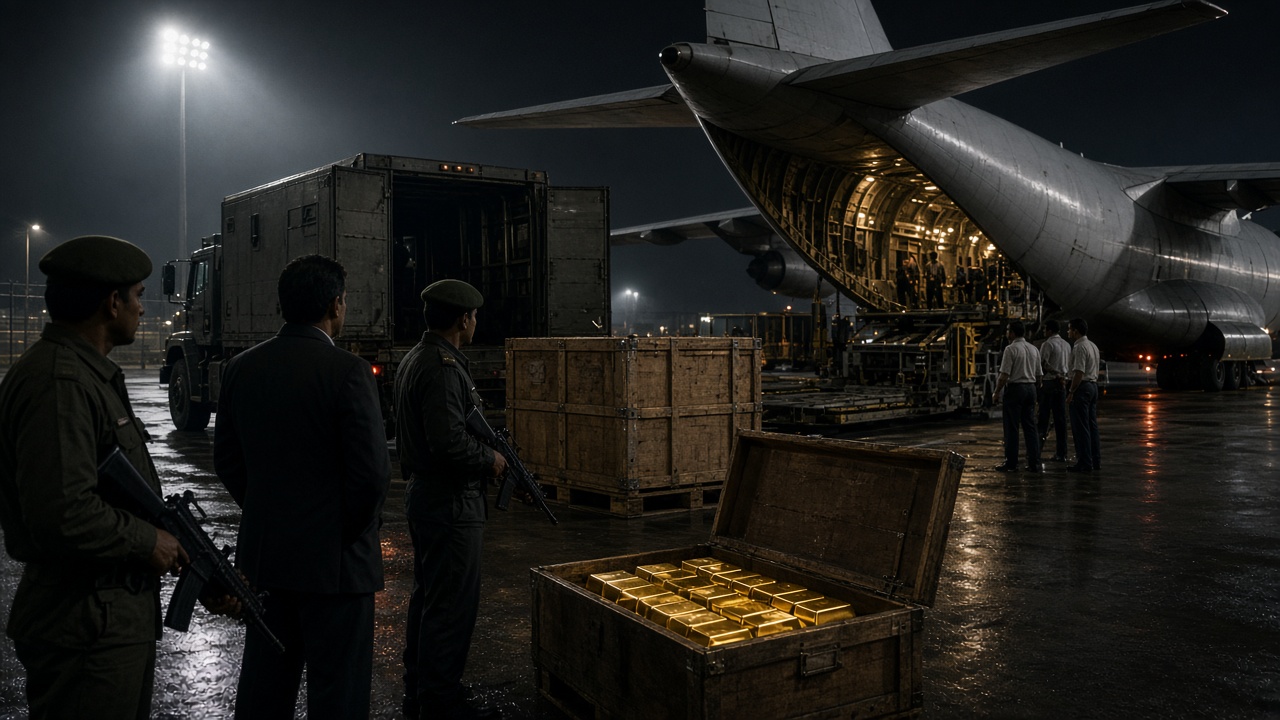
In 1991 India nearly ran out of foreign exchange. The government pledged gold, devalued the rupee, and launched economic reforms. The rupee moved to a market-determined exchange rate, became convertible for trade and travel, and foreign exchange reserves began to grow strongly.
In 1991 India pledged gold abroad to raise emergency foreign exchange (artistic illustration).
1991: Reserves fall to only a few weeks of imports; India pledges about 47 tonnes of gold with the Bank of England and the Bank of Japan; the rupee is devalued in two steps on 1 and 3 July; IMF support and liberalisation follow.
1992–1993: The Liberalised Exchange Rate Management System (LERMS) introduces a dual rate (1992); the rupee becomes market-determined in March 1993.
1994–1997: Current account convertibility is accepted in August 1994; the Tarapore Committee (1997) plans a path to capital account convertibility.
1999–2009: FEMA replaces FERA (in force from 2000); strong inflows push the rupee to about ₹39 per US dollar in 2007; it weakens to about ₹50 in the 2008 global financial crisis.
Value basis
Managed float: Market sets the rate; RBI smooths volatility.
Forex market: Banks trade rupees and dollars electronically.
Reserves: RBI builds reserves as a safety buffer.
Features
Open economy: Easier trade, travel, and foreign investment.
Convertibility: Free exchange for current account deals.
Global shocks: Rupee now reacts to world markets.
🌏 Global Rupee2010 – Present
₹ Symbol & Global Rupee
The rupee gained its own symbol, a formal inflation target, and record foreign exchange reserves. India began promoting rupee trade settlement, linking UPI with other countries, and piloting a digital rupee — steps toward a more international currency.
Bank dealers trade rupees against the dollar and other currencies every working day (artistic illustration).
2010: The ₹ symbol, designed by D. Udaya Kumar, is adopted on 15 July 2010.
2013: During the “taper tantrum,” the rupee falls to a then-record of about ₹68.8 per US dollar (August 2013).
2016–2019: RBI adopts inflation targeting — 4% CPI inflation with a ±2% band — and forms the Monetary Policy Committee (2016).
2022–present: RBI allows international trade settlement in rupees (July 2022); the rupee crosses ₹80 per US dollar (2022) and ₹85 (December 2024); forex reserves pass $700 billion (2024); UPI links with other countries.
Value basis
Inflation targeting: Stable prices support the rupee’s value.
Vostro accounts: Foreign banks hold rupees for trade settlement.
Digital rails: UPI and e₹ for faster payments.
Features
Identity: ₹ symbol recognised worldwide.
Large buffer: Among the world’s largest forex reserves.
Still managed: Capital account only partly open.
Rupee vs US Dollar Through the Years
Approximate rupees per US dollar (official rates before 1993, rounded yearly averages after). For exact figures, see RBI data.
Year
₹ per US$ (approx.)
Context
1947
3.31
Rupee at 1s 6d, linked to sterling
1949
4.76
Devaluation with the British pound
1966
7.50
Devaluation of about 36.5%
1975
8.4
Basket peg begins
1985
12.4
Gradual managed depreciation
1990
17.5
Before the balance of payments crisis
1991
22.7
July devaluation; near 26 by year-end
1995
32.4
Market-determined rate
2000
45.0
FEMA in force
2007
41.3
Strong inflows; touched about 39
2010
45.7
₹ symbol adopted
2013
58.6
Taper tantrum; low of about 68.8
2015
64.2
Inflation falls, reserves rise
2020
74.1
COVID-19 pandemic
2022
78.6
Crosses 80 amid a strong dollar
2024
83.7
Crosses 85 in December
What Backed the Rupee: Monetary Standards
Period
Standard
How it worked
1540s–1893
Silver standard
Rupee worth its silver; value moved with silver prices
1893–1898
Transition
Mints closed to free silver coinage
1899–1917
Gold exchange standard
Fixed at 1s 4d (₹15 = £1), backed by reserves in London
1917–1926
Unstable rates
Wartime silver rise; failed attempt to fix 2s gold (1920)
1927–1931
Gold bullion / exchange standard
Fixed at 1s 6d under the Currency Act, 1927
1931–1947
Sterling standard
Linked to the British pound at 1s 6d
1947–1971
IMF par value system
Fixed rate; devaluations in 1949 and 1966
1971–1975
Sterling link
After Bretton Woods collapse
1975–1992
Basket peg
RBI managed rate against major currencies
1992–1993
LERMS dual rate
Part official, part market rate
1993–present
Market-determined (managed float)
Market sets the rate; RBI limits volatility
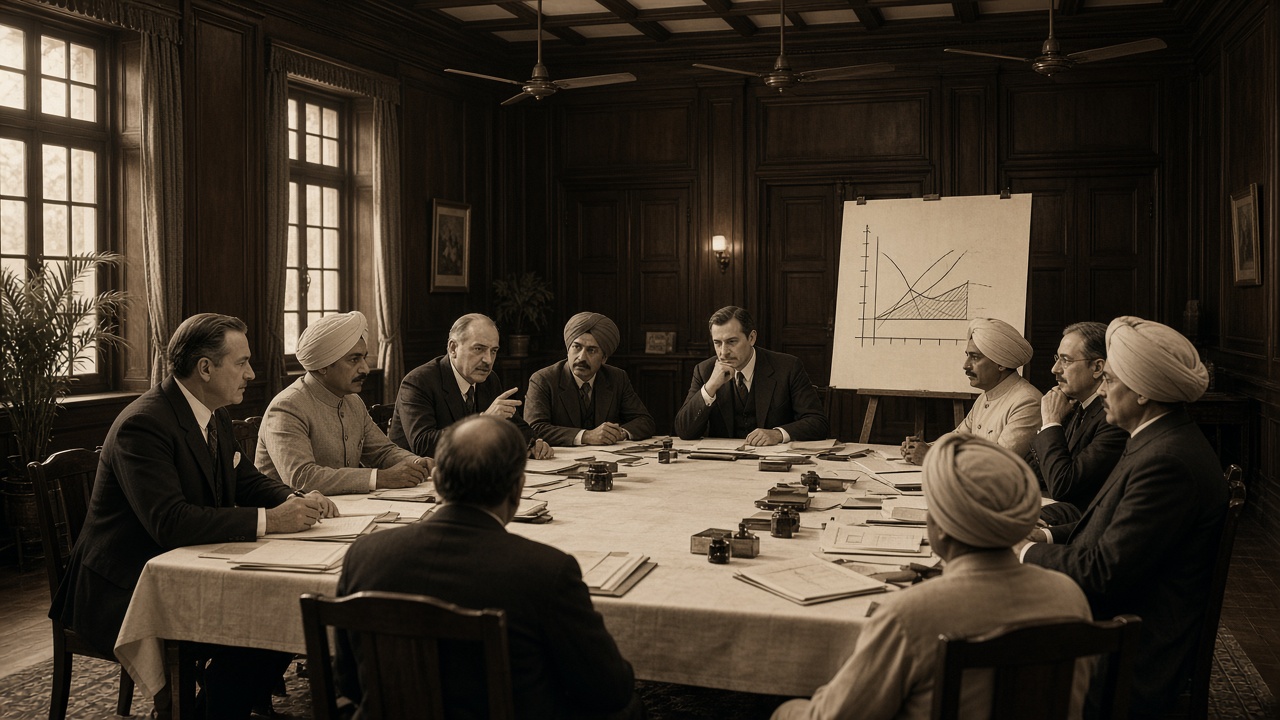
Committees, Laws & Books That Shaped the Rupee
Royal commissions debated the rupee’s exchange rate for decades before independence (artistic illustration).
Year
Committee / law / book
Key outcome
1835
Coinage Act
Uniform Company rupee across British India
1893
Herschell Committee
Mints closed to free silver coinage
1898–1899
Fowler Committee
Rupee fixed at 1s 4d; gold exchange standard
1913
Chamberlain Commission; Keynes’s Indian Currency and Finance
Studied and explained the gold exchange standard
1919–1920
Babington Smith Committee
Recommended 2s gold — failed in practice
1923
Ambedkar’s The Problem of the Rupee
Argued for a stable, rule-based currency
1926–1927
Hilton Young Commission; Currency Act
Rupee at 1s 6d; recommended a central bank
1934
Reserve Bank of India Act
RBI set up in 1935 to manage currency
1973
FERA
Strict foreign exchange controls
1997
Tarapore Committee
Roadmap for capital account convertibility
1999
FEMA
Replaced FERA with a management approach
2014–2016
Urjit Patel Committee; RBI Act amendment
Inflation targeting and the Monetary Policy Committee
The Rupee Beyond India
The Indian rupee once circulated far beyond India, and several countries still use currencies named “rupee.”
Place
Rupee connection
Persian Gulf states
Used the Indian rupee, then the Gulf rupee (1959–1966); Oman until 1970
East Africa
Indian rupee widely used; East African rupee until 1920
Aden
Indian rupee used until 1951
Burma (Myanmar)
Indian rupee until separation in 1937; later the kyat (1952)
Pakistan
Indian notes overprinted until Pakistan issued its own rupee (1948)
Nepal
Nepalese rupee pegged at 1.6 per Indian rupee; Indian rupee widely accepted
Bhutan
Ngultrum pegged 1:1 to the Indian rupee; Indian rupee also accepted
Sri Lanka, Mauritius, Seychelles
Own currencies also called “rupee”
Rupee History Timeline Summary
Year / Era
Milestone
1540–1545
Sher Shah Suri’s silver rupiya
1835
Uniform Company rupee
1873–1892
Fall of silver and the rupee
1893
Mints closed to free silver coinage
1899
Rupee fixed at 1s 4d
1917
₹1 note during the silver shortage
1927
Rupee fixed at 1s 6d
1931
Rupee linked to sterling
1935
Reserve Bank of India begins
1949
RBI nationalised; devaluation to ₹4.76/$
1959
Gulf rupee issued
1966
Devaluation to ₹7.50/$
1975
Basket peg
1991
Crisis, gold pledged, devaluation, reforms
1993
Market-determined exchange rate
1994
Current account convertibility
2000
FEMA in force
2010
₹ symbol
2016
Inflation targeting and MPC
2022
Rupee trade settlement; rupee crosses 80/$
2024
Forex reserves pass $700 billion
Test Your Knowledge
20 quick questions from the rupee history timeline. Click each question to reveal the answer.
Answer: Wrought or stamped silver.
Answer: Sher Shah Suri.
Answer: The Sicca, Arcot, or Surat rupee.
Answer: The Coinage Act, 1835.
Answer: It was on a silver standard, and silver prices fell as major countries moved to gold.
Answer: 1893.
Answer: 1 shilling 4 pence (₹15 = £1).
Answer: John Maynard Keynes.
Answer: Dr B. R. Ambedkar.
Answer: The Hilton Young Commission (1926).
Answer: 1 April 1935.
Answer: About ₹4.76 per US dollar.
Answer: A special rupee issued by the RBI from 1959 for use in Persian Gulf states.
Answer: 6 June 1966.
Answer: Gold — about 47 tonnes with the Bank of England and the Bank of Japan.
Click any panel to expand and explore the visual mood.
The rupee’s story in pictures — silver rupiyas, port trade, colonial treasuries, currency commissions, the Gulf rupee, 1991 gold, forex dealing rooms, and global trade.
Silver Rupiya
1540s
Trade Rupee
Indian Ocean ports
Silver Standard
Colonial treasury
Currency Commissions
1s 4d vs 1s 6d
Gulf Rupee
1959–1966
1991 Crisis
Gold pledged abroad
Market Rupee
From 1993
Global Rupee
Trade in ₹
Explore all economy timelines
Jump to any other economy timeline on WorldTimelineHub.
Disclaimer: This content is AI-generated for educational purposes and may contain errors or outdated details. For correct and authoritative information, please refer to official and reliable sources such as government publications, manufacturers, museums, and academic references.