From cowrie shells and silver punch-marked coins to colourful rupee notes and instant UPI payments — India has one of the world’s longest
and richest histories of money, stretching back more than 2,600 years.
This timeline follows ancient coins, classical gold dinars, Sher Shah Suri’s silver rupiya, Mughal mohurs, colonial rupees and the first paper
notes, RBI banknotes, the switch from annas to decimal paise, the ₹ symbol, demonetisation, the latest notes and coins, and digital money.
c. 600 BCE → PresentCowrie → Coin → Note → UPISilver · Gold · Paper · Digital
What Is Currency?
Currency is money that people accept in exchange for goods and services — coins, banknotes, and today, digital money. Before coins, people
bartered goods or used items such as cowrie shells. In India today, coins are issued by the Government of India and minted at Mumbai, Kolkata,
Hyderabad, and Noida, while banknotes are issued by the Reserve Bank of India (RBI). The Indian rupee (INR, ₹) is divided into 100 paise.
Big picture
Indian money in one view
Each era changed what money was made of and who controlled it — from local guilds and kings, to sultans and emperors, to the colonial
government, and finally to the Reserve Bank of India and digital payment networks. Related timelines:
rupee history & exchange rate,
mobile phones & UPI,
internet,
printing & publishing.
c. 600 BCE
First punch-marked coins
1540s
Sher Shah’s silver rupiya
1957
Decimal: 100 naye paise
2010
₹ symbol adopted
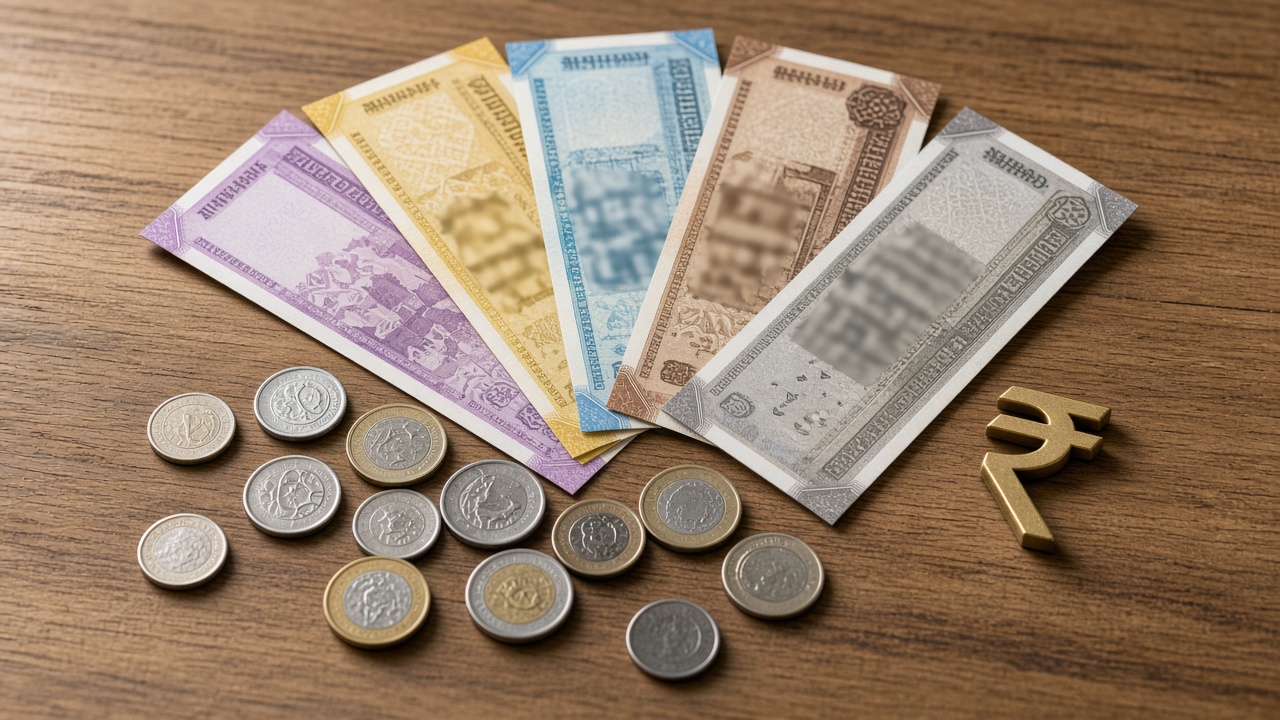
Today’s rupee notes come in different colours and sizes, with steel and bimetallic coins and the ₹ symbol (artistic illustration).
🐚 First Moneyc. 600 – 200 BCE
Barter, Cowries & Punch-Marked Coins
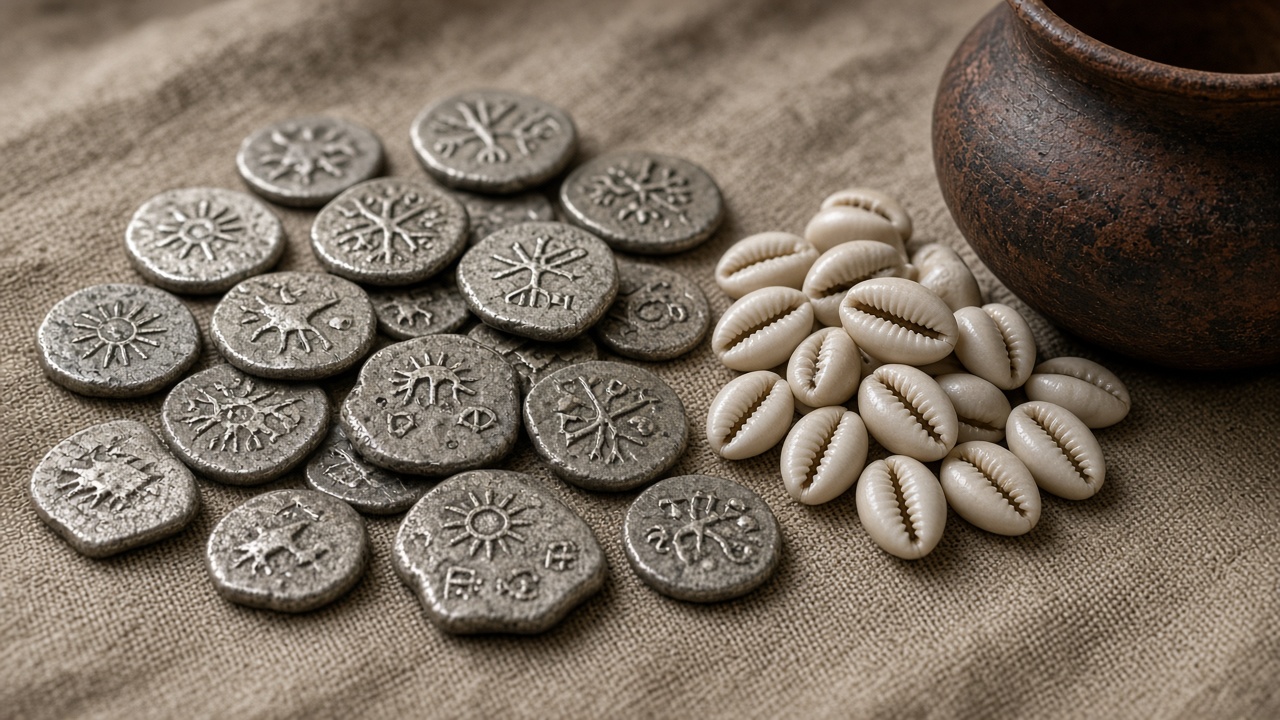
People first exchanged grain, cattle, and goods, and used cowrie shells for small payments. Around the 6th century BCE, the Mahajanapadas began issuing silver pieces stamped with symbols — India’s first coins, known as punch-marked coins or karshapanas.
Silver punch-marked coins carried symbols such as the sun, trees, and animals; cowries served as small change (artistic illustration).
Before 600 BCE: Barter of grain, cattle, and metal; cowrie shells used for small payments in many regions.
c. 6th century BCE: Mahajanapadas such as Gandhara, Kosala, and Magadha issue silver punch-marked coins.
c. 4th–3rd century BCE: The Mauryan Empire issues punch-marked coins across much of India; the Arthashastra describes a superintendent of the mint.
c. 3rd–2nd century BCE: Cast copper coins and tribal and city coins appear alongside silver karshapanas.
Making money
Silver sheets: Cut into pieces of fixed weight.
Punches: Symbols hammered on one side, one at a time.
Casting: Copper coins cast in moulds.
Features
Value by weight: Worth equal to the metal content.
No names: Symbols only, no rulers’ names or dates.
Irregular shapes: Square, rectangular, and round pieces.
👑 Kings on Coinsc. 200 BCE – 1200 CE
Classical Dynasty Coins
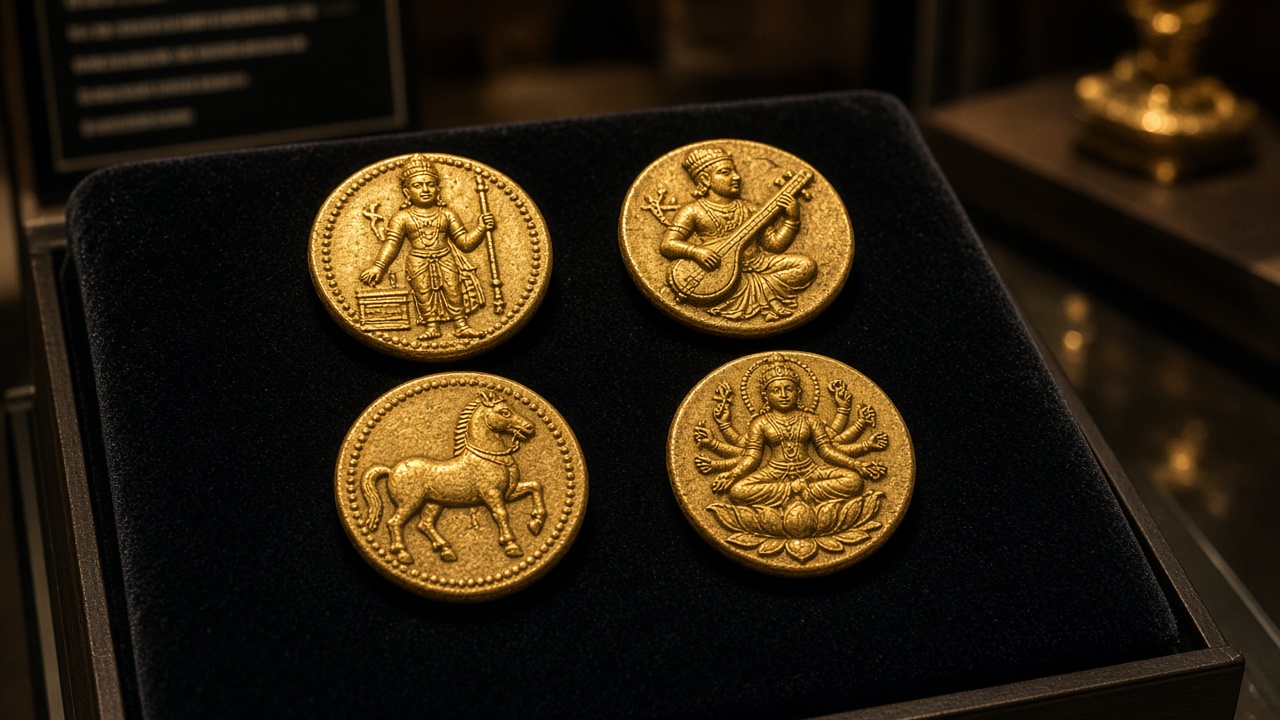
Rulers began putting their portraits, names, and gods on coins. Indo-Greek, Kushana, Satavahana, Gupta, and Chola coins tell historians about kings, religions, trade, and art — India’s gold coinage reached its artistic peak under the Guptas.
Gupta-style gold dinars showed kings playing the veena, horse sacrifices, and goddesses on lotuses (artistic illustration).
c. 2nd century BCE: Indo-Greek kings issue bilingual coins in Greek and Kharosthi with realistic royal portraits.
1st–2nd century CE: Kushana rulers issue gold coins, with Kanishka’s showing Indian, Greek, and Persian deities, including the Buddha; Roman gold coins arrive through southern trade.
1st–3rd century CE: Satavahana rulers issue lead and potin coins, some showing ships — a sign of busy sea trade.
4th–6th century / 10th–11th century: Gupta gold dinars (Samudragupta’s veena-player and horse-sacrifice types); Chola coins with the tiger emblem.
Making money
Die-striking: Engraved dies stamp both sides at once.
Gold coinage: High-value dinars for large trade.
Many metals: Gold, silver, copper, lead, and potin.
Features
Royal portraits: Kings shown with names and titles.
Religious symbols: Gods and goddesses on coins.
History source: Coins reveal dates, rulers, and trade routes.
🪙 Birth of the Rupee1200 – 1757
Sultanate, Vijayanagara & Mughal Coins
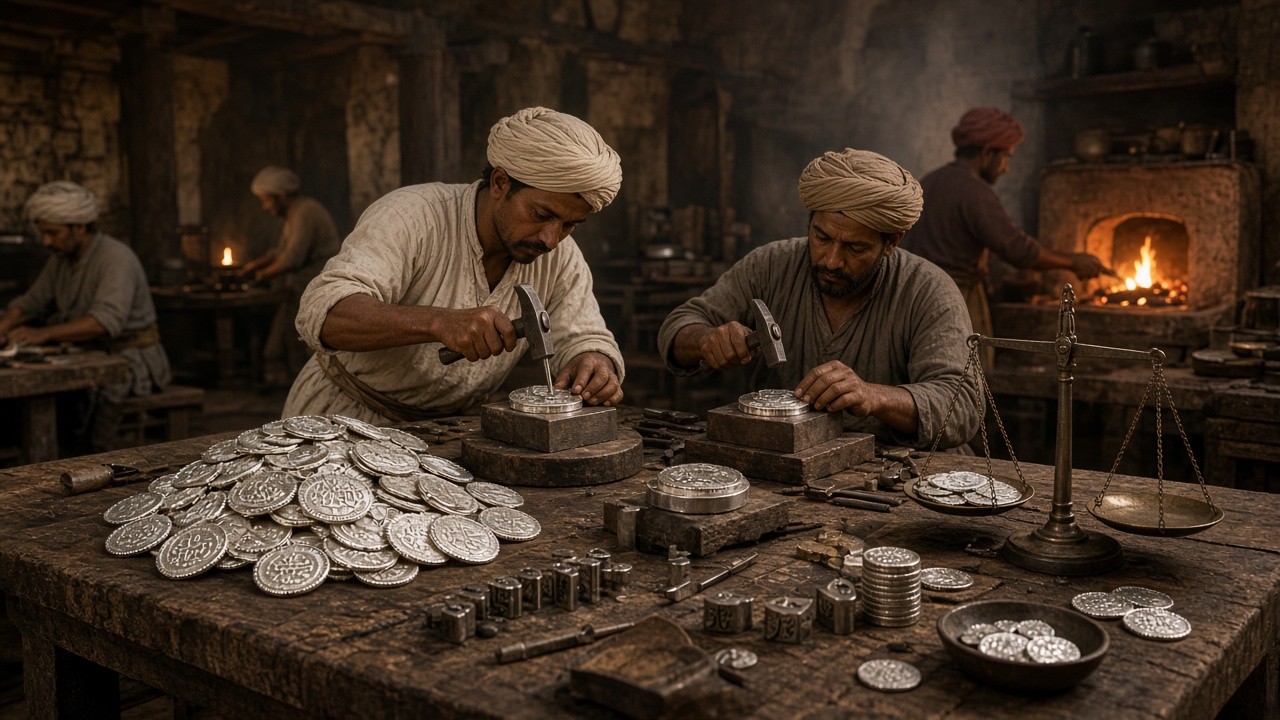
Delhi sultans introduced the silver tanka and copper jital, Vijayanagara struck gold pagodas, and Sher Shah Suri created the silver rupiya — the ancestor of today’s rupee. The Mughals built a standard system of gold mohurs, silver rupees, and copper dams used across the subcontinent.
Mint workers hammered silver blanks between engraved dies to strike rupees with calligraphic inscriptions (artistic illustration).
Early 13th century: Sultan Iltutmish of Delhi introduces the silver tanka and copper jital.
1329–1332: Muhammad bin Tughlaq issues brass and copper “token currency”; widespread forgery forces him to withdraw it.
14th–16th century / 1540–1545: Vijayanagara issues gold varahas (pagodas); Sher Shah Suri introduces the silver rupiya of about 178 grains.
1556–1750s: Mughals issue gold mohurs, silver rupees, and copper dams; Akbar’s square coins and Jahangir’s zodiac mohurs become famous.
Making money
Imperial mints: Dozens of mint towns across the empire.
Calligraphy dies: Persian inscriptions, ruler’s name, mint, and year.
Standard weights: Rupee purity carefully controlled.
Features
Trimetallic system: Gold, silver, and copper coins.
Trusted rupee: Silver rupee accepted far beyond India.
Money changers: Sarrafs tested and exchanged coins.
📜 Paper Money Arrives1757 – 1947
Colonial Rupee & Paper Money
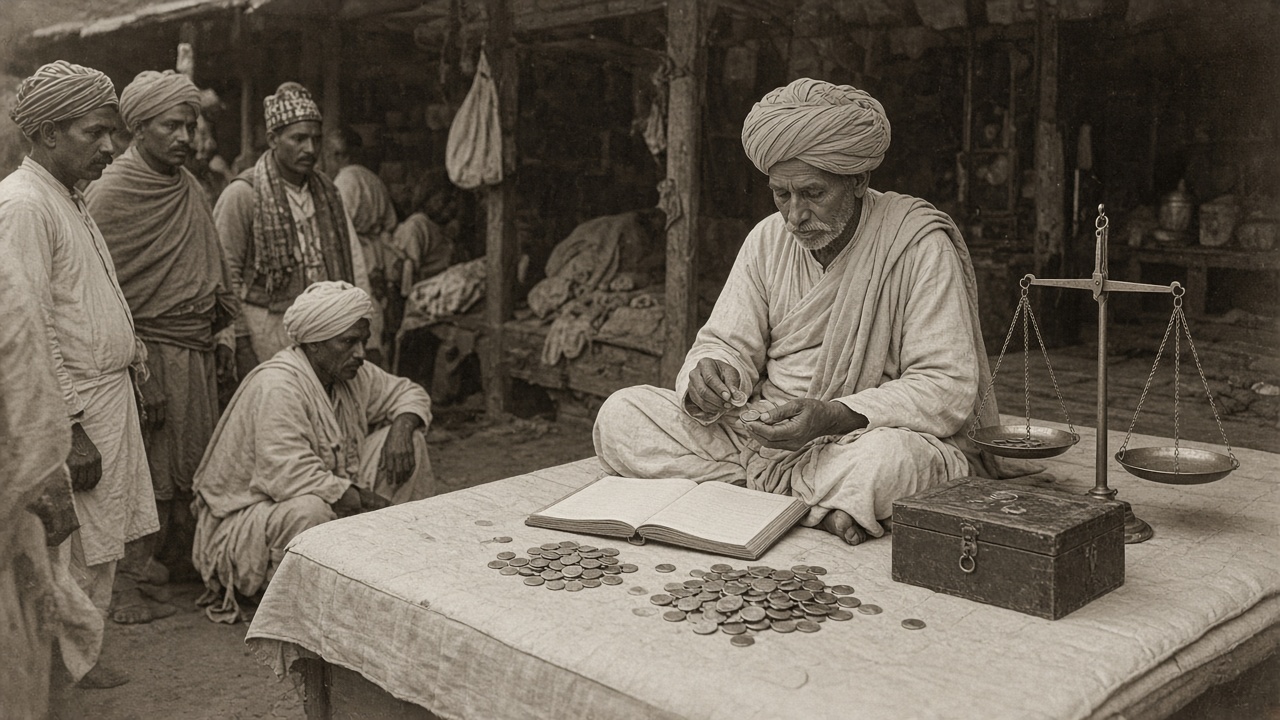
The East India Company and later the British Crown made the rupee uniform across British India and introduced paper money. Private banks, then the government, and finally the Reserve Bank of India issued banknotes, while coins carried portraits of British monarchs.
In colonial bazaars, sarrafs counted rupees, annas, and pice and weighed coins to check them (artistic illustration).
1770–1784: Early paper notes issued by private banks such as the Bank of Hindostan (1770), the General Bank of Bengal and Bihar (1773), and the Bengal Bank (1784).
1835: The Coinage Act introduces uniform coinage across British India, with the portrait of King William IV.
1861 / 1917: The Paper Currency Act gives the Government of India the monopoly of note issue (1861); the ₹1 note is introduced during a First World War silver shortage (1917).
1935–1946: The Reserve Bank of India is set up (1 April 1935) and issues its first note, a ₹5 note with King George VI (1938); ₹1,000 and ₹10,000 notes are demonetised (1946).
Making money
Machine minting: Steam-powered presses in Calcutta and Bombay mints.
Printed notes: Watermarked paper and intricate engraving.
Security Press, Nashik: Notes printed in India from the late 1920s.
Monarch portraits: Victoria, Edward VII, George V, George VI.
Multilingual notes: Values printed in several Indian languages.
🇮🇳 Independent Rupee1947 – 1999
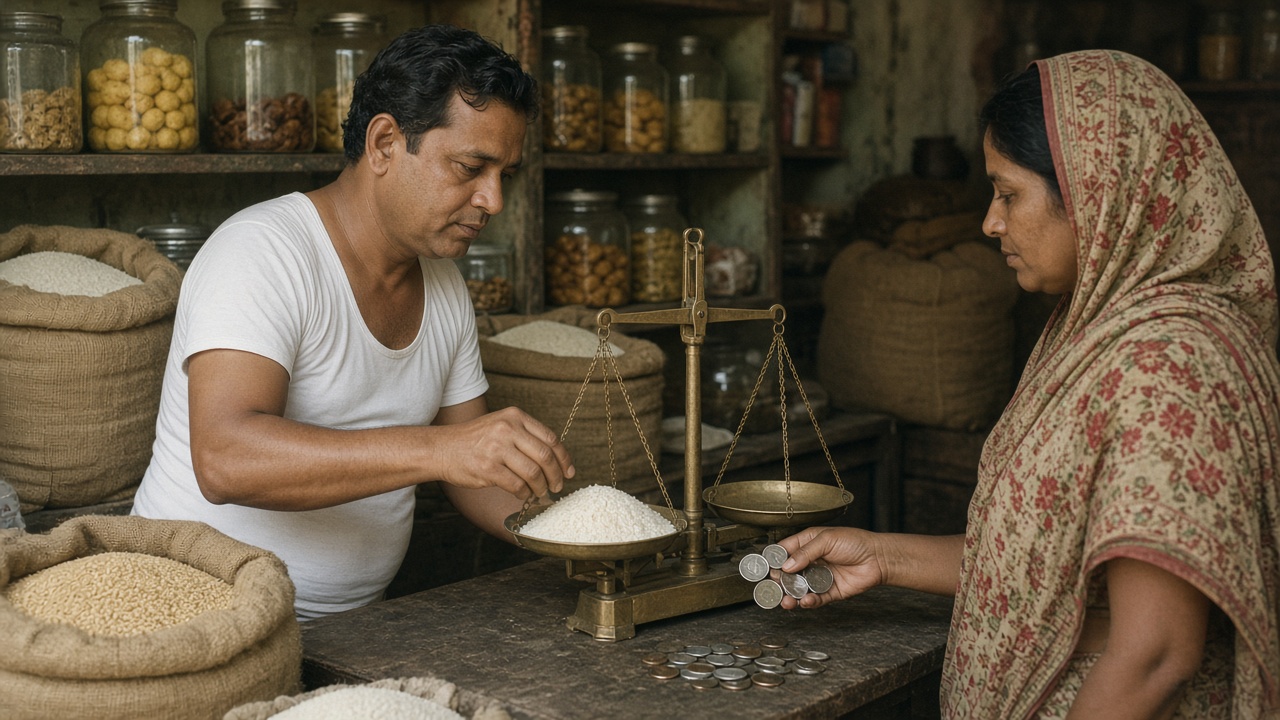
Republic Rupee & Decimal Paise
Independent India replaced the king’s portrait with the Lion Capital of Ashoka, moved from annas to a decimal system, and introduced new coin metals. Mahatma Gandhi appeared on banknotes, and the Mahatma Gandhi Series of notes began in 1996.
After 1957, shoppers paid with decimal naye paise coins of many shapes and metals (artistic illustration).
1949 / 1950: A new ₹1 note carries the Lion Capital of Ashoka instead of the king’s portrait; the first coins of the Republic (anna series) are issued on 15 August 1950.
1957 / 1964: Decimal system from 1 April 1957 — 1 rupee = 100 naye paise; the word “naye” is dropped in 1964.
1954 / 1978: ₹1,000, ₹5,000, and ₹10,000 notes are reintroduced (1954) and demonetised on 16 January 1978.
1969–1996: Gandhi centenary commemorative notes (1969); ₹500 note (1987); stainless steel coins (1988); Mahatma Gandhi Series notes begin (1996).
Making money
New metals: Aluminium, cupro-nickel, and stainless steel coins.
Indian presses: Nashik, Dewas, and later Mysuru and Salboni.
Security features: Watermarks, security threads, and latent images.
Features
National symbols: Lion Capital, then Mahatma Gandhi.
Decimal counting: Easier calculations with 100 paise.
Themed reverses: Science, agriculture, and heritage motifs.
📱 Digital Rupee2000 – Present
₹ Symbol, New Notes & Digital Money
India gave the rupee its own symbol, carried out a major demonetisation, and introduced a new series of smaller, colourful notes with heritage motifs. At the same time, UPI made India a world leader in real-time digital payments, and the RBI began piloting a digital rupee.
UPI QR codes let even small street vendors accept instant digital payments (artistic illustration).
2000–2009: ₹1,000 note reintroduced (2000); MG Series 2005 adds new security features; ₹10 bimetallic coin enters circulation (2009).
2010–2011: The ₹ symbol, designed by D. Udaya Kumar, is adopted (15 July 2010); coins of 25 paise and below are withdrawn (30 June 2011).
2016–2019: UPI launched (April 2016); ₹500 and ₹1,000 notes demonetised (8 November 2016); ₹2,000 and new ₹500, ₹200, ₹100, ₹50, ₹20, and ₹10 notes of the MG (New) Series; new visually impaired-friendly coins including a 12-edged ₹20 coin (2019).
2022–present: Digital rupee (e₹) pilots begin (wholesale 1 November, retail 1 December 2022); ₹2,000 notes withdrawn from circulation but remain legal tender (May 2023); UPI crosses 10 billion transactions a month (2023).
Making money
Colour-shifting ink: Thread and numerals change from green to blue.
UPI & QR codes: Instant bank-to-bank payments by phone.
CBDC: RBI-issued digital tokens in e₹ wallets.
Features
Heritage motifs: Monuments and Mangalyaan on note reverses.
Accessibility: Raised marks, bleed lines, and the MANI app for the visually impaired.
Less cash use: Digital payments grow, but cash is still widely used.
Famous Coins of Indian History
Coins are one of the most important sources for Indian history — each tells us about its ruler, religion, art, and economy.
Coin
Issuer
Metal
Period
Punch-marked karshapana
Mahajanapadas, Mauryas
Silver
c. 6th–2nd century BCE
Bilingual portrait coins
Indo-Greek kings
Silver
c. 2nd–1st century BCE
Kushana gold coins
Kushana rulers (e.g., Kanishka)
Gold
1st–3rd century CE
Ship-type coins
Satavahanas
Lead / potin
1st–3rd century CE
Gold dinar
Guptas
Gold
4th–6th century CE
Tiger-emblem coins
Cholas
Gold, silver, copper
10th–12th century
Tanka & jital
Delhi Sultanate (Iltutmish)
Silver & copper
13th century
Token currency
Muhammad bin Tughlaq
Brass / copper
1329–1332
Varaha (pagoda)
Vijayanagara Empire
Gold
14th–16th century
Rupiya
Sher Shah Suri
Silver
1540–1545
Mohur, rupee & dam
Mughals
Gold, silver, copper
16th–18th century
Uniform rupee
East India Company
Silver
From 1835
Anna series
Republic of India
Nickel, cupro-nickel, bronze
1950
₹10 bimetallic coin
Government of India
Bimetallic
2009
12-edged ₹20 coin
Government of India
Bimetallic
2019–2020
Old Units: Rupee, Anna, Pice & Pie
Before 1957 the rupee was not divided into 100 parts. Grandparents may still remember prices in annas.
Unit
Value (before 1957)
After decimalisation
1 Rupee
16 annas = 64 pice = 192 pies
100 naye paise (later 100 paise)
1 Anna
4 pice = 12 pies
About 6.25 paise
1 Pice (paisa)
3 pies
About 1.5 paise
1 Pie
Smallest unit
About 0.5 paise
Half rupee (Athanni)
8 annas
50 paise
Quarter rupee (Chavanni)
4 annas
25 paise
Indian Banknote Series Through Time
Series
From
Key features
Private and Presidency bank notes
1770s–1850s
Issued by banks such as the Bank of Hindostan and Bank of Bengal
Victoria Portrait Series
1861
First Government of India notes, one-sided, with Queen Victoria
King’s Portrait notes
1917–1947
George V and George VI portraits; ₹1 note from 1917; RBI notes from 1938
Ashoka Pillar (Lion Capital) Series
1949
Lion Capital of Ashoka replaces the king’s portrait
Gandhi commemorative notes
1969
Mahatma Gandhi’s birth centenary
Mahatma Gandhi Series
1996
Gandhi portrait and watermark, windowed security thread, latent image
Mahatma Gandhi Series 2005
2005
Machine-readable thread, colour-shifting features, year of printing
Mahatma Gandhi (New) Series
2016
Smaller sizes, new colours, Swachh Bharat logo, heritage motifs
Latest Notes: Mahatma Gandhi (New) Series
Each new note has its own base colour and a motif of Indian heritage on the reverse.
Note
Colour
Motif on reverse
Introduced
₹10
Chocolate brown
Sun Temple, Konark
2018
₹20
Greenish yellow
Ellora Caves
2019
₹50
Fluorescent blue
Hampi with Chariot
2017
₹100
Lavender
Rani ki Vav
2018
₹200
Bright yellow
Sanchi Stupa
2017
₹500
Stone grey
Red Fort
2016
₹2,000
Magenta
Mangalyaan
2016 (withdrawn from circulation 2023; still legal tender)
Demonetisations & Withdrawals in India
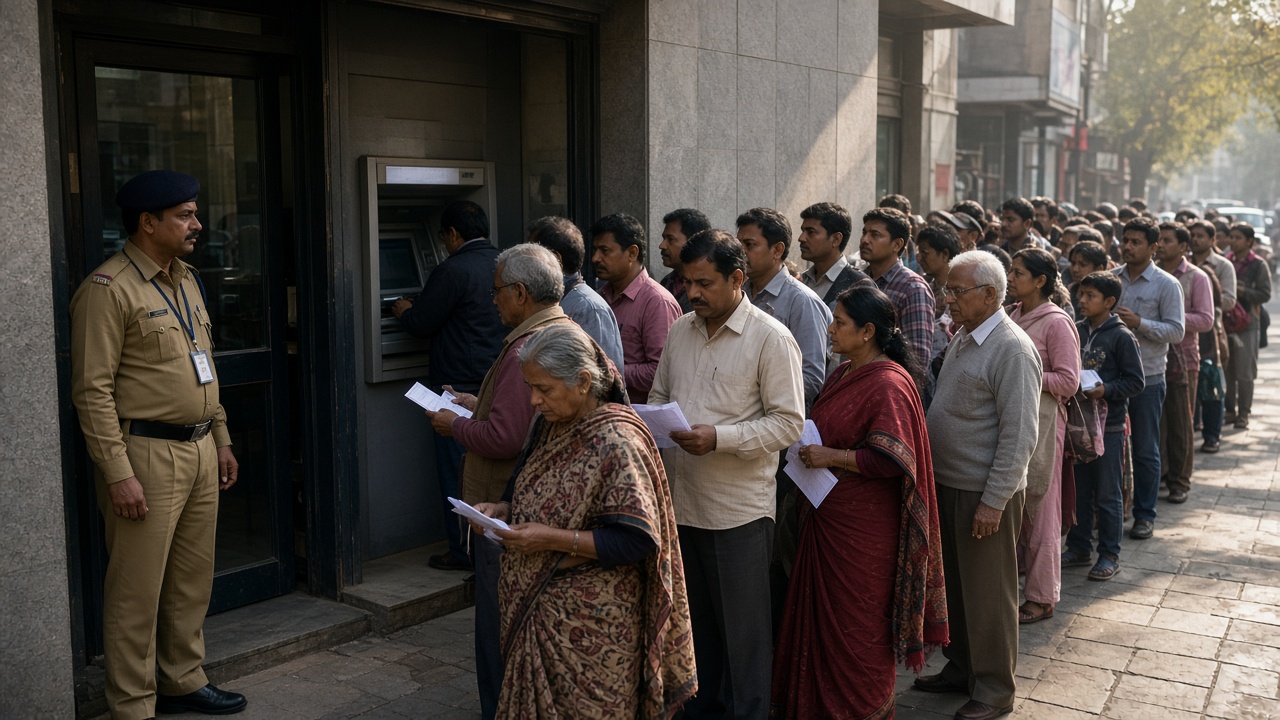
After the 2016 demonetisation, people queued at banks and ATMs to exchange or deposit old notes (artistic illustration).
Year
Notes affected
What happened
1946
₹1,000 and ₹10,000
High-value notes demonetised in January 1946
1978
₹1,000, ₹5,000, ₹10,000
Demonetised on 16 January 1978 to curb black money
2011
25 paise and smaller coins
Withdrawn and ceased to be legal tender from 30 June 2011
2016
₹500 and ₹1,000
Demonetised on 8 November 2016; new ₹500 and ₹2,000 notes issued
2023
₹2,000
Withdrawn from circulation from 19 May 2023, but still legal tender
How to Check a Genuine Note
Modern Indian notes include many security features. Remember: see, feel, and tilt.
Feature
How to check
Watermark
Hold against light to see Mahatma Gandhi’s portrait and the numeral
Security thread
Windowed thread with “भारत” and “RBI”; on higher notes it shifts from green to blue when tilted
Latent image
Hold the note at eye level to see the hidden denomination numeral
See-through register
The denomination numeral appears complete when held against light
Micro-lettering
Tiny “RBI” and “भारत” text visible with a magnifying glass
Intaglio printing
Raised print of the portrait, emblem, and guarantee clause can be felt
Bleed lines & identification mark
Raised lines and shapes help visually impaired people identify notes
Number panel
Numbers grow in size from left to right on MG (New) Series notes
Indian Currency Timeline Summary
Year / Era
Milestone
c. 6th century BCE
Silver punch-marked coins
c. 2nd century BCE
Indo-Greek portrait coins
1st–2nd century CE
Kushana gold coins
4th–6th century CE
Gupta gold dinars
13th century
Silver tanka and copper jital
1329–1332
Muhammad bin Tughlaq’s token currency
1540–1545
Sher Shah Suri’s silver rupiya
1770
Bank of Hindostan’s early paper notes
1835
Uniform coinage under the Coinage Act
1861
Paper Currency Act; Government of India notes
1917
First ₹1 note
1935 / 1938
RBI founded; first RBI note (₹5)
1949 / 1950
Lion Capital ₹1 note; Republic coins
1957
Decimal system: 100 naye paise
1978
High-value notes demonetised
1996
Mahatma Gandhi Series notes
2010
₹ symbol adopted
2016
UPI launched; ₹500 and ₹1,000 demonetised; MG (New) Series
2019
Visually impaired-friendly coins including ₹20
2022
Digital rupee (e₹) pilots
2023
₹2,000 notes withdrawn from circulation
Test Your Knowledge
20 quick questions from the Indian currency timeline. Click each question to reveal the answer.
Answer: Punch-marked coins (karshapanas).
Answer: Cowrie shells.
Answer: The Indo-Greek kings.
Answer: The Guptas.
Answer: Ships.
Answer: Iltutmish.
Answer: Muhammad bin Tughlaq.
Answer: Sher Shah Suri.
Answer: Mohur.
Answer: The Vijayanagara Empire.
Answer: The Bank of Hindostan.
Answer: The Paper Currency Act, 1861.
Answer: 1 April 1935.
Answer: 16 annas.
Answer: The Lion Capital of Ashoka at Sarnath.
Answer: 1 April 1957.
Answer: D. Udaya Kumar.
Answer: ₹500 and ₹1,000 notes.
Answer: Rani ki Vav, Patan (Gujarat).
Answer: The digital rupee, e₹ (a central bank digital currency).
Classroom activity
Students Tasks
Use these prompts for discussion or projects on the history of Indian currency.
Timeline understandingFinancial literacyHistory through coinsCritical thinking
Collect coins at home and arrange them by year, metal, and denomination. What changes do you notice?
Make a chart showing the heritage motif on the back of each new banknote.
Ask a grandparent what things cost in annas and paise when they were young.
Convert 5 rupees 8 annas into pice and pies using the old system.
Explain why Muhammad bin Tughlaq’s token currency failed.
Use the security features table to check a real note with a teacher or parent.
Debate: “India should become a completely cashless economy.”
Write a short story from the point of view of a silver coin travelling from Sher Shah’s mint to today.
Compare paying with cash, cards, and UPI — list the advantages and risks of each.
Design your own banknote with a motif that represents your state.
Continue exploring
India’s currency story connects to printing, mobile phones, the internet, and digital payments. Explore more timelines next.
Click any panel to expand and explore the visual mood.
Indian money in pictures — punch-marked coins, gold dinars, medieval mints, colonial moneychangers, naye paise, demonetisation queues, modern notes, and UPI.
Punch-Marked Coins
c. 6th century BCE
Gold Dinars
Kushana & Gupta gold
Silver Rupiya
Sher Shah & Mughals
Colonial Rupee
Annas, pice & pies
Naye Paise
Decimal from 1957
Demonetisation
8 November 2016
New Notes
MG (New) Series
UPI
Scan and pay
Explore all economy timelines
Jump to any other economy timeline on WorldTimelineHub.
Disclaimer: This content is AI-generated for educational purposes and may contain errors or outdated details. For correct and authoritative information, please refer to official and reliable sources such as government publications, manufacturers, museums, and academic references.