From steel tiffins and refill bottles to the single-use boom, Swachh drives, EPR and bans,
and circular economy experiments — India’s plastic story is everyday convenience meeting public cleanup.
This timeline follows five turns: reuse culture, single-use boom, Swachh, EPR / bans,
and circular economy.
Plastic is not only a material — it is a system of packaging, litter, livelihoods, and law.
India moved from reuse-first habits to disposable convenience, then to national cleanliness campaigns,
producer responsibility rules, and circular design goals that try to close the loop.
Big picture
Plastic in one view
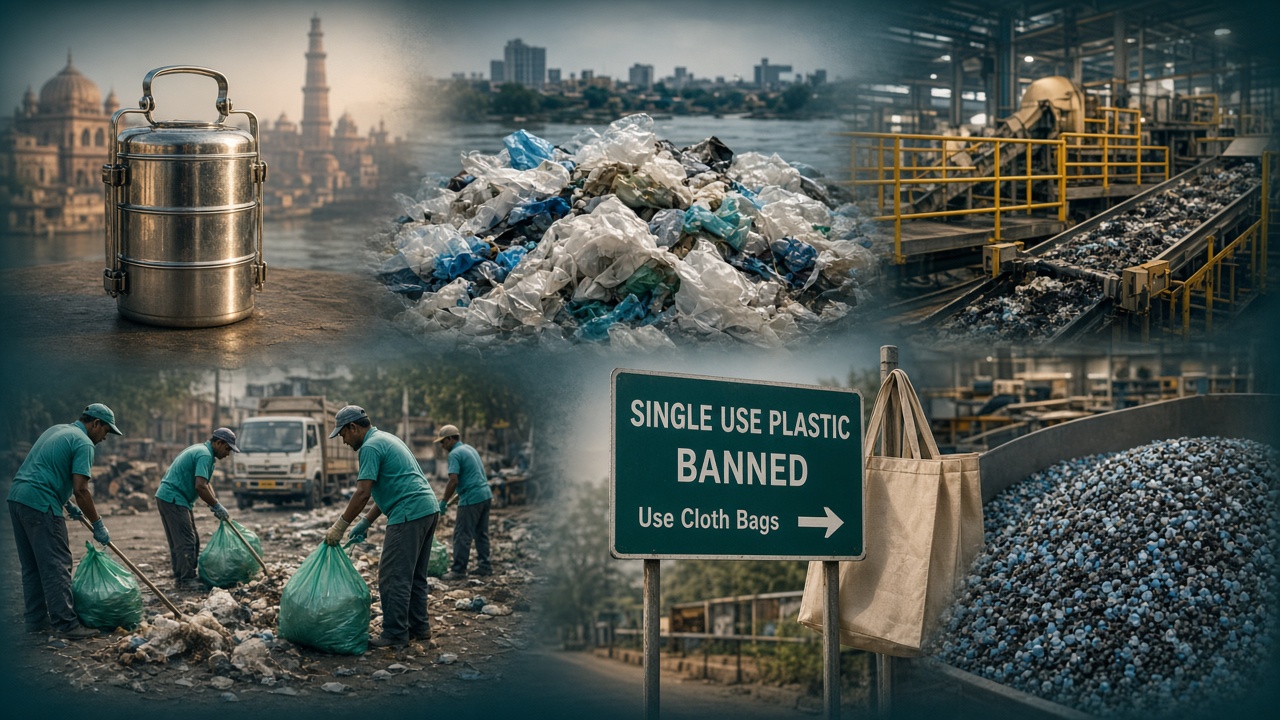
Durable reuse gave way to disposables; cleanup and policy then tried to redesign the waste stream.
Related timelines:
air quality,
water management,
parks,
disasters.
From reuse culture to single-use, Swachh, bans/EPR, and circular systems.
Refill & RepairPre-plastic / Everyday Tradition
Reuse Culture
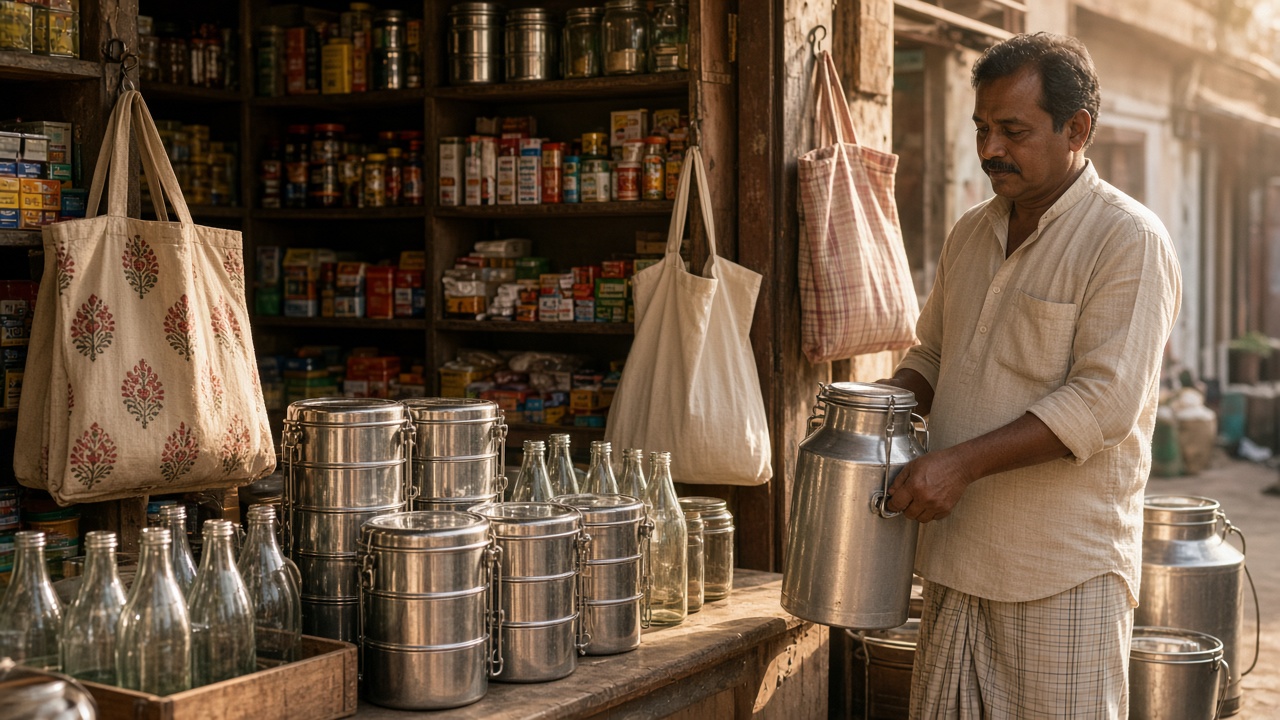
Before disposable packaging took over, Indian households ran on reuse. Milk cans, glass soda bottles, steel dabbas, cloth jholas, and the kabadiwala’s repair-and-resale loop meant materials stayed in circulation by habit — not by slogan.
Reuse culture: packaging that came back again.
Durable containers: Metal, glass, and cloth as everyday norms.
Refill systems: Milk, oil, and groceries without throwaway wraps.
Informal recycling: Kabadi networks recover value from scrap.
Repair ethos: Fix first; replace later.
Ideas & Practices
Returnable glass: Deposit bottles for soft drinks and milk.
Shared logistics: Local vendors and home delivery reduce packaging.
Material literacy: Households sort by resale value instinctively.
Features
Low litter baseline: Less single-use material in circulation.
Labour intensive: Reuse depends on local service networks.
Living memory: Still visible in many homes and small towns.
Convenience Wave1980s – 2010s
Single-use Boom
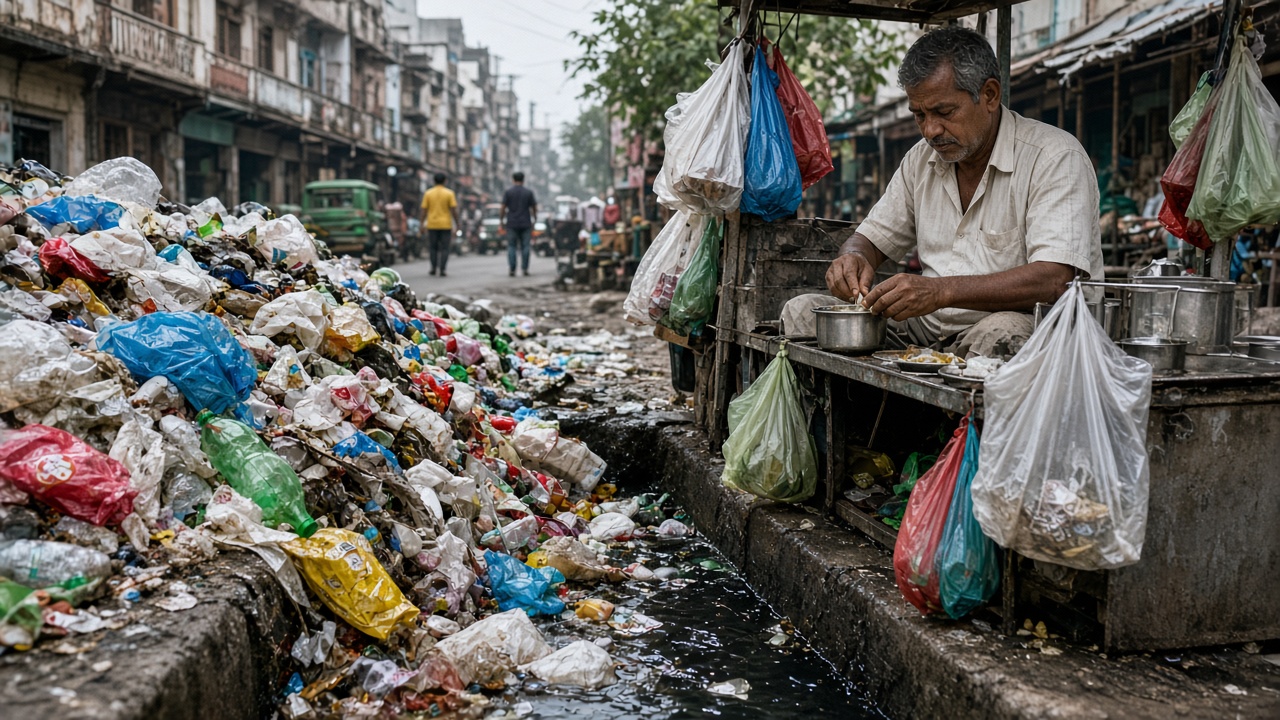
Cheap plastic remade retail. Thin carry bags, PET bottles, multilayer sachets, and Styrofoam took over markets and takeaways. Convenience soared — and so did clogged drains, littered coasts, and a waste stream hard to collect and recycle.
Single-use boom: cheap packaging everywhere.
Retail shift: Packaged goods replace many loose/refill sales.
Sachet economy: Tiny packs expand access — and micro-waste.
Urban litter: Bags and bottles choke drains and waterways.
Recycling gap: Mixed and dirty plastics outpace formal systems.
Technology Used
Polymers: PE, PP, PET, multilayer films for shelf life.
Affordability: Low unit cost for consumers and sellers.
Persistence: Many plastics last far longer than their use.
Public backlash: Visible pollution drives later bans.
Civic Cleanup2014 –
Swachh
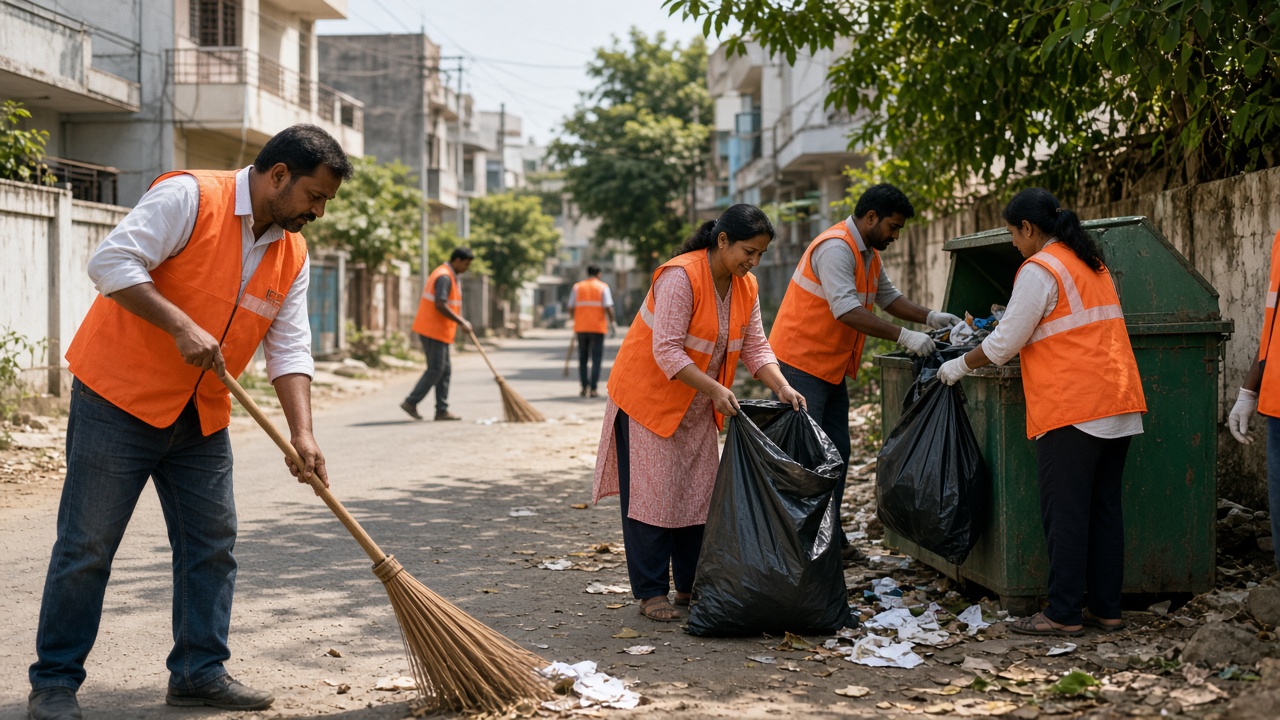
Swachh Bharat made cleanliness a mass campaign. Toilets, street sweeping, waste collection, and segregation messaging put plastic litter into everyday politics — cities built more bins and processing plants, while citizens were asked to change habits at home and in public.
Swachh: plastic waste enters the civic spotlight.
National mission: Cleanliness as a visible public goal.
Collection push: Door-to-door and city systems expand.
Behaviour change: Campaigns target littering and open dumping.
Tools & Systems
Municipal fleets: Bins, trucks, and transfer stations.
Processing plants: Composting, MRFs, and waste-to-energy pilots.
IEC campaigns: Schools, media, and local drives.
Features
Awareness leap: Plastic pollution becomes common knowledge.
Uneven outcomes: Infrastructure quality varies by city.
Bridge: Sets the stage for stricter plastic rules.
Rules & Responsibility2016 – Present
EPR / Bans
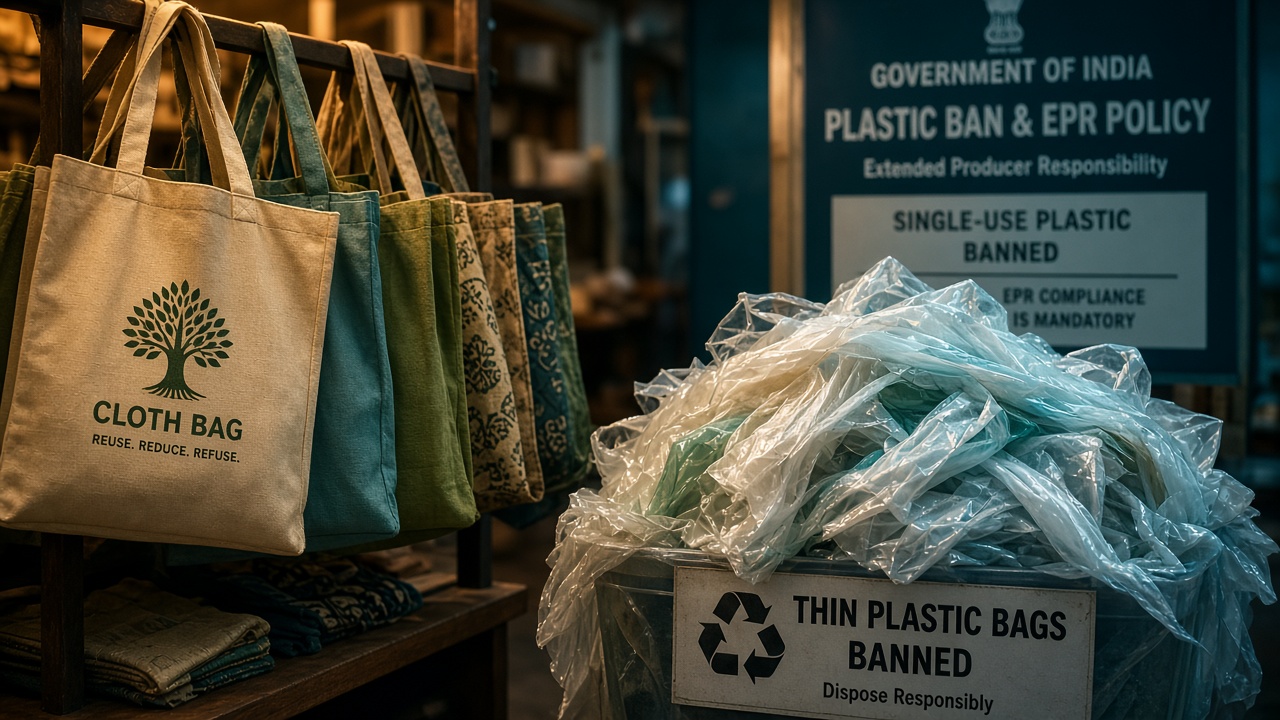
Policy shifted from cleanup alone to producer duty and product bans. Plastic Waste Management rules, Extended Producer Responsibility (EPR), thickness norms, and phased single-use bans made brands accountable for packaging after sale — while states experimented with carry-bag restrictions.
EPR / bans: producers and products under new rules.
PWM rules: National framework for plastic waste management.
Item bans: Selected single-use plastics restricted in phases.
Alternatives: Cloth, paper, compostables, and redesign pressures.
Policy Tools
Registration & targets: Online EPR tracking for obligated entities.
Thickness norms: Thicker bags meant to curb the thinnest litter.
Enforcement: Fines, seizures, and market checks — uneven in practice.
Features
Accountability shift: From only municipalities to producers too.
Compliance race: Industry adapts packaging and take-back.
Gaps remain: Informal waste workers still carry much of the load.
Close the LoopPresent – Future
Circular Economy
The next turn is design, not only disposal. Circular economy ideas push reuse models, recyclable mono-materials, recycled content, deposit-return pilots, and better sorting — aiming to keep plastic in productive loops instead of drains, landfills, and oceans.
Circular economy: waste as feedstock, not endpoint.
Design for recycle: Fewer multilayer traps; more mono-materials.
Recycled content: Demand for rPET and secondary resins.
Reuse revival: Refill stations and returnable packaging return.
Just transition: Integrating waste pickers into formal value chains.
Technology Used
MRFs & sorting: Mechanical separation of PET, HDPE, and more.
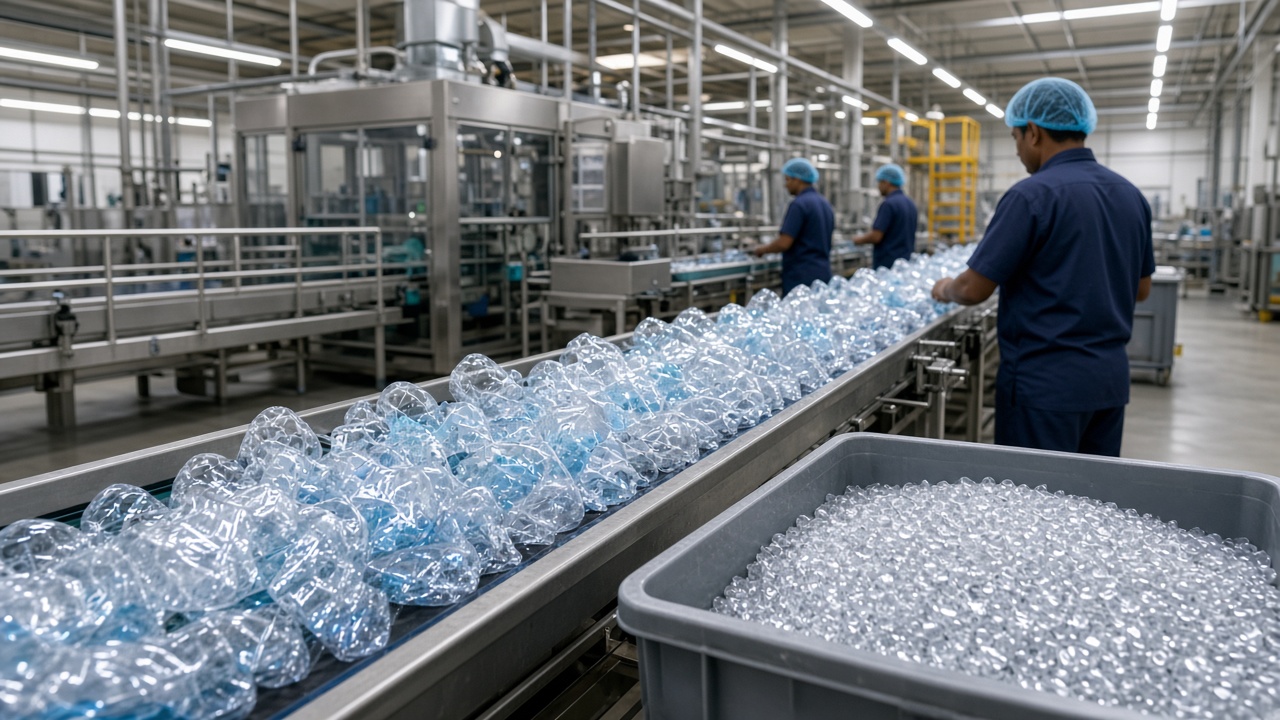
Recycling plants: Flaking, washing, pelletising.
Digital EPR: Credits, audits, and traceability systems.
Features
System goal: Reduce virgin plastic and leakage.
Hard plastics: Flexible films remain difficult to circularise.
Continuity: Modern circularity echoes older reuse culture.
Plastic Eras Compared
Each era answers a different need: thrift, convenience, cleanup, regulation, and closed-loop design.
Era
Main idea
Strength
Limitation
Reuse culture
Refill & repair
Low disposable waste
Less packaging convenience
Single-use boom
Cheap disposables
Access & speed
Litter & pollution
Swachh
Civic cleanup
Awareness & collection
Doesn’t redesign products alone
EPR / bans
Rules & producer duty
Accountability shift
Enforcement & alternatives gaps
Circular economy
Keep materials in use
System redesign
Hard for mixed flexible plastics
India Spotlight: Plastic Milestones
From reuse habits and sachets to Swachh, EPR, bans, and circular pilots.
Year / Era
Milestone
Significance
Everyday tradition
Reuse & refill culture
Low single-use packaging baseline.
1980s–2010s
Single-use boom
Bags, bottles, sachets dominate retail.
2014+
Swachh Bharat
Waste & litter become national campaign.
2016+
PWM rules / EPR / bans
Producer duty and item restrictions.
Present+
Circular economy push
Recycle, redesign, reuse at scale.
Plastic Timeline Summary
Year / Era
Milestone
Pre-plastic / everyday
Reuse culture
1980s–2010s
Single-use boom
2014+
Swachh cleanliness mission
2016+
EPR / plastic bans
Present–future
Circular economy
Test Your Knowledge
10 quick questions from the plastic timeline. Click each question to reveal the answer.
Click any panel to expand and explore the visual mood.
Plastic in pictures — reuse, single-use, Swachh, EPR/bans, and circular systems.
Reuse Culture
Refill & repair
Single-use Boom
Convenience wave
Swachh
Civic cleanup
EPR / Bans
Rules & duty
Circular Economy
Close the loop
Through Time
Reuse to circular
Explore all environment timelines
Jump to any other environment timeline on WorldTimelineHub.
Disclaimer: This content is AI-generated for educational purposes and may contain errors or outdated details. For correct and authoritative information, please refer to official and reliable sources such as government publications, manufacturers, museums, and academic references.