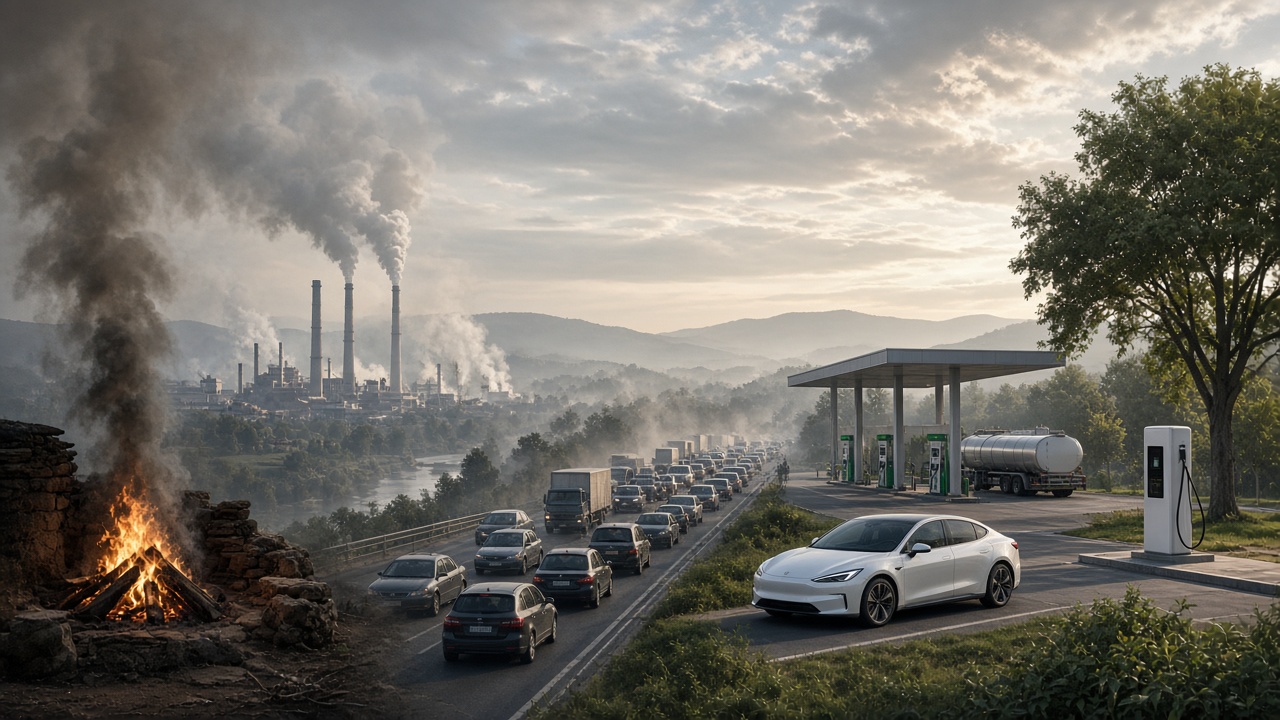
From kitchen wood smoke and factory chimneys to traffic smog, CNG fleets, BS-VI engines, and electric vehicles —
India’s fight for cleaner air is a story of fuel, technology, and cities.
This timeline follows six turns: household biomass smoke, industrial coal pollution, the vehicle boom,
CNG as a cleaner city fuel, Bharat Stage VI norms, and the EV transition still underway.
Ancient → PresentSmoke → Norms → EVHome · Industry · Roads
Why Air Quality Matters
Clean air is a public-health infrastructure. Smoke from cooking fires, factories, and engines loads the lungs with
particles and gases. India’s journey moves from traditional biomass and early industry to vehicle-dominated city smog —
then cleaner fuels, stricter emission norms, and electric mobility.
From chulha smoke and chimneys to CNG, BS-VI, and electric chargers.
🔥 Household SmokeAncient – Living
Wood Smoke
For millennia, wood, dung, and crop residue heated Indian kitchens. Open fires and chulhas filled homes with fine particles — still one of the world’s largest indoor air-pollution burdens.
Wood smoke: the oldest and still-living air quality challenge.
Chulha cooking: Biomass fuels release PM2.5, carbon monoxide, and other toxins indoors.
Health impact: Linked to COPD, pneumonia in children, and heart disease — especially for women and infants near the stove.
Cleaner cooking: LPG (including Ujjwala), improved cookstoves, and electricity begin to cut exposure.
Outdoor too: Crop-residue burning and waste fires add seasonal haze beyond the kitchen.
Technology Used
Open fire / chulha: Simple combustion with incomplete burning.
Improved cookstoves: Better draft and insulation to reduce smoke.
LPG & induction: Cleaner household fuels and electric cooking.
Features
Invisible crisis: Indoor smoke often ignored in city AQI debates.
Gendered exposure: Cooks spend longest hours in smoke.
Transition uneven: Cost, refill access, and habits slow the switch.
🏭 Coal & Chimneys1800s – 1950s
Industrial Revolution
Coal-powered mills, railways, and factories remade city skies. Global industrial smogs — and India’s colonial mill towns — made air pollution a modern public problem.
Factory smoke: progress measured in soot as well as steel.
Coal age: Steam engines and mill boilers fill urban air with sulphur and soot.
1952 Great Smog (London): A deadly episode that pushed modern clean-air legislation worldwide.
Indian mills: Textile and industrial centres add chimney pollution to crowded cities.
Early regulation: Smoke abatement and factory laws begin — still weak by today’s standards.
Technology Used
Coal combustion: High particulate and sulphur emissions.
Tall stacks: Dilute pollution rather than remove it.
Later controls: Scrubbers and filters emerge after mid-century crises.
Features
Visible smog: Cities darken at midday.
Class & place: Workers near mills breathe the worst air.
Policy birth: Public health enters industrial planning.
🚗 Traffic Smog1960s – 2000s
Vehicular Pollution
As cars, buses, and two-wheelers multiplied, tailpipes joined chimneys as the face of Indian city pollution — diesel smoke, congestion, and winter haze in the plains.
Vehicles: mobility growth with a particulate price.
Policy pressure: Sets the stage for CNG and stricter norms.
🟢 Cleaner City Fuel1990s – 2010s
CNG
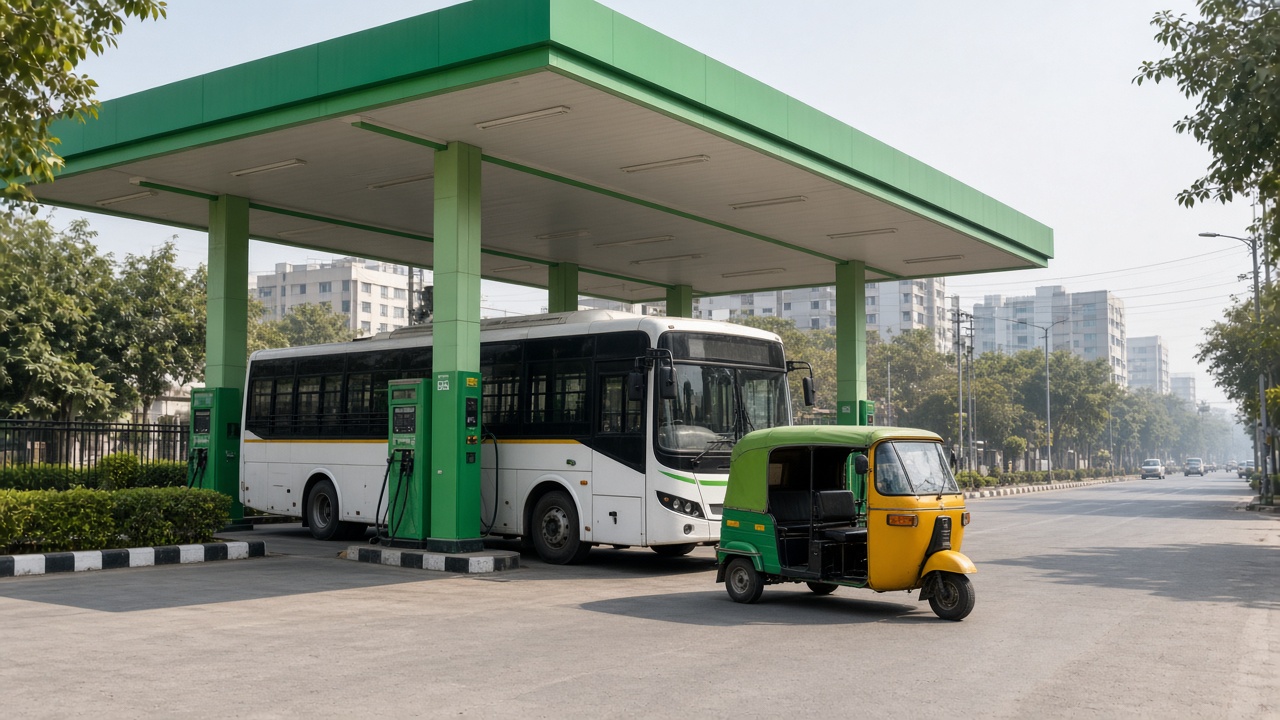
Compressed natural gas became Delhi’s signature air-quality fix for buses and autos — lower particulate emissions than diesel, with a visible fleet colour change on city roads.
CNG: a fuel switch that cut diesel soot on key routes.
Supreme Court & EPCA era: Mandates push public transport toward CNG in Delhi.
Bus & auto fleets: Millions of daily trips shift fuel chemistry at street level.
Station network: CNG infrastructure becomes a city utility.
Limits: CNG helps particles but does not erase congestion, dust, or all NOx issues.
Technology Used
Compressed natural gas: Methane-rich fuel stored under pressure.
Dedicated / bi-fuel engines: Vehicles designed or converted for CNG.
Dispenser networks: City filling stations as critical infrastructure.
Features
Less black smoke: Noticeable drop in diesel soot on converted routes.
Policy-driven: Courts and regulators accelerate adoption.
Not the endgame: Cleaner ICE still burns fuel; EVs come next.
📋 Strict Norms2020 – Present
BS-VI
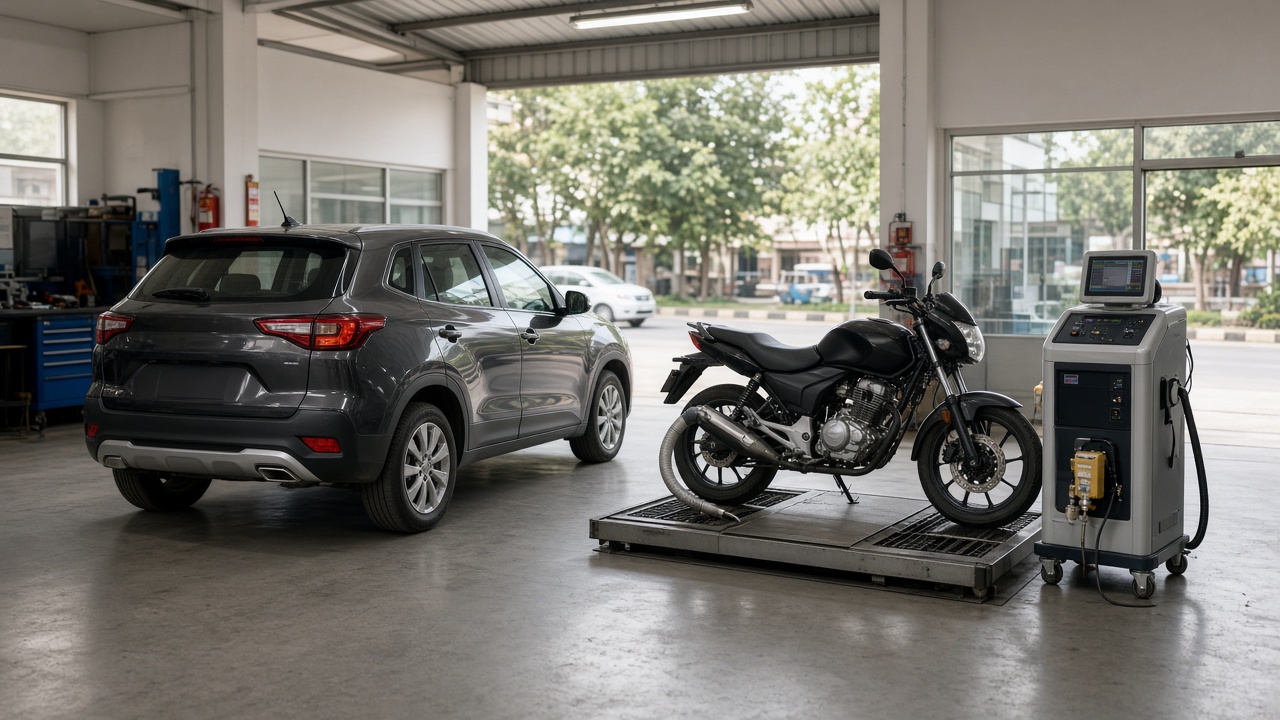
Bharat Stage VI leapfrogged India to near Euro 6-level new-vehicle standards in 2020 — cleaner engines, better fuel, and advanced after-treatment on petrol and diesel vehicles.
BS-VI: cleaner new vehicles — the fleet still takes years to turn over.
April 2020: Nationwide BS-VI for new vehicles; BS-IV fuel upgraded in step.
Tech leap: Diesel particulate filters, SCR systems, and tighter petrol controls.
Fleet lag: Older BS-III/IV vehicles remain on roads for years.
NCAP backdrop: City clean-air plans sit alongside vehicle norms.
Technology Used
After-treatment: DPFs, catalytic converters, SCR for NOx.
OBD & testing: On-board diagnostics and tighter certification.
Features
Big cut per new vehicle: Especially for diesel PM and NOx.
Industry adaptation: Rapid engineering change across makers.
Incomplete alone: Dust, industry, and old fleets still pollute.
⚡ Zero Tailpipe2010s – Present
EV Transition
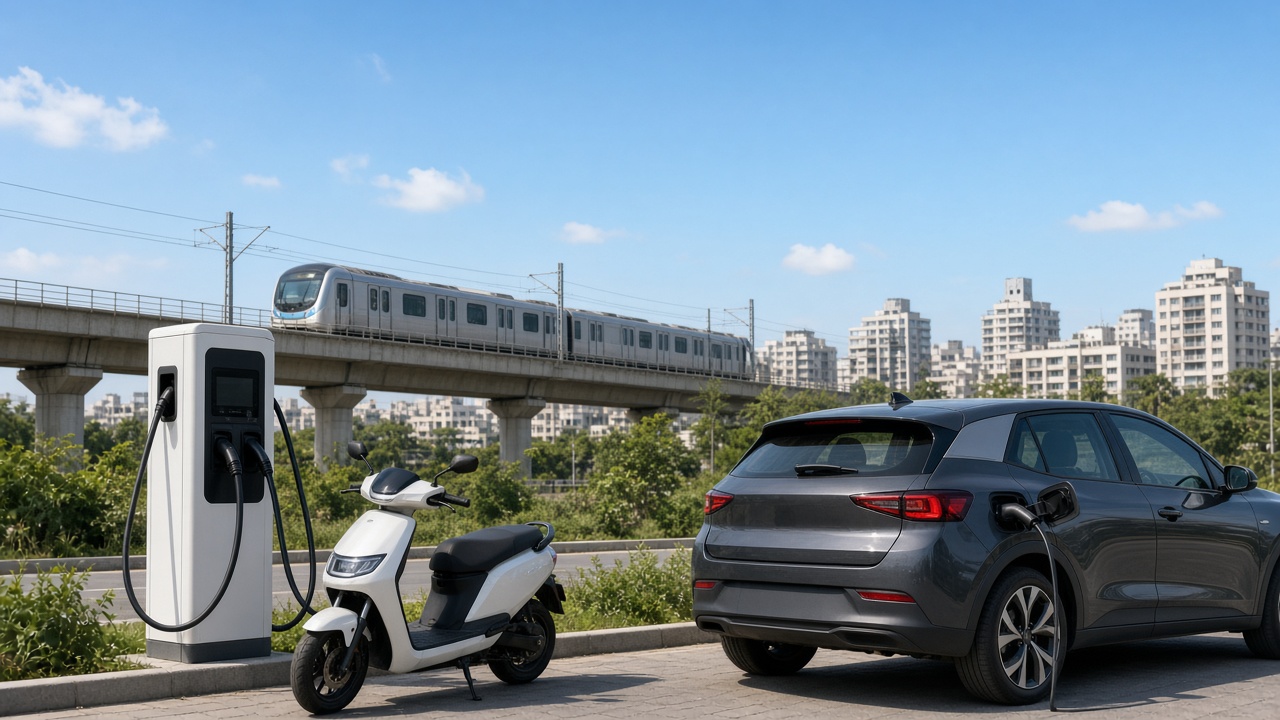
Electric two-wheelers, cars, and buses remove tailpipe emissions from city streets. India’s EV push — FAME incentives, charging networks, and local manufacturing — is the newest chapter in clean-air strategy.
EVs: cleaner local air — with a grid that must get greener too.
Two-wheeler lead: Electric scooters drive early adoption volume in India.
Policy stack: FAME, state EV policies, and city bus electrification pilots.
Charging challenge: Home, workplace, and public chargers must scale with the fleet.
Full picture: Tailpipe zero helps cities; lifecycle benefits grow as power turns renewable.
Technology Used
Li-ion batteries: Energy storage for scooters, cars, and buses.
Motors & controllers: Efficient electric drive.
Charging infra: AC/DC chargers and battery swapping experiments.
Features
Quiet & clean streets: Less local NOx and PM from traffic.
Cost curves falling: Batteries get cheaper; range improves.
System task: Grid, minerals, and recycling must keep pace.
Air Approaches Compared
Each era attacks a different pollution source — home fires, factories, traffic, fuels, engine standards, or zero-tailpipe mobility.
Approach
Main target
Strength
Limitation
Cleaner cooking
Household biomass smoke
Huge health gains indoors
Access, cost, habit change
Industrial controls
Factory & power emissions
Cuts large point sources
Needs monitoring & enforcement
Traffic management
Congestion & exposure
Local relief on corridors
Does not clean engines alone
CNG fleets
Diesel soot in cities
Quick particulate wins
Still combustion; infra limited
BS-VI norms
New vehicle emissions
Strict per-vehicle cuts
Old fleet turnover is slow
EV transition
Tailpipe pollution
Zero local exhaust
Grid, chargers, minerals
India Spotlight: Clean Air Milestones
From Ujjwala kitchens to BS-VI roads and EV chargers.
Year / Era
Milestone
Significance
Ancient–living
Biomass cooking smoke
Longest indoor air challenge.
Colonial–mid 20th c.
Mill & coal smoke
Industrial urban pollution arrives.
1980s–2000s
Vehicle boom + early BS norms
Traffic becomes a primary city source.
Late 1990s–2000s
Delhi CNG mandate era
Fuel switch for buses/autos.
2016+
Ujjwala LPG expansion
Cleaner cooking at national scale.
2019
NCAP launched
City clean-air programme framework.
2020
BS-VI nationwide
Leap to stringent new-vehicle norms.
2010s–2020s
EV policies & FAME
Zero-tailpipe mobility push.
Air Quality Timeline Summary
Year / Era
Milestone
Ancient–living
Wood and biomass smoke from cooking
1800s–1950s
Industrial coal smoke and urban smogs
1960s–2000s
Vehicular pollution dominates cities
1990s–2010s
CNG fleets for buses and autos
2020
BS-VI emission norms nationwide
2010s–present
EV transition accelerates
Test Your Knowledge
10 quick questions from the air quality timeline. Click each question to reveal the answer.
Answer: It releases fine particles (PM2.5) and gases that harm lungs and hearts.
Answer: Coal.
Answer: 1952.
Answer: Rapid growth of cars, buses, and two-wheelers with older emission controls.
Answer: Compressed Natural Gas.
Answer: Delhi.
Answer: April 2020.
Answer: Diesel particulate filter (DPF) or SCR for NOx.
Answer: They have zero tailpipe emissions of PM and NOx.
Answer: Industry, dust, crop burning, waste burning, power plants, and household fuels.
Classroom activity
Students Tasks
Use these prompts for discussion or projects on air quality in India.
Timeline understandingSources of pollutionLocal AQI watchClean solutions
Check today’s AQI for your city and list the top likely sources.
Make a six-panel poster from wood smoke to EV transition.
Interview an elder about cooking fuels used in their childhood kitchen.
Compare CNG and diesel buses: smoke, noise, and fuel logistics.
Explain why BS-VI helps new cars but cities can still look hazy.
Map EV chargers within 2 km of your school or home.
Debate: “Odd-even driving rules are fair.”
Design a clean-air week for your neighbourhood (dust, waste, traffic).
Write a short story from the point of view of a PM2.5 particle.
Predict one air-quality technology India will need by 2040.
Continue exploring
Air quality links vehicles, energy, industry, and cooking. Explore those timelines next.
Click any panel to expand and explore the visual mood.
Air quality in pictures — wood smoke, industry, traffic, CNG, BS-VI, and EVs.
Wood Smoke
Kitchen fires
Industry
Coal chimneys
Vehicles
Traffic smog
CNG
Cleaner city fuel
BS-VI
Strict norms
EV Transition
Zero tailpipe
Through Time
Smoke to EV
Explore all environment timelines
Jump to any other environment timeline on WorldTimelineHub.
Disclaimer: This content is AI-generated for educational purposes and may contain errors or outdated details. For correct and authoritative information, please refer to official and reliable sources such as government publications, manufacturers, museums, and academic references.