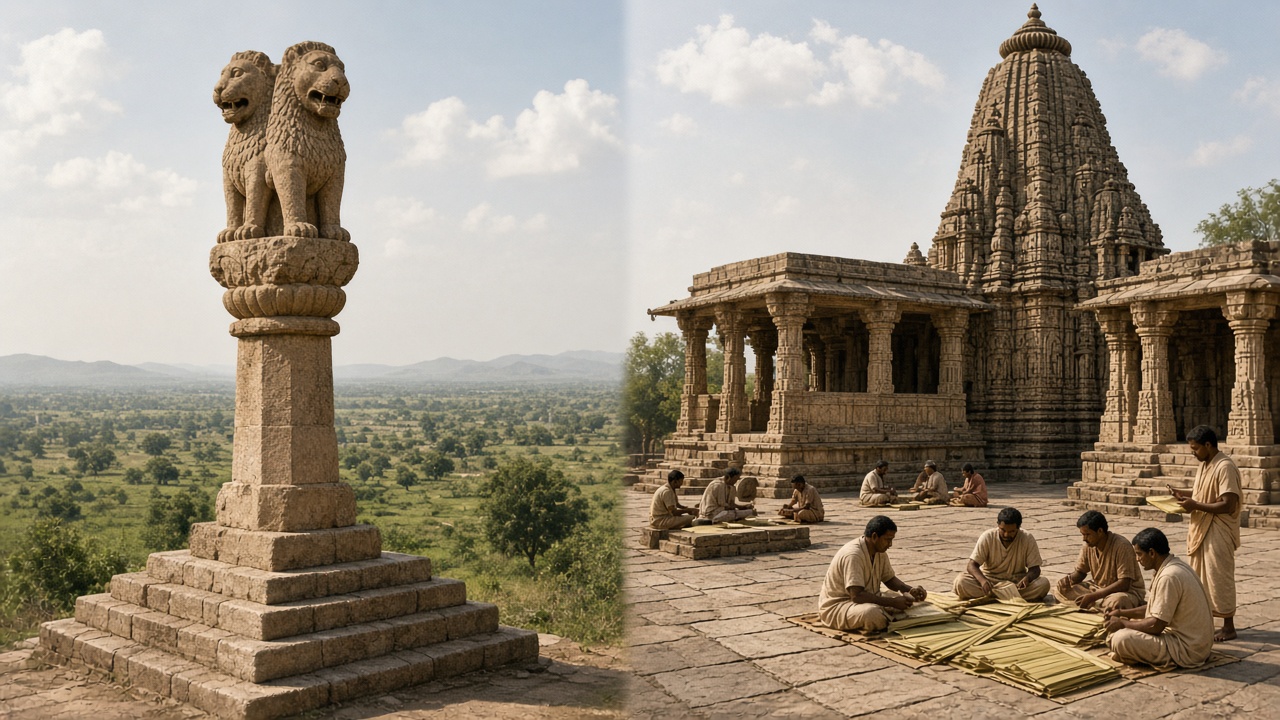
After the Indus cities faded and long before Babur rode into Panipat, northern India built vast empires from Magadha.
Chandragupta and Chanakya forged the Mauryan state; Ashoka turned conquest into dhamma; centuries later the Guptas lit a classical age of poetry, maths, temples, and painted caves —
the natural bridge to later medieval and Mughal India.
This timeline covers the mahajanapadas and Magadha, Chandragupta Maurya, the Arthashastra world, Ashoka and Kalinga, pillar edicts,
post-Maurya kingdoms, the Gupta rise, Kalidasa and Aryabhata, Ajanta and Nalanda, and the legacy that later empires inherited.
These centuries show how India moved from competing kingdoms to subcontinental empire, written law and ethics, and a classical culture that still shapes language, religion, science memory, and national symbols
(the Lion Capital of Ashoka is on India’s state emblem). Read this as the bridge between the
Indus Valley
and the later
Mughal Empire.
Big picture
Maurya to Gupta in one view
Magadha unifies much of the north under the Mauryas; Ashoka broadcasts dhamma on stone; after fragmentation, the Guptas rebuild a courtly classical age —
then regional powers carry pieces of that inheritance into the medieval world.
c. 321 BCE
Chandragupta founds Maurya rule
Ashoka
Edicts across the empire
c. 320 CE
Gupta era begins
Classical
Poetry, maths, caves
Pillars of empire and courtyards of learning — Maurya to Gupta in one frame (artistic illustration).
🏛️ Magadha Risingc. 600 – 297 BCE
Magadha & Chandragupta Maurya
In the age of mahajanapadas, Magadha grew richest and strongest along the Ganga. The Nandas built a large army; Chandragupta Maurya, advised by Chanakya,
seized power around 321 BCE, pushed into the northwest after Alexander’s successors, and made Pataliputra the hub of a new empire.
Tradition pairs Chandragupta’s rise with Chanakya’s statecraft (artistic illustration).
Mahajanapadas: Sixteen great states; Magadha outpaces rivals through iron, forests, and river trade.
Nandas: Powerful Magadha dynasty with a huge army — the hurdle Chandragupta must clear.
c. 321 BCE: Maurya rule begins; capital at Pataliputra.
Seleucid war & peace: Conflict with Seleucus ends in territory and a marriage alliance; Megasthenes later describes the court.
State tools
Arthashastra world: Taxes, officials, forts, and spies as instruments of rule.
Standing army: Infantry, cavalry, chariots, and elephants.
Roads & posts: Links that later emperors also prized.
Features
First pan-Indian scale: Ambition beyond one valley kingdom.
Advisor culture: Chanakya as model of political wisdom.
Urban capital: Pataliputra as administrative giant.
🦁 Dhamma on Stonec. 268 – 232 BCE
Ashoka & Dhamma
Bindusara held the empire; Ashoka expanded it — then the Kalinga war’s slaughter changed his public message.
Rock and pillar edicts urged restraint, welfare, and respect for many faiths. Buddhism found a royal patron who sent missions abroad.
Edicts turned royal policy into public stone messages (artistic illustration).Kalinga becomes the moral turning point in Ashoka’s story (artistic illustration).
Kalinga (c. 261 BCE): Costly conquest; Ashoka’s own words speak of remorse.
Dhamma: Ethical governance — kindness, truthfulness, religious tolerance, care for subjects.
Edicts: Prakrit inscriptions from Afghanistan to Karnataka; pillars with animal capitals.
Missions: Buddhist teachers sent to Sri Lanka and other regions; third Buddhist council traditions.
State tools
Pillars & rocks: Mass communication before printing.
Dhamma-mahamatras: Officers for moral and welfare work.
Hospitals & wells: Public works mentioned in edicts.
Features
Empire + ethics: Power justified by moral duty.
Multifaith space: Respect for Brahmins, shramanas, and others.
Living symbol: Lion Capital becomes modern India’s emblem.
🗺️ Many Kingdomsc. 185 BCE – 300 CE
Post-Maurya Age
After the last Mauryas, no single power held all India. Shungas and Kanvas ruled Magadha; Satavahanas rose in the Deccan;
Indo-Greeks, Shakas, and Kushans shaped the northwest and trade along routes that fed the Silk Road world.
Pushyamitra Shunga: Traditional accounts mark the Mauryan end and a Brahmanical revival in Magadha.
Satavahanas: Deccan dynasty bridging north–south trade and Buddhism/Brahmanism patronage.
Kushans: Kanishka’s age links Central Asia, Gandhara art, and Buddhist expansion.
Cultural mix: Coin portraits, bilingual inscriptions, and cross-border trade keep India connected abroad.
State tools
Regional courts: Local capitals replace one imperial centre.
Coinage boom: Gold and silver issues advertise kings.
Trade routes: Ports and overland paths to Rome and Central Asia.
Features
Political pluralism: Many centres of power.
Artistic fusion: Gandhara and Mathura styles.
Setup for Guptas: North waits for the next unifiers.
✨ Golden Courtc. 320 – 415 CE
Gupta Rise & Expansion
Chandragupta I begins a new imperial line; Samudragupta’s conquests and Chandragupta II’s reign create a prosperous north Indian empire.
Gold coins, Sanskrit court culture, and temple patronage define the image of a classical age.
Courts of the Guptas became models of royal patronage (artistic illustration).
Chandragupta I (c. 320 CE): Marriage alliance and Magadha base strengthen the dynasty.
Samudragupta: Prayaga (Allahabad) pillar inscription boasts of conquests and diplomacy.
Chandragupta II (Vikramaditya tradition): Peak prosperity; Chinese pilgrim Faxian later describes a peaceful land.
Administration: Provinces, land grants, and local assemblies share rule with the centre.
State tools
Gold dinaras: High-quality coins with royal imagery.
Land grants: Support for temples and Brahmins recorded on copper plates.
Sanskrit as prestige: Court language of poetry and inscriptions.
Features
Classical label: Later ages look back to Gupta standards.
Hindu temple rise: Early structural temples take shape.
Soft power: Culture travels with merchants and monks.
📜 Words, Numbers, Cavesc. 400 – 550 CE
Classical Arts & Learning
Kalidasa’s plays and poems, Aryabhata’s astronomy and maths, Ajanta’s painted caves, and great monasteries such as Nalanda
make this one of the most celebrated cultural peaks in Indian history.
Ajanta murals are a high point of classical Buddhist art (artistic illustration).Monastic universities drew students from across Asia (artistic illustration).
Literature: Kalidasa and other Sanskrit masters set classical literary taste.
Science: Aryabhata’s work on astronomy, place value, and trigonometry echoes worldwide.
Art: Ajanta paintings; temple sculpture; metal icons.
Learning centres: Nalanda and other viharas become international campuses of Buddhist and secular study.
Cultural tools
Palm-leaf manuscripts: Knowledge copied by hand.
Rock-cut architecture: Caves as temples and monasteries.
Debate halls: Oral scholarship as public performance.
Features
Creativity + empire: Peace and patronage feed the arts.
Faith diversity: Hindu, Buddhist, and Jain streams flourish.
Global reach: Ideas travel with pilgrims to East and Southeast Asia.
🌉 Toward Medieval Indiac. 550 onward
Decline & Bridge to Medieval India
Huna invasions and internal weakness shrink Gupta power. Harshavardhana briefly reunites parts of the north; then regional dynasties dominate —
until Turkish and Afghan sultanates, and much later the Mughals, build new empires on older roads, coins, and court ideas.
Maurya–Gupta heritage still lives in museums, emblems, and schoolbooks (artistic illustration).
Later Guptas: Power fragments; new kingdoms rise in Bengal, Deccan, and beyond.
Harsha (7th century): A last major north Indian unifier before longer regionalism.
Inherited toolkit: Land revenue habits, Sanskrit prestige, temple networks, and trade routes persist.
Next chapter: Delhi Sultanate and
Mughal Empire
reshape politics — but remember Magadha’s earlier imperial experiments.
Legacy tools
National symbols: Ashokan Lion Capital and Dharma Chakra.
Classical canon: Texts still taught and staged.
Archaeology: Pillars, coins, and caves as evidence.
Features
Bridge era: Links Bronze Age cities to medieval empires.
Moral memory: Ashoka as model of repentant power.
Cultural depth: Classical age as a reference point for later India.
Key Rulers at a Glance
Ruler / era
Approx. dates
Why it matters
Chandragupta Maurya
c. 321–297 BCE
Founds the Maurya Empire
Bindusara
c. 297–273 BCE
Holds and extends Mauryan power
Ashoka
c. 268–232 BCE
Kalinga, edicts, dhamma, Buddhist missions
Chandragupta I
c. 320–335 CE
Starts the Gupta imperial line
Samudragupta
c. 335–375 CE
Military expansion; Prayaga inscription
Chandragupta II
c. 375–415 CE
Peak prosperity; classical patronage
Then vs Now
Then (empire on the Ganga)
Pataliputra as imperial capital
Stone edicts as public media
Palm-leaf learning and court poets
Armies of elephants and infantry
Now (living heritage)
Ashokan symbols on the Republic’s emblem
Edicts in museums and school lessons
Ajanta and Nalanda as world heritage memory
Classical texts still read and performed
India spotlight
From Magadha to the Republic’s symbols
Modern India reached back to this era for moral and visual identity: the Lion Capital of Sarnath and the wheel from Ashokan imagery sit at the heart of the national emblem and flag.
Magadha
Imperial workshop
The Ganga heartland invents large-scale Indian empire before any Mughal court exists.
Ashoka
Ethics in stone
Edicts give India some of its earliest dated, readable political documents.
Guptas
Classical benchmark
Literature, maths, and temple forms become later reference points.
Today
Emblem & classrooms
Ashokan imagery and Gupta-age culture remain staples of civic and school memory.
Milestones
When
Milestone
What changed
c. 600–400 BCE
Mahajanapadas / Magadha rise
Large kingdoms replace tribal polities
c. 321 BCE
Chandragupta Maurya
First great pan-north empire
c. 261 BCE
Kalinga war
Ashoka’s turn toward dhamma
c. 250 BCE
Edicts & missions
Ethics and Buddhism projected widely
c. 185 BCE
Mauryan end
Regional powers return
c. 320 CE
Gupta beginning
New imperial classical age
5th century CE
Ajanta / Aryabhata era
Arts and science peak
c. 550 CE+
Gupta decline
Bridge toward medieval kingdoms
Timeline Summary
Era
Headline
Magadha & Chandragupta
Empire forged from the Ganga heartland
Ashoka
Conquest, remorse, and dhamma on stone
Post-Maurya
Many kingdoms, trade, and cultural fusion
Gupta rise
Classical imperial prosperity
Arts & learning
Poetry, maths, caves, monasteries
Legacy
Bridge toward medieval and Mughal India
Test Your Knowledge
20 quick questions from the Maurya–Gupta timeline. Click each question to reveal the answer.
Answer: Magadha (middle Ganga valley / Bihar).
Answer: Chandragupta Maurya, advised by Chanakya (Kautilya).
Answer: Pataliputra (near modern Patna).
Answer: The Arthashastra.
Answer: The Kalinga war.
Answer: An ethical policy of good conduct, welfare, and religious tolerance.
Answer: Through rock and pillar edicts (inscriptions).
Answer: The Lion Capital of Sarnath (national emblem) / Ashokan wheel imagery.
Answer: The Satavahanas (among others).
Answer: The Kushans (e.g., Kanishka’s age).
Answer: Early 4th century CE (c. 320 CE with Chandragupta I).
Answer: Samudragupta.
Answer: Flowering of Sanskrit literature, science, art, temples, and prosperous courts.
Answer: Kalidasa.
Answer: Aryabhata.
Answer: Rock-cut Buddhist halls and painted murals.
Answer: A great monastic university / learning centre.
Answer: Faxian (Fa-Hien).
Answer: The Mughal Empire timeline (Babur to 1857).
Answer: Magadha → Maurya empire → Ashoka’s dhamma → post-Maurya kingdoms → Gupta classical age → bridge to medieval/Mughal India.
Classroom activity
Students Tasks
Use these prompts for discussion or projects on Maurya–Gupta India.
Ancient IndiaEmpire & ethicsClassical cultureHeritage
Draw a map of Magadha and mark Pataliputra, Kalinga, and one Ashokan edict site.
Write a diary entry from Ashoka after the Kalinga war.
Compare Chandragupta’s rise with a later empire-builder such as Babur (use the Mughal timeline).
Design a classroom “edict” on cardboard announcing three school rules in Ashokan style.
Explain why the Lion Capital was chosen for India’s emblem.
Create a poster of Gupta-age achievements: literature, maths, art, temples.
Debate: “Ashoka was stronger as a conqueror or as a moral teacher.”
Research one Ajanta painting theme and present it to the class.
Interview a family elder: what do they remember learning about Ashoka or the Guptas in school?
Click any panel to expand and explore the visual mood.
Maurya–Gupta India in pictures — courts, edicts, Kalinga, Gupta halls, Ajanta, Nalanda, and living heritage.
Overview
Pillar to court
Chandragupta
Chanakya’s counsel
Ashoka
Edicts
Kalinga
Turning point
Gupta Court
Classical age
Ajanta
Painted caves
Nalanda
Learning
Then & Now
Living heritage
Explore all civilizations timelines
Jump to any other civilizations timeline on WorldTimelineHub.
Disclaimer: This content is AI-generated for educational purposes and may contain errors or outdated details. For correct and authoritative information, please refer to official and reliable sources such as government publications, manufacturers, museums, and academic references.