Major Empires Timeline: First Empires → Classical Empires → Faith & Trade Empires → Mongols & Mighty Kingdoms → Gunpowder & Ocean Empires → Imperialism to Independence
For more than four thousand years, much of humanity lived inside empires — vast states where one ruler governed many peoples, languages, and faiths. Empires built roads, cities, laws, and trade networks that linked continents, but they
were also won by conquest and kept by force. Their rise and fall, from Akkad to the British Empire, explains many of the languages, religions, and borders of the world today — including India’s.
This timeline covers Sargon of Akkad, Hammurabi, Egypt and the Hittites, Assyria, Achaemenid Persia, Alexander, the Maurya Empire and Ashoka, Qin and Han China, Rome, the Guptas, the Byzantine Empire, the caliphates, Tang China,
the Cholas, the Mongols, Mali, the Ottomans, Vijayanagara, the Aztecs and Incas, the Mughals, the European ocean empires, the British Raj, the Scramble for Africa, and decolonisation.
c. 2334 BCE Akkad → c. 550 BCE Persiac. 321 BCE Maurya Empire → 1206 Mongol Empire1498 Vasco da Gama in Calicut → 15 Aug 1947 India free
Why Empires Matter
Empires spread religions such as Buddhism, Christianity, and Islam, carried crops, inventions, and ideas across continents, and left behind monuments from the Great Wall to the Taj Mahal. They also brought conquest, slavery,
famine, and the drawing of borders by outsiders. Comparing empires across the world — how they rose, how they ruled, and why they fell — helps explain the world we live in, and why freedom from empire mattered so much to India and
to more than 80 other nations.
Big picture
Major empires in one view
Kings in Mesopotamia and Egypt built the first empires, Persia, the Mauryas, Han China, and Rome created continent-sized states, faith and trade empires spread religions and learning, the Mongols conquered the largest land empire
ever, gunpowder and ocean empires reached around the globe, and in the 20th century world wars and freedom movements brought the age of empires to an end. For individual civilisations, see the timelines of
ancient Rome,
the Mughals, and
ancient Egypt.
c. 2334 BCE
Sargon of Akkad founds what is often called the first empire
24 million km²
Mongol Empire, the largest connected land empire (estimate)
About ¼
Share of the world’s land in the British Empire around 1920
15 Aug 1947
India’s independence starts a worldwide wave of freedom
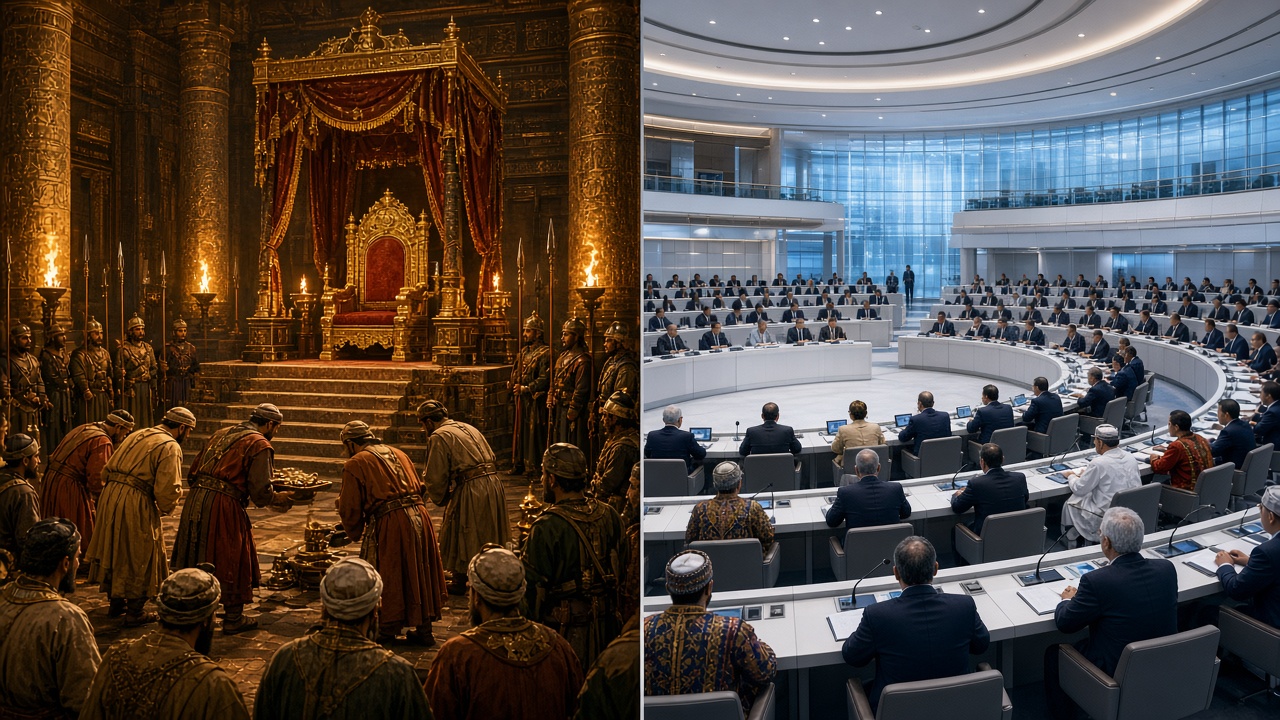
Envoys bow before an emperor’s throne, while today delegates of independent nations meet as equals (artistic illustration).
The Age of Empires vs Today
Feature
Around 100 CE
Today
How the world was divided
A few giant empires — Rome, Parthia, the Kushans, and Han China — ruled most people
193 member states of the United Nations
Who held power
Emperors claiming the gods’ favour or the Mandate of Heaven
Mostly constitutions and elected governments
Largest states
Rome and Han China, each with roughly 50–60 million people
India and China, each with about 1.4 billion people
Sending a message
Relay riders on imperial roads, taking days or weeks
Instant messages around the world
Trade
Silk Road caravans and monsoon ships to Indian ports
Container ships and global trade rules
Borders
Frontier zones, walls, and forts
Mapped borders recognised by international law
Conquest
An accepted way for rulers to gain land and glory
The UN Charter (1945) bans taking territory by force
People
Subjects of a ruler; many enslaved
Citizens with rights; slavery banned under international law
Languages spread by power
Latin, Greek, Persian, and Chinese
English, Spanish, French, and Portuguese spoken worldwide — a legacy of empire
Self-rule
No idea that every nation should govern itself
More than 80 former colonies independent since 1945
🏺 First Empiresc. 2334 – 550 BCE
First Empires
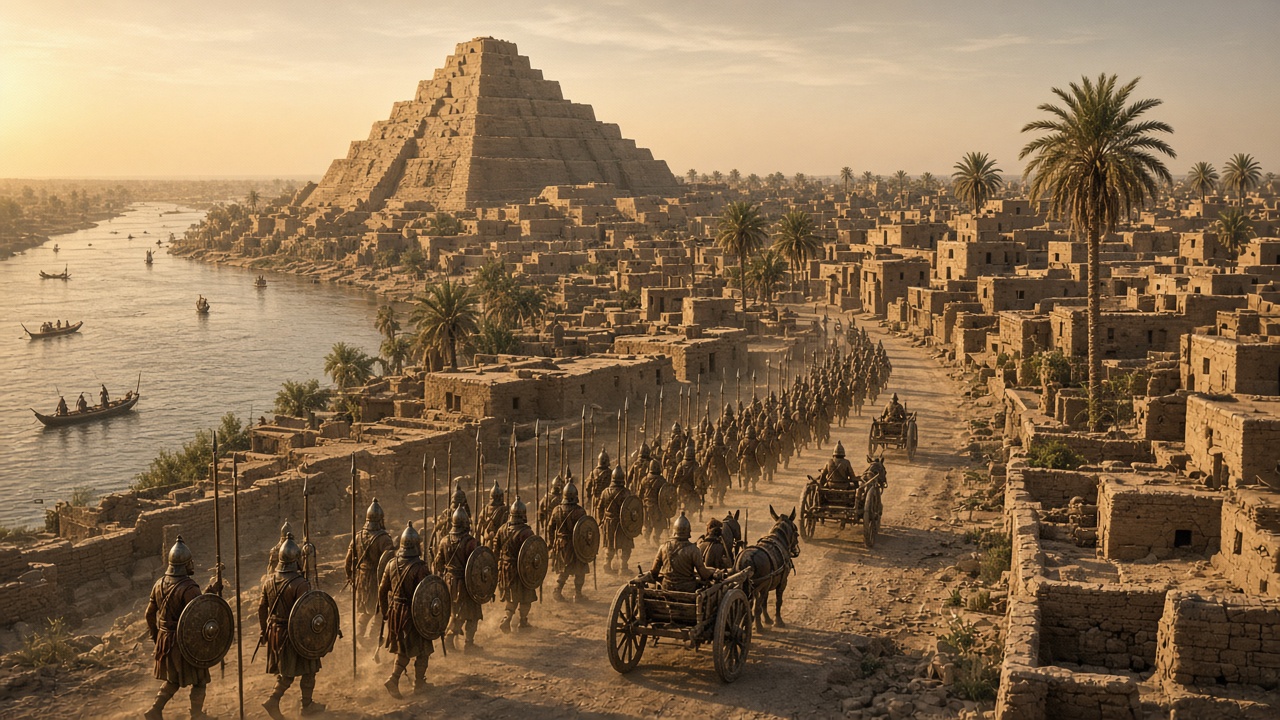
In the river valleys of Mesopotamia and Egypt, kings learned to rule many cities and peoples from one capital. They used bronze and later iron weapons, chariots, governors, tribute, and written laws. Rival empires fought, traded, and even signed peace treaties, while in China the Zhou kings claimed that Heaven itself gave them the right to rule.
Soldiers march past a stepped temple tower in a Mesopotamian city by the river (artistic illustration).
c. 2334–2154 BCE: Sargon of Akkad conquers the city-states of Sumer in Mesopotamia and creates the Akkadian Empire, often called the world’s first empire, ruled through governors and a standing army.
c. 1792–1750 BCE: Hammurabi of Babylon unites Mesopotamia and has one of the earliest written law codes carved on a tall stone pillar for all to see.
c. 1550–1070 BCE: Egypt’s New Kingdom builds an empire from Nubia to Syria and clashes with the Hittite Empire of Anatolia at Kadesh (c. 1274 BCE), and the two sign one of the earliest known peace treaties (c. 1259 BCE).
c. 1046–539 BCE: The Zhou dynasty of China claims the Mandate of Heaven (c. 1046 BCE), the Assyrian Empire conquers the Near East with iron weapons (911–609 BCE), and Babylon falls to Cyrus of Persia (539 BCE).
Technology
Bronze and iron: Stronger weapons and tools.
Chariots: Fast, fearsome armies.
Writing: Cuneiform and hieroglyphs for records and laws.
Features
God-kings: Rulers backed by the gods.
Tribute: Conquered lands pay their rulers.
Law codes: Rules written in stone.
🏛️ Classical Empires550 BCE – 500 CE
Classical Empires
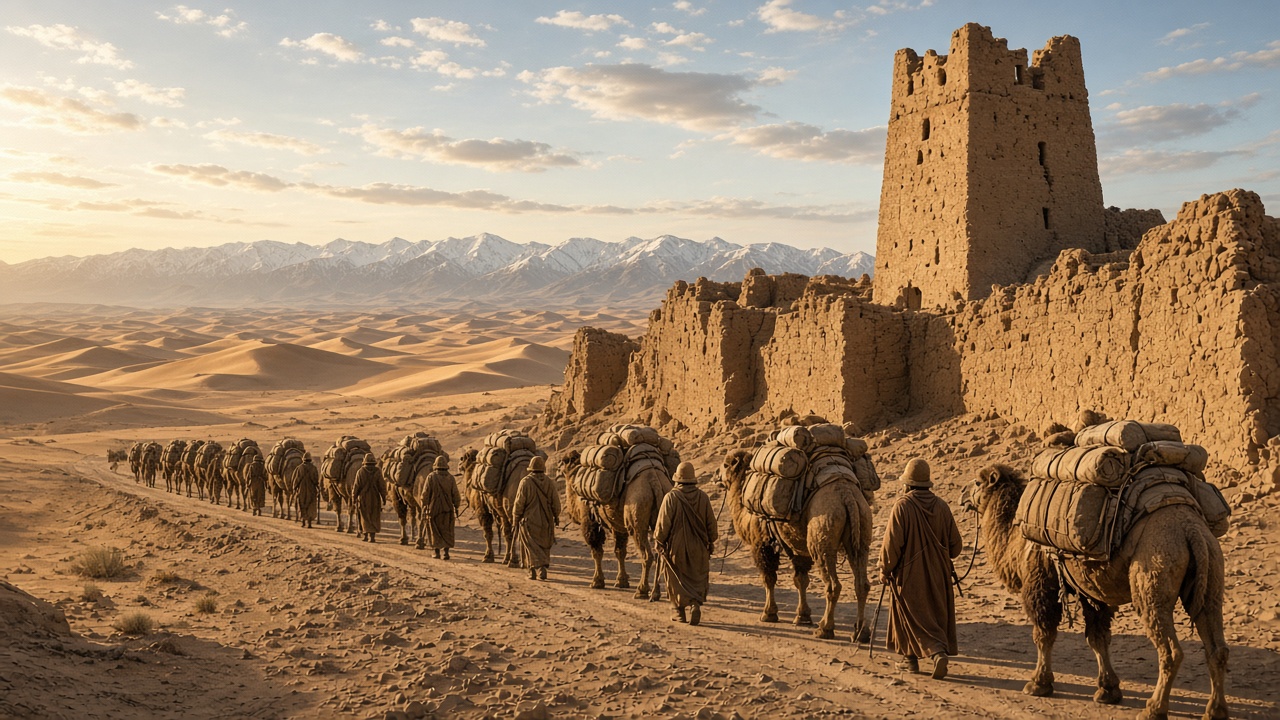
Empires now stretched across continents. Persia, the Maurya Empire, Qin and Han China, and Rome governed tens of millions of people through officials, roads, coins, and laws. The Silk Road and the monsoon sea routes linked them in a chain of trade from China to the Mediterranean, with India at its centre.
A camel caravan carrying silk passes a frontier watchtower on the Silk Road (artistic illustration).
c. 550–323 BCE: Cyrus the Great founds the Achaemenid Persian Empire, which stretches from Egypt to the Indus, Darius I builds the Royal Road of about 2,700 km with relay stations, and Alexander of Macedon conquers Persia and reaches the Beas River in Punjab (326 BCE).
c. 321–185 BCE: Chandragupta Maurya founds the Maurya Empire, and Ashoka (ruled c. 268–232 BCE) turns away from war after conquering Kalinga (c. 261 BCE), spreading dhamma through edicts on rocks and pillars.
221 BCE–220 CE: The Qin ruler unites China and standardises writing, coins, and weights (221 BCE), and the Han dynasty (206 BCE–220 CE) trains officials, invents paper, and opens the Silk Road to Central Asia.
27 BCE–476 CE: Augustus becomes Rome’s first emperor (27 BCE), the Roman Empire reaches its greatest size under Trajan (117 CE), the Kushan and Gupta empires rule northern India (Gupta c. 320–550 CE), and the Western Roman Empire ends (476 CE).
Technology
Roads and relays: Royal Road and Roman roads.
Coins: One currency across an empire.
Paper: Invented in Han China.
Features
Silk Road: Trade from China to Rome.
Edicts: Ashoka’s messages of dhamma.
Officials: Governing millions from afar.
⚓ Faith & Trade Empires500 – 1200
Faith & Trade Empires
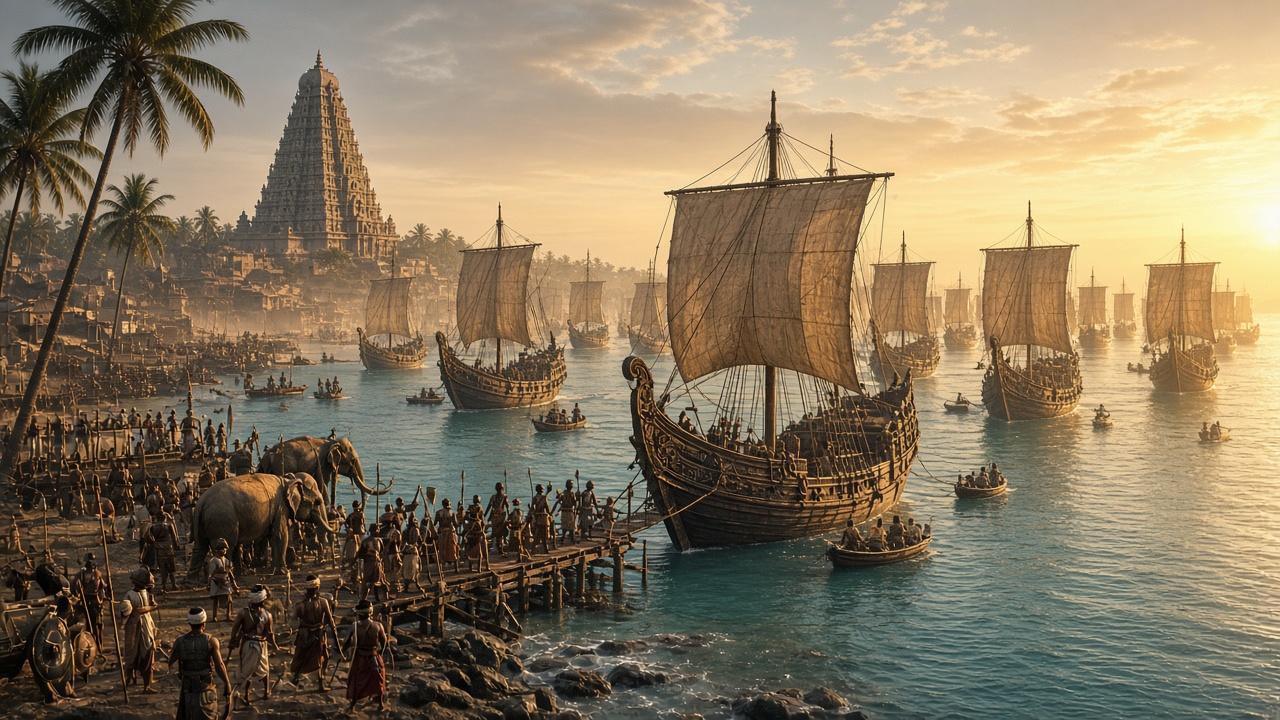
New empires spread religions, learning, and trade. The Byzantine Empire carried on Rome’s legacy in the east, Islamic caliphates stretched from Spain to the Indus, and Tang China flourished. In South India the Cholas built a sea power that reached Southeast Asia, while the Khmer of Angkor and the Ghana Empire of West Africa grew rich on trade.
A South Indian war fleet sets sail across the Bay of Bengal around 1025 (artistic illustration).
527–565: Byzantine emperor Justinian wins back parts of the old western empire, collects Roman law into a great code, and builds the Hagia Sophia in Constantinople (537).
661–762: The Umayyad Caliphate stretches from Spain to Sindh by 711–712, and the Abbasids, who take power in 750, found Baghdad (762), which becomes a world centre of learning and translation.
618–907 and 800: Tang China rules from Chang’an, one of the largest cities on Earth, the Ghana Empire grows rich on trans-Saharan trade in gold and salt, and Charlemagne is crowned emperor in Rome on 25 December 800.
985–1150: Chola kings Rajaraja I and Rajendra I build a sea-based empire from Tamil Nadu, complete the Brihadisvara Temple at Thanjavur (c. 1010), and send a naval expedition against Srivijaya (c. 1025), and the Khmer Empire builds Angkor Wat (early 1100s).
Technology
Navies: Fleets that cross the ocean.
Papermaking: Spreads west from China.
Astrolabes: Science and navigation.
Features
Faith: Religions shape empires.
Learning: Baghdad’s scholars.
Sea trade: Chola power on the waves.
🐎 Mongols & Mighty Kingdoms1200 – 1491
Mongols & Mighty Kingdoms
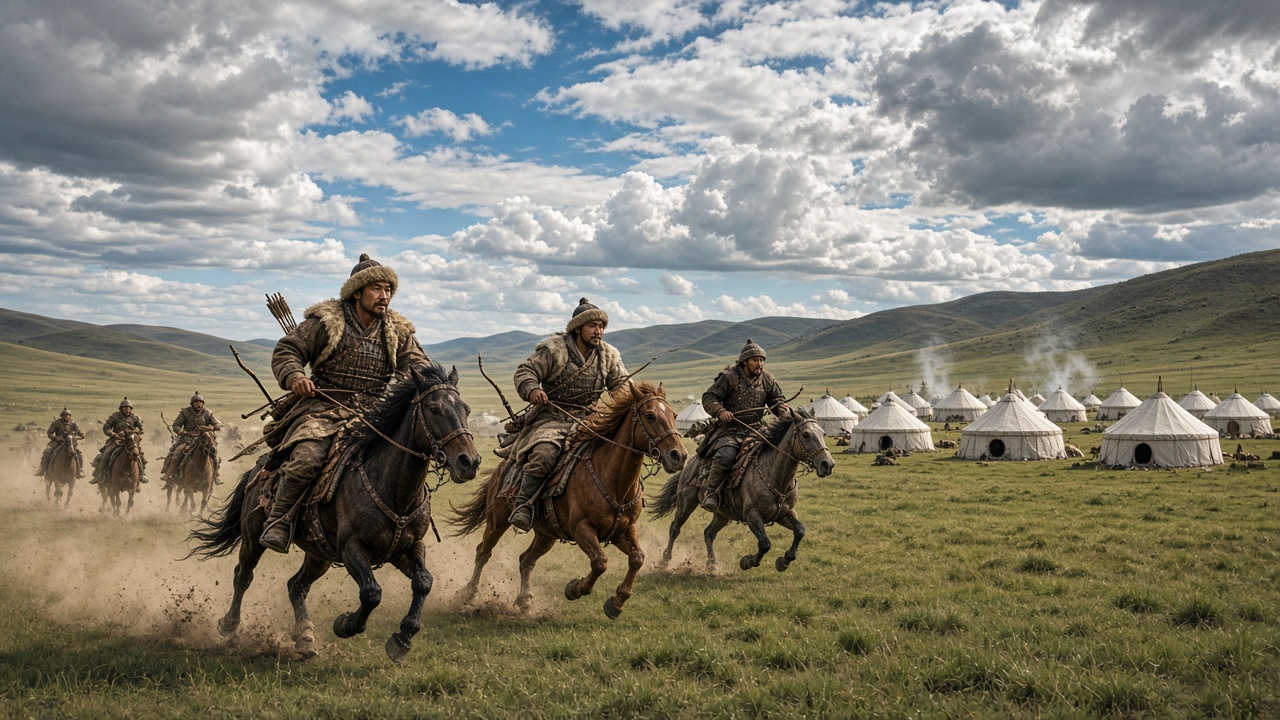
Mounted archers from the steppes of Mongolia conquered the largest connected land empire in history, linking China, Persia, and Russia. As it broke apart, new powers rose: the Delhi Sultanate, Mali, the Ottomans, Vijayanagara, and Ming China — and, unknown to the rest of the world, the Aztec and Inca empires in the Americas.
Mounted archers gallop across the steppe past a camp of felt tents in the 13th century (artistic illustration).
1206–1279: Temujin is proclaimed Genghis Khan (1206), the Mongols conquer lands from Korea to Eastern Europe, sack Baghdad (1258), and complete the conquest of China under Kublai Khan (1279).
1206–1324: The Delhi Sultanate is founded (1206) and holds back repeated Mongol invasions, and Mansa Musa of the Mali Empire makes his famous pilgrimage to Mecca (1324) with so much gold that he lowers its value in Cairo.
c. 1299–1453: The Ottoman state is founded (c. 1299), the Vijayanagara Empire rises in South India (1336), the Ming dynasty takes power in China (1368), and the Ottomans capture Constantinople (29 May 1453), ending the Byzantine Empire.
1428–1491: The Aztec Triple Alliance rules central Mexico from Tenochtitlan (from 1428), and the Inca under Pachacuti (from 1438) build an empire along the Andes linked by some 30,000 km of roads.
Technology
Composite bows: Deadly from horseback.
Relay posts: Mongol messengers across Asia.
Gunpowder cannons: Breaking city walls.
Features
Mongol peace: Safer trade across Asia.
Gold of Mali: Africa’s richest empire.
1453: Constantinople falls.
⛵ Gunpowder & Ocean Empires1492 – 1814
Gunpowder & Ocean Empires
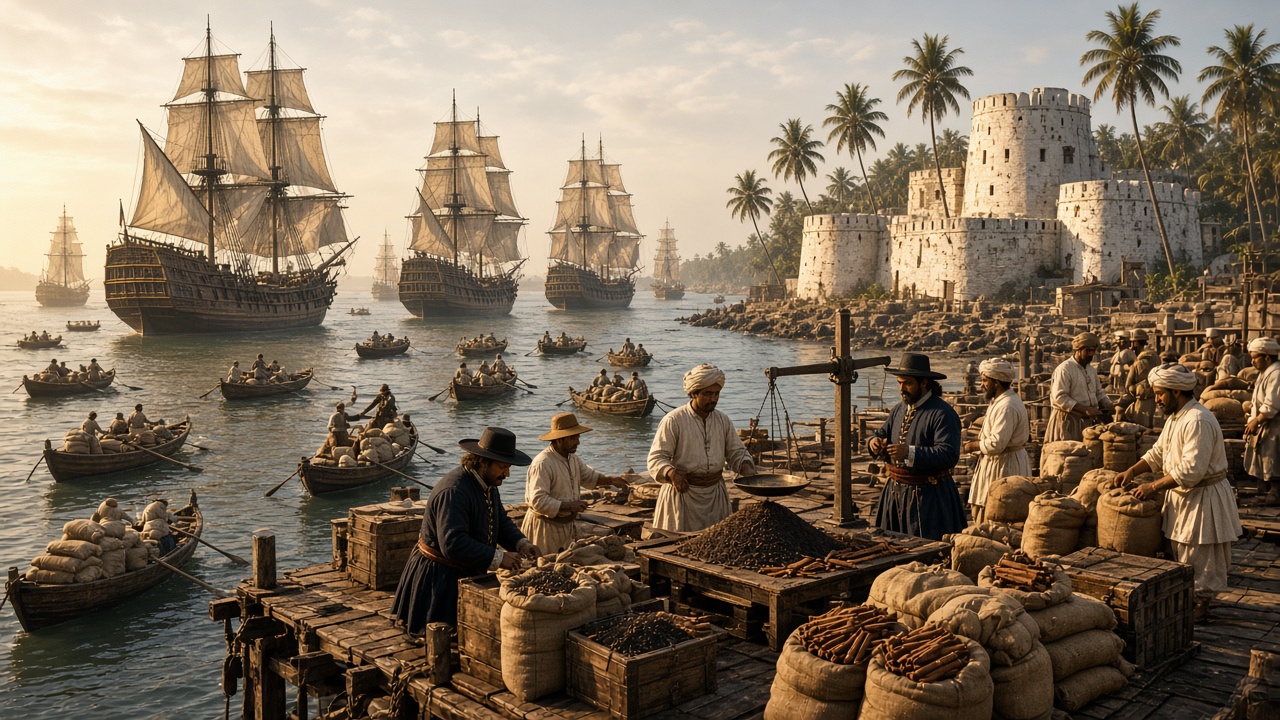
On land, the Ottoman, Safavid, and Mughal “gunpowder empires” used cannons and muskets to rule huge populations. At sea, European ships reached the Americas and India, and Spain, Portugal, the Netherlands, Britain, and France built the first empires that spanned the globe — bringing new crops and wealth to some, and conquest, disease, and slavery to many others.
Merchants weigh pepper and cinnamon at a spice port on India’s west coast around 1600 (artistic illustration).
1492–1533: Columbus reaches the Caribbean (1492), Vasco da Gama reaches Calicut (1498), Portugal seizes Goa (1510), and Spain conquers the Aztec (1521) and Inca (1532–1533) empires, helped by diseases that killed millions.
1501–1605: The Safavids unite Persia (1501), Suleiman the Magnificent leads the Ottomans to their height (1520–1566), and Babur founds the Mughal Empire at Panipat (1526), which Akbar (1556–1605) makes one of the richest states on Earth.
1600–1757: The English (1600) and Dutch (1602) East India Companies are founded, the Qing dynasty takes China (1644), Shivaji is crowned founder of the Maratha kingdom (1674), and the Battle of Plassey (1757) gives the English company control of Bengal.
1776–1814: The United States declares independence from Britain (1776), Haiti becomes independent after the first successful revolt by enslaved people (1804), and wars of independence begin across Spanish America (from 1808).
Technology
Cannons and muskets: Gunpowder armies.
Ocean ships: Sailing around the world.
Trading companies: Merchants who become rulers.
Features
Columbian exchange: Crops and diseases cross oceans.
Atlantic slave trade: About 12.5 million Africans shipped.
First revolts: America and Haiti break free.
🕊️ Imperialism to Independence1815 – Today
Imperialism to Independence
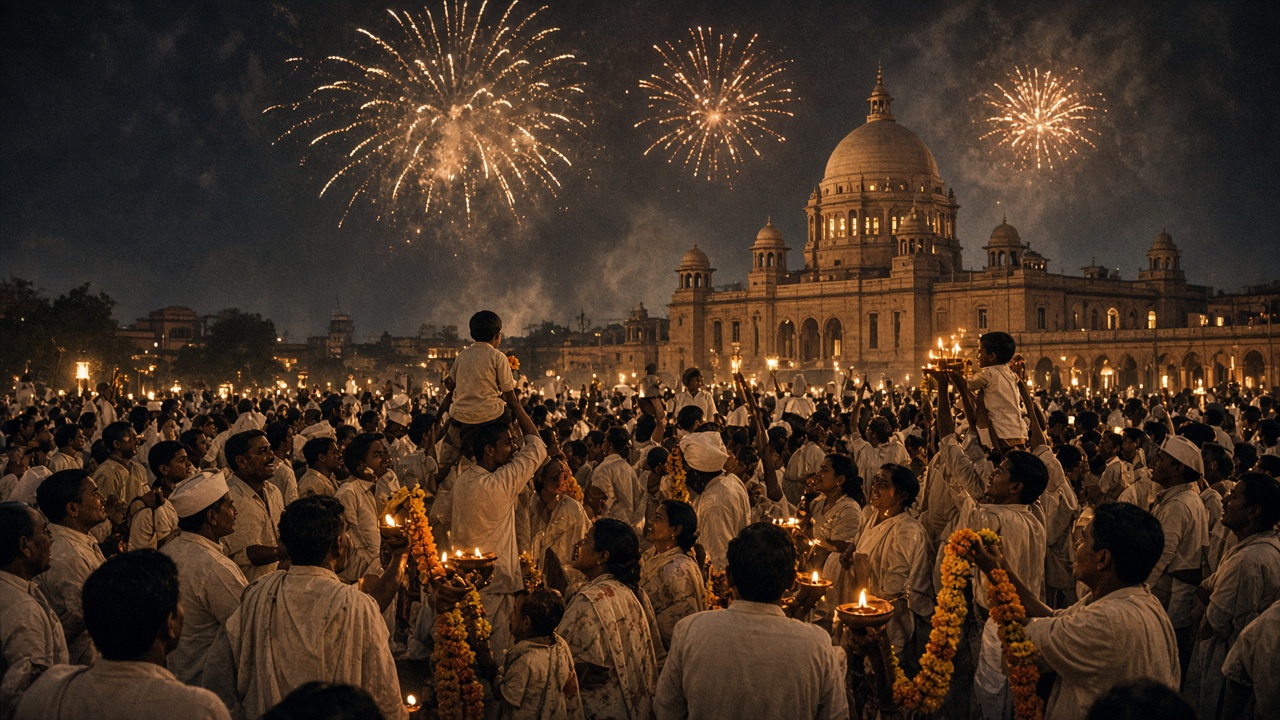
Steamships, railways, telegraphs, and machine guns let industrial powers conquer much of Asia and Africa, and Britain built the largest empire in history. Two world wars then broke the old empires, and freedom movements — led by India’s — ended most colonial rule within a generation after 1945.
Crowds with lamps and garlands celebrate independence at midnight under fireworks (artistic illustration).
1815–1858: Britain becomes the leading world power after Napoleon’s defeat at Waterloo (1815), the Opium War (1839–1842) forces China to open its ports, and after the revolt of 1857 the British Crown takes direct rule of India (1858), ending the Mughal Empire.
1868–1914: Japan modernises after the Meiji Restoration (1868), European powers divide Africa at the Berlin Conference (1884–1885) and control about 90% of it by 1914, and Ethiopia defeats Italy at Adwa (1896) to stay independent.
1914–1945: The First World War brings down the German, Austro-Hungarian, Russian, and Ottoman empires (1917–1922), the British Empire reaches its largest size around 1920, and Japan’s empire is defeated in the Second World War (1945).
1947–Today: India and Pakistan become independent (August 1947), 17 African countries become independent in 1960, the Soviet Union breaks into 15 countries (1991), Hong Kong is handed to China (1997), and the UN counts more than 80 former colonies independent since 1945.
Technology
Steamships and railways: Moving armies and goods.
Telegraph: Orders across oceans in hours.
Machine guns: Colonial wars of conquest.
Features
Scramble for Africa: A continent divided.
World wars: Old empires collapse.
Decolonisation: Freedom for over 80 nations.
The Largest Empires in History
Areas are historians’ estimates at each empire’s peak and vary between sources.
Empire
Peak
Approx. area
Notes
British Empire
c. 1920
About 35 million km²
Largest empire ever; about a quarter of the world’s land and people
Mongol Empire
c. 1270
About 24 million km²
Largest connected land empire
Russian Empire
c. 1895
About 23 million km²
Stretched from Europe to the Pacific
Qing dynasty (China)
c. 1790
About 15 million km²
China’s largest extent
Spanish Empire
c. 1810
About 14 million km²
The first empire on which “the sun never set”
Umayyad Caliphate
c. 720
About 11 million km²
From Spain to Sindh
Achaemenid Persian Empire
c. 500 BCE
About 5.5 million km²
Largest empire of the ancient world
Roman Empire
117 CE
About 5 million km²
Surrounded the whole Mediterranean
Maurya Empire
c. 250 BCE
About 3.4–5 million km²
Most of the Indian subcontinent
Mughal Empire
c. 1700
About 4 million km²
Ruled perhaps a quarter of the world’s economy
Empires of the Indian Subcontinent
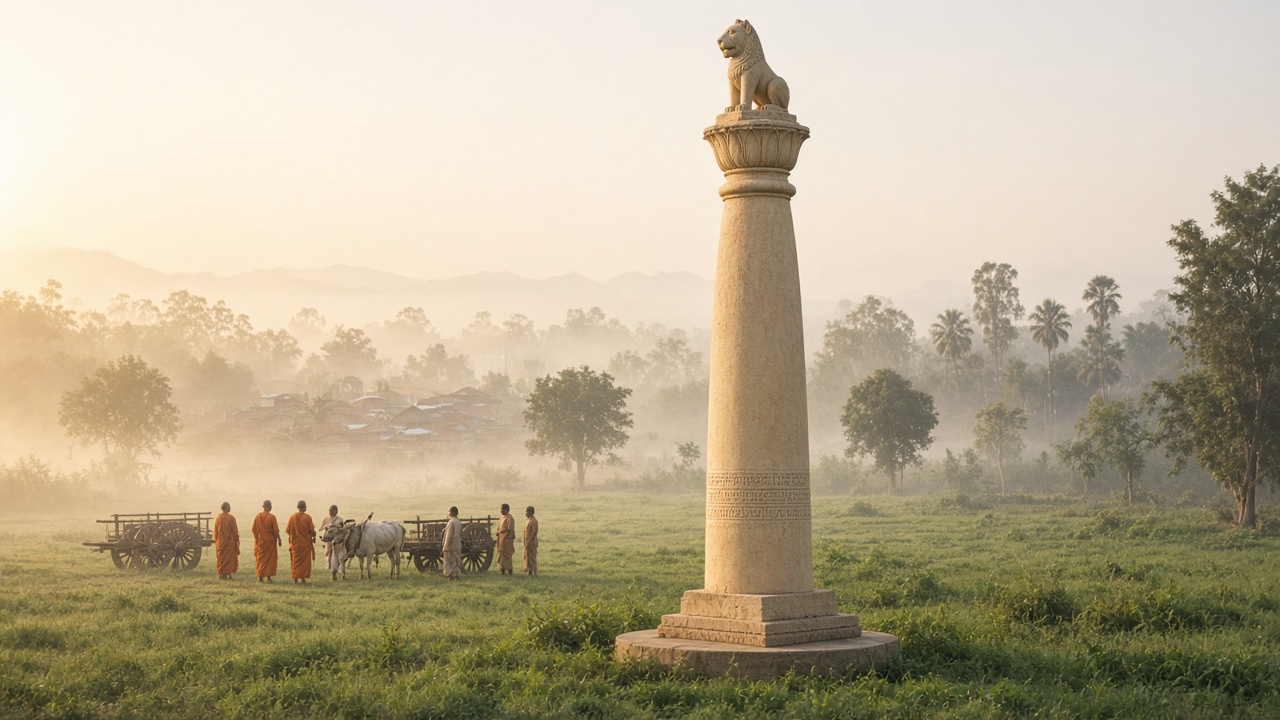
A polished Mauryan pillar with a lion capital, like those carrying Ashoka’s edicts, stands in the morning mist (artistic illustration).
Empire
Years
Main capital
Known for
Maurya
c. 321–185 BCE
Pataliputra
First empire over most of the subcontinent; Ashoka’s edicts
Kushan
c. 1st–3rd centuries CE
Purushapura (Peshawar)
Silk Road trade, Gandhara art, Kanishka
Gupta
c. 320–550 CE
Pataliputra
A golden age of Aryabhata’s mathematics, Kalidasa’s plays, and the iron pillar
Chola
c. 848–1279
Thanjavur, later Gangaikonda Cholapuram
Navy, Brihadisvara Temple, bronze sculpture
Delhi Sultanate
1206–1526
Delhi
Qutb Minar; held back the Mongols
Vijayanagara
1336–1646
Vijayanagara (Hampi)
Krishnadevaraya, grand temple city; declined after 1565
Mughal
1526–1857
Agra, Fatehpur Sikri, Delhi
Akbar, the Taj Mahal, a vast economy
Maratha
1674–1818
Raigad, later Pune
Shivaji; the leading Indian power of the 18th century
British Raj
1858–1947
Calcutta, then New Delhi
Railways and famines; ended by the freedom struggle
Why Empires Rise and Fall
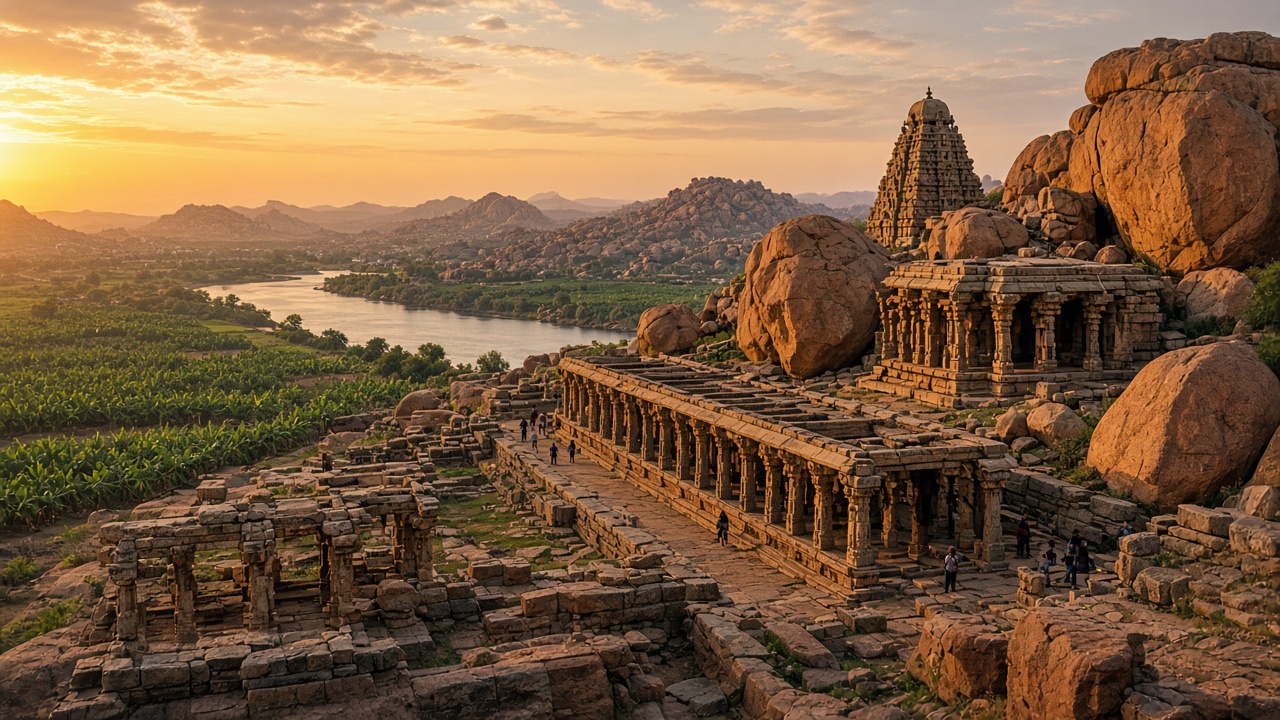
The ruins of a once-great imperial capital among giant boulders, like Vijayanagara at Hampi (artistic illustration).
Factor
How it built empires
How it brought them down
Military power
New weapons and tactics — chariots, mounted archers, cannons, machine guns
Costly wars and frontiers too long to defend
Roads and messages
Persian, Roman, and Inca roads; Mongol relay posts
Distant provinces became hard to control
Trade and wealth
Silk, spices, gold, and taxes paid for armies
Shifting trade routes and debased coins
Government
Officials, laws, censuses, and common coins
Weak rulers, corruption, and fights over succession
Ideas and religion
Shared beliefs such as Ashoka’s dhamma or the Mandate of Heaven united peoples
Revolts by peoples denied rights, and new ideas of nationhood
Climate and disease
Good harvests in fertile river valleys
Droughts and plagues, such as the Black Death of the 1340s
Outside pressure
Weak neighbours were easy to conquer
Invasions, rival empires, and freedom movements
What Empires Left Behind
Legacy
Examples
Languages
English, Spanish, French, and Portuguese spoken worldwide; Persian and Arabic words in Hindi and Urdu
Religions
Buddhism spread by Ashoka’s missions, Christianity through Rome, and Islam through the caliphates
Law and government
Roman law, China’s civil-service exams, and India’s Penal Code (1860)
Borders
Many borders in Africa, the Middle East, and South Asia were drawn by empires
Monuments
The Great Wall, the Colosseum, the Brihadisvara Temple, Angkor Wat, and the Taj Mahal
Food and crops
Chillies, potatoes, and tomatoes reached India through Portuguese traders
Railways and cities
Indian Railways, Mumbai, Kolkata, Chennai, and Singapore grew under colonial rule
Wounds
Slavery, famines, Partition, and inequalities that still shape the world
Major Empires Timeline Summary
Date
Milestone
c. 2334 BCE
Sargon founds the Akkadian Empire
c. 1754 BCE
Hammurabi’s law code
c. 1259 BCE
Egyptian–Hittite peace treaty
c. 550 BCE
Cyrus founds the Persian Empire
326 BCE
Alexander reaches the Beas River
c. 321 BCE
Maurya Empire founded
c. 261 BCE
Kalinga war; Ashoka turns to dhamma
221 BCE
Qin unites China
27 BCE
Augustus becomes Rome’s first emperor
c. 320 CE
Gupta Empire begins
476
Western Roman Empire ends
762
Baghdad founded by the Abbasids
c. 1025
Chola naval expedition to Srivijaya
1206
Genghis Khan; Delhi Sultanate founded
1324
Mansa Musa’s pilgrimage
1336
Vijayanagara Empire founded
1453
Ottomans capture Constantinople
1498
Vasco da Gama reaches Calicut
1526
Babur founds the Mughal Empire
1757
Battle of Plassey
1858
British Crown rule in India
1884–1885
Berlin Conference
1917–1922
Four empires fall after the First World War
15 August 1947
India becomes independent
1960
17 African countries become independent
1997
Hong Kong handed to China
Test Your Knowledge
20 quick questions from the major empires timeline. Click each question to reveal the answer.
Click any panel to expand and explore the visual mood.
Major empires in pictures — a Mesopotamian army, a Silk Road caravan, a Mauryan pillar, the Chola fleet, Mongol riders, the ruins of Vijayanagara, a spice port, independence at midnight, and empires then versus now.
First Empires
Mesopotamia
Silk Road
Han to Rome
Mauryan Pillar
Ashoka’s edicts
Chola Fleet
c. 1025
Mongol Riders
From 1206
Fallen Capital
Hampi
Ocean Empires
Spice ports, c. 1600
Independence
15 August 1947
Then vs Now
Throne to assembly
Explore all world history timelines
Jump to any other world history timeline on WorldTimelineHub.
Disclaimer: This content is AI-generated for educational purposes and may contain errors or outdated details. For correct and authoritative information, please refer to official and reliable sources such as government publications, manufacturers, museums, and academic references.