Indus Valley Civilization Timeline: Mehrgarh Farmers → Early Harappan Towns → Great Planned Cities → Trade & Script → Decline → Rediscovery
More than 4,500 years ago, along the Indus and Ghaggar-Hakra rivers, people built some of the world’s first planned cities, with straight streets, baked-brick houses, private bathrooms, and covered drains. The Indus Valley or
Harappan Civilization grew from early farming villages, flourished from about 2600 to 1900 BCE across a larger area than Egypt or Mesopotamia, slowly declined, and was forgotten until archaeologists rediscovered it in the 1920s.
This timeline covers Mehrgarh, early Harappan towns and the Kalibangan ploughed field, Harappa, Mohenjo-daro, Dholavira, Rakhigarhi, Lothal, and other sites, the Great Bath, drains, standard bricks and weights, seals and the
undeciphered script, beads, bronze, and cotton, trade with Mesopotamia, theories of decline, the 1924 announcement of the discovery, excavations in India and Pakistan, UNESCO World Heritage Sites, and the civilization’s legacy.
c. 7000 BCE Mehrgarh → c. 3300 BCE Early Harappanc. 2600–1900 BCE Great Cities1921 Harappa Dug → 1924 Discovery Announced
Why the Indus Valley Civilization Matters
The Indus Valley Civilization is one of the world’s earliest urban civilizations, alongside Mesopotamia and Egypt. Its people planned cities, managed water, standardised bricks and weights, traded across the seas, and
developed a script — all without leaving behind grand palaces, royal tombs, or signs of large armies. Many everyday things in South Asia, from cotton cloth and bangles to bullock carts and clay toys, echo this ancient world.
Big picture
The Indus Valley Civilization in one view
Farmers settled at Mehrgarh around 7000 BCE, walled towns and early signs appeared from about 3300 BCE, great planned cities flourished from about 2600 BCE, trade reached Mesopotamia and the Persian Gulf, cities slowly
emptied after about 1900 BCE as climate and rivers changed, and archaeologists revealed the civilization to the world in 1924. Related timelines:
homes then and now,
irrigation,
water transport.
7000 BCE
Farming begins at Mehrgarh (approx.)
2600 BCE
Great planned cities flourish
1,000+
Sites found in India and Pakistan
1924
Discovery announced to the world
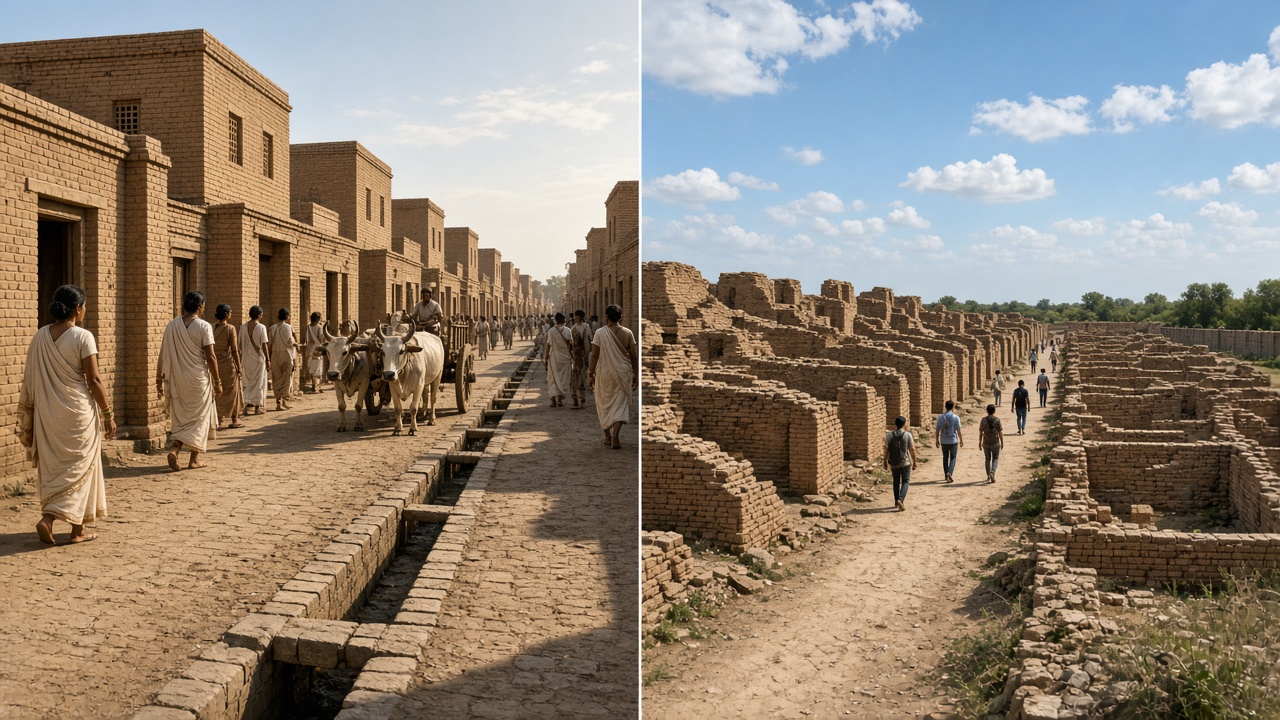
A busy Harappan street reimagined, and the brick ruins visitors see today (artistic illustration).
Harappan Life Then vs South Asia Now
Feature
Harappan city (c. 2500 BCE)
Today
Town planning
Grid-like streets, citadel and lower town
Planned cities such as Chandigarh, and smart city plans
Drainage
Covered brick drains along streets
Underground sewers, though many towns still lack them
Bricks
Standard ratio of 1:2:4
Standard modern bricks
Water
Private wells, reservoirs, and the Great Bath
Piped water, tanks, and rainwater harvesting
Weights and measures
Standard cube-shaped stone weights
Metric system and digital scales
Writing
Short inscriptions on seals, still undeciphered
Many scripts, printing, and digital text
Trade
Boats to the Persian Gulf and Mesopotamia
Container ships and global trade
Farming
Wheat, barley, pulses, cotton, and cattle
The same crops, plus rice, sugarcane, and many more
Transport
Bullock carts with solid wheels and river boats
Bullock carts still in villages, beside roads, rail, and air
Ornaments
Shell and faience bangles, carnelian beads
Bangles and beads remain popular across South Asia
🌾 Farmersc. 7000 – 3300 BCE
First Farmers of Mehrgarh
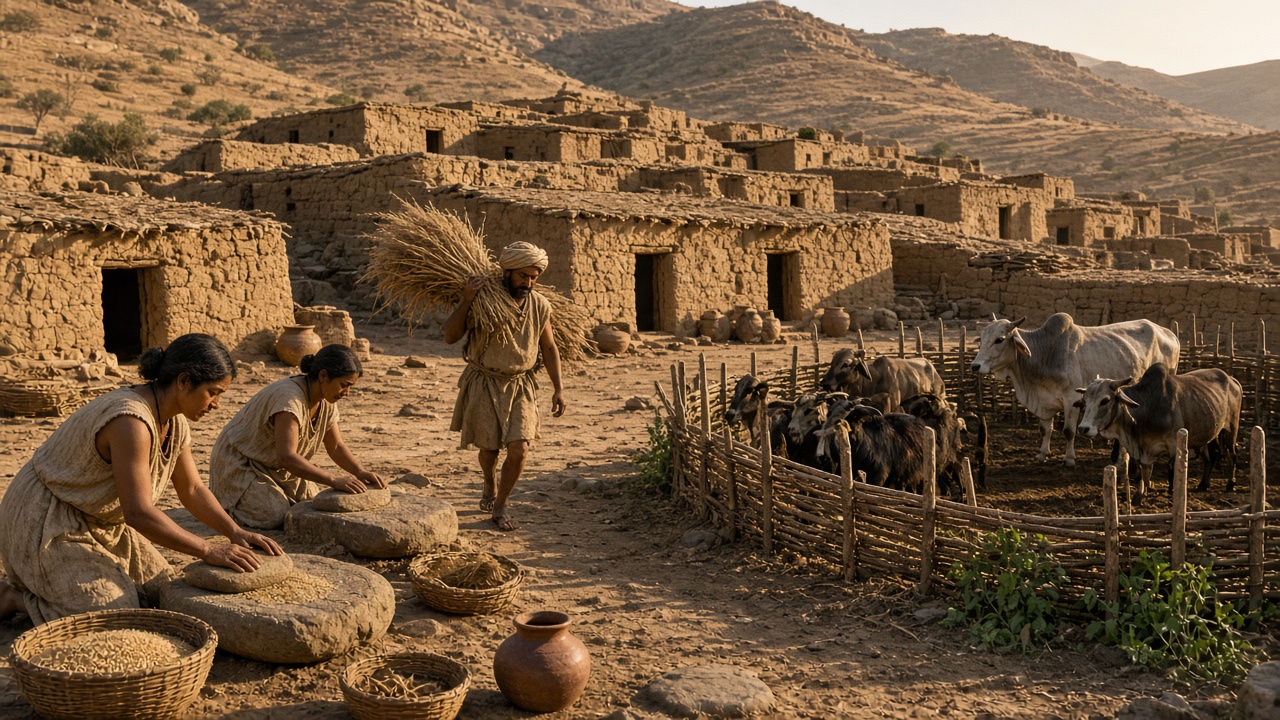
Long before the cities, people at the edge of the Indus plains learned to farm and herd animals. At Mehrgarh, near the Bolan Pass in Balochistan, villagers lived in mud-brick houses, grew wheat and barley, kept goats, sheep, and humped cattle, and gradually developed crafts that would later flourish in the Indus cities.
Villagers grind grain and herd cattle in an early farming settlement (artistic illustration).
c. 7000 BCE: Farming begins at Mehrgarh, one of the earliest farming villages in South Asia, with wheat, barley, and domesticated goats and sheep.
c. 7000–5500 BCE: Mehrgarh villagers keep humped zebu cattle, build multi-room mud-brick houses, and even drill teeth, among the earliest evidence of dentistry in the world.
c. 6000–4000 BCE: Traces of cotton, copper, and pottery appear, and farming villages spread across Balochistan and towards the Indus plains.
c. 4000–3300 BCE: Villages grow larger, potters use the wheel and paint pots with bold designs, and trade in shells and stones links hills, plains, and coast.
Technology
Mud bricks: Sun-dried houses.
Grinding stones: Querns for grain.
Potter’s wheel: Later in this period.
Features
Farming: Wheat and barley.
Herding: Zebu cattle and goats.
Village life: Settled homes.
🧱 Early Townsc. 3300 – 2600 BCE
Early Harappan Towns
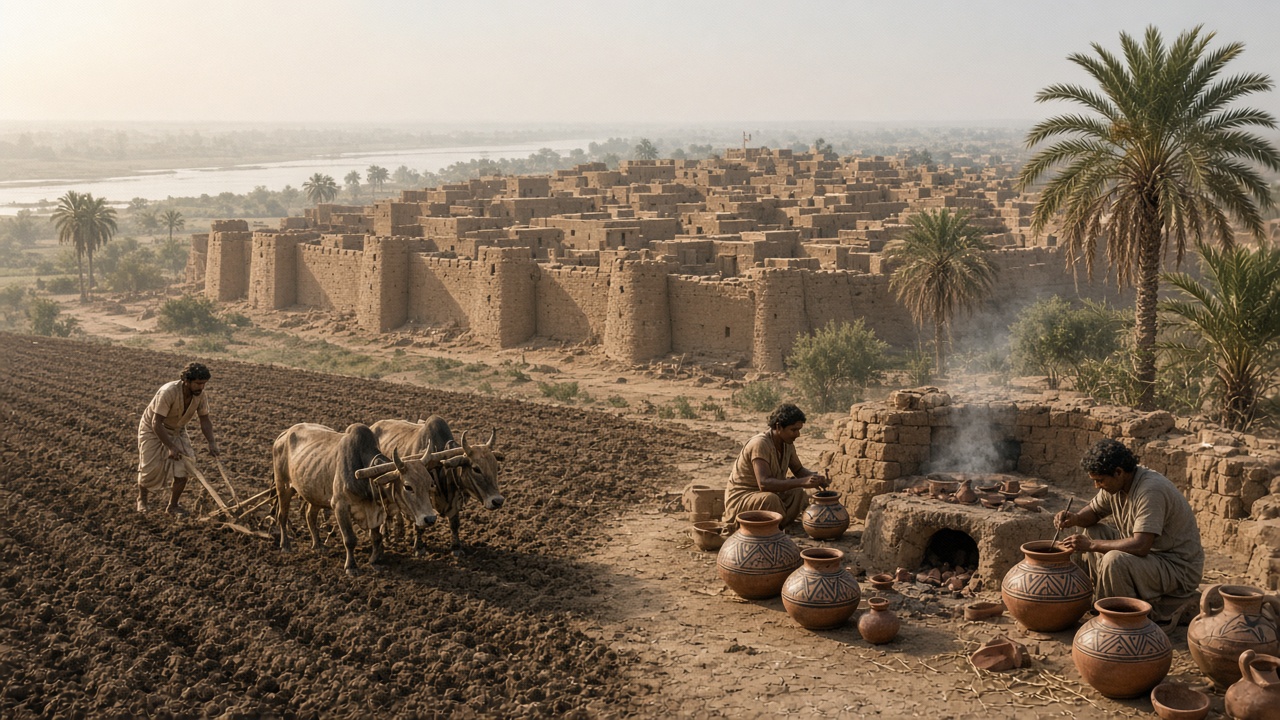
In the Early Harappan phase, villages along the Indus and Ghaggar-Hakra rivers grew into walled towns. People began to standardise their pottery, bricks, and settlement layouts, farmers ploughed their fields, and the first signs that may be early writing were scratched onto pots.
Farmers plough and potters paint pots outside an early walled town (artistic illustration).
c. 3300–2800 BCE: The Ravi phase settlement grows at Harappa, and marks scratched on pottery there are among the earliest possible signs of Indus writing.
c. 2800–2600 BCE: The Kot Diji phase sees fortified towns with walls of mud brick in Sindh, Punjab, and beyond.
c. 2800 BCE: At Kalibangan in Rajasthan, farmers plough a field in a criss-cross pattern, one of the earliest ploughed fields found in the world.
c. 3000–2600 BCE: Early settlements begin at sites such as Dholavira and Rakhigarhi, and styles of pottery, bricks, and ornaments become similar across a wide region.
Technology
Ploughs: Ox-drawn wooden ploughs.
Kilns: Fired painted pottery.
Town walls: Mud-brick defences.
Features
Walled towns: Growing populations.
Shared styles: Across regions.
Early signs: Marks on pots.
🏛️ Citiesc. 2600 – 2300 BCE
The Great Planned Cities
Around 2600 BCE the Mature Harappan period began. Large cities rose with a raised citadel and a lower town, streets laid out in a grid-like pattern, houses of standard baked bricks, private wells and bathrooms, and covered drains. Similar bricks, weights, seals, and pottery were used across hundreds of kilometres.
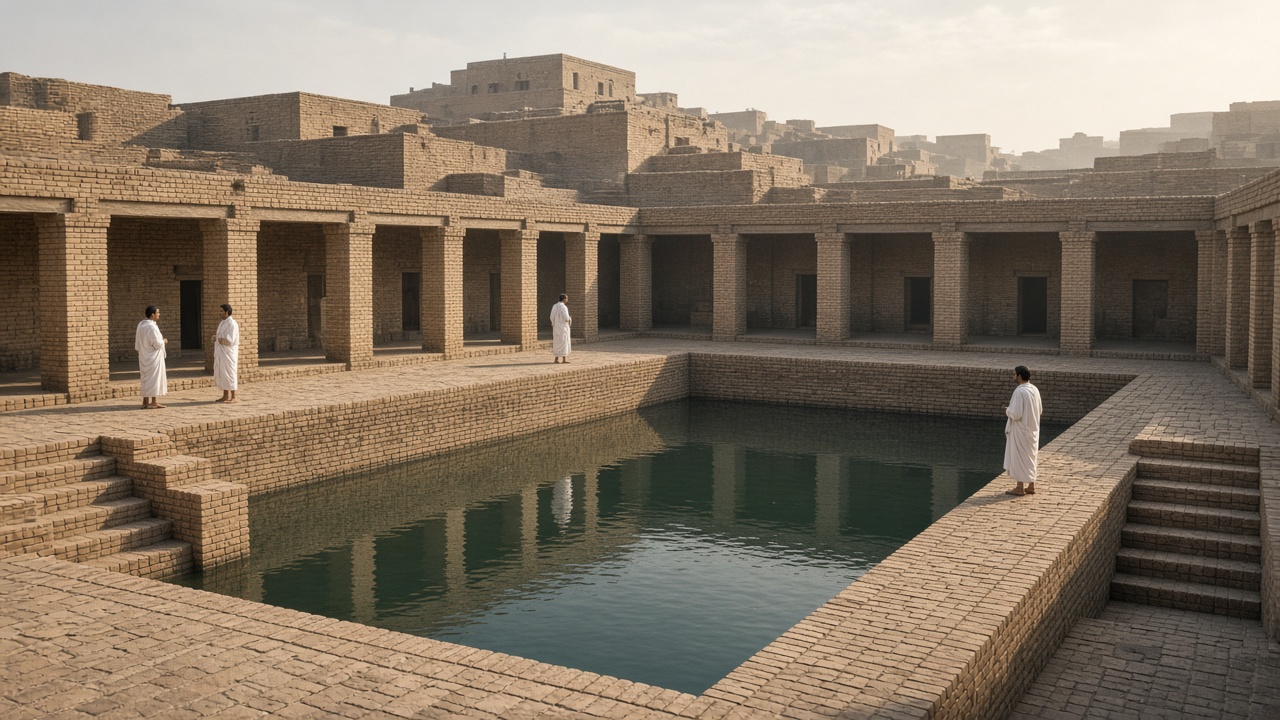
The Great Bath of Mohenjo-daro as it may have looked (artistic illustration).
c. 2600 BCE: Mohenjo-daro and Harappa grow into great cities, with Mohenjo-daro perhaps home to around 40,000 people.
c. 2600–2500 BCE: The Great Bath, about 12 by 7 metres and 2.4 metres deep, is built on Mohenjo-daro’s citadel and made watertight with fitted bricks and bitumen.
c. 2600–2300 BCE: Baked bricks in a 1:2:4 ratio, covered drains, hundreds of wells, and large public buildings appear, and cities such as Dholavira, Rakhigarhi, Ganweriwala, and Kalibangan flourish.
c. 2500 BCE: Craftspeople make the bronze “Dancing Girl” and the stone “Priest-King”, two of the most famous artworks of the civilization, both found at Mohenjo-daro.
Technology
Baked bricks: Standard sizes.
Covered drains: Along every street.
Lost-wax casting: Bronze figures.
Features
Planned cities: Citadel and lower town.
Great Bath: Public water structure.
Standardisation: Across a huge region.
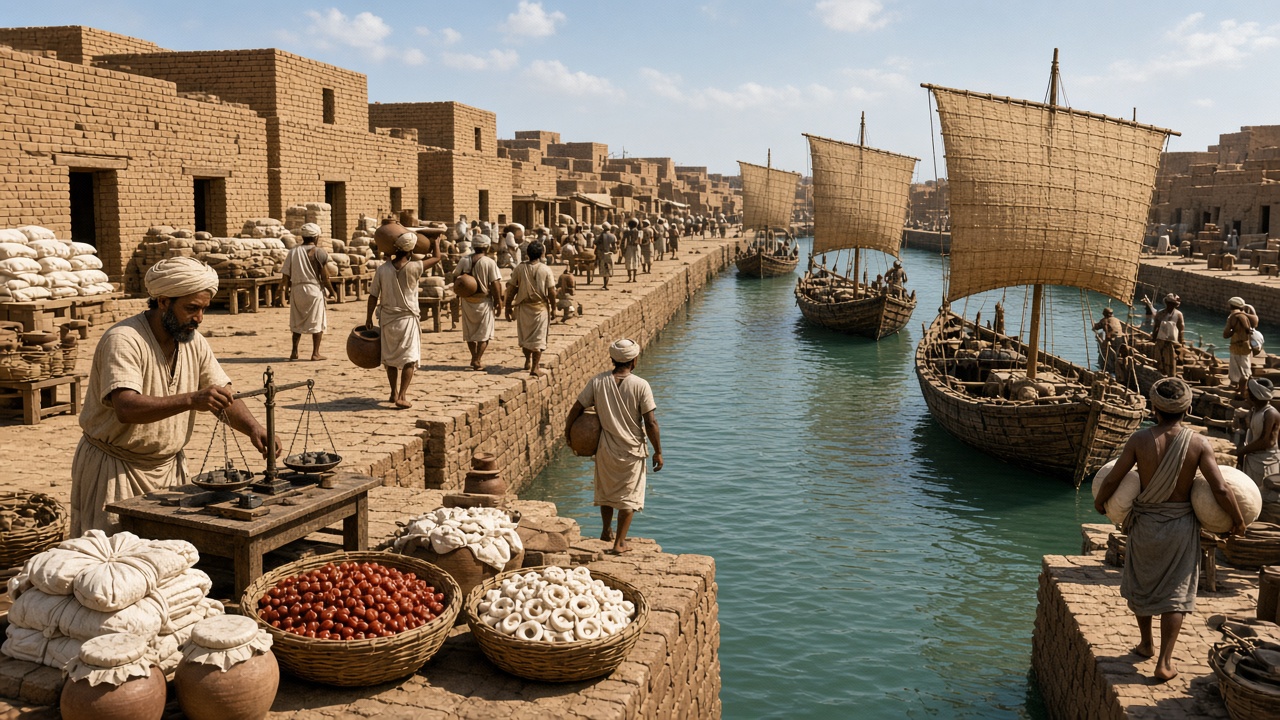
⛵ Tradec. 2300 – 1900 BCE
Trade, Crafts & Script at Their Height
At its height the civilization stretched from Afghanistan to Gujarat and from Balochistan to western Uttar Pradesh. Merchants traded beads, cotton, timber, and ivory by land and sea, craftspeople made fine seals and ornaments, and short inscriptions in the Indus script were stamped on goods and sealings.
Merchants weigh beads and load boats at a Harappan port (artistic illustration).
c. 2300 BCE: Texts of Sargon of Akkad in Mesopotamia mention ships from Meluhha, a land most scholars identify with the Indus region.
c. 2400–1900 BCE: Lothal in Gujarat grows as a bead-making and trading town with a large brick basin, often described as a dockyard, and Chanhudaro becomes a centre of bead making.
c. 2300–1900 BCE: Indus seals, carnelian beads, and weights reach Mesopotamia and the Persian Gulf, and a trading outpost at Shortugai in Afghanistan obtains lapis lazuli.
Mature phase: Thousands of seals carry animal motifs such as the “unicorn” and short inscriptions, and Dholavira’s north gate displays a large signboard of ten Indus signs.
Technology
Stamp seals: Carved steatite.
Bead drilling: Long carnelian beads.
Standard weights: Cube-shaped stones.
Features
Sea trade: Gulf and Mesopotamia.
Fine crafts: Beads, bangles, bronze.
Indus script: Still undeciphered.
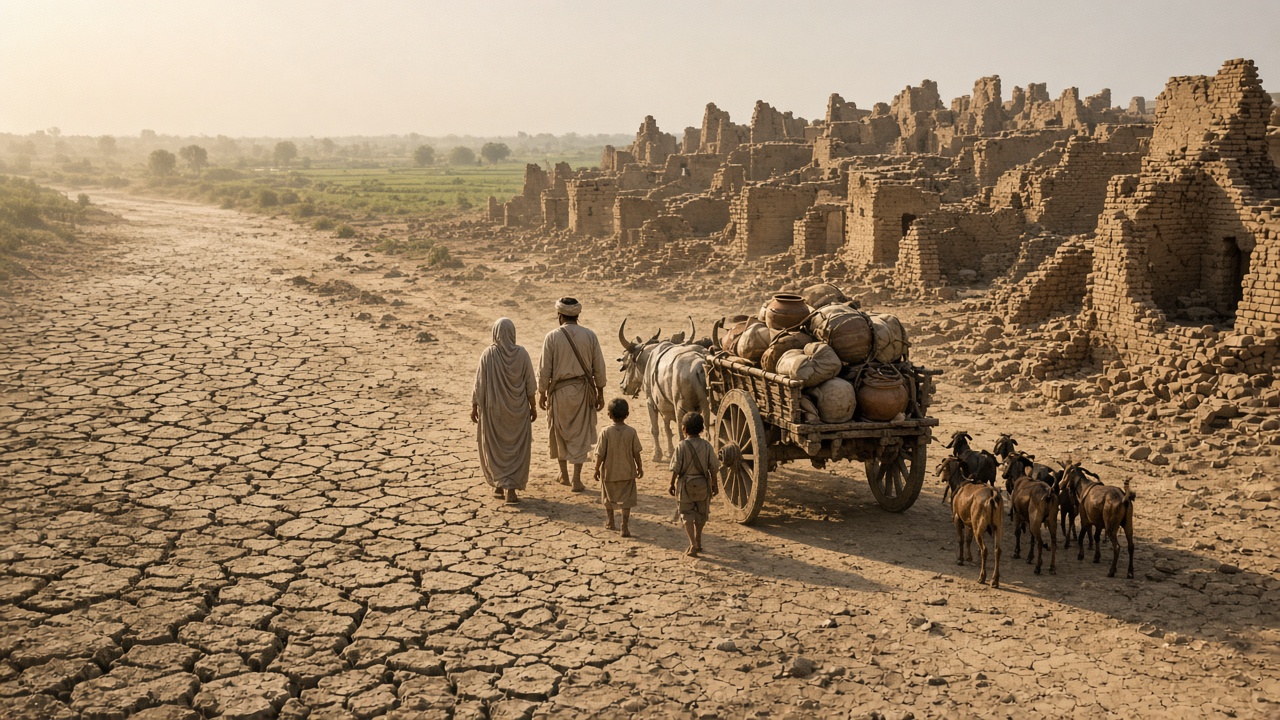
🏜️ Declinec. 1900 – 1300 BCE
Late Harappan Decline
After about 1900 BCE the great cities slowly emptied. Seals, writing, and standard weights fell out of use, long-distance trade faded, and people moved into smaller villages, especially towards the east and south. Most scholars now see this as a gradual change linked to climate and rivers, not a sudden destruction.
A family leaves a declining town beside a dried-up river (artistic illustration).
c. 2200 BCE onwards: A drier climate and weaker monsoon, seen in many parts of the world around this time, put pressure on farming.
c. 1900 BCE: Rivers such as the Ghaggar-Hakra shrink or change course, trade with Mesopotamia declines, and big cities including Mohenjo-daro begin to be abandoned.
c. 1900–1300 BCE: Regional Late Harappan cultures, such as Cemetery H in Punjab, Jhukar in Sindh, and Rangpur in Gujarat, continue in smaller settlements.
c. 1300 BCE onwards: Settlements spread into the Ganga-Yamuna plains and elsewhere, and elements of Harappan farming and crafts continue in later Indian cultures.
Technology
Simpler pottery: Regional styles.
Farming shifts: Millets and rice grow.
Crafts continue: Beads and copper.
Features
De-urbanisation: Cities empty.
Migration: East and south.
Gradual change: Not sudden collapse.
⛏️ Rediscovery1826 – Today
Rediscovery & Legacy
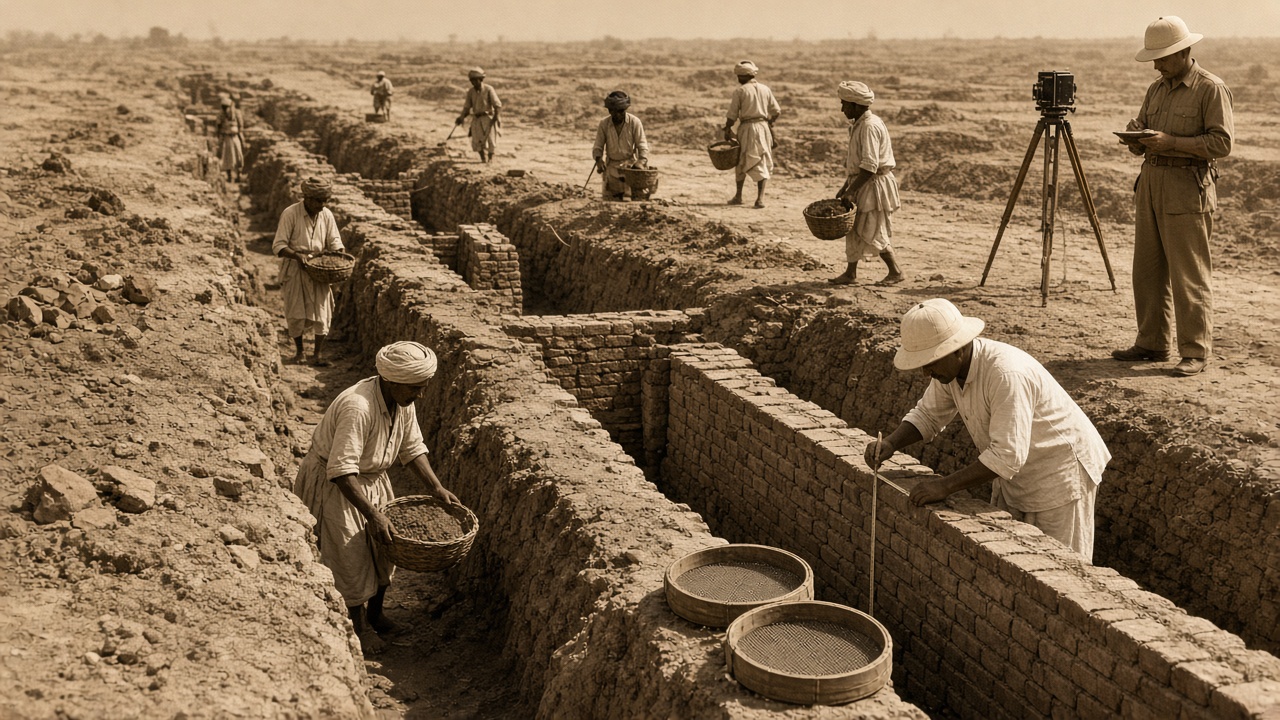
For thousands of years the Indus cities lay buried and forgotten. Travellers and railway builders noticed the ancient bricks, but only in the 1920s did archaeologists realise they had found a whole lost civilization. Excavations in India and Pakistan continue to reveal new sites, and scientists still study its script, people, and environment.
Archaeologists and workers uncover brick walls in the 1920s (artistic illustration).
1826–1875: Charles Masson describes the ruins of Harappa, railway builders in the 1850s use its bricks as ballast, and Alexander Cunningham publishes a strange seal found there.
1921–1924: Daya Ram Sahni excavates Harappa (1921), R. D. Banerji works at Mohenjo-daro (1922), and John Marshall announces a new civilization in September 1924.
1947–2005: After Partition, Indian archaeologists excavate Ropar, Lothal, Kalibangan, Banawali, Dholavira, and Rakhigarhi, showing how far the civilization extended into India.
1980–Today: Mohenjo-daro becomes a UNESCO World Heritage Site (1980), a 2019 ancient DNA study from Rakhigarhi sheds light on Harappan ancestry, and Dholavira is inscribed by UNESCO (2021).
Technology
Excavation: Trenches and layers.
Radiocarbon dating: Dating the past.
Ancient DNA: Studying people.
Features
Lost civilization: Found in 1924.
Sites in two nations: India and Pakistan.
World Heritage: Mohenjo-daro, Dholavira.
Major Indus Valley Sites
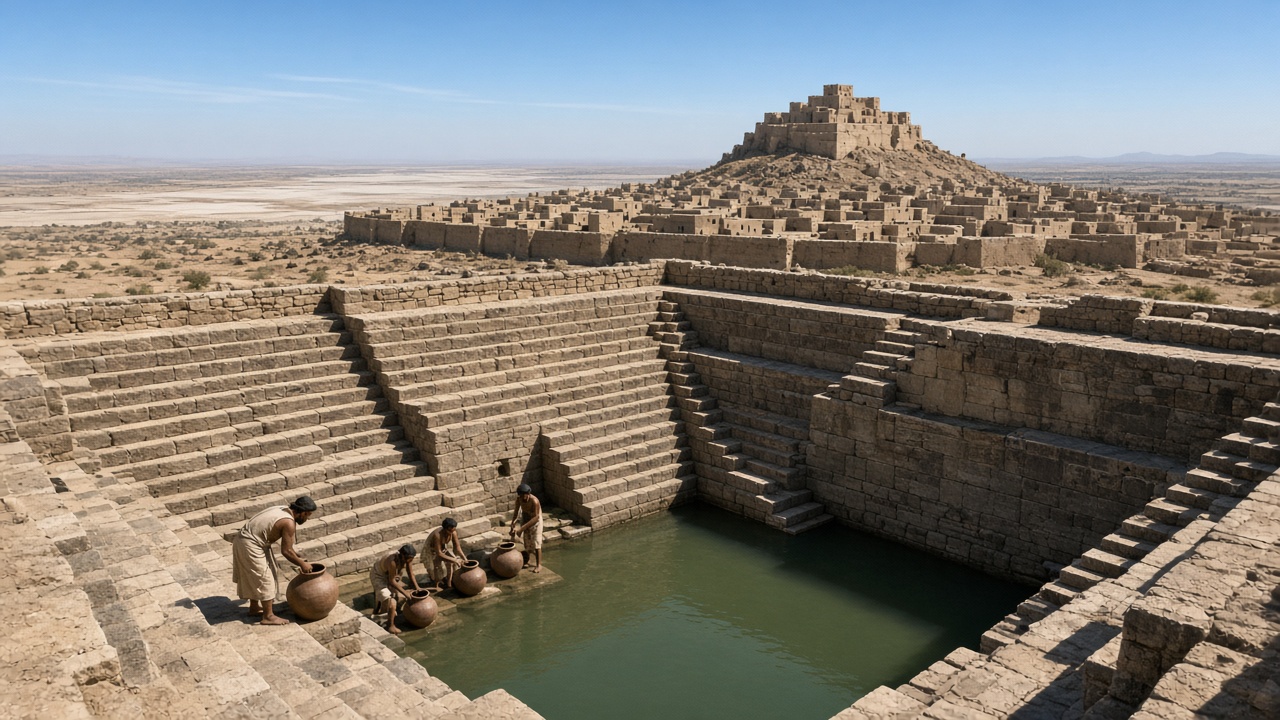
A stone reservoir at Dholavira in the dry Kutch region as it may have looked (artistic illustration).
Site
Where
Known for
Mehrgarh
Balochistan, Pakistan
Early farming village, roots of the civilization
Harappa
Punjab, Pakistan
First city excavated (1921), granary-like buildings
Mohenjo-daro
Sindh, Pakistan
Great Bath, drains, Dancing Girl, Priest-King
Chanhudaro
Sindh, Pakistan
Bead-making workshops
Ganweriwala
Cholistan, Pakistan
One of the largest cities, little excavated
Rakhigarhi
Haryana, India
Largest known Indus site in India, ancient DNA study
Kalibangan
Rajasthan, India
Early ploughed field, fire altars
Banawali
Haryana, India
Fortified town, clay model of a plough
Dholavira
Kutch, Gujarat, India
Stone reservoirs, signboard, UNESCO site (2021)
Lothal
Gujarat, India
Brick basin or dockyard, bead making
Ropar
Punjab, India
One of the first sites excavated in independent India
Shortugai
Afghanistan
Trading outpost near lapis lazuli sources
How a Harappan City Worked
Feature
What it was like
Citadel
A raised, walled area with large public buildings
Lower town
Homes and workshops of ordinary people
Streets
Main streets laid out in a grid-like pattern, with smaller lanes
Houses
Rooms around a courtyard, often with a well and a bathroom
Drains
Covered brick drains with inspection holes along the streets
Wells
Hundreds of brick-lined wells at Mohenjo-daro
Great Bath
A large watertight pool, possibly for ritual bathing
Storehouses
Large buildings often called granaries (their use is debated)
Reservoirs
Huge stone reservoirs at Dholavira to store water
Walls and gates
City walls and gateways at many sites
Famous Finds, Crafts, and the Indus Script
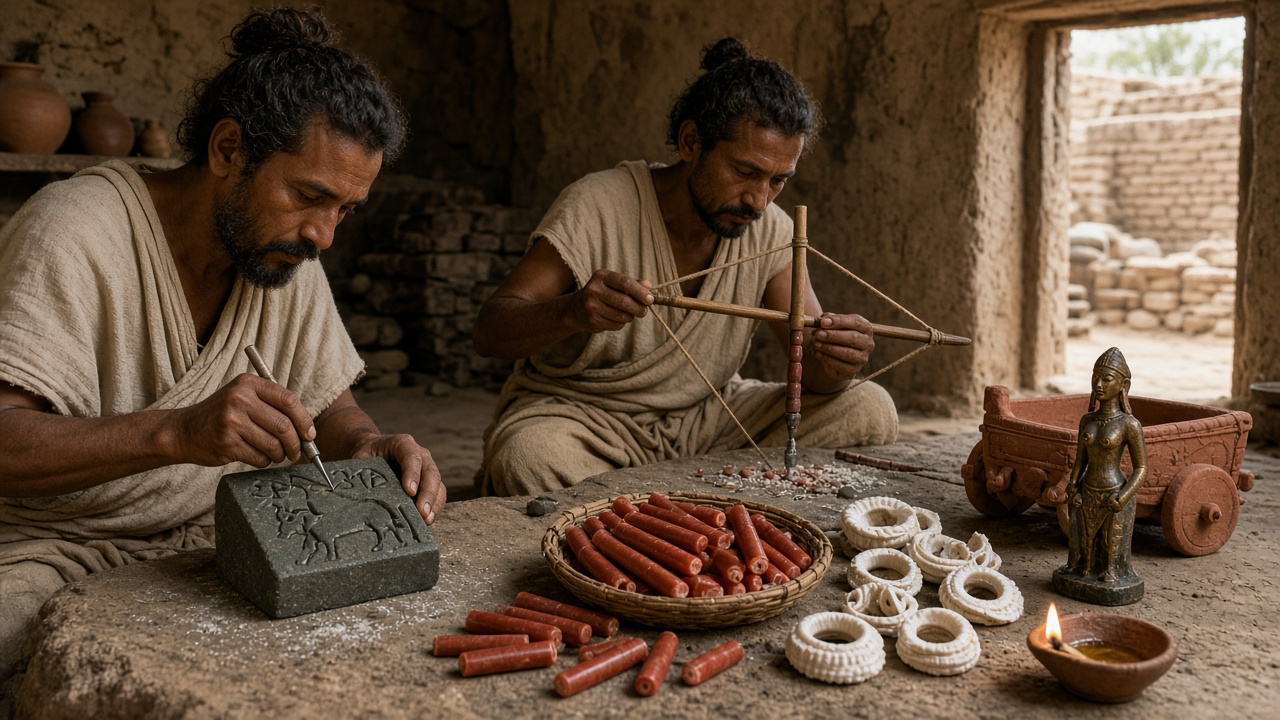
Artisans carve a stamp seal and drill carnelian beads (artistic illustration).
Find
Where found
What it tells us
“Dancing Girl” bronze
Mohenjo-daro
Skill in lost-wax metal casting
“Priest-King” bust
Mohenjo-daro
Fine stone carving and dress
“Unicorn” seals
Many sites
Most common seal motif, used in trade
“Pashupati” seal
Mohenjo-daro
Seated figure surrounded by animals, meaning debated
Indus script
Seals, tablets, pottery
About 400 or more signs, still undeciphered
Dholavira signboard
Dholavira
Ten large signs, perhaps a city name
Stone weights
Many sites
A shared system of measurement
Carnelian beads
Chanhudaro, Lothal, Mesopotamia
Skilled crafts and long-distance trade
Terracotta toys and carts
Many sites
Children’s play and solid-wheeled carts
Cotton fragments
Mohenjo-daro and Mehrgarh
Among the earliest uses of cotton in the world
Why Did the Cities Decline? Main Theories
Theory
Evidence
How scholars see it today
Weaker monsoon, drier climate
Lake and cave records of drying from around 2200 BCE
Widely accepted as a major factor
Rivers drying or shifting
Old channels of the Ghaggar-Hakra and Indus
Widely accepted as important
Floods
Layers of silt at some sites
Possible local factor
Loss of trade
Fewer Indus goods in Mesopotamia after c. 1900 BCE
Likely part of the story
Disease and overuse of land
Some skeletal and environmental studies
Possible contributing factors
Sudden invasion
An old idea from the 1940s
Not supported by evidence
Indus Valley Civilization Timeline Summary
Year / Era
Milestone
c. 7000 BCE
Farming begins at Mehrgarh
c. 5500 BCE
Early dentistry and crafts at Mehrgarh
c. 3300 BCE
Early Harappan phase; early signs on pots at Harappa
c. 2800 BCE
Ploughed field at Kalibangan; walled towns
c. 2600 BCE
Mature Harappan cities begin
c. 2500 BCE
Great Bath; Dancing Girl and Priest-King
c. 2300 BCE
Mesopotamian texts mention Meluhha
c. 2200 BCE
Climate becomes drier
c. 1900 BCE
Cities begin to decline
c. 1900–1300 BCE
Late Harappan regional cultures
1826
Charles Masson visits Harappa
1850s
Harappa bricks used for railway ballast
1875
Cunningham publishes a Harappan seal
1921
Daya Ram Sahni excavates Harappa
1922
R. D. Banerji at Mohenjo-daro
1924
John Marshall announces the civilization
1950s–1960s
Ropar, Lothal, and Kalibangan excavated in India
1980
Mohenjo-daro becomes a UNESCO World Heritage Site
1990–2005
Major excavations at Dholavira
2019
Rakhigarhi ancient DNA study
2021
Dholavira becomes a UNESCO World Heritage Site
Future
Deciphering the script and protecting the sites
Test Your Knowledge
20 quick questions from the Indus Valley Civilization timeline. Click each question to reveal the answer.
Answer: Because Harappa was the first of its cities to be excavated.
Answer: Mehrgarh.
Answer: About 2600 to 1900 BCE.
Answer: Kalibangan, Rajasthan.
Answer: The Great Bath.
Answer: 1:2:4 (thickness to width to length).
Answer: A raised citadel and a lower town.
Answer: The “Dancing Girl”.
Answer: The “unicorn”.
Answer: No, it remains undeciphered.
Answer: Meluhha.
Answer: Lothal.
Answer: Dholavira.
Answer: Rakhigarhi, Haryana.
Answer: Chanhudaro.
Answer: A drier climate with a weaker monsoon, and drying or shifting rivers (loss of trade also played a part).
Answer: Daya Ram Sahni.
Answer: R. D. Banerji.
Answer: Sir John Marshall, Director-General of the Archaeological Survey of India.
Answer: Mohenjo-daro (1980) and Dholavira (2021).
Classroom activity
Students Tasks
Use these prompts for discussion or projects on the Indus Valley Civilization.
Make a timeline poster: c. 7000 BCE Mehrgarh, c. 3300 BCE Early Harappan, c. 2600 BCE great cities, c. 1900 BCE decline, 1921 Harappa excavated, and 1924 discovery announced.
On a map of India and Pakistan, mark Harappa, Mohenjo-daro, Rakhigarhi, Kalibangan, Lothal, and Dholavira.
Draw a plan of a Harappan city with a citadel, a lower town, streets, houses, wells, and drains.
Design your own “seal” with an animal and a few symbols, and explain what it might tell a trader.
Compare the drainage system of Mohenjo-daro with the drains in your own street or town.
Make a clay model of a Harappan toy cart with solid wheels.
List five things we still use today that the Indus people also used.
Write a diary entry as a child living in Mohenjo-daro around 2500 BCE.
Research why the Indus script is so hard to decipher, and suggest what clues might help.
Debate: “Climate change, not invasion, ended the Indus cities.”
Continue exploring
The Indus Valley story connects to how homes, irrigation, money and trade, and boats developed over thousands of years. Explore these connected timelines next.
Click any panel to expand and explore the visual mood.
The Indus Valley Civilization in pictures — the first farmers, an early walled town, the Great Bath, a busy port, seal carvers and bead makers, a stone reservoir, the decline, the 1920s excavations, and then versus now.
First Farmers
Mehrgarh
Early Town
Walls and ploughs
Great Bath
Mohenjo-daro
Port & Trade
Sea trade
Seals & Beads
Master crafts
Reservoir
Dholavira
Decline
Rivers run dry
Rediscovery
1920s excavations
Then vs Now
Streets to ruins
Explore all civilizations timelines
Jump to any other civilizations timeline on WorldTimelineHub.
Disclaimer: This content is AI-generated for educational purposes and may contain errors or outdated details. For correct and authoritative information, please refer to official and reliable sources such as government publications, manufacturers, museums, and academic references.