Ancient Egyptian Civilization Timeline: Nile Farmers → Pyramid Age → Middle Kingdom → New Kingdom Empire → Greeks & Romans → Rediscovery
For about three thousand years, a civilization along the Nile built pyramids, temples, and tombs that still amaze the world. Farming villages grew into a single kingdom around 3100 BCE, pharaohs raised the pyramids of Giza,
New Kingdom rulers built an empire, and Greek and Roman rulers followed — until hieroglyphs were forgotten. Their secrets returned only after the Rosetta Stone was deciphered in 1822.
This timeline covers predynastic Nile villages, Narmer and the unification, Djoser’s Step Pyramid, the Great Pyramid and Sphinx, the Middle Kingdom and the Hyksos, Hatshepsut, Thutmose III, Akhenaten, Tutankhamun, Ramesses II,
Kushite and Persian rule, Alexander, Alexandria and the Ptolemies, Cleopatra, Roman Egypt, hieroglyphs and papyrus, mummies and gods, Napoleon’s expedition, Champollion, Howard Carter, and the Grand Egyptian Museum.
c. 3100 BCE Unification → c. 2560 BCE Great Pyramidc. 1279 BCE Ramesses II → 30 BCE Cleopatra1822 Hieroglyphs Deciphered → 1922 Tutankhamun
Why Ancient Egypt Matters
Ancient Egypt was one of the world’s first great civilizations and one of its longest lasting. Its people developed writing, a 365-day calendar, medicine, mathematics, and engineering on a scale never seen before, and left
monuments, art, and texts that tell us how they lived, worked, worshipped, and thought about death. Egypt also traded with and influenced its neighbours, from Nubia and the Levant to Greece and Rome.
Big picture
Ancient Egypt in one view
Farmers settled along the Nile, Egypt was unified around 3100 BCE, the Old Kingdom built the pyramids, the Middle Kingdom restored order and literature, the New Kingdom became an empire, foreign rulers from Nubia, Persia,
Greece, and Rome followed, and modern Egyptology began with Napoleon’s expedition and the Rosetta Stone. Related timelines:
irrigation,
writing and printing,
water transport.
3100 BCE
Upper and Lower Egypt unified (approx.)
146 m
Original height of the Great Pyramid
30+
Dynasties of pharaohs
1822
Hieroglyphs deciphered
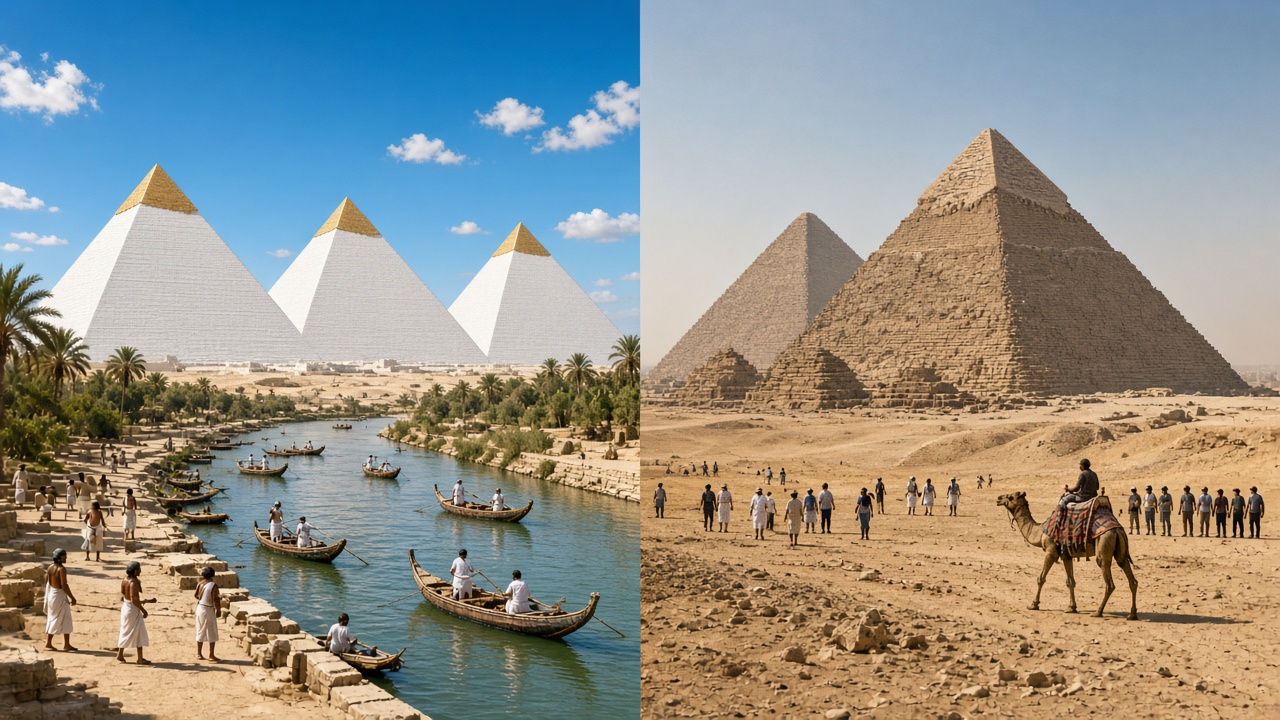
The pyramids of Giza with their white casing reimagined, and as visitors see them today (artistic illustration).
Ancient Egypt Then vs Egypt Now
Feature
Ancient Egypt (c. 1500 BCE)
Egypt today
Ruler
Pharaoh, seen as a link to the gods
President of the Arab Republic of Egypt
Capital
Memphis and Thebes
Cairo and a New Administrative Capital
Language and writing
Egyptian in hieroglyphs and hieratic
Arabic in the Arabic script
Religion
Many gods, such as Ra, Osiris, Isis, and Amun
Mostly Islam, with a Coptic Christian minority
Nile flood
Yearly flood brought water and silt
Controlled by the Aswan High Dam since 1970
Farming
Basin irrigation and the shaduf
Canals, pumps, and year-round irrigation
Writing material
Papyrus, stone, and pottery pieces
Paper and digital screens
Transport
Boats on the Nile, donkeys
Roads, railways, and Suez Canal shipping
Population
A few million (estimated)
More than 100 million
Monuments
Temples and tombs being built
World Heritage Sites and museums for visitors
🌾 Nile Farmersc. 6000 – 3100 BCE
Nile Farmers & Predynastic Egypt
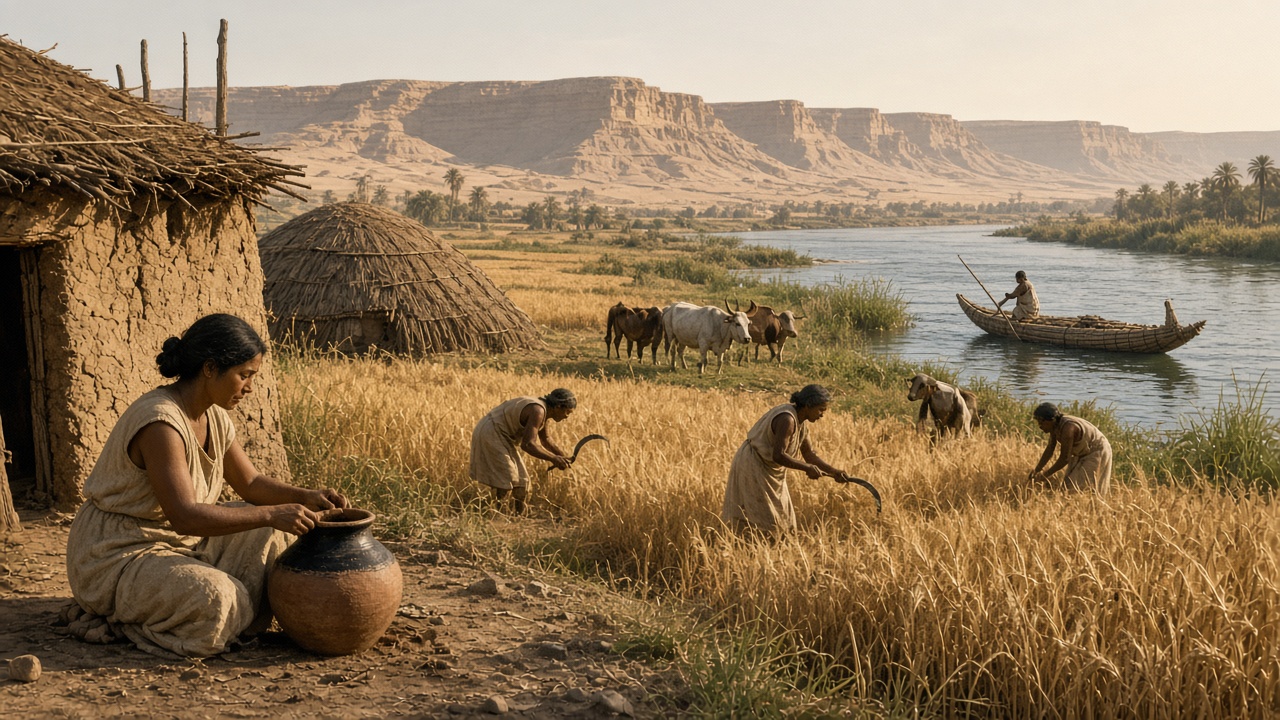
As the Sahara dried, people settled along the Nile, where the yearly flood left rich black soil. Farming villages grew into chiefdoms and small kingdoms in Upper (southern) and Lower (northern) Egypt, and the first signs of Egyptian writing appeared on labels and pottery.
Farmers harvest wheat beside the Nile in a predynastic village (artistic illustration).
c. 5500–5000 BCE: Farming villages appear in the Faiyum and at Merimde in the Nile Delta, growing wheat and barley and keeping cattle, sheep, and goats.
c. 4400–4000 BCE: The Badarian culture of Upper Egypt makes fine black-topped red pottery and uses small copper objects.
c. 4000–3200 BCE: The Naqada culture spreads along the Nile, towns such as Hierakonpolis grow, and trade links reach the Levant and Mesopotamia.
c. 3250–3100 BCE: Labels from tomb U-j at Abydos show some of the earliest Egyptian writing, and the Narmer Palette shows a king wearing the crowns of both Upper and Lower Egypt.
Technology
Flint sickles: Harvesting grain.
Reed boats: Travel on the Nile.
Pottery and copper: Early crafts.
Features
Gift of the Nile: Flood and silt.
Two lands: Upper and Lower Egypt.
First writing: Signs on labels.
🔺 Pyramid Agec. 3100 – 2181 BCE
Unification & the Pyramid Age
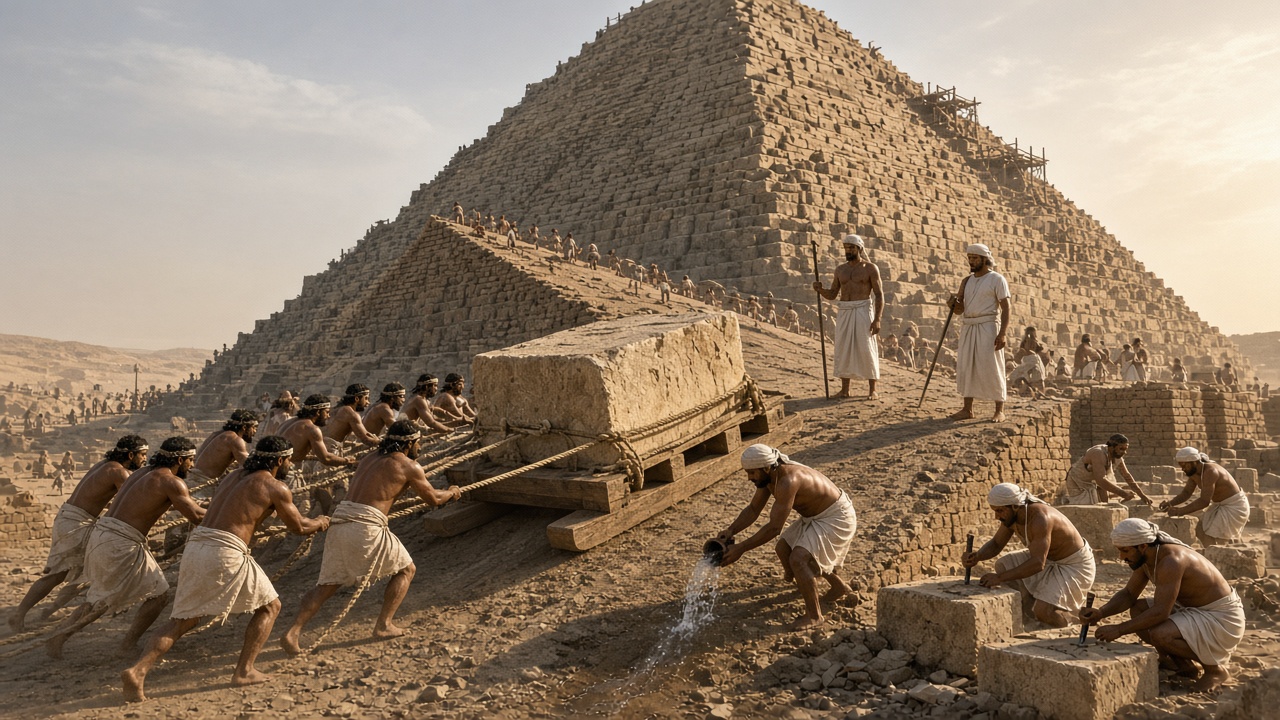
Around 3100 BCE Egypt became one kingdom ruled by a king, later called pharaoh. In the Old Kingdom, rulers based at Memphis organised the people and resources of the whole country to build huge stone pyramids as tombs, ending with the giant pyramids of Giza.
Workers haul a limestone block up a ramp to build a pyramid (artistic illustration).
c. 3100 BCE: Upper and Lower Egypt are unified under a king remembered as Narmer or Menes, and Memphis becomes the capital in the Early Dynastic Period.
c. 2670 BCE: The architect Imhotep designs the Step Pyramid of King Djoser at Saqqara, the first large building made entirely of stone.
c. 2600–2560 BCE: Sneferu builds the Bent and Red Pyramids, and his son Khufu builds the Great Pyramid of Giza, about 146 metres tall.
c. 2550–2181 BCE: Khafre builds his pyramid and probably the Great Sphinx, Menkaure adds a third pyramid, the Pyramid Texts are carved for King Unas, and central power weakens by about 2181 BCE.
Technology
Stone masonry: Copper tools and sledges.
Surveying: Precise alignment.
Papyrus: Records and accounts.
Features
One kingdom: Ruled from Memphis.
Pyramids: Royal tombs.
Organised labour: Paid work crews.
📜 Middle Kingdomc. 2181 – 1550 BCE
Middle Kingdom & the Hyksos
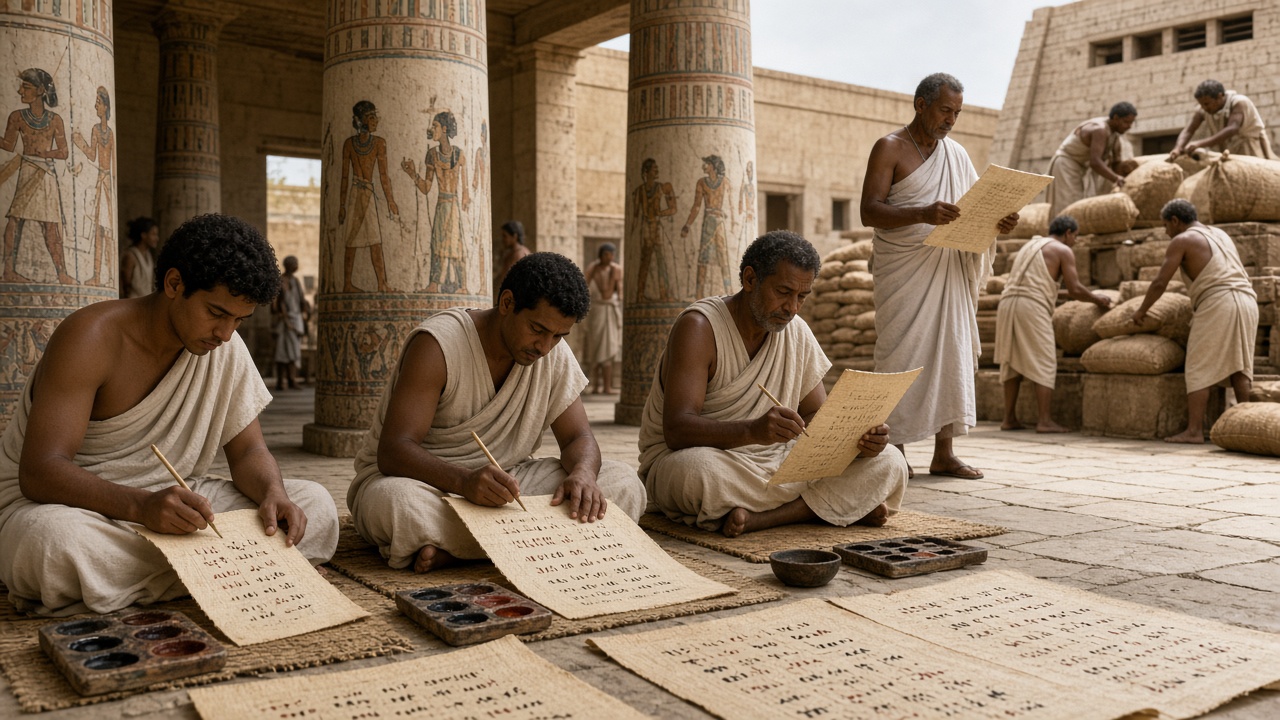
After a time of division and low Nile floods, Theban kings reunited Egypt. The Middle Kingdom is remembered as a classical age of literature, art, and government, with scribes keeping careful records. Later, foreign rulers called the Hyksos took over the north, bringing horses and chariots, until Theban kings drove them out.
Scribes record grain stores on papyrus in a temple courtyard (artistic illustration).
c. 2181–2055 BCE: In the First Intermediate Period, local governors hold power, and low Nile floods bring hardship.
c. 2055 BCE: Mentuhotep II of Thebes reunites Egypt, beginning the Middle Kingdom.
c. 1985–1773 BCE: Twelfth Dynasty kings build forts in Nubia under Senusret III, reclaim land in the Faiyum under Amenemhat III, and scribes write classics such as the Story of Sinuhe.
c. 1650–1550 BCE: The Hyksos rule northern Egypt from Avaris and introduce the horse-drawn chariot, until Ahmose of Thebes expels them around 1550 BCE.
Technology
Hieratic script: Fast writing.
Land reclamation: Faiyum projects.
Chariots: Arrive with the Hyksos.
Features
Reunification: From Thebes.
Classical literature: Stories and teachings.
Foreign rule: The Hyksos.
⚔️ Empirec. 1550 – 1069 BCE
New Kingdom Empire
The New Kingdom was Egypt’s age of empire. Pharaohs led chariot armies into the Levant and Nubia, built vast temples at Karnak, Luxor, and Abu Simbel, and were buried in hidden tombs in the Valley of the Kings. It is the era of Hatshepsut, Akhenaten, Tutankhamun, and Ramesses II.
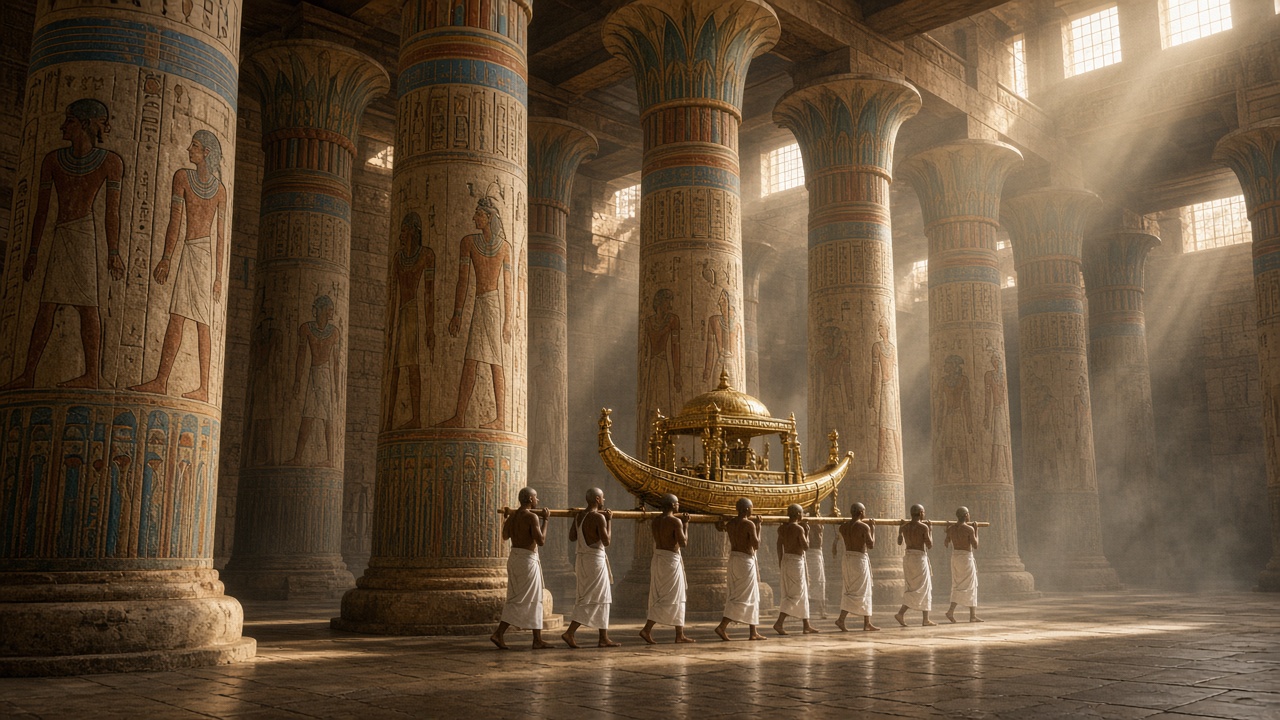
Priests carry a god’s golden boat shrine through a painted temple hall (artistic illustration).
c. 1550–1458 BCE: Ahmose founds the Eighteenth Dynasty, kings are buried in the Valley of the Kings, and Hatshepsut rules as pharaoh, building her temple at Deir el-Bahari and sending an expedition to Punt.
c. 1457 BCE: Thutmose III wins the Battle of Megiddo, and Egypt’s empire stretches from Syria to Nubia.
c. 1353–1323 BCE: Akhenaten builds a new capital at Amarna and promotes worship of the Aten, and the young king Tutankhamun restores the old gods before dying around 1323 BCE.
c. 1279–1069 BCE: Ramesses II fights at Kadesh (1274 BCE), signs one of the earliest known peace treaties with the Hittites, and builds Abu Simbel, and Ramesses III repels the Sea Peoples.
Technology
Chariots: Light, fast armies.
Glass and faience: Bright crafts.
Shaduf: Lifting irrigation water.
Features
Empire: Levant to Nubia.
Great temples: Karnak and Luxor.
Valley of the Kings: Hidden tombs.
🏛️ Greeks & Romansc. 1069 BCE – 641 CE
Late Period, Greeks & Romans
After the New Kingdom, Egypt was often divided or ruled by outsiders — Libyans, Nubians, Assyrians, and Persians. Alexander the Great’s conquest brought the Greek Ptolemies, who made Alexandria a world centre of learning. After Cleopatra, Egypt became a Roman province, and the old religion and writing slowly faded.
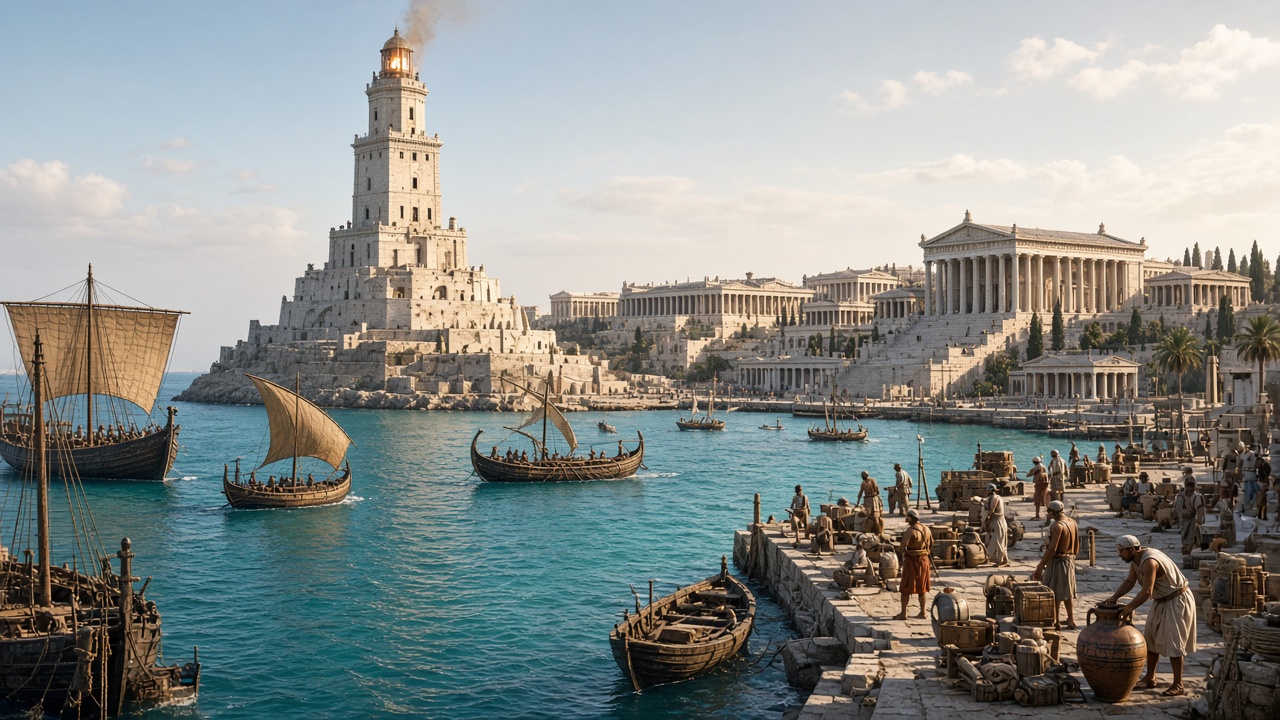
The harbour of Alexandria with its famous lighthouse (artistic illustration).
c. 1069–664 BCE: In the Third Intermediate Period, Libyan dynasties rule parts of Egypt, Kushite kings from Nubia take control as the Twenty-fifth Dynasty, and the Assyrians invade and sack Thebes (663 BCE).
664–332 BCE: The Saite kings revive Egyptian art and trade, but the Persian king Cambyses II conquers Egypt in 525 BCE.
332–30 BCE: Alexander the Great takes Egypt (332 BCE) and founds Alexandria, the Ptolemies build its Library and Lighthouse, the Rosetta Stone is carved (196 BCE), and Cleopatra VII dies in 30 BCE.
30 BCE–641 CE: As a Roman province Egypt feeds Rome with grain, Christianity spreads, the last known hieroglyphic inscription is carved at Philae (394 CE), and the Arab conquest follows (639–642 CE).
Technology
Lighthouse: The Pharos of Alexandria.
Library: Scrolls from many lands.
Coins: Introduced in this era.
Features
Foreign rulers: Nubians to Romans.
Greek culture: Ptolemaic Egypt.
End of hieroglyphs: 394 CE.
🔍 Rediscovery1798 – Today
Rediscovery & Egyptology
For centuries no one could read hieroglyphs. Napoleon’s expedition brought scholars to Egypt and led to the discovery of the Rosetta Stone, and its decipherment opened up Egypt’s history. Archaeologists then excavated temples and tombs, and today Egyptian scholars, scientists, and museums lead the study of their ancient past.
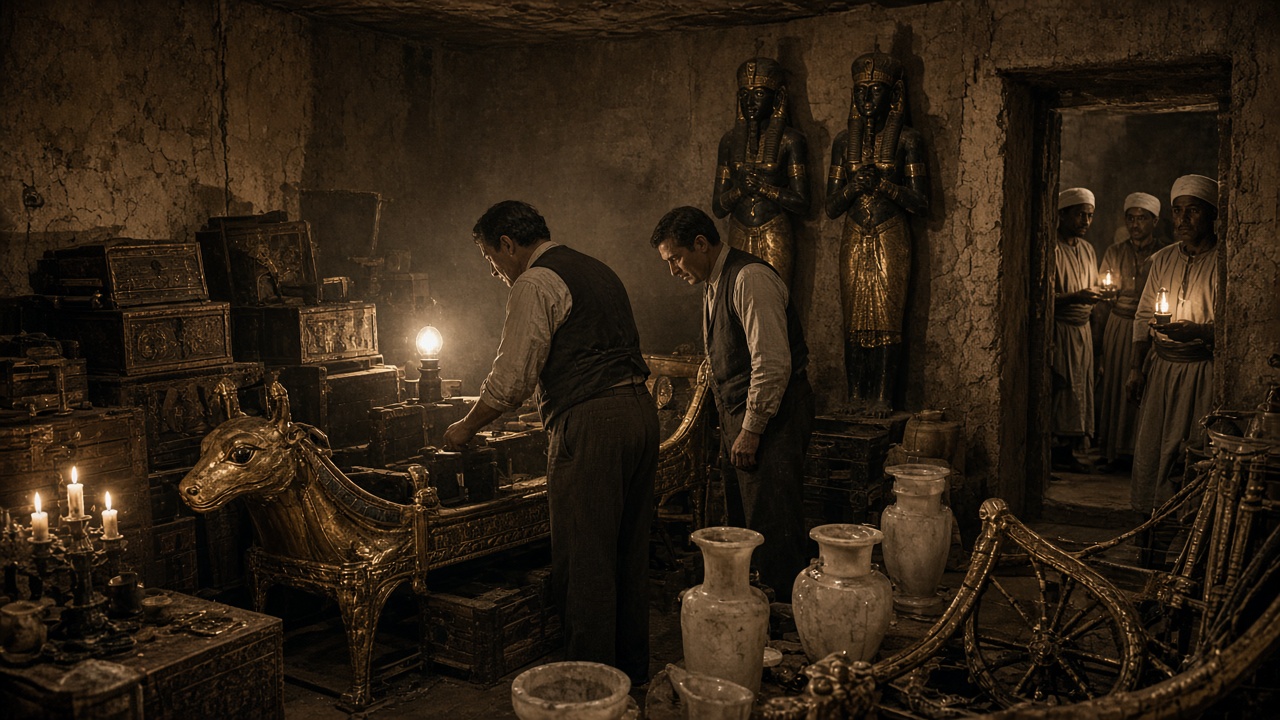
Archaeologists examine a tomb packed with treasures, like Tutankhamun’s in 1922 (artistic illustration).
1798–1809: Napoleon’s expedition brings scholars to Egypt, French soldiers find the Rosetta Stone (1799), and the great Description de l’Égypte begins publication (1809).
1822–1858: Jean-François Champollion announces the decipherment of hieroglyphs (1822), and Auguste Mariette founds Egypt’s Antiquities Service (1858).
1880–1922: Flinders Petrie introduces careful scientific excavation, and Howard Carter discovers the tomb of Tutankhamun in the Valley of the Kings on 4 November 1922.
1960–Today: A UNESCO campaign moves Abu Simbel above the rising waters of the Aswan High Dam (1964–1968), royal mummies parade to a new museum (2021), and the Grand Egyptian Museum near Giza opens (2025).
Technology
Decipherment: Reading hieroglyphs.
CT scans: Looking inside mummies.
Satellite surveys: Finding lost sites.
Features
Egyptology: A new science.
Famous finds: Tutankhamun’s tomb.
Heritage: Museums and UNESCO.
Periods of Ancient Egyptian History
Period
Approximate dates
Highlights
Predynastic
c. 6000–3100 BCE
Farming villages, Badarian and Naqada cultures
Early Dynastic
c. 3100–2686 BCE
Unification, Memphis, early hieroglyphs
Old Kingdom
c. 2686–2181 BCE
Step Pyramid, Great Pyramid, Sphinx
First Intermediate
c. 2181–2055 BCE
Division and low floods
Middle Kingdom
c. 2055–1650 BCE
Reunification, classical literature, Nubian forts
Second Intermediate
c. 1650–1550 BCE
Hyksos rule in the north
New Kingdom
c. 1550–1069 BCE
Empire, Valley of the Kings, Ramesses II
Third Intermediate
c. 1069–664 BCE
Libyan and Kushite dynasties
Late Period
664–332 BCE
Saite revival, Persian conquest
Ptolemaic
332–30 BCE
Alexandria, Rosetta Stone, Cleopatra
Roman and Byzantine
30 BCE–641 CE
Grain for Rome, Christianity, end of hieroglyphs
Famous Rulers of Ancient Egypt
Ruler
Approximate time
Known for
Narmer (Menes)
c. 3100 BCE
Unifying Upper and Lower Egypt
Djoser
c. 2670 BCE
Step Pyramid, designed by Imhotep
Khufu
c. 2589–2566 BCE
The Great Pyramid of Giza
Mentuhotep II
c. 2055–2004 BCE
Reuniting Egypt, starting the Middle Kingdom
Senusret III
c. 1878–1839 BCE
Strong rule and forts in Nubia
Ahmose I
c. 1550–1525 BCE
Expelling the Hyksos, founding the New Kingdom
Hatshepsut
c. 1479–1458 BCE
Female pharaoh, temple at Deir el-Bahari, Punt expedition
Thutmose III
c. 1479–1425 BCE
Great conqueror, Battle of Megiddo
Akhenaten
c. 1353–1336 BCE
Worship of the Aten, new capital at Amarna
Tutankhamun
c. 1332–1323 BCE
Boy king, treasure-filled tomb found in 1922
Ramesses II
1279–1213 BCE
Kadesh, peace treaty, Abu Simbel
Cleopatra VII
51–30 BCE
Last active ruler of the Ptolemaic dynasty
Great Monuments of Ancient Egypt
Monument
Place
Built
Known for
Step Pyramid of Djoser
Saqqara
c. 2670 BCE
First large stone building
Great Pyramid of Khufu
Giza
c. 2560 BCE
Last surviving Wonder of the Ancient World
Great Sphinx
Giza
c. 2500 BCE
Lion body with a royal human head
Karnak Temple
Luxor (Thebes)
c. 2000–30 BCE
Huge temple complex of Amun, Great Hypostyle Hall
Luxor Temple
Luxor
c. 1400–1250 BCE
Temple for festivals, linked to Karnak by an avenue of sphinxes
Temple of Hatshepsut
Deir el-Bahari
c. 1470 BCE
Terraced temple against the cliffs
Valley of the Kings
West bank of Luxor
c. 1500–1070 BCE
Rock-cut royal tombs, including Tutankhamun’s
Abu Simbel
Nubia, southern Egypt
c. 1264 BCE
Colossal statues of Ramesses II, moved in the 1960s
Lighthouse of Alexandria
Alexandria
c. 280 BCE
Wonder of the Ancient World, now lost
Temple of Isis
Philae
c. 380 BCE onwards
Last known hieroglyphic inscription (394 CE)
Writing, Knowledge, and Decipherment
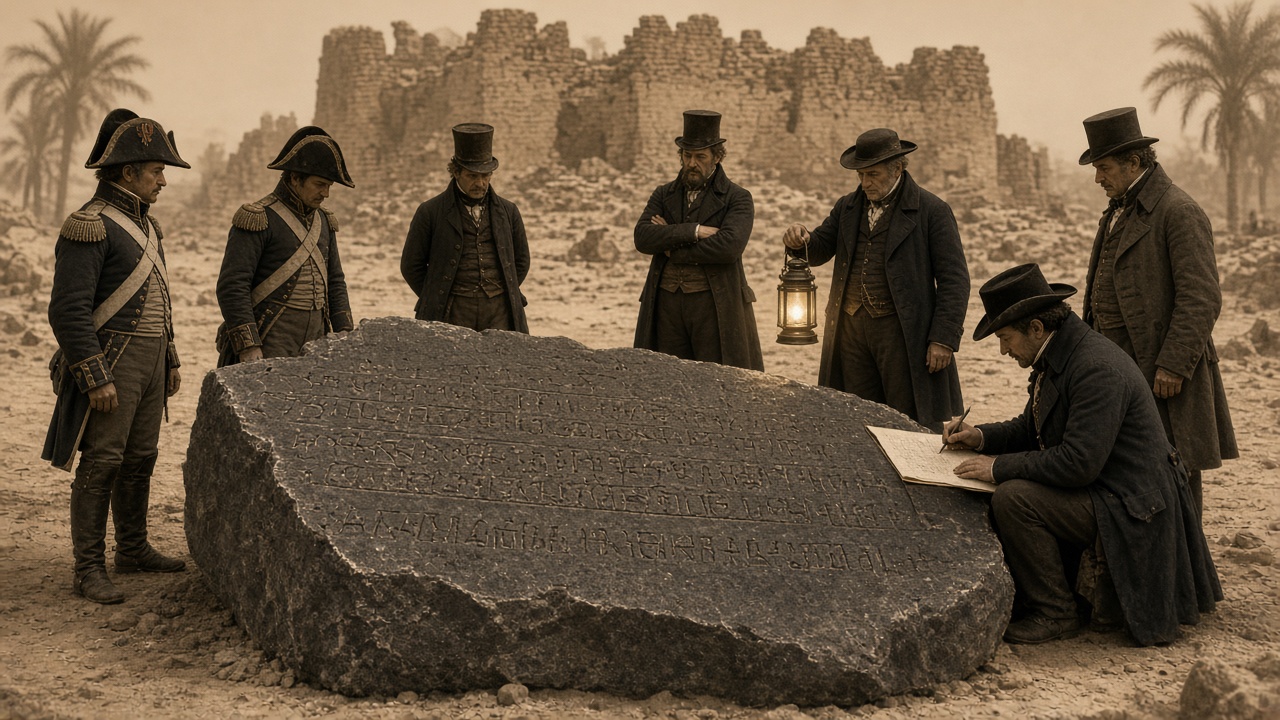
Soldiers and scholars examine an inscribed stone like the Rosetta Stone, found in 1799 (artistic illustration).
Item
Date
Why it matters
Hieroglyphs
From c. 3200 BCE
Picture signs for sounds and words, used on monuments
Hieratic
From c. 3000 BCE
Faster joined-up script for papyrus
Demotic
From c. 650 BCE
Everyday script of later Egypt
Papyrus
From c. 3000 BCE
Paper-like sheets made from papyrus reeds
365-day calendar
Early dynastic times
Three seasons of four months, plus five extra days
Rhind Mathematical Papyrus
c. 1550 BCE
Fractions, areas, and volumes
Edwin Smith and Ebers Papyri
c. 1600–1550 BCE
Early medical and surgical texts
Book of the Dead
From c. 1550 BCE
Spells to guide the dead in the afterlife
Rosetta Stone
Carved 196 BCE, found 1799
Same decree in hieroglyphic, demotic, and Greek
Champollion’s breakthrough
1822
Hieroglyphs can be read again
Daily Life, Beliefs, and Mummies
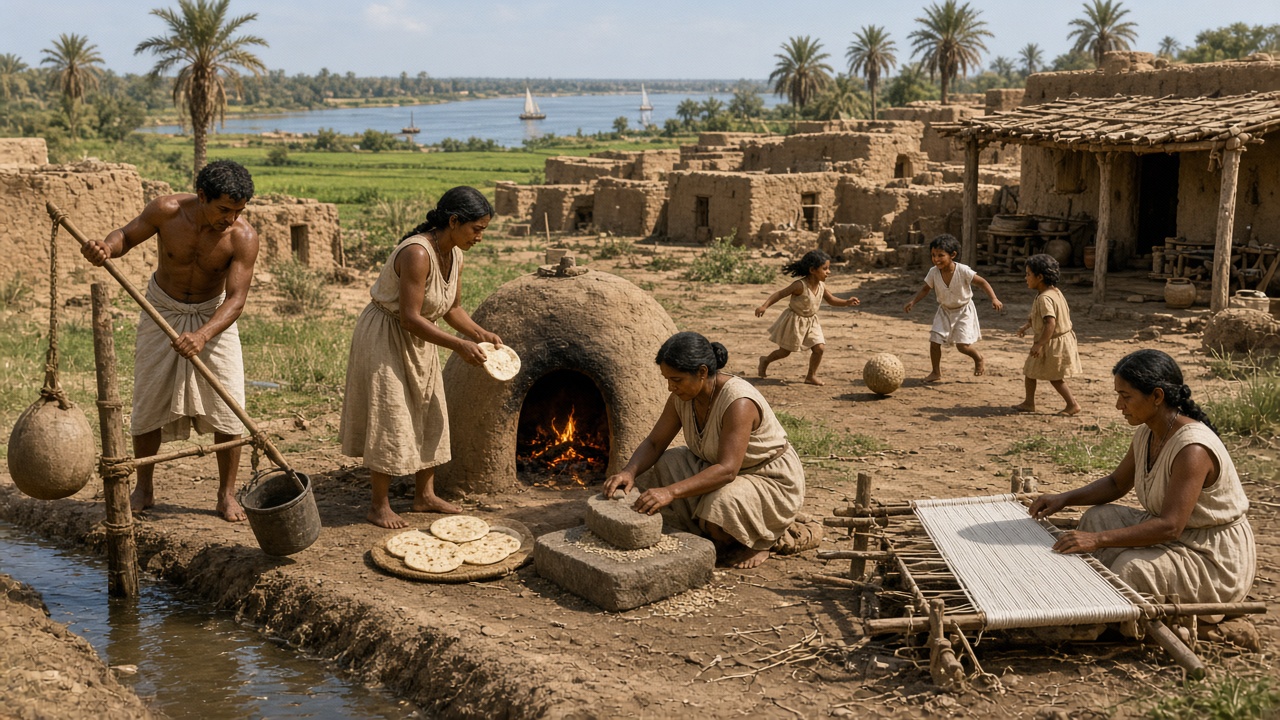
Villagers lift water, bake bread, grind grain, and weave linen by the Nile (artistic illustration).
Topic
Ancient Egyptian life
Seasons
Akhet (flood), Peret (growing), and Shemu (harvest)
Food
Bread and beer from wheat and barley, onions, fish, and dates
Clothing
White linen kilts and dresses, wigs, and kohl eye make-up
Homes
Mud-brick houses with flat roofs, often used for sleeping in summer
Work
Farmers, scribes, priests, craftspeople, soldiers, and builders
Women
Could own property, run businesses, and go to court
Games
Board games such as senet, toys, and ball games
Gods
Ra (sun), Osiris (afterlife), Isis, Horus, Anubis, and Amun
Mummification
Organs removed, body dried with natron and wrapped in linen, about 70 days
Afterlife
The heart weighed against the feather of Ma’at (truth)
Ancient Egyptian Civilization Timeline Summary
Year / Era
Milestone
c. 5500 BCE
Farming villages along the Nile
c. 3250 BCE
Early writing at Abydos
c. 3100 BCE
Unification under Narmer (Menes)
c. 2670 BCE
Step Pyramid of Djoser
c. 2560 BCE
Great Pyramid of Khufu
c. 2181 BCE
End of the Old Kingdom
c. 2055 BCE
Middle Kingdom begins
c. 1650 BCE
Hyksos rule in the north
c. 1550 BCE
New Kingdom begins under Ahmose
c. 1479 BCE
Hatshepsut becomes pharaoh
c. 1353 BCE
Akhenaten and the Aten
c. 1323 BCE
Death of Tutankhamun
1274 BCE
Battle of Kadesh
525 BCE
Persian conquest
332 BCE
Alexander the Great takes Egypt
196 BCE
Rosetta Stone carved
30 BCE
Death of Cleopatra VII; Roman rule
394 CE
Last known hieroglyphic inscription
1799
Rosetta Stone found
1822
Champollion deciphers hieroglyphs
1922
Tutankhamun’s tomb discovered
1964–1968
Abu Simbel relocated
2025
Grand Egyptian Museum opens
Test Your Knowledge
20 quick questions from the ancient Egyptian civilization timeline. Click each question to reveal the answer.
Answer: The Nile.
Answer: Around 3100 BCE.
Answer: Narmer, also remembered as Menes.
Answer: Imhotep.
Answer: Khufu.
Answer: The Great Pyramid of Giza.
Answer: Mentuhotep II.
Answer: The Hyksos.
Answer: Hatshepsut.
Answer: Akhenaten.
Answer: The Valley of the Kings.
Answer: Ramesses II.
Answer: Cambyses II.
Answer: Alexandria.
Answer: Cleopatra VII.
Answer: Hieroglyphic, demotic, and ancient Greek.
Answer: Jean-François Champollion.
Answer: Natron, a natural salt.
Answer: Howard Carter, on 4 November 1922.
Answer: Abu Simbel.
Classroom activity
Students Tasks
Use these prompts for discussion or projects on ancient Egyptian civilization.
Make a timeline poster: c. 3100 BCE unification, c. 2560 BCE Great Pyramid, c. 1550 BCE New Kingdom, 1274 BCE Kadesh, 30 BCE Cleopatra, 1822 decipherment, and 1922 Tutankhamun.
On a map of Egypt, mark the Nile, Memphis, Giza, Thebes (Luxor), Amarna, Abu Simbel, and Alexandria.
Write your name using a simple chart of hieroglyphic sound signs.
Build a model pyramid and explain how workers may have moved the stone blocks.
Compare the Nile flood with the monsoon in India and explain how each shapes farming.
Make a fact card for one famous ruler, such as Hatshepsut, Ramesses II, or Cleopatra.
Explain in your own words why the Rosetta Stone was the key to reading hieroglyphs.
Compare ancient Egypt with the Indus Valley Civilization: cities, writing, rulers, and trade.
Write a diary entry as a worker building the Great Pyramid.
Debate: “Ancient treasures should be returned to the countries they came from.”
Continue exploring
Ancient Egypt’s story connects to the history of writing, irrigation, boats on rivers and seas, and education. Explore these connected timelines next.
Click any panel to expand and explore the visual mood.
Ancient Egypt in pictures — Nile farmers, pyramid builders, scribes, a temple procession, Alexandria’s lighthouse, village life, the Rosetta Stone, a treasure-filled tomb, and the pyramids then versus now.
Nile Farmers
Predynastic villages
Pyramid Builders
Giza, c. 2560 BCE
Scribes
Middle Kingdom
Temple Procession
New Kingdom
Alexandria
Lighthouse & library
Village Life
Bread, linen, shaduf
Rosetta Stone
Found 1799
Tomb Discovery
1922
Then vs Now
Gleaming to weathered
Explore all civilizations timelines
Jump to any other civilizations timeline on WorldTimelineHub.
Disclaimer: This content is AI-generated for educational purposes and may contain errors or outdated details. For correct and authoritative information, please refer to official and reliable sources such as government publications, manufacturers, museums, and academic references.