Ancient Roman Civilization Timeline: Kings → Republic → Punic Wars & Caesar → Pax Romana → Fall of the West → Byzantium & Legacy
A cluster of hilltop villages beside the River Tiber grew into a city, then a republic that conquered Italy, and finally an empire that stretched from Britain to Egypt and from Spain to Mesopotamia. Its roads, aqueducts,
laws, and language shaped Europe and the Mediterranean, and its eastern half survived as the Byzantine Empire until 1453.
This timeline covers the Palatine villages and the legend of Romulus, the seven kings, the founding of the Republic, the Twelve Tables, the Appian Way, Hannibal and the Punic Wars, the Gracchi, Spartacus, Julius Caesar,
Augustus, the Colosseum, Pompeii, Trajan, Hadrian, Marcus Aurelius, Constantine, the sack of Rome, the fall of the West in 476 CE, Justinian, Constantinople, and the rediscovery of Rome in the Renaissance and at Pompeii.
753 BCE Founding (legend) → 509 BCE Republic44 BCE Caesar → 27 BCE Augustus476 CE Fall of the West → 1453 Constantinople
Why Ancient Rome Matters
Ancient Rome built one of the largest and longest-lasting states in history. For more than a thousand years in the West, and nearly two thousand counting its eastern half, Romans governed peoples of many languages and
religions, linked them with roads and trade, and spread Latin, Roman law, and city life. Much of today’s world — from alphabets and calendars to legal systems, domes, and the words “senate” and “republic” — still carries Rome’s mark.
Big picture
Ancient Rome in one view
Villages on the hills of Rome became a city ruled by kings, the Romans set up a republic in 509 BCE and conquered Italy, they defeated Carthage and expanded around the Mediterranean, civil wars ended the Republic, Augustus
began two centuries of imperial peace, crises and invasions brought down the Western Empire in 476 CE, and the Eastern Empire lasted until 1453. Related timelines:
roads,
coins and currency,
water supply.
753 BCE
Traditional founding of Rome
117 CE
Empire at its greatest size under Trajan
80,000+ km
Main paved roads (estimate)
1453
Fall of the Eastern Roman Empire
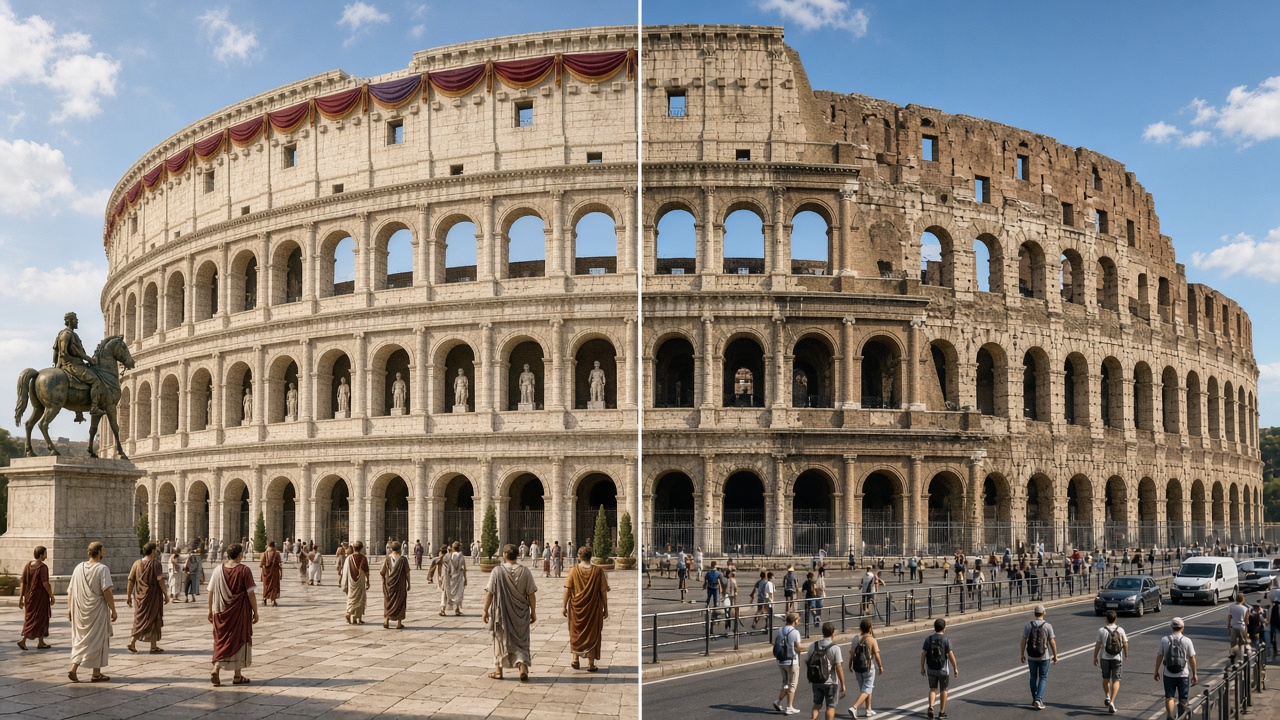
The Colosseum reimagined as new around 80 CE, and as visitors see it today (artistic illustration).
Ancient Rome Then vs Rome Now
Feature
Ancient Rome (c. 100 CE)
Rome and Italy today
Government
Emperor, with a Senate and appointed governors
Italian Republic with an elected parliament and a president
Rome’s role
Capital of an empire across three continents
Capital of Italy (since 1871) and home to Vatican City
Language
Latin in the west, Greek in the east
Italian, a Romance language that grew out of Latin
Religion
Many gods, such as Jupiter, Juno, Mars, and Vesta
Mostly Christian, with the Pope based in Vatican City
City population
Perhaps about 1 million (estimated)
About 2.7 million in the city of Rome
Water
Aqueducts carried water from the hills into the city
Modern pipes; the ancient Aqua Virgo still feeds the Trevi Fountain
Roads
Stone-paved roads such as the Via Appia
Motorways, some following old Roman routes
Law
Roman law, from the Twelve Tables onwards
Civil law codes that grew from Roman law
Entertainment
Gladiator games and chariot races
Football, films, and the Colosseum as a monument
Money
Silver denarius and gold aureus coins
The euro
🐺 Founding & Kingsc. 1000 – 509 BCE
Founding & the Kings
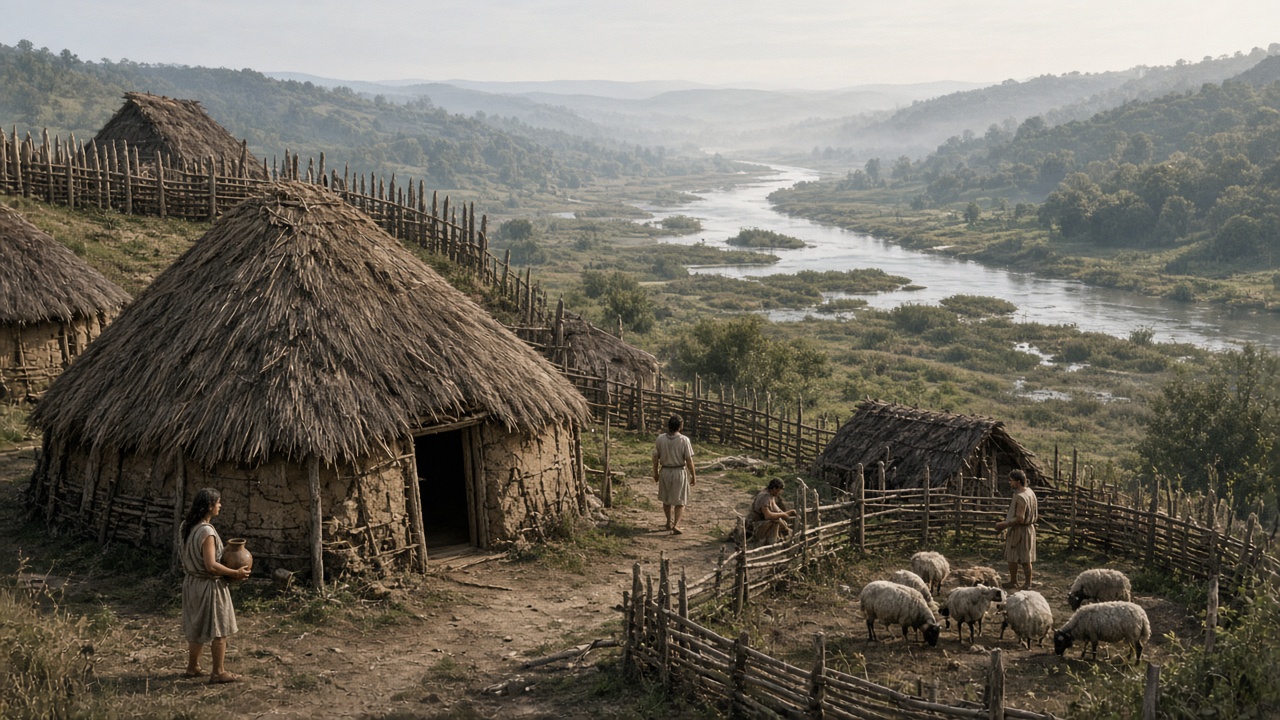
Latin-speaking farmers and herders lived in hut villages on the hills beside the River Tiber, at a natural crossing point in central Italy. Roman legend says Romulus founded the city in 753 BCE after quarrelling with his twin Remus. Rome was then ruled by seven kings, the last of them Etruscans, who drained the marshy valley that became the Forum.
A thatched hut village above the Tiber, like the earliest settlements on the Palatine Hill (artistic illustration).
c. 1000–800 BCE: Small Iron Age villages of oval huts appear on the Palatine and other hills of Rome, and the dead are buried in the valley below.
753 BCE (tradition): According to legend, Romulus, raised with his twin Remus by a she-wolf, founds Rome on 21 April and becomes its first king.
c. 625–575 BCE: The villages merge into a city, the Forum valley is drained and paved, and the Etruscans of central Italy strongly influence Roman building, religion, and dress.
c. 509 BCE: The Romans expel their seventh and last king, Tarquin the Proud, and the Temple of Jupiter on the Capitoline Hill is traditionally dedicated.
Technology
Huts and palisades: Wood, reeds, and clay.
Drainage: Early Cloaca Maxima channel.
Iron tools: Farming and weapons.
Features
Seven hills: By the Tiber crossing.
Seven kings: Romulus to Tarquin.
Etruscan influence: Temples and rituals.
🏛️ Republic509 – 264 BCE
Early Republic & the Conquest of Italy
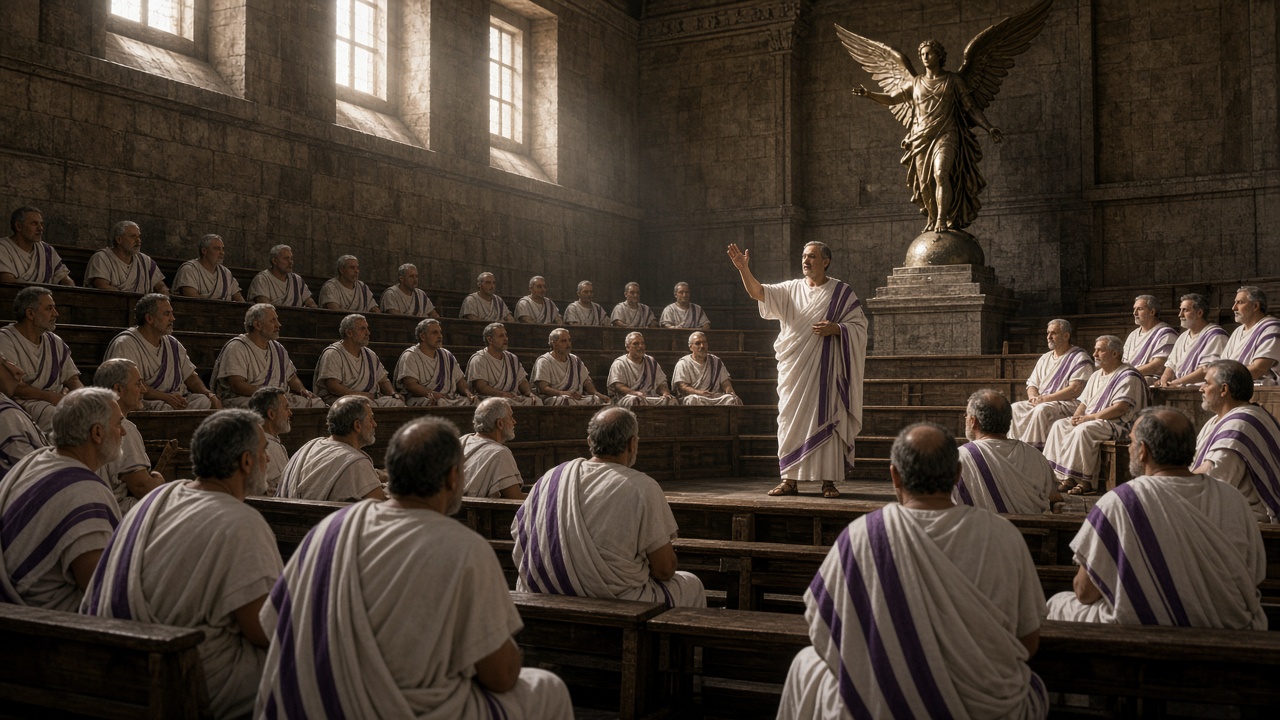
Without a king, Romans elected two consuls each year, advised by the Senate. Ordinary citizens, the plebeians, struggled for rights against the noble patricians and won their own officials and written laws. Step by step, through wars and alliances, Rome came to control almost all of Italy south of the River Po.
A senator addresses the Senate beneath a statue of Victory (artistic illustration).
509–494 BCE: The Republic begins with two consuls elected for one year, and after the plebeians walk out of the city in protest (494 BCE), they win their own officials, the tribunes of the plebs.
c. 451–450 BCE: The Twelve Tables, Rome’s first written laws, are displayed in the Forum so that all citizens can know the law.
c. 390 BCE: Gauls from the north sack Rome, and the Romans afterwards build a stronger stone city wall.
312–264 BCE: Appius Claudius begins the Appian Way and the first aqueduct (312 BCE), Rome defeats the Samnites and King Pyrrhus, and by 264 BCE it leads most of the Italian peninsula.
Technology
Via Appia: The first great Roman road.
Aqua Appia: The first aqueduct.
Bronze coins: Early Roman money.
Features
Elected consuls: Two, for one year.
Written law: The Twelve Tables.
Italy united: Through wars and alliances.
⚔️ Punic Wars & Caesar264 – 27 BCE
Punic Wars & the Late Republic
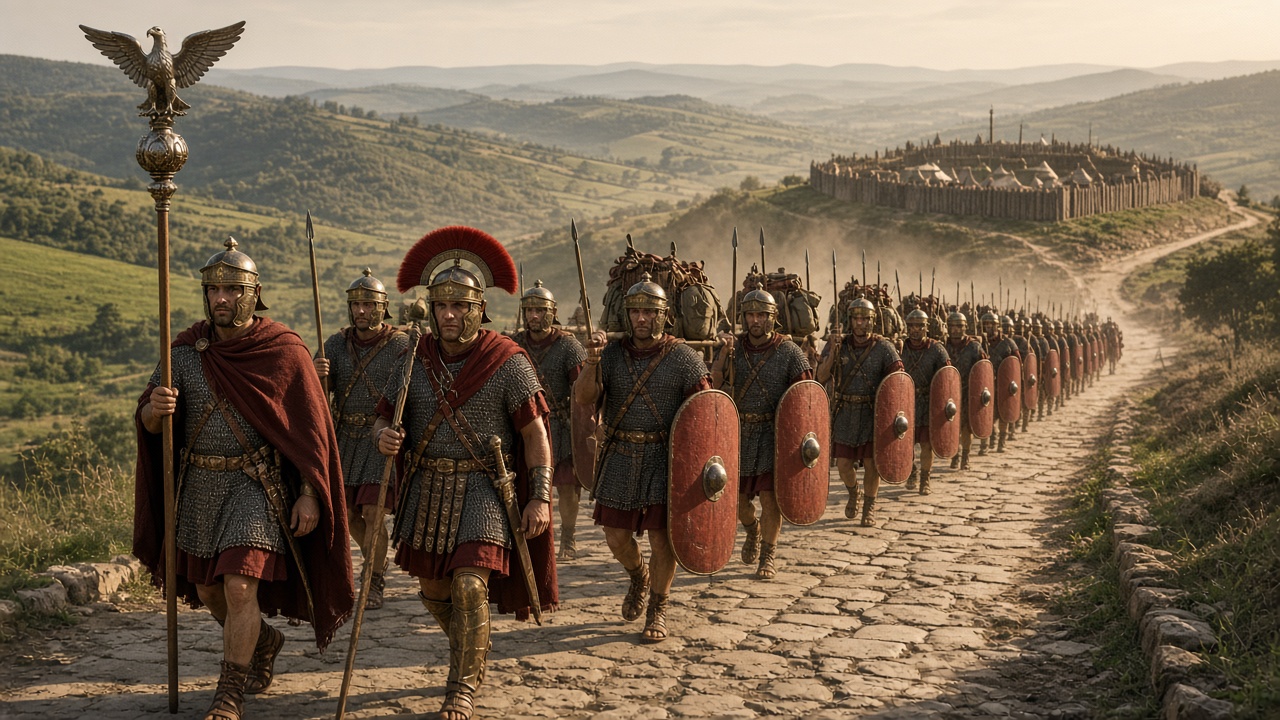
Three wars against Carthage made Rome the master of the western Mediterranean, and further wars brought Greece, Spain, and Asia Minor under its rule. But wealth and slaves flowed to the rich, generals built private armies, and a century of political violence and civil wars ended with Julius Caesar’s dictatorship and, finally, rule by one man.
Legionaries march behind their eagle standard on a Roman road (artistic illustration).
264–201 BCE: Rome wins the First Punic War and gains Sicily, its first province, and in the Second, Hannibal crosses the Alps (218 BCE) and wins at Cannae (216 BCE) before Scipio defeats him at Zama (202 BCE).
146 BCE: Rome destroys both Carthage and Corinth, and Africa and Macedonia become Roman provinces.
133–71 BCE: The reforming Gracchus brothers are killed (133 and 121 BCE), Marius recruits landless men into the army, and the gladiator Spartacus leads a great slave revolt (73–71 BCE).
58–27 BCE: Julius Caesar conquers Gaul, crosses the Rubicon (49 BCE), and is assassinated on the Ides of March (44 BCE), and Octavian defeats Antony and Cleopatra at Actium (31 BCE) before becoming Augustus (27 BCE).
Technology
Corvus: Boarding bridge for warships.
Roman concrete: Strong and long lasting.
Julian calendar: 365¼ days, 46 BCE.
Features
Mediterranean power: After Carthage.
Professional legions: Loyal to generals.
Civil wars: End of the Republic.
👑 Pax Romana27 BCE – 180 CE
Augustus & the Pax Romana
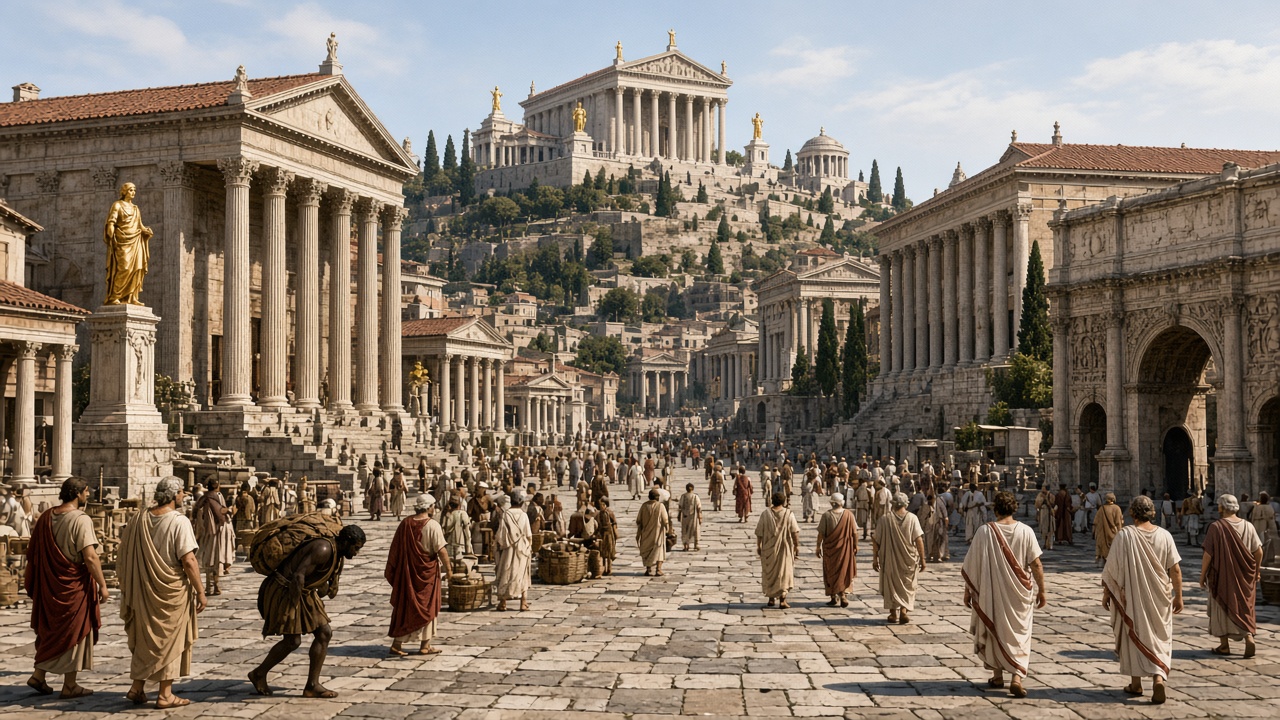
Augustus kept the outward forms of the Republic but held real power as the first emperor. About two centuries of relative peace followed, the Pax Romana, when trade, cities, roads, and aqueducts spread across the empire. Rome itself filled with marble temples, baths, and arenas such as the Colosseum.
Citizens, merchants, and porters fill the Roman Forum in the age of the emperors (artistic illustration).
27 BCE–14 CE: Augustus rules as the first emperor, reforms the army and provinces, sets up a fire brigade and police for Rome, and boasts that he found Rome a city of brick and left it a city of marble.
43–79 CE: Claudius invades Britain (43 CE), a great fire burns much of Rome under Nero (64 CE), and Mount Vesuvius buries Pompeii and Herculaneum (79 CE).
80–125 CE: The Colosseum opens under Titus (80 CE), the empire reaches its greatest size under Trajan (117 CE), and Hadrian begins his wall in Britain (122 CE) and rebuilds the Pantheon.
161–180 CE: The philosopher-emperor Marcus Aurelius fights on the Danube frontier while a deadly epidemic, the Antonine Plague, spreads, and his death in 180 CE is often seen as the end of the Pax Romana.
Technology
Domes and vaults: The Pantheon.
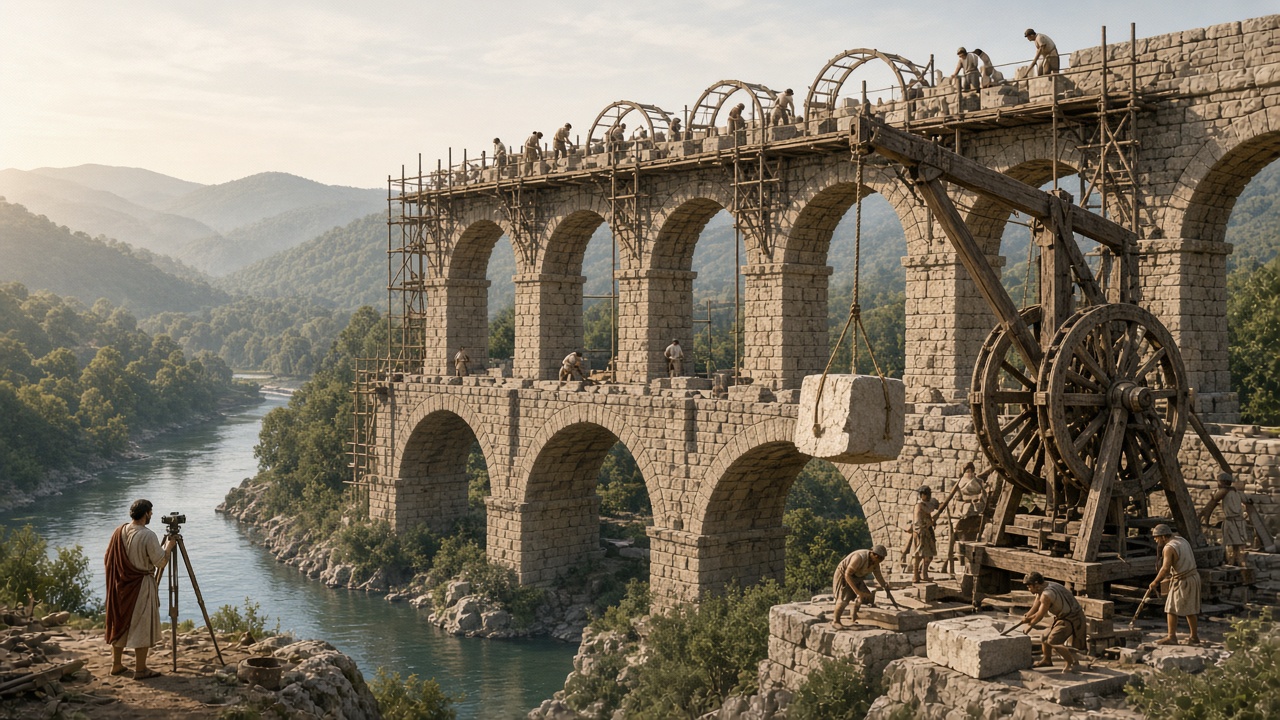
Aqueduct bridges: Such as the Pont du Gard.
Treadwheel cranes: Lifting heavy stone.
Features
Emperors: Power in one person.
Roman peace: About 200 years.
Greatest extent: Under Trajan.
🛡️ Fall of the West180 – 476 CE
Crisis, Christianity & the Fall of the West
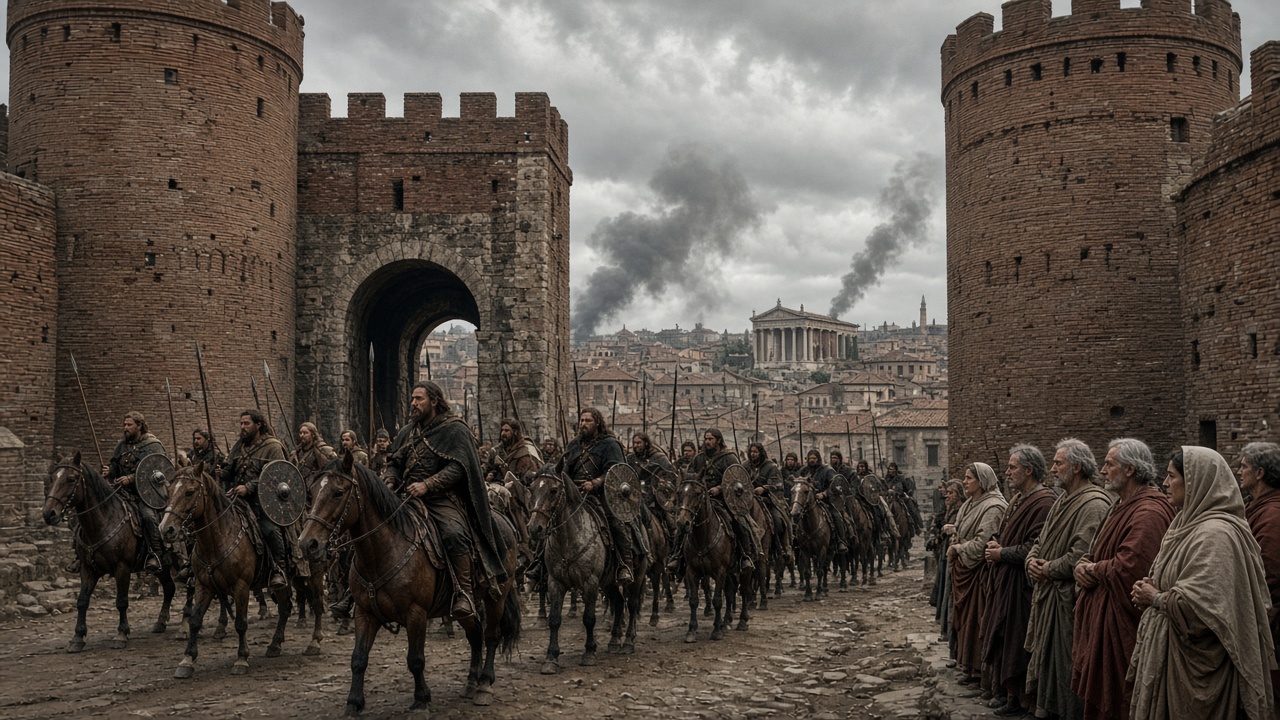
In the third century the empire nearly collapsed under civil wars, invasions, plague, and inflation. Strong emperors such as Diocletian and Constantine reorganised it, Christianity became its main religion, and a new capital rose at Constantinople. But the western half, under pressure from Germanic peoples and the Huns, slowly broke apart.
Gothic warriors ride through a gate in Rome’s walls, as in the sack of 410 CE (artistic illustration).
212–284 CE: Caracalla gives citizenship to almost all free people of the empire (212 CE), and in the Crisis of the Third Century about two dozen emperors rise and fall while Aurelian builds new walls around Rome (from 271 CE).
284–330 CE: Diocletian divides power among four rulers, Constantine and Licinius grant Christians freedom of worship in the Edict of Milan (313 CE), and Constantine dedicates Constantinople (330 CE).
380–410 CE: Theodosius I makes Nicene Christianity the state religion (380 CE), the empire splits for good into East and West at his death (395 CE), and the Visigoths under Alaric sack Rome (410 CE).
451–476 CE: Attila the Hun invades Gaul and Italy, the Vandals sack Rome (455 CE), and the general Odoacer deposes the last western emperor, Romulus Augustulus (476 CE).
Technology
Aurelian Walls: Defending Rome.
Solidus: A stable gold coin.
Codex books: Replacing scrolls.
Features
Crisis: Wars, plague, inflation.
Christian empire: From Constantine.
East and West: Split in 395 CE.
📜 Legacy476 – Today
Byzantium & Rome’s Legacy
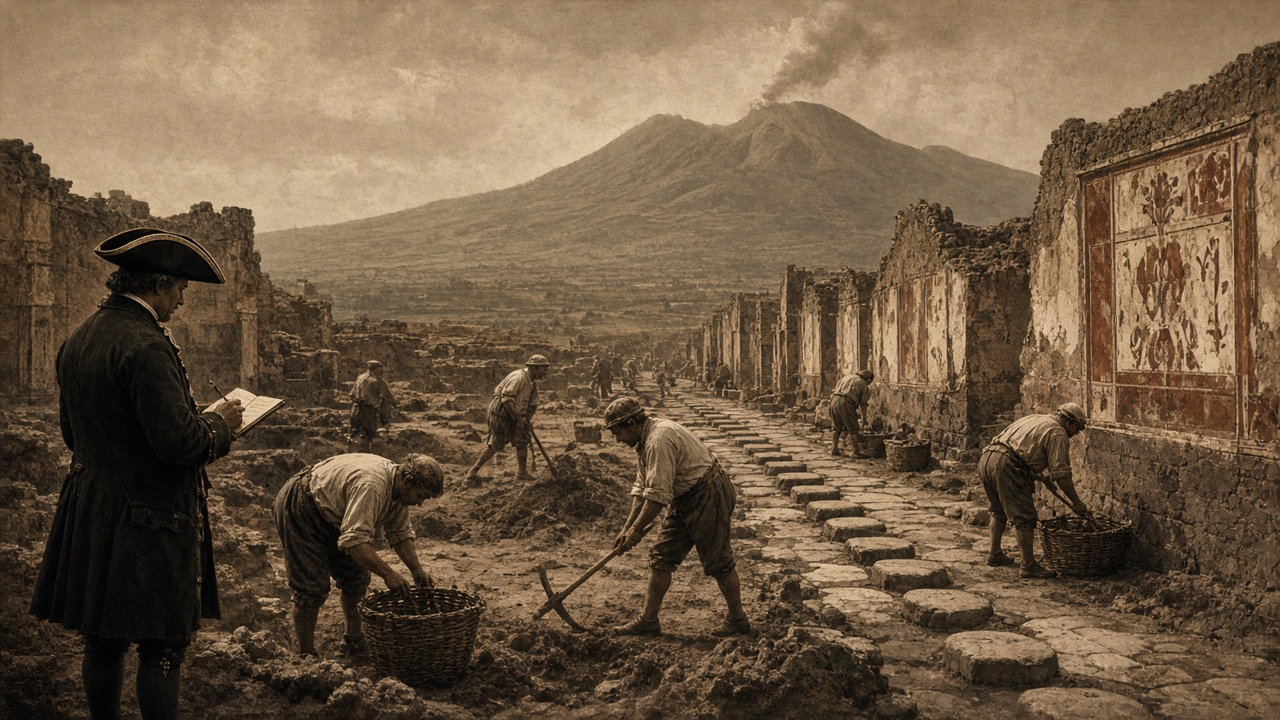
The Eastern Roman Empire, later called the Byzantine Empire, carried on Roman law and government in Greek for almost another thousand years. In the West, Latin lived on in the Church and in scholarship, the Renaissance revived Roman art and ideas, and excavations at Pompeii and Rome brought the ancient city back to life.
Workers uncover a Pompeii street in the 18th century as a scholar takes notes (artistic illustration).
527–565 CE: The eastern emperor Justinian collects Roman law into the Corpus Juris Civilis (529–534 CE), completes Hagia Sophia in Constantinople (537 CE), and reconquers Italy and North Africa.
800–1453: Charlemagne is crowned emperor in Rome (800 CE), reviving the western imperial title, and the Byzantine Empire lasts until Constantinople falls to the Ottoman Turks on 29 May 1453.
1400s–1748: Renaissance scholars and artists study Roman texts and ruins, Pope Gregory XIII reforms the Julian calendar (1582), and excavations begin at Herculaneum (1738) and Pompeii (1748).
1804–Today: The Napoleonic Code builds on Roman law (1804), the Historic Centre of Rome becomes a UNESCO World Heritage Site (1980), and archaeologists still make new finds at Pompeii.
Technology
Great domes: Hagia Sophia.
Gregorian calendar: Reform of 1582.
Digital archaeology: 3D scans of ruins.
Features
Byzantium: Roman empire in the east.
Roman law: Basis of civil law.
Latin: Mother of Romance languages.
Periods of Roman History
Period
Dates
Highlights
Early settlements
c. 1000–753 BCE
Iron Age hut villages on the hills of Rome
Regal period (kings)
753–509 BCE (traditional)
Seven kings, Etruscan influence, the Forum
Early Republic
509–264 BCE
Consuls, Twelve Tables, conquest of Italy
Middle Republic
264–133 BCE
Punic Wars, Greece and Spain conquered
Late Republic
133–27 BCE
Gracchi, Spartacus, Caesar, civil wars
Principate (early empire)
27 BCE–235 CE
Augustus, Pax Romana, greatest extent
Crisis of the Third Century
235–284 CE
Civil wars, invasions, inflation
Late Empire
284–476 CE
Diocletian, Constantine, Christianity, fall of the West
Eastern Roman (Byzantine) Empire
395–1453 CE
Justinian, Hagia Sophia, Constantinople
Famous Romans
Person
Time
Known for
Romulus
753 BCE (legendary)
Mythical founder and first king of Rome
Cincinnatus
458 BCE (tradition)
Gave up power as dictator to return to his farm
Hannibal (Carthage)
247–c. 183 BCE
Crossed the Alps with elephants; Rome’s great enemy
Scipio Africanus
236–183 BCE
Defeated Hannibal at Zama
Cicero
106–43 BCE
Orator, lawyer, and writer of Latin prose
Julius Caesar
100–44 BCE
Conquered Gaul, dictator, Julian calendar
Augustus
Ruled 27 BCE–14 CE
First emperor, began the Pax Romana
Nero
Ruled 54–68 CE
Emperor during the Great Fire of Rome
Trajan
Ruled 98–117 CE
Empire at its largest, Trajan’s Column
Hadrian
Ruled 117–138 CE
Hadrian’s Wall, rebuilt Pantheon
Marcus Aurelius
Ruled 161–180 CE
Philosopher-emperor, wrote the Meditations
Diocletian
Ruled 284–305 CE
Reorganised the empire, rule by four
Constantine the Great
Ruled 306–337 CE
Supported Christianity, founded Constantinople
Justinian I
Ruled 527–565 CE
Code of Roman law, Hagia Sophia
Roman Engineering and Great Buildings
Builders raise an aqueduct bridge with timber frames and a treadwheel crane (artistic illustration).
Work
Place
Date
Why it matters
Cloaca Maxima
Rome
c. 6th century BCE onwards
Drain and sewer, still partly in use
Via Appia
Rome to southern Italy
From 312 BCE
The “queen of roads”
Aqua Appia
Rome
312 BCE
Rome’s first aqueduct
Roman concrete
Across the empire
From c. 2nd century BCE
Lime and volcanic ash, even sets under water
Pont du Gard
Southern France
c. mid-1st century CE
Three-tier aqueduct bridge, about 49 m high
Colosseum
Rome
c. 70–80 CE
Largest Roman amphitheatre, about 50,000 spectators
Pantheon
Rome
c. 113–125 CE
Dome 43 m wide, still the largest unreinforced concrete dome
Hadrian’s Wall
Northern Britain
From 122 CE
About 117 km frontier wall with forts
Baths of Caracalla
Rome
c. 212–216 CE
Huge public bath complex
Hagia Sophia
Constantinople (Istanbul)
532–537 CE
Great domed church of the Eastern Empire
Daily Life in Ancient Rome
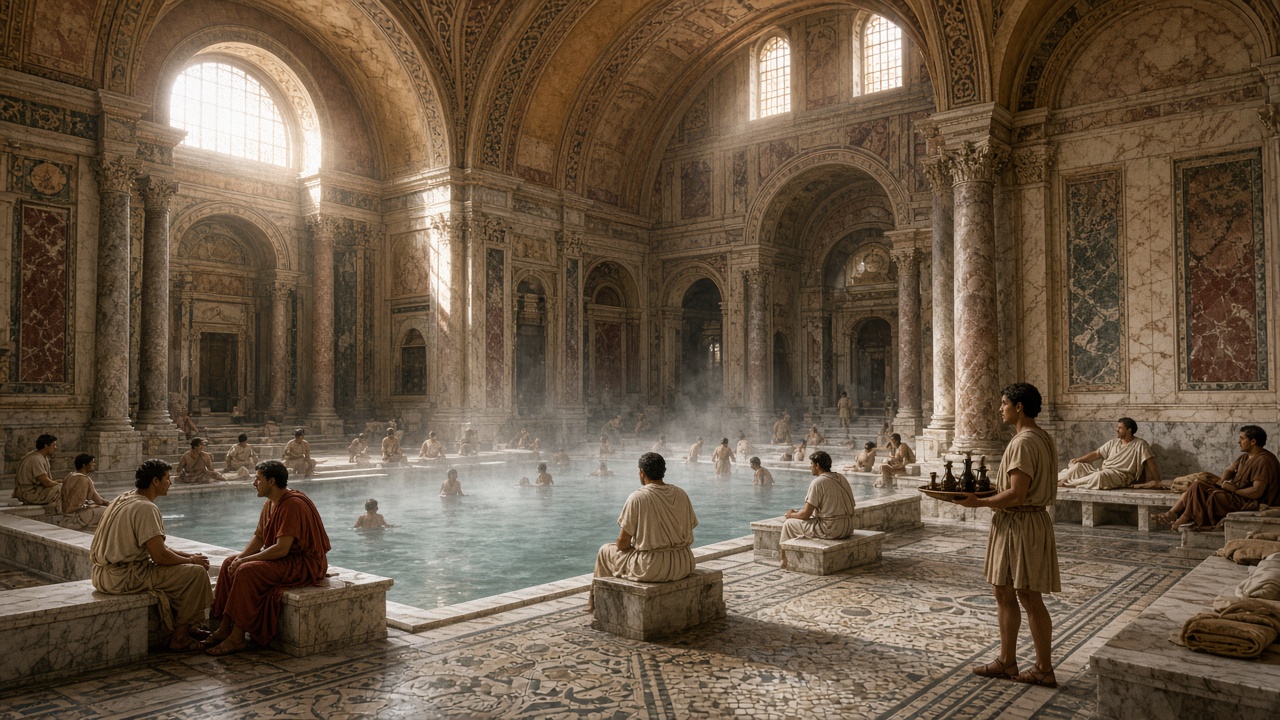
Romans relax and talk in the steamy marble hall of a public bath (artistic illustration).
Topic
Roman life
Homes
The rich lived in a domus with a courtyard; most city people rented rooms in apartment blocks called insulae
Food
Bread, wheat porridge, olive oil, vegetables, wine, and a fish sauce called garum
Clothing
Tunics for everyone; the toga for male citizens and the stola for married women
Baths
Public baths with hot, warm, and cold rooms, used for washing, exercise, and meeting friends
Entertainment
Gladiator games, chariot races at the Circus Maximus, and plays in theatres
School
Children of families who could pay learned reading, writing, arithmetic, and public speaking
Family
The father (paterfamilias) had legal power over the household
Slavery
Enslaved people did much of the work; some were later freed and became citizens
Religion
Jupiter, Juno, Mars, Vesta, and household spirits (Lares), later Christianity
Numbers
Roman numerals such as I, V, X, L, C, D, and M
Roman Legacy in the Modern World
Roman idea
Where we see it today
Latin language
Italian, Spanish, French, Portuguese, Romanian, and many English words
Latin alphabet
Used to write English and hundreds of other languages
Roman law
Civil law systems in Europe, Latin America, and elsewhere
Senate and republic
Names and ideas used in modern governments
Julian calendar
Today’s Gregorian calendar; July and August are named after Julius Caesar and Augustus
Arches, vaults, and domes
Government buildings, churches, and stations built in Roman style
Roads and town planning
Routes and street grids in many European cities
Roman numerals
Clock faces, book chapters, and event names
Ancient Roman Civilization Timeline Summary
Year / Era
Milestone
c. 1000 BCE
Hut villages on the hills of Rome
753 BCE
Traditional founding by Romulus
509 BCE
Last king expelled; Republic begins
c. 450 BCE
Twelve Tables
c. 390 BCE
Gauls sack Rome
312 BCE
Via Appia and Aqua Appia begun
264 BCE
First Punic War begins
216 BCE
Hannibal wins at Cannae
146 BCE
Carthage and Corinth destroyed
44 BCE
Julius Caesar assassinated
27 BCE
Augustus becomes the first emperor
79 CE
Vesuvius buries Pompeii
80 CE
Colosseum opens
117 CE
Empire at its greatest extent
212 CE
Citizenship for almost all free people
313 CE
Edict of Milan
330 CE
Constantinople dedicated
410 CE
Visigoths sack Rome
476 CE
End of the Western Roman Empire
537 CE
Hagia Sophia completed
1453
Fall of Constantinople
1748
Excavations begin at Pompeii
Test Your Knowledge
20 quick questions from the ancient Roman civilization timeline. Click each question to reveal the answer.
Answer: The River Tiber.
Answer: 21 April 753 BCE.
Answer: A she-wolf.
Answer: Tarquin the Proud (Tarquinius Superbus).
Answer: Two.
Answer: The Twelve Tables.
Answer: The Via Appia (Appian Way).
Answer: Carthage.
Answer: Hannibal.
Answer: Spartacus.
Answer: The Rubicon.
Answer: The Ides of March, 15 March 44 BCE.
Answer: Augustus (Octavian).
Answer: Mount Vesuvius.
Answer: Trajan, in 117 CE.
Answer: Hadrian.
Answer: Constantine the Great, in 330 CE.
Answer: Romulus Augustulus, deposed by Odoacer in 476 CE.
Answer: Justinian I.
Answer: 1453.
Classroom activity
Students Tasks
Use these prompts for discussion or projects on ancient Roman civilization.
Timeline understandingWorld historyMap skillsCivics and law
Make a timeline poster: 753 BCE founding, 509 BCE Republic, 216 BCE Cannae, 44 BCE Caesar, 27 BCE Augustus, 79 CE Pompeii, 117 CE greatest extent, 476 CE fall of the West, and 1453 Constantinople.
On a map of the Mediterranean, mark Rome, Carthage, Alexandria, Athens, Constantinople, Pompeii, Hadrian’s Wall, and the River Rubicon.
Compare the Roman Republic with India’s parliamentary democracy: who voted, who made laws, and who led the government.
Write today’s date and your age in Roman numerals.
Build a model arch or aqueduct and explain how an arch carries weight.
Find ten English words that come from Latin and give their Latin roots.
Make a fact card for one famous Roman, such as Julius Caesar, Augustus, Hadrian, or Constantine.
Write a diary entry for a day in Pompeii just before the eruption of 79 CE.
Compare ancient Rome with ancient Egypt: rulers, buildings, writing, and religion.
Debate: “The Roman Empire fell mainly because of problems inside, not attacks from outside.”
Continue exploring
Rome’s story connects to the history of roads, coins and money, water supply, and maps. Explore these connected timelines next.
Click any panel to expand and explore the visual mood.
Ancient Rome in pictures — the first hut villages, the Senate, a marching legion, the imperial Forum, aqueduct builders, a public bath, the Goths at the gates, the dig at Pompeii, and the Colosseum then versus now.
First Villages
Palatine Hill
The Senate
Roman Republic
The Legion
Late Republic
The Forum
Imperial Rome
Aqueduct Builders
Arches & cranes
Public Baths
Daily life
Goths at the Gates
410 CE
Digging Pompeii
From 1748
Then vs Now
New to ruined
Explore all civilizations timelines
Jump to any other civilizations timeline on WorldTimelineHub.
Disclaimer: This content is AI-generated for educational purposes and may contain errors or outdated details. For correct and authoritative information, please refer to official and reliable sources such as government publications, manufacturers, museums, and academic references.