Mughal Civilization Timeline: Babur & Panipat → Humayun & Sher Shah → Akbar the Great → Golden Age of Jahangir & Shah Jahan → Aurangzeb → Decline & 1857
In 1526 a Central Asian prince named Babur won a battle at Panipat and founded a dynasty that would rule much of the Indian subcontinent for two centuries. The Mughals built the Taj Mahal and the Red Fort, ran one of the
richest states in the world, and blended Persian, Central Asian, and Indian traditions in art, food, music, and language — before declining into a shadow empire that ended after the revolt of 1857.
This timeline covers Babur and the First Battle of Panipat, Khanwa, Humayun’s exile, Sher Shah Suri’s rupiya and roads, Akbar, Bairam Khan and the Second Battle of Panipat, Rajput alliances, Fatehpur Sikri, Todar Mal and the
mansabdari system, Jahangir and Nur Jahan, Shah Jahan, the Taj Mahal and Shahjahanabad, Aurangzeb and the Deccan wars, Shivaji and the Marathas, Nader Shah, Plassey and Buxar, Bahadur Shah Zafar, and the Mughal legacy.
1526 First Panipat → 1556 Akbarc. 1632 Taj Mahal begun → 1687 Golconda1739 Nader Shah → 1857 Revolt & End
Why the Mughal Empire Matters
The Mughal Empire was one of the largest and wealthiest states of the early modern world. It united much of the subcontinent under one government, linked its markets with roads, coins, and trade, and drew merchants from
Europe and Asia to Indian ports. Its emperors patronised poets, painters, architects, and musicians, and the blend of cultures at their courts shaped Indian architecture, cuisine, clothing, and the Urdu and Hindustani languages.
Big picture
The Mughals in one view
Babur founded the empire in 1526, Humayun lost it to Sher Shah Suri and won it back, Akbar built its system of government, Jahangir and Shah Jahan presided over a golden age of art and architecture, Aurangzeb pushed it to
its greatest size but exhausted it in the Deccan, and after 1707 regional powers and the British East India Company reduced the emperor to a figurehead until 1857. Related timelines:
rupee history,
roads,
clothing and fashion.
1526
First Battle of Panipat founds the empire
6
“Great Mughals”, from Babur to Aurangzeb
c. 1653
Taj Mahal complex completed
1857
Revolt and the end of Mughal rule
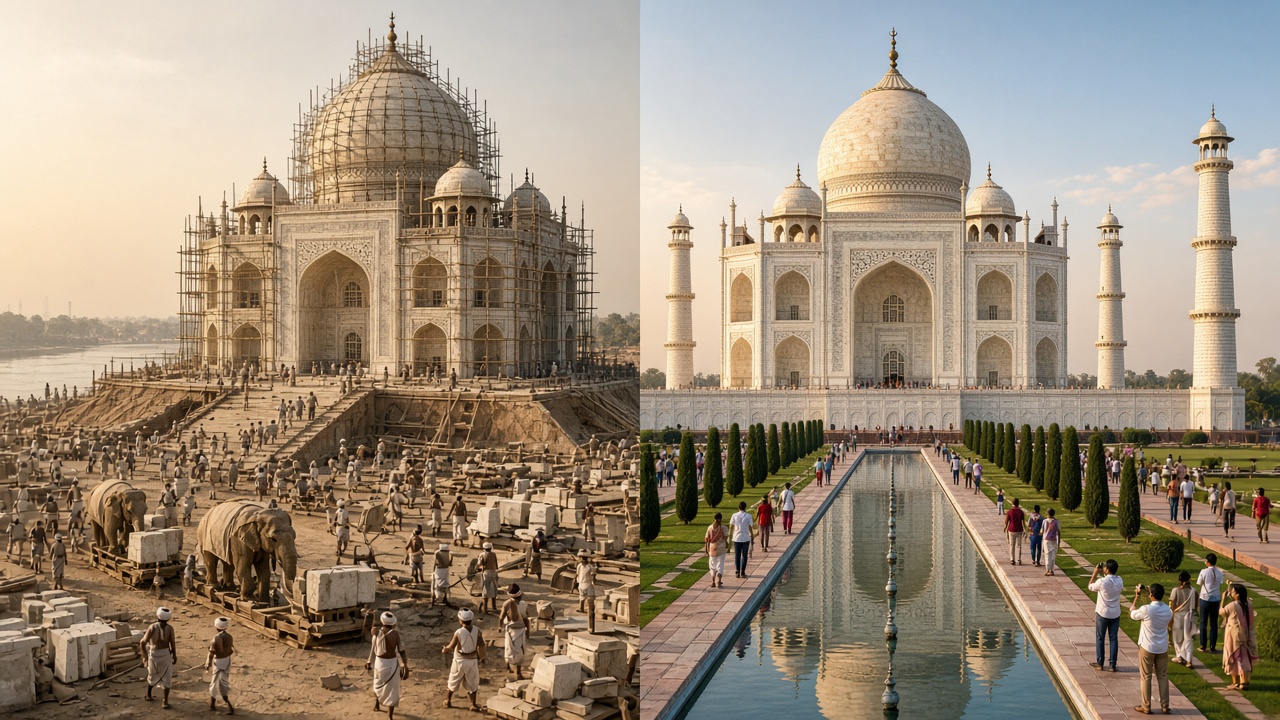
The Taj Mahal reimagined under construction in the 1640s, and as visitors see it today (artistic illustration).
Mughal India Then vs India Now
Feature
Mughal India (c. 1600)
India today
Ruler
Emperor (padshah), served by ranked nobles
Elected Prime Minister and President under the Constitution
Capital
Agra, Fatehpur Sikri, Lahore, and later Delhi (Shahjahanabad)
New Delhi
Official language
Persian at court and in records
Hindi and English, with 22 scheduled languages
Everyday speech
Hindavi and regional languages; Urdu took shape later
Hindi, Urdu, and many regional languages
Taxes
Land revenue assessed on crops and measured fields
Income tax, GST, and other taxes
Money
Silver rupiya, gold mohur, and copper dam
The Indian rupee (₹)
Travel
Horses, elephants, bullock carts, and roadside sarais
National highways, railways, and flights
News
Runners and horse couriers carrying the royal post
Phones, television, and the internet
Clothing
Jama (long coat), patka (sash), turban, and pyjama trousers
Kurta-pyjama and sherwani echo Mughal styles
Monuments
Tombs, forts, and mosques being built
UNESCO World Heritage Sites visited by millions
⚔️ Babur1526 – 1530
Babur & the Founding
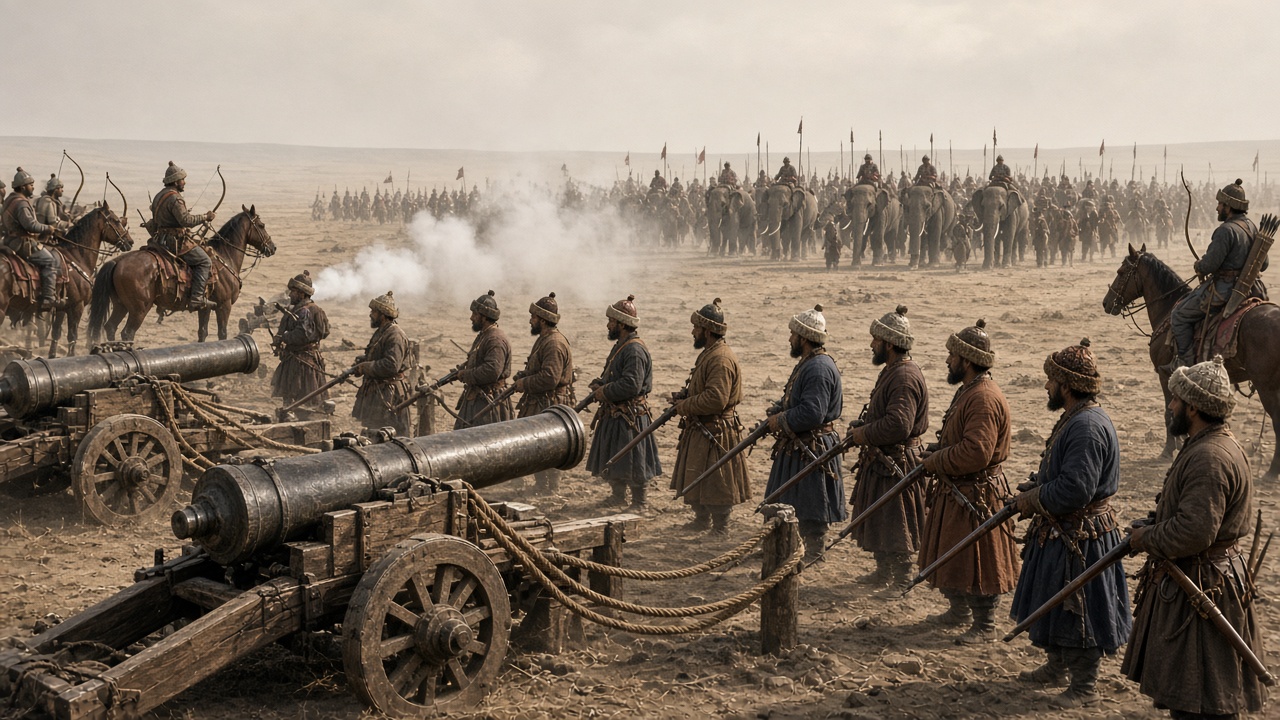
Babur, a descendant of Timur and Genghis Khan, lost his homeland in Central Asia and made Kabul his base. Using cannons, muskets, and fast cavalry, he defeated the Sultan of Delhi at Panipat and then the Rajput confederacy, laying the foundations of a new empire in north India in just four years.
Babur’s gunners wait behind roped carts as an army with war elephants approaches (artistic illustration).
Before 1526: Babur, born in 1483 in Fergana (today’s Uzbekistan), becomes its ruler at age 11, loses Samarkand, captures Kabul in 1504, and leads raids into the Punjab from 1519.
21 April 1526: At the First Battle of Panipat, Babur’s cannons, matchlocks, wall of carts, and flanking cavalry defeat the much larger army of Ibrahim Lodi, who is killed, and Babur takes Delhi and Agra.
1527–1529: Babur defeats Rana Sanga of Mewar and his Rajput allies at Khanwa (1527) and the Afghan chiefs of the east at the Ghaghra (1529).
1528–1530: Babur lays out Persian-style gardens in Agra and records his life in his memoir, the Baburnama, before dying in Agra in December 1530 and being succeeded by his son Humayun.
Technology
Field cannons: Gunpowder on the battlefield.
Matchlock muskets: Infantry firearms.
Charbagh gardens: Four-part water gardens.
Features
Timurid roots: Central Asian heritage.
Delhi and Agra: New power base.
Memoir: The Baburnama.
🛣️ Humayun & Sher Shah1530 – 1556
Humayun, Sher Shah & the Return
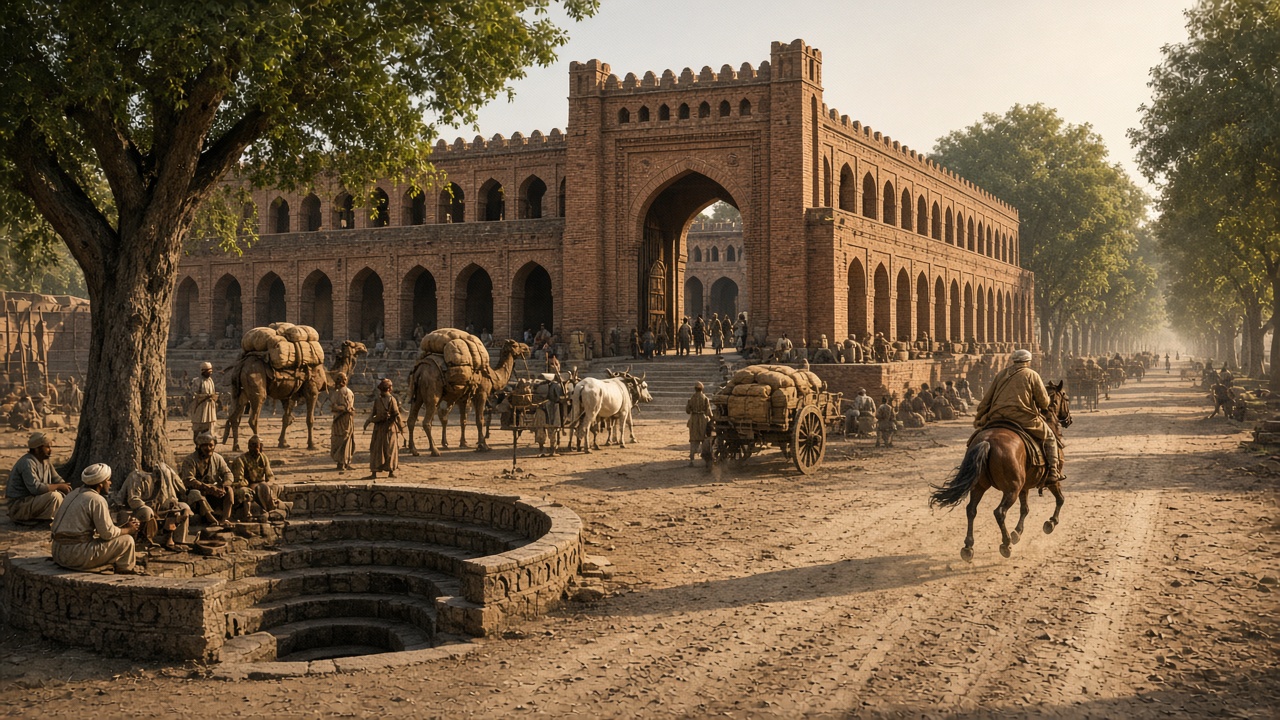
Humayun struggled to hold his father’s conquests and was driven out of India by the Afghan leader Sher Shah Suri. In a short but remarkable reign, Sher Shah reformed coinage, revenue, and roads. Humayun spent fifteen years in exile, partly in Persia, before winning back Delhi just months before his death.
Merchants and a courier at a roadside sarai on the great highway of north India (artistic illustration).
1530–1539: Humayun campaigns against Bahadur Shah of Gujarat and the Afghan leader Sher Khan, who defeats him at Chausa in 1539.
1540–1545: After losing at Kannauj (1540), Humayun flees, and Sher Shah Suri issues the silver rupiya, surveys land for revenue, and improves the great road from Bengal to the north-west with sarais.
1542–1545: Humayun’s son Akbar is born at Umerkot in Sindh (1542), Humayun takes refuge at the court of Shah Tahmasp of Persia, and Sher Shah dies at the siege of Kalinjar (1545).
1555–1556: With Persian help, Humayun retakes Kabul and then Delhi (1555), but dies in January 1556 after a fall on the stairs of his library; his tomb in Delhi is built in the 1560s.
Technology
Rupiya: Standard silver coin.
Sarais: Rest houses along roads.
Land survey: Measuring fields for tax.
Features
Exile: Fifteen years away.
Sur rule: Lasting reforms.
Persian links: Art and culture.
👑 Akbar1556 – 1605
Akbar the Great
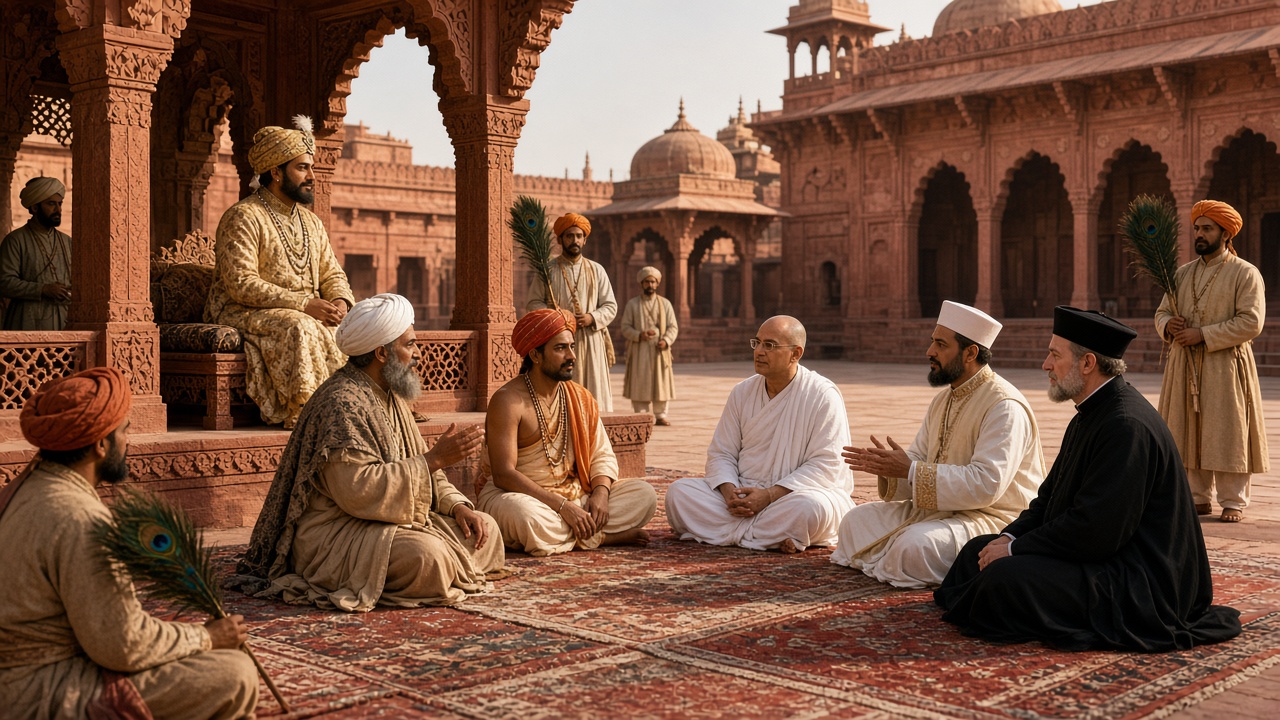
Akbar came to the throne at 13 and ruled for almost fifty years. He expanded the empire across north and central India, brought Rajput rulers into partnership, and built a lasting system of government. Curious about all faiths, he held debates between religious scholars and promoted sulh-i-kul, or peace with all.
Scholars of many faiths debate before the emperor at Fatehpur Sikri (artistic illustration).
1556–1562: Akbar’s regent Bairam Khan defeats Hemu at the Second Battle of Panipat (5 November 1556), Akbar takes full control, and his marriage to a princess of Amber (1562) begins alliances with Rajput rulers.
1563–1576: Akbar abolishes the pilgrim tax (1563) and the jizya (1564), takes Chittor (1568), Gujarat (1573), and Bengal (1576), and his army fights Maharana Pratap of Mewar at Haldighati (1576).
1571–1582: Akbar builds Fatehpur Sikri, hosts religious debates in its Ibadat Khana (from 1575), introduces Raja Todar Mal’s land revenue system and divides the empire into provinces (subahs) around 1580.
1585–1605: Akbar adds Kashmir (1586), Sindh, Kandahar, and parts of the Deccan, Abul Fazl writes the Akbarnama and Ain-i-Akbari, and Akbar dies in 1605.
Technology
Revenue survey: Average crops and prices.
Royal workshops: Painting and crafts.
Translation bureau: Sanskrit into Persian.
Features
Sulh-i-kul: Peace with all.
Rajput alliances: Partners in power.
Mansabdari: Ranked officers.
🌹 Golden Age1605 – 1658
Golden Age of Jahangir & Shah Jahan
Under Jahangir and Shah Jahan the empire was rich and mostly at peace inside its borders. Jahangir loved painting, nature, and gardens, and his wife Nur Jahan became one of the most powerful women of her age. Shah Jahan was the greatest builder of the dynasty, creating the Taj Mahal, the Red Fort, and a new capital at Delhi.
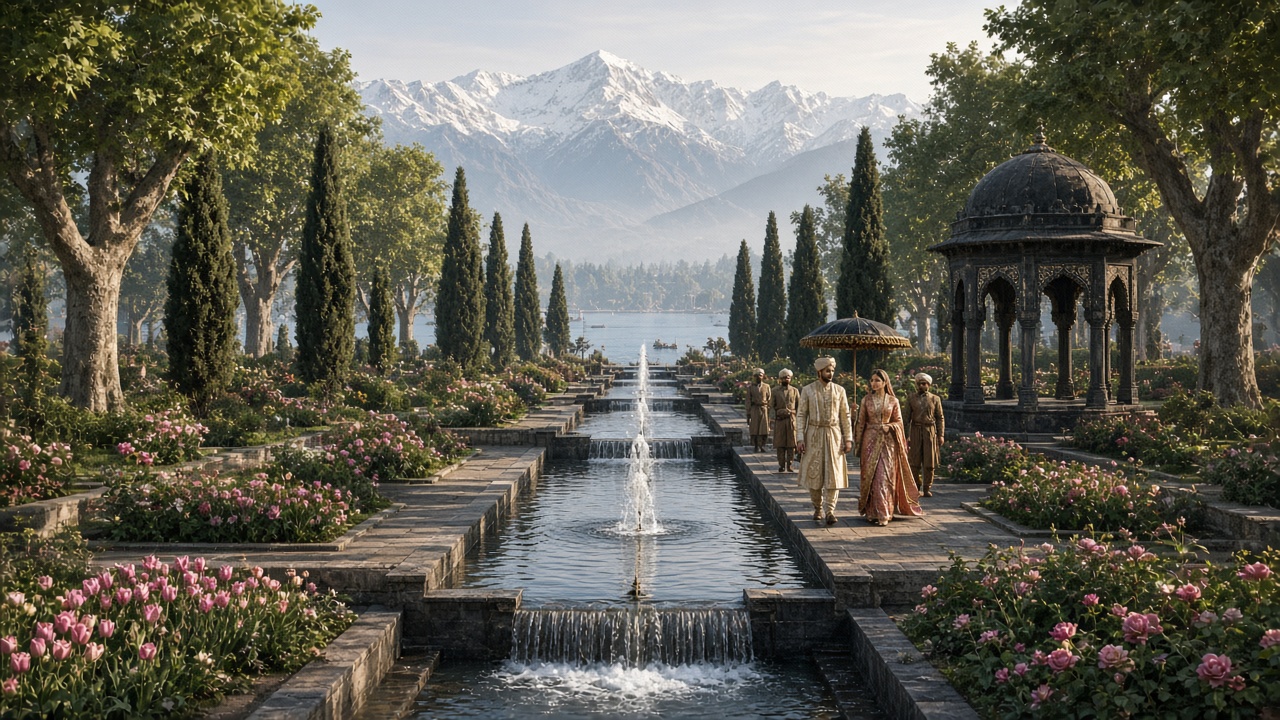
A royal couple strolls through a terraced Mughal garden in Kashmir (artistic illustration).
1605–1615: Jahangir becomes emperor, Guru Arjan Dev is executed in Lahore (1606), the English East India Company wins permission to trade at Surat (1613), and Sir Thomas Roe arrives as English ambassador (1615).
1611–1627: Jahangir marries Nur Jahan (1611), who issues orders and coins in her name, court painters such as Ustad Mansur paint birds and animals, and the Shalimar Bagh is laid out in Srinagar (1619).
1628–1648: Shah Jahan takes the throne, his wife Mumtaz Mahal dies (1631), work on the Taj Mahal begins in Agra around 1632, and the Red Fort and the new city of Shahjahanabad are built in Delhi (1639–1648).
1648–1658: The Jama Masjid of Delhi is built (1650–1656), Princess Jahanara lays out Chandni Chowk, the Taj Mahal complex is completed around 1653, and Shah Jahan’s illness (1657) sparks a war between his sons.
Technology
Pietra dura: Stone inlay in marble.
Garden hydraulics: Channels and fountains.
Double dome: Taj Mahal design.
Features
Art and painting: Royal workshops.
Great buildings: Taj and Red Fort.
European traders: At Surat.
🏰 Aurangzeb1658 – 1707
Aurangzeb & the Greatest Extent
Aurangzeb seized the throne after a bitter war with his brothers and ruled for nearly fifty years. He conquered the sultanates of the Deccan, bringing the empire to its greatest size, but his stricter religious policies and long wars against the Marathas, together with Rajput, Jat, and Sikh resistance, drained the empire’s strength.
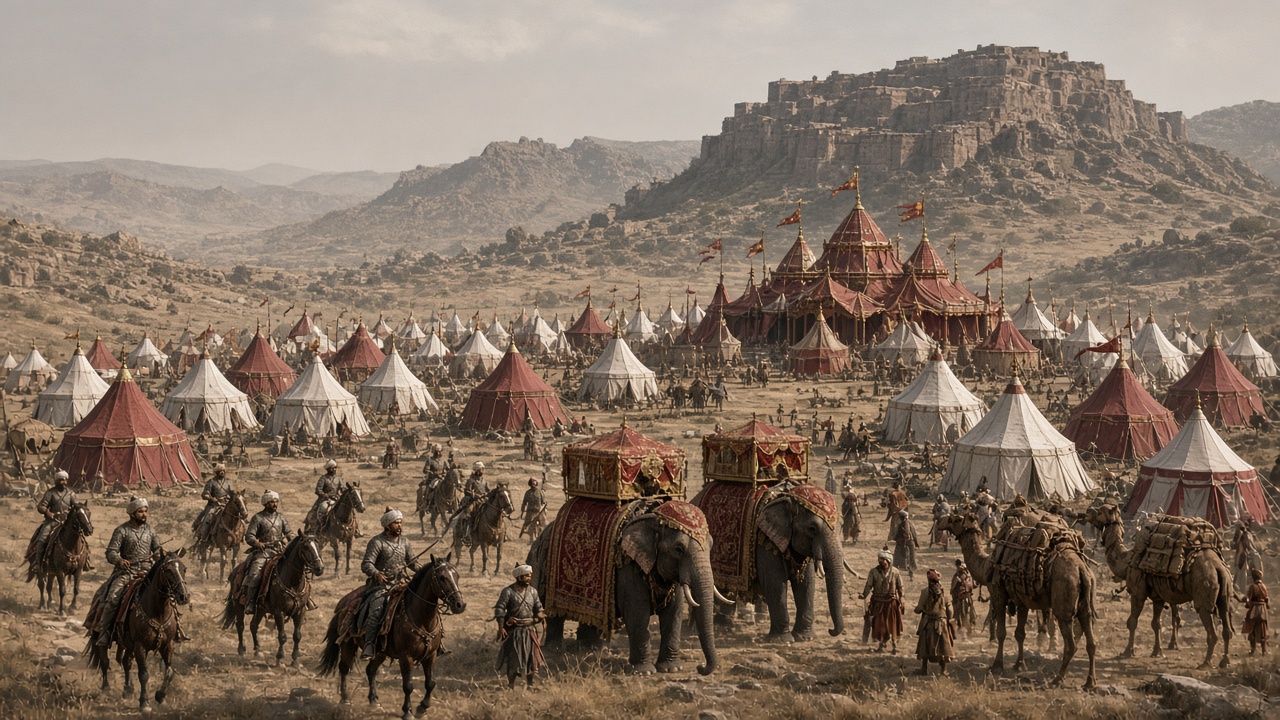
A Mughal army camp with elephants and cavalry below a Deccan hill fort (artistic illustration).
1658–1666: Aurangzeb defeats his brother Dara Shikoh at Samugarh (1658) and has him executed (1659), and his father Shah Jahan is kept in Agra Fort until his death in 1666.
1664–1679: Shivaji raids Surat (1664), escapes from Agra (1666), and is crowned Chhatrapati at Raigad (1674), Guru Tegh Bahadur is executed in Delhi (1675), and Aurangzeb reimposes the jizya (1679).
1681–1689: Aurangzeb moves his court to the Deccan for the rest of his life, conquers Bijapur (1686) and Golconda (1687), and captures and executes the Maratha ruler Sambhaji (1689).
1689–1707: The empire reaches its greatest extent, but Maratha resistance continues, Guru Gobind Singh founds the Khalsa (1699), and Aurangzeb dies at Ahmednagar in 1707.
Technology
Siege artillery: Against Deccan forts.
Hill forts: Maratha strongholds.
Moving capital: Vast tent cities.
Features
Greatest extent: Almost all of India.
Deccan wars: Long and costly.
New powers: Marathas and Sikhs.
🌅 Decline & Legacy1707 – Today
Decline, 1857 & Legacy
After Aurangzeb, wars of succession and weak emperors let provincial governors and regional powers break away. Invaders sacked Delhi, and the British East India Company took control of Bengal and later Delhi itself. The last emperor became the symbolic leader of the revolt of 1857, after which the British ended the dynasty.
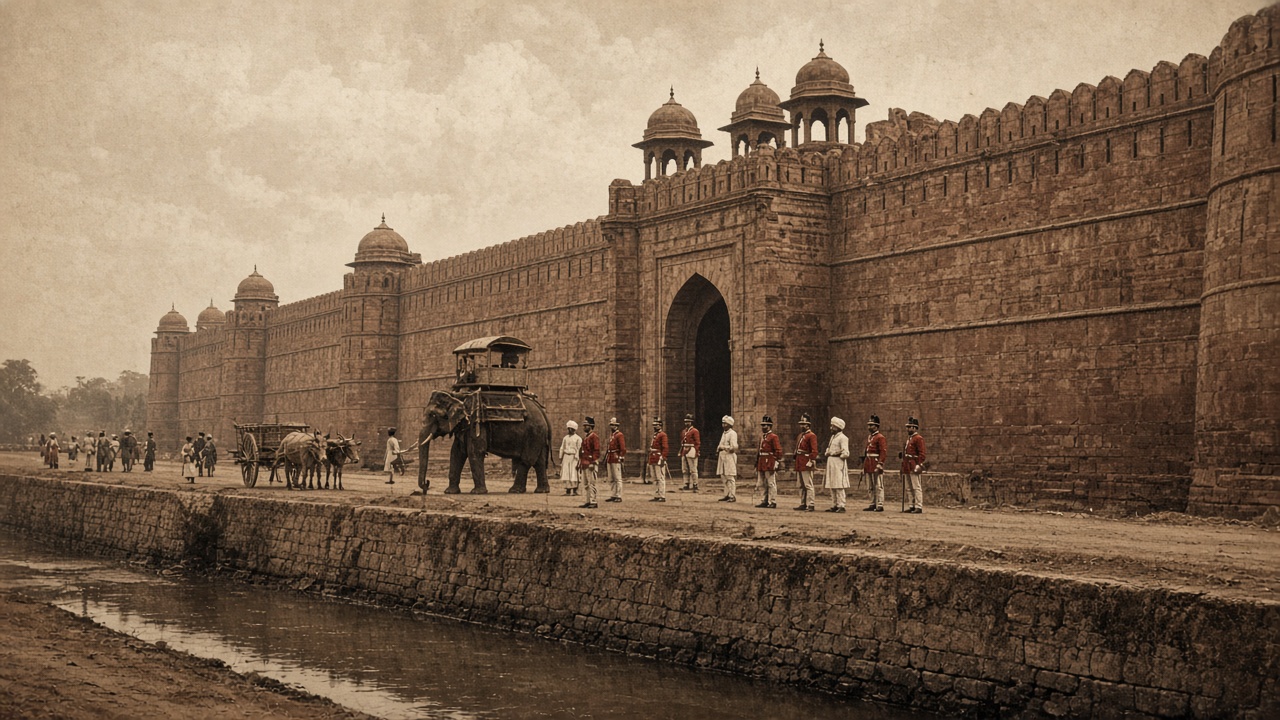
Company soldiers and sepoys outside the Red Fort in the last years of Mughal rule (artistic illustration).
1707–1739: Succession wars follow Aurangzeb’s death, Hyderabad, Bengal, and Awadh become largely independent, and Nader Shah of Persia sacks Delhi (1739), carrying off the Peacock Throne and the Koh-i-Noor diamond.
1757–1765: The East India Company wins at Plassey (1757), Ahmad Shah Abdali defeats the Marathas at the Third Battle of Panipat (1761), and after Buxar (1764) Shah Alam II grants the Company the revenue rights (diwani) of Bengal, Bihar, and Orissa (1765).
1803–1862: The British take Delhi (1803) and pension the emperor, the rebels of 1857 proclaim Bahadur Shah Zafar their leader, and after the revolt he is exiled to Rangoon (1858), where he dies in 1862.
1947–Today: India’s Prime Minister addresses the nation from the Red Fort every Independence Day, and the Taj Mahal and Agra Fort (1983), Fatehpur Sikri (1986), Humayun’s Tomb (1993), and the Red Fort (2007) become UNESCO World Heritage Sites.
Technology
Telegraph: Used against the 1857 rebels.
Photography: Recording Delhi in the 1850s.
Conservation: Restoring monuments.
Features
Regional powers: Marathas, Nizam, Awadh.
Company rule: Plassey to 1857.
Heritage: World Heritage Sites.
Mughal Emperors
Emperor
Reign
Known for
Babur
1526–1530
First Battle of Panipat, the Baburnama
Humayun
1530–1540, 1555–1556
Exile in Persia, return to Delhi
(Sher Shah Suri, Sur dynasty)
1540–1545
Rupiya coin, roads, and revenue reforms
Akbar
1556–1605
Expansion, mansabdari, sulh-i-kul, Fatehpur Sikri
Jahangir
1605–1627
Painting, gardens, Nur Jahan, the chain of justice
Shah Jahan
1628–1658
Taj Mahal, Red Fort, Peacock Throne
Aurangzeb (Alamgir)
1658–1707
Deccan conquests, greatest extent
Bahadur Shah I
1707–1712
Tried to make peace with Rajputs and Marathas
Muhammad Shah
1719–1748
Nader Shah’s sack of Delhi (1739)
Shah Alam II
1759–1806
Lost at Buxar, granted the diwani (1765)
Bahadur Shah Zafar
1837–1857
Poet, symbolic leader of 1857, exiled to Rangoon
How the Mughal Empire Was Run
System
What it meant
Mansabdari
Every officer held a numbered rank (mansab): zat for status and pay, sawar for the cavalry he kept
Jagir
Officers were paid with the revenue of assigned lands, usually moved every few years
Subahs
Provinces, each under a governor (subahdar), with separate finance officers
Zabt (dahsala) system
Land measured and tax set on average crops and prices of ten years, organised by Raja Todar Mal
Coinage
Silver rupiya, gold mohur, and copper dam of standard weight
Royal post (dak)
Relays of runners and riders carried letters and reports
News-writers
Officials who sent regular reports from the provinces to the court
Sulh-i-kul
Akbar’s policy of peace and tolerance towards all religions
Great Mughal Monuments
Monument
Place
Built
Known for
Humayun’s Tomb
Delhi
c. 1565–1572
First great garden tomb in India
Agra Fort
Agra
1565–1573 (rebuilt)
Red sandstone fort with later marble palaces
Fatehpur Sikri
Near Agra
c. 1571–1585
Akbar’s planned capital, Buland Darwaza
Akbar’s Tomb
Sikandra, Agra
c. 1605–1613
Tiered tomb with a grand gateway
Shalimar Bagh
Srinagar
1619
Terraced garden with water channels
Tomb of Itimad-ud-Daulah
Agra
c. 1622–1628
Marble tomb with inlay, the “Baby Taj”
Taj Mahal
Agra
c. 1632–1653
White marble tomb of Mumtaz Mahal
Red Fort
Delhi
1639–1648
Palace-fort of Shahjahanabad
Jama Masjid
Delhi
1650–1656
One of India’s largest mosques
Badshahi Mosque
Lahore
1671–1673
Huge mosque built by Aurangzeb
Bibi Ka Maqbara
Aurangabad
c. 1660s
Tomb modelled on the Taj Mahal
Art, Culture, and Learning
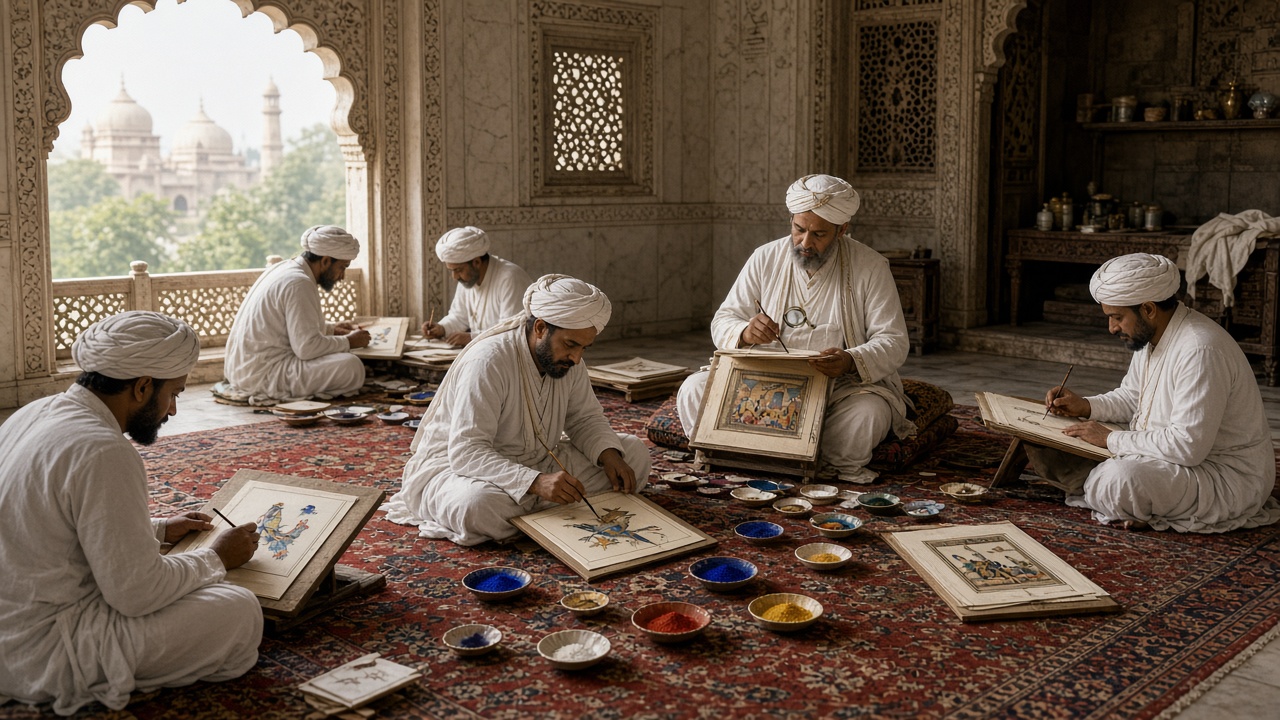
Court artists paint miniatures with fine brushes and mineral colours (artistic illustration).
Area
Highlights
Miniature painting
The Hamzanama (from c. 1562), illustrated histories, and nature studies under Jahangir
Books
The Baburnama, Akbarnama, Ain-i-Akbari, and Jahangir’s memoir
Translations
The Mahabharata translated into Persian as the Razmnama (1580s)
Music
Tansen and other musicians shaped Hindustani classical music
Language
Persian at court; Urdu grew from Hindavi, Persian, and Arabic words
Food
Mughlai cuisine such as biryani, kebabs, korma, and rich breads
Gardens
Charbagh gardens divided into four parts by water channels
Textiles
Fine muslins, silks, brocades, and Kashmir shawls
Jewellery
Jewelled daggers, jade cups, and the Peacock Throne
Trade, Cities, and Daily Life
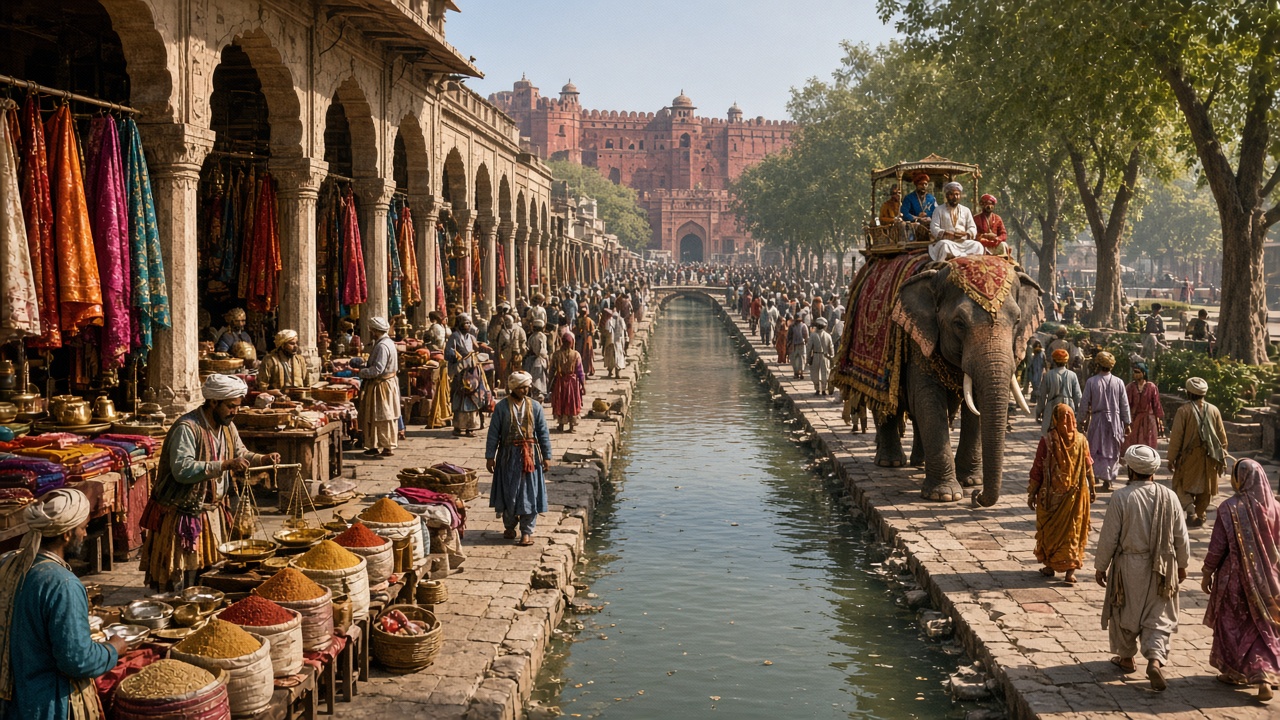
Merchants and shoppers crowd a canal-side bazaar leading to the Red Fort (artistic illustration).
Topic
Mughal India
Population
Perhaps 100–150 million people around 1600–1700 (estimates vary)
Exports
Cotton and silk cloth, indigo, saltpetre, sugar, and spices
Ports
Surat, Hooghly, Masulipatnam, and Lahari Bandar
European traders
Portuguese, then the English (from 1613 at Surat), Dutch, and French companies
Big cities
Agra, Delhi, Lahore, Dhaka, and Ahmedabad
Farming
Wheat, rice, cotton, sugarcane, and new crops such as maize, chilli, and tobacco from the Americas
Bazaars
Covered markets such as Chandni Chowk in Delhi
Clothing
Jama, patka, turban, and pyjama for men; peshwaz and odhni for women
Festivals
Eid, Nauroz, Diwali, and Holi celebrated at court
Games
Polo (chaugan), chess, pachisi, hunting, and pigeon flying
Mughal Civilization Timeline Summary
Year
Milestone
1526
First Battle of Panipat; Babur founds the empire
1527
Battle of Khanwa
1540
Humayun defeated at Kannauj; Sher Shah Suri rules
1555
Humayun retakes Delhi
1556
Akbar crowned; Second Battle of Panipat
1564
Jizya abolished
1571
Fatehpur Sikri begun
1576
Battle of Haldighati
c. 1580
Todar Mal’s revenue system and the subahs
1605
Jahangir becomes emperor
1613
English trading post at Surat
1628
Shah Jahan becomes emperor
c. 1632
Taj Mahal begun
1648
Red Fort completed
1658
Aurangzeb becomes emperor
1674
Shivaji crowned Chhatrapati
1687
Golconda conquered
1707
Death of Aurangzeb
1739
Nader Shah sacks Delhi
1757
Battle of Plassey
1765
Diwani granted to the East India Company
1857
Revolt; Bahadur Shah Zafar proclaimed leader
1858
Last emperor exiled; Mughal rule ends
Test Your Knowledge
20 quick questions from the Mughal civilization timeline. Click each question to reveal the answer.
Answer: Babur.
Answer: 1526.
Answer: Ibrahim Lodi.
Answer: The Baburnama.
Answer: Sher Shah Suri.
Answer: The rupiya.
Answer: Umerkot, in Sindh.
Answer: Hemu.
Answer: Sulh-i-kul.
Answer: Raja Todar Mal.
Answer: Fatehpur Sikri.
Answer: Abul Fazl.
Answer: Nur Jahan.
Answer: His wife, Mumtaz Mahal.
Answer: Shahjahanabad.
Answer: Bijapur and Golconda.
Answer: Shivaji.
Answer: Nader Shah.
Answer: Bahadur Shah Zafar.
Answer: Rangoon (Yangon), in Burma.
Classroom activity
Students Tasks
Use these prompts for discussion or projects on the Mughal Empire.
Make a timeline poster: 1526 Panipat, 1540 Sher Shah, 1556 Akbar, c. 1632 Taj Mahal begun, 1658 Aurangzeb, 1707 his death, 1739 Nader Shah, 1757 Plassey, and 1857 revolt.
On a map of India, mark Panipat, Agra, Fatehpur Sikri, Delhi, Lahore, Srinagar, Surat, Bijapur, Golconda, and Raigad.
Draw a family tree of the six Great Mughals from Babur to Aurangzeb.
Explain how the mansabdari system worked, using a simple chart of zat and sawar ranks.
Design a charbagh garden on paper, showing its four parts, water channels, and central pavilion.
Compare Sher Shah’s rupiya with today’s rupee: metal, weight, and who issues it.
Make a fact card for one monument: Humayun’s Tomb, Fatehpur Sikri, the Taj Mahal, or the Red Fort.
List ten Indian dishes, words, or clothes that show Mughal influence.
Write a diary entry as a merchant arriving at Surat in the 1620s.
Debate: “The Mughal Empire declined mainly because of Aurangzeb’s Deccan wars.”
Continue exploring
The Mughal story connects to the history of the rupee, roads, clothing and fashion, and India’s gardens and horticulture. Explore these connected timelines next.
Click any panel to expand and explore the visual mood.
The Mughal world in pictures — cannons at Panipat, a highway sarai, a debate at Fatehpur Sikri, a Kashmir garden, court painters, a Delhi bazaar, a Deccan war camp, the Red Fort in the 1850s, and the Taj Mahal then versus now.
Panipat 1526
Cannons & cavalry
Highway Sarai
Sher Shah’s roads
Akbar’s Court
Fatehpur Sikri
Mughal Garden
Kashmir
Court Painters
Miniatures
Delhi Bazaar
Shahjahanabad
Deccan Camp
Aurangzeb’s wars
Red Fort 1850s
Last years
Then vs Now
Scaffold to icon
Explore all civilizations timelines
Jump to any other civilizations timeline on WorldTimelineHub.
Disclaimer: This content is AI-generated for educational purposes and may contain errors or outdated details. For correct and authoritative information, please refer to official and reliable sources such as government publications, manufacturers, museums, and academic references.