Ancient Greek Civilization Timeline: Minoans & Mycenaeans → Archaic Greece → Golden Age → Philosophers → Alexander & Hellenistic Age → Legacy
On rocky peninsulas and islands around the Aegean Sea, the ancient Greeks built palaces, then hundreds of independent city-states. They invented democracy, theatre, and the Olympic Games, asked big questions in philosophy
and science, and — through Alexander the Great — spread Greek culture from Egypt to the edge of India. Their ideas still shape how the world thinks, builds, and governs.
This timeline covers the Cycladic islands, Minoan Knossos, Mycenae and Linear B, the Bronze Age collapse, Homer and the alphabet, the first Olympics, colonies, Solon and Cleisthenes, Sparta, Marathon, Thermopylae and Salamis,
Pericles and the Parthenon, the Peloponnesian War, Socrates, Plato and Aristotle, Philip and Alexander, Euclid and Archimedes, Roman and Byzantine Greece, the War of Independence, and the modern Olympics.
776 BCE First Olympics → 508 BCE Democracy480 BCE Salamis → 432 BCE Parthenon326 BCE Alexander in India → 1896 Athens Olympics
Why Ancient Greece Matters
Ancient Greece was never a single country, yet its small, competitive city-states produced an extraordinary burst of ideas. Greeks were among the first to let ordinary citizens vote on laws, to write critical history, to
stage tragedy and comedy, and to explain nature through reason and mathematics rather than myth alone. Rome, Byzantium, the Islamic world, and Renaissance Europe all learned from Greek books, and Greek words fill our science and politics today.
Big picture
Ancient Greece in one view
Bronze Age palaces on Crete and the mainland collapsed around 1100 BCE, city-states and the alphabet rose in the Archaic age, Athens and Sparta beat Persia and Athens enjoyed a golden age, the Peloponnesian War and the great
philosophers followed, Alexander carried Greek culture across Asia, and Greece then lived on under Rome, Byzantium, and the Ottomans until independence. Related timelines:
history of education,
fitness and sport,
maps.
776 BCE
First Olympic Games (traditional date)
508 BCE
Democracy begins in Athens
1,000+
Independent city-states (estimate)
24
Letters in the classical Greek alphabet
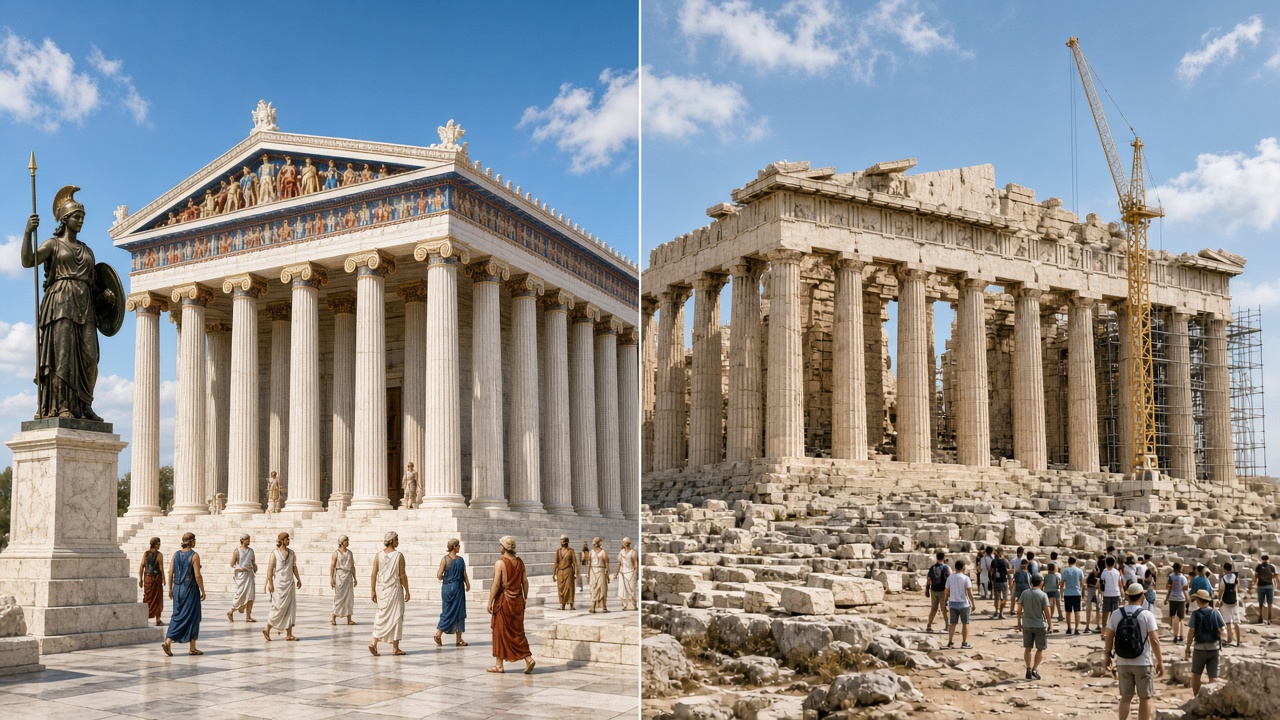
The Parthenon reimagined with its painted sculptures around 430 BCE, and under restoration today (artistic illustration).
Ancient Greece Then vs Greece Now
Feature
Ancient Greece (c. 430 BCE)
Greece today
Country
Hundreds of independent city-states
One nation, the Hellenic Republic
Government
Athens: direct democracy of male citizens; Sparta: two kings and a council
Parliamentary republic with votes for all adults
Language
Ancient Greek in several dialects
Modern Greek, written in the same 24-letter alphabet
Religion
Olympian gods such as Zeus, Athena, and Apollo
Mostly Greek Orthodox Christian
Athens
A few hundred thousand people in Athens and Attica (estimated)
About 3.7 million in the Athens area
Games
Olympic Games at Olympia for Greek men
Modern Olympics for men and women worldwide
Medicine
Hippocrates and healing temples of Asclepius
Modern hospitals; doctors still take versions of the Hippocratic Oath
Theatre
Open-air drama festivals for the god Dionysus
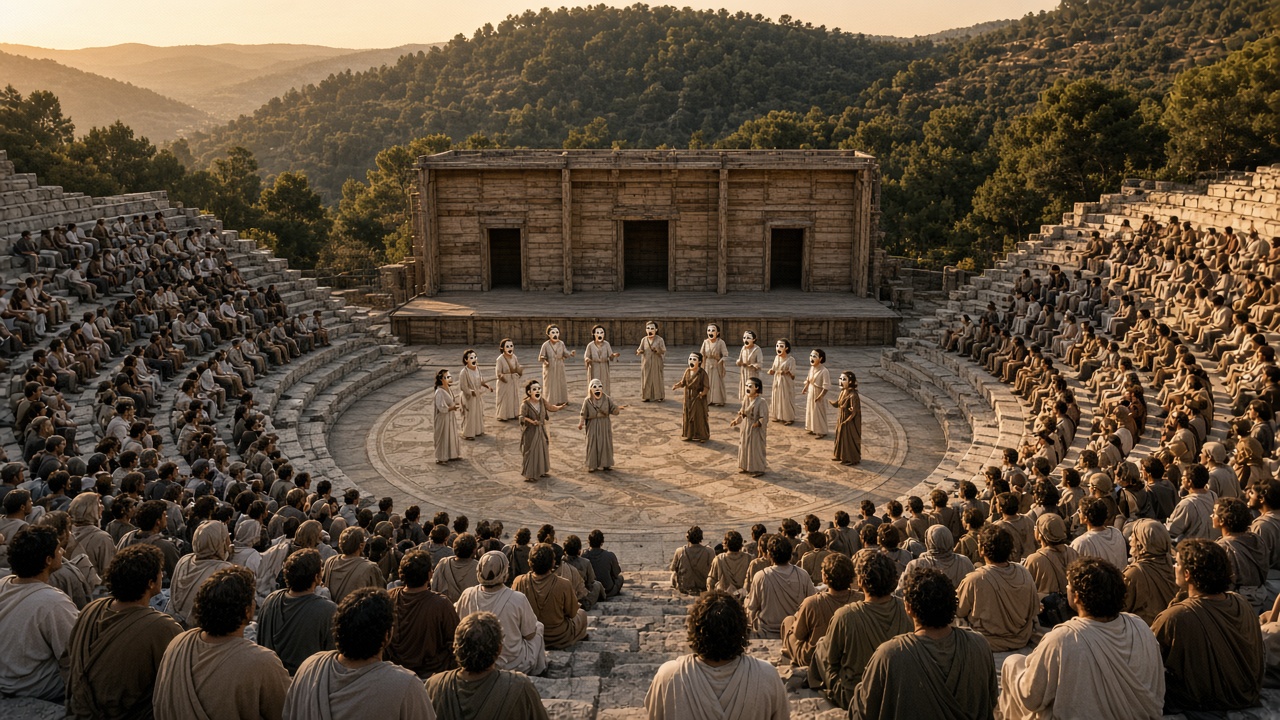
Ancient theatres such as Epidaurus still host summer plays
Ships
Oared triremes and merchant sailing ships
One of the world’s largest merchant shipping fleets
Money
Silver drachma coins, such as the Athenian “owls”
The euro (since 2002)
🐂 Minoans & Mycenaeansc. 3200 – 1100 BCE
Minoans & Mycenaeans
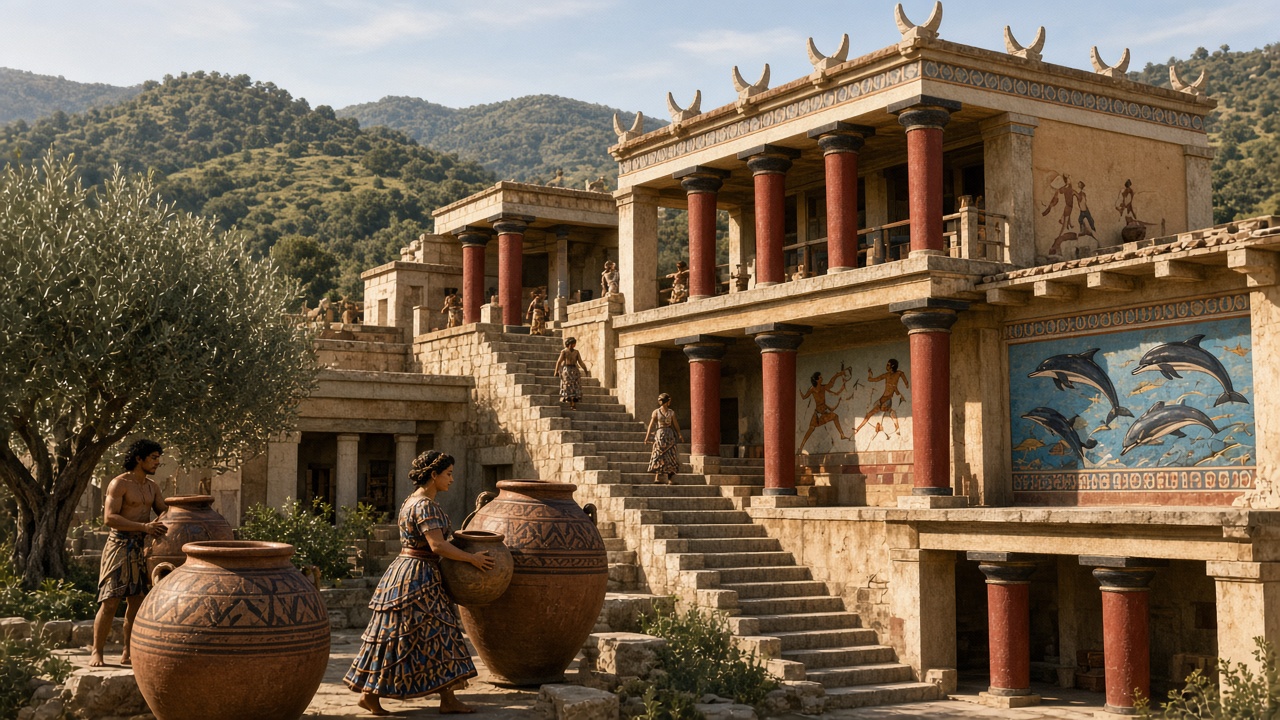
In the Bronze Age, the Minoans of Crete built great palaces decorated with colourful frescoes and traded across the sea. Later, warrior kings at Mycenae and other mainland citadels took over Crete and wrote an early form of Greek. Around 1200–1100 BCE their palaces were destroyed and writing disappeared.
The palace of Knossos with its red columns and dolphin frescoes (artistic illustration).
c. 3200–2000 BCE: Early Bronze Age peoples farm and trade in the Aegean, and Cycladic islanders carve elegant white marble figurines.
c. 2000–1450 BCE: The Minoans build palaces at Knossos, Phaistos, and Malia, use the still-undeciphered Linear A script, and the volcano of Thera (Santorini) erupts around 1600 BCE.
c. 1600–1250 BCE: Mycenaean kings are buried with gold masks, take control of Knossos around 1450 BCE, write Greek in Linear B, and build the Lion Gate at Mycenae around 1250 BCE.
c. 1200–1100 BCE: Mycenaean palaces are destroyed in the wider Bronze Age collapse, and later Greeks remember this age in stories of the Trojan War.
Technology
Bronze: Copper and tin tools and weapons.
Frescoes: Painting on wet plaster.
Linear B: Earliest written Greek.
Features
Palaces: Centres of trade and storage.
Sea trade: Egypt to the Levant.
Collapse: Around 1200–1100 BCE.
🏺 Archaic Greecec. 1100 – 490 BCE
Dark Age & Archaic Greece
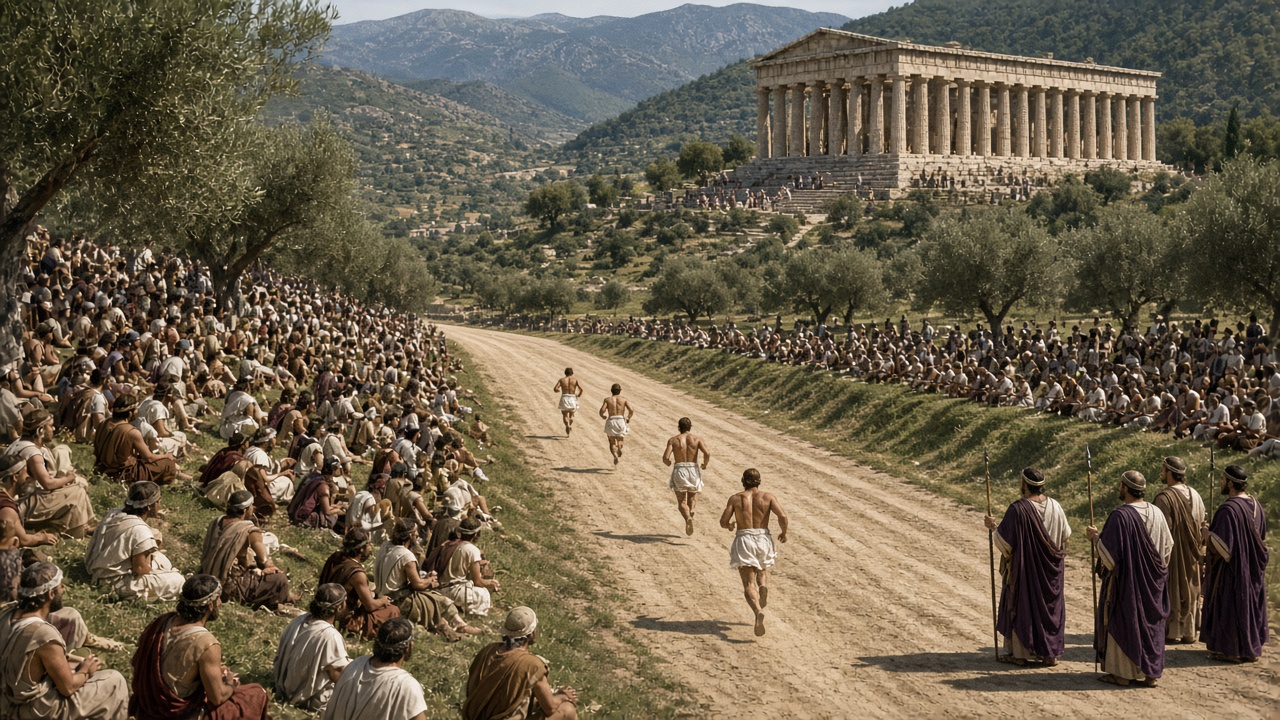
After the collapse, Greece became poorer and writing was forgotten for centuries. From about 800 BCE, towns grew into independent city-states, Greeks adopted an alphabet, and Homer’s epics were written down. Greek colonies spread around the Mediterranean and Black Sea, and Athens took its first steps towards democracy.
Runners race before crowds and judges at a festival like the Olympic Games (artistic illustration).
c. 1100–800 BCE: In the Greek Dark Age, people use iron, live in small villages, and decorate pottery with geometric patterns.
c. 800–700 BCE: Greeks adapt the Phoenician alphabet and add vowels, the first Olympic Games are held at Olympia (776 BCE, traditional date), and Homer’s Iliad and Odyssey take shape.
c. 750–550 BCE: City-states found colonies from Spain and southern France to Sicily, southern Italy, Libya, and the Black Sea, and Sparta builds a strict military society.
594–508 BCE: Solon reforms the laws of Athens (594 BCE), thinkers such as Thales and Pythagoras ask how nature works, and Cleisthenes’ reforms (508–507 BCE) found Athenian democracy.
Technology
Alphabet: With letters for vowels.
Coins: Spread from Lydia.
Hoplite armour: Bronze shield and spear.
Features
City-states: Each with its own laws.
Colonies: Across the Mediterranean.
Democracy: Born in Athens.
🛡️ Golden Age490 – 431 BCE
Persian Wars & the Golden Age
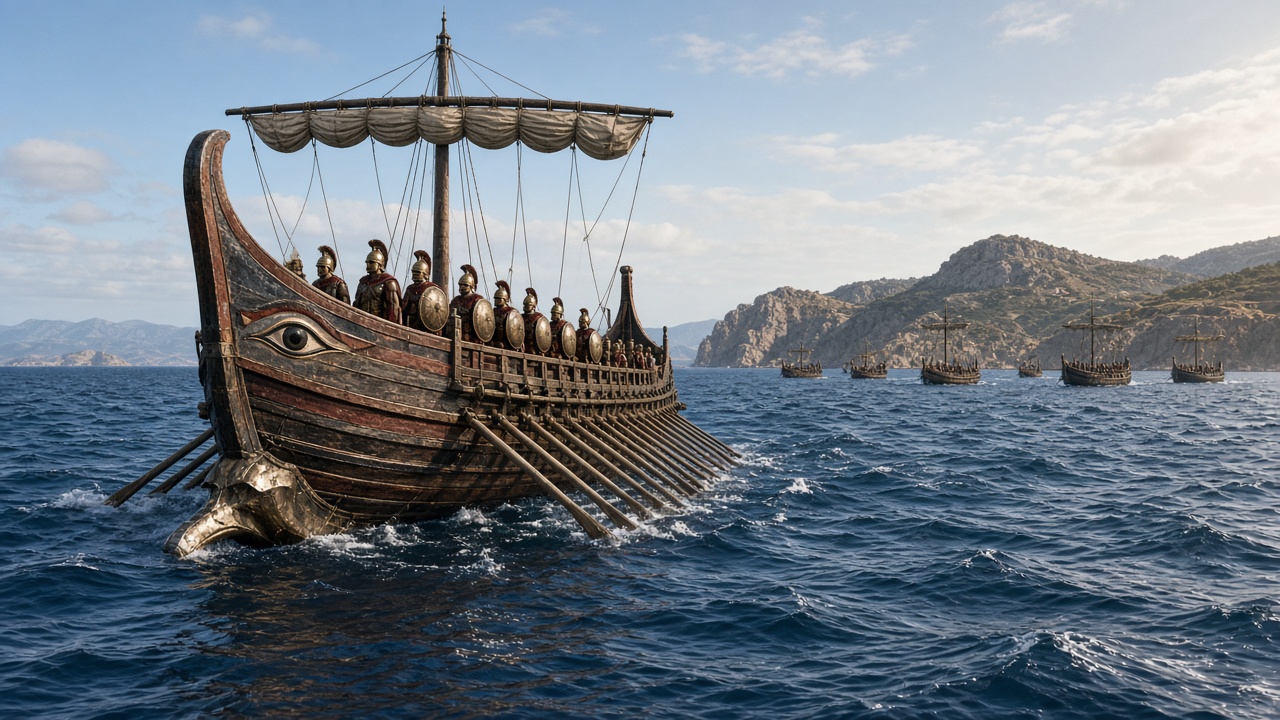
Twice the mighty Persian Empire invaded Greece, and twice the outnumbered Greek city-states drove it back. Victory made Athens the leader of a naval alliance and paid for a golden age under Pericles, when the Parthenon rose on the Acropolis and drama, history writing, and art flourished.
A Greek trireme with a bronze ram and painted eye rows into battle (artistic illustration).
499–490 BCE: Greek cities in Ionia revolt against Persia, and the Athenians defeat the first Persian invasion at Marathon (490 BCE).
480–479 BCE: King Xerxes invades, Leonidas and his Spartans make their stand at Thermopylae, Themistocles’ fleet wins at Salamis, and the Greeks win on land at Plataea.
478–447 BCE: Athens leads the Delian League against Persia, gradually turning it into an Athenian empire, and Pericles becomes the city’s leading figure from about 461 BCE.
447–432 BCE: The Parthenon is built on the Acropolis, Aeschylus, Sophocles, and Euripides write tragedies, and Herodotus writes his history of the Persian Wars.
Technology
Trireme: Warship with three banks of oars.
Marble temples: Precise Doric design.
Silver mining: Laurion mines fund the fleet.
Features
Persia defeated: Marathon to Plataea.
Athenian power: The Delian League.
Golden age: Pericles and the Parthenon.
🦉 Philosophers431 – 336 BCE
Peloponnesian War & the Philosophers
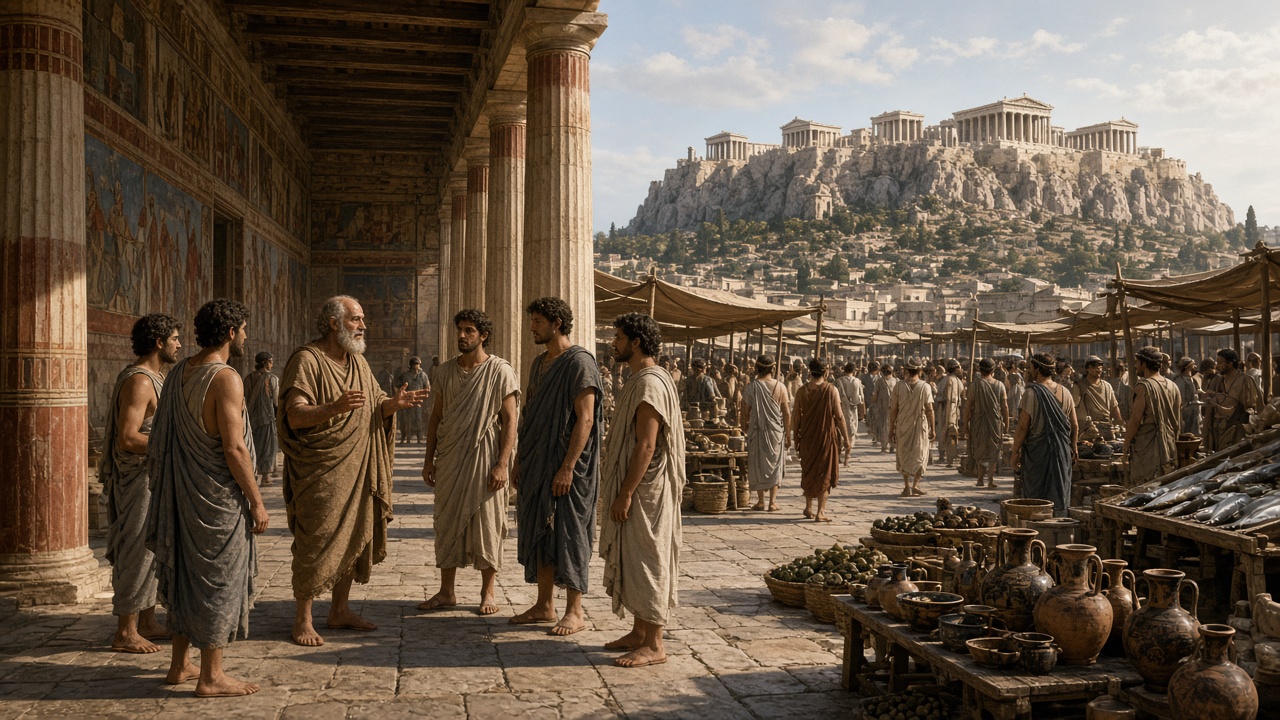
Rivalry between Athens and Sparta exploded into a long war that exhausted Greece. Yet this troubled age produced Socrates, Plato, and the physician Hippocrates. In the end, the city-states were overshadowed by a new power from the north, Macedon, under King Philip II.
A philosopher questions young Athenians in the agora below the Acropolis (artistic illustration).
431–429 BCE: The Peloponnesian War between Athens and Sparta begins, and a deadly plague strikes crowded Athens, killing Pericles in 429 BCE.
415–404 BCE: A huge Athenian expedition to Sicily ends in disaster (413 BCE), Sparta builds a fleet with Persian money, and Athens surrenders in 404 BCE.
399–387 BCE: Socrates is tried and sentenced to death by drinking hemlock (399 BCE), and his student Plato founds the Academy in Athens around 387 BCE.
371–336 BCE: Thebes defeats Sparta at Leuctra (371 BCE), Philip II of Macedon defeats Athens and Thebes at Chaeronea (338 BCE), and Philip is assassinated in 336 BCE.
Technology
Hippocratic medicine: Observing the patient.
Sarissa: Macedonian long pike.
Torsion catapults: Early siege engines.
Features
Athens vs Sparta: 27 years of war.
Philosophy: Socrates and Plato.
Rise of Macedon: Philip II.
🐎 Alexander & Hellenistic336 – 146 BCE
Alexander & the Hellenistic Age
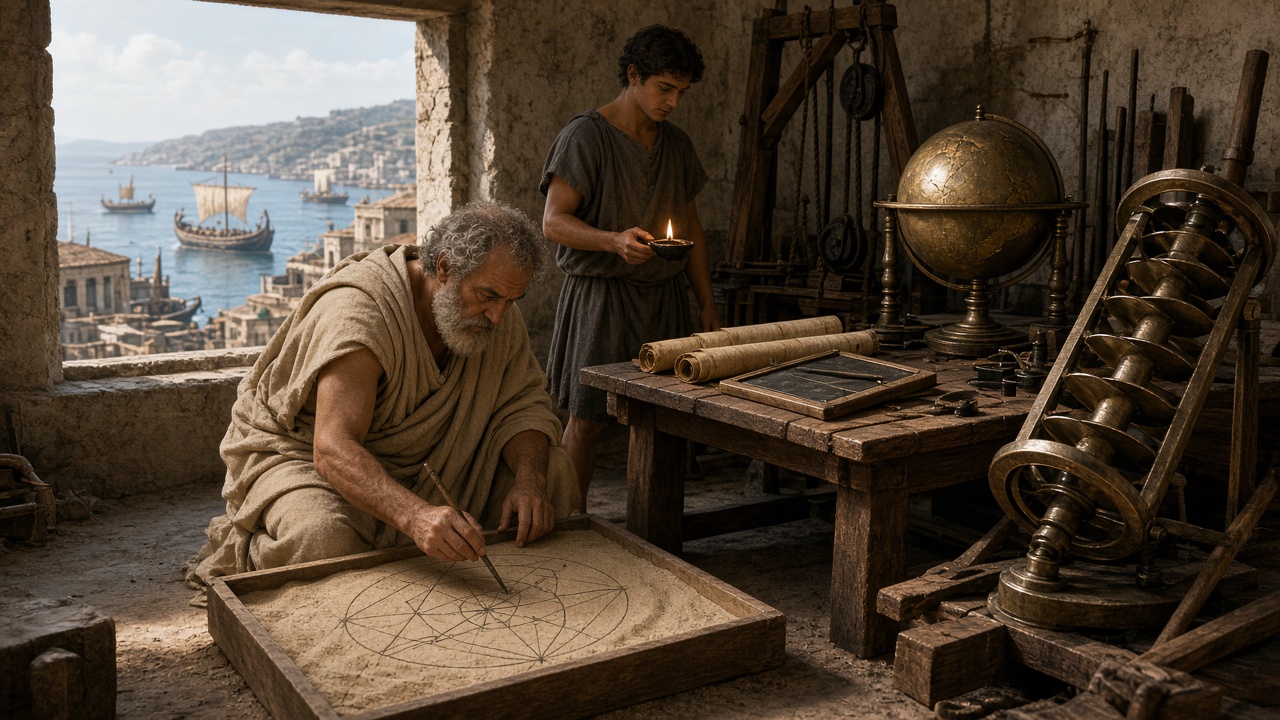
Philip’s son Alexander conquered the Persian Empire and marched as far as north-western India before dying at 32. His generals divided his empire into kingdoms ruled by Greek-speaking dynasties, and Greek culture mixed with Egyptian, Persian, and Indian traditions. Scholars made great advances in mathematics, astronomy, and engineering.
A mathematician draws geometry in sand beside a water screw, like Archimedes in Syracuse (artistic illustration).
336–331 BCE: Alexander becomes king, crosses into Asia (334 BCE), takes Egypt, and defeats the Persian king Darius III at Gaugamela (331 BCE), while Aristotle opens the Lyceum in Athens (335 BCE).
326–323 BCE: Alexander defeats King Porus at the Hydaspes (Jhelum) river in India (326 BCE), his army refuses to go beyond the Beas, and he dies in Babylon in 323 BCE.
c. 305–200 BCE: The Ptolemaic, Seleucid, and Antigonid kingdoms rise, Megasthenes visits Chandragupta Maurya’s court, Euclid writes the Elements, and Eratosthenes estimates the Earth’s size.
c. 250–146 BCE: Archimedes works in Syracuse, Indo-Greek kings rule parts of north-western India, and Rome defeats Macedon and destroys Corinth (146 BCE), bringing Greece under Roman control.
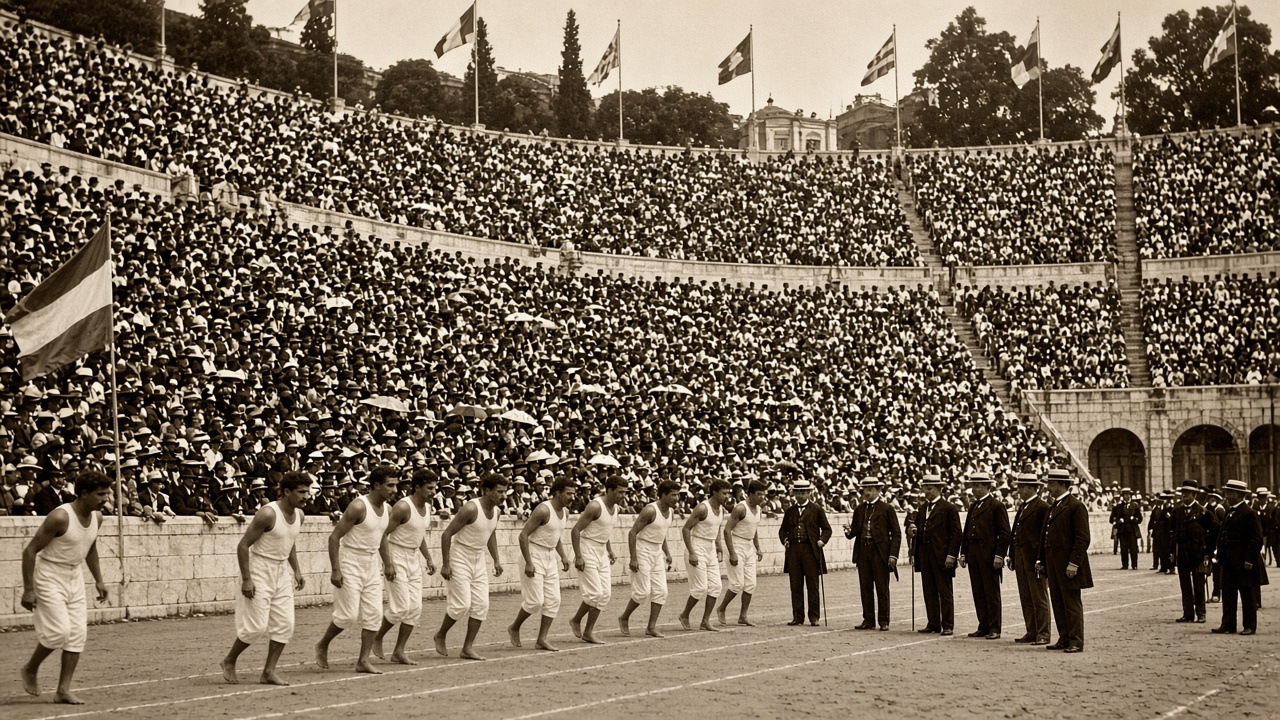
Rome conquered Greece but adopted Greek art, philosophy, and gods. Greek remained the main language of the eastern Mediterranean and of the Byzantine Empire for over a thousand years. After almost four centuries of Ottoman rule, Greece won independence, archaeologists uncovered its past, and Athens revived the Olympic Games.
Runners line up in the marble stadium of Athens at the first modern Olympics in 1896 (artistic illustration).
146 BCE–393 CE: Under Rome, Greek art and learning are admired and copied, the New Testament is written in Greek, and the ancient Olympic Games end in the late 4th century CE.
330–1453: Greek-speaking Byzantium preserves ancient texts in Constantinople until the Ottoman conquest of 1453, and Byzantine scholars later carry Greek books to Renaissance Italy.
1821–1900: Greeks rise against Ottoman rule (1821) and win recognition of independence (1830), Heinrich Schliemann digs at Troy and Mycenae (1870s), and Athens hosts the first modern Olympics (1896).
1900–Today: Arthur Evans excavates Knossos (from 1900), Michael Ventris deciphers Linear B (1952), Athens hosts the Olympics again (2004), and the new Acropolis Museum opens (2009).
Technology
Codex copies: Byzantine manuscripts.
Codebreaking: Decipherment of Linear B.
Restoration: Rebuilding the Acropolis.
Features
Greek East: Language of Byzantium.
Independence: Recognised in 1830.
Olympic revival: Athens, 1896.
Athens vs Sparta
Feature
Athens
Sparta
Government
Direct democracy: an assembly of male citizens voted on laws
Two kings, a council of elders, and five elected ephors
Economy
Trade, silver mines, crafts, and a large navy
Farming done by helots (state-owned serfs)
Education
Boys of citizen families learned reading, music, and athletics
Boys trained for war in the harsh agoge from age seven
Women
Mostly kept at home, with few public rights
More freedom; could own land and did athletics
Military
Strongest at sea, with a fleet of triremes
Strongest on land, with full-time hoplite soldiers
Known for
Philosophy, theatre, and the Parthenon
Discipline, courage, and Thermopylae
Famous Ancient Greeks
Person
Approximate time
Known for
Homer
c. 8th century BCE
Epic poems the Iliad and the Odyssey
Sappho
c. 630–570 BCE
Lyric poet from the island of Lesbos
Thales
c. 624–546 BCE
Early philosopher who explained nature without myths
Pythagoras
c. 570–495 BCE
Mathematics and the theorem named after him
Pericles
c. 495–429 BCE
Leader of Athens in its golden age
Herodotus
c. 484–425 BCE
“Father of history”
Socrates
c. 470–399 BCE
Teaching by asking questions
Hippocrates
c. 460–370 BCE
“Father of medicine”
Plato
c. 428–348 BCE
The Academy and The Republic
Aristotle
384–322 BCE
Logic, biology, politics; tutor of Alexander
Alexander the Great
356–323 BCE
Empire from Greece to India
Euclid
c. 300 BCE
Geometry in the Elements
Archimedes
c. 287–212 BCE
Levers, buoyancy, and the water screw
Eratosthenes
c. 276–194 BCE
Estimated the circumference of the Earth
Theatre, Art, and Architecture
A masked chorus performs before a packed hillside theatre (artistic illustration).
Item
Date
Why it matters
Black-figure pottery
From c. 700 BCE
Black figures painted on red clay
Red-figure pottery
From c. 530 BCE
Red figures on a black background, with finer detail
Doric and Ionic columns
From c. 600 BCE
Styles still used in buildings today
Corinthian column
From c. 430 BCE
Decorated with carved acanthus leaves
Tragedy
5th century BCE
Aeschylus, Sophocles, and Euripides
Comedy
5th century BCE
Aristophanes mocked politicians and philosophers
Parthenon
447–432 BCE
Temple of Athena, sculpture under Phidias
Theatre of Epidaurus
Late 4th century BCE
About 13,000 seats and famous acoustics
Statue of Zeus at Olympia
c. 435 BCE
Wonder of the Ancient World by Phidias
Colossus of Rhodes
c. 280 BCE
Giant bronze statue, a Wonder of the Ancient World
Daily Life in Ancient Greece
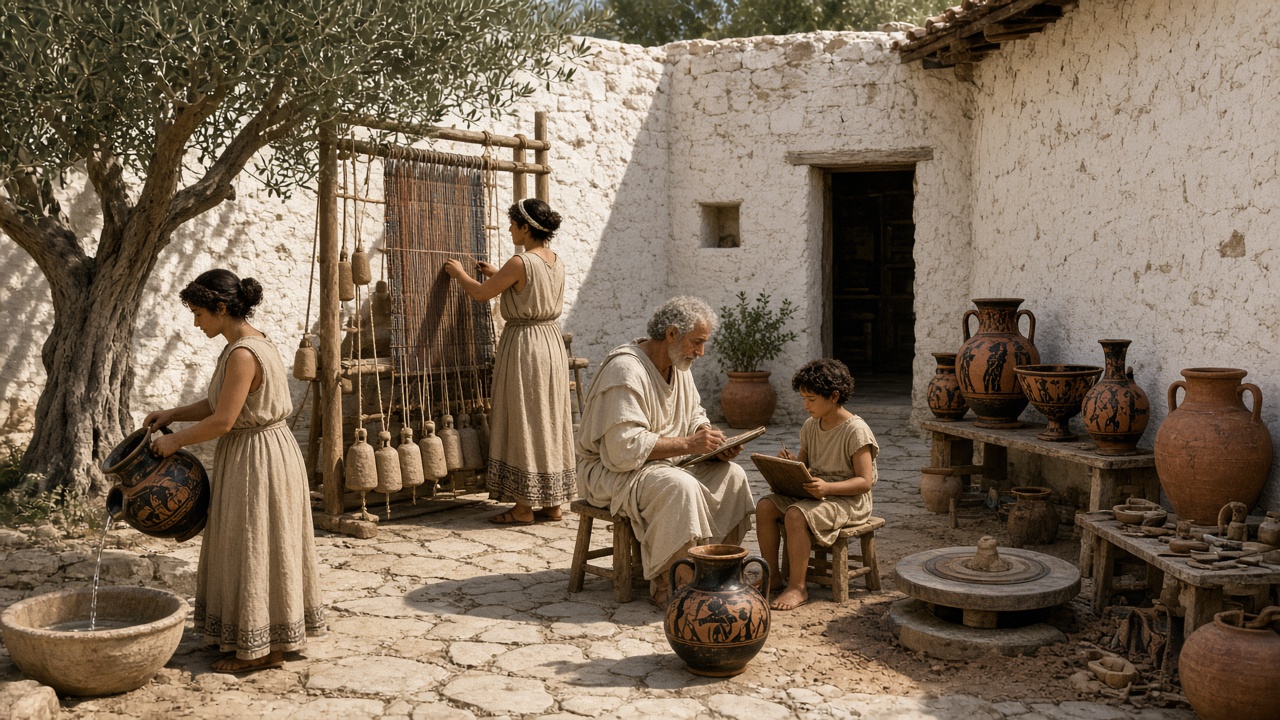
Women weave and fetch water while a tutor teaches a boy his letters (artistic illustration).
The chiton (tunic) and himation (cloak), made of wool or linen
School
Boys learned letters, Homer, music, and athletics, often with a private tutor
Women
Ran the household, spun and wove cloth, and took part in religious festivals
Slavery
Enslaved people worked in homes, farms, workshops, and mines
Symposium
Evening drinking party for men, with poetry, music, and debate
Religion
Olympian gods, temple sacrifices, and festivals
Oracles
People asked the god Apollo for advice at Delphi
Sport
Running, wrestling, boxing, discus, and javelin at the gymnasium
Greek Legacy in the Modern World
Greek idea
Where we see it today
Democracy
Citizens voting on how they are governed
Olympic Games
The modern Olympics, the torch relay, and the marathon race
Philosophy and logic
University subjects, ethics, and scientific reasoning
Geometry
School mathematics, engineering, and architecture
Medicine
The Hippocratic Oath and medical words such as diagnosis
Theatre
Tragedy, comedy, and the shape of modern theatres
Greek alphabet
Source of the Latin and Cyrillic alphabets; letters such as π and Δ in science
Columns and temples
Museums, parliaments, courts, and banks in classical style
Greek words
Democracy, history, geography, biology, telephone, and many more
Ancient Greek Civilization Timeline Summary
Year / Era
Milestone
c. 2000 BCE
Minoan palaces built on Crete
c. 1450 BCE
Mycenaeans at Knossos; Linear B
c. 1200–1100 BCE
Bronze Age palaces destroyed
c. 800 BCE
Greek alphabet
776 BCE
First Olympic Games (traditional)
594 BCE
Solon’s reforms in Athens
508–507 BCE
Cleisthenes founds democracy
490 BCE
Battle of Marathon
480 BCE
Thermopylae and Salamis
447–432 BCE
Parthenon built
431–404 BCE
Peloponnesian War
399 BCE
Death of Socrates
c. 387 BCE
Plato’s Academy
338 BCE
Philip II wins at Chaeronea
326 BCE
Alexander defeats Porus in India
323 BCE
Death of Alexander
c. 300 BCE
Euclid’s Elements
146 BCE
Rome destroys Corinth
1821
Greek War of Independence begins
1830
Independence recognised
1896
First modern Olympics in Athens
1952
Linear B deciphered
2004
Athens hosts the Olympics again
Test Your Knowledge
20 quick questions from the ancient Greek civilization timeline. Click each question to reveal the answer.
Answer: Crete.
Answer: Knossos.
Answer: Linear B.
Answer: Homer.
Answer: 776 BCE.
Answer: A polis.
Answer: Cleisthenes.
Answer: Marathon.
Answer: Leonidas.
Answer: Salamis.
Answer: Athena.
Answer: Athens and Sparta.
Answer: Socrates.
Answer: Plato.
Answer: Hippocrates.
Answer: Aristotle.
Answer: King Porus.
Answer: Euclid.
Answer: 1821.
Answer: Athens.
Classroom activity
Students Tasks
Use these prompts for discussion or projects on ancient Greek civilization.
Timeline understandingWorld historyMap skillsCivics and democracy
Make a timeline poster: 776 BCE first Olympics, 508 BCE democracy, 490 BCE Marathon, 480 BCE Salamis, 432 BCE Parthenon, 399 BCE Socrates, 326 BCE Alexander in India, and 1896 modern Olympics.
On a map, mark Crete, Mycenae, Athens, Sparta, Olympia, Delphi, Marathon, Thermopylae, Macedon, and the Hydaspes (Jhelum) river.
Write your name using Greek letters.
Hold a class assembly like Athens: debate a school rule and decide it by a show of hands.
Make a chart comparing life in Athens and Sparta for a child your age.
Draw Doric, Ionic, and Corinthian columns and find a building near you that uses one of them.
Explain how Eratosthenes estimated the size of the Earth using shadows.
Find ten English words that come from Greek and give their meanings.
Compare ancient Greece with ancient Rome: government, gods, buildings, and legacy.
Debate: “Athenian democracy was not a true democracy because most people could not vote.”
Continue exploring
Greece’s story connects to the history of schools and learning, sport and fitness, medicine, and maps. Explore these connected timelines next.
Click any panel to expand and explore the visual mood.
Ancient Greece in pictures — the palace of Knossos, a festival footrace, a trireme, a philosopher in the agora, a mathematician’s workshop, a hillside theatre, family life, the 1896 Olympics, and the Parthenon then versus now.
Knossos
Minoan Crete
Festival Race
Olympia
Trireme
Salamis, 480 BCE
The Agora
Philosophers
Mathematician
Hellenistic science
Theatre
Masks & chorus
Family Life
Loom & lessons
Athens 1896
Olympic revival
Then vs Now
Painted to weathered
Explore all civilizations timelines
Jump to any other civilizations timeline on WorldTimelineHub.
Disclaimer: This content is AI-generated for educational purposes and may contain errors or outdated details. For correct and authoritative information, please refer to official and reliable sources such as government publications, manufacturers, museums, and academic references.