In 1850 a single telegraph wire carried Morse code messages from Calcutta to Diamond Harbour. For more than a century, a phone call meant waiting for an operator,
and a telegram meant urgent news. Today India has more than 115 crore telephone connections and one of the world’s largest and cheapest mobile data markets.
This timeline covers the first telegraph lines, undersea cables, the Indian Telegraph Act, the first telephone exchanges, wireless telegraphy, manual switchboards,
trunk calls, telex, satellites, C-DOT, MTNL and VSNL, STD booths, mobile phones, TRAI, BSNL, the end of the telegram, 4G, 5G, and the Telecommunications Act, 2023.
Telecommunication means sending messages over a distance using electricity, radio, or light. In India it began as a government monopoly for running the empire,
grew into the Posts and Telegraphs Department that connected families and businesses, and became one of the world’s most competitive mobile markets.
Telecom now carries phone calls, internet data, digital payments, online classes, and emergency alerts to almost every corner of the country.
Big picture
India’s telecom journey in one view
Telecom moved from Morse code telegraph lines and undersea cables, to operator-run switchboards and slow trunk calls, to Indian-made digital exchanges and roadside
STD booths, to mobile phones in every pocket, and finally to cheap 4G data, 5G networks, and satellite links. Related timelines:
postal system,
mobile phones,
Digital India.
1850
First telegraph line
1882
First telephone exchanges
163 years
Of telegram service (ended 2013)
115 crore+
Telephone connections
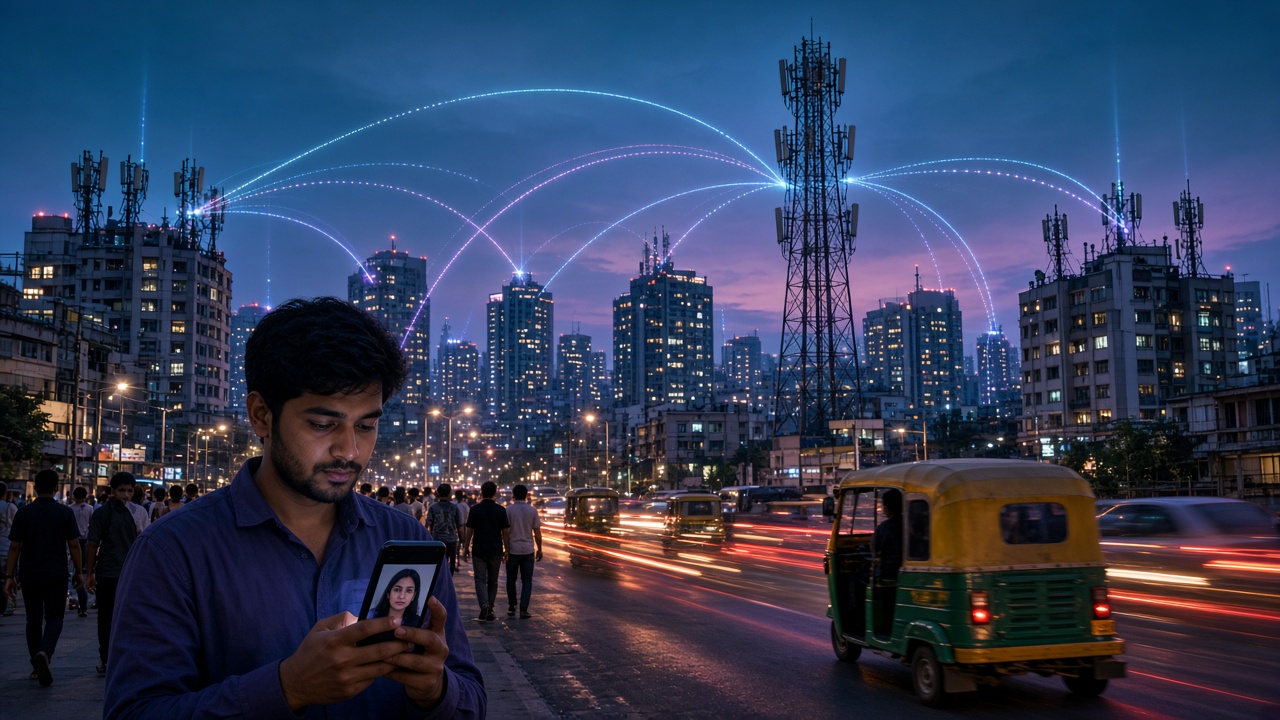
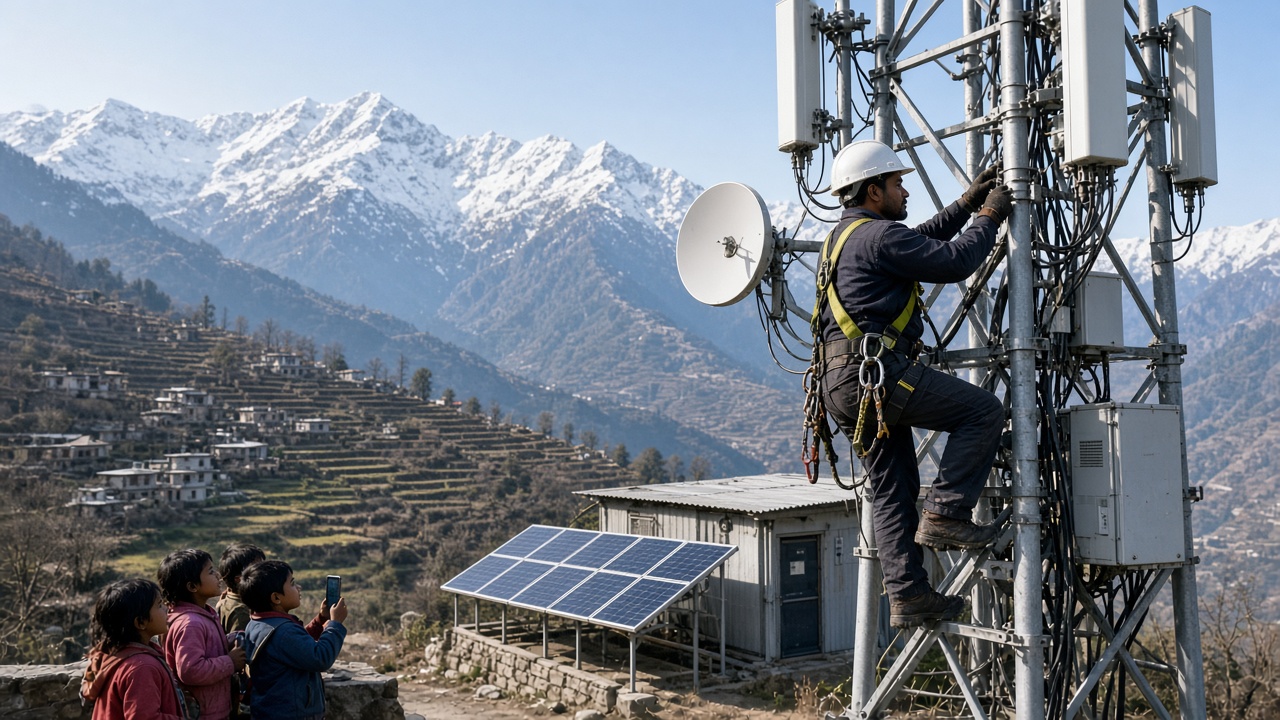
Mobile towers now carry voice, video, and data to crores of smartphones (artistic illustration).
📟 Telegraph1850 – 1901
Telegraph & First Telephones
India’s first telegraph line was tested in 1850, and within a few years wires linked the major cities of the subcontinent. Undersea cables connected India to Britain, a telegraph law gave the government control, and the first telephone exchanges opened in the presidency towns.
Telegraph clerks sent messages in Morse code as dots and dashes along the wires (artistic illustration).
1850–1851: William O’Shaughnessy sets up an experimental telegraph line from Calcutta to Diamond Harbour; the East India Company starts using it in 1851.
1853–1857: Telegraph lines link Calcutta, Agra, Bombay, Madras, and Peshawar; public telegraph service opens (1855); telegraph messages play a key role during the 1857 uprising.
1870: A submarine cable links Bombay with Britain via the Red Sea, cutting message time from weeks to hours.
1882–1885: Telephone exchanges open in Calcutta, Bombay, and Madras (January 1882); the Indian Telegraph Act, 1885 gives the government exclusive rights over telegraphs and telephones.
Technology
Morse code: Letters sent as dots and dashes.
Overhead wires: Iron wires on wooden and iron poles.
Submarine cables: Insulated cables under the sea.
Features
Empire’s nerves: Orders and news in hours, not weeks.
Pay per word: Short, costly telegram messages.
Few telephones: Only offices and wealthy homes.
📡 Wireless1902 – 1946
Wireless, Automatic Exchanges & Radio Links
Wireless telegraph stations began sending messages without wires, the first automatic exchange opened in Shimla, and radio links connected India directly with Britain. Most calls, however, still went through operators at manual switchboards.
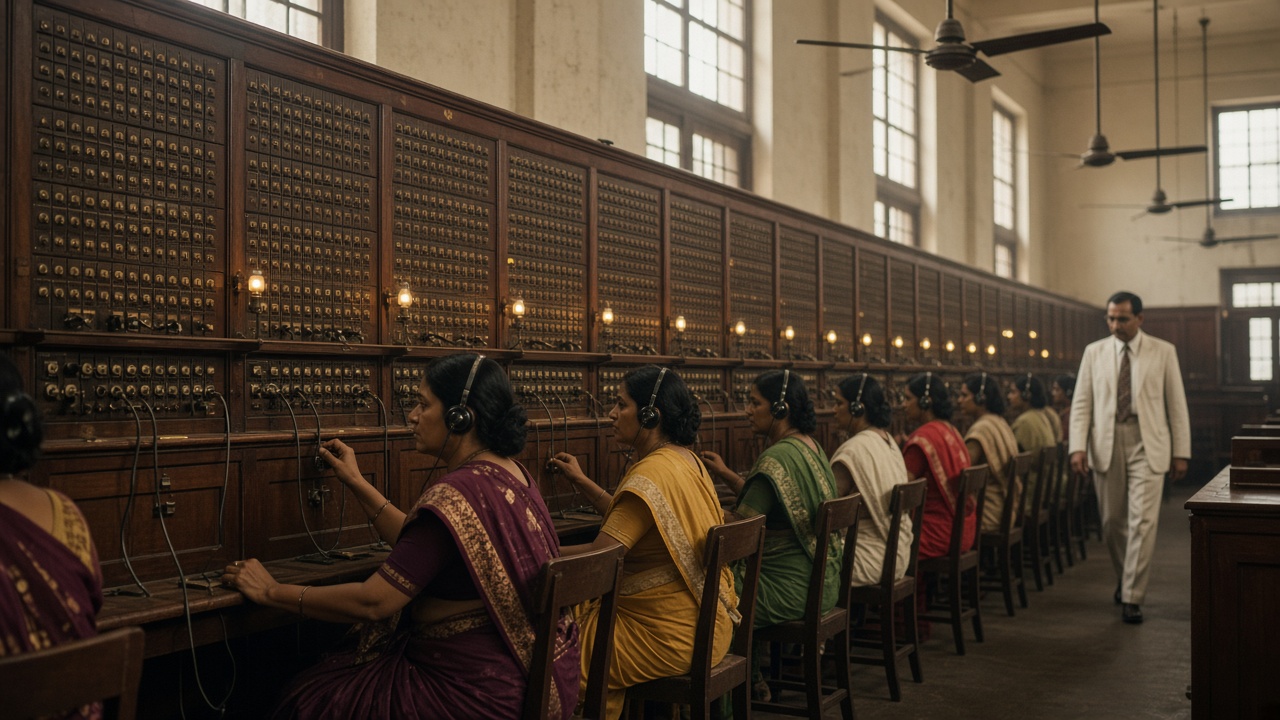
Switchboard operators connected each call by hand with patch cords (artistic illustration).
1902: Wireless telegraph stations are set up between Sagar Island and Sandheads in the Bay of Bengal.
1913–1914: India’s first automatic telephone exchange opens in Shimla (1913); the Posts and Telegraphs departments are merged (1914).
1927: A beam wireless radio-telegraph service links India directly with Britain.
1933–1946: A radio-telephone service to Britain begins and the Indian Wireless Telegraphy Act is passed (1933); by independence India has fewer than one lakh telephones.
Technology
Wireless telegraphy: Radio waves carry Morse code.
Automatic exchanges: Electro-mechanical switches.
Manual switchboards: Operators with plugs and cords.
Features
Ship-to-shore: Radio messages at sea.
Operator service: “Number please?” calls.
City-only phones: Villages relied on the post and telegraph.
☎️ Trunk Calls1947 – 1983
P&T Era, Trunk Calls & Satellites
After independence, the Posts and Telegraphs Department ran telephones and telegrams, and Indian Telephone Industries began making handsets and equipment. Long-distance dialling, telex, microwave links, and satellites arrived, but people often waited years for a phone connection.
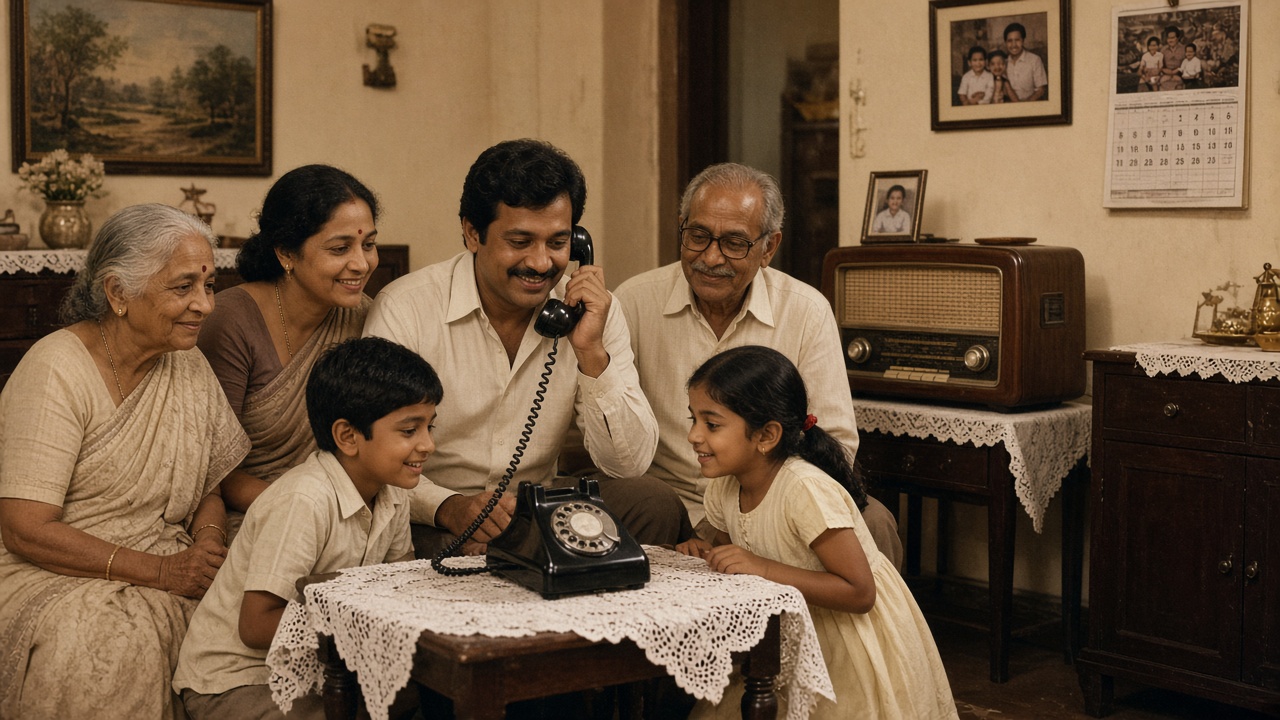
A long-distance trunk call was a family event, often booked hours in advance (artistic illustration).
1948: Indian Telephone Industries (ITI) is set up in Bangalore to make telephones and exchange equipment.
1960: Subscriber trunk dialling (STD) begins between Lucknow and Kanpur, letting callers dial long-distance numbers directly.
1960s–1970s: Telex services link businesses; microwave relay links carry trunk calls; the Arvi satellite earth station near Pune opens for international calls (1971).
1983: The INSAT-1B satellite supports telephone links and TV across India; waiting lists for new phone connections run into lakhs.
Technology
Rotary-dial phones: Black ITI handsets.
Microwave links: Towers relaying calls between cities.
Satellite earth stations: International calls via space.
Features
Telegrams for news: Births, jobs, exams, and emergencies.
Long waits: Years for a home phone connection.
Lightning calls: Priority trunk calls at extra cost.
🔧 C-DOT1984 – 1994
C-DOT, MTNL & STD Booths
C-DOT designed rugged digital exchanges for India’s heat, dust, and small villages. Telecom was separated from the post office, new companies ran city and international services, and yellow STD/ISD booths spread to every street corner.
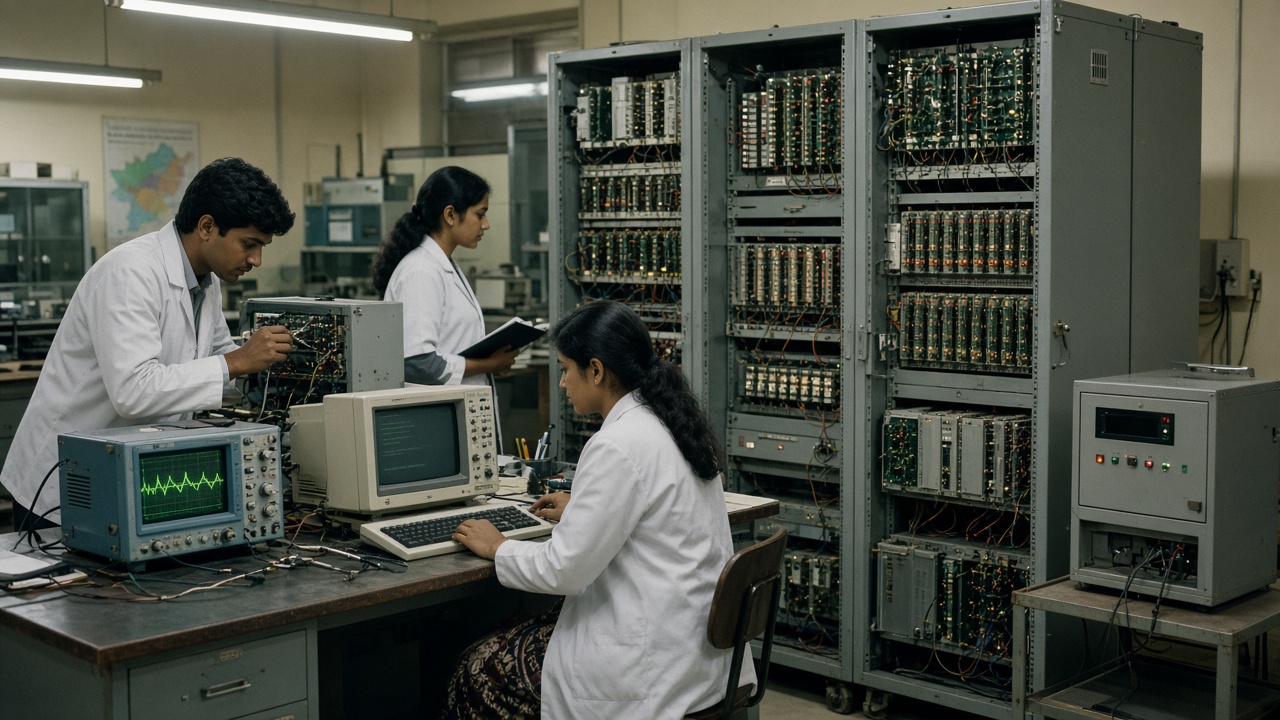
Indian engineers designed digital exchanges suited to rural conditions (artistic illustration).
1984–1985: The Centre for Development of Telematics (C-DOT) is founded (1984); the Department of Telecommunications is separated from the postal department (1985).
1986: Mahanagar Telephone Nigam Limited (MTNL) takes over Delhi and Bombay phones; Videsh Sanchar Nigam Limited (VSNL) runs international services.
Late 1980s: C-DOT rural exchanges and public call offices (STD/ISD PCOs) spread across towns and villages; the Telecom Commission is set up (1989).
1994: The National Telecom Policy, 1994 opens telephone services to private companies.
Technology
Digital switching: Electronic exchanges replace mechanical ones.
Push-button phones: Faster dialling.
Optical fibre: First fibre links between exchanges.
Features
STD booths: Calls for all, without owning a phone.
Local jobs: Lakhs of booths run by small owners.
Cheaper night calls: Reduced rates after 11 pm.
📱 Mobile Phones1995 – 2012
Mobile Phones, TRAI & Private Operators
India made its first mobile call in 1995. An independent regulator, new licensing policies, and fierce competition made calls cheaper every year, and prepaid mobile phones reached farmers, vendors, and students across the country.
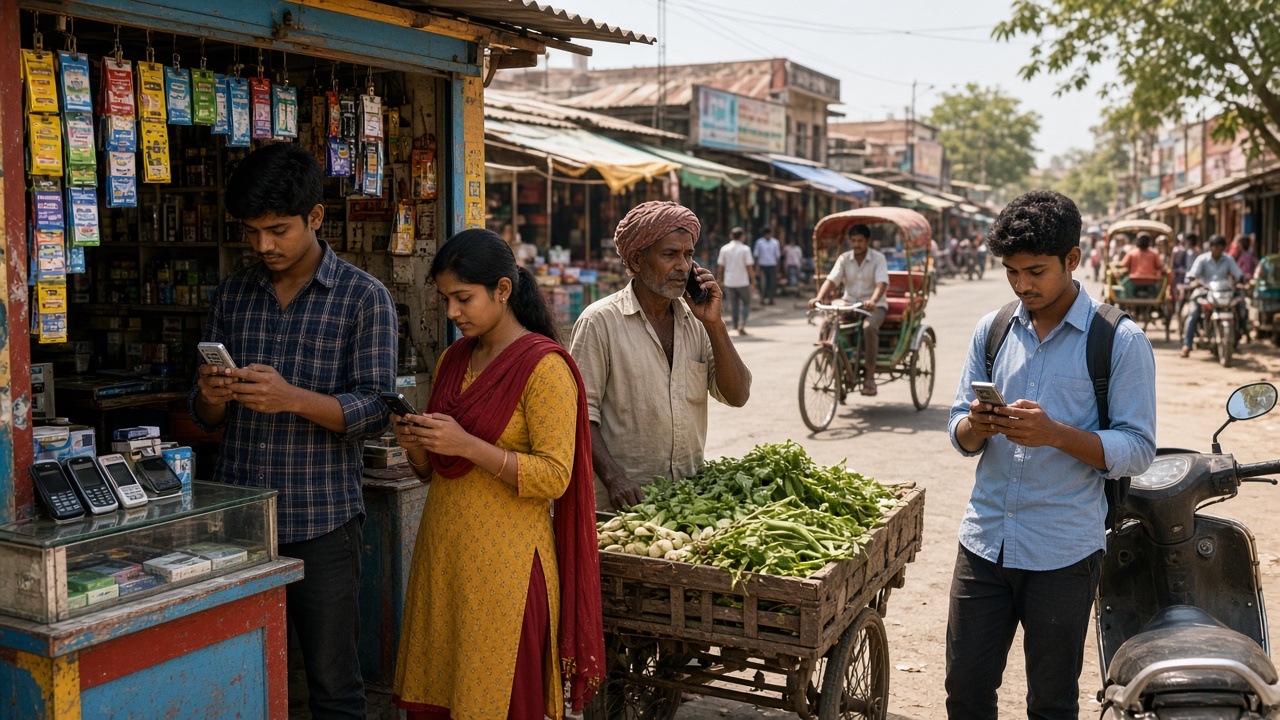
Cheap prepaid connections and recharge shops put mobile phones in crores of hands (artistic illustration).
1995: India’s first mobile phone call is made between Kolkata and New Delhi (31 July); VSNL launches public internet (15 August).
1997–2000: The Telecom Regulatory Authority of India (TRAI) is set up (1997); the New Telecom Policy, 1999 moves to revenue sharing; BSNL is formed (1 October 2000).
2003–2008: “Calling party pays” makes incoming mobile calls free (2003); unified licences are introduced; mobile users cross 10 crore (2006); 3G service begins (2008).
2010–2012: 3G and broadband wireless spectrum is auctioned (2010); mobile number portability goes nationwide (2011); 4G service begins in Kolkata (2012).
Technology
GSM and CDMA: Digital mobile networks.
SMS: Text messages on keypad phones.
3G data: Mobile internet and video calls.
Features
Prepaid recharge: Small top-ups for everyone.
Falling tariffs: Among the world’s cheapest calls.
STD booths decline: Phones move into pockets.
🚀 4G & 5G2013 – Present
Telegram Ends, 4G Boom & 5G
The telegram service ended after about 163 years. Cheap 4G data turned India into one of the world’s biggest users of mobile data, 5G spread at record speed, and a new telecom law replaced the colonial-era Telegraph Act.
Mobile towers, some solar-powered, now reach remote mountain villages (artistic illustration).
15 July 2013: BSNL sends India’s last telegrams and ends the telegram service.
2016–2018: A 4G price war makes mobile data very cheap and sends data use soaring; the National Digital Communications Policy is released (2018).
2022: 5G services are launched on 1 October and quickly reach hundreds of cities and towns.
2023–present: The Sanchar Saathi portal helps block lost and stolen phones; the Bharat 6G vision is released; the Telecommunications Act, 2023 replaces the Indian Telegraph Act, 1885; satellite broadband services are being rolled out.
Technology
4G VoLTE: Voice calls over data networks.
5G: Very high speed and low delay.
Satellite broadband: Internet for remote areas.
Features
Free voice calls: Plans charge mainly for data.
Video everywhere: Classes, meetings, and entertainment.
Made in India: Indigenous 4G and 5G equipment.
How Indians Sent Messages Over Time
Method
In India from
What it was like
Telegram
1850s
Short messages in Morse code, paid per word, delivered by messenger
Landline telephone
1882
Voice calls through operators, later by dialling
Trunk call
Early 1900s
Long-distance calls booked through an operator
Telex
1960s
Typed messages between business teleprinters
STD/ISD booth
1980s
Pay-per-call public phones on every street
Pager
1990s
Short text alerts on a small device
Mobile phone and SMS
1995
Calls and texts from anywhere
Smartphone apps
2010s
Free voice, video, and chat over mobile data
Key Telecom Laws, Policies & Bodies
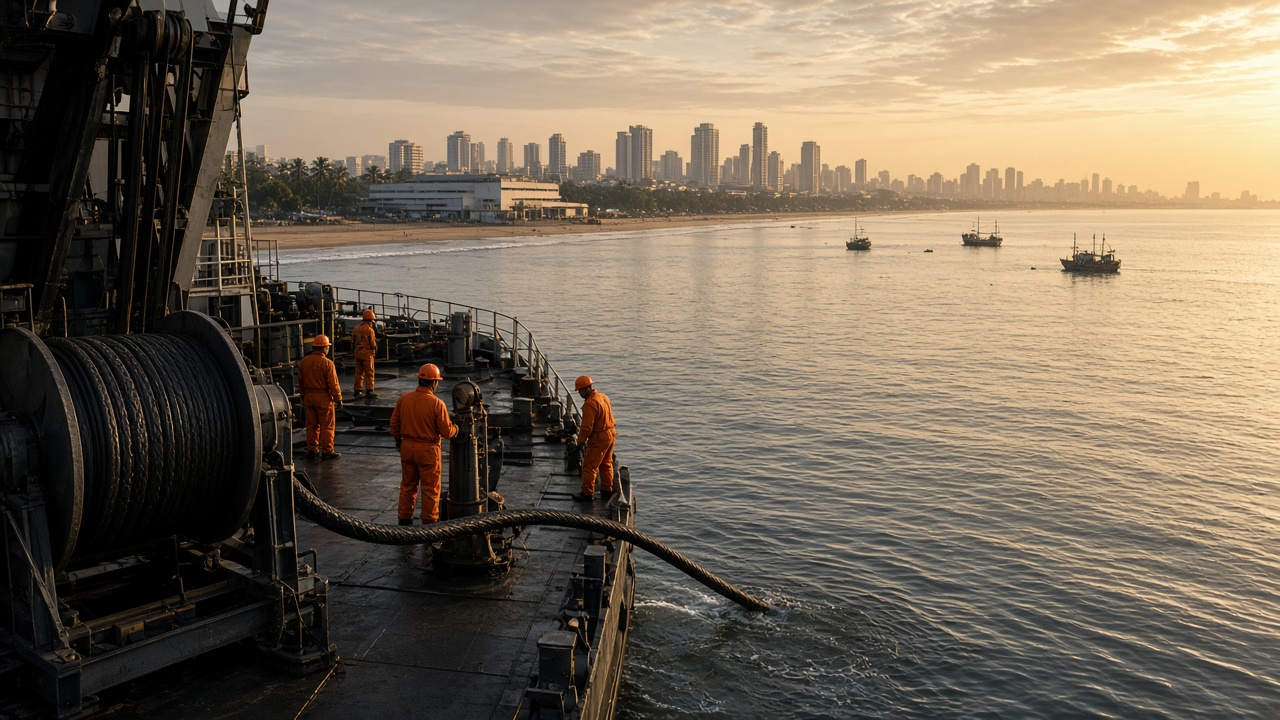
From the 1870 telegraph cable to today’s fibre links, undersea cables connect India to the world (artistic illustration).
Law / policy / body
Year
What it did
Indian Telegraph Act
1885
Gave the government exclusive rights over telegraphs and telephones
Indian Wireless Telegraphy Act
1933
Required licences for wireless equipment
C-DOT
1984
Developed Indian digital exchanges and telecom technology
National Telecom Policy
1994
Opened basic telephone services to private companies
TRAI
1997
Independent regulator for tariffs and service quality
New Telecom Policy
1999
Moved licences to revenue sharing, boosting mobile growth
National Digital Communications Policy
2018
Broadband for all and digital communication goals
Telecommunications Act
2023
Replaced the 1885 and 1933 laws with a modern framework
Keeping in Touch: Then and Now
Aspect
Then
Now
Urgent news
Telegram delivered to the door
Instant message or call on a mobile
Getting a phone
Wait months or years for a landline
Get a SIM card in minutes with e-KYC
Long-distance call
Book a trunk call and wait for the operator
Dial or video call anywhere instantly
Cost
Expensive per minute and per word
Unlimited calls with low-cost data plans
Network
Copper wires and manual exchanges
Fibre, 4G, 5G, and satellites
Handset
Heavy black rotary phone at home
Smartphone in every pocket
Telecom & Telegraph Timeline Summary
Year
Milestone
1850
First experimental telegraph line, Calcutta to Diamond Harbour
1855
Telegraph opened to the public
1870
Submarine cable links Bombay with Britain
1882
First telephone exchanges in Calcutta, Bombay, and Madras
1885
Indian Telegraph Act
1902
First wireless telegraph stations
1913
First automatic exchange in Shimla
1948
Indian Telephone Industries set up
1960
First subscriber trunk dialling, Lucknow–Kanpur
1984
C-DOT founded
1986
MTNL and VSNL formed
1994
National Telecom Policy
1995
First mobile phone call
1997
TRAI set up
2000
BSNL formed
2003
Incoming mobile calls become free
2011
Nationwide mobile number portability
2012
4G service begins
2013
Telegram service ends
2022
5G launched
2023
Telecommunications Act replaces the Telegraph Act
Test Your Knowledge
20 quick questions from the telecom and telegraph timeline. Click each question to reveal the answer.
Answer: Calcutta and Diamond Harbour.
Answer: William O’Shaughnessy.
Answer: 1855.
Answer: Morse code — dots and dashes.
Answer: 1882, in Calcutta, Bombay, and Madras.
Answer: The Indian Telegraph Act, 1885.
Answer: Shimla.
Answer: Indian Telephone Industries (ITI).
Answer: Subscriber Trunk Dialling.
Answer: Lucknow and Kanpur.
Answer: A long-distance call booked through an operator.
Answer: C-DOT (Centre for Development of Telematics).
Answer: Delhi and Bombay (Mumbai).
Answer: 31 July 1995.
Answer: Telecom Regulatory Authority of India.
Answer: 1 October 2000.
Answer: The “calling party pays” rule.
Answer: 15 July 2013.
Answer: 1 October 2022.
Answer: The Telecommunications Act, 2023.
Classroom activity
Students Tasks
Use these prompts for discussion or projects on the history of telecom and the telegraph in India.
Timeline understandingScience of signalsOral historyDigital safety
Write your name in Morse code and send a short message to a classmate using taps or a torch.
Write a telegram of no more than ten words announcing exam results, then explain why telegrams were so short.
Interview an elder about booking a trunk call, using an STD booth, or receiving a telegram.
Make a picture timeline from the Morse key to the smartphone using eight milestones.
Explain how a mobile phone call travels from your phone to a friend’s phone through towers and exchanges.
Compare the cost of a long-distance call in 1990 with today’s mobile plans.
Make a poster on mobile safety: never share OTPs, beware of fake calls, and report lost phones.
Mark on a world map the undersea cable routes that connect India to other countries.
Debate: “Smartphones have brought people closer together.”
Imagine and describe how people might communicate in India in 2050 with 6G.
Continue exploring
India’s telecom story connects with its postal system, mobile phones, radio, the internet, and Digital India. Explore more timelines next.
Click any panel to expand and explore the visual mood.
India’s telecom story in pictures — telegraph offices, switchboard operators, family trunk calls, digital exchanges, the mobile boom, undersea cables, mountain towers, and 5G cities.
Telegraph
From 1850
Switchboards
Operator era
Trunk Calls
Rotary phones
C-DOT
From 1984
Mobile Boom
From 1995
Undersea Cables
From 1870
Towers Everywhere
Remote villages
5G
From 2022
Explore all government timelines
Jump to any other government timeline on WorldTimelineHub.
Disclaimer: This content is AI-generated for educational purposes and may contain errors or outdated details. For correct and authoritative information, please refer to official and reliable sources such as government publications, manufacturers, museums, and academic references.