Long before telephones and the internet, India’s messages travelled by foot, horse, camel, boat, and train. Today the red post box, the khaki-clad postman,
and more than 1.5 lakh post offices form the largest postal network in the world — delivering letters, parcels, pensions, savings, and even banking to every corner of the country.
This timeline covers dak runners and Sher Shah Suri’s horse post, the East India Company’s post offices, the Scinde Dawk stamp, the founding of India Post in 1854,
postcards, money orders, the world’s first official airmail, PIN codes, Speed Post, e-Post, India Post Payments Bank, the Post Office Act 2023, and DIGIPIN.
Ancient → PresentRunner → Rail → Speed Post → DigitalLetters · Parcels · Banking
Why Did India Need a Postal System?
Rulers needed fast news from distant provinces, traders needed to send orders and money, and families wanted to stay in touch. India’s postal system grew
from royal relay runners into a public service open to everyone. Today the Department of Posts, under the Ministry of Communications, runs mail, parcels,
savings schemes, insurance, and a payments bank — making the post office one of the most trusted government services in rural India.
Big picture
India’s postal journey in one view
The post moved from royal messengers, to Company post offices in port cities, to a single national service with cheap uniform stamps, and finally to
a digital, banking-enabled network that reaches remote villages, mountain passes, and even a floating post office on Dal Lake. Related timelines:
railways,
banking in India,
mobile phones.
1.5 lakh+
Post offices across India
1854
India Post as one national service
1972
Six-digit PIN code introduced
1911
World’s first official airmail
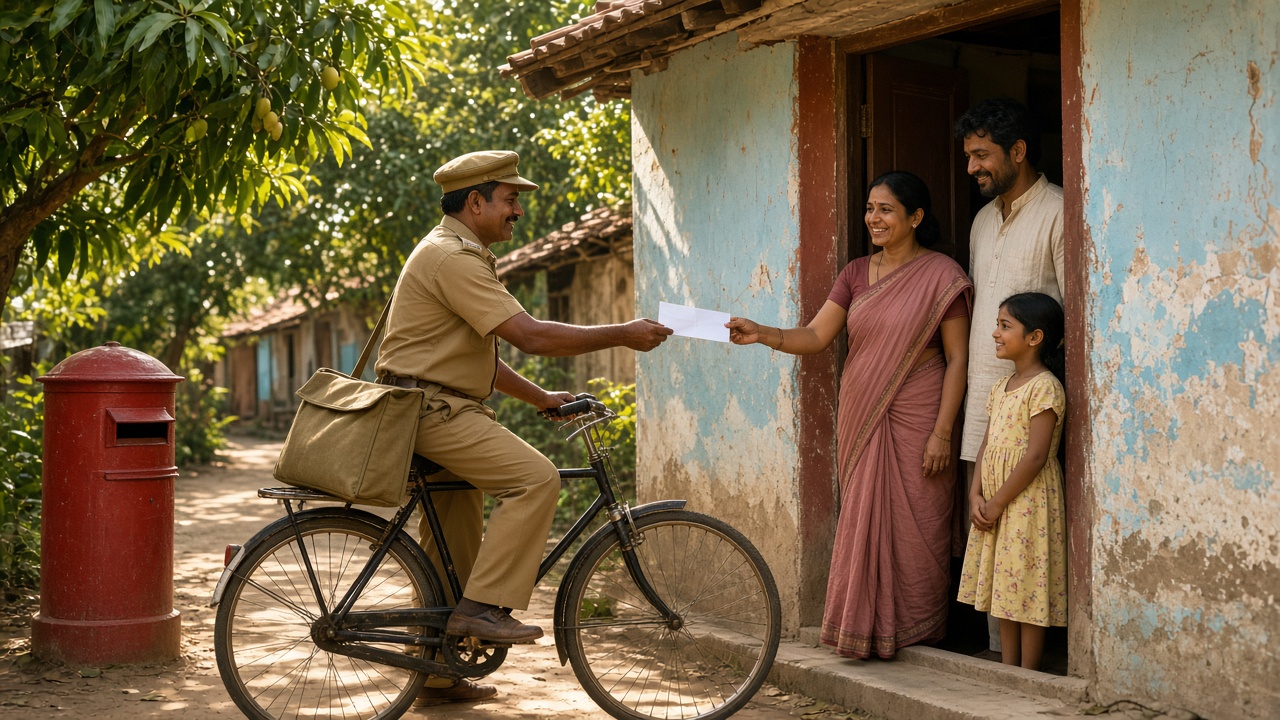
The village postman on a bicycle became one of India’s most familiar and trusted faces (artistic illustration).
🏃 Dak RunnersAncient – 1700s
Messengers, Dak Runners & Horse Post
For centuries, rulers used relays of runners and horsemen to carry official messages. Runners changed at fixed stations every few miles, so letters moved day and night. These dak networks, built along great roads, were the ancestors of the modern post.
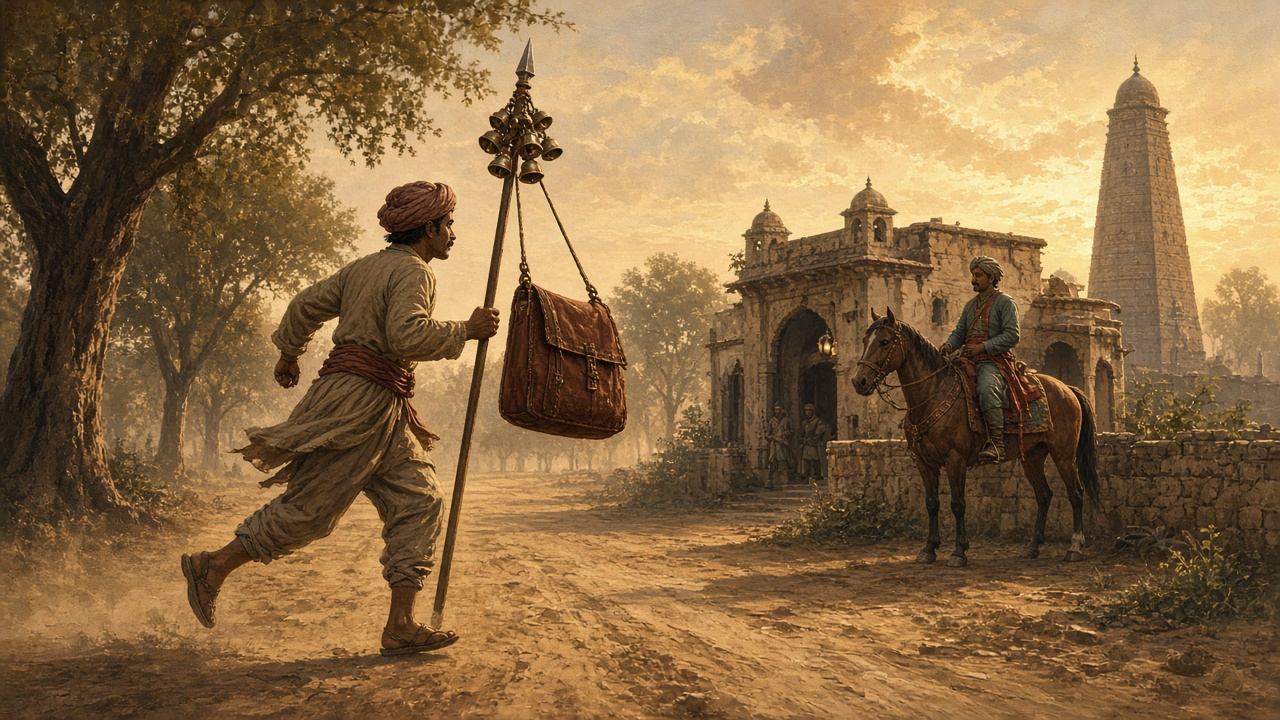
Dak runners carried bells on their spears to warn of their approach and scare away animals (artistic illustration).
Ancient India: Kings used messengers, spies, and carrier pigeons; the Arthashastra describes royal communication networks.
Around 1300: Alauddin Khilji sets up dak chowkis — relay posts of runners and horsemen — to get fast news from his army and provinces.
14th century: The traveller Ibn Battuta describes foot runners and horse post carrying letters across the Delhi Sultanate at remarkable speed.
1540s–1700s: Sher Shah Suri builds sarais along the Grand Trunk Road that double as horse-post stations; the Mughals expand the dak with harkaras (runners) and kos minars marking distance.
How mail moved
Relay runners: Fresh runners every few miles.
Horse post: Mounted riders for urgent royal messages.
Pigeon post: Trained birds for short, fast messages.
Features
Royal use: Mostly for government and army messages.
Private couriers: Merchants and bankers ran their own messengers.
Road network: Sarais and milestones supported travel.
📮 Company Post1727 – 1853
Company Post & First Stamps
The East India Company opened post offices in its port cities and slowly allowed the public to use them. Postage was costly and charged by distance until a local experiment in Sindh produced Asia’s first postage stamp.
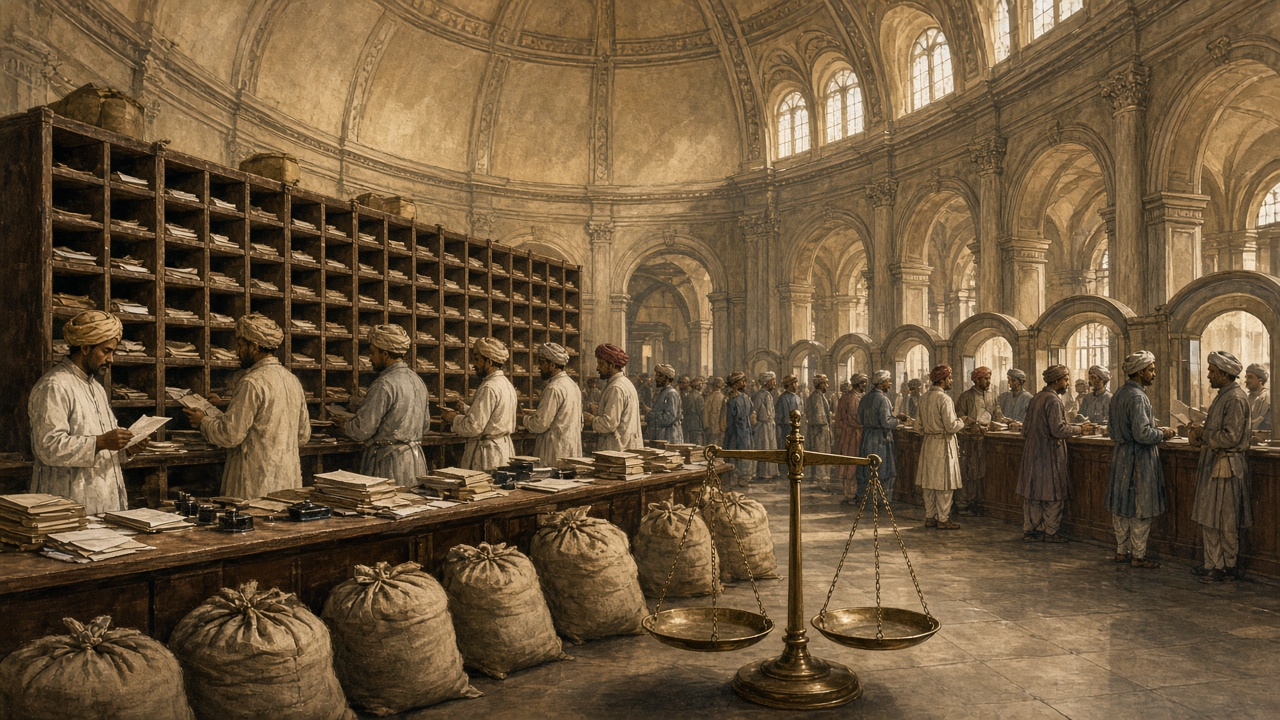
General Post Offices in Calcutta, Madras, and Bombay became the hubs of Company mail (artistic illustration).
1727–1766: The East India Company opens a post office in Calcutta (1727); Robert Clive organises a regular postal system for Company business (1766).
1774–1793: Warren Hastings opens the Calcutta General Post Office to the public (1774), followed by GPOs in Madras (1786) and Bombay (1793).
1837: The Post Office Act makes the post a government monopoly and links the three presidencies into one network.
1852: Bartle Frere issues the Scinde Dawk in Karachi — the first postage stamp of Asia.
How mail moved
Distance-based fees: Postage paid in cash by distance.
Mail coaches & boats: Road and river routes linked cities.
Postmarks: Hand stamps recorded place and date.
Features
Expensive: Letters cost too much for ordinary people.
Urban focus: Offices mainly in Company towns.
First stamp: Prepaid postage idea arrives.
✉️ India Post1854 – 1946
India Post, Postcards & Airmail
In 1854 the post became one national department with cheap, uniform rates. Railways carried mail across the country, and new services — postcards, money orders, savings banks, and insurance — turned the post office into a lifeline for ordinary families.
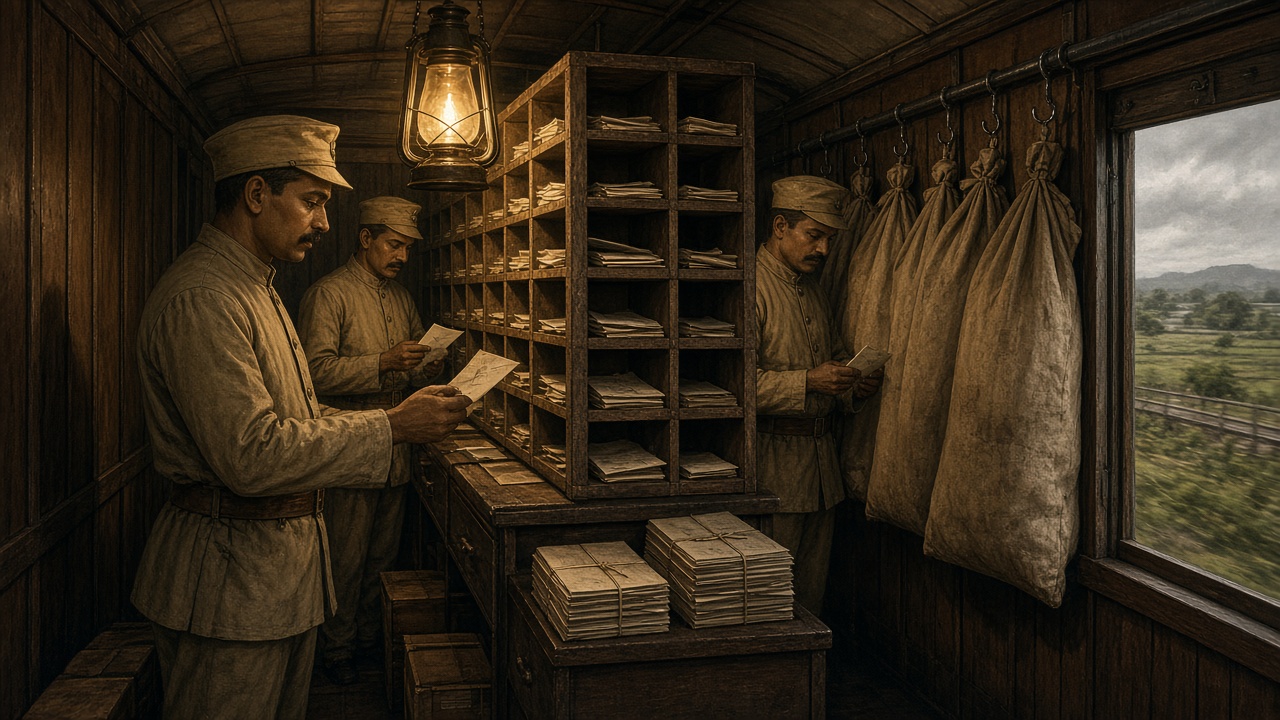
Railway mail sorters sorted letters inside moving trains so mail was ready for delivery on arrival (artistic illustration).
1 October 1854: India Post is organised as one all-India department; uniform postage by weight (half an anna for a light letter) and the first all-India stamps are introduced.
1860s–1880s: Mail is sorted on running trains; value-payable post (1877), the postcard (1879), money orders (1880), the Post Office Savings Bank (1882), and Postal Life Insurance (1884) begin.
1898: The Indian Post Office Act, 1898 sets the rules for postal services for more than a century.
18 February 1911: About 6,500 letters are flown from Allahabad to Naini — the world’s first official airmail flight; airmail stamps follow in 1929.
How mail moved
Railway Mail Service: Sorting sections on trains.
Postage stamps: Prepaid, uniform, and cheap.
Telegraph link: Posts and telegraphs worked together.
Features
Mass service: Letters affordable for everyone.
Money by post: Migrant workers sent money home by money order.
Grand GPOs: Landmark buildings in Kolkata, Chennai, and Mumbai.
📍 PIN Codes1947 – 1985
Independent India & PIN Codes
Independent India issued its own stamps and expanded post offices into villages. As mail volumes grew, the six-digit PIN code made sorting faster and more accurate, and post offices reached the Himalayas and even Antarctica.
PIN codes let sorters route letters by number instead of reading long addresses (artistic illustration).
21 November 1947: Independent India’s first stamp, “Jai Hind,” shows the national flag; Gandhi memorial stamps follow in 1948.
1950s–1960s: Thousands of new rural post offices open; the post office becomes a village centre for letters, savings, and money orders.
15 August 1972: The six-digit Postal Index Number (PIN) is introduced, an idea associated with Shriram Bhikaji Velankar.
1983–1985: A post office opens at Hikkim in the Himalayas (1983), one at Dakshin Gangotri in Antarctica (1984), and the Department of Posts becomes separate from telecommunications (1985).
How mail moved
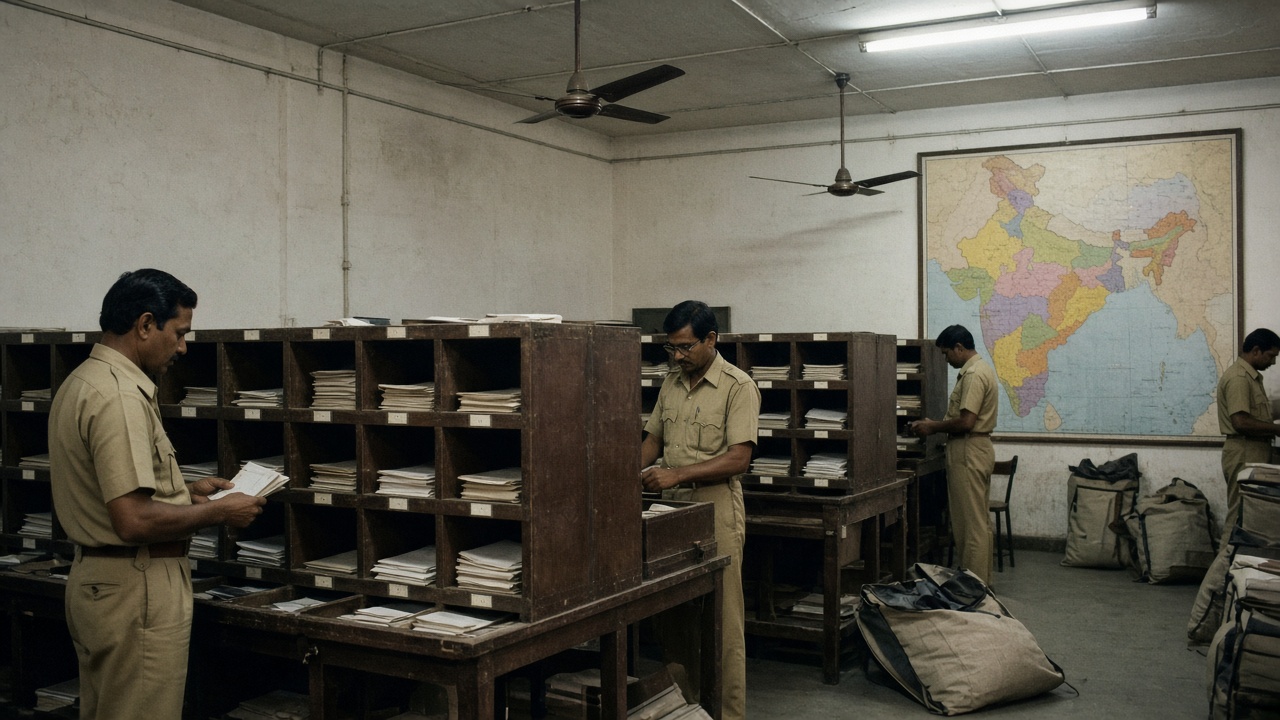
PIN-based sorting: Numbers route mail by region.
Air and rail links: Night airmail and mail trains.
Army Postal Service: Mail for soldiers on the borders.
Features
Rural reach: A post office within walking distance.
Philately: Stamps celebrate Indian culture and leaders.
🚀 Speed Post1986 – 2011
Speed Post & Modernisation
Private couriers, fax, email, and mobile phones challenged the post. India Post responded with Speed Post, computerised counters, electronic money orders, and a push to improve the look and service of post offices.
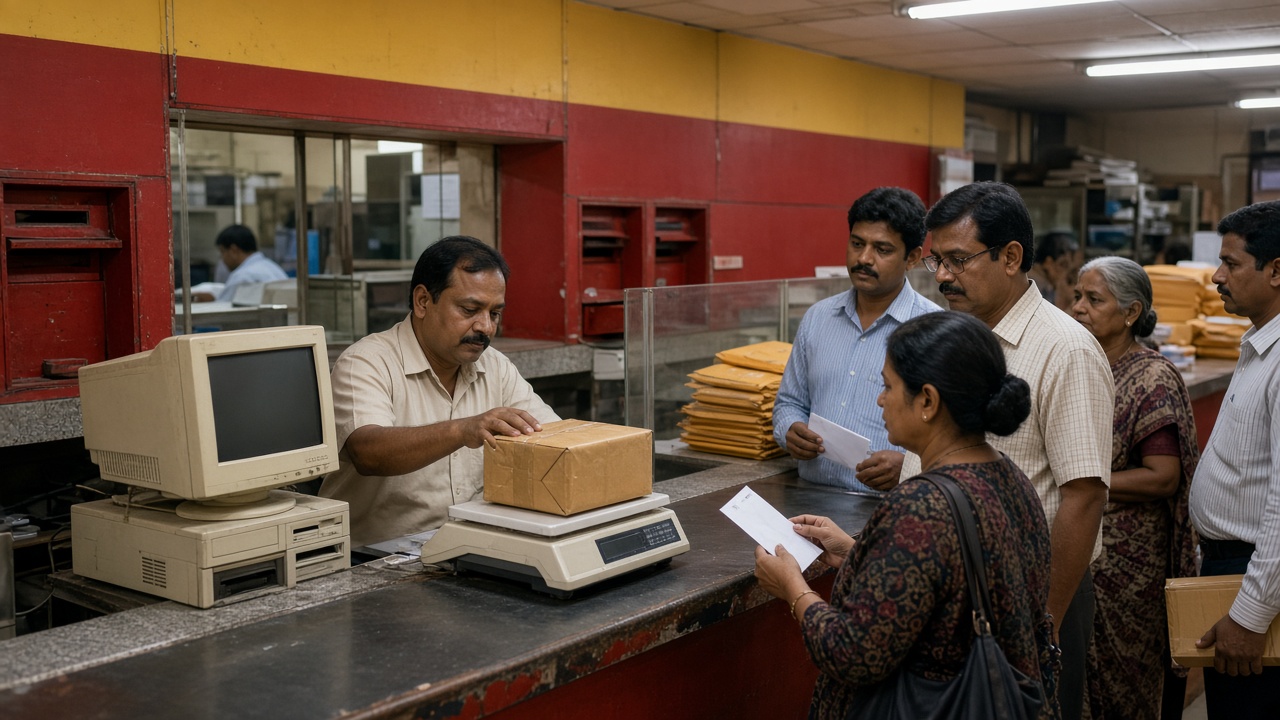
Computerised counters and electronic scales sped up booking of Speed Post and parcels (artistic illustration).
1 August 1986: Speed Post launches for fast, time-bound delivery of letters and parcels.
1990s: Post office counters are computerised; Rural Postal Life Insurance starts (1995); business and bulk mail services grow.
2004–2008: e-Post lets people send messages that are printed and delivered as letters (2004); Project Arrow modernises post offices and electronic money orders begin (2008).
2011: “My Stamp” lets people print personalised stamps with their own photos.
How mail moved
Track and trace: Barcodes to follow Speed Post items.
Mail processing centres: Hubs for faster sorting.
Electronic money orders: Money sent without paper forms.
Features
Competition: Couriers pushed the post to improve.
Fewer letters: Phones replaced personal letters.
Trusted savings: Post office schemes stayed popular.
📱 Digital Post2012 – Present
Postal Banking, Parcels & DIGIPIN
The post office reinvented itself as a digital service centre. Postmen now carry smartphones and biometric devices, India Post runs a payments bank, parcels from online shopping fill mail vans, and a new law and digital address system prepare the post for the future.
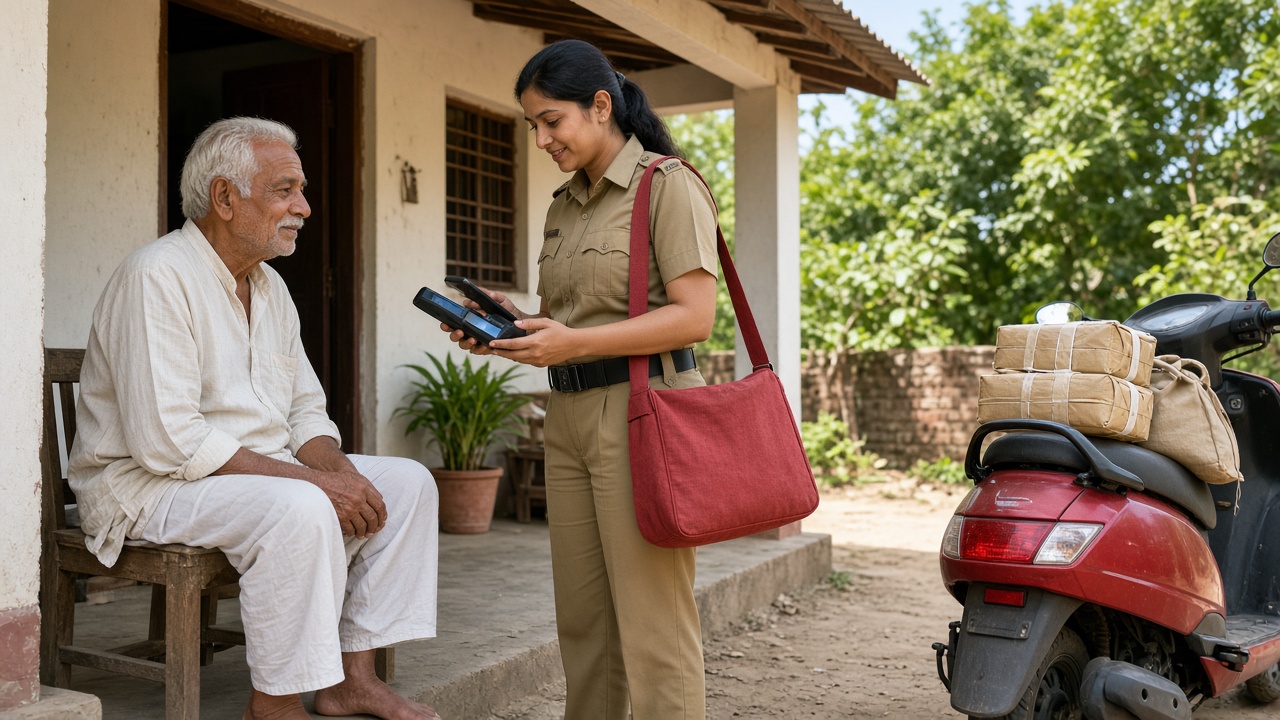
Postmen and postwomen now deliver cash, pensions, and banking services at the doorstep (artistic illustration).
2012–2016: The IT Modernisation Project links post offices through core banking and core insurance; Sukanya Samriddhi accounts open at post offices (2015).
2017–2018: Post Office Passport Seva Kendras open (2017); India Post Payments Bank launches on 1 September 2018 with doorstep banking.
2020–2022: Postmen deliver cash and medicines during the COVID-19 lockdown; parcel services grow with e-commerce; drone delivery of mail is trialled in Gujarat (2022).
2023–present: The Post Office Act, 2023 replaces the 1898 Act (in force from 2024); DIGIPIN, a digital grid-based address code, is launched (2025).
How mail moved
Handheld devices: Postmen record delivery digitally.
Aadhaar-enabled payments: Cash withdrawal at the doorstep.
DIGIPIN: Precise location codes for every place.
Features
One-stop centre: Mail, banking, passports, and Aadhaar services.
Parcel boom: Online shopping deliveries to villages.
Financial inclusion: Banking for remote communities.
Stamp & Philately Milestones
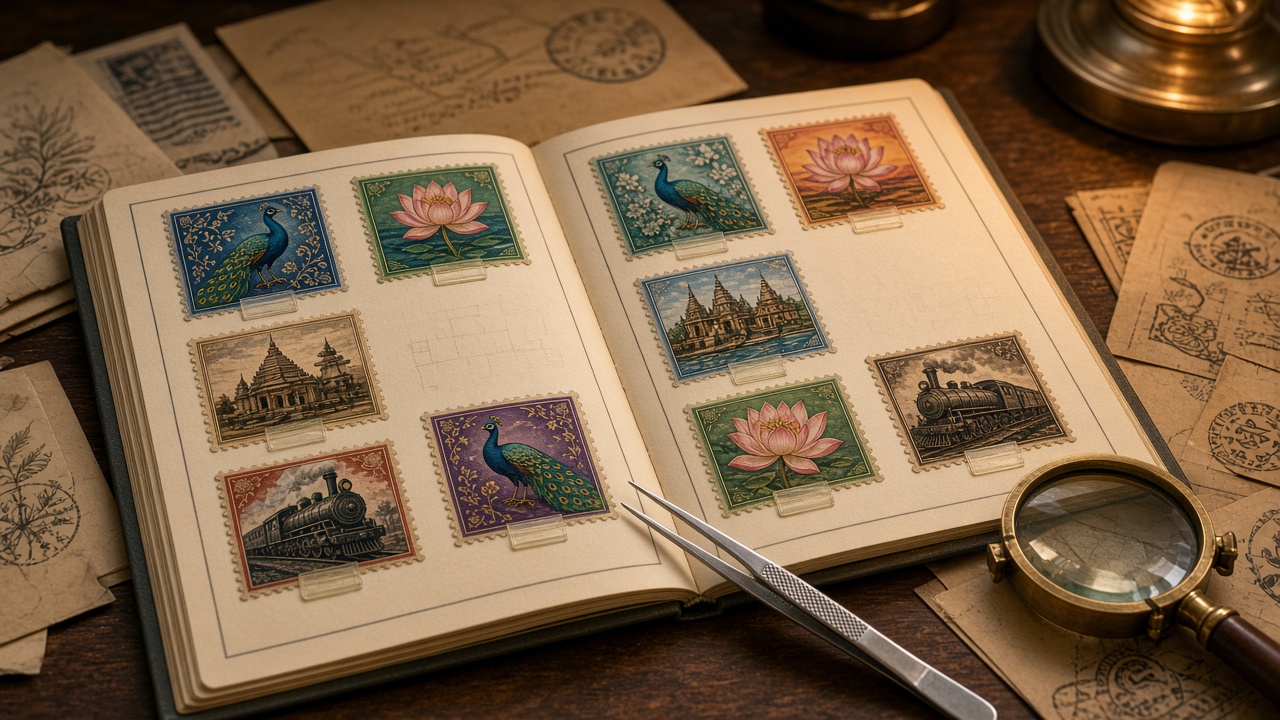
Indian stamps celebrate wildlife, heritage, festivals, and national achievements (artistic illustration).
Year
Stamp / philately milestone
Why it matters
1852
Scinde Dawk
First postage stamp of Asia
1854
First all-India stamps
Uniform prepaid postage across India
1879
Postcard
Cheapest way to send a short message
1911
First official airmail
Special cancellation for Allahabad–Naini flight
1929
First airmail stamps
Stamps for air postage
1931
New Delhi inauguration stamps
Marked the new capital
1947
“Jai Hind” stamp
First stamp of independent India
1948
Gandhi memorial stamps
Among India’s most famous stamps
2011
My Stamp
Personalised stamps with your own photo
Today
Commemorative stamps and philatelic bureaus
Collectors buy new issues at post offices and online
How the PIN Code Works
A PIN has six digits: the first shows the postal region, the second the sub-region, the third the sorting district, and the last three the delivery post office.
Click any panel to expand and explore the visual mood.
India’s postal story in pictures — dak runners, colonial GPOs, railway mail, PIN sorting, Speed Post, stamps, village postmen, and doorstep banking.
Dak Runners
Relay post
General Post Office
From 1774
Railway Mail
Sorting on trains
Stamps
Since 1852
PIN Codes
1972
Speed Post
1986
Village Postman
Every doorstep
Doorstep Banking
IPPB from 2018
Explore all government timelines
Jump to any other government timeline on WorldTimelineHub.
Disclaimer: This content is AI-generated for educational purposes and may contain errors or outdated details. For correct and authoritative information, please refer to official and reliable sources such as government publications, manufacturers, museums, and academic references.