From Socrates questioning students in the streets of Athens to AI tutors answering questions on a phone — education has
travelled through academies, monasteries, universities, printed books, public schools, and global online classrooms.
This timeline follows the big turning points in world education: the first schools of philosophy, great libraries,
medieval universities, the printing revolution, compulsory schooling, child-centred learning, education as a human right,
and the digital age of open, lifelong learning.
c. 500 BCE → PresentAcademy → University → OnlineThinkers · Schools · Reforms
Why Study the History of Education?
The classroom we know today — with teachers, subjects, textbooks, exams, and degrees — was built step by step over more than 2,500 years.
Knowing where these ideas came from helps us understand why schools look the way they do, which reforms really changed lives,
and how technology and new thinking may reshape learning in the future.
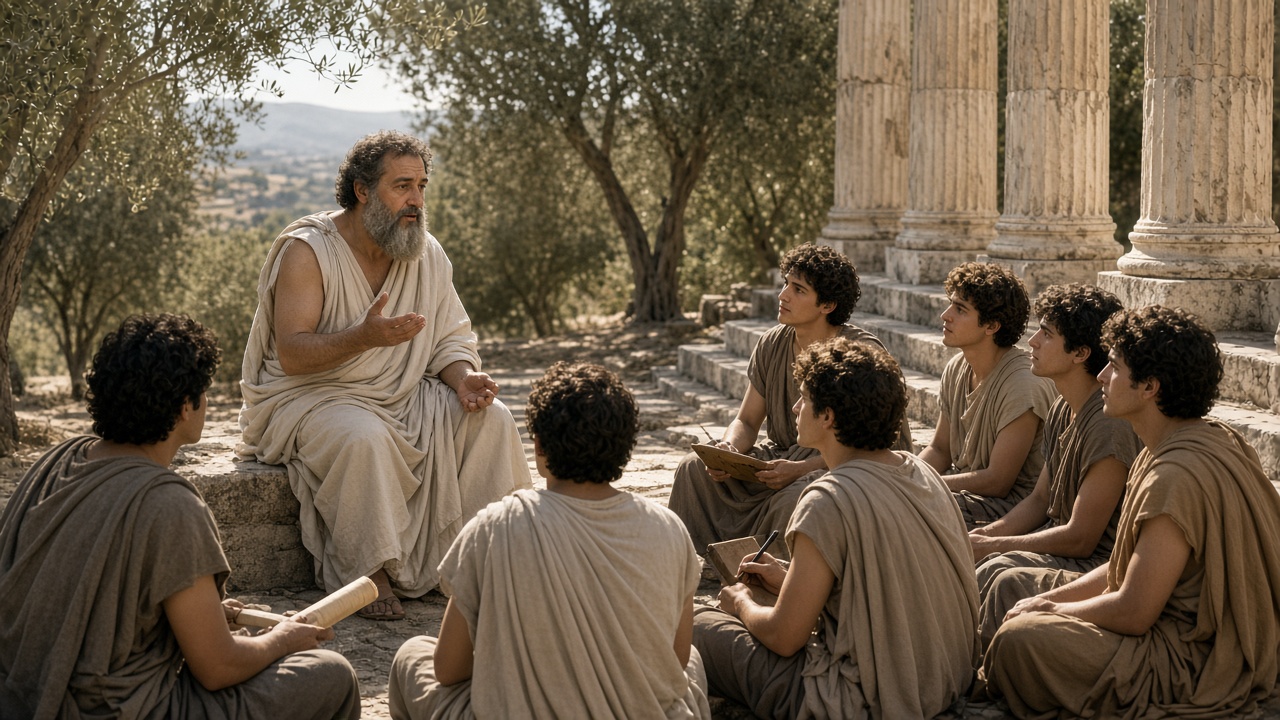
Ancient Athens: open-air dialogue between teacher and students laid the foundation of Western education.
🏛️ Birth of Schoolsc. 500 BCE – 500 CE
Ancient Greece & Rome
Greek philosophers turned questioning into a method of teaching and created the first formal schools of higher learning. Rome built a graded system of schools, while great centres such as Alexandria, Takshashila in India, and Confucian academies in China spread learning across the ancient world.
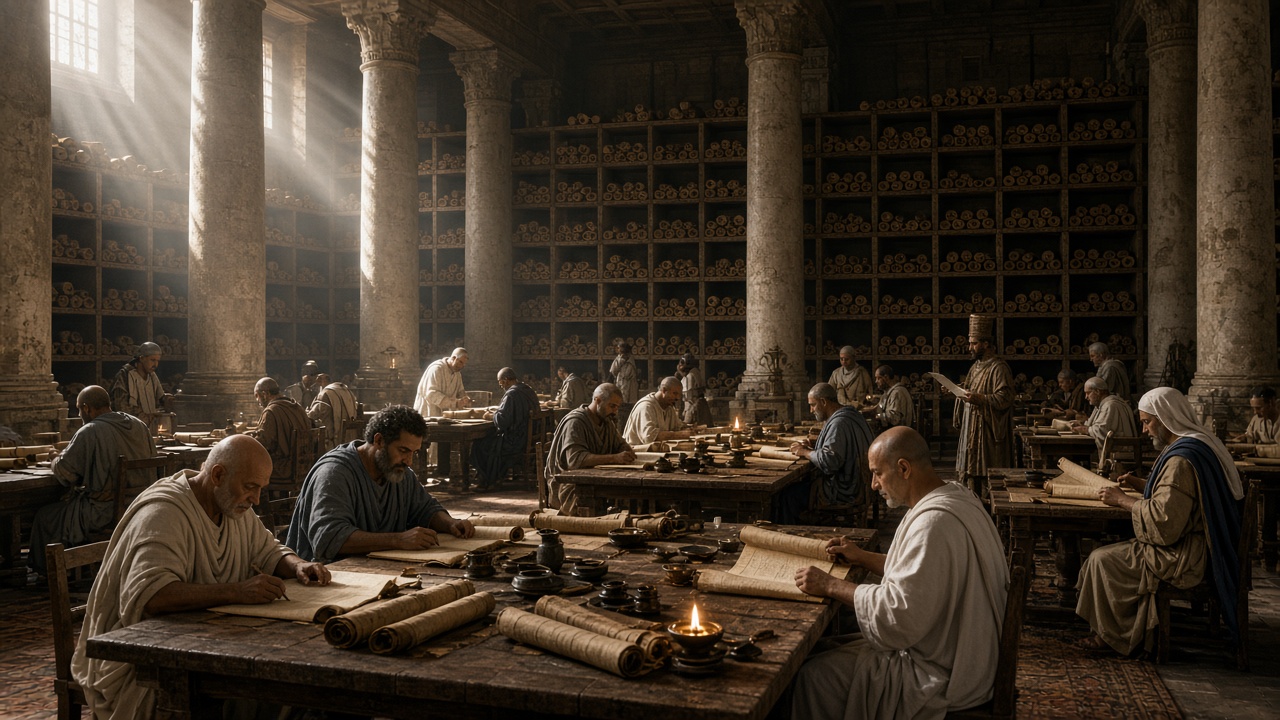
The Library of Alexandria gathered scrolls and scholars from across the Mediterranean world.
c. 470–399 BCE: Socrates teaches through questions — the “Socratic method.” In China, Confucius (551–479 BCE) teaches ethics and learning.
c. 387 BCE: Plato founds the Academy in Athens; it runs for about 300 years.
335 BCE: Aristotle opens the Lyceum, teaching logic, science, and politics while walking (the “Peripatetic” school).
3rd century BCE – c. 95 CE: Library and Mouseion of Alexandria flourish; Roman schools of the ludus, grammaticus, and rhetor develop; Quintilian writes Institutio Oratoria.
Tools of Learning
Wax tablets & stylus: Reusable writing surfaces for practice.
Papyrus scrolls: Books copied by hand and stored in libraries.
Dialogue & memory: Oral debate, recitation, and memorisation.
Features
Liberal arts: Grammar, rhetoric, logic, and mathematics for free citizens.
Critical thinking: Questioning ideas instead of simply accepting them.
For the few: Mostly wealthy boys; girls and enslaved people largely excluded.
🎓 First Universities500 – 1400
Medieval Learning & First Universities
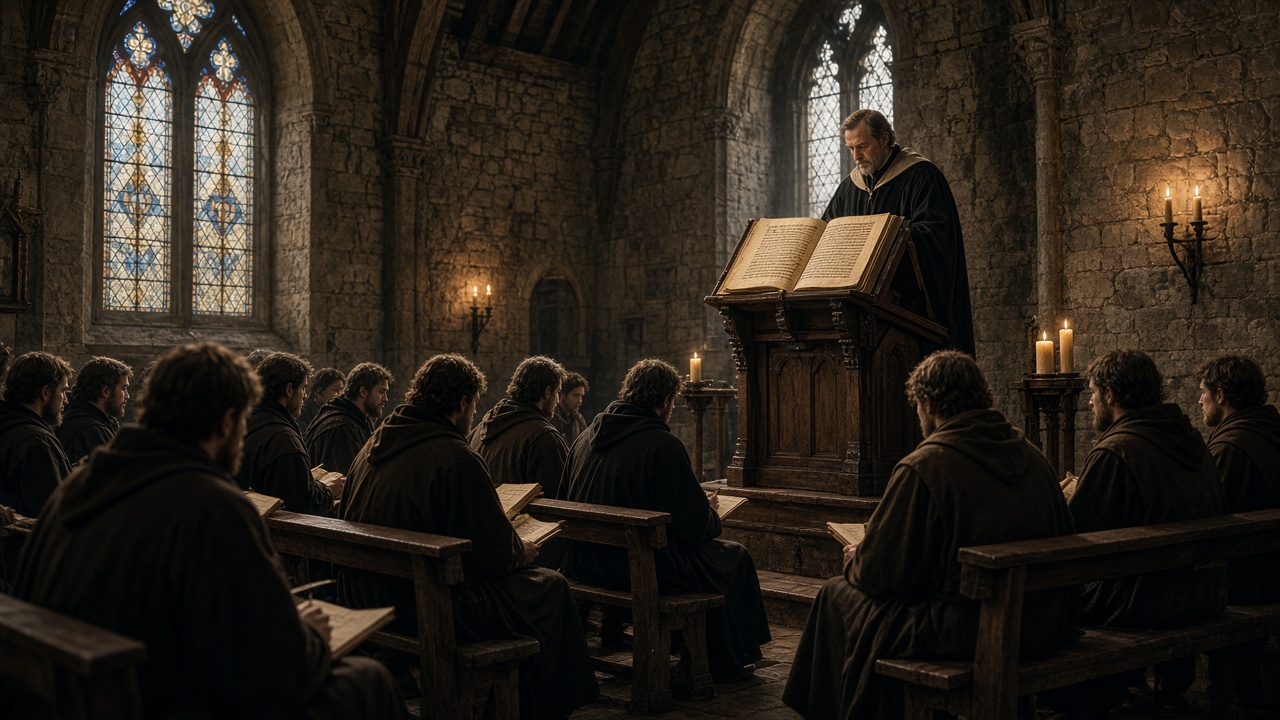
After Rome’s fall, monasteries and cathedral schools kept learning alive in Europe, while Baghdad, Fez, Cairo, and Nalanda became world centres of scholarship. From the 11th century, scholars and students formed the first universities, which awarded degrees and set up faculties.
A medieval lecture: the master read and explained texts while students listened and took notes.
5th–12th century: Nalanda in India attracts thousands of students and scholars from across Asia.
c. 800: Charlemagne and the scholar Alcuin promote palace, monastic, and cathedral schools.
9th century / 859 / 970s: Baghdad’s House of Wisdom; Fatima al-Fihri founds al-Qarawiyyin in Fez; Al-Azhar is established in Cairo.
1088 / c. 1096 / c. 1150: University of Bologna; teaching at Oxford; University of Paris — followed by Cambridge (1209) and many more.
Tools of Learning
Handwritten manuscripts: Copied by monks in scriptoria.
Lecture & disputation: Reading texts aloud and debating questions.
Latin: Common language of scholars across Europe.
Features
Trivium & quadrivium: The seven liberal arts as the core curriculum.
Degrees & faculties: Arts, law, medicine, and theology.
Religious control: Church and religious institutions shaped most learning.
📖 Books for Many1400 – 1700
Renaissance, Printing & Reformation
Renaissance humanists revived Greek and Latin classics and put the individual at the centre of learning. Gutenberg’s press made books affordable, the Reformation pushed people to read for themselves, and educators like Comenius argued that all children — rich or poor, boys or girls — should go to school.
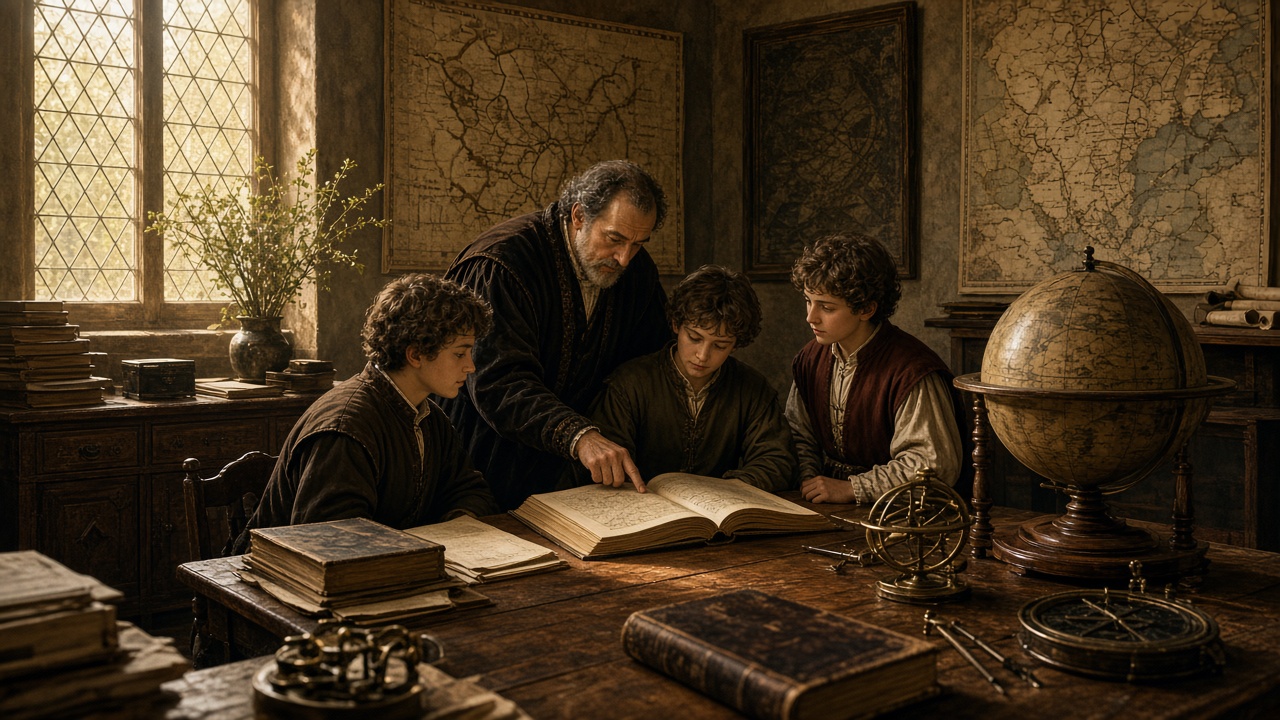
Printed books, globes, and instruments filled the studies of Renaissance scholars.
14th–15th century: Humanists such as Petrarch and Vittorino da Feltre promote the studia humanitatis — history, poetry, ethics, and rhetoric.
c. 1440: Johannes Gutenberg develops movable-type printing in Mainz.
1517 / 1599: Martin Luther’s Reformation encourages schools and Bible reading; the Jesuit Ratio Studiorum standardises teaching in hundreds of colleges.
1636 / 1657–58: Harvard College founded; Comenius publishes Didactica Magna and Orbis Pictus, the first picture textbook for children.
Tools of Learning
Printed books: Textbooks, grammars, and dictionaries in large numbers.
Illustrated texts: Pictures used to teach children (Orbis Pictus).
Globes & maps: Geography shaped by new voyages of discovery.
Features
Humanism: Education to develop the whole person.
Rising literacy: Reading spreads beyond clergy and nobles.
Graded classes: Comenius proposes age-based stages of schooling.
🏫 School for All1700 – 1900
Enlightenment & Mass Schooling
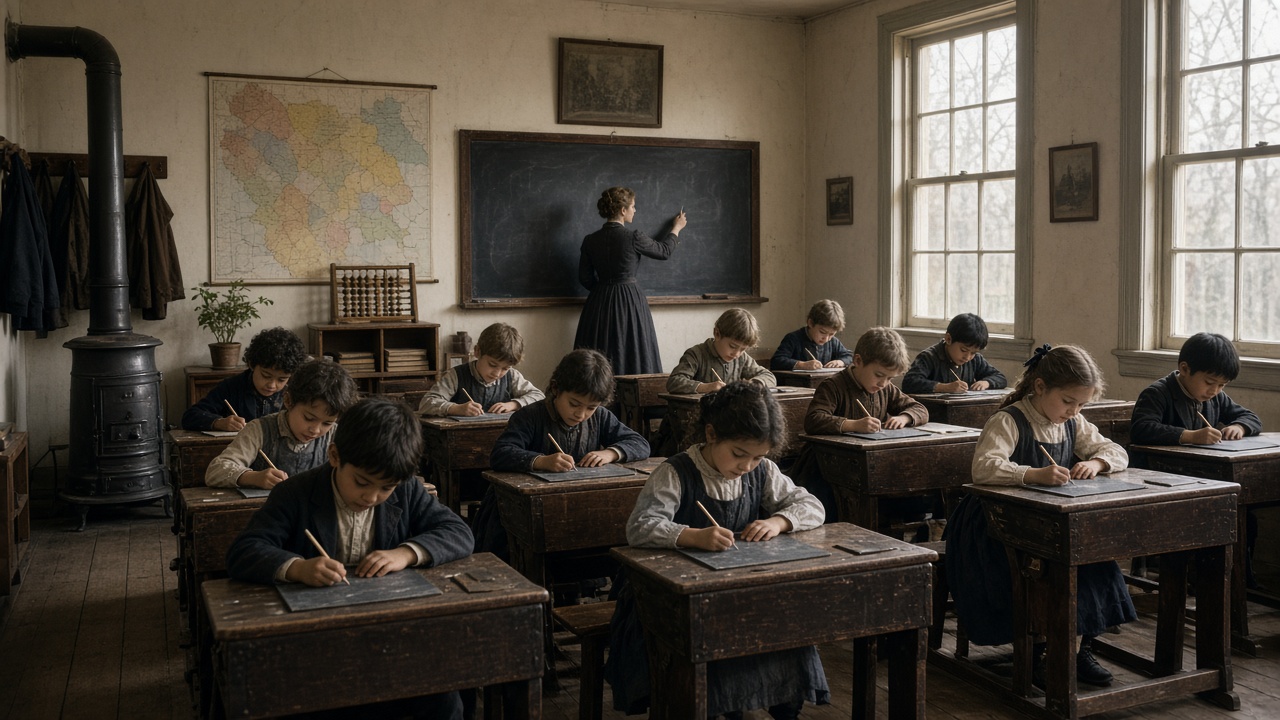
Enlightenment thinkers argued that reason and education could improve society. Governments began to see schooling as a public duty, and by the late 19th century many countries had free, compulsory primary schools with trained teachers, fixed timetables, and standard textbooks.
A 19th-century classroom: rows of desks, slates, and a blackboard became the global model of schooling.
1690s–1762: John Locke’s Some Thoughts Concerning Education (1693) and Rousseau’s Émile (1762) promote learning through experience.
1763: Prussia’s General School Regulations introduce compulsory schooling for children.
1800s: Pestalozzi’s child-centred teaching; Froebel opens the first kindergarten (1837); Horace Mann champions free “common schools” in the USA.
1870 / 1872: England’s Elementary Education Act and Japan’s Gakusei school system spread mass education; in India, Wood’s Despatch (1854) and the first universities (1857) follow.
Tools of Learning
Slates & blackboards: Cheap tools for whole-class teaching.
Standard textbooks: Primers and readers printed in large numbers.
Teacher-training colleges: “Normal schools” prepare professional teachers.
Features
Compulsory attendance: School becomes a legal duty for children.
Age-graded classes: Children grouped by age with fixed syllabi.
Discipline & drill: Strict rules and rote learning were common.
🌱 Child-Centred1900 – 1990
Progressive & Universal Education
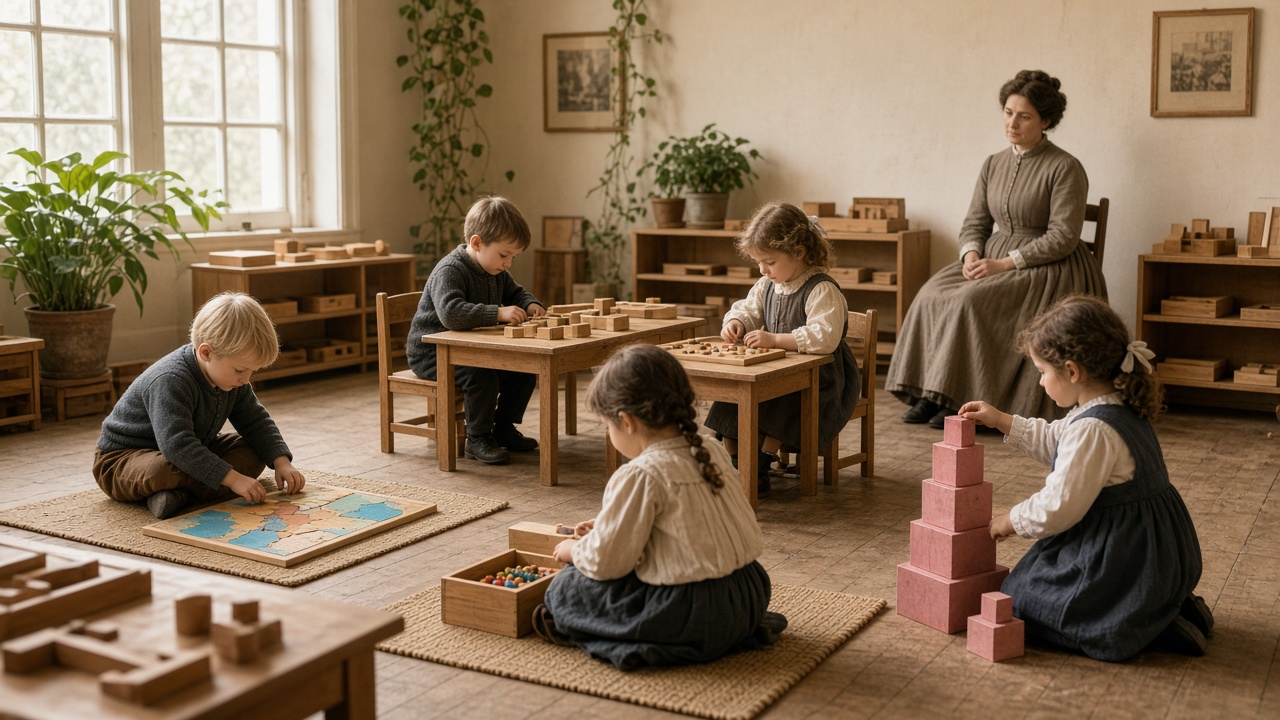
New thinkers put the child at the centre, arguing that children learn best by doing, exploring, and interacting. After two world wars, education was declared a human right, schooling expanded rapidly worldwide, and new ideas such as distance learning and adult literacy took root.
Hands-on learning: progressive classrooms let children explore materials at their own pace.
1907 / 1916: Maria Montessori opens the Casa dei Bambini in Rome; John Dewey publishes Democracy and Education.
1920s–1960s: Piaget and Vygotsky explain how children think and learn; Tagore’s Santiniketan and Gandhi’s Nai Talim offer Indian alternatives.
1945 / 1948 / 1954: UNESCO founded; Universal Declaration of Human Rights (Article 26) declares education a right; Brown v. Board of Education ends legal school segregation in the USA.
1957–1990: Sputnik sparks science education reform; Paulo Freire’s Pedagogy of the Oppressed (1968); the Open University (1969); UN Convention on the Rights of the Child (1989); Education for All at Jomtien (1990).
Tools of Learning
Learning materials: Montessori blocks, charts, and science kits.
Radio & TV: Educational broadcasts reach distant learners.
Projectors & early computers: Audio-visual aids enter classrooms.
Features
Learning by doing: Projects, play, and experiments.
Education as a right: Free primary education promised for all.
Equality: Push to include girls, minorities, and children with disabilities.
🌐 Learning Anywhere1990 – Present
Digital & Global Learning
The internet opened free courses, videos, and libraries to anyone with a connection. The COVID-19 pandemic forced the biggest shift to online learning in history, and generative AI is now changing how students study, write, and get help — while access, equity, and quality remain global challenges.
Online classrooms connect learners and teachers across countries and time zones.
1991 / 2001: The World Wide Web goes public; MIT OpenCourseWare makes university course materials free online.
2008 / 2012: Khan Academy offers free video lessons; Coursera, edX, and Udacity launch the “Year of the MOOC.”
2015 / 2020: UN adopts SDG 4 on quality education for all; COVID-19 school closures affect about 1.6 billion learners, pushing online classes worldwide.
2022–present: Generative AI tools such as ChatGPT arrive; schools and universities write new rules for AI tutoring, assessment, and academic honesty.
Tools of Learning
Online platforms: MOOCs, learning apps, and video lessons.
Smart classrooms: Interactive boards, tablets, and learning management systems.
AI tutors: Personalised practice, feedback, and translation.
Features
Lifelong learning: Courses for every age, anytime.
Global access: Top teachers and universities reachable from home.
Digital divide: Millions still lack devices, internet, or trained teachers.
Great Thinkers Who Shaped Education
Ideas from these educators and philosophers still influence how teachers teach and how schools are organised today.
Thinker
Period
Key idea
Socrates
c. 470–399 BCE
Learning through questioning and dialogue
Confucius
551–479 BCE
Education for moral character and good government
Plato
c. 428–348 BCE
Founded the Academy; education shapes a just society
Aristotle
384–322 BCE
Observation, logic, and learning by habit
Quintilian
c. 35–100 CE
Kind teaching, motivation, and training of orators
John Amos Comenius
1592–1670
Universal schooling and picture textbooks
Jean-Jacques Rousseau
1712–1778
Natural, child-centred learning (Émile)
Friedrich Froebel
1782–1852
Kindergarten and learning through play
Maria Montessori
1870–1952
Self-directed, hands-on learning
John Dewey
1859–1952
Learning by doing; education for democracy
Rabindranath Tagore
1861–1941
Learning in harmony with nature (Santiniketan)
Paulo Freire
1921–1997
Critical pedagogy and education for freedom
Famous Early Centres of Learning
Long before modern universities, these centres attracted scholars and students from far and wide.
Centre
Location
Founded
Known for
Takshashila
Gandhara (present-day Pakistan)
c. 6th–5th century BCE
Medicine, grammar, politics, and the arts
Plato’s Academy
Athens, Greece
c. 387 BCE
Philosophy and mathematics
Aristotle’s Lyceum
Athens, Greece
335 BCE
Science, logic, and politics
Library of Alexandria
Alexandria, Egypt
3rd century BCE
Vast scroll collection and research
Nalanda
Bihar, India
5th century CE
Buddhist studies, logic, and medicine
House of Wisdom
Baghdad, Iraq
9th century
Translation, mathematics, and astronomy
al-Qarawiyyin
Fez, Morocco
859
Oldest existing educational institution
Al-Azhar
Cairo, Egypt
970s
Islamic law, theology, and Arabic
University of Bologna
Bologna, Italy
1088
Oldest university in Europe; law
University of Oxford
Oxford, England
c. 1096
Oldest English-speaking university
Education: Then vs Now
The future classroom may combine human teachers with personalised AI tutors and immersive technology.
Aspect
Ancient & Medieval
Today
Who could learn
Mostly wealthy boys, clergy, and nobles
Every child has a legal right to education in most countries
Where
Gardens, temples, monasteries, and lecture halls
Schools, universities, homes, and online platforms
Teaching method
Dialogue, lecture, recitation, and memorisation
Activity-based, collaborative, and personalised learning
Materials
Wax tablets, scrolls, and hand-copied manuscripts
Printed textbooks, e-books, videos, and apps
Language
Greek, Latin, Sanskrit, Arabic, or classical Chinese
Mother tongue plus national and global languages
Curriculum
Liberal arts, philosophy, and religion
Sciences, humanities, technology, arts, and vocational skills
Certification
Teacher’s approval or a university licence
Board exams, degrees, and digital credentials
Reach
A few thousand students at great centres
Over a billion learners worldwide
Education History Timeline Summary
Year / Era
Milestone
c. 470–399 BCE
Socrates develops the questioning method
c. 387 BCE
Plato founds the Academy in Athens
335 BCE
Aristotle opens the Lyceum
3rd century BCE
Library of Alexandria flourishes
5th century CE
Nalanda becomes a great centre of learning
859
al-Qarawiyyin founded in Fez
1088
University of Bologna
c. 1440
Gutenberg’s printing press
1658
Comenius’s Orbis Pictus — first picture textbook
1763
Prussia introduces compulsory schooling
1837
Froebel opens the first kindergarten
1870
England’s Elementary Education Act
1907
Montessori’s Casa dei Bambini
1948
UDHR Article 26: education as a human right
1969
Open University pioneers distance learning
2012
Year of the MOOC
2015
UN SDG 4 on quality education
2020
COVID-19 drives global online learning
2022
Generative AI enters classrooms
Test Your Knowledge
20 quick questions from the education history timeline. Click each question to reveal the answer.
Answer: Socrates (the Socratic method).
Answer: Plato.
Answer: The Lyceum (335 BCE).
Answer: Egypt.
Answer: Quintilian.
Answer: Takshashila and Nalanda.
Answer: Fatima al-Fihri.
Answer: The University of Bologna (1088).
Answer: Grammar, rhetoric, and logic.
Answer: Johannes Gutenberg.
Answer:Orbis Pictus (1658).
Answer: Prussia.
Answer:Émile (1762).
Answer: Friedrich Froebel (1837).
Answer: Horace Mann.
Answer: Rome, Italy (1907).
Answer: John Dewey (1916).
Answer: Article 26 (1948).
Answer: 2012.
Answer: SDG 4 (adopted in 2015).
Classroom activity
Students Tasks
Use these prompts for discussion or projects on the history of education.
Click any panel to expand and explore the visual mood.
Education through the ages — Athens, Alexandria, medieval halls, Renaissance studies, Victorian classrooms, Montessori rooms, online classes, and AI tutors.
Ancient Greece
Plato’s Academy
Alexandria
The great library
Medieval University
Lectures and disputations
Renaissance
Printed books and humanism
Mass Schooling
Slates and blackboards
Progressive Education
Learning by doing
Online Learning
Global classrooms
AI Future
Personalised AI tutors
Explore all education timelines
Jump to any other education timeline on WorldTimelineHub.
Disclaimer: This content is AI-generated for educational purposes and may contain errors or outdated details. For correct and authoritative information, please refer to official and reliable sources such as government publications, manufacturers, museums, and academic references.