Golden Revolution & Horticulture Timeline of India
India has grown mangoes and bananas for thousands of years and gathered wild honey even longer. But for decades after independence, horticulture was a side activity. From the
1990s a “Golden Revolution” in fruits, vegetables, flowers, and spices — and later a “Sweet Revolution” in honey — made horticulture bigger than foodgrains.
This timeline covers ancient mango groves and honey hunters, Mughal gardens, crops brought by the Portuguese, tea and coffee plantations, Himachal apples, the first bee boxes,
KVIC beekeeping, horticulture research, the Golden Revolution, the National Horticulture Mission, polyhouses, and the Honey Mission.
Fruits and vegetables give vitamins, minerals, and fibre that cereals alone cannot. Horticulture crops earn far more per acre than grains, so they help small farmers raise
their incomes, and they create jobs in nurseries, packing, cold storage, processing, and exports. Bees make honey and wax, but their bigger gift is pollination: many
fruits, vegetables, and oilseeds give much higher yields when bees visit their flowers.
Big picture
India’s horticulture and honey in one view
Ancient orchards, royal gardens, and forest honey came first. Colonial rule added plantations and hill apples. After independence, research institutes and KVIC
beekeeping laid the base, and from the 1990s better planting material, drip irrigation, and horticulture missions turned India into the world’s second-largest producer
of fruits and vegetables.
Related timelines:
Green Revolution,
Yellow Revolution,
Silver Revolution.
~355 MT
Horticulture output, 2023–24
2nd
Largest fruit and vegetable producer
1st
In mangoes, bananas, papayas
~1.4 lakh t
Honey produced a year
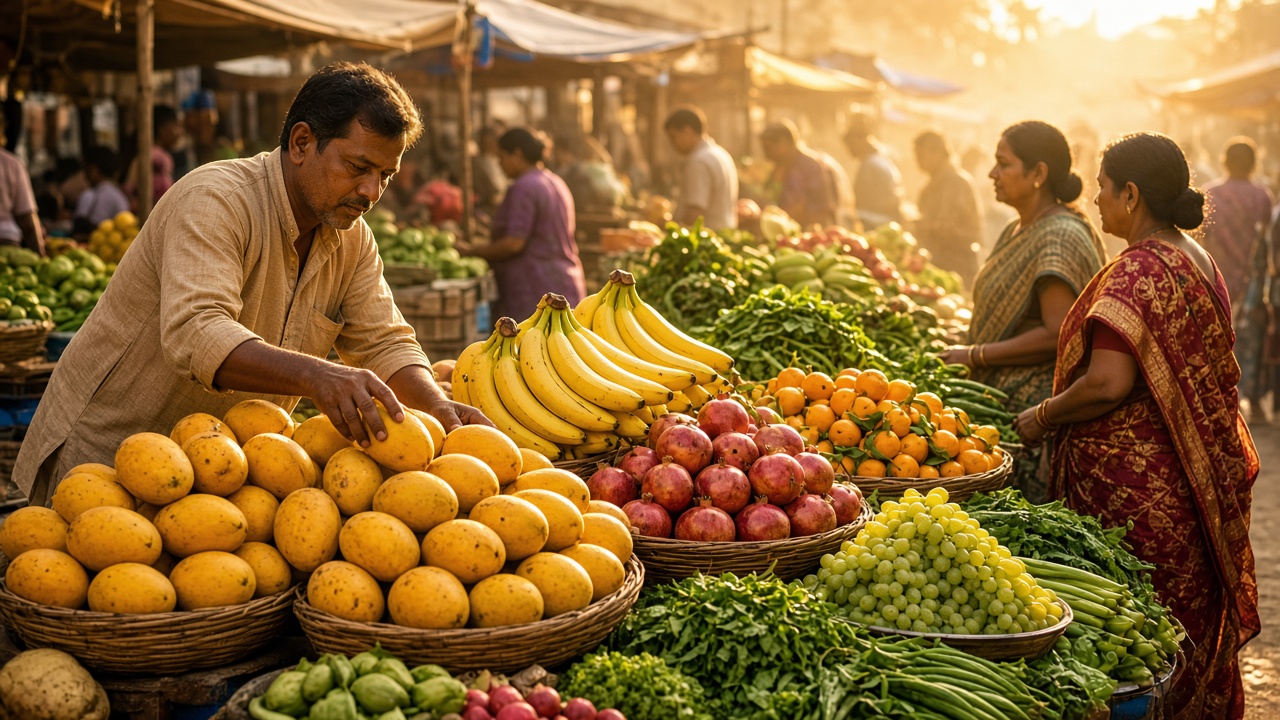
Mangoes, bananas, pomegranates, and fresh vegetables fill Indian markets (artistic illustration).
🥭 Ancient OrchardsAncient – 1750
Mango Groves, Mughal Gardens & Honey Hunters
India is the homeland of the mango and a centre of banana, citrus, and spice cultivation. Forest communities hunted wild honey, rulers planted great orchards, and Portuguese traders brought new fruits from the Americas.
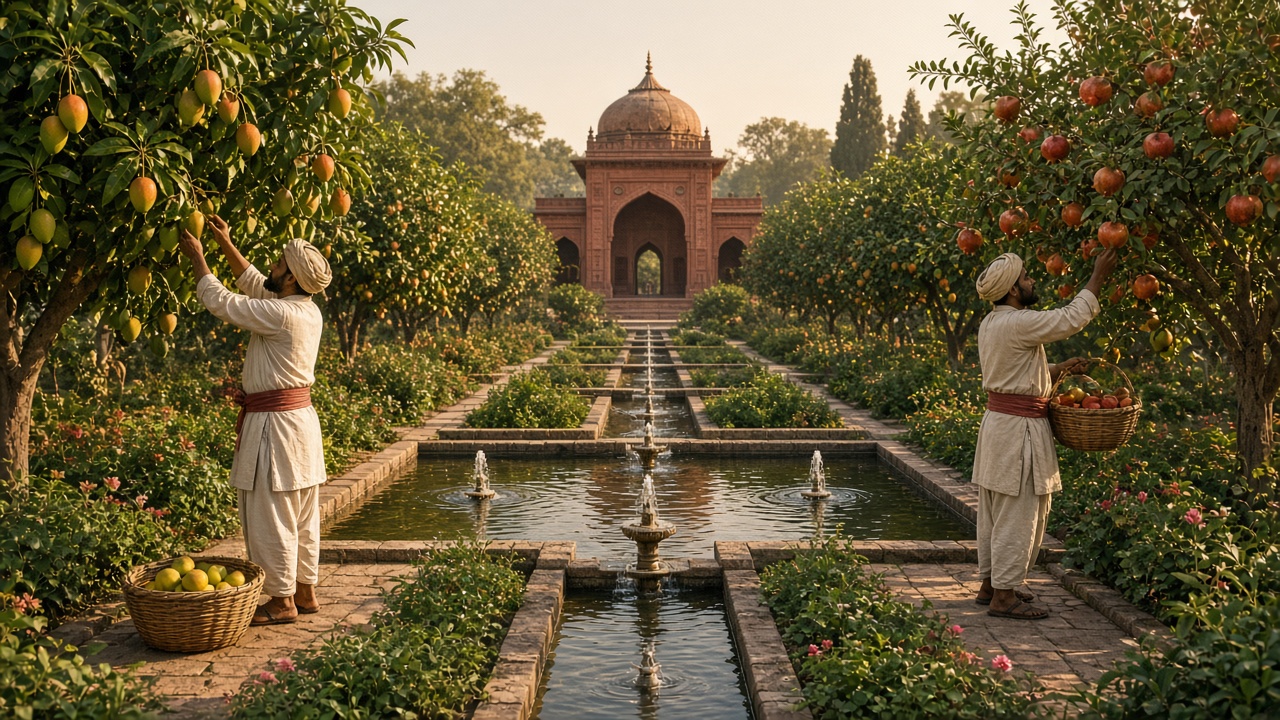
Mughal gardens combined flowing water with fruit trees and flowers (artistic illustration).
Prehistoric–Vedic times: Rock paintings in central India show people gathering wild honey; the Rig Veda praises madhu (honey), and mangoes are grown for over 4,000 years.
Ancient period: Ayurvedic texts of Charaka and Sushruta describe many kinds of honey as medicine; the Arthashastra mentions royal orchards and gardens.
16th century: The Portuguese bring pineapple, papaya, cashew, guava, chilli, and potato, and spread mango grafting in Goa; the Alphonso mango is named after Afonso de Albuquerque.
16th–17th centuries: Babur praises Indian fruits in the Baburnama; Mughal charbagh gardens flourish, and Akbar is said to plant the Lakhi Bagh of one lakh mango trees near Darbhanga.
Technology
Grafting: Copying the best mango trees.
Garden canals: Water for orchards.
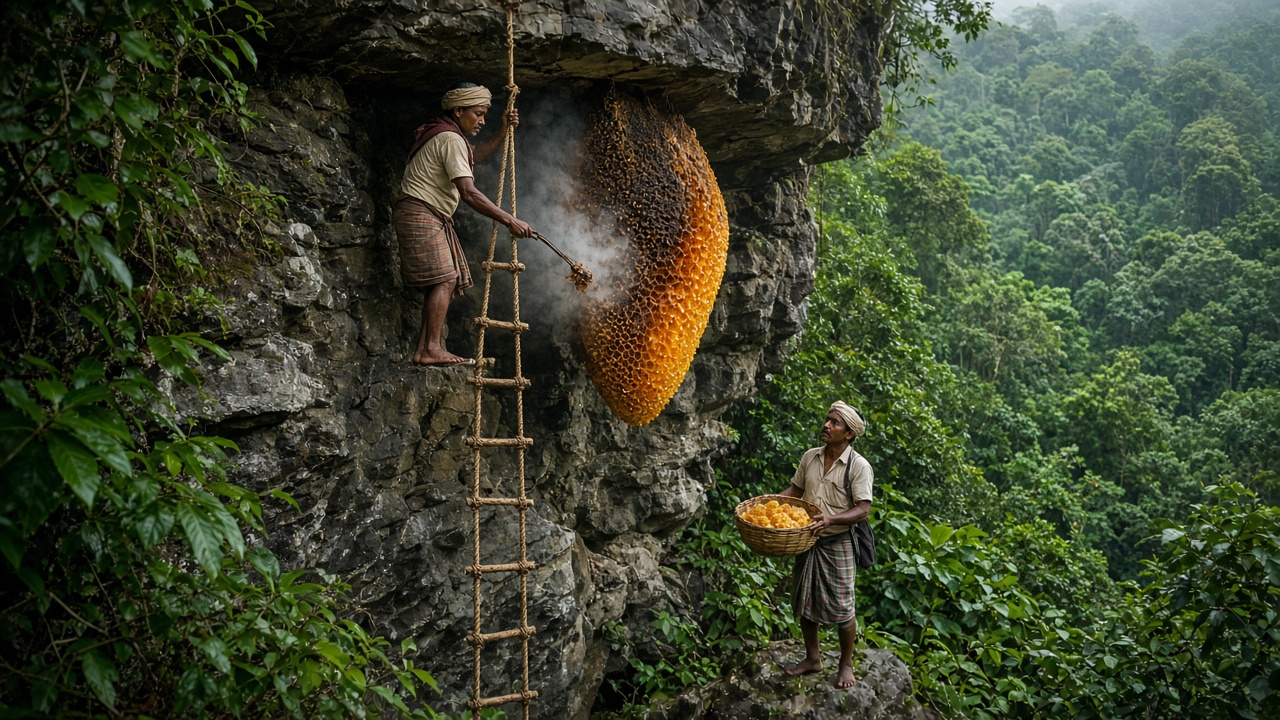
Smoke and ropes: Honey hunting on cliffs.
Features
Native fruits: Mango, banana, jackfruit.
New World crops: Arrive by sea.
Forest honey: Collected, not farmed.
🍎 Plantations1750 – 1946
Plantations, Hill Apples & the First Bee Boxes
Colonial rule built botanical gardens and export plantations of tea, coffee, and spices. Hill stations gained apple orchards, and missionaries and officials first tried keeping Indian honeybees in wooden boxes.
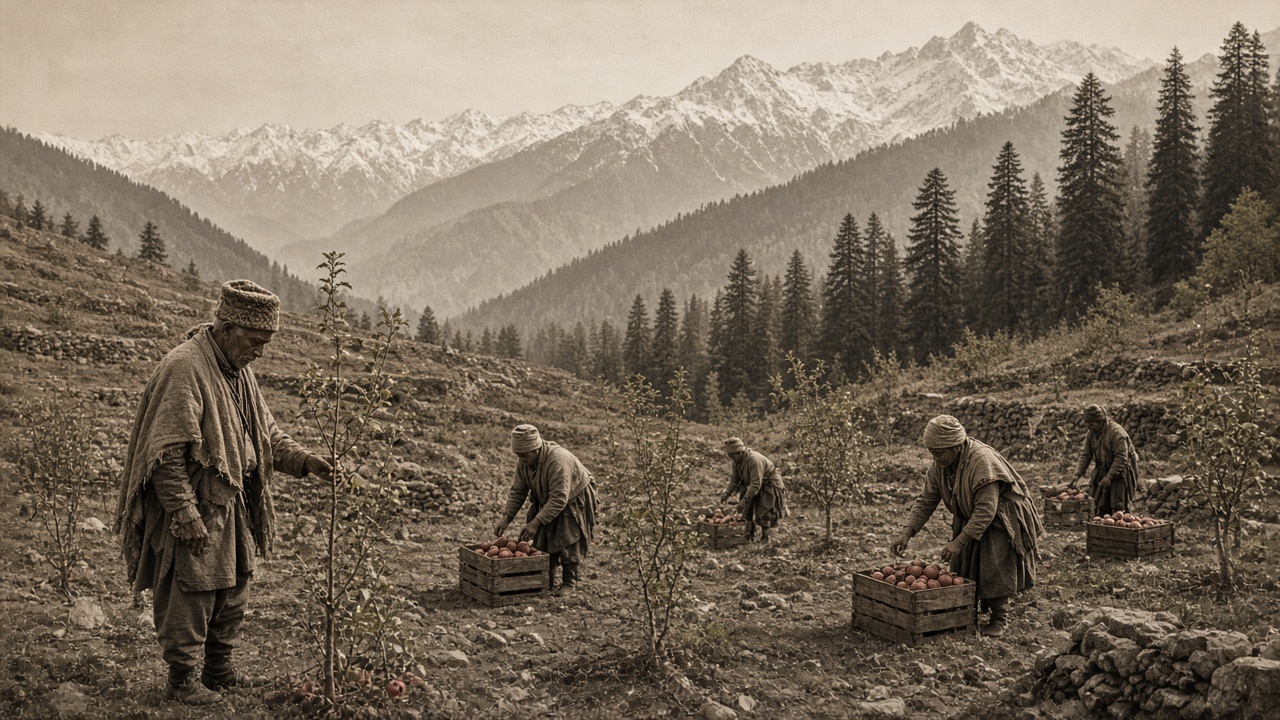
American apple varieties transformed the hills of Himachal from 1916 (artistic illustration).
1787: The Calcutta Botanic Garden is founded and tests fruit, spice, and plantation crops from around the world.
1830s–1870s: Tea gardens spread in Assam and Darjeeling, coffee estates in the southern hills; apples are planted in Kullu by Captain R. C. Lee (around 1870).
1880s–1910s: The first attempts to keep bees in modern hives are made in Bengal and Punjab; Rev. Newton trains beekeepers in Travancore and designs the Newton hive.
1916–1939: Samuel Evans Stokes brings Red Delicious apples to Kotgarh (1916); the All India Beekeepers’ Association is formed (1939).
Technology
Movable-frame hives: Honey without killing bees.
Botanical gardens: Testing new crops.
Hill terraces: Orchards on slopes.
Features
Export crops: Tea, coffee, spices.
Apple economy: Begins in the hills.
Village fruit: Still unorganised.
🐝 Foundations1947 – 1990
Research Institutes, KVIC Beekeeping & Horticulture Boards
While the Green Revolution focused on grain, independent India quietly built the base for horticulture and beekeeping: research institutes, village beekeeping through KVIC, a new honeybee, and national boards for horticulture and exports.
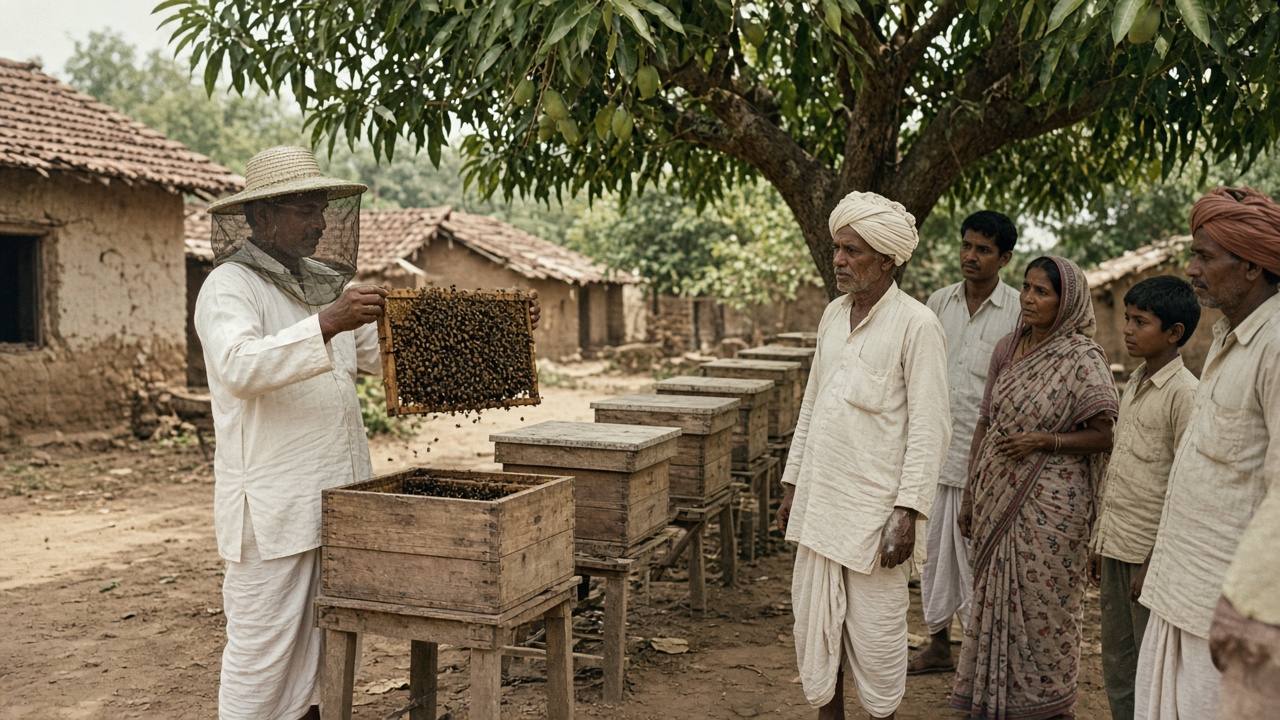
KVIC workers taught villagers to keep bees in wooden boxes (artistic illustration).
1956–1962: The Khadi and Village Industries Commission takes up beekeeping as a village industry and sets up the Central Bee Research Institute in Pune (1962).
1960s–1970s: The European honeybee (Apis mellifera) is introduced, first in Himachal and then commercially in Punjab; the Indian Institute of Horticultural Research opens in Bengaluru (1967).
Late 1970s–1980s: Thai sacbrood virus wipes out most Indian hive-bee colonies in many regions, pushing beekeepers towards the European bee.
1984–1986: The National Horticulture Board (1984) and APEDA (1986) are set up to develop horticulture and farm exports.
Technology
Standard bee boxes: ISI hive sizes.
Honey extractors: Spin honey from combs.
Improved varieties: From research stations.
Features
Village industry: Beekeeping for income.
Grain first: Horticulture lower priority.
New institutions: Boards and institutes.
✨ Golden Revolution1991 – 2004
The Golden Revolution in Horticulture
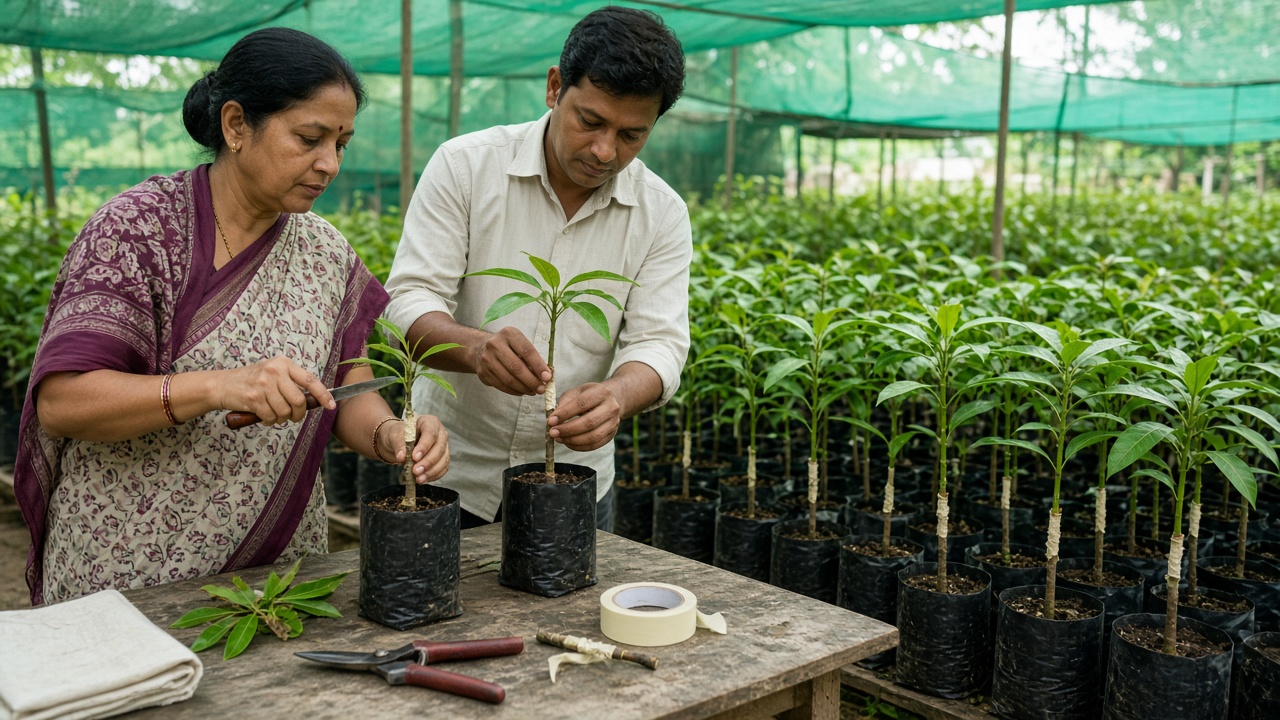
With food grain needs met, planners turned to horticulture. Grafted plants, drip irrigation, and state orchard schemes spread fruit and vegetable farming quickly, and India became a world leader in several crops. This period is called the Golden Revolution.
Millions of grafted saplings from nurseries spread improved fruit varieties (artistic illustration).
1990–1991: Maharashtra links orchard planting to its Employment Guarantee Scheme, starting a boom in mango, grape, pomegranate, and cashew orchards.
1990s: The Eighth Plan gives horticulture special attention; Nashik grapes and Alphonso mangoes grow as exports. Nirpakh Tutej is often called the father of the Golden Revolution.
2000: A National Bee Board is set up to promote scientific beekeeping and pollination.
2001–2004: A Technology Mission supports horticulture in the North-Eastern states; Darjeeling tea becomes India’s first GI product (2004).
Technology
Drip irrigation: Water to each plant.
Tissue culture: Disease-free banana plants.
High-density orchards: More trees per acre.
Features
Higher incomes: Fruits pay more than grain.
Exports: Grapes, mangoes, flowers.
Diversification: Beyond rice and wheat.
🫑 Missions2005 – 2015
Horticulture Missions, Polyhouses & Cold Chains
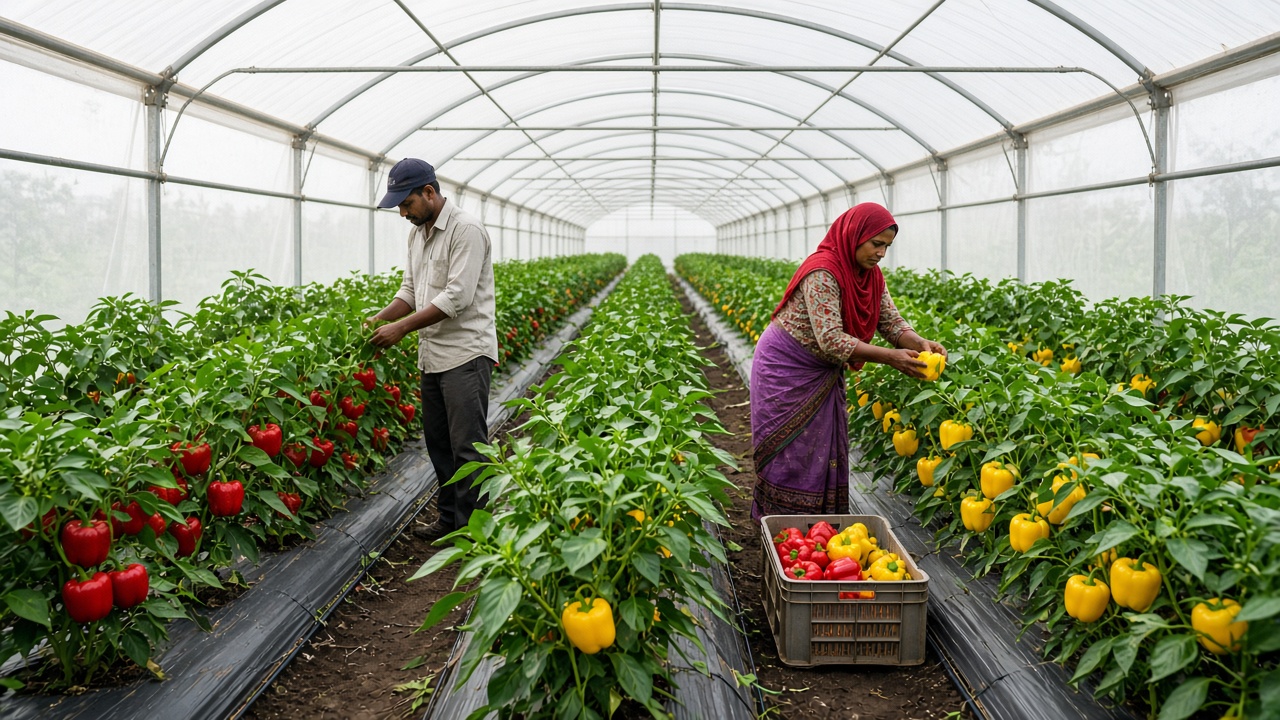
National missions funded orchards, nurseries, greenhouses, and cold storage. Protected cultivation made high-value vegetables and flowers possible year-round, and horticulture output overtook foodgrains for the first time.
Polyhouses with drip lines grow coloured capsicum and flowers year-round (artistic illustration).
2005–2006: The National Horticulture Mission begins; the National Bee Board is reconstituted (2006) to link beekeeping with pollination.
2008–2011: Polyhouses, shade nets, and plastic mulch spread with subsidies; the National Centre for Cold-chain Development is set up (2011).
2012–2013: Horticulture production (about 268 million tonnes) overtakes foodgrain production for the first time.
2014–2015: Horticulture schemes merge into the Mission for Integrated Development of Horticulture (MIDH); a European ban on Indian Alphonso mangoes (2014) is lifted after stricter checks (2015).
Technology
Polyhouses: Controlled growing.
Fertigation: Nutrients through drip.
Pack houses: Sorting and grading.
Features
Horticulture leads: Beats foodgrains.
Cold storage: Less waste.
Quality rules: For export markets.
🍯 Sweet Revolution2016 – Present
Sweet Revolution, Honey Mission & Record Harvests
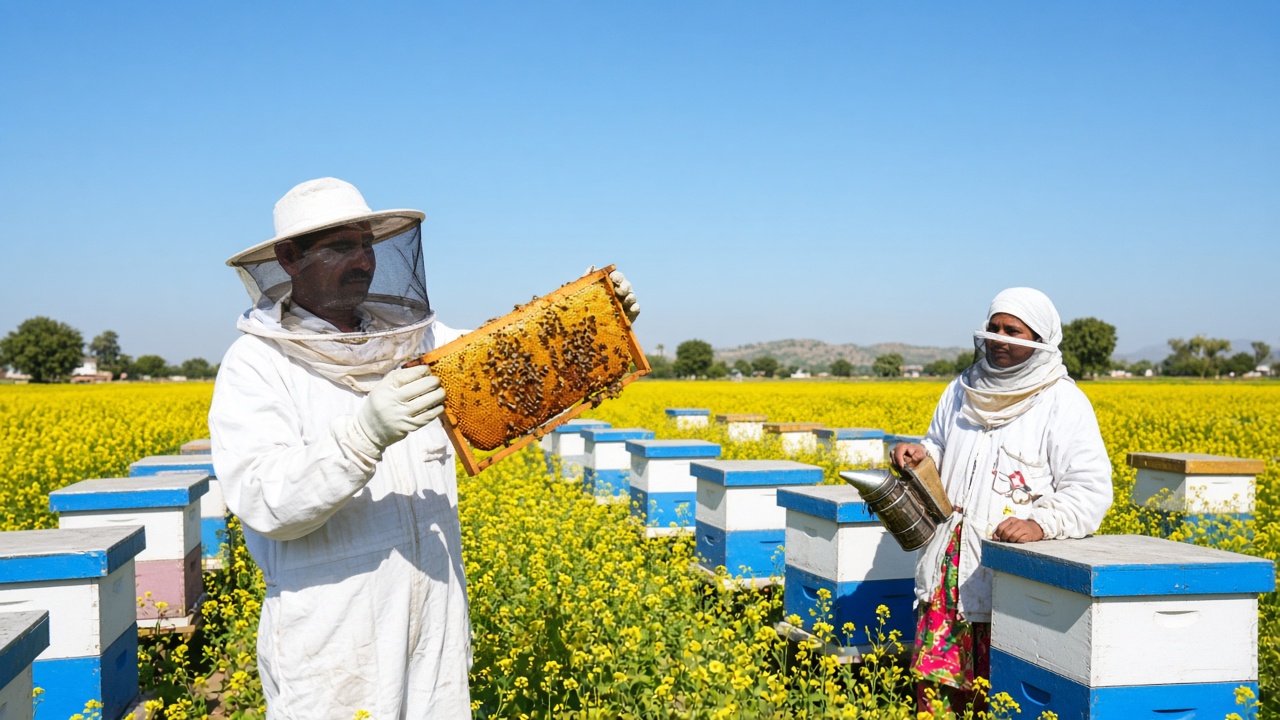
Honey became a national priority with bee-box distribution and a dedicated beekeeping mission. Horticulture reached record levels, GI tags promoted famous regional fruits, and new programmes tackled price crashes and plant diseases.
Bee boxes in mustard fields give honey and better oilseed yields (artistic illustration).
2017–2018: KVIC launches the Honey Mission, distributing bee boxes to farmers; Operation Greens targets tomato, onion, and potato prices; Ratnagiri Alphonso and Shahi litchi receive GI tags.
2020: The National Beekeeping and Honey Mission is launched with about ₹500 crore; a report on honey adulteration leads to stricter testing.
2021–2023: Honey production crosses about 1.3 lakh tonnes, and India becomes one of the world’s leading honey exporters.
2024–present: A Clean Plant Programme is approved to supply virus-free planting material; horticulture output reaches about 355 million tonnes.
Forest communities still harvest giant rock bee combs using smoke and rope ladders (artistic illustration).
Bee
Type
Known for
Rock bee (Apis dorsata)
Wild, native
Huge single combs on cliffs and tall trees; most forest honey
Indian hive bee (Apis cerana indica)
Native, kept in boxes
Traditional beekeeping in wall cavities and bee boxes
Little bee (Apis florea)
Wild, native
Small single combs on bushes; little honey
European honeybee (Apis mellifera)
Introduced, kept in boxes
Gentle and productive; gives most commercial honey
Stingless bee (dammar bee)
Native, kept in pots and logs
Tiny amounts of prized medicinal honey, especially in Kerala
Leading Horticulture Crops and Regions
Crop
Leading regions
Fact
Mango
Uttar Pradesh, Andhra Pradesh, Karnataka
India grows about 40% of the world’s mangoes
Banana
Andhra Pradesh, Maharashtra, Gujarat, Tamil Nadu
India is the largest producer
Apple
Jammu & Kashmir, Himachal Pradesh
Grown on hill terraces
Grapes
Maharashtra (Nashik)
Major fresh-fruit export
Orange and kinnow
Maharashtra (Nagpur), Punjab
Nagpur orange has a GI tag
Pomegranate
Maharashtra (Solapur), Karnataka
Grown in dry regions with drip irrigation
Litchi
Bihar (Muzaffarpur)
Shahi litchi has a GI tag
Potato and onion
Uttar Pradesh, West Bengal, Maharashtra
India is the second-largest producer of both
Coconut and cashew
Kerala, Karnataka, Tamil Nadu, Goa
Key plantation crops of the coast
Spices
Kerala, Rajasthan, Gujarat, Andhra Pradesh
India is the largest producer and exporter
Flowers
Karnataka, Tamil Nadu, West Bengal
Roses, marigolds, and jasmine for markets and temples
India’s Horticulture Production Over Time
Year
Horticulture (approx. million tonnes)
What was happening
1991–92
~97
Golden Revolution begins
2001–02
~146
Drip irrigation and orchard schemes
2005–06
~182
National Horticulture Mission launched
2011–12
~257
Polyhouses and cold chains spread
2012–13
~268
Horticulture overtakes foodgrains
2017–18
~311
Honey Mission and Operation Greens
2021–22
~347
Honey output crosses 1.3 lakh tonnes
2023–24
~355
Record production
Golden Revolution & Horticulture Timeline Summary
Year / Era
Milestone
Prehistoric
Rock paintings show wild honey gathering
Vedic period
Honey (madhu) praised in the Rig Veda
16th century
Portuguese bring pineapple, papaya, cashew, and chilli
16th–17th centuries
Mughal gardens and royal mango orchards
1787
Calcutta Botanic Garden founded
1830s
Tea gardens begin in Assam
1880s
First modern bee hives tried
1916
Red Delicious apples reach Kotgarh
1939
All India Beekeepers’ Association
1962
Central Bee Research Institute, Pune
1967
Indian Institute of Horticultural Research, Bengaluru
1984
National Horticulture Board
1986
APEDA formed
1991–2003
The Golden Revolution in horticulture
2000
National Bee Board
2004
Darjeeling tea becomes India’s first GI
2005–06
National Horticulture Mission
2012–13
Horticulture overtakes foodgrains
2014–15
Mission for Integrated Development of Horticulture
2017
KVIC Honey Mission
2018
Operation Greens; Alphonso and Shahi litchi GI tags
2020
National Beekeeping and Honey Mission
2024
Clean Plant Programme approved
Test Your Knowledge
20 quick questions from the Golden Revolution, horticulture, and honey timeline. Click each question to reveal the answer.
Answer: Horticulture (fruits, vegetables, flowers, spices) and honey.
Answer: Nirpakh Tutej.
Answer: About 1991 to 2003.
Answer: Increasing honey production through scientific beekeeping.
Answer:Madhu.
Answer: Afonso de Albuquerque, a Portuguese general.
Answer: Any two of pineapple, papaya, cashew, and guava.
Answer: Samuel Evans Stokes, at Kotgarh.
Answer: The Khadi and Village Industries Commission (KVIC).
Answer: Pune, Maharashtra.
Answer: The European honeybee (Apis mellifera).
Answer: The rock bee (Apis dorsata).
Answer: 1984.
Answer: Darjeeling tea (2004).
Answer: 2005–06.
Answer: 2012–13.
Answer: Mission for Integrated Development of Horticulture.
Answer: The National Beekeeping and Honey Mission (NBHM).
Answer: Mango, banana, and papaya.
Answer: 20 May.
Classroom activity
Students Tasks
Use these prompts for discussion or projects on horticulture, honey, and the Golden Revolution in India.
Timeline understandingGeographyPollination and ecologyFarmer incomes
Mark India’s famous fruit regions — Ratnagiri Alphonso, Nashik grapes, Nagpur oranges, Himachal apples, Muzaffarpur litchi — on a map.
Make a bar graph of India’s horticulture production from 1991–92 to 2023–24 using the table on this page.
List ten fruits and vegetables in your kitchen and find out which came to India from other continents.
Draw the life of a honeybee colony: queen, workers, drones, and how honey is made.
Explain with a diagram how bees pollinate flowers and why this raises crop yields.
Compare the costs and benefits of growing vegetables in a polyhouse versus an open field.
Research how honey is tested for purity and why adulteration is a problem.
Debate: “Horticulture is more important than foodgrains for India’s farmers today.”
Visit a nursery or orchard and describe how grafting or drip irrigation is used.
Compare the Green, White, Yellow, Blue, Silver, and Golden Revolutions in one table.
Continue exploring
The Golden Revolution is one of India’s colourful farm revolutions. Explore the Silver, Yellow, Green, White, and Blue Revolutions and other agriculture timelines next.
Click any panel to expand and explore the visual mood.
India’s horticulture and honey in pictures — Mughal gardens, honey hunters, hill apples, village bee boxes, grafted saplings, polyhouses, mustard-field hives, and fruit markets.
Mughal Garden
Royal orchards
Honey Hunters
Rock bee combs
Hill Apples
Kotgarh, 1916
Village Hives
KVIC beekeeping
Grafting
Golden Revolution
Polyhouse
Protected farming
Honey Harvest
Sweet Revolution
Fruit Market
Record harvests
Explore all agriculture timelines
Jump to any other agriculture timeline on WorldTimelineHub.
Disclaimer: This content is AI-generated for educational purposes and may contain errors or outdated details. For correct and authoritative information, please refer to official and reliable sources such as government publications, manufacturers, museums, and academic references.