Clothing Fashion Trends of India: From Handloom to Runway
India gave the world cotton cloth, muslin, chintz, and brocade, and for thousands of years most Indians wore simple draped, unstitched garments woven by hand. Today the same
country wears jeans and kurtis, follows film stars and influencers, shops for clothes on phone apps — and is rediscovering its handlooms.
This timeline covers Harappan cotton, the antariya and uttariya, Mughal jamas, muslins and brocades, British mill cloth, the blouse and petticoat, Swadeshi and khadi,
Bollywood trends, polyester and denim, global brands and fashion weeks, online shopping, National Handloom Day, and sustainable fashion.
Clothes tell the story of a society. What Indians wore changed with trade, empires, colonial rule, the freedom struggle, cinema, the economy, and technology. Cloth was
once India’s biggest export, then the symbol of its exploitation, and then — through khadi — a symbol of freedom. Today the textile and clothing industry is one of India’s
largest employers, and choices about what we wear affect weavers’ livelihoods and the environment.
Big picture
Indian fashion in one view
Hand-spun cotton drapes served India for thousands of years. Stitched garments spread with the Sultanates and Mughals, British mill cloth hit weavers hard, and khadi became
the uniform of freedom. After independence, film stars set trends and synthetics and denim arrived; after 1991, global brands, fashion weeks, and malls followed, and
today phones, influencers, and a handloom revival shape what India wears. Related timelines:
cotton and Bt cotton,
television,
Digital India.
5,000+ yrs
Of cotton weaving in India
~35 lakh
Handloom workers, 2019–20
~4.5 crore
Direct jobs in textiles
7 August
National Handloom Day
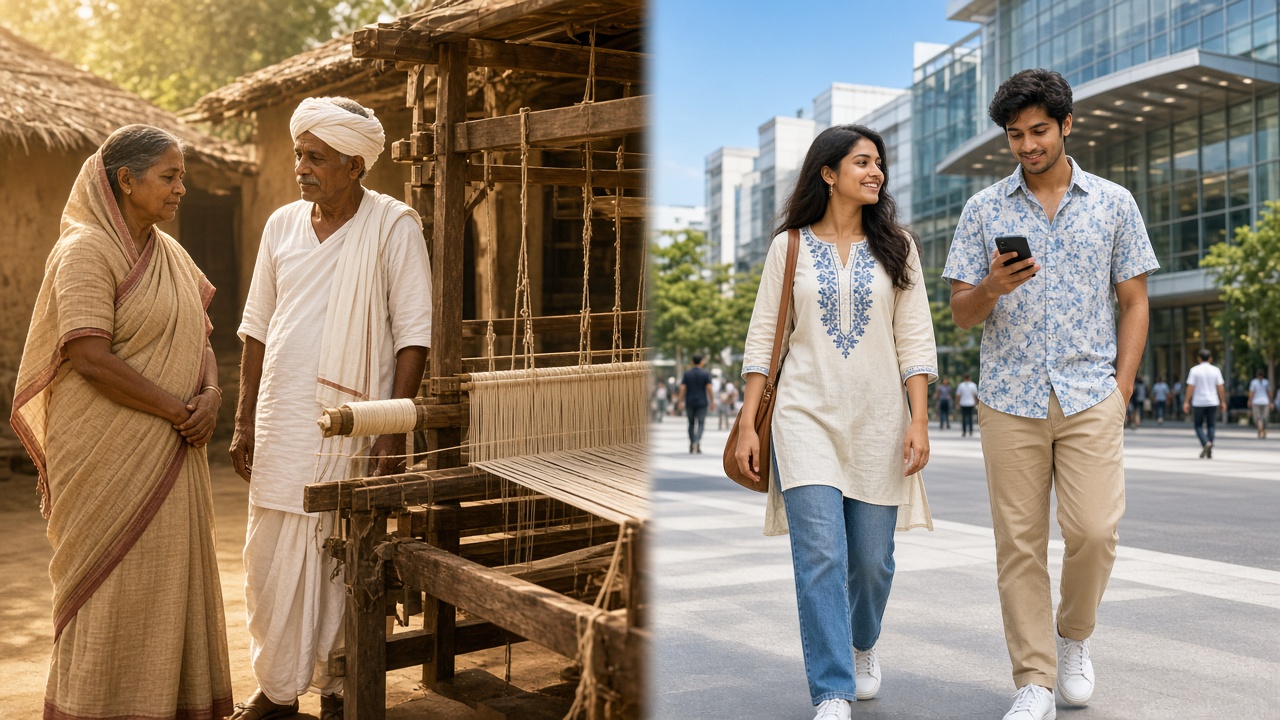
From handwoven saris and dhotis to kurtis, jeans, and sneakers (artistic illustration).
Old Fashion vs Modern Fashion at a Glance
Feature
Old times
Today
Fabric
Hand-spun cotton, silk, wool
Cotton, polyester, blends, denim, lycra
How cloth was made
Hand spinning and handlooms
Mills, powerlooms, and factories
Dyes
Natural dyes: indigo, madder, turmeric
Synthetic dyes and digital printing
Women’s everyday wear
Sari, ghagra-choli, regional drapes
Salwar-kameez, kurti with jeans, western wear
Men’s everyday wear
Dhoti, lungi, kurta, angavastram
Shirt and trousers, jeans and T-shirts
Stitching
Mostly unstitched drapes, then the local darzi
Mostly readymade garments
Where people bought clothes
Weavers, village haats, cloth merchants
Malls, brand stores, and shopping apps
Who set trends
Royal courts, religion, and community
Films, designers, social media influencers
How long clothes lasted
Years; passed down and reused
Often a season; fast fashion
Footwear
Barefoot, wooden paduka, leather mojari and kolhapuri
Sandals, shoes, and sneakers
Special occasions
Heirloom silks and brocades
Designer lehengas, sherwanis, and rentals
🧵 Cotton & DrapesAncient – 1200
Cotton, Drapes & Unstitched Cloth
India is one of the first places in the world where cotton was spun and woven. For centuries most people wore unstitched lengths of cloth, draped and tied in different ways, along with plenty of jewellery. Indian cotton cloth was traded as far as Rome.
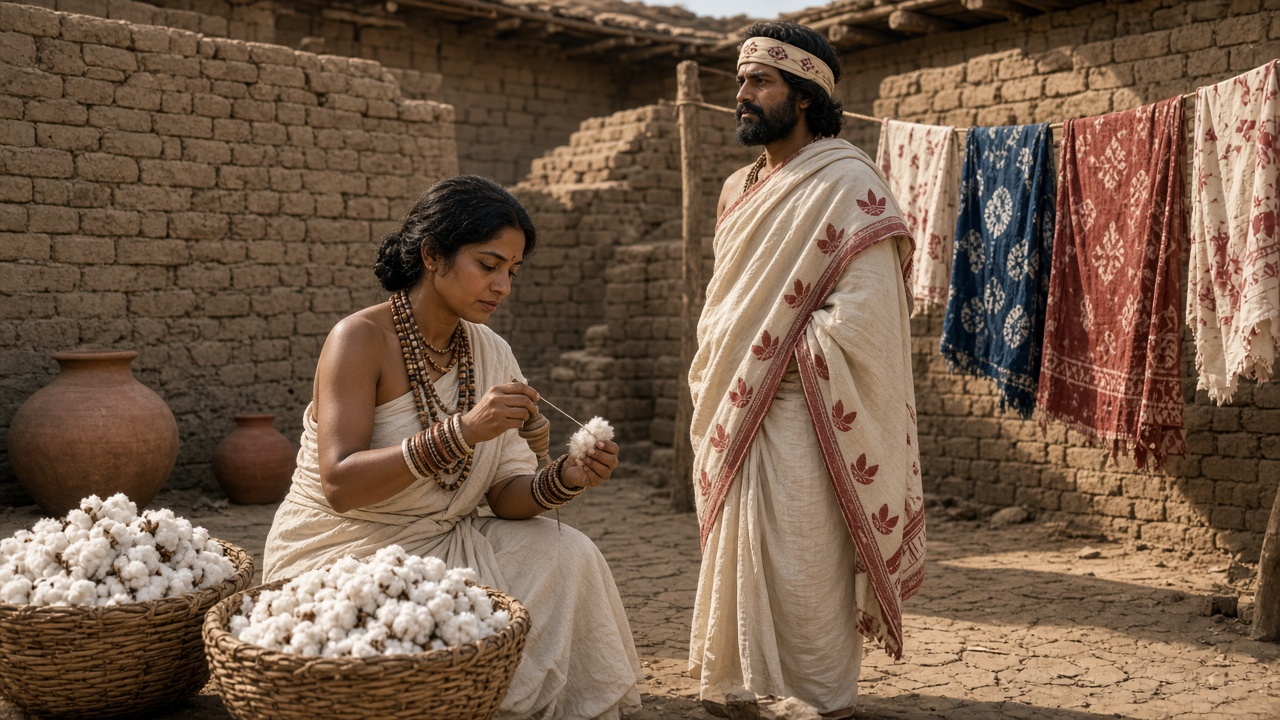
Harappans spun cotton, dyed it with madder and indigo, and wore draped shawls (artistic illustration).
c. 6000–5000 BCE: Cotton threads preserved inside a copper bead at Mehrgarh are among the world’s oldest evidence of cotton use.
c. 2600–1900 BCE: Harappans spin and weave cotton; a madder-dyed cotton fragment is found at Mohenjo-daro, and the “Priest-King” statue wears a shawl with a trefoil pattern.
Vedic to Mauryan period: People wear the antariya (lower cloth), uttariya (upper cloth), and kayabandh (waistband); Greek visitors note Indians’ fine cotton and gold ornaments.
1st–5th centuries CE: Indian muslins are exported to Rome; the Ajanta paintings show stitched tunics, tie-dyed fabrics, and a variety of styles.
Technology
Spindle and handloom: Spinning and weaving cotton.
Natural dyes: Indigo, madder, and turmeric.
Tie-dye and block print: Early patterns.
Features
Unstitched drapes: Wrapped and tied.
Jewellery: Worn by men and women.
Global trade: Cotton to Rome.
👑 Court Fashion1200 – 1757
Silks, Muslins & Mughal Court Fashion
Stitched garments such as tunics, trousers, and robes spread widely, and the tailor became an important craftsman. Mughal emperors ran royal workshops, and Indian muslins, brocades, shawls, and printed chintz were prized across Asia and Europe.
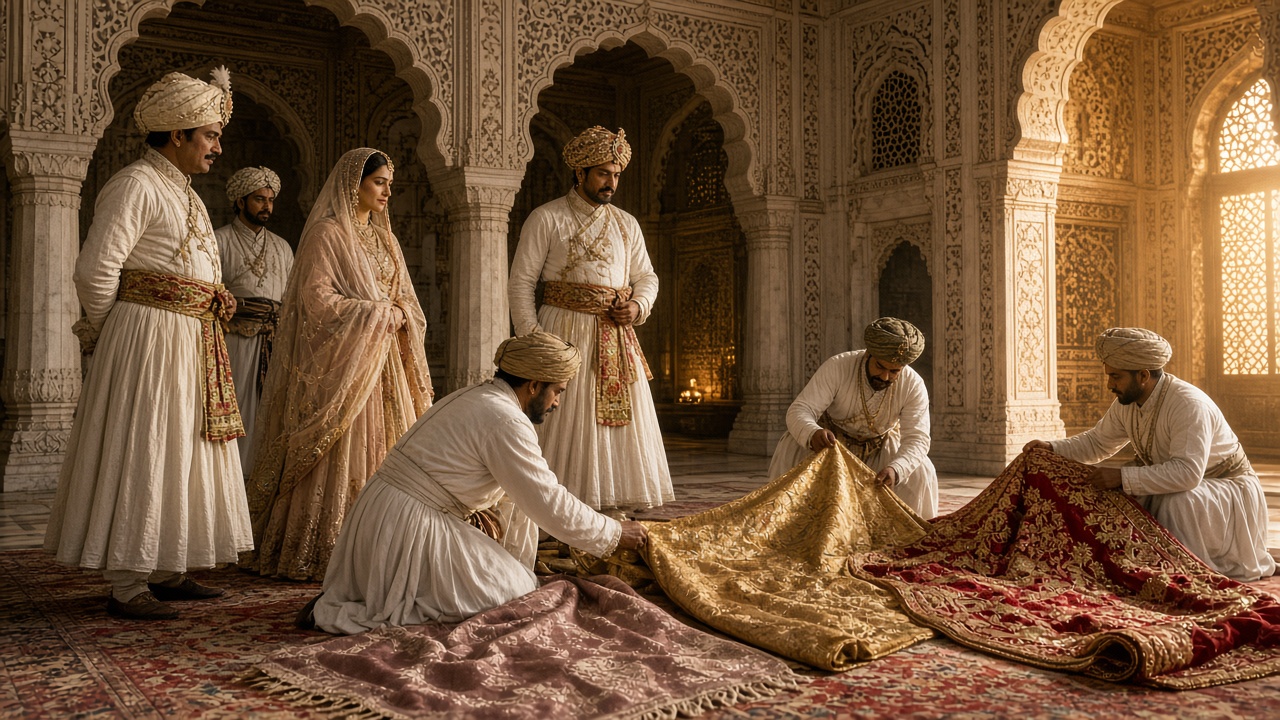
Mughal nobles wore flared jamas and patkas, and courts prized brocades and shawls (artistic illustration).
13th–14th centuries: The Delhi Sultanate brings wider use of stitched tunics and trousers (pyjama, salwar); the darzi (tailor) becomes important.
16th century: Mughal men wear the flared jama tied at the side, a patka sash, and a turban; Akbar supports royal karkhanas (workshops) and Kashmiri shawls.
17th century: Dhaka muslin, called ab-e-rawan (“flowing water”), becomes legendary; Banarasi brocade, zardozi embroidery, and Gujarat’s patola silk flourish.
17th–18th centuries: Chintz and kalamkari from the Coromandel coast become a craze in Europe; southern weaving centres such as Kanchipuram grow famous for silk.
Technology
Brocade weaving: Gold and silver zari.
Ikat: Yarn tied and dyed before weaving.
Mordant dyeing: Colourfast chintz.
Features
Stitched clothes: Jama and salwar.
Royal patronage: Court workshops.
World exports: Muslin and chintz.
🪡 Mill & Khadi1757 – 1946
Mill Cloth, Blouses & Khadi
Cheap British machine-made cloth flooded India and ruined many weavers. The sari gained the blouse and petticoat, educated men took up Western suits, and the Swadeshi movement and Gandhi’s khadi turned clothing into a weapon of the freedom struggle.
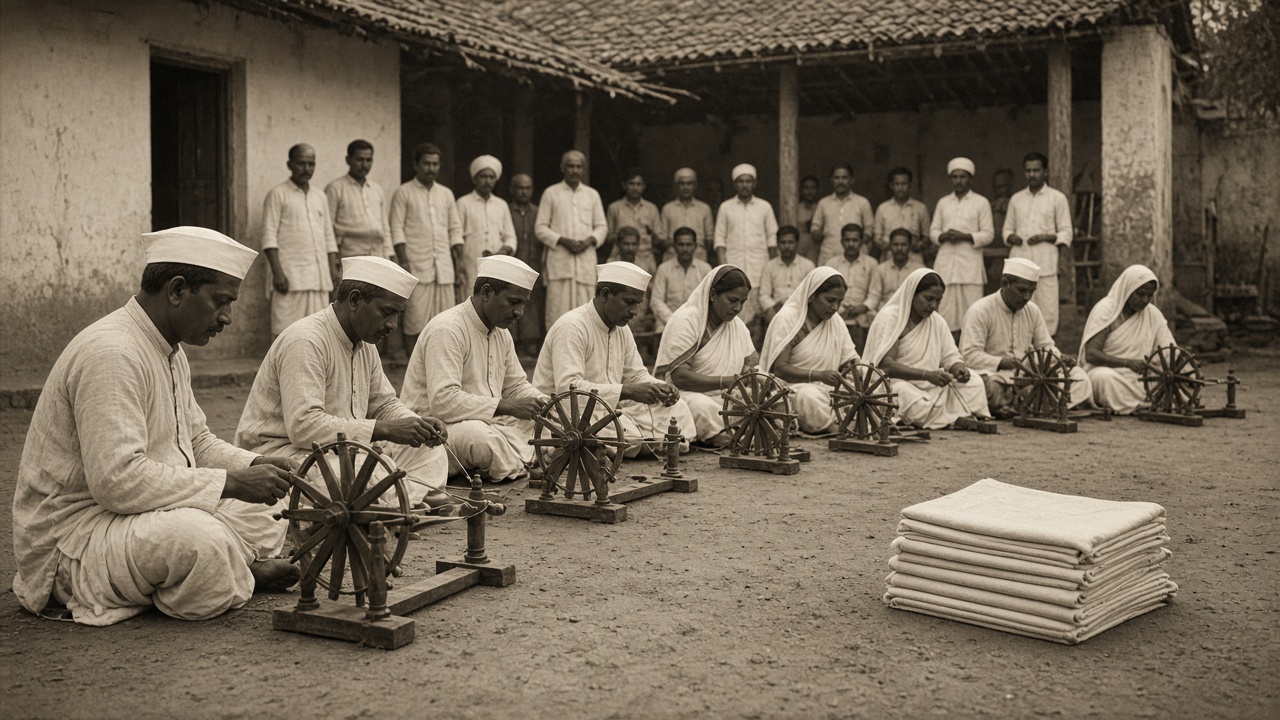
Spinning khadi on the charkha became a symbol of the freedom movement (artistic illustration).
Late 1700s–1800s: British mill cloth floods Indian markets; weavers in Bengal and elsewhere lose their livelihoods, and India becomes an exporter of raw cotton.
1854: The first cotton mill in Bombay starts work; Indian-owned mills grow in Bombay and Ahmedabad.
1860s–1870s: Jnanadanandini Devi popularises the sari worn with a blouse and petticoat; educated men adopt Western suits, and Parsi women wear embroidered gara saris.
1905–1921: The Swadeshi movement (1905) boycotts foreign cloth; Gandhi promotes khadi and the charkha, and in 1921 adopts the simple loincloth; the Gandhi cap becomes a symbol.
Technology
Textile mills: Machine-spun cloth.
Sewing machines: Faster tailoring.
Synthetic dyes: Cheap bright colours.
Features
Blouse and petticoat: New sari style.
Western suits: For the elite.
Khadi: Fabric of freedom.
🎬 Film Fashion1947 – 1990
Handloom Revival, Bollywood & Synthetics
Free India set up boards to revive handlooms and crafts, while film stars became the new trendsetters. Cheap, wrinkle-free polyester spread, the salwar-kameez became everyday wear for women across the country, and jeans arrived for the young.
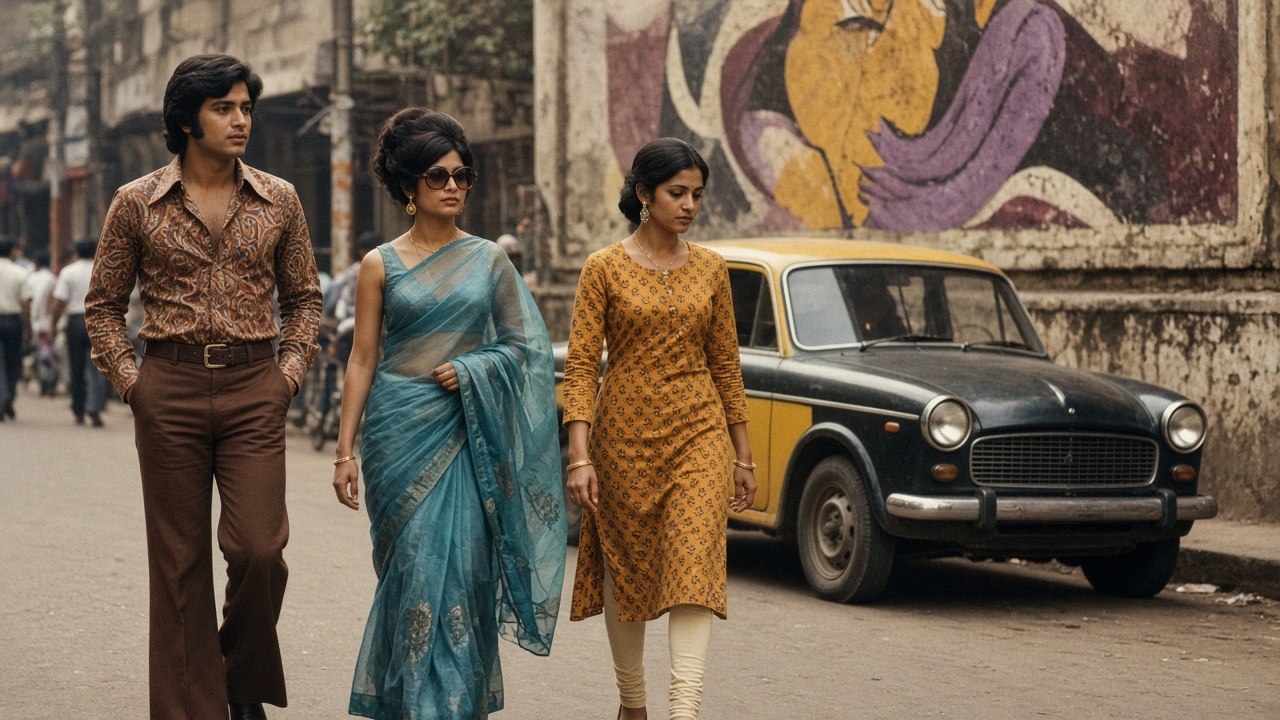
Bell-bottoms, big collars, and chiffon saris — film fashion on the street in the 1970s (artistic illustration).
Early 1950s: National handloom and handicrafts boards are set up; Kamaladevi Chattopadhyay leads the revival of Indian crafts; the bandhgala and Nehru jacket become formal wear.
1960s: Film heroines popularise tight churidar-kurtas, bouffant hair, and the “Sadhana cut” fringe; sunglasses and slim trousers become cool for men.
1970s: Bell-bottoms, wide collars, and polka dots rule; polyester and terry-cot become popular because they are cheap, colourful, and wrinkle-free.
1980s: The salwar-kameez becomes everyday wear for women across India; jeans spread among the young; NIFT, the National Institute of Fashion Technology, opens in 1986.
Technology
Synthetic fibres: Polyester and nylon.
Powerlooms: Cheaper mass cloth.
Indian denim: Mills start making jeans fabric.
Features
Film trends: Stars set styles.
Tailor-made: Cloth bought and stitched.
Salwar-kameez: All-India wear.
🌍 Global Brands1991 – 2014
Global Brands, Fashion Weeks & Indo-Western
After economic reforms, foreign brands and readymade clothes filled city stores and malls. Indian designers and fashion weeks gained fame, beauty-pageant wins put India on the fashion map, and the kurti worn with jeans became a new national favourite.
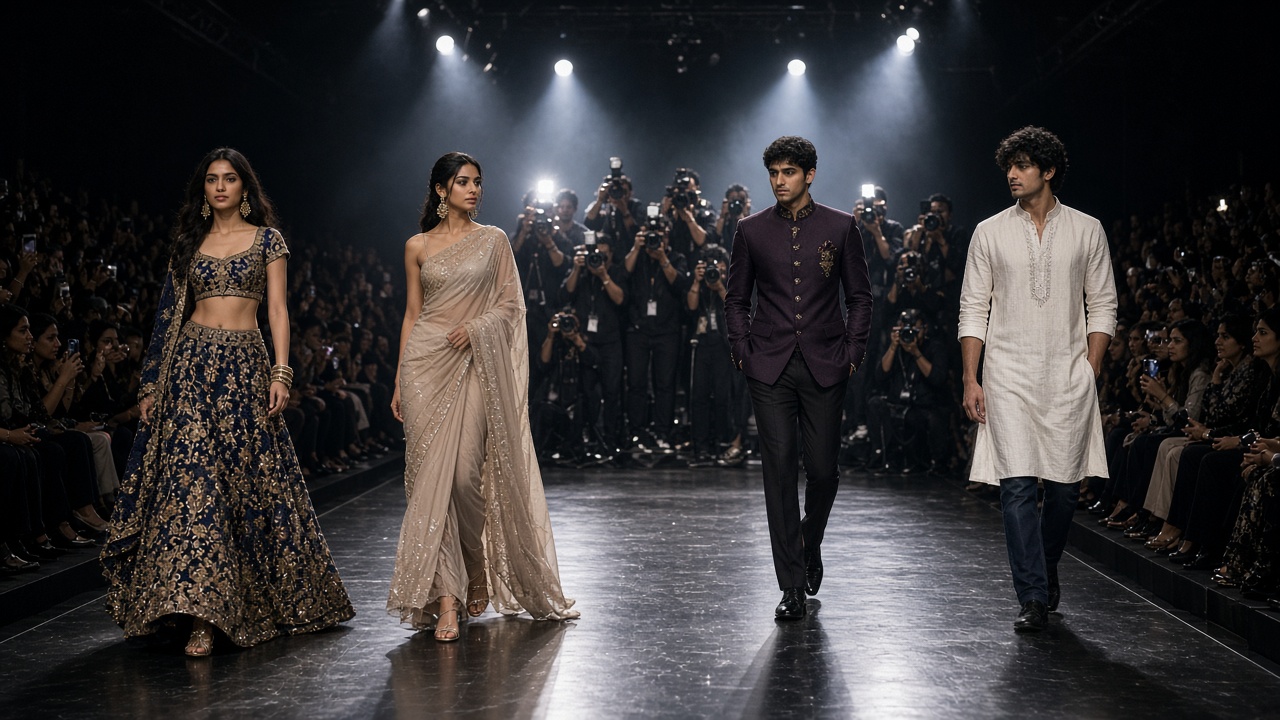
Fashion weeks made Indian designers and indo-western styles famous (artistic illustration).
1994: Sushmita Sen wins Miss Universe and Aishwarya Rai wins Miss World, boosting India’s fashion and modelling industry.
1998–2000: The Fashion Design Council of India is formed (1998), and regular fashion weeks begin in Delhi and Mumbai around 2000.
2000s–2014: Designer bridal wear booms; kurtis with jeans become college wear; malls, online fashion stores, and international fast-fashion chains arrive.
Technology
Readymade garments: Standard sizes.
E-commerce: Clothes bought online.
Fast fashion: New styles every few weeks.
Features
Indo-western: Kurti with jeans.
Designer labels: Bridal and couture.
Malls: Brand shopping.
📱 Digital & Handloom2015 – Present
Handloom Pride, Instagram & Sustainable Fashion
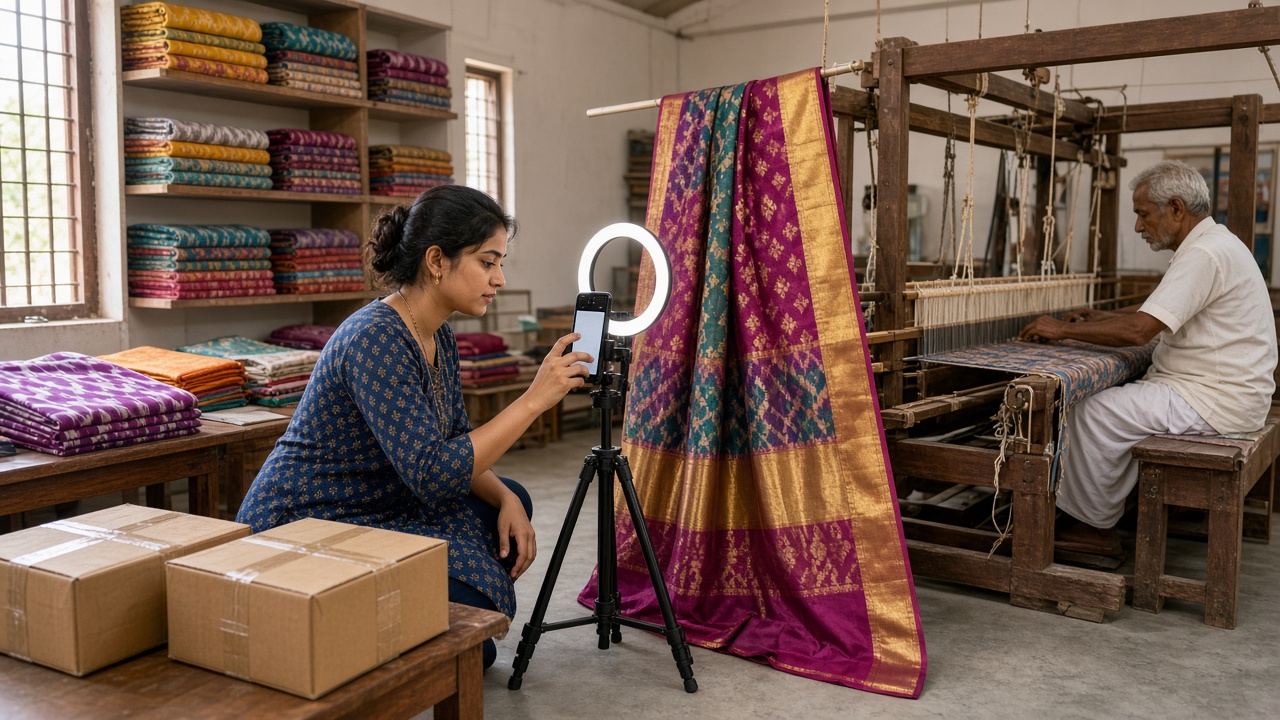
Smartphones and social media now set trends overnight, and small sellers and weavers reach buyers directly online. At the same time, young Indians are rediscovering khadi, handloom saris, and natural fabrics, and thinking about the waste created by fast fashion.
Weavers and small sellers now reach buyers directly through phones and social media (artistic illustration).
2015: 7 August is observed as the first National Handloom Day, marking the launch of the Swadeshi movement in 1905.
2015–2019: Social media influencers and shopping apps spread trends quickly; athleisure, palazzos, and oversized styles become popular.
2020–2021: During COVID-19, face masks become fashion items, comfort and home wear boom, and online clothes shopping surges.
2021–present: PM MITRA textile parks are announced; GI-tagged weaves, thrift, rental, and sustainable fashion grow; AI and virtual try-on arrive in online stores.
Technology
Social commerce: Selling through phones.
Digital printing: Small custom batches.
Virtual try-on: AI in shopping apps.
Features
Handloom pride: Weaves back in style.
Influencer trends: Viral overnight.
Sustainability: Thrift and rentals.
Famous Handloom Weaves of India
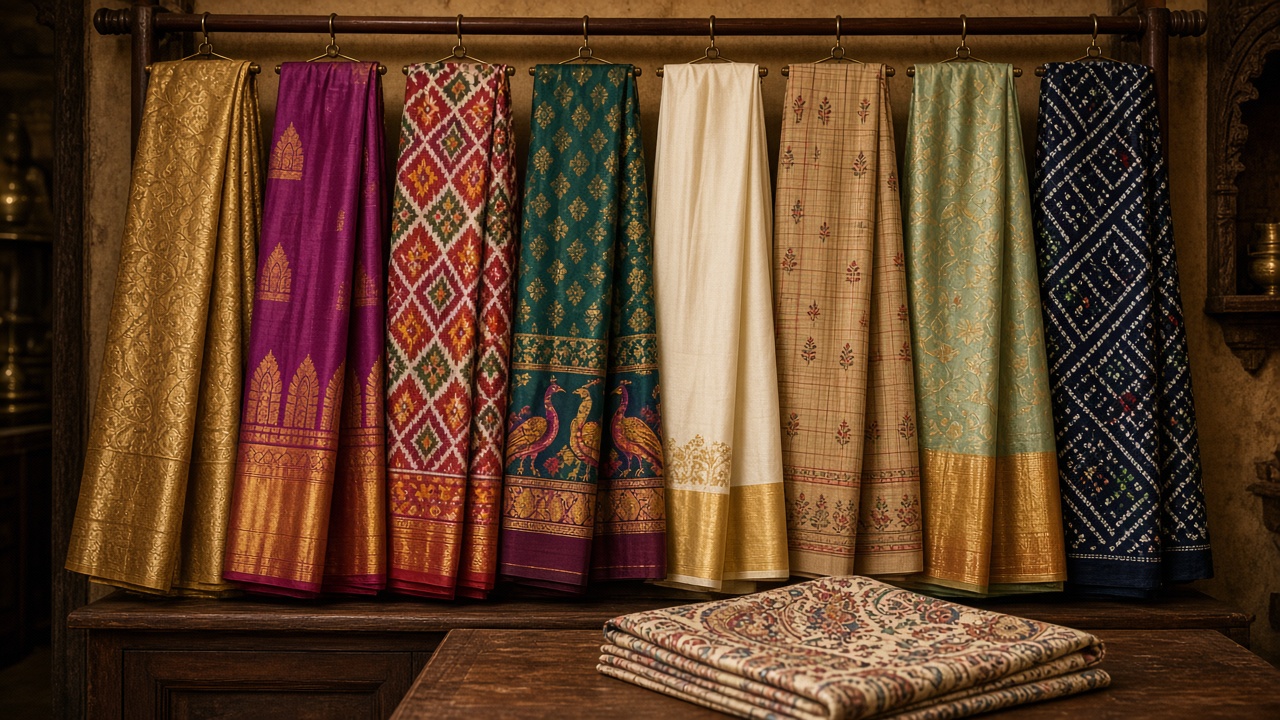
Brocade, temple borders, ikat, peacock pallus, kasavu, and tie-dye — India’s great weaves (artistic illustration).
Weave
Region
Known for
Banarasi
Uttar Pradesh
Silk brocade with gold and silver zari
Kanchipuram (Kanjivaram)
Tamil Nadu
Heavy silk with contrast temple borders
Patola
Gujarat
Double ikat silk with geometric patterns
Paithani
Maharashtra
Silk with a peacock-motif pallu
Kasavu
Kerala
Off-white cotton with a gold border
Tant
West Bengal
Light, crisp cotton for hot weather
Chanderi
Madhya Pradesh
Sheer silk-cotton with small motifs
Pochampally
Telangana
Ikat with bold geometric designs
Bandhani
Gujarat and Rajasthan
Tie-dye dots in bright colours
Muga silk
Assam
Natural golden silk
Pashmina
Kashmir
Very fine, warm wool shawls
Fashion Trends Decade by Decade
Decade
Women
Men
1950s
Simple cotton and handloom saris
Dhoti or pyjama with kurta; bandhgala for formal wear
Click any panel to expand and explore the visual mood.
Indian fashion in pictures — Harappan cotton, Mughal courts, khadi and the charkha, 1970s film style, fashion week runways, online handloom sellers, famous weaves, and then versus now.
Harappan Cotton
Spinning and dyeing
Mughal Court
Jamas and brocade
Khadi & Charkha
Fabric of freedom
1970s Style
Bell-bottoms and chiffon
Fashion Week
Indo-western runway
Handloom Online
Weavers go digital
Famous Weaves
Banarasi to Patola
Then vs Now
Handloom to jeans
Explore all daily life timelines
Jump to any other daily life timeline on WorldTimelineHub.
Disclaimer: This content is AI-generated for educational purposes and may contain errors or outdated details. For correct and authoritative information, please refer to official and reliable sources such as government publications, manufacturers, museums, and academic references.