Water Facility Timeline of India: Wells → Hand Pumps → Taps → RO
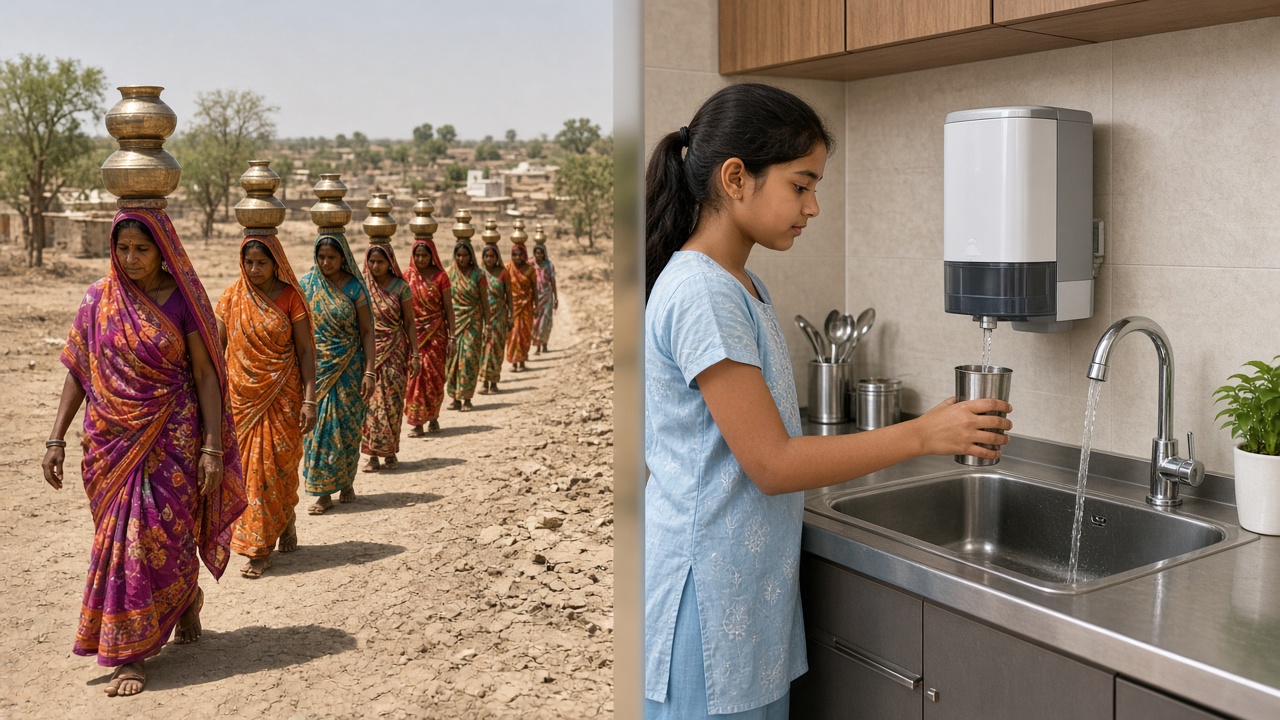
In the 1950s most Indian families drew water from open wells, ponds, and rivers, and women walked long distances with pots on their heads. Hand pumps arrived in villages
in the 1970s, taps and tankers served growing cities, RO purifiers entered kitchens, and since 2019 the Jal Jeevan Mission has brought tap water to crores of village homes.
This timeline covers Harappan wells and stepwells, traditional tanks, colonial waterworks, 1950s village wells, 1970s India Mark II hand pumps and borewells, city taps and
tankers, bottled water and RO purifiers, the Jal Jeevan Mission (2019), drink-from-tap cities, and smart water meters in the 2020s.
1950s Wells → 1970s Hand Pumps2019 Jal Jeevan Mission2020s Smart Water Meters
Why the Water Story Matters
Safe water at home changes lives. It prevents diarrhoea, cholera, and other water-borne diseases, and it frees women and girls from hours of fetching water every day, giving
them time for school, work, and rest. India’s journey from wells to taps is one of its biggest public health stories — but falling groundwater, pollution, and waste mean
that saving water matters as much as supplying it.
Big picture
India’s water journey in one view
Harappan wells, stepwells, and village tanks served India for thousands of years. After independence, most villages still relied on open wells; from the 1970s, government
programmes installed lakhs of hand pumps and borewells. Cities grew on taps, tankers, and bottled water, RO purifiers spread in homes, and from 2019 the Jal Jeevan Mission
set out to put a tap in every rural home. Now smart meters and sensors are making water supply measurable. Related timelines:
irrigation,
water policy and Jal Shakti,
Digital India.
17% → 79%+
Rural homes with taps, 2019 → 2025
15 crore+
Rural tap connections
~4%
World’s fresh water for ~18% of people
#1
Largest groundwater user in the world
From carrying pots from a distant well to purified water at the kitchen tap (artistic illustration).
Water Then vs Now at a Glance
Feature
Then
Now
Main source
Open wells, ponds, rivers, stepwells
Piped taps, borewells, treated surface water
Distance
Often a long walk outside the village
A tap in the home or courtyard
Who fetched it
Mostly women and girls, many times a day
Flows to the home; less time lost
Lifting water
Rope, bucket, and pulley
Electric pumps and overhead tanks
Storage
Brass, copper, and clay pots; matkas
Plastic and steel tanks, bottles, fridges
Cleaning
Cloth filter, boiling, alum, clearing-nut seeds
Chlorination, candle filters, UV, RO
Quality check
Taste, smell, and look
Lab tests, field test kits, TDS meters
Paying for water
Usually free, community-managed
Water bills, meters, bottled and canned water
Common problems
Cholera, guinea worm, dry wells
Falling groundwater, fluoride, arsenic, pollution
Monitoring
Village elders and panchayats
Online dashboards, sensors, smart meters
🏺 StepwellsAncient – 1947
Stepwells, Tanks & Wells
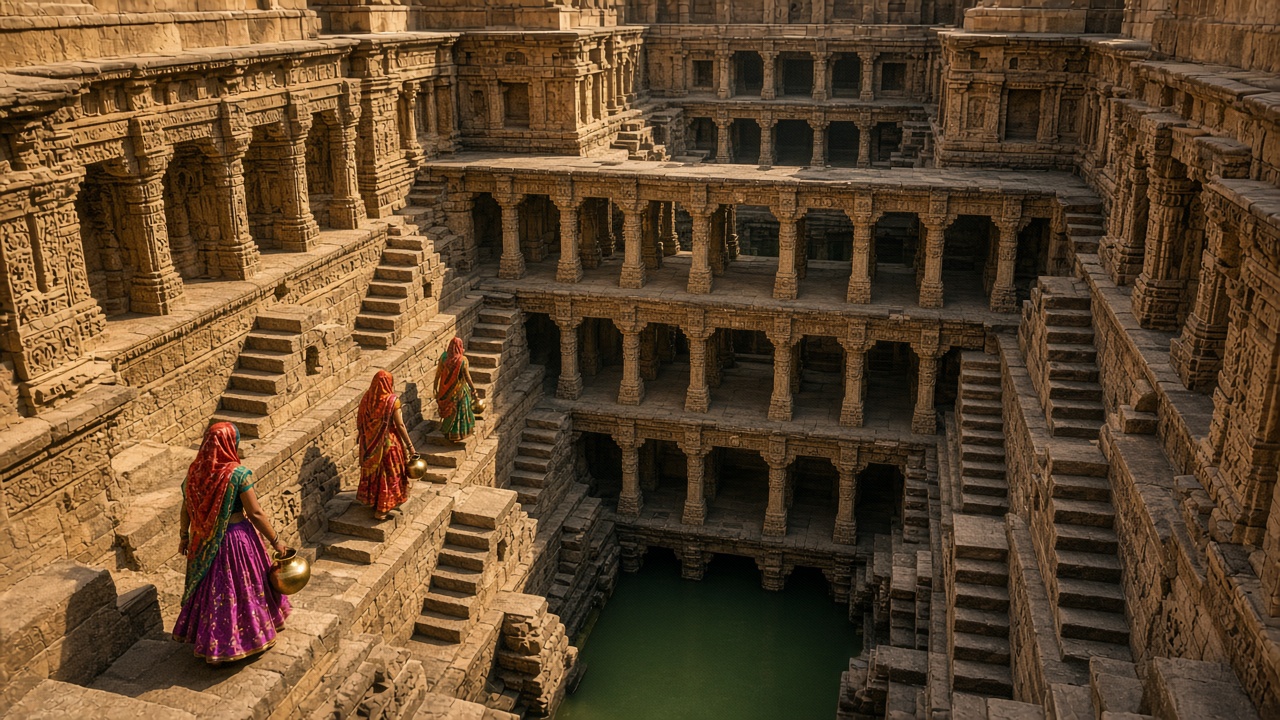
Indians have managed water cleverly for thousands of years — Harappan brick wells, carved stepwells in dry western India, and village tanks that stored the monsoon rain. Access was not always fair, and under colonial rule piped water reached only parts of big cities.
Stepwells let people reach water deep underground through long flights of steps (artistic illustration).
c. 2600–1900 BCE: Mohenjo-daro has hundreds of brick-lined wells — by some estimates about 700 — and Dholavira builds large stone reservoirs to store rainwater.
c. 800–1100 CE: Stepwells such as Chand Baori (Abhaneri, Rajasthan) and Rani ki Vav (Patan, Gujarat, 11th century) combine water storage with fine carving.
Medieval period: Village tanks (eris) in the south, johads and kunds in Rajasthan, and bamboo pipes in the north-east collect and share water.
1860–1927: Piped water reaches parts of colonial cities — Bombay’s Vihar lake supply (1860) and Calcutta’s Palta waterworks (1870); in 1927 B. R. Ambedkar leads the Mahad Satyagraha for Dalits’ right to draw water from a public tank.
Technology
Brick-lined wells: Harappan engineering.
Stepwells: Steps down to deep water.
Tanks and johads: Storing rain.
Features
Community-managed: Shared water.
Rain-based: Monsoon storage.
Unequal access: Caste barriers.
🪣 Village Wells1947 – 1969
Village Wells & the Long Walk
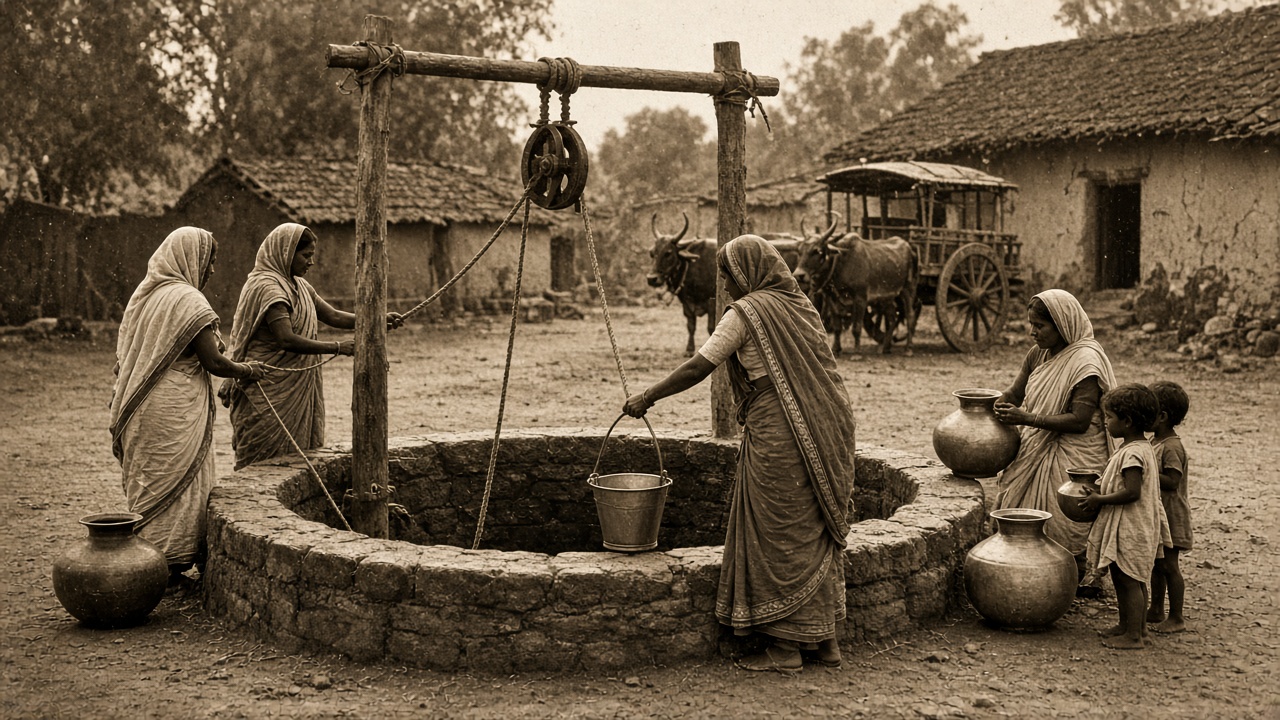
In the 1950s most Indian villages depended on open wells, ponds, and rivers. Women drew water with ropes and buckets and carried it home in heavy pots, and water-borne diseases were common. Early Five-Year Plans began digging and protecting village wells.
In the 1950s the village well was the centre of daily life (artistic illustration).
1950s: Open wells, ponds, and rivers are the main water sources in villages; women and girls spend hours each day fetching water.
1952–1954: The Community Development Programme (1952) and the National Water Supply and Sanitation Programme (1954) fund new and protected village wells.
1965: Bisleri bottled water is launched in Bombay; bottled water remains a small luxury for decades.
1966–1967: During the Bihar drought, UNICEF-supported drilling rigs bore deep wells, pointing the way to groundwater for drinking.
Technology
Rope and pulley: Lifting water by hand.
Parapet walls: Protecting wells from dirt.
Drilling rigs: First deep borewells.
Features
The long walk: Heavy daily work.
Disease risk: Open, uncovered water.
Village meeting point: Life around the well.
🚰 Hand Pumps1970 – 1990
Hand Pumps & Borewells
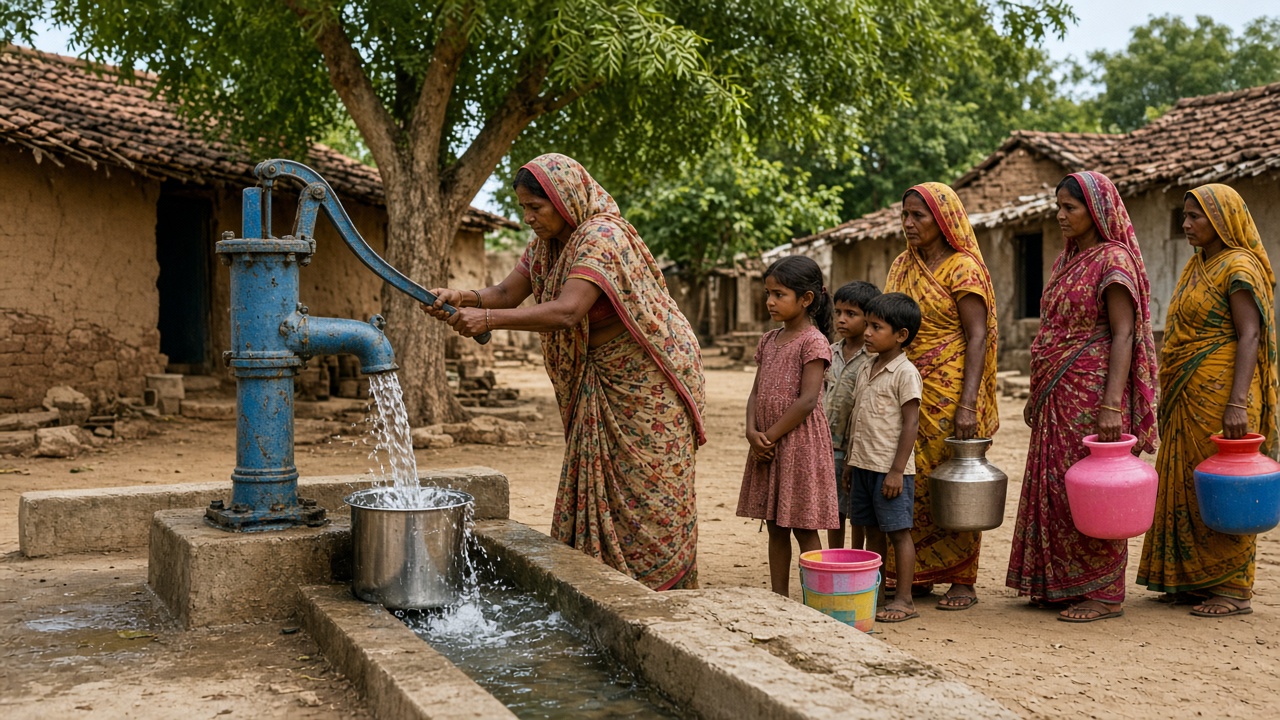
In the 1970s the government began a huge drive to bring safe groundwater to villages. The sturdy India Mark II hand pump, fitted on deep borewells, became a familiar sight in almost every Indian village and helped reduce water-borne diseases.
From the 1970s, the hand pump brought cleaner groundwater close to village homes (artistic illustration).
1972–1973: The Accelerated Rural Water Supply Programme (ARWSP) funds drinking water for “problem villages” with no safe source.
Mid–late 1970s: The India Mark II deep-well hand pump is developed with UNICEF support and becomes the national standard; it is later used around the world.
1981–1990: The UN’s International Drinking Water Supply and Sanitation Decade speeds up the drilling of borewells and hand pumps across India.
1986: The National Drinking Water Mission is launched to use technology against problems such as fluoride, salinity, and guinea worm (renamed after Rajiv Gandhi in 1991).
Technology
India Mark II: Sturdy deep-well pump.
Borewells: Tapping deep groundwater.
Village mechanics: Local repair teams.
Features
Safer water: Covered groundwater.
Closer to home: Shorter walks.
Queues: Many families, one pump.
🚚 Taps & Tankers1991 – 2018
Tap Water, Tankers & RO Purifiers
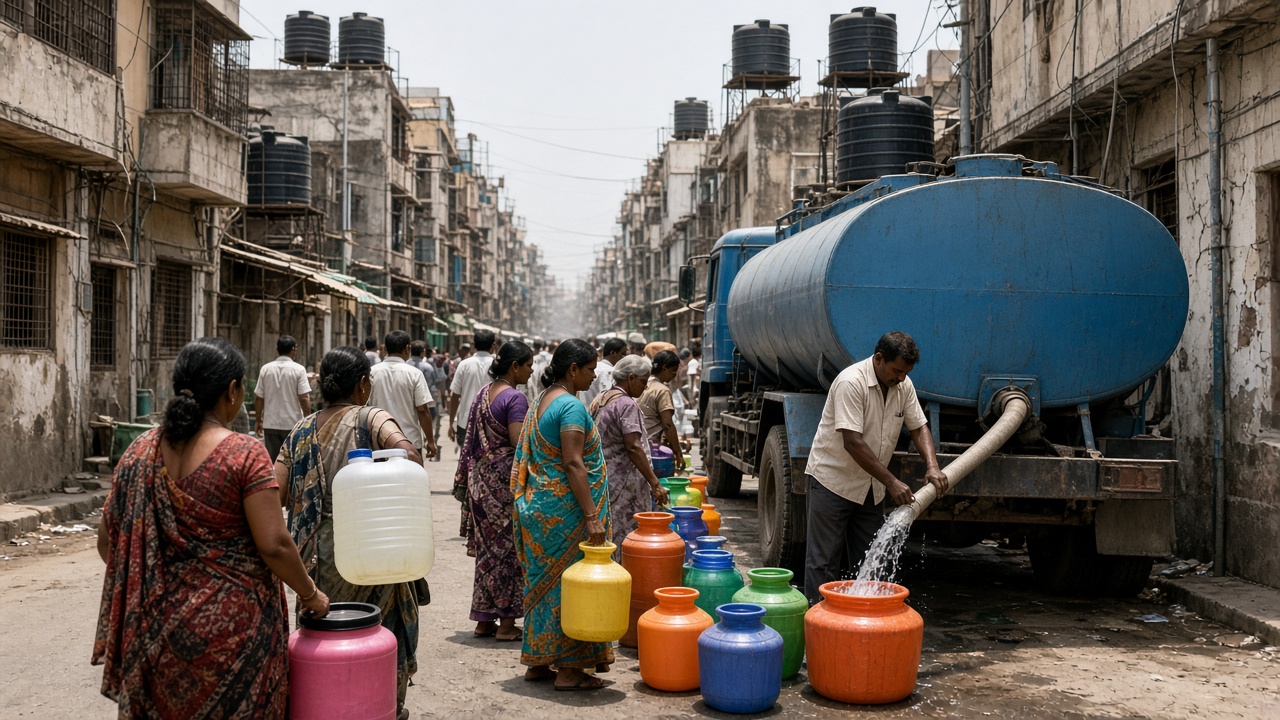
Growing cities built pipelines and overhead tanks, but supply was often for only a few hours a day, and water tankers filled the gaps in summer. Families that could afford it bought water purifiers — first UV, then RO — and bottled and canned water became common.
When city taps ran dry, water tankers filled the gap (artistic illustration).
1984–2000s: Home water purifiers spread — UV purifiers such as Aquaguard from 1984, and RO purifiers in the 2000s where water is hard or salty.
2000 and 2003: India is certified free of guinea worm disease (2000); Tamil Nadu makes rooftop rainwater harvesting compulsory for buildings (2003).
2009: The National Rural Drinking Water Programme (NRDWP) focuses on piped water and water quality, including arsenic and fluoride.
2011: The Census finds about 43.5% of households use tap water as their main source, while about a third rely on hand pumps.
Technology
UV and RO purifiers: Home water treatment.
Overhead tanks: Storing supply hours.
Rainwater harvesting: Recharging groundwater.
Features
Intermittent supply: Few hours a day.
Tankers and cans: Paying for water.
Urban–rural gap: Taps mostly in cities.
💧 Har Ghar Jal2019 – 2024
Jal Jeevan Mission: Har Ghar Jal
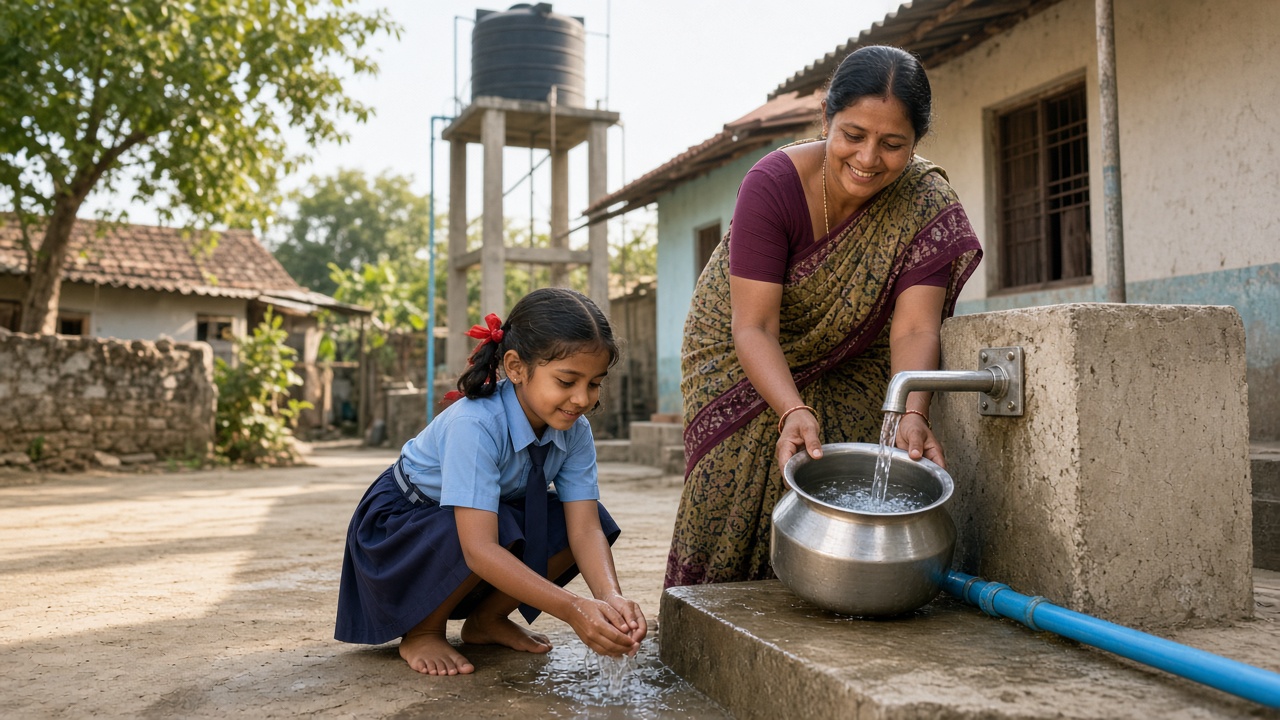
In 2019 India set out to give every rural household a working tap. The Jal Jeevan Mission laid pipelines, built overhead tanks, and trained village women to test water, and rural homes with taps grew more than four times in about five years.
A tap at home means girls can spend more time in school instead of fetching water (artistic illustration).
May–August 2019: The Ministry of Jal Shakti is formed, and on 15 August the Jal Jeevan Mission is launched, when only about 3.2 crore rural homes (about 17%) have taps.
December 2019: The Atal Bhujal Yojana begins community management of groundwater in water-stressed areas.
2021–2022: Goa becomes the first state to reach every rural home with tap water; rural tap connections cross 10 crore in August 2022; village women are trained to test water with field kits.
2024–2025: Rural tap connections cross 15 crore — around 79% of rural households — though regular supply and quality still vary between states.
Technology
Village piped schemes: Tanks and pipelines.
Field test kits: Checking water quality.
Online dashboard: Tracking every village.
Features
Tap at home: No long walk.
Women-led: Village water committees.
Groundwater care: Atal Bhujal.
📡 Smart Water2020s – Future
Smart Water Meters & Water Tech
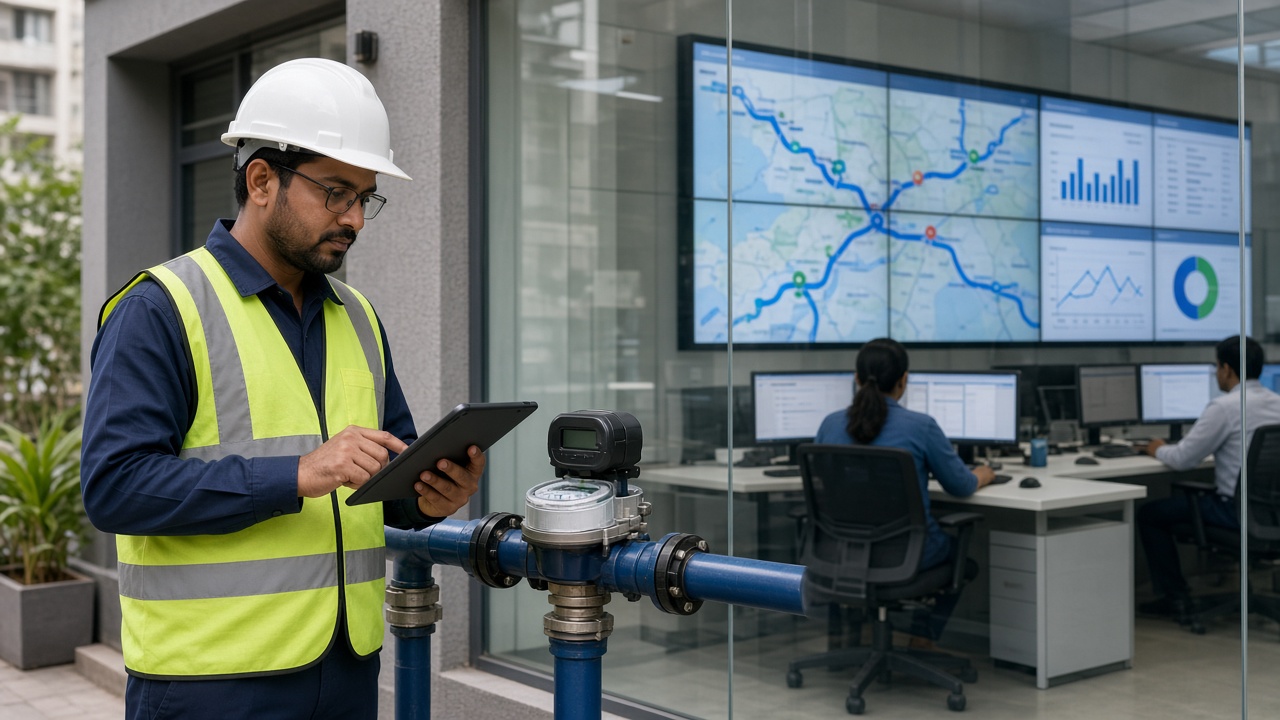
In the 2020s Indian cities began installing smart water meters, sensors, and control rooms to measure every litre, find leaks, and move towards 24×7 supply. Old water bodies are being revived, and some cities now supply water safe to drink straight from the tap.
Smart meters and control rooms help cities track every litre and find leaks (artistic illustration).
2019: Chennai’s severe water crisis shows the risk of overusing groundwater; the National Green Tribunal says RO should be discouraged where TDS is below 500 mg per litre.
2021: Puri becomes India’s first city with 24×7 drink-from-tap water; AMRUT 2.0 aims for taps in every urban home; the Catch the Rain campaign promotes rainwater harvesting.
2020s: Cities such as Pune install smart water meters under 24×7 supply projects; sensor-based monitoring of village water schemes is piloted.
2022–present: Mission Amrit Sarovar builds or revives 75 ponds in every district; water ATMs, wastewater reuse, and leak-detecting sensors spread.
Technology
Smart meters: Digital readings.
SCADA and IoT sensors: Real-time monitoring.
Water ATMs: Cheap purified water.
Features
24×7 supply: The new goal.
Leak detection: Less water lost.
Save and reuse: Ponds and recycling.
Traditional Water Systems of India
System
Region
How it works
Stepwell (baoli / vav)
Gujarat, Rajasthan, Delhi
Steps lead down to deep groundwater
Kund / tanka
Rajasthan
Covered underground tank for rainwater
Johad
Rajasthan, Haryana
Small earthen dam that stores rain and recharges wells
Eri
Tamil Nadu
Linked village tanks for drinking and farming
Kuhl
Himachal Pradesh
Channels carry glacier and stream water to villages
Zabo
Nagaland
Rain collected on hills and stored in ponds
Bamboo drip
Meghalaya
Bamboo pipes carry stream water downhill
Surangam
Kerala, Karnataka
Horizontal tunnels dug into hills to tap water
Ahar-pyne
Bihar
Channels and catchment ponds for floodwater
Village pond
Across India
Stores monsoon rain for people and animals
Drinking Water in Numbers
Year / survey
What it found
Census 2011
Main source: tap about 43.5%, hand pump about 33.5%, well about 11%, tube well about 8.5%, others about 3.5%
August 2019
About 3.2 crore rural homes (about 17%) have tap water
August 2022
Rural tap connections cross 10 crore
2024–2025
More than 15 crore rural homes (around 79%) have taps
Figures are rounded. A tap connection does not always mean water every day or water that is safe to drink without treatment — regular supply and quality are still being improved.
Ways of Making Water Safe: Old and New
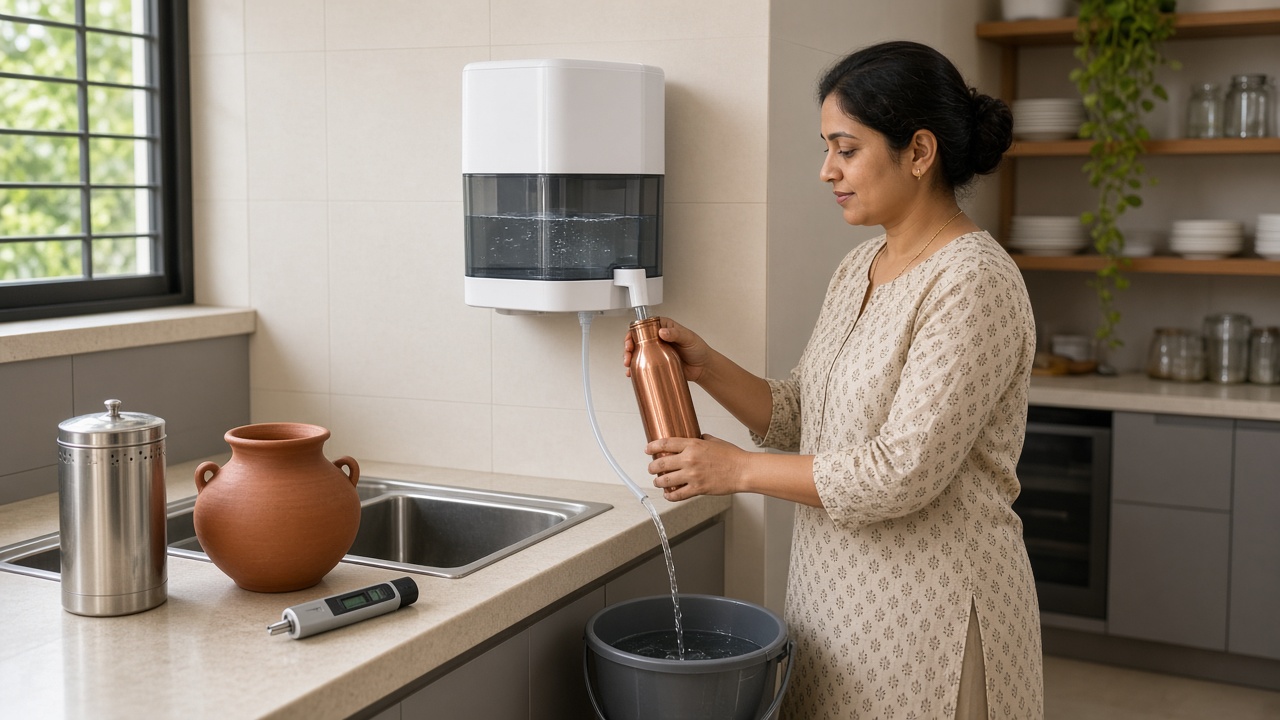
An RO purifier beside an old candle filter and matka — note the bucket catching reject water (artistic illustration).
Method
How it works
Good for
Cloth filtering
Folded cloth strains out dirt
Removing visible dirt and some germs
Clearing-nut seeds and alum
Make mud settle to the bottom
Clearing muddy water
Boiling
Heat kills germs
Germs, but not salts or chemicals
Copper and clay pots
Storage that keeps water cool; copper can reduce some germs
Traditional storage
Candle filter
Ceramic candles block dirt and some germs
Cheap home filtering
Chlorination
Chlorine kills germs in tanks and pipes
City and village supply
UV purifier
Ultraviolet light kills germs
Low-TDS water with germs
RO purifier
A fine membrane removes salts and metals
Hard, salty, or high-TDS water; wastes water
Water Facility Timeline Summary
Year / Era
Milestone
c. 2600–1900 BCE
Harappan wells and Dholavira reservoirs
c. 800–1100 CE
Chand Baori and Rani ki Vav stepwells
1860
Vihar lake water supply for Bombay
1870
Palta waterworks for Calcutta
1927
Mahad Satyagraha for the right to water
1950s
Village wells are the main source
1954
National Water Supply and Sanitation Programme
1965
Bisleri bottled water launched
1972–1973
Accelerated Rural Water Supply Programme
1970s
India Mark II hand pump
1984
UV home water purifiers arrive
1986
National Drinking Water Mission
2000
India free of guinea worm
2000s
RO purifiers spread in homes
2003
Tamil Nadu makes rainwater harvesting compulsory
2009
National Rural Drinking Water Programme
2019
Jal Shakti ministry and Jal Jeevan Mission
2021
Puri drink-from-tap; AMRUT 2.0; Catch the Rain
2022
10 crore rural taps; Mission Amrit Sarovar
2020s
Smart water meters and sensors
2024–2025
15 crore+ rural tap connections
Test Your Knowledge
20 quick questions from the water facility timeline. Click each question to reveal the answer.
Answer: Mohenjo-daro.
Answer: Baoli (or baori) in Hindi and vav in Gujarati.
Answer: Gujarat, in Patan.
Answer: B. R. Ambedkar led Dalits to claim their right to draw water from a public tank.
Answer: Open wells, ponds, and rivers.
Answer: Mostly women and girls.
Answer: Bisleri.
Answer: The India Mark II.
Answer: UNICEF.
Answer: Accelerated Rural Water Supply Programme, started in 1972–73.
Answer: Guinea worm disease.
Answer: Tamil Nadu.
Answer: Reverse osmosis.
Answer: They waste a lot of water, or they remove useful minerals.
Answer: 15 August 2019.
Answer: About 17%.
Answer: Goa.
Answer: Puri, in Odisha (2021).
Answer: It measures water use and sends readings digitally, helping detect leaks and bill fairly.
Answer: 75.
Classroom activity
Students Tasks
Use these prompts for discussion or projects on how India’s drinking water supply changed over time.
Timeline understandingHealth and hygieneWater conservationGovernment schemes
Ask your grandparents where their family got water when they were children and how long it took to fetch it.
Draw a flow chart showing the journey of water from its source to your home tap.
Make a timeline poster: wells (1950s), hand pumps (1970s), taps, RO purifiers, Jal Jeevan Mission (2019), smart meters (2020s).
Measure how much water your family uses in one day and suggest three ways to save it.
If you have an RO purifier, measure how much reject water it produces and think of ways to reuse it.
Find out the main source of drinking water in your village, town, or city.
Make a model of a stepwell or a rooftop rainwater harvesting system.
Explain how getting a tap at home can help girls stay in school.
Collect news about a water shortage in an Indian city and list its causes.
Debate: “Every home needs an RO purifier.”
Continue exploring
Drinking water is linked to irrigation, water policy, electricity for pumps, and digital monitoring. Explore these connected India timelines next.
Click any panel to expand and explore the visual mood.
India’s water journey in pictures — stepwells, 1950s village wells, 1970s hand pumps, city tankers, RO purifiers, Jal Jeevan Mission taps, smart meters, and then versus now.
Stepwell
Steps to deep water
1950s Well
Rope and bucket
1970s Hand Pump
India Mark II
City Tanker
Summer queues
RO Purifier
Water in the kitchen
Har Ghar Jal
A tap in every home
Smart Meter
Every litre counted
Then vs Now
Well to tap
Explore all daily life timelines
Jump to any other daily life timeline on WorldTimelineHub.
Disclaimer: This content is AI-generated for educational purposes and may contain errors or outdated details. For correct and authoritative information, please refer to official and reliable sources such as government publications, manufacturers, museums, and academic references.