Industrial Revolution Timeline: Before the Machines → Steam & Cotton → Railways Spread → Steel & Electricity → Mass Production → Digital Industry
For most of history, almost everything people wore, used, and ate was made by hand or grown in the fields. Then, starting in Britain around 1760, machines driven by water, steam, and later electricity moved work into factories.
The change spread across Europe, America, Japan, India, and China, and it is still going on today — transforming how the world works, travels, communicates, and lives, and leaving deep marks on societies and the environment.
This timeline covers India’s handloom textiles, coke-smelted iron, Newcomen’s and Watt’s steam engines, the spinning jenny and water frame, the Iron Bridge, the Luddites, the first railways, the Great Exhibition, India’s first train
and mills, the Bessemer process, the Meiji Restoration, electricity, cars, Tata Steel, the assembly line, five-year plans, the transistor, robots, the microprocessor, liberalisation, and Industry 4.0.
1712 Newcomen engine → 1769 Watt’s condenser1830 first inter-city railway → 1853 India’s first train1913 assembly line → 2011 Industry 4.0
Why the Industrial Revolution Matters
The Industrial Revolution is one of the biggest turning points in human history, comparable to the beginning of farming. It made goods cheaper and more plentiful, allowed populations and cities to grow, and eventually raised living
standards for billions of people. It also brought harsh factory work, child labour, colonial exploitation, and pollution, and it shifted economic power between nations — including India, which went from a leading maker of textiles to a supplier of raw materials under colonial rule.
Big picture
The Industrial Revolution in one view
Craft workshops and global trade led to coal, iron, and the first steam engines; cotton mills and Watt’s engine launched the factory age in Britain; railways and telegraphs carried industry across the world; steel, electricity,
and chemicals powered a second revolution; the assembly line brought mass production; and computers, robots, and the internet have created today’s digital industry. Related timelines:
railways,
clothing and fashion,
lighting.
1712
First successful steam engine pumps a coal mine
~25% → <2%
India’s share of world manufacturing, 1750 to 1900 (estimate)
1853
India’s first passenger train, Bombay to Thane
280 → 420+
Carbon dioxide in the air, parts per million, before industry vs today
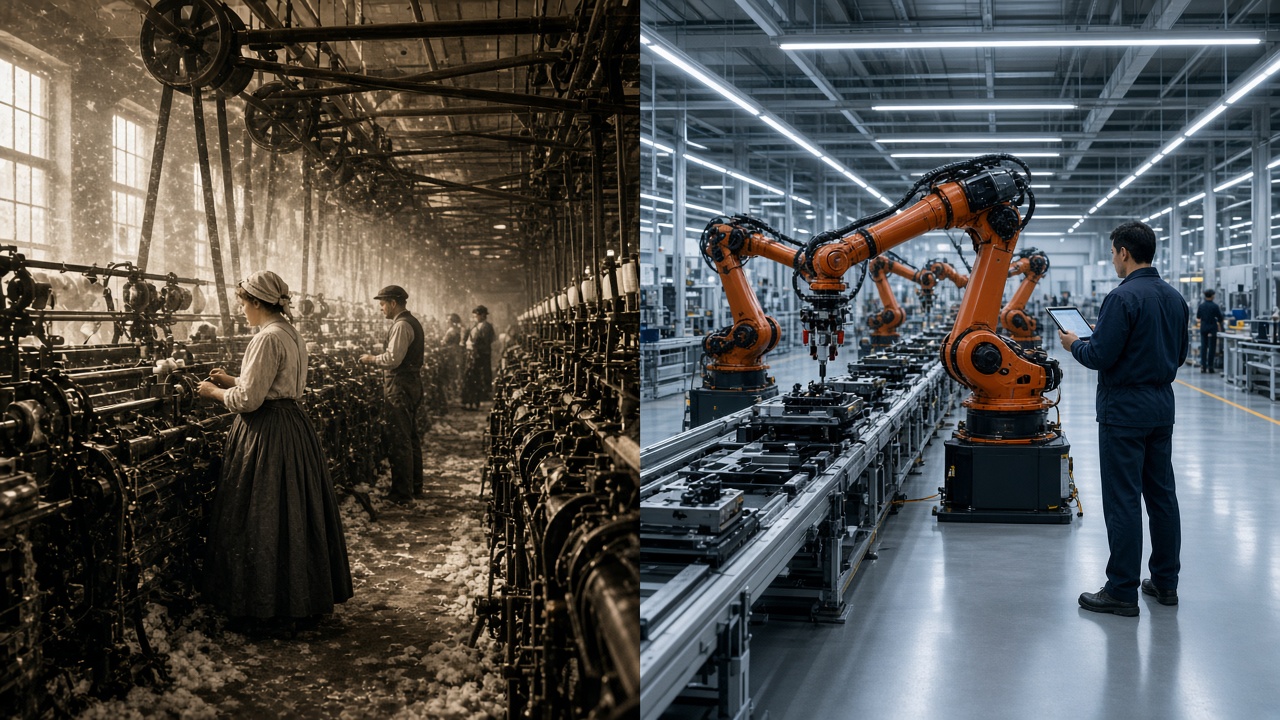
A belt-driven cotton mill of the 1850s and a robot-run factory of today (artistic illustration).
Life and Work Then vs Now
Feature
Around 1800
Today
Main power
Muscle, water wheels, windmills, and early steam engines
Electricity from coal, gas, nuclear, solar, wind, and hydro
Where people lived
Most people lived in villages and worked on the land
More than half the world’s people live in towns and cities
Working day
Often 12–14 hours, six days a week
About 8 hours in many countries, with weekly rest days
Child labour
Common in mills, mines, and workshops
Banned by law in most countries, though it still exists
Making cloth
Spun and woven by hand or on early machines
Automated mills and synthetic fibres
Travel on land
Walking, horses, and carts, about 5–15 km/h
Cars, and high-speed trains at over 300 km/h
Messages
Letters carried by horse or sailing ship
Instant messages and video calls
Lighting
Candles and oil lamps
Electric LED lighting
Factory machines
Driven by belts from a single engine, run by hand
Robots, sensors, and computer control
Air quality
Coal smoke and soot in growing industrial towns
Emission controls and climate targets, but pollution remains a problem
🧵 Before the Machines1600 – 1760
Before the Machines
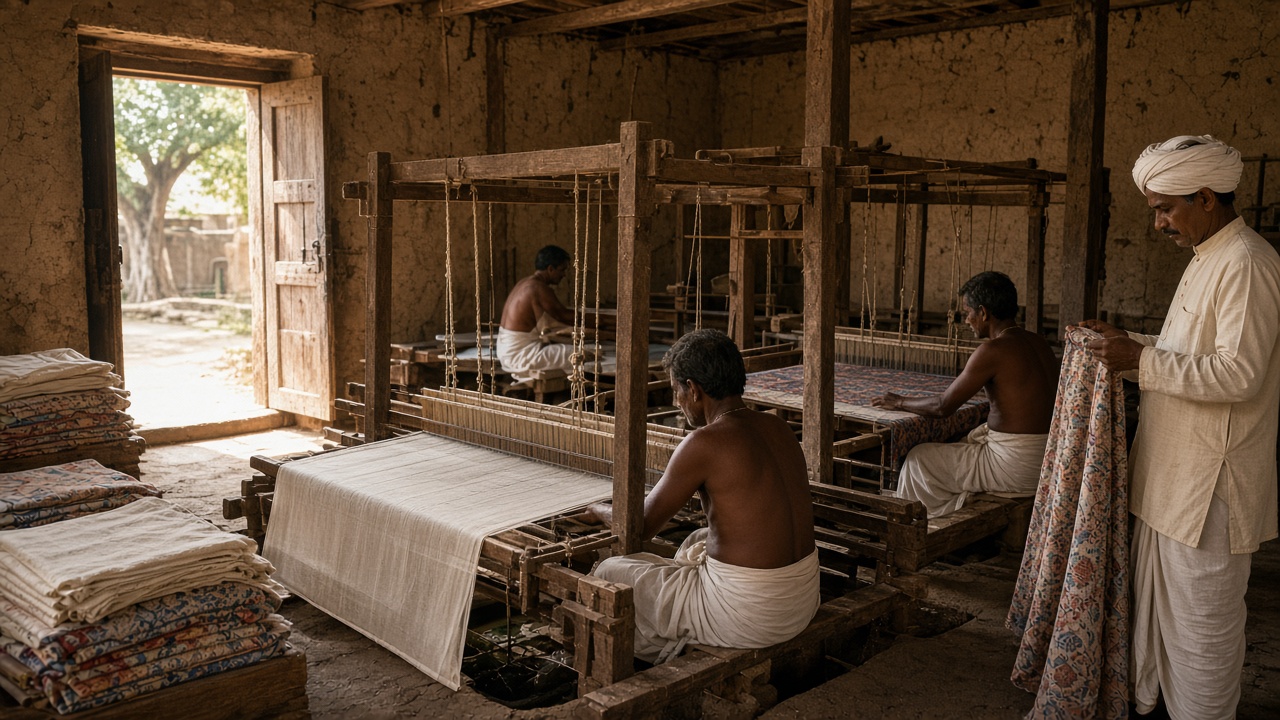
Before the factory age, goods were made by hand in homes and workshops. India and China were the world’s leading manufacturers, and Indian cotton cloth — fine muslins, calicoes, and chintzes — was prized from Europe to Southeast Asia. In Britain, growing trade, better farming, cheap coal, and a demand for Indian-style cloth set the stage for new machines.
Indian handloom weavers make fine muslin and printed calico, prized around the world (artistic illustration).
1600–1700: India, especially Bengal, Gujarat, and the Coromandel Coast, and China lead the world in textiles, silk, and porcelain, and the English (1600) and Dutch (1602) East India Companies are founded to trade in Asian goods.
1700–1721: Britain restricts imports of Indian printed calicoes to protect its own weavers (Calico Acts of 1700 and 1721), as Indian cloth becomes hugely fashionable in Europe.
1709–1733: Abraham Darby smelts iron with coke instead of charcoal at Coalbrookdale (1709), Thomas Newcomen’s steam engine pumps water from a coal mine (1712), and John Kay’s flying shuttle speeds up weaving (1733).
1750–1761: New crops and farming methods feed a growing British population, the Battle of Plassey (1757) gives the East India Company control of Bengal’s wealth, and the Bridgewater Canal (1761) starts Britain’s canal age.
Technology
Coke smelting: Iron made with coal.
Atmospheric engine: Steam pumps for mines.
Flying shuttle: Faster hand weaving.
Features
Cottage industry: Spinning and weaving at home.
Asian leadership: India and China lead manufacturing.
Global trade: East India Companies.
⚙️ Steam & Cotton1760 – 1840
Steam & Cotton
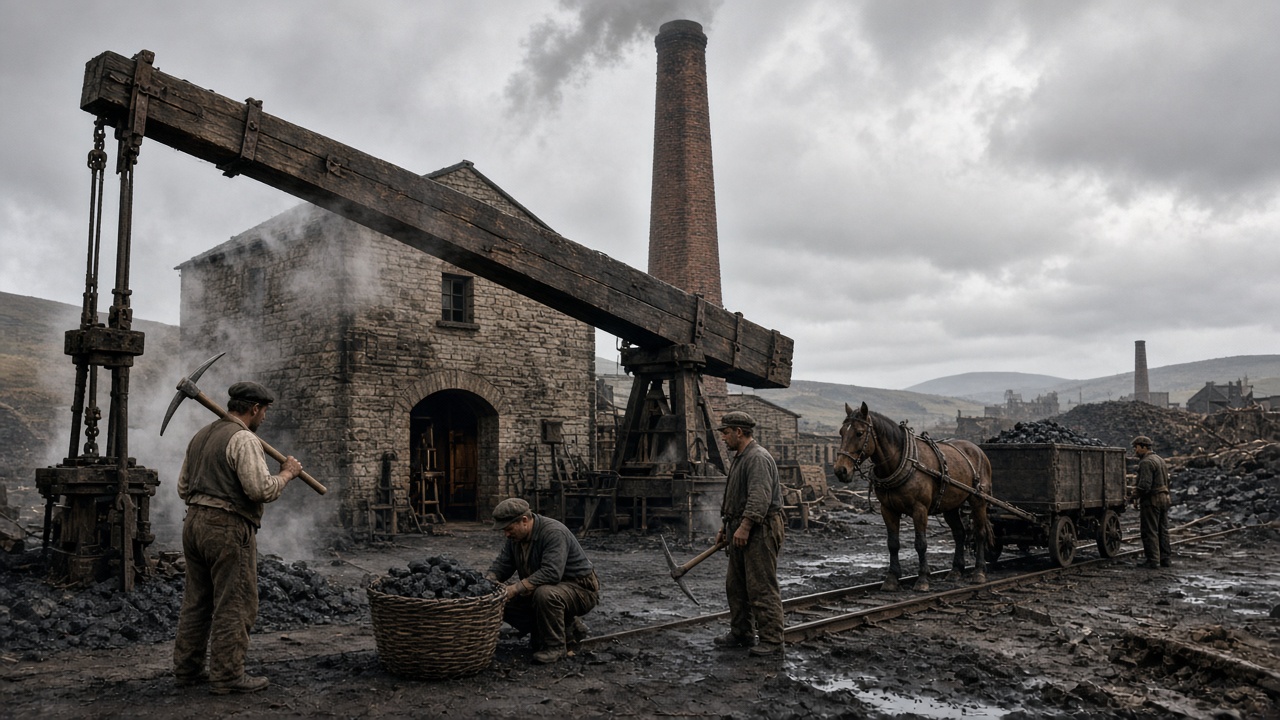
In Britain, a burst of inventions mechanised cotton spinning and weaving, and James Watt’s improved steam engine provided power anywhere. Workers moved from cottages into factories, iron production soared, and canals and the first railways moved coal and goods. The new machines also deepened links with slavery in the American cotton fields and hurt hand weavers in Britain and India.
An early beam engine pumps water from a coal mine as miners load coal wagons (artistic illustration).
1764–1771: James Hargreaves’ spinning jenny (about 1764) spins many threads at once, Richard Arkwright patents the water frame (1769) and opens Cromford Mill (1771), and James Watt patents his separate condenser (1769).
1776–1785: Boulton and Watt sell their first steam engines (1776), Samuel Crompton’s spinning mule (1779) and Edmund Cartwright’s power loom (1785) appear, and the world’s first iron bridge crosses the River Severn (1779).
1793–1816: Eli Whitney’s cotton gin (1793) spreads slave-grown cotton in the American South, Samuel Slater opens a water-powered mill in Rhode Island (1793), Richard Trevithick runs a steam locomotive (1804), and Luddites smash machines (1811–1816).
1825–1840: The Stockton and Darlington Railway opens (1825), the Liverpool and Manchester Railway becomes the first inter-city steam railway (1830), Britain’s Factory Act limits child labour in mills (1833), and Belgium and France begin to industrialise.
Technology
Spinning machines: Jenny, water frame, and mule.
Watt engine: Efficient rotary steam power.
Puddled iron: Cheap wrought iron.
Features
Factory system: Work under one roof.
Cotton boom: Britain’s leading industry.
Canals and rails: Moving coal and goods.
🚂 Railways Spread1840 – 1870
Railways & the Spread of Industry
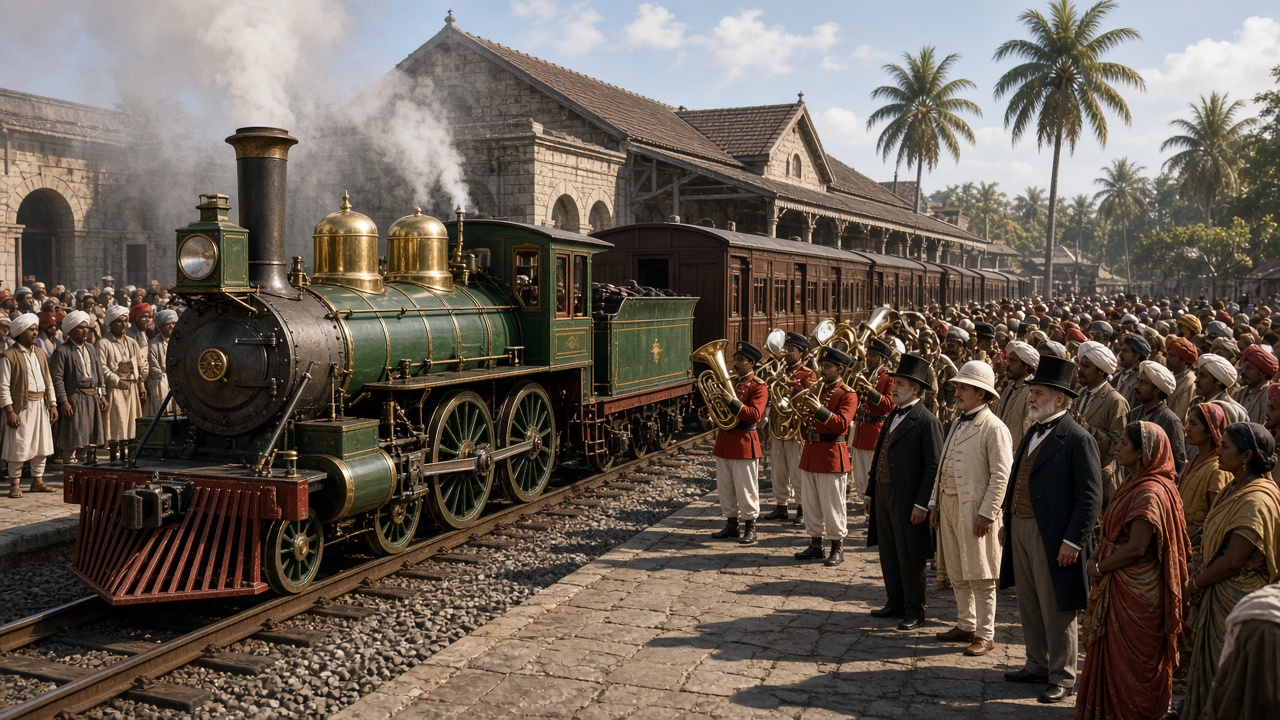
Railways and the electric telegraph shrank distances and carried industry far beyond Britain. Factories rose across Europe and North America, world’s fairs showed off new machines, and steamships and canals tied the world economy together. India got its first railway and its first modern cotton and jute mills, even as its handloom industry declined under colonial rule.
Crowds gather to see one of India’s first steam trains in the 1850s (artistic illustration).
1840s: “Railway mania” spreads lines across Britain, Samuel Morse sends a telegraph message from Washington to Baltimore (1844), and Karl Marx and Friedrich Engels publish The Communist Manifesto (1848), criticising factory capitalism.
1851–1856: The Great Exhibition in London’s Crystal Palace shows off machines from around the world (1851), India’s first passenger train runs from Bombay to Thane (16 April 1853), and Henry Bessemer invents a cheap way to make steel (1856).
1854–1865: Bombay’s first cotton mill (1854), the first jute mill near Calcutta (1855), and Ahmedabad’s first mill (1861) open, and the American Civil War (1861–1865) creates a boom in Indian raw cotton exports.
1858–1869: The first transatlantic telegraph cable is laid (1858), the first commercial oil well is drilled in Pennsylvania (1859), Japan’s Meiji Restoration (1868) starts rapid modernisation, and the Suez Canal opens (1869).
Technology
Steam locomotives: Fast overland transport.
Electric telegraph: Instant long-distance messages.
Bessemer converter: Cheap steel.
Features
Railway age: Lines across continents.
World’s fairs: Showcases of industry.
Global economy: Raw materials and factory goods.
⚡ Steel & Electricity1870 – 1914
Steel, Electricity & Chemicals
A “Second Industrial Revolution” was driven by cheap steel, electricity, chemicals, and oil. The telephone, the electric light, the car, and the aeroplane were all invented in these decades. The United States and Germany overtook Britain, giant companies emerged, and workers organised unions to demand shorter hours. In India, the first large steel plant was founded at Jamshedpur.
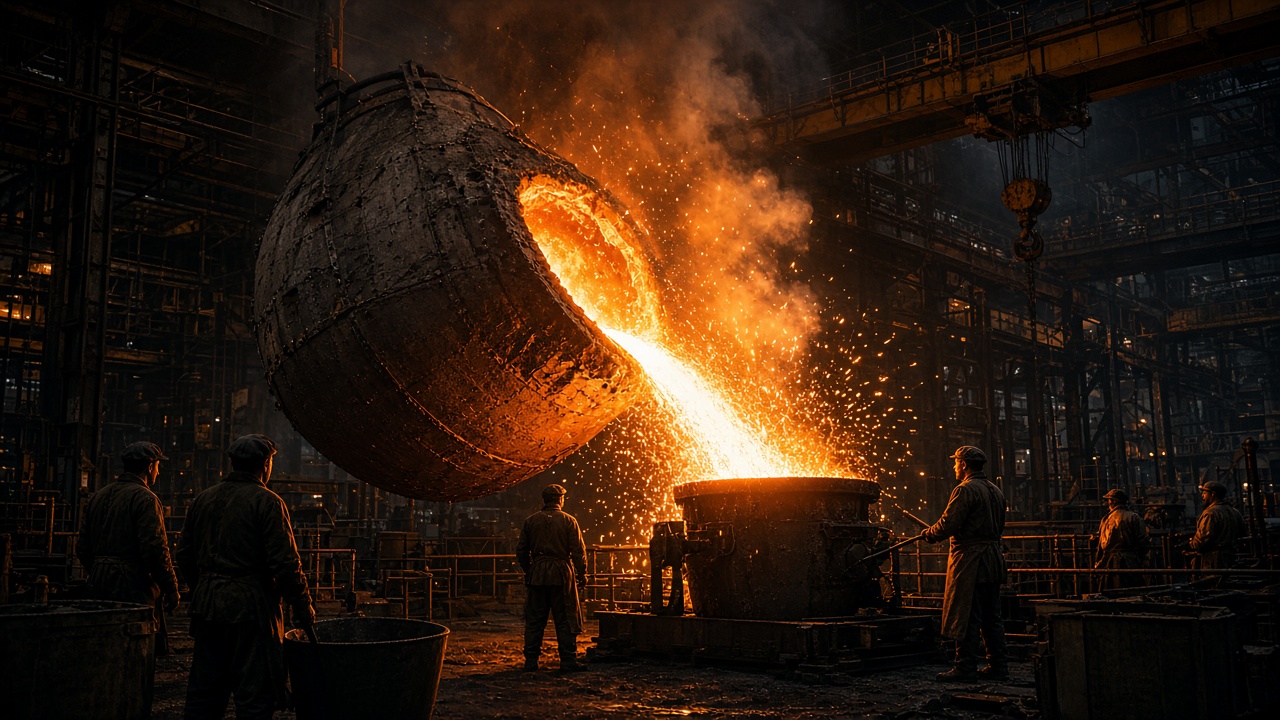
Molten steel pours in a showering of sparks in a late 19th-century steelworks (artistic illustration).
1876–1882: Alexander Graham Bell patents the telephone (1876), Thomas Edison develops a long-lasting light bulb (1879) and opens a central power station in New York (1882), and India passes its first Factories Act (1881).
1886–1903: Karl Benz builds a petrol-powered motor car (1886), Rudolf Diesel develops his engine (1890s), Jagadish Chandra Bose demonstrates radio waves in Calcutta (1895), and the Wright brothers make the first powered flight (1903).
1886–1900: Workers’ protests for an eight-hour day in Chicago (1886) lead to May Day, the United States becomes the world’s largest industrial economy, and Germany leads in chemicals and electrical goods.
1907–1913: The Tata Iron and Steel Company is founded (1907) and makes steel at Jamshedpur from 1912, Bakelite becomes the first fully synthetic plastic (1907), the Haber–Bosch process makes fertiliser from air (1909–1913), and Henry Ford introduces the moving assembly line (1913).
Technology
Electric power: Motors and lighting.
Internal combustion engine: Cars and aircraft.
Synthetic chemicals: Dyes, plastics, fertilisers.
Features
Big business: Giant corporations.
New leaders: USA and Germany.
Labour movement: Unions and May Day.
🏭 Mass Production1914 – 1970
Mass Production
The assembly line made cars, radios, and household goods affordable for millions. Two world wars turned whole economies into war factories, while the Soviet Union and later India and China used state planning to build heavy industry. After 1945, a long boom spread consumer goods across the West and Japan, and the transistor opened the electronic age.
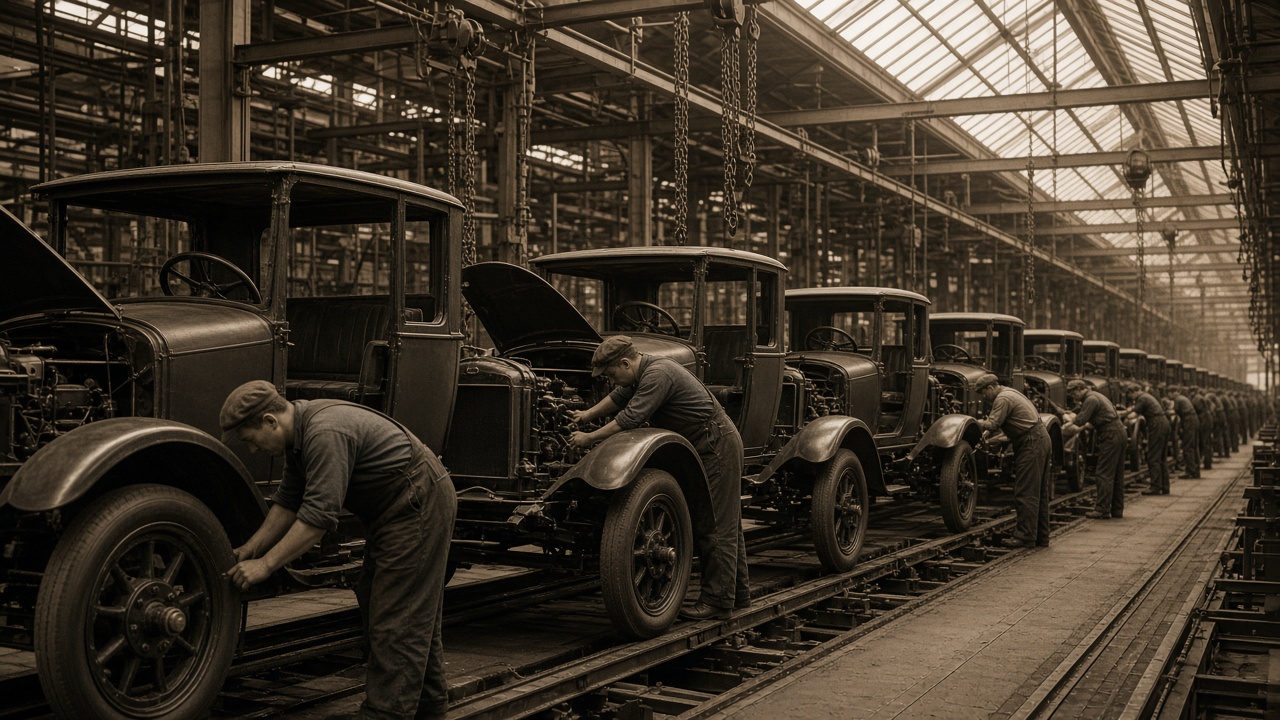
Workers build identical cars on a moving assembly line in the 1920s (artistic illustration).
1914–1929: The First World War drives huge factory output, electricity spreads to homes and factories in industrial countries, and the Soviet Union launches its first five-year plan for heavy industry (1928).
1929–1945: The Great Depression closes factories worldwide (from 1929), Hindustan Aircraft is founded in Bangalore (1940), and the Second World War turns industry to mass-producing ships, tanks, and aircraft.
1947–1960: The transistor is invented (1947), India’s first Five-Year Plan begins (1951), public-sector steel plants rise at Bhilai, Rourkela, and Durgapur, container shipping begins (1956), and Japan’s post-war economic boom takes off.
1961–1970: The first industrial robot goes to work in a US car factory (1961), South Korea and Taiwan begin export-led industrialisation, and programmable logic controllers start to automate factory machines (late 1960s).
Technology
Assembly line: Standard parts, moving work.
Plastics and nylon: New materials.
Transistor: The start of electronics.
Features
Mass consumption: Cars and appliances.
Planned economies: Five-year plans.
Post-war boom: Rising living standards.
🤖 Digital Industry1970 – Today
Digital Industry & Industry 4.0
Microchips, computers, and robots transformed factories, and global trade spread manufacturing to East Asia, with China becoming the “workshop of the world”. India opened its economy in 1991 and became a hub for software, cars, and pharmaceuticals. Today, smart factories link robots, sensors, data, and artificial intelligence, while industry races to cut carbon emissions.
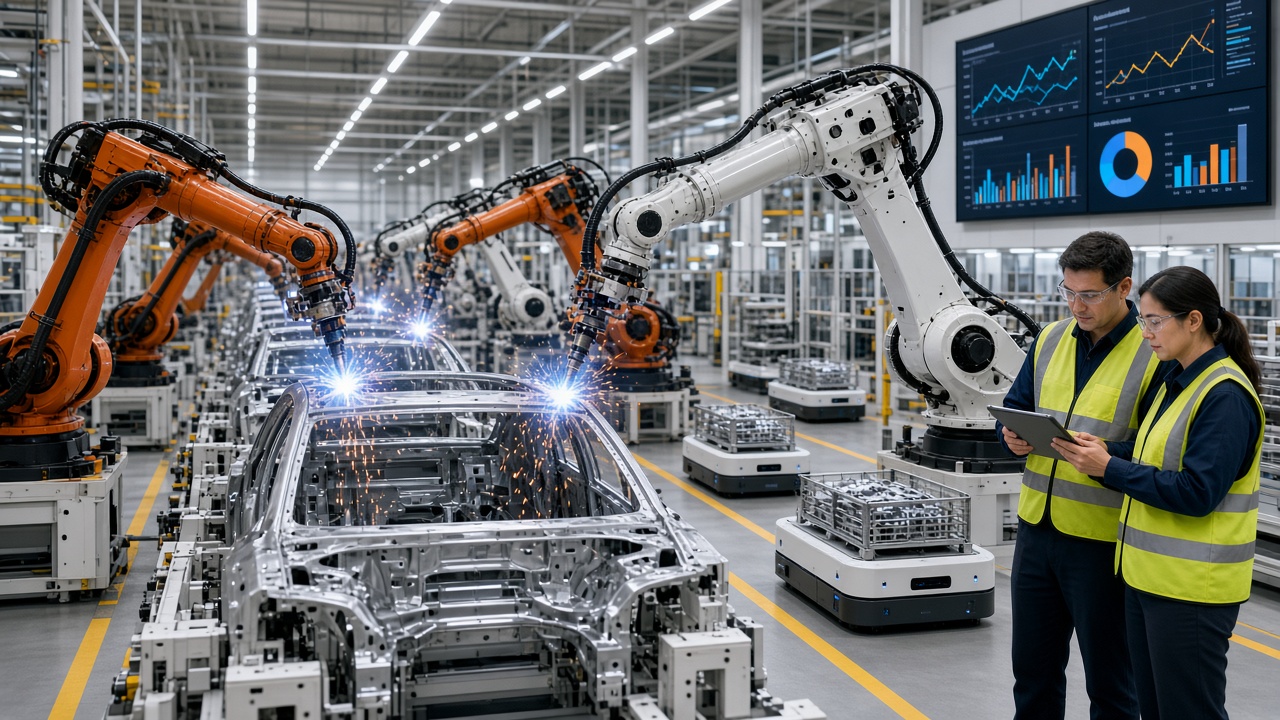
Robotic arms weld car bodies as engineers monitor data in a smart factory (artistic illustration).
1971–1980: The microprocessor is invented (1971), oil price shocks (1973, 1979) hit industry, computer-controlled machine tools and robots spread, and China begins economic reforms (1978).
1980s–1990s: Japanese “lean” and just-in-time production is copied worldwide, India launches economic liberalisation (1991), the World Trade Organization is founded (1995), and the internet links global supply chains.
2000s–2015: China becomes the world’s largest manufacturing nation (around 2010), the term “Industry 4.0” is launched in Germany (2011), India starts the Make in India campaign (2014), and the Paris Agreement (2015) sets climate goals.
Today: Factories use artificial intelligence, 3D printing, connected sensors, and collaborative robots, and countries including India compete to build semiconductors, batteries, electric vehicles, and solar panels.
Technology
Microprocessors: Computers in every machine.
Industrial robots: Precise, tireless work.
Internet of Things: Connected factories.
Features
Globalisation: Worldwide supply chains.
Automation: Smart factories.
Green industry: Cutting emissions.
Inventions That Changed the World
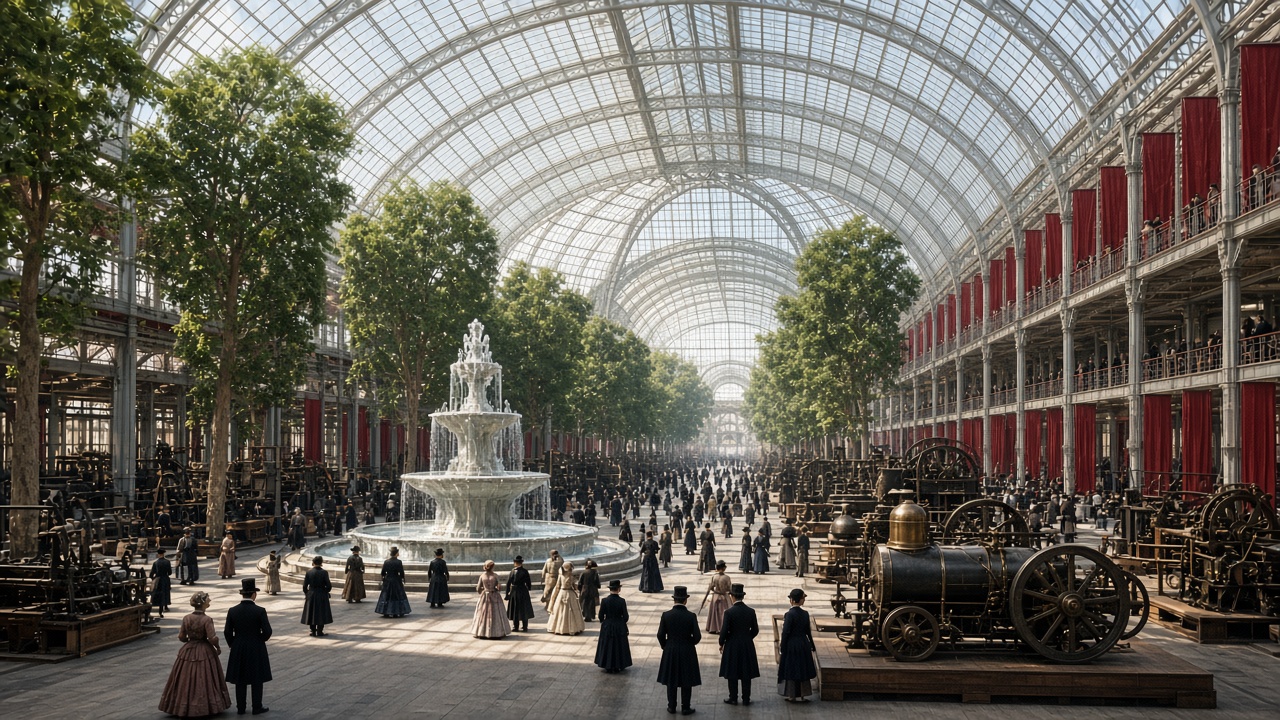
Visitors admire steam engines and machines at the Great Exhibition of 1851 in London (artistic illustration).
Invention
Inventor
Year
Why it mattered
Coke-smelted iron
Abraham Darby
1709
Iron could be made in large amounts with coal
Atmospheric steam engine
Thomas Newcomen
1712
Pumped water out of deep mines
Flying shuttle
John Kay
1733
Doubled the speed of weaving
Spinning jenny
James Hargreaves
About 1764
Spun many threads at once
Water frame
Richard Arkwright
1769
Powered spinning in large mills
Separate condenser steam engine
James Watt
1769
Far more efficient steam power for factories
Power loom
Edmund Cartwright
1785
Mechanised weaving
Steam locomotive
Richard Trevithick; George Stephenson
1804; 1820s
Railways for goods and passengers
Bessemer process
Henry Bessemer
1856
Cheap steel for rails, ships, and buildings
Electric light and power station
Thomas Edison and others
1879–1882
Electricity for homes and factories
Petrol motor car
Karl Benz
1886
Began the age of the automobile
Moving assembly line
Henry Ford’s company
1913
Mass production at low cost
Microprocessor
Engineers in the United States
1971
Computers small enough to control any machine
How Industry Spread Around the World
Country
Industrialisation began
Key industries
Notes
Britain
About 1760
Cotton, coal, iron, steam engines
The first industrial nation
Belgium
1820s
Coal, iron, textiles
First on the European mainland
United States
1790s–1820s
Textiles, railways, steel, oil, cars
Largest industrial economy by the 1890s
France
1830s–1840s
Textiles, railways, luxury goods
Gradual, steady growth
Germany
1850s–1870s
Coal, steel, chemicals, electrical goods
Led by the Ruhr region
Japan
From 1868
Silk, cotton, shipbuilding, steel
First non-Western industrial power
Russia and the Soviet Union
1890s; five-year plans from 1928
Railways, coal, steel, machinery
Rapid state-led industrialisation
India
From the 1850s
Railways, cotton and jute mills, steel (1912)
Limited under colonial rule; planned growth after 1951
China
1950s; reforms from 1978
Steel, textiles, electronics, everything
Largest manufacturer since around 2010
South Korea
1960s
Steel, ships, electronics, cars
One of the fastest industrialisations in history
India and the Industrial Revolution
Topic
Details
Before 1750
A world leader in cotton textiles — Dhaka muslin, calico, and chintz — with about a quarter of world manufacturing (estimate)
Decline of handlooms
Cheap machine-made British cloth and colonial trade policies ruined many weavers (often called “deindustrialisation”)
Raw materials
India increasingly exported raw cotton, jute, indigo, and tea, and imported factory goods
Railways
First passenger train from Bombay to Thane (1853); a large network by 1900
Mills
Bombay’s first cotton mill (1854), the first jute mill near Calcutta (1855), and Ahmedabad’s first mill (1861)
Swadeshi
The Swadeshi movement (from 1905) promoted Indian-made goods and industry
Steel
Tata Iron and Steel Company founded in 1907; steel produced at Jamshedpur from 1912
Workers
First Factories Act (1881), the Madras Labour Union (1918), and the All India Trade Union Congress (1920)
After independence
Five-Year Plans from 1951, public-sector steel plants, liberalisation in 1991, and Make in India in 2014
Working Life and Society
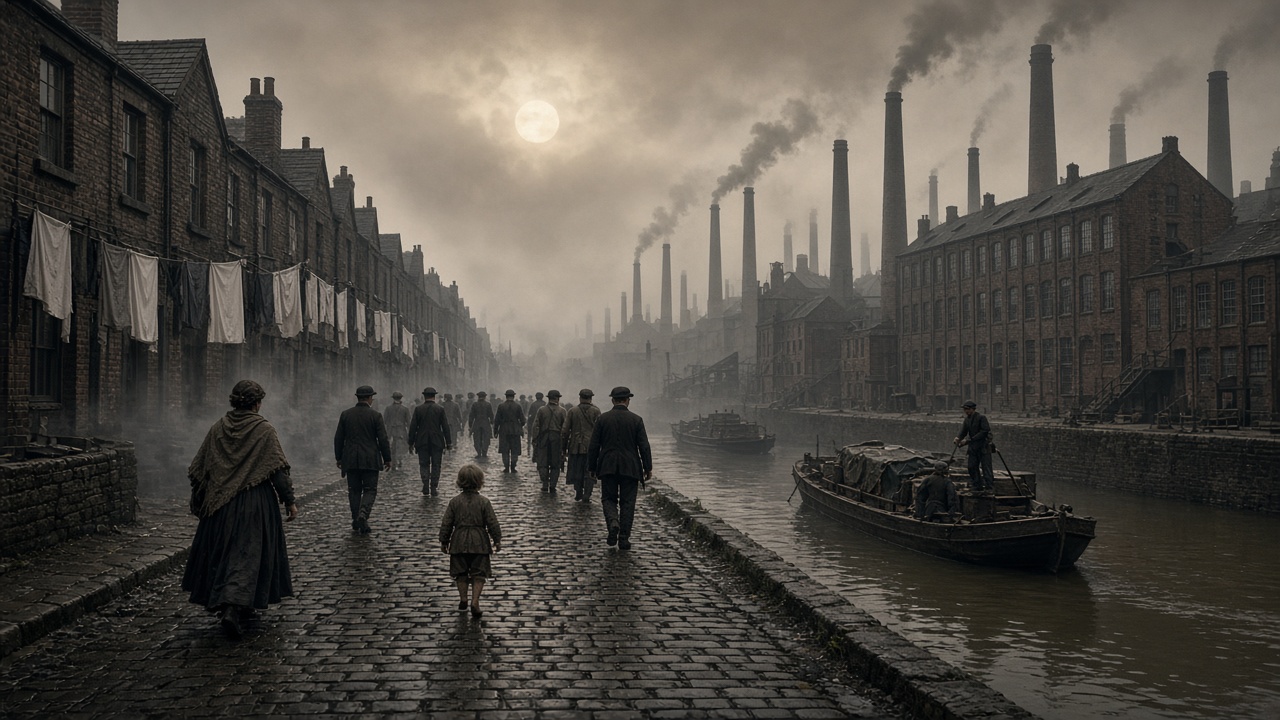
Workers walk to the mills through a smoky industrial town in the 1860s (artistic illustration).
Topic
What changed
Growth of cities
Millions moved from villages to fast-growing factory towns such as Manchester
Working hours
12–14 hour days were common, ruled by the factory clock
Child labour
Children worked in mills and mines; Britain’s Factory Act (1833) and Mines Act (1842) began to limit it
Housing and health
Crowded slums, dirty water, and cholera led to public health laws, sewers, and clean water supplies
Trade unions
Workers organised for better pay, shorter hours, and safer conditions
Women at work
Women worked in textile mills and later in offices, shops, and factories
Slavery and empire
Slave-grown American cotton fed British mills; colonies supplied raw materials and bought factory goods
Education
Industrial countries introduced free, compulsory schooling in the late 1800s
Environment
Coal smoke, smog, polluted rivers, and later rising carbon dioxide and climate change
Industrial Revolution Timeline Summary
Date
Milestone
1709
Coke-smelted iron at Coalbrookdale
1712
Newcomen’s steam engine
1733
Flying shuttle
About 1764
Spinning jenny
1769
Arkwright’s water frame and Watt’s separate condenser
1771
Cromford Mill opens
1779
Iron Bridge and the spinning mule
1785
Power loom
1793
Cotton gin; first US water-powered cotton mill
1830
Liverpool and Manchester Railway
1833
British Factory Act limits child labour
1851
Great Exhibition in London
16 April 1853
India’s first passenger train
1854
First cotton mill in Bombay
1856
Bessemer steel process
1868
Meiji Restoration in Japan
1869
Suez Canal opens
1879–1882
Electric light and the first central power station
1886
Benz motor car
1907–1912
Tata Iron and Steel Company founded; steel from Jamshedpur
1913
Moving assembly line
1951
India’s first Five-Year Plan
1971
Microprocessor
1991
India’s economic liberalisation
2011
“Industry 4.0” launched in Germany
Test Your Knowledge
20 quick questions from the Industrial Revolution timeline. Click each question to reveal the answer.
Answer: Britain, around 1760.
Answer: Muslin.
Answer: Coke, made from coal.
Answer: Pumping water out of mines.
Answer: The spinning jenny.
Answer: A separate condenser, making steam engines far more efficient.
Answer: The River Severn in England.
Answer: Luddites.
Answer: The Liverpool and Manchester Railway.
Answer: The Crystal Palace in London.
Answer: Bombay (Mumbai) and Thane.
Answer: Steel.
Answer: The Meiji Restoration.
Answer: Steel, electricity, chemicals, and oil.
Answer: Jagadish Chandra Bose.
Answer: Jamshedpur.
Answer: The moving assembly line.
Answer: 1951.
Answer: The microprocessor.
Answer: Industry 4.0.
Classroom activity
Students Tasks
Use these prompts for discussion or projects on the Industrial Revolution.
Timeline understandingWorld historyScience and technologyCause and effect
Make a timeline poster: 1712 Newcomen engine, 1769 Watt and Arkwright, 1830 first inter-city railway, 1853 India’s first train, 1913 assembly line, 1971 microprocessor, and 2011 Industry 4.0.
On a world map, mark when industry began in Britain, Belgium, the United States, Germany, Japan, Russia, India, China, and South Korea.
Draw a cause-and-effect chain showing how coal, iron, and steam engines led to railways.
Write a diary entry as a young mill worker in Manchester or Bombay in the 1850s.
Explain how machine-made cloth affected India’s handloom weavers, and how the Swadeshi movement responded.
Make a fact card about the Tata steel works at Jamshedpur.
Compare a factory of 1850 with a smart factory today: power, workers, safety, and machines.
List five things in your home that were made possible by the Industrial Revolution and explain each.
Research how industry contributes to climate change and suggest three ways factories can become greener.
Debate: “The Industrial Revolution did more good than harm.”
Continue exploring
The Industrial Revolution transformed railways, clothing, lighting, and road transport. Explore these connected timelines next.
Click any panel to expand and explore the visual mood.
The Industrial Revolution in pictures — Indian handloom weavers, an early steam engine, a cotton mill, India’s first trains, the Great Exhibition, a steelworks, the assembly line, a robot factory, and a mill then versus now.
Handlooms
India, 1700s
Steam Power
1712 onwards
Cotton Mill
Factory system
India’s Railways
1853
Great Exhibition
London, 1851
Age of Steel
1856 onwards
Assembly Line
Mass production
Smart Factory
Industry 4.0
Then vs Now
Mill to robots
Explore all world history timelines
Jump to any other world history timeline on WorldTimelineHub.
Disclaimer: This content is AI-generated for educational purposes and may contain errors or outdated details. For correct and authoritative information, please refer to official and reliable sources such as government publications, manufacturers, museums, and academic references.