From limited colonial assemblies to the Constituent Assembly’s grand debate, the Republic on 26 January 1950, the world’s largest elections, and today’s EVMs, VVPATs, and digital voter services.
Assemblies -> 1950Universal franchiseElections & digital
Why This Story Matters
India’s Constitution turned a diverse subcontinent into a republic with written rights, federal institutions, and periodic elections. Understanding the path from limited councils to universal adult franchise—and from paper ballots to EVMs—explains how democracy works at Indian scale.
Big picture
Democracy’s arc in one view
Limited representation under colonial law gave way to a sovereign Constituent Assembly, a republican Constitution, competitive elections, and newer digital tools that help run—and scrutinise—the world’s largest democracy.
Assemblies, a written Constitution, ballots—and now electronic voting at continental scale.
Limited Voice1861 - 1935
Colonial Assemblies and Councils
British Indian Councils Acts and the Government of India Acts gradually expanded legislative councils. Representation remained limited by property, education, and communal electorates—yet these chambers trained a generation of Indian politicians and lawyers who later wrote the Republic’s rules.
Assembly era: debate under empire, without full sovereignty.
Indian Councils Acts expand nominated and elected members.
1919 & 1935 Acts deepen provincial autonomy in constrained form.
National movement presses for real self-government.
Institutions
Legislative councils: Imperial and provincial chambers.
Dyarchy / provincial autonomy: Shared but unequal power.
Franchise limits: Not universal adult suffrage yet.
Features
Learning democracy: Procedure, petitions, and party politics grow.
Incomplete mandate: Millions still excluded from voting.
Demand for a constitution: Swaraj needs a written charter.
We, the People1946 - 1949
Constituent Assembly
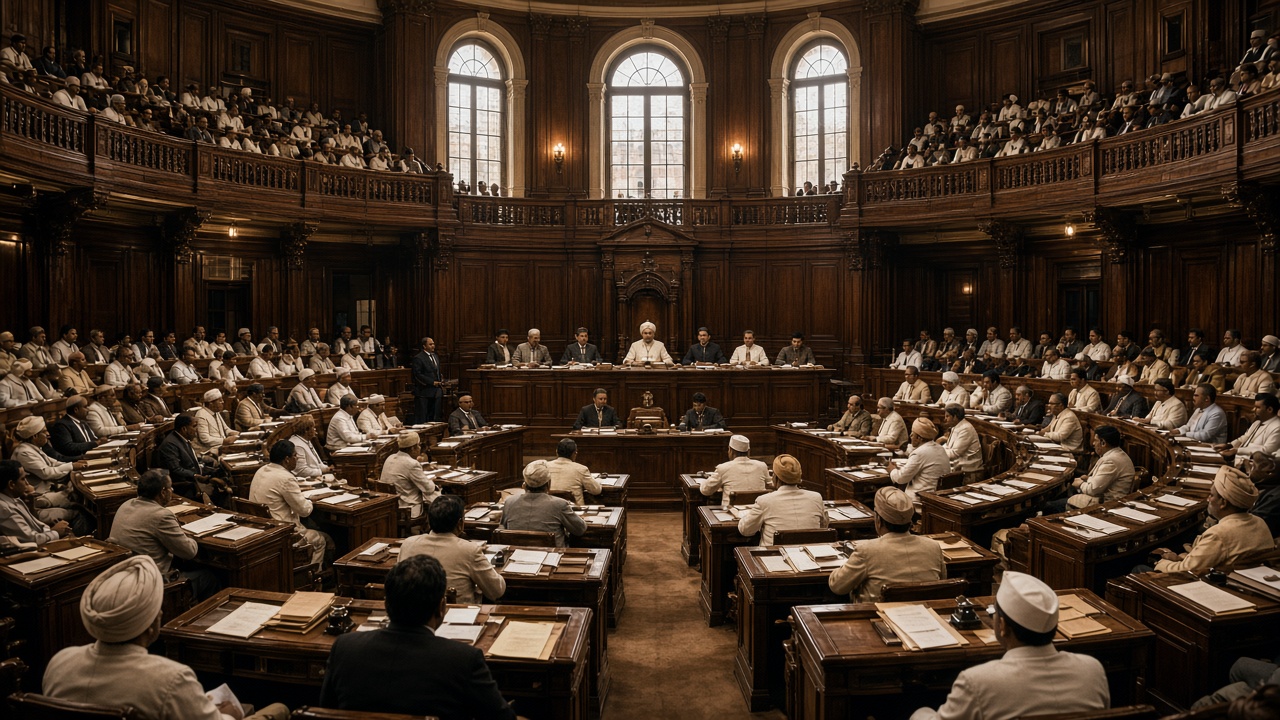
After World War II and independence, the Constituent Assembly drafted India’s Constitution. Committees debated federalism, rights, minorities, language, and emergency powers. Dr B. R. Ambedkar chaired the Drafting Committee; the Assembly adopted the text on 26 November 1949.
Drafting era: a diverse assembly builds the republic’s rulebook.
Assembly first meets in December 1946.
Objectives Resolution sets the republic’s goals.
26 Nov 1949: Constitution adopted (Constitution Day).
Building Blocks
Drafting Committee: Turns debates into articles.
Borrowed & adapted: Lessons from other constitutions, fitted to India.
Lengthy text: Detailed federal and rights framework.
Features
Inclusive ambition: Social justice alongside political liberty.
Compromise craft: Many viewpoints negotiated into one charter.
Legal supremacy: Constitution above ordinary law.
Republic1950
Constitution Comes into Force
On 26 January 1950 India became a republic. The Constitution established Parliament, the Union and states, an independent judiciary, Fundamental Rights, Directive Principles, and adult franchise. Republic Day marks that constitutional birthday every year.
26 January 1950: the written Constitution becomes the supreme law.
Preamble declares the republic’s core ideals.
Fundamental Rights become justiciable.
Offices of President, Parliament, and courts take constitutional form.
Core Parts
Part III: Fundamental Rights.
Part IV: Directive Principles of State Policy.
Federal scheme: Union, states, and concurrent lists.
Features
Single citizenship: One Indian citizenship across states.
Amendable: Flexible enough to evolve by amendment.
Judicial review: Courts can strike down unconstitutional laws.
Franchise1951 - 1952
First General Elections
India’s first Lok Sabha elections stretched across months in 1951–52. Officials built rolls for a mostly rural, multilingual electorate and used ballot boxes at scale. Universal adult franchise from the start was a radical democratic choice.
1951–52: democracy goes to the village polling booth.
Election Commission oversees the national poll.
Voters choose Lok Sabha and many state assemblies.
Paper ballots and symbols help non-literate voters.
Peaceful transfer: Results accepted as legitimate.
Living Charter1952 - 1990s
Parliamentary Democracy Matures
Parliament, state legislatures, the Supreme Court, and Election Commission became routines of public life. Amendments, coalitions, emergencies, and landmark judgments tested—and reshaped—the Constitution while regular elections continued.
Parliament era: law-making, oversight, and constitutional contests.
States reorganisation and federal bargaining reshape the map.
Judiciary: Interprets and reviews constitutionality.
Features
Amendment culture: Constitution evolves without a new assembly each time.
Rights litigation: Citizens use courts to enforce freedoms.
Electoral competition: Power changes hands through votes.
Tech & Trust1990s - Present
EVMs and Digital Democracy
Electronic Voting Machines sped up counting and reduced some paper-ballot fraud risks. VVPATs added a paper trail. Online voter services, apps, and digital campaigning joined the story—while debates on transparency, data, and misinformation continue.
Digital era: machines at the booth, services on the phone—trust still earned offline.
EVMs roll out widely; VVPATs become standard.
Voter helplines, portals, and EPIC services go digital.
Social media reshapes campaigns and fact-checking needs.
Tools
EVM + VVPAT: Electronic vote with audit slip.
Online rolls / apps: Check names, booths, and forms.
e-Governance link: Digital India services meet citizenship.
Features
Faster results: Counting finishes sooner.
Scrutiny: Civil society and courts watch election tech.
Hybrid reality: Digital tools + physical polling stations.
Constitution Timeline Summary
Era
Milestone
Why it matters
1861–1935
Colonial councils
Limited representation under empire.
1946–49
Constituent Assembly
Indians draft their own supreme law.
26 Jan 1950
Republic begins
Constitution in force.
1951–52
First general elections
Universal adult franchise at scale.
1952–90s
Parliament & courts
Democracy becomes routine practice.
1990s–
EVM / digital services
Tech aids polling and citizen access.
Key Historical Events
Event
Year
Significance
Indian Councils Act expansions
1861+
More Indian voices in legislatures.
Government of India Act
1935
Major (still colonial) constitutional framework.
Constituent Assembly begins
1946
Drafting of the Constitution starts.
Constitution adopted
26 Nov 1949
Constitution Day.
Constitution in force
26 Jan 1950
Republic Day.
First general elections
1951–52
Lok Sabha chosen by universal franchise.
Basic Structure doctrine
1973 (Kesavananda)
Core features protected from amendment.
EVMs / VVPATs nationwide
1990s–2010s
Electronic voting with paper audit trail.
Then vs Now
From limited councils and paper ballots to a republic with electronic voting and digital services.
Metric
Then
Now
Sovereignty
Colonial / dominion transition
Republic under Constitution
Who votes
Restricted franchise
Universal adult franchise
Supreme law
British Acts / interim rules
Constitution of India
Voting method
Paper ballots / boxes
EVM + VVPAT (plus paper where needed)
Citizen services
Mostly offline forms
Portals, apps, e-governance
Future Predictions
2025–2030: Stronger rules around political ads and deepfakes online.
Electoral tech: Continued audits and transparency demands around EVMs/VVPATs.
Civic literacy: More classroom focus on Constitution and voting rights.
Digital + booth: Hybrid model stays—online services, physical polling.
India spotlight
Living the Constitution
Republic Day parades, Constitution Day readings, voter festivals, and court judgments keep constitutional democracy visible in everyday Indian life—beyond textbooks.
India spotlight: a charter that citizens, courts, and elections continually reinterpret.
26 Nov
Constitution Day
Schools and institutions read the Preamble and remember adoption in 1949.
26 Jan
Republic Day
National celebration of the Constitution coming into force.
Every 5 years
Lok Sabha cycle
General elections renew the popular mandate (unless dissolved earlier).
Ongoing
Rights & PILs
Citizens and courts test how Fundamental Rights apply to new problems.
Digital age
Voter services online
Check rolls, find booths, and follow results—while voting remains at the booth.
Citizen tip: Verify your name on the electoral roll before every election.
Classroom tip: Read the Preamble aloud; discuss one Fundamental Right.
Link: Digital India tools support services; the Constitution sets the rules.
Test Your Knowledge
20 questions on assemblies, the Constitution, elections, and digital voting. Click to reveal answers.
Answer: 26 January 1950.
Answer: 26 November 1949.
Answer: Dr B. R. Ambedkar.
Answer: The anniversary of the Constitution coming into force.
Answer: Every adult citizen can vote, without wealth or literacy tests.
Answer: 1951–1952.
Answer: Conducts elections and maintains electoral processes/rolls.
Answer: Justiciable rights in Part III of the Constitution.
Answer: Goals for the state in Part IV (not directly enforceable like rights).
Answer: The Constitution’s introductory statement of ideals.
Answer: Electronic Voting Machine used at polling stations.
Answer: Voter Verifiable Paper Audit Trail—a paper slip for the vote cast.
Answer: Franchise and powers were restricted; sovereignty remained with the empire.
Answer: Courts can examine whether laws violate the Constitution.
Answer: Core constitutional features cannot be destroyed by amendment.
Answer: Online voter services / e-governance platforms for citizens.
Answer: The people of India through general elections.
Answer: To help voters recognise parties/candidates, including non-literate voters.
Answer: No—voting is at polling stations (with EVMs); many services around voting are digital.
Answer: From limited assemblies to a republican Constitution, mass elections, and digital election support tools.
Classroom activity
Students Tasks
Ten prompts on the Constitution, elections, rights, and digital democracy.
ConstitutionElectionsRightsDigital
Explain the difference between Constitution Day and Republic Day.
Why was universal adult franchise a bold choice in 1950?
List three Fundamental Rights and give a modern example for each.
Compare colonial councils with today’s Parliament in a table.
Role-play a short Constituent Assembly debate on language or federalism.
Describe how an EVM + VVPAT booth works in five steps.
Check (with a guardian) how to verify a name on the electoral roll online.
Design a poster: “Read the Preamble.”
Debate: should political ads on social media face stronger rules?
Write one paragraph on why an independent Election Commission matters.
Continue exploring
The Constitution connects Digital India, cyber law, education, and public services. Explore these linked stories next.
Jump to any other government timeline on WorldTimelineHub.
Disclaimer: This content is AI-generated for educational purposes and may contain errors or outdated details. For correct and authoritative information, please refer to official and reliable sources such as government publications, manufacturers, museums, and academic references.