First World War Timeline: Roots of War → 1914 Outbreak → Trenches & Total War → 1917 Turning Point → 1918 Armistice → Peace & Remembrance
In the summer of 1914 two shots in Sarajevo set off a chain of declarations that pulled Europe’s great powers and their empires into the first truly global, industrial war. For more than four years, millions of soldiers —
including over a million from India — fought in trenches, deserts, mountains, and at sea. The war toppled empires, redrew the map, changed the lives of women and workers, and shaped the century that followed.
This timeline covers the alliance system and the naval race, the Balkan Wars, the assassination at Sarajevo, the July Crisis, the Marne and the race to the sea, the Christmas truce, poison gas, Gallipoli, Verdun, Jutland, the
Somme, Kut, the first tanks, the Russian Revolution, the United States’ entry, Passchendaele, Haifa, the Hundred Days, the Armistice, the 1918 flu, the Treaty of Versailles, the League of Nations, and India Gate.
28 June 1914 Sarajevo → 4 Aug 1914 Britain at war1 July 1916 Somme → 6 April 1917 USA joins11 Nov 1918 Armistice → 28 June 1919 Versailles
Why the First World War Matters
The First World War was fought on a scale never seen before, with entire economies turned to war production and soldiers drawn from every inhabited continent. It killed millions of soldiers and civilians, ended the German,
Austro-Hungarian, Russian, and Ottoman empires, sparked the Russian Revolution, and led to new countries and the League of Nations. Its unresolved tensions helped cause the Second World War, and its memory still shapes how nations remember their dead.
Big picture
The First World War in one view
Rival alliances and an arms race divided Europe, a murder in Sarajevo triggered war in 1914, the Western Front froze into trenches, 1915–1916 brought gas, Gallipoli, Verdun, and the Somme, 1917 saw Russia collapse and the
United States join, the Allies broke through in 1918 to force an armistice, and the peace of 1919 redrew the world map. Related timelines:
air transport,
radio,
communication.
4 yrs 3 mths
From 28 July 1914 to 11 November 1918
~70 million
Soldiers mobilised worldwide (estimate)
~1.3 million
Indian soldiers and labourers served (estimate)
11 a.m.
The guns fall silent, 11 November 1918
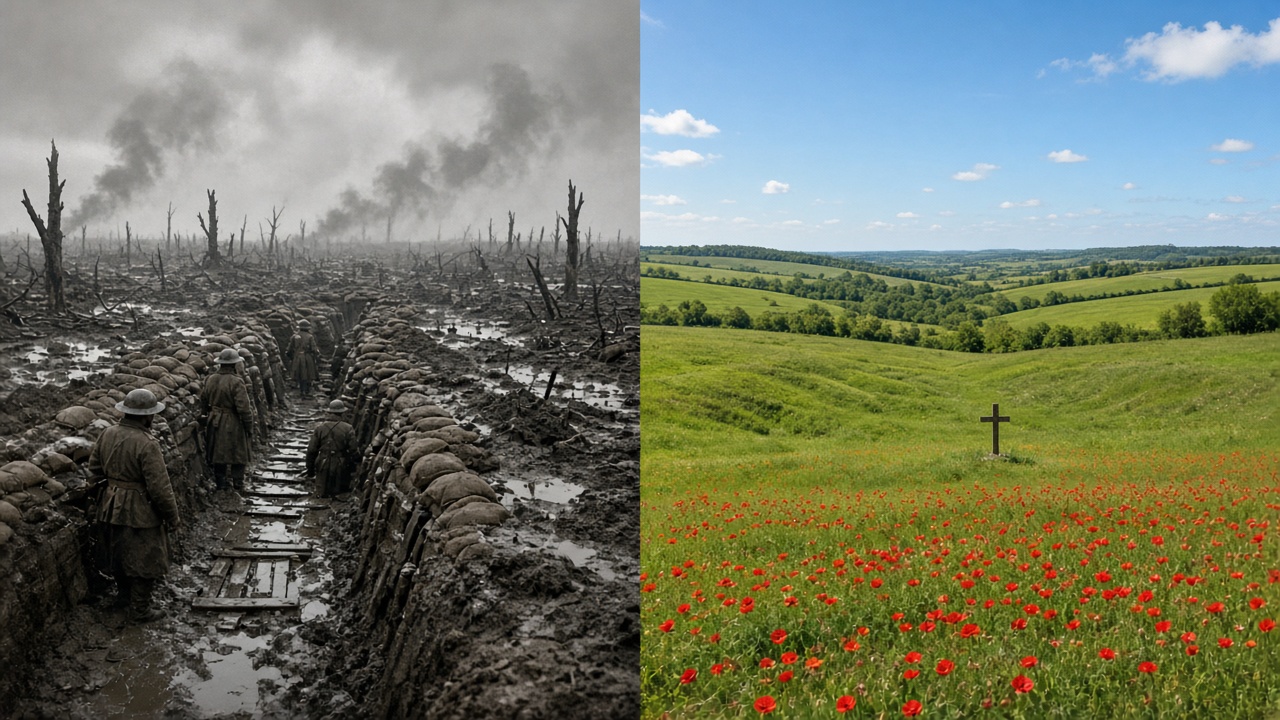
A Western Front trench in 1916 and the same fields with poppies today (artistic illustration).
War and the World Then vs Now
Feature
1914–1918
Today
World map
Great empires ruled much of Asia and Africa
About 193 independent member states of the United Nations
India
A British colony; troops raised and sent abroad by Britain
An independent republic and a leading contributor to UN peacekeeping
Battlefield messages
Field telephones, runners, signal lamps, and carrier pigeons
Satellite links and secure digital networks
Aircraft
Wood-and-fabric biplanes, often under 200 km/h
Jet fighters, drones, and satellites
Armoured vehicles
Slow early tanks, about 6 km/h
Fast modern tanks and armoured vehicles
Medical care
No antibiotics; infection killed many wounded
Antibiotics, trauma surgery, and air ambulances
News from the front
Censored letters and newspapers, often days late
Live video and social media
Rules of war
Hague Conventions of 1899 and 1907
Geneva Conventions (1949) and a global ban on chemical weapons (1997)
World body for peace
None before 1920
The United Nations (since 1945)
Women’s votes
Few countries allowed women to vote
Women vote in almost every country
🧭 Roots of War1871 – 1914
Roots of War
In the decades before 1914, Europe’s great powers competed for colonies, trade, and prestige. They formed two rival alliances, built ever-larger armies and navies, and made detailed war plans. Meanwhile, nationalism in the Balkans threatened the crumbling Ottoman and Austro-Hungarian empires and drew Russia into the region.
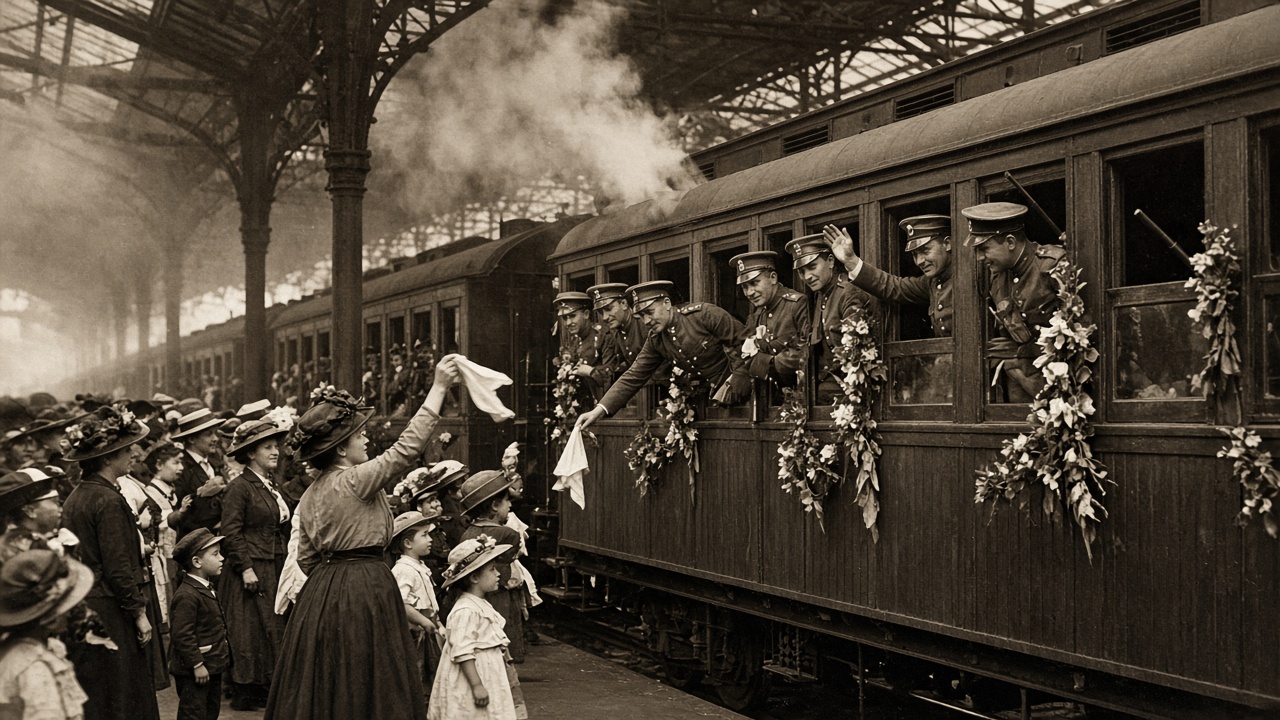
Families wave off soldiers on a flower-decked train as war begins (artistic illustration).
1871–1882: Germany is unified after defeating France, which loses Alsace-Lorraine, and Germany, Austria-Hungary, and Italy form the Triple Alliance (1882).
1894–1907: France and Russia ally (1894), Britain and France sign the Entente Cordiale (1904), and the Anglo-Russian agreement (1907) completes the Triple Entente.
1906–1912: Britain launches HMS Dreadnought (1906), starting a naval race with Germany, while crises over Morocco (1905, 1911) raise tensions.
1908–1913: Austria-Hungary annexes Bosnia (1908), angering Serbia and Russia, and two Balkan Wars (1912–1913) push the Ottomans out of most of Europe and enlarge Serbia.
Technology
Dreadnoughts: All-big-gun battleships.
Railways: Fast mobilisation of armies.
Machine guns: Maxim-type weapons.
Features
Two alliances: Triple Alliance and Triple Entente.
Arms race: On land and at sea.
Balkan tension: The “powder keg”.
💥 1914 Outbreak1914
July Crisis & Outbreak
A political murder in Sarajevo turned into a world war within six weeks, as alliances and mobilisation plans came into play. Germany’s plan to knock out France quickly through Belgium failed at the Marne, and by Christmas both sides were dug into trenches. Troops from India arrived in France in the autumn and fought at Ypres.
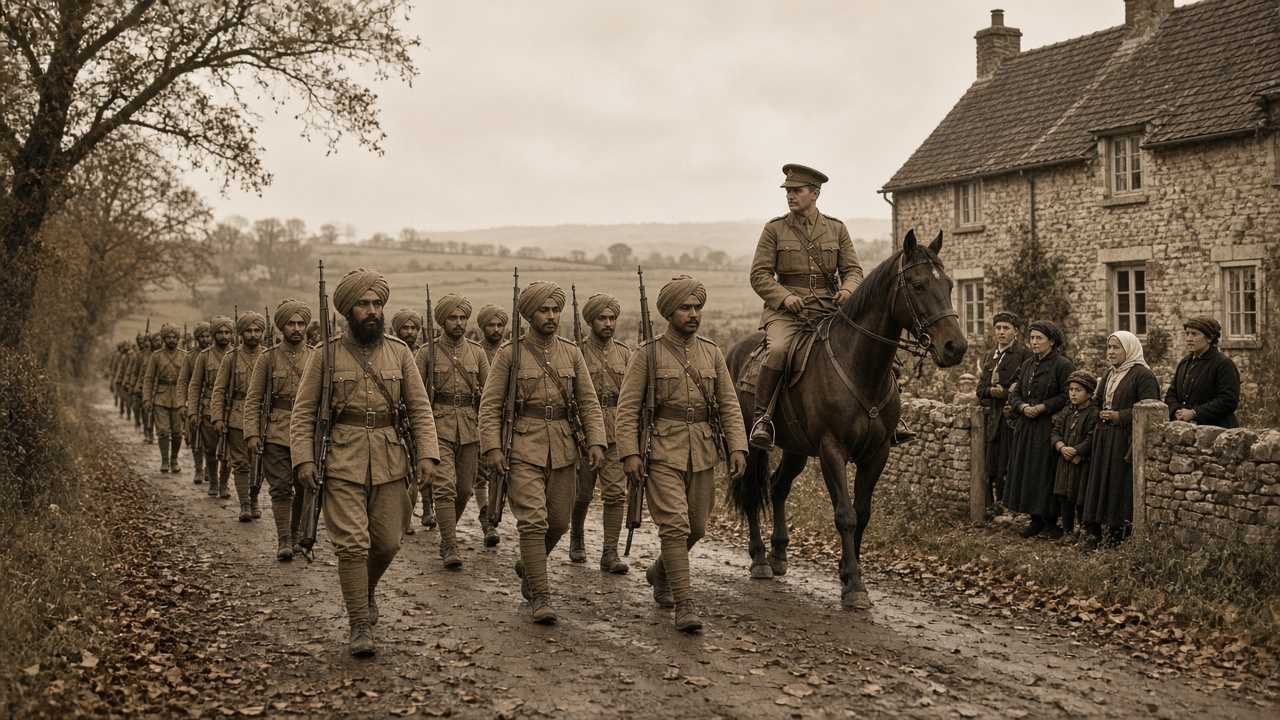
Indian soldiers march through a French village in the autumn of 1914 (artistic illustration).
28 June–28 July 1914: Archduke Franz Ferdinand of Austria-Hungary is assassinated in Sarajevo, Austria-Hungary sends Serbia an ultimatum (23 July), and declares war on Serbia (28 July).
1–4 August 1914: Germany declares war on Russia (1 August) and France (3 August), invades neutral Belgium, and Britain and its empire, including India, enter the war (4 August).
August–September 1914: Germany crushes a Russian army at Tannenberg, while the French and British halt the German advance on Paris at the First Battle of the Marne (6–12 September).
September–December 1914: Indian divisions land at Marseille, Khudadad Khan wins the first Victoria Cross for an Indian soldier at Ypres (October), the Ottoman Empire joins Germany, and an unofficial Christmas truce takes place.
Technology
Heavy artillery: Siege guns smash Belgian forts.
Telegraph and wireless: Orders and news.
Trenches: Dug for protection.
Features
Chain reaction: Alliances drawn in.
Plans fail: No quick victory.
Global war: Empires join in.
🪖 Trenches1915 – 1916
Trenches & Total War
With the Western Front locked in place, both sides tried new weapons and new fronts to break the deadlock. Poison gas, the Gallipoli campaign, and huge battles of attrition at Verdun and the Somme cost hundreds of thousands of lives for little ground. At home, whole societies were mobilised for “total war”.
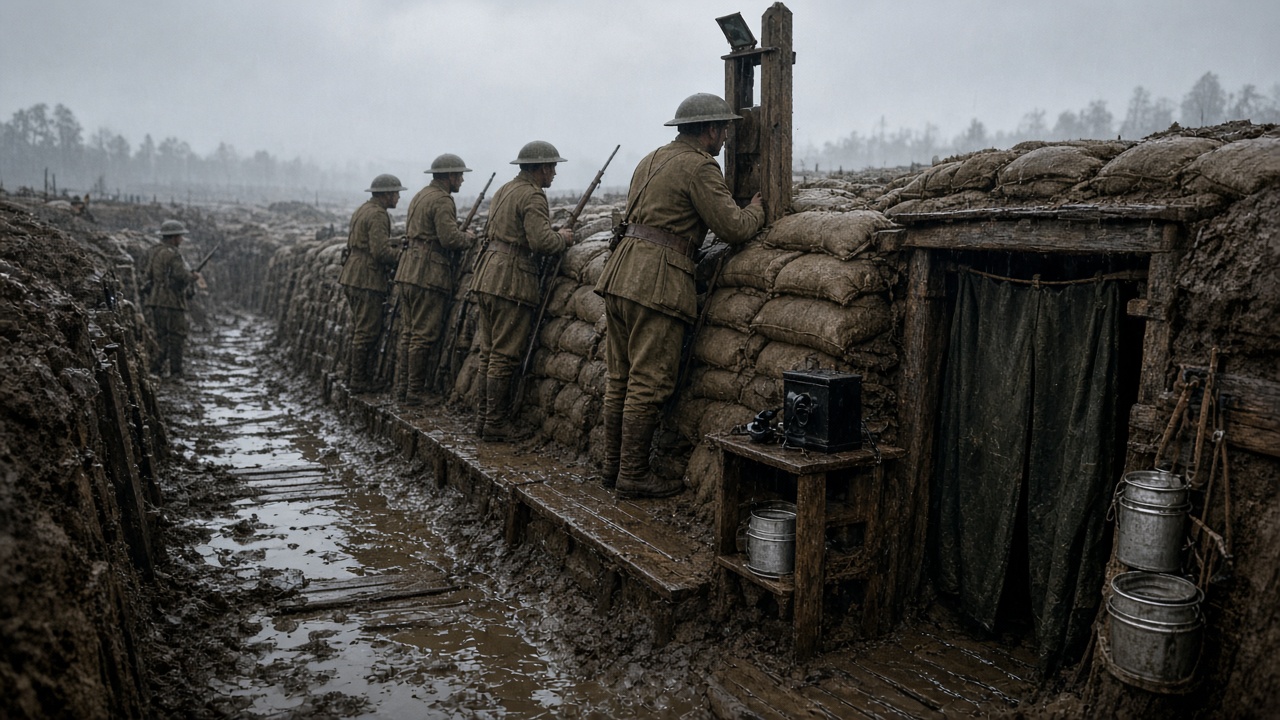
Soldiers keep watch from a muddy front-line trench (artistic illustration).
April–May 1915: Germany releases chlorine gas at Ypres (22 April), Allied troops including Australians, New Zealanders, and Indians land at Gallipoli (25 April), and a U-boat sinks the liner Lusitania (7 May).
1915: Italy joins the Allies (May), Bulgaria joins the Central Powers (October), and the Ottoman government carries out the mass deportation and killing of Armenians.
February–June 1916: The Battle of Verdun begins (21 February), British and Indian troops besieged at Kut in Mesopotamia surrender (29 April), and the British and German fleets clash at Jutland (31 May–1 June).
July–November 1916: The Battle of the Somme begins on 1 July, the worst single day in British military history, and tanks go into action for the first time on 15 September.
Technology
Poison gas: And the first gas masks.
Tanks: First used in 1916.
Steel helmets: Protecting soldiers’ heads.
Features
Stalemate: Trenches from sea to Switzerland.
Attrition: Verdun and the Somme.
New fronts: Gallipoli, Mesopotamia, Italy.
🔄 Turning Point1917
The Turning Point
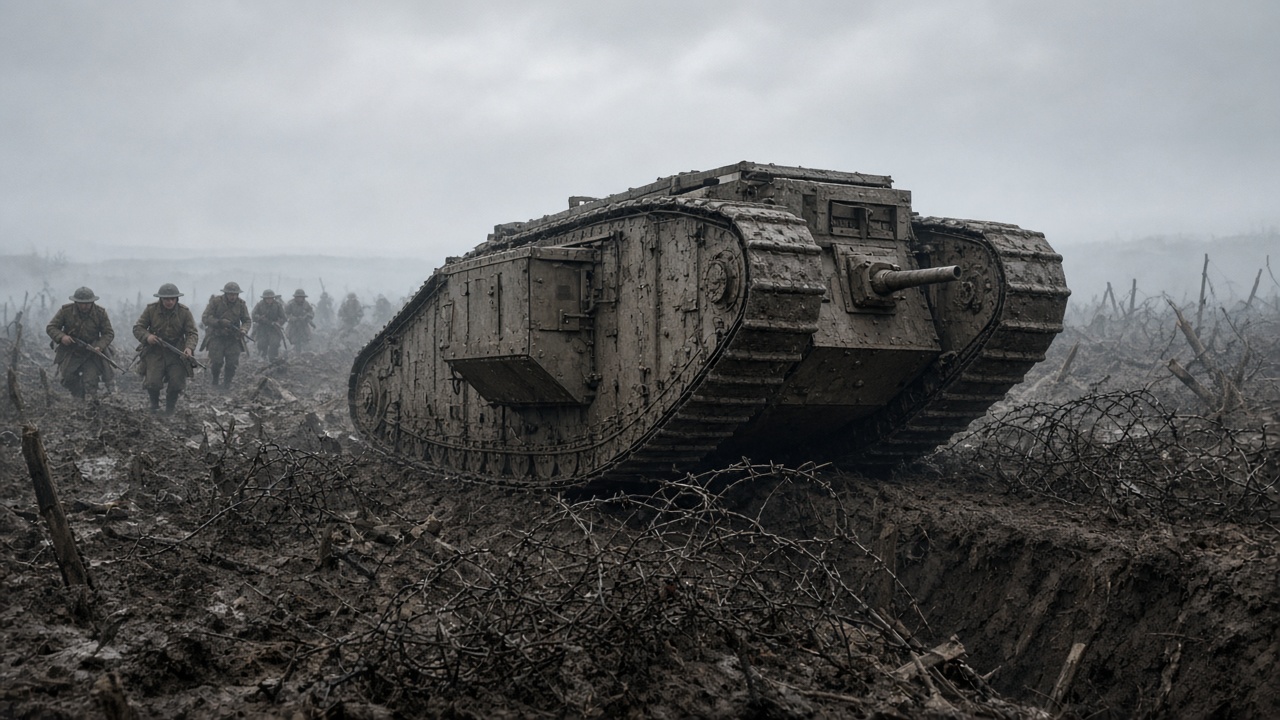
In 1917 the war changed direction. Germany’s submarine campaign brought the United States into the war, while revolution swept away the Russian tsar and then the provisional government, taking Russia out of the fighting. On the Western Front, the mud of Passchendaele showed the horror of attrition, but massed tanks at Cambrai hinted at the future.
A tank crushes barbed wire as infantry follow, as at Cambrai in 1917 (artistic illustration).
January–April 1917: Germany restarts unrestricted submarine warfare (1 February), the Zimmermann Telegram is revealed, and the United States declares war on Germany (6 April).
March–November 1917: Tsar Nicholas II abdicates in the February Revolution (March), and the Bolsheviks under Lenin seize power in the October Revolution (November), soon seeking peace.
March–December 1917: British and Indian forces take Baghdad (March), Canadians capture Vimy Ridge (April), the Battle of Passchendaele is fought in deep mud (July–November), and Jerusalem falls to the British (December).
August–November 1917: The Montagu Declaration promises India gradual self-government (August), Italy is defeated at Caporetto (October–November), and hundreds of tanks attack at Cambrai (20 November).
Technology
U-boats: Attacks on merchant ships.
Convoys: Escorted groups of ships.
Mustard gas: First used in July 1917.
Features
USA joins: Fresh troops and money.
Russia leaves: Revolution.
Middle East: Baghdad and Jerusalem.
🕊️ Armistice1918
Final Offensives & Armistice
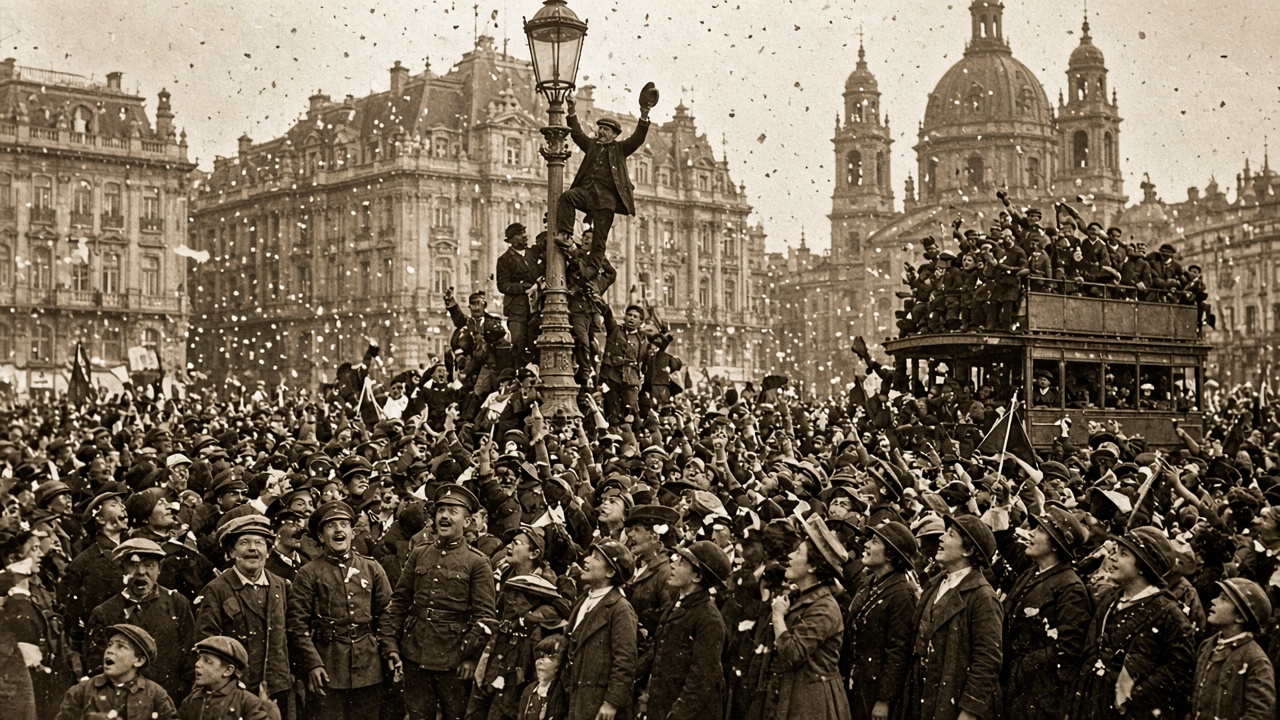
With Russia out of the war, Germany gambled on a huge spring offensive in the west before American troops arrived in strength. It gained ground but exhausted the German army. From August, the Allies pushed back in the Hundred Days Offensive, Germany’s allies collapsed one by one, and the guns fell silent on 11 November.
Crowds cheer in a city square as news of the Armistice spreads (artistic illustration).
January–March 1918: President Wilson sets out his Fourteen Points for peace (8 January), Russia signs the Treaty of Brest-Litovsk (3 March), and Germany launches its Spring Offensive (21 March).
August–September 1918: The Allies win at Amiens (8 August), beginning the Hundred Days Offensive, and Indian cavalry of the Jodhpur and Mysore Lancers capture Haifa (23 September).
September–November 1918: Bulgaria (29 September), the Ottoman Empire (30 October), and Austria-Hungary (3 November) agree to armistices, and Kaiser Wilhelm II abdicates (9 November).
11 November 1918: The Armistice signed in a railway carriage at Compiègne takes effect at 11 a.m., while a deadly influenza pandemic spreads around the world, killing millions, including in India.
Technology
Combined arms: Tanks, aircraft, and artillery together.
Long-range guns: Shelling Paris from far away.
Air forces: Britain’s RAF formed in April 1918.
Features
Last gamble: German Spring Offensive.
Hundred Days: Allied advance.
Armistice: 11 a.m., 11 November.
🌺 Remembrance1919 – Today
Peace & Remembrance
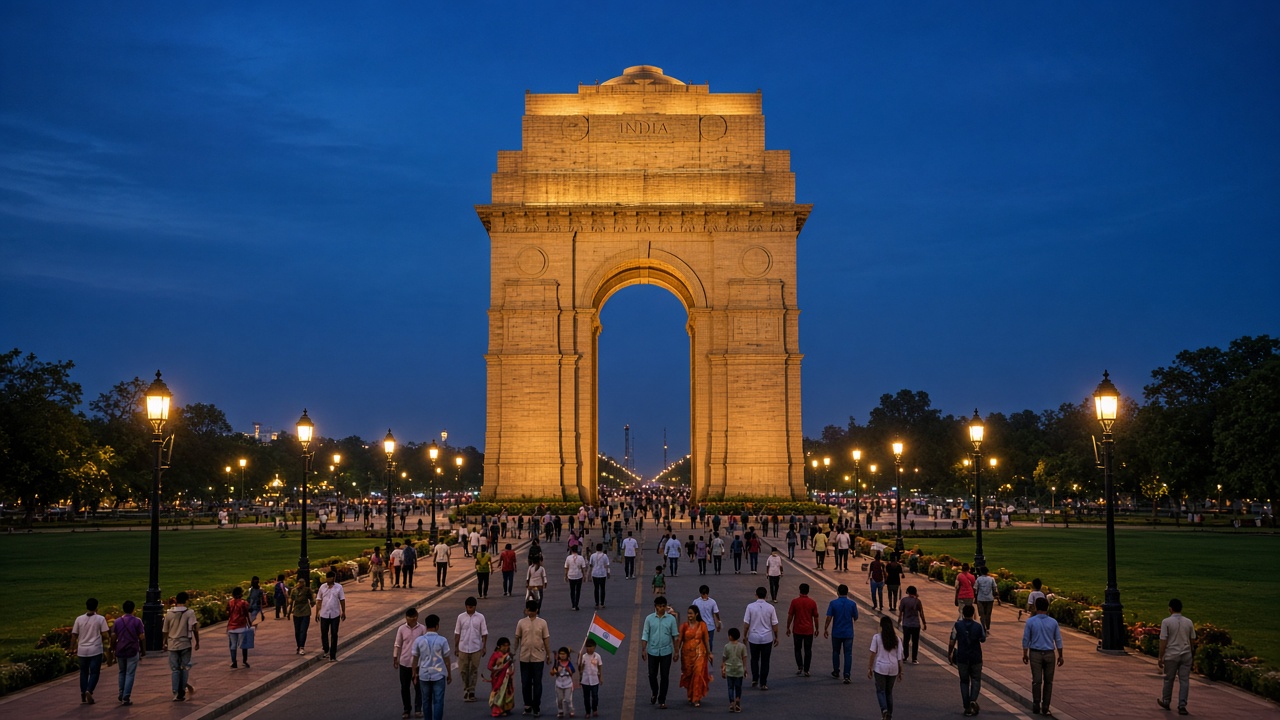
The peace treaties of 1919–1920 punished Germany, broke up old empires, and created new countries and the League of Nations. In India, wartime promises and post-war repression fuelled the freedom movement. Nations built memorials, and the red poppy became a symbol of remembrance that is still worn today.
India Gate, memorial to Indian soldiers of the First World War, at dusk (artistic illustration).
1919: The Paris Peace Conference opens (January), the Rowlatt Act and the Jallianwala Bagh massacre (13 April) shake India, and the Treaty of Versailles is signed on 28 June.
1920–1923: The League of Nations begins work (January 1920), Austria-Hungary and the Ottoman Empire are broken up into new states, and the Unknown Warrior is buried in Westminster Abbey and Paris (1920).
1921–1931: The foundation stone of the All India War Memorial, now India Gate, is laid (1921), and the memorial designed by Edwin Lutyens is inaugurated in 1931.
2011–Today: The last known veterans of the war die (2011–2012), centenary events are held from 2014 to 2018, and Haifa Day is marked by the Indian Army every 23 September.
Technology
Plastic surgery: Rebuilding injured faces.
Blood banks: Stored blood for transfusion.
Digital archives: Service records online.
Features
Treaties: Versailles and others.
New countries: Poland, Czechoslovakia, Yugoslavia.
Remembrance: Poppies and memorials.
Who Fought on Each Side
Country
Side
Entered the war
Notes
Serbia
Allies
July 1914
Invaded by Austria-Hungary
Russia
Allies
August 1914
Left the war in 1918 after revolution
France
Allies
August 1914
Much of the Western Front on French soil
Britain and its empire
Allies
August 1914
Including India, Canada, Australia, New Zealand, and South Africa
Belgium
Allies
August 1914
Neutral country invaded by Germany
Japan
Allies
August 1914
Took German bases in China and the Pacific
Italy
Allies
May 1915
Fought Austria-Hungary in the Alps
United States
Allies (associated power)
April 1917
Over two million troops sent to France
Germany
Central Powers
August 1914
Fought on both Western and Eastern Fronts
Austria-Hungary
Central Powers
July 1914
Broke apart at the end of the war
Ottoman Empire
Central Powers
November 1914
Fought at Gallipoli, in Mesopotamia, and in Palestine
Bulgaria
Central Powers
October 1915
First Central Power to seek an armistice
Major Battles and Campaigns
Battle
Date
Front
Why it matters
Tannenberg
August 1914
Eastern
German victory over a Russian army
First Marne
September 1914
Western
Stopped the German advance on Paris
First and Second Ypres
1914, 1915
Western
Indian troops in action; first major gas attack
Gallipoli
1915–1916
Ottoman
Failed Allied landing; birth of the ANZAC legend
Verdun
February–December 1916
Western
Longest battle of the war, a symbol for France
Siege of Kut
1915–1916
Mesopotamia
Surrender of British and Indian troops
Jutland
May–June 1916
North Sea
Largest naval battle of the war
Somme
July–November 1916
Western
Huge losses; first use of tanks
Brusilov Offensive
June–September 1916
Eastern
Major Russian success against Austria-Hungary
Passchendaele
July–November 1917
Western
Fought in deep mud near Ypres
Megiddo and Haifa
September 1918
Palestine
Indian cavalry played a leading role
Amiens
August 1918
Western
Start of the Allied Hundred Days Offensive
India in the First World War
Topic
Details
People who served
About 1.3 million soldiers and labourers (estimates vary)
Deaths
Around 74,000 Indian soldiers died
Fronts
France and Belgium, Gallipoli, Mesopotamia, Egypt and Palestine, East Africa, and Persia
Bravery awards
11 Victoria Crosses, the first to Sepoy Khudadad Khan (1914)
Who fought
Soldiers from Punjab, the Frontier, Garhwal, Nepal (Gurkhas), Rajputana, the Deccan, and princely state forces
Money and supplies
Large contributions of money, food, cloth, animals, and war materials
Politics
Home Rule Leagues (1916), the Lucknow Pact (1916), and the Montagu Declaration (1917)
After the war
The Rowlatt Act and Jallianwala Bagh (1919) turned many towards non-cooperation
Memorials
India Gate (1931), Teen Murti in Delhi, and the Neuve-Chapelle memorial in France
New Weapons, Machines, and Medicine
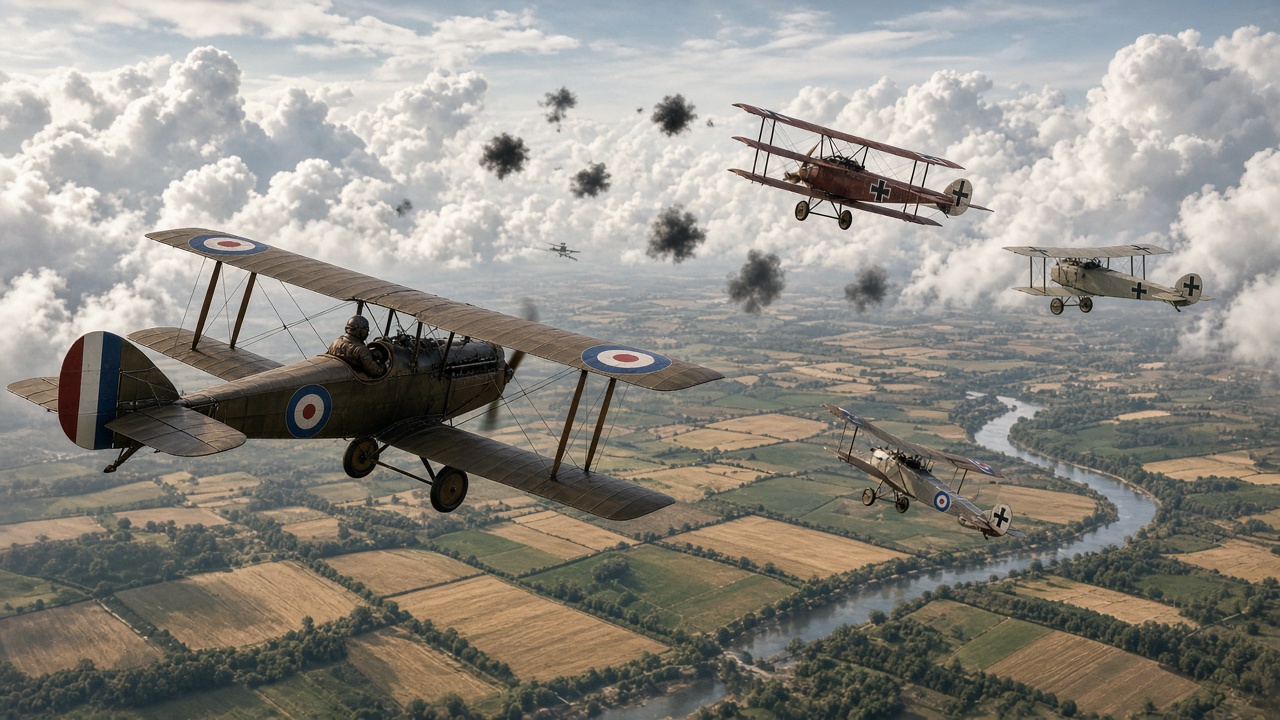
Wood-and-fabric biplanes duel above the fields of France (artistic illustration).
Invention or use
First major use
Impact
Machine guns
From 1914
Made attacks across open ground deadly
Fighter aircraft
1915
Guns firing through the propeller; aerial combat
Poison gas
April 1915
Chlorine, phosgene, and later mustard gas
Gas masks
1915
Protection against gas attacks
Tanks
September 1916
Crossed trenches and barbed wire
U-boats
1914–1918
Sank thousands of merchant ships
Wireless radio
1914–1918
Messages to ships, aircraft, and headquarters
Mobile X-ray units
1914
Marie Curie’s vans helped surgeons find bullets
Blood banks
1917
Stored blood saved wounded soldiers
Plastic surgery
1917
Harold Gillies rebuilt the faces of wounded men
Life on the Home Front
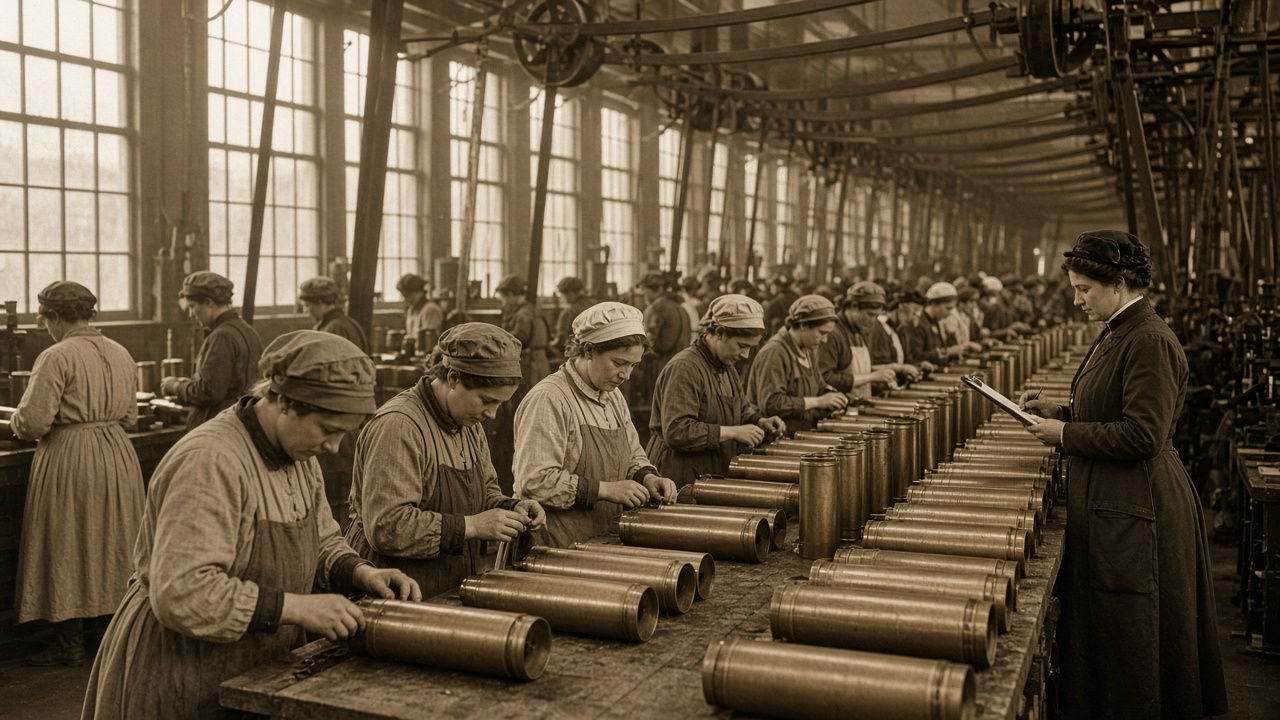
Women fill and check shell cases in a wartime munitions factory (artistic illustration).
Topic
Life at home during the war
Women at work
Women took jobs in factories, transport, farms, offices, and nursing
Conscription
Compulsory military service, introduced in Britain in 1916
Rationing
Food shortages led to rationing, and severe hunger in Germany
Propaganda
Posters, films, and newspapers urged people to join up and save
War loans
Governments borrowed money from citizens through war bonds
Letters
Millions of letters and parcels went between home and the front
Daylight saving time
First adopted by Germany in 1916 to save fuel
Votes for women
Britain gave some women the vote in 1918, and others followed
India
Recruitment drives, rising prices, war funds, and the 1918 influenza
First World War Timeline Summary
Date
Milestone
1882
Triple Alliance formed
1907
Triple Entente completed
28 June 1914
Assassination in Sarajevo
28 July 1914
Austria-Hungary declares war on Serbia
4 August 1914
Germany invades Belgium; Britain and India at war
September 1914
First Battle of the Marne
October 1914
Khudadad Khan wins the first Indian Victoria Cross
22 April 1915
First major poison gas attack at Ypres
25 April 1915
Gallipoli landings
21 February 1916
Battle of Verdun begins
1 July 1916
Battle of the Somme begins
15 September 1916
First tanks in battle
6 April 1917
United States declares war
November 1917
October Revolution in Russia
3 March 1918
Treaty of Brest-Litovsk
8 August 1918
Battle of Amiens; Hundred Days begin
23 September 1918
Indian cavalry capture Haifa
11 November 1918
Armistice
28 June 1919
Treaty of Versailles
January 1920
League of Nations begins work
1931
India Gate inaugurated
Test Your Knowledge
20 quick questions from the First World War timeline. Click each question to reveal the answer.
Answer: Germany, Austria-Hungary, and Italy.
Answer: Britain, France, and Russia.
Answer: Archduke Franz Ferdinand of Austria-Hungary.
Answer: 28 July 1914.
Answer: Belgium.
Answer: The First Battle of the Marne.
Answer: Sepoy Khudadad Khan, in 1914.
Answer: The Christmas truce.
Answer: Ypres, in Belgium.
Answer: Gallipoli.
Answer: The Lusitania.
Answer: Verdun.
Answer: The Battle of the Somme, on 15 September 1916.
Answer: The Zimmermann Telegram.
Answer: 6 April 1917.
Answer: The Treaty of Brest-Litovsk.
Answer: Haifa.
Answer: 11 a.m.
Answer: The Treaty of Versailles.
Answer: India Gate.
Classroom activity
Students Tasks
Use these prompts for discussion or projects on the First World War.
Timeline understandingWorld historyMap skillsCause and effect
Make a timeline poster: 28 June 1914 Sarajevo, 4 August 1914 Britain at war, 1915 Gallipoli, 1916 Somme, 6 April 1917 USA, 11 November 1918 Armistice, and 28 June 1919 Versailles.
On a map of Europe and the Middle East, mark the two alliances and the Western Front, Gallipoli, Mesopotamia, and Haifa.
Draw a cause-and-effect chain from the assassination in Sarajevo to Britain’s entry into the war.
Write a letter home as an Indian soldier in France in the winter of 1914.
Make a fact card about Khudadad Khan or the Indian cavalry at Haifa.
Compare communication in 1914 (letters, telegrams, field telephones) with communication in the armed forces today.
Explain how the war changed women’s lives, using examples from factories and voting rights.
Design a poppy or remembrance display for 11 November, explaining its meaning.
Find out about a war memorial in your town or state and present its history.
Debate: “The Treaty of Versailles made another world war more likely.”
Continue exploring
The First World War sped up the development of aircraft, radio, long-distance communication, and railways. Explore these connected timelines next.
Click any panel to expand and explore the visual mood.
The First World War in pictures — soldiers leaving in 1914, Indian troops in France, a front-line trench, a tank at Cambrai, biplanes overhead, women in a munitions factory, Armistice crowds, India Gate, and the Western Front then versus now.
Off to War
August 1914
Indian Soldiers
France, 1914
The Trenches
Western Front
First Tanks
1916–1917
War in the Air
Biplanes
Home Front
Women at work
Armistice
11 November 1918
India Gate
Remembrance
Then vs Now
Mud to poppies
Explore all world history timelines
Jump to any other world history timeline on WorldTimelineHub.
Disclaimer: This content is AI-generated for educational purposes and may contain errors or outdated details. For correct and authoritative information, please refer to official and reliable sources such as government publications, manufacturers, museums, and academic references.