Space Age Timeline: Rocket Pioneers → The Space Race → To the Moon → Shuttles & Stations → New Space Nations → Space for Everyone
On 4 October 1957 a small metal ball beeping overhead changed the world. Within twelve years people were walking on the Moon. Since then, space has grown from a Cold War contest between two superpowers into a shared human
adventure involving dozens of nations — India among the leaders — and private companies. Satellites now quietly shape everyday life, from weather forecasts and maps to television, banking, and disaster warnings.
This timeline covers Mysore’s rockets, the first liquid-fuel rocket, Sputnik, Laika, Gagarin, Tereshkova, the first rocket from Thumba, ISRO’s founding, Apollo 11, Aryabhata, the Space Shuttle, Rakesh Sharma, Mir, Hubble,
the International Space Station, China’s first astronaut, Chandrayaan-1, Mangalyaan, reusable rockets, the James Webb Space Telescope, Chandrayaan-3, Aditya-L1, and the new race to the Moon.
4 Oct 1957 Sputnik → 12 Apr 1961 first human in space20 July 1969 Moon landing → 3 Apr 1984 first Indian in space24 Sept 2014 Mangalyaan → 23 Aug 2023 Chandrayaan-3
Why the Space Age Matters
The Space Age gave humanity its first view of Earth as a small, fragile planet, and showed that people could live and work beyond it. It drove advances in computing, materials, and communications, and created satellite services
that billions of people now depend on every day. It also began as a dangerous rivalry built on missile technology — and today raises new questions about space debris, the peaceful use of space, and who may use the Moon’s resources.
Big picture
The Space Age in one view
Rocket pioneers dreamed of spaceflight, Sputnik and Gagarin started the Space Race, Apollo took people to the Moon, shuttles and space stations made orbit a workplace, China and India joined the leading space nations, and today
reusable rockets, private companies, and missions to the Moon’s south pole are opening space to everyone. Related timelines:
air transport,
maps and navigation,
television.
4 Oct 1957
Sputnik 1, the first artificial satellite
12
People who have walked on the Moon, 1969–1972
10,000+
Active satellites orbiting Earth (recent estimate)
23 Aug 2023
India lands near the Moon’s south pole
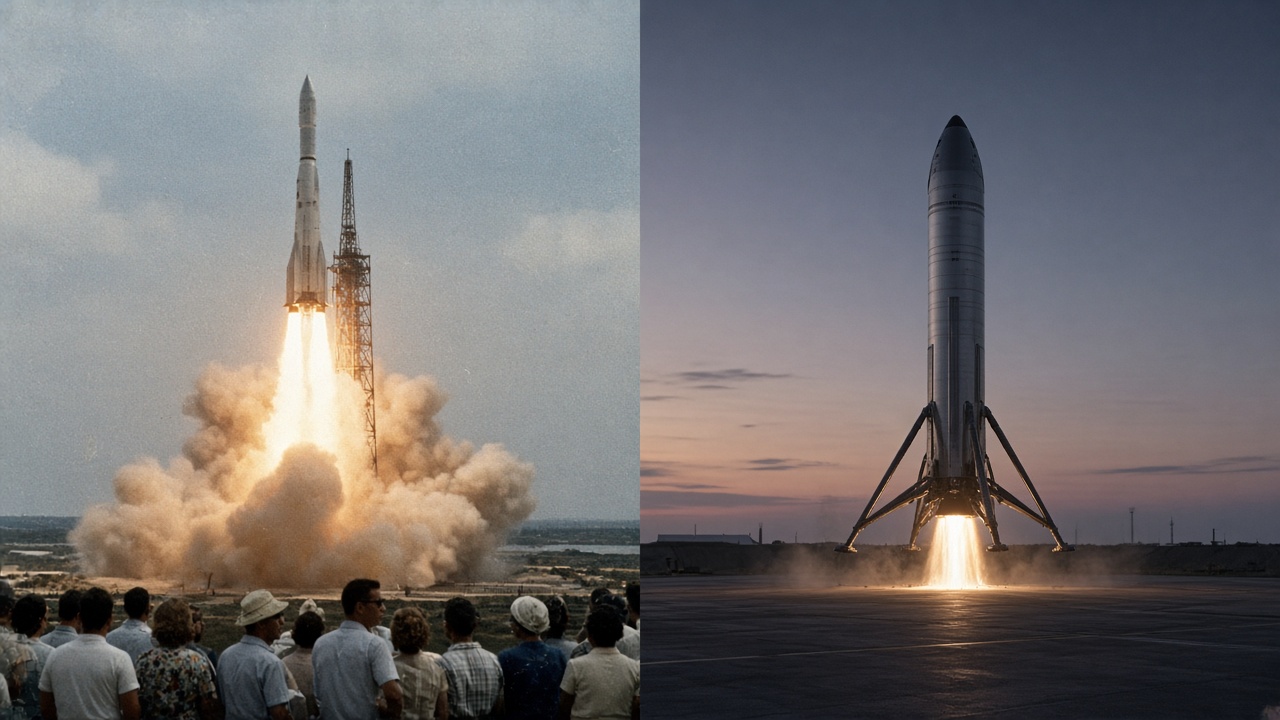
A 1960s rocket launch watched by crowds, and a reusable booster landing back on Earth today (artistic illustration).
Space Then vs Now
Feature
1957
Today
Satellites in orbit
Two by the end of 1957
More than 10,000 active satellites
Countries able to launch satellites
One (the Soviet Union)
Around a dozen, including India, plus Europe’s ESA
People who had flown in space
None
More than 600
Rockets
Used once and thrown away
Reusable boosters land and fly again
Who goes to space
Only two superpower governments
Space agencies, private companies, universities, and even school projects
Finding your way
Paper maps, compasses, and the stars
Satellite navigation on every smartphone
Weather forecasting
Ground stations and weather balloons
Satellite images that track cyclones days ahead
Pictures of Earth
No photograph of the whole Earth yet
Live images of the planet from orbit
Space debris
Almost none
Tens of thousands of tracked pieces of space junk
India in space
No space programme yet
Missions to the Moon, Mars, and the Sun
🎆 Rocket Pioneers1780s – 1956
Rocket Pioneers
Rockets were invented in China centuries ago, and in the 1780s–1790s the Kingdom of Mysore in southern India used iron-cased rockets in battle. In the early 1900s, thinkers in Russia, the United States, and Germany worked out how rockets could reach space. Wartime missile programmes then built the first rockets powerful enough to cross the edge of space, and after 1945 the United States and the Soviet Union raced to build on them.
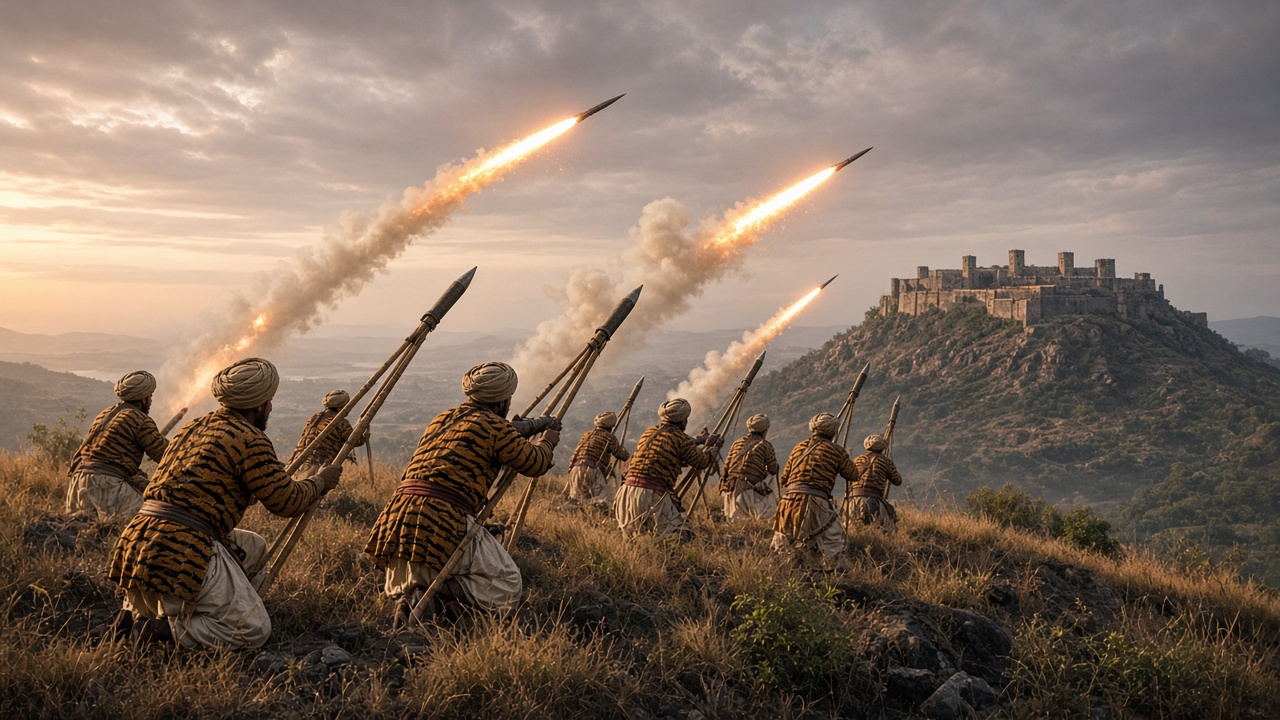
Soldiers of the Kingdom of Mysore launch iron-cased war rockets in the 1790s (artistic illustration).
1780s–1799: Hyder Ali and Tipu Sultan of Mysore use iron-cased rockets against British forces, and captured examples inspire Britain’s Congreve rockets in the early 1800s.
1903–1926: Konstantin Tsiolkovsky in Russia publishes the mathematics of rocket flight into space (1903), Hermann Oberth in Germany writes on rockets to space (1923), and Robert Goddard launches the first liquid-fuel rocket in the United States (16 March 1926).
1942–1945: Germany develops the V-2 ballistic missile, which in 1944 becomes the first human-made object to cross the edge of space, and is used to bomb cities including London and Antwerp.
1945–1956: The United States and the Soviet Union recruit German rocket engineers and build their own missiles, as the Cold War begins and both plan satellites for the International Geophysical Year (1957–1958).
Technology
Iron-cased rockets: Mysore’s battlefield weapons.
Liquid-fuel engines: More power and control.
Ballistic missiles: The first rockets to reach space.
Features
Dreamers: Science fiction and science.
War origins: Missiles before spaceships.
Cold War: Two superpowers compete.
🛰️ The Space Race1957 – 1965
The Space Race Begins
The Soviet Union shocked the world with the first satellite, the first animal in orbit, and the first man and woman in space. The United States responded by founding NASA and setting the goal of landing on the Moon. Meanwhile, India began its own space journey, launching its first small rocket from a fishing village near Thiruvananthapuram.
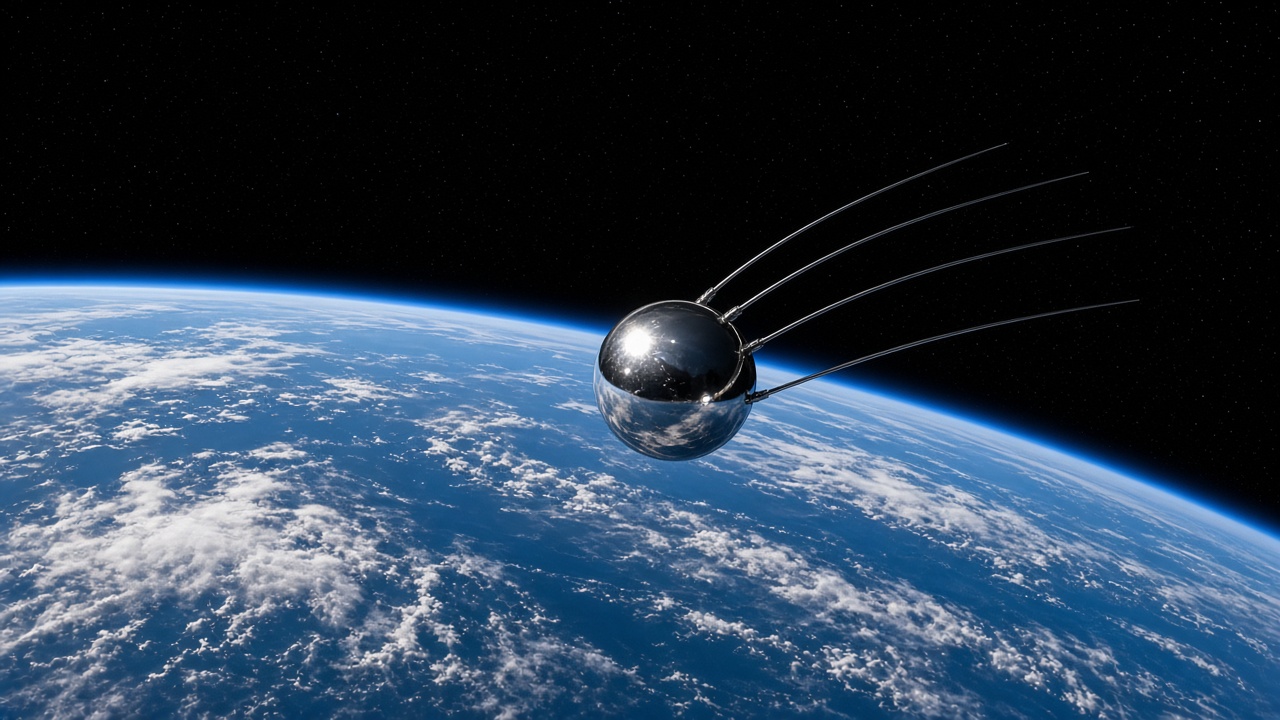
Sputnik 1, the first artificial satellite, orbits Earth in October 1957 (artistic illustration).
1957–1959: The Soviet Union launches Sputnik 1 (4 October 1957) and the dog Laika on Sputnik 2 (3 November), the United States launches Explorer 1 (January 1958) and founds NASA (October 1958), and Luna 3 photographs the Moon’s far side (1959).
1961: Yuri Gagarin becomes the first person in space (12 April), Alan Shepard becomes the first American in space (5 May), and President John F. Kennedy sets the goal of landing a man on the Moon before 1970.
1962–1963: India forms its space research committee, INCOSPAR, under Vikram Sarabhai (1962), Valentina Tereshkova becomes the first woman in space (16 June 1963), and India’s first rocket is launched from Thumba in Kerala (21 November 1963).
1962–1965: The first live transatlantic television is relayed by satellite (1962), US probes fly past Venus (1962) and Mars (1965), and Alexei Leonov makes the first spacewalk (18 March 1965).
Technology
Satellites: Radio beeps from orbit.
Crewed capsules: Vostok, Mercury, Gemini.
Space probes: To the Moon, Venus, and Mars.
Features
Soviet firsts: Satellite, man, woman, spacewalk.
Moon goal: America’s answer.
India begins: Rockets from Thumba.
🌕 To the Moon1966 – 1975
To the Moon
Robotic landers proved it was possible to touch down on the Moon, and in July 1969 Apollo 11 landed two astronauts there, watched live by hundreds of millions of people. Six Apollo landings followed by 1972. The Soviet Union built the first space station, China and Japan launched their first satellites, the world agreed the Outer Space Treaty, and India founded ISRO and sent up its first satellite.
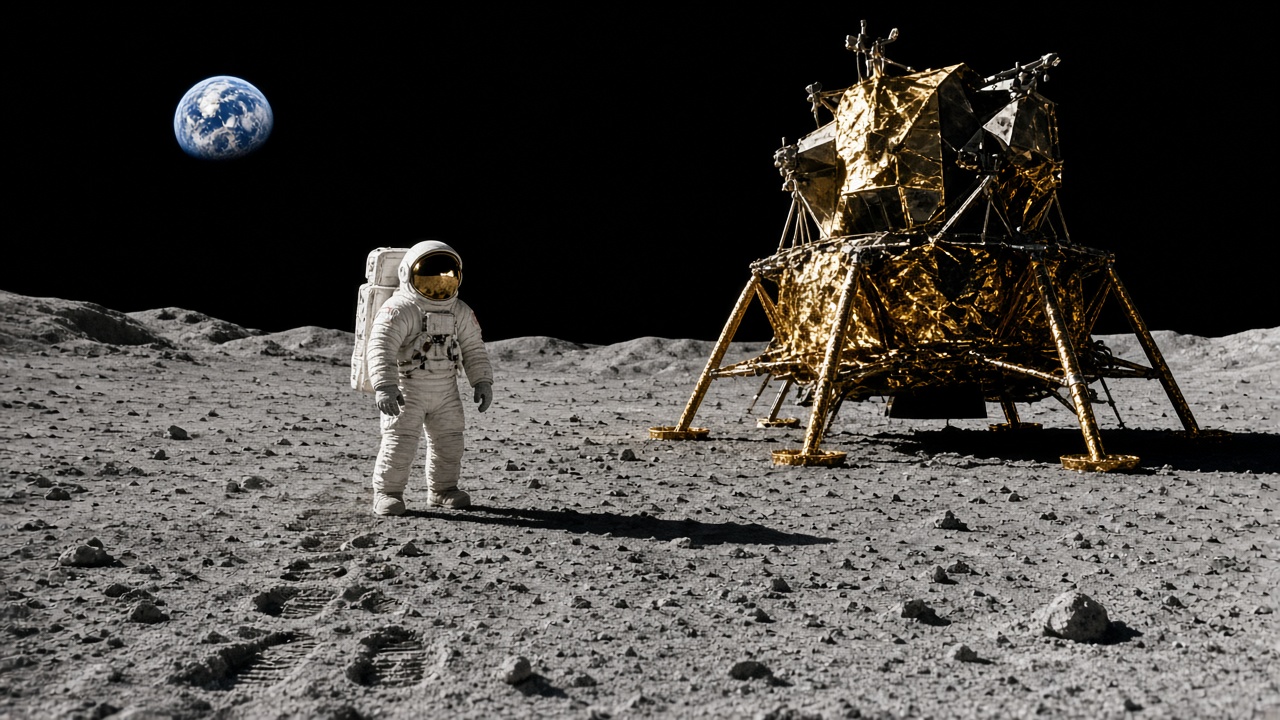
An astronaut stands beside the lunar module, with Earth in the black sky (artistic illustration).
1966–1968: The Soviet Luna 9 makes the first soft landing on the Moon (February 1966), the Outer Space Treaty comes into force (1967), and Apollo 8 astronauts orbit the Moon and photograph “Earthrise” (December 1968).
1969: Apollo 11’s Neil Armstrong and Buzz Aldrin land on the Moon on 20 July, and the Indian Space Research Organisation (ISRO) is founded on 15 August.
1970–1972: Japan and China launch their first satellites (1970), the Soviet Venera 7 lands on Venus (1970), the Soviet Union launches Salyut 1, the first space station (1971), and Apollo 17 makes the last crewed Moon landing (December 1972).
1973–1975: The US Skylab station is occupied (1973), India’s first satellite, Aryabhata, is launched on a Soviet rocket (19 April 1975), and American and Soviet spacecraft dock in orbit in the Apollo–Soyuz mission (July 1975).
Technology
Saturn V: The giant Moon rocket.
Lunar module: Landing craft for the Moon.
Space stations: Salyut and Skylab.
Features
Moonwalks: 12 astronauts, 1969–1972.
Space law: The Outer Space Treaty.
Détente: Apollo–Soyuz handshake.
🚀 Shuttles & Stations1976 – 1999
Shuttles & Stations
Robots explored the planets, the winged Space Shuttle made spaceflight more routine, and long stays on space stations taught people how to live in orbit. Europe and India built their own rockets, Rakesh Sharma became the first Indian in space, and after the Cold War ended, former rivals joined forces to build the International Space Station.
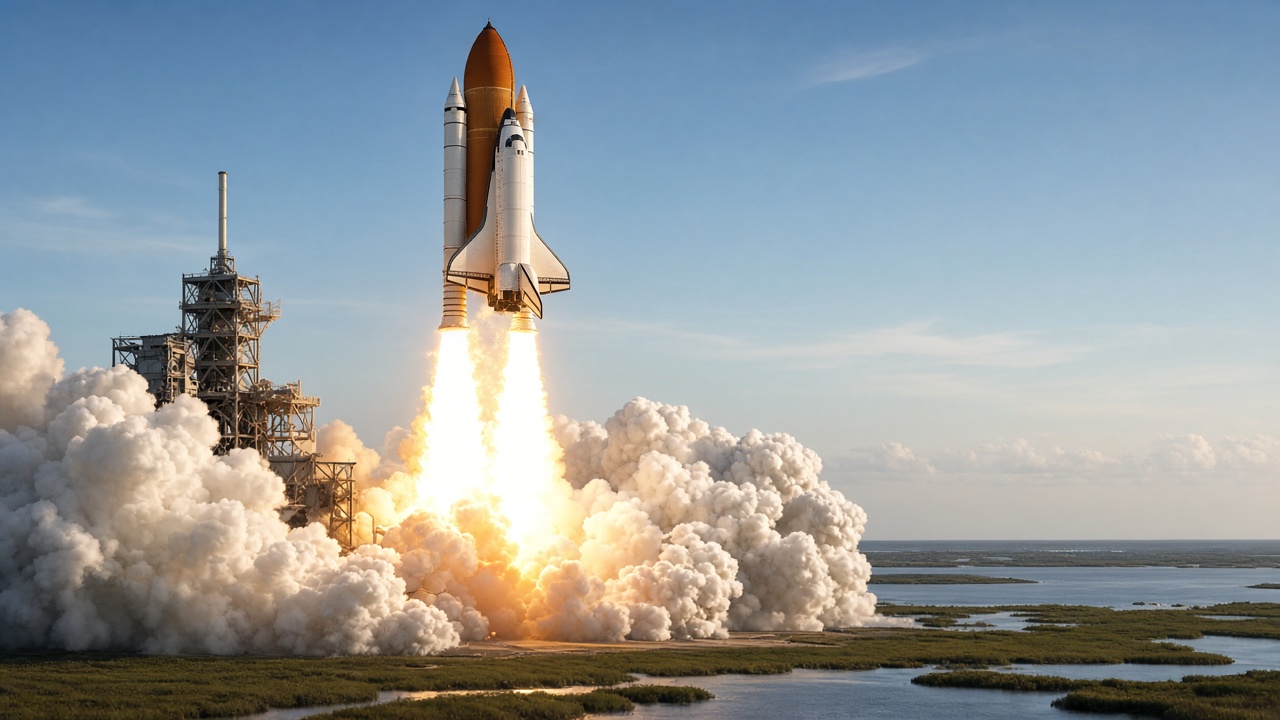
A space shuttle roars off the launch pad on its boosters and orange fuel tank (artistic illustration).
1975–1979: The European Space Agency is founded (1975), NASA’s Viking 1 lands on Mars (1976), the two Voyager probes set off for the outer planets (1977), and Europe’s Ariane rocket makes its first flight (1979).
1980–1984: India’s SLV-3 rocket puts the Rohini satellite into orbit from Sriharikota (18 July 1980), the Space Shuttle Columbia makes its first flight (12 April 1981), and Rakesh Sharma becomes the first Indian in space (3 April 1984).
1986–1990: The Space Shuttle Challenger breaks apart after launch (28 January 1986), the Soviet Union begins the Mir space station (1986), and the Hubble Space Telescope is launched (1990).
1994–1998: India’s PSLV rocket makes its first successful flight (1994), the US GPS satellite system becomes fully operational (1995), and the first module of the International Space Station is launched (November 1998).
Technology
Space Shuttle: A reusable winged orbiter.
Space telescopes: Hubble’s sharp views.
Satellite navigation: GPS for the world.
Features
Planetary probes: Mars to Neptune.
New launchers: Europe and India.
Cooperation: Building the ISS together.
🌏 New Space Nations2000 – 2015
New Space Nations
The International Space Station became humanity’s permanent home in orbit. China became the third nation to launch its own astronauts, and India sent missions to the Moon and Mars on small budgets. The Space Shuttle retired, private companies began flying cargo to the station, and robots explored Mars, a comet, and Pluto.
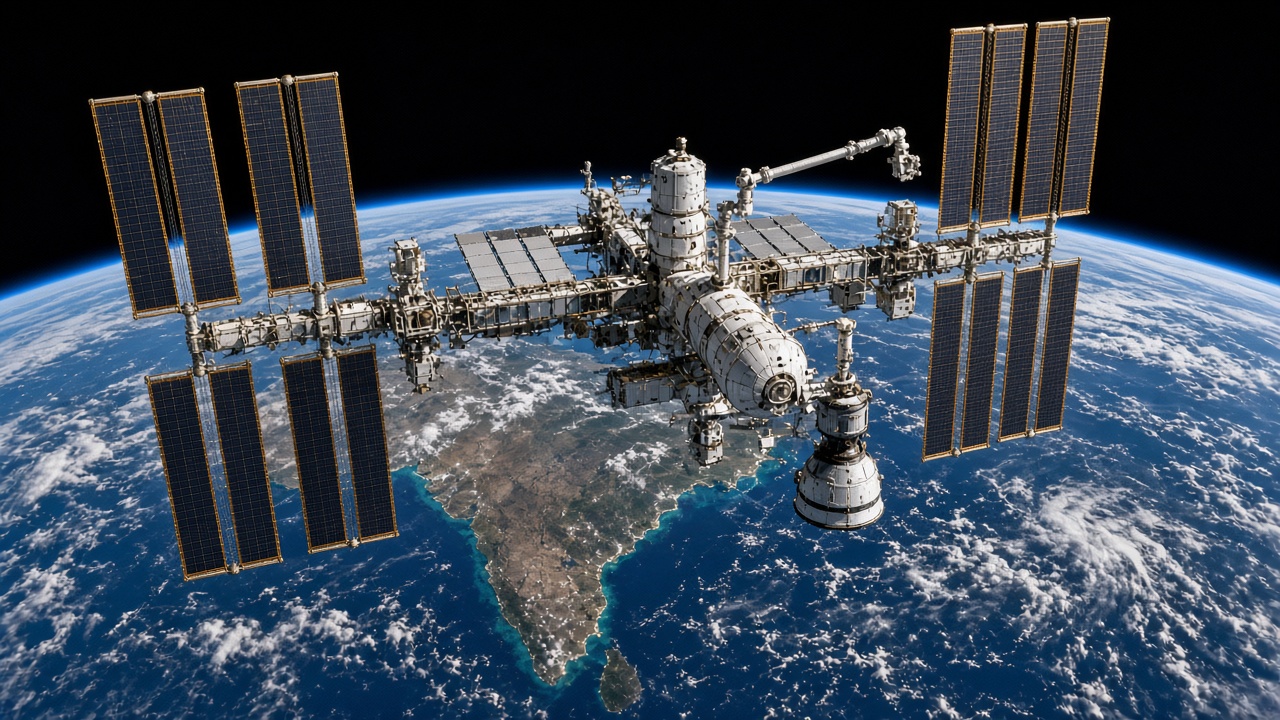
A space station passes over the Indian peninsula, about 400 km above Earth (artistic illustration).
2000–2003: The first crew moves into the International Space Station (2 November 2000), the Space Shuttle Columbia is lost on its return (1 February 2003), killing all seven astronauts including India-born Kalpana Chawla, and Yang Liwei becomes China’s first astronaut (15 October 2003).
2008–2011: India’s Chandrayaan-1 orbits the Moon and helps find evidence of water (2008), and the Space Shuttle makes its final flight (July 2011).
2012–2013: A privately built capsule delivers cargo to the space station for the first time (May 2012), NASA’s Curiosity rover lands on Mars (August 2012), and Voyager 1 crosses into interstellar space (August 2012, confirmed in 2013).
2014–2015: India’s Mangalyaan enters orbit around Mars on its first attempt (24 September 2014), Europe’s Philae lands on a comet (November 2014), New Horizons flies past Pluto (July 2015), and a reusable booster lands after reaching orbit (December 2015).
Technology
Mars rovers: Mobile robot geologists.
Low-cost missions: Moon and Mars on small budgets.
Reusable boosters: Rockets that land.
Features
Permanent presence: People always in orbit.
Asian powers: China and India rise.
Commercial space: Private cargo flights.
🌌 Space for Everyone2016 – Today
Space for Everyone
Reusable rockets and tiny satellites have made space cheaper than ever, and thousands of satellites now form internet constellations. China has built its own space station and brought back samples from the Moon’s far side, and India has landed near the lunar south pole, sent a mission to study the Sun, and opened its space sector to private companies. A new race to return people to the Moon is under way.
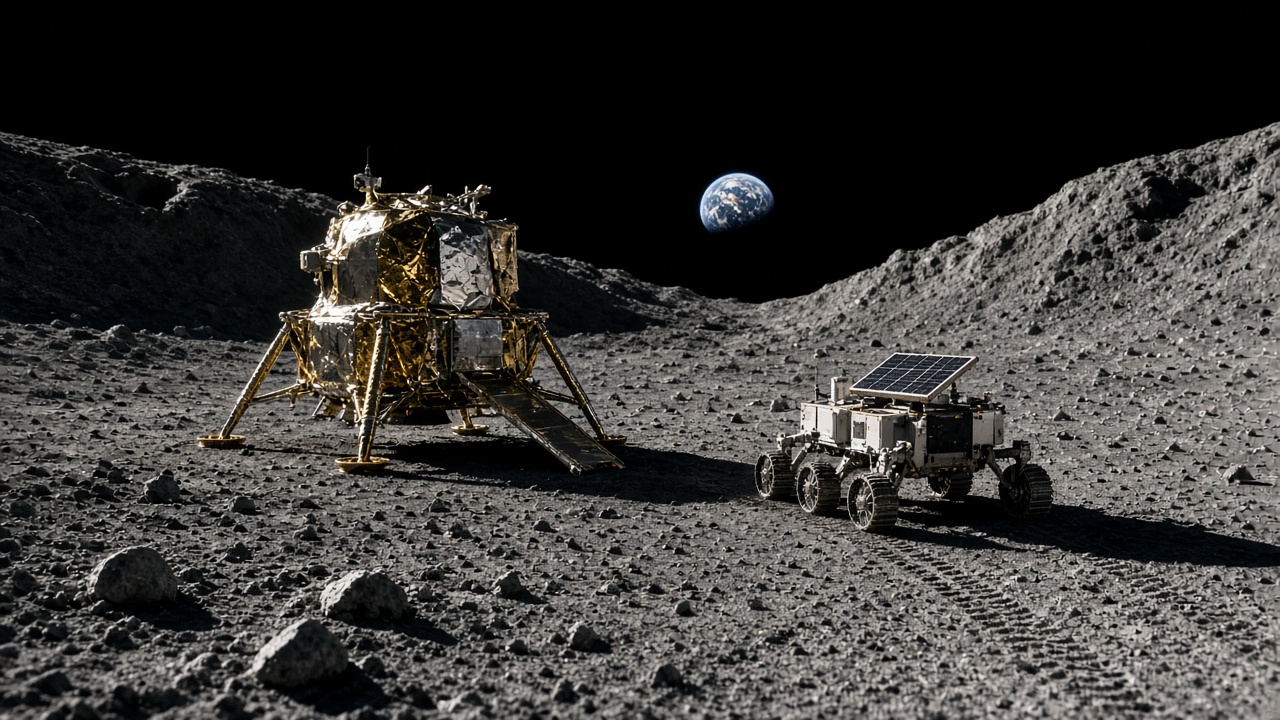
A lander and its rover explore the grey surface near the Moon’s south pole (artistic illustration).
2017–2019: India’s PSLV launches a record 104 satellites on one rocket (15 February 2017), China’s Chang’e 4 makes the first landing on the Moon’s far side (January 2019), and India’s Chandrayaan-2 orbiter reaches the Moon (2019).
2020–2022: India opens its space sector to private firms (2020), the UAE’s Hope probe reaches Mars (2021), the James Webb Space Telescope is launched (25 December 2021), China completes its Tiangong station (2022), and a NASA spacecraft deliberately nudges an asteroid (2022).
2023–2024: Chandrayaan-3 lands near the Moon’s south pole (23 August 2023), India launches the Aditya-L1 solar observatory (September 2023), Japan’s SLIM lands on the Moon (January 2024), and China’s Chang’e 6 returns the first far-side samples (June 2024).
2025–Today: India docks two satellites in orbit in its SpaDeX mission (January 2025), Shubhanshu Shukla becomes the first Indian astronaut on the ISS (2025), and India prepares its Gaganyaan crewed missions while NASA’s Artemis programme aims to return astronauts to the Moon.
Technology
Satellite constellations: Thousands of small satellites.
Infrared telescopes: Seeing the first galaxies.
Precision landers: Polar and far-side landings.
Features
New space economy: Private launchers and start-ups.
Return to the Moon: Many nations, one goal.
Space debris: A growing challenge.
Great Firsts in Space
First
Mission or person
Country
Date
Artificial satellite
Sputnik 1
Soviet Union
4 October 1957
Animal in orbit
Laika, on Sputnik 2
Soviet Union
3 November 1957
Human in space
Yuri Gagarin, Vostok 1
Soviet Union
12 April 1961
Woman in space
Valentina Tereshkova, Vostok 6
Soviet Union
16 June 1963
Spacewalk
Alexei Leonov, Voskhod 2
Soviet Union
18 March 1965
Soft landing on the Moon
Luna 9
Soviet Union
February 1966
Humans on the Moon
Apollo 11
United States
20 July 1969
Space station
Salyut 1
Soviet Union
April 1971
Long-lasting Mars landing
Viking 1
United States
July 1976
Reusable crewed spaceplane
Space Shuttle Columbia
United States
12 April 1981
Mars orbit on a first attempt
Mangalyaan
India
24 September 2014
Landing on the Moon’s far side
Chang’e 4
China
January 2019
Landing near the Moon’s south pole
Chandrayaan-3
India
23 August 2023
Space Agencies Around the World
Agency
Country
Founded
Famous for
Soviet space programme / Roscosmos
Soviet Union / Russia
1950s; Russian agency from 1992
Sputnik, Gagarin, Mir, Soyuz
NASA
United States
1958
Apollo, Space Shuttle, Hubble, Mars rovers
ISRO
India
1969
PSLV, Chandrayaan, Mangalyaan, Aditya-L1
European Space Agency (ESA)
Europe (over 20 member states)
1975
Ariane rockets, Rosetta comet mission
China National Space Administration
China
1993 (programme since the 1950s)
Shenzhou, Tiangong, Chang’e missions
JAXA
Japan
2003 (earlier agencies from the 1960s)
Asteroid sample return, SLIM Moon landing
UAE Space Agency
United Arab Emirates
2014
Hope Mars orbiter (2021)
Private space companies
Many countries, including India
2000s onwards
Reusable rockets, satellite constellations, space tourism
India’s Space Journey
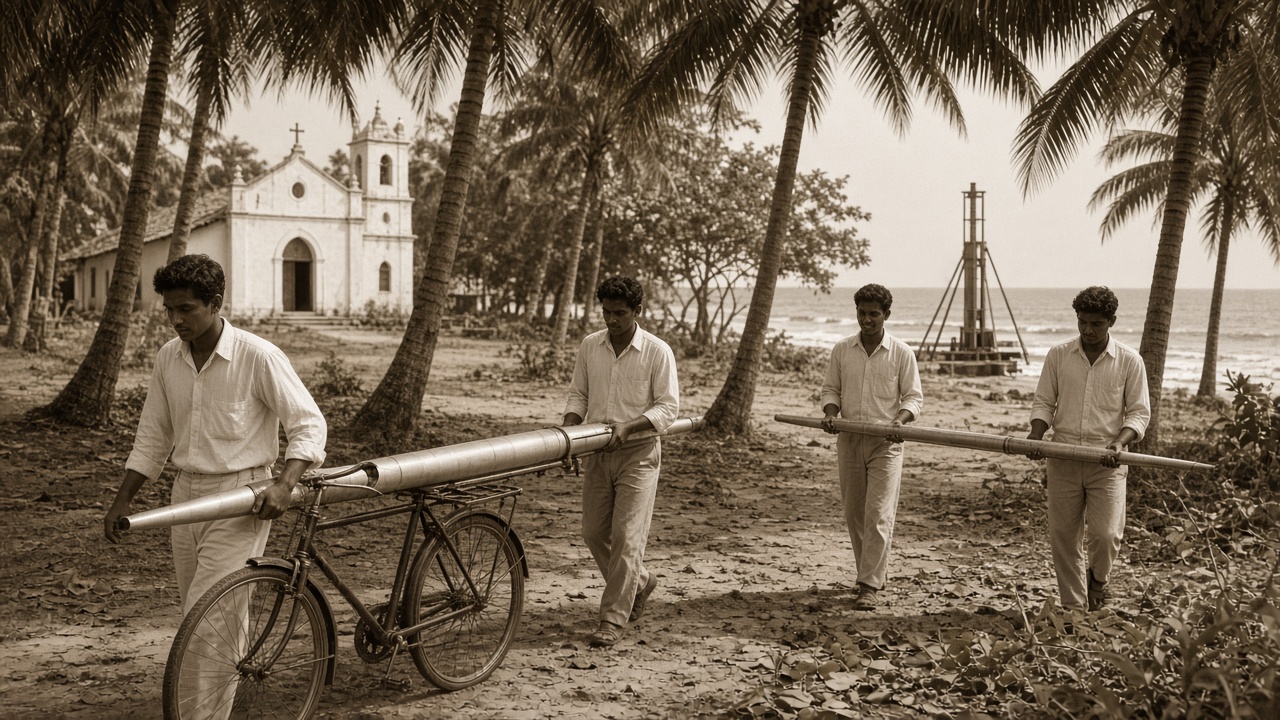
Young scientists carry rocket parts through the coconut groves of Thumba, where India’s space journey began in 1963 (artistic illustration).
Year
Milestone
1780s–1790s
Mysore’s iron-cased rockets used in battle
1962
INCOSPAR formed under Vikram Sarabhai
21 November 1963
First rocket launched from Thumba, Kerala
15 August 1969
ISRO founded
1975
Aryabhata satellite; the SITE experiment brings satellite TV to about 2,400 villages (1975–1976)
18 July 1980
SLV-3 launches Rohini, India’s first satellite on its own rocket
3 April 1984
Rakesh Sharma becomes the first Indian in space
1994
First successful PSLV launch
2008
Chandrayaan-1 orbits the Moon
24 September 2014
Mangalyaan reaches Mars orbit
15 February 2017
PSLV launches 104 satellites at once
23 August 2023
Chandrayaan-3 lands near the lunar south pole; now National Space Day
2023–2024
Aditya-L1 travels to study the Sun
2025
SpaDeX docking; Shubhanshu Shukla visits the ISS
Planned
Gaganyaan crewed flights and the Bharatiya Antariksh Station
How Space Helps Life on Earth
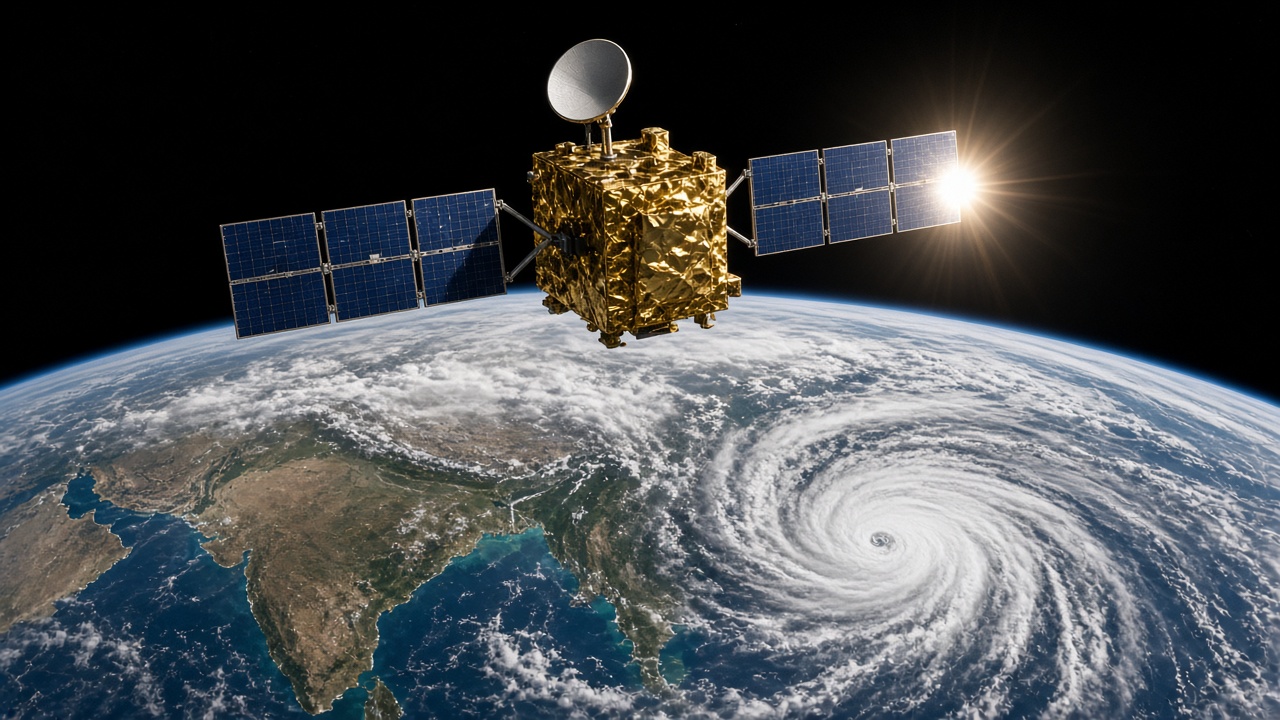
A weather and communication satellite watches a cyclone over the Bay of Bengal (artistic illustration).
Use
How satellites help
Weather and cyclones
Track storms and monsoons; early warnings have saved many lives in India and elsewhere
Television and communication
Relay TV channels, phone calls, and internet to remote places
Navigation
GPS, India’s NavIC, Europe’s Galileo, China’s BeiDou, and Russia’s GLONASS guide travellers and ships
Farming and fishing
Monitor crops and soil moisture, and advise fishers where to find fish
Disasters
Map floods, earthquakes, and forest fires to guide rescue work
Climate and environment
Measure ice, sea levels, forests, and greenhouse gases
Education and health
Satellite classrooms and telemedicine links for villages
Banking and timekeeping
Precise satellite time signals keep networks and payments in step
Space debris
Old satellites and fragments now threaten working spacecraft, so tracking and clean-up are vital
Space Age Timeline Summary
Date
Milestone
1780s–1790s
Mysorean rockets
16 March 1926
First liquid-fuel rocket
1944
V-2 reaches the edge of space
4 October 1957
Sputnik 1
1958
NASA founded
12 April 1961
Yuri Gagarin, first human in space
16 June 1963
Valentina Tereshkova, first woman in space
21 November 1963
India’s first rocket from Thumba
18 March 1965
First spacewalk
1967
Outer Space Treaty in force
20 July 1969
Apollo 11 Moon landing
15 August 1969
ISRO founded
1971
First space station
19 April 1975
Aryabhata, India’s first satellite
1977
Voyager probes launched
12 April 1981
First Space Shuttle flight
3 April 1984
Rakesh Sharma in space
1990
Hubble Space Telescope
2 November 2000
ISS permanently crewed
15 October 2003
China’s first astronaut
24 September 2014
Mangalyaan reaches Mars
25 December 2021
James Webb Space Telescope launched
23 August 2023
Chandrayaan-3 lands near the lunar south pole
2025
SpaDeX docking; first Indian on the ISS
Test Your Knowledge
20 quick questions from the Space Age timeline. Click each question to reveal the answer.
Answer: The Kingdom of Mysore, under Hyder Ali and Tipu Sultan.
Answer: Robert Goddard, in the United States.
Answer: Sputnik 1.
Answer: Laika.
Answer: Yuri Gagarin, on 12 April 1961.
Answer: Valentina Tereshkova, in 1963.
Answer: Thumba, near Thiruvananthapuram.
Answer: Vikram Sarabhai.
Answer: Alexei Leonov.
Answer: Apollo 11.
Answer: 15 August 1969.
Answer: Aryabhata.
Answer: Rakesh Sharma.
Answer: The Hubble Space Telescope.
Answer: 2 November 2000.
Answer: Kalpana Chawla.
Answer: India became the first country to reach Mars orbit on its first attempt, and the first in Asia to reach Mars orbit.
Answer: 104.
Answer: China, with Chang’e 4.
Answer: Chandrayaan-3 landed near the Moon’s south pole on 23 August 2023.
Classroom activity
Students Tasks
Use these prompts for discussion or projects on the Space Age.
Timeline understandingScience and technologyWorld historyCause and effect
Make a timeline poster: 1957 Sputnik, 1961 Gagarin, 1963 Thumba, 1969 Apollo 11 and ISRO, 1975 Aryabhata, 1984 Rakesh Sharma, 2014 Mangalyaan, and 2023 Chandrayaan-3.
On a world map, mark the main launch sites, including Sriharikota, Thumba, Baikonur, Cape Canaveral, Kourou, and Jiuquan.
Explain how the Cold War rivalry between the United States and the Soviet Union drove the Space Race.
Write a diary entry as a student in India listening to news of the Moon landing in July 1969.
Make a fact card about Vikram Sarabhai, Kalpana Chawla, or Rakesh Sharma.
List five ways satellites help your family every day.
Compare Chandrayaan-1, Chandrayaan-2, and Chandrayaan-3: aims, results, and lessons learned.
Design a mission patch for a future Indian mission to the Moon or Mars, and explain its symbols.
Research the problem of space debris and suggest ways to keep orbit clean.
Debate: “Money spent on space exploration is money well spent.”
Continue exploring
Space technology transformed television, navigation, computing, and flight. Explore these connected timelines next.
Click any panel to expand and explore the visual mood.
The Space Age in pictures — Mysore’s war rockets, Sputnik, India’s first rocket at Thumba, a Moon landing, a shuttle launch, a space station over India, a weather satellite, a lander near the lunar south pole, and rockets then versus now.
Mysore Rockets
1790s
Sputnik
4 October 1957
Thumba
India, 1963
Moon Landing
20 July 1969
Space Shuttle
1981–2011
Space Station
Crewed since 2000
Satellites at Work
Cyclone watch
Lunar South Pole
23 August 2023
Then vs Now
Launch to landing
Explore all world history timelines
Jump to any other world history timeline on WorldTimelineHub.
Disclaimer: This content is AI-generated for educational purposes and may contain errors or outdated details. For correct and authoritative information, please refer to official and reliable sources such as government publications, manufacturers, museums, and academic references.