Global Internet Timeline: Wiring the World → Networks Cross Borders → The Web Goes Global → Digital Divide → Mobile Planet → Connecting Everyone
The internet is often told as a story of inventors and protocols. This timeline tells it as a world story — how cables were laid across oceans, how country after country joined the network, who governs it, and how billions of
people in Asia, Africa, and Latin America came online through mobile phones. It is a story of connection and opportunity, but also of gaps, censorship, and the 2.6 billion people who are still offline.
This timeline covers undersea telegraph cables, the 1870 cable to India, the first telephone cable and communication satellites, the first international computer links, Minitel, ERNET, the web’s release by CERN, the first connections
in South Africa, China, and India, ICANN, the world information summits, mobile money, the Arab Spring, net neutrality in India, cheap data, UPI, GDPR, the pandemic, 5G, satellite internet, and the Global Digital Compact.
1866 transatlantic cable → 1973 first international network links1993 web free for all → 15 Aug 1995 internet in India2018 half the world online → 2024 about 5.5 billion users
Why the Global Internet Matters
In just a few decades the internet has gone from a handful of research computers to a network used by most of humanity. It carries trade, banking, news, education, healthcare, and friendships across borders in an instant. But
access is still uneven, and questions about who controls the network, how data is protected, and whether governments can censor or shut it down have become some of the most important political issues of our time.
Big picture
The global internet in one view
Telegraph and telephone cables first wired the continents, research networks began crossing borders in the 1970s and 1980s, the web spread to nearly every country in the 1990s, the 2000s brought debates over the digital divide and
who governs the internet, cheap smartphones put billions online in the 2010s, and today the goal is to connect everyone safely and fairly. For the technology itself, see the
internet technology timeline; related timelines:
computer networking,
mobile phones.
~5.5 billion
Internet users worldwide in 2024 (ITU estimate)
~68%
Share of the world’s people online in 2024
~2.6 billion
People still offline in 2024
500+
Undersea cables linking the continents
Waiting for a dial-up connection in 1995, and three generations on a video call today (artistic illustration).
The Connected World Then vs Now
Feature
Mid-1990s
Today
People online
About 16 million in 1995, under 1% of the world
About 5.5 billion, around two-thirds of the world
Where users lived
Mostly North America and Western Europe
Asia has more than half of all users
How people connected
Dial-up modems on desktop computers
Mostly smartphones over 4G, 5G, fibre, and Wi-Fi
Languages
Overwhelmingly English
Content in hundreds of languages, including Hindi, Tamil, Bengali, and Swahili
India
Public internet launched in 1995 for a small number of users
The world’s second-largest internet population
Paying for things
Cash, cheques, and cards
Mobile money and instant payment systems such as UPI
Crossing oceans
A few fibre-optic and copper cables plus satellites
More than 500 undersea fibre cables
Going online in public
Cyber cafés and university labs
Public Wi-Fi, village digital centres, and personal phones
Rules and rights
Few internet laws
Data protection laws, such as Europe’s GDPR (2018) and India’s DPDP Act (2023)
🔌 Wiring the World1850 – 1968
Wiring the World
Long before computers, the world was already being wired together. Undersea telegraph cables linked Europe, America, India, and Australia in the 1800s, and telephone cables and satellites followed in the 1900s. The routes and landing points chosen for these cables still shape where internet cables run today. In the 1960s, scientists in the United States and Britain developed packet switching, the idea at the heart of the internet.
A giant steamship pays out an undersea telegraph cable across the Atlantic (artistic illustration).
1850–1866: The first undersea telegraph cable crosses the English Channel (1850–1851), a transatlantic cable works briefly in 1858, and a lasting cable between Ireland and Newfoundland is laid in 1866.
1870–1902: A direct undersea telegraph cable links Britain with Bombay (1870), Australia is connected (1872), and a cable across the Pacific completes a telegraph link around the world (1902).
1956–1965: The first transatlantic telephone cable opens (1956), the Soviet Union launches Sputnik (1957), and the first commercial communication satellite carries calls and television across the Atlantic (1965).
1960s: Paul Baran in the United States and Donald Davies in Britain independently develop packet switching — breaking messages into small blocks that can travel separately across a network.
Technology
Undersea telegraph cables: Messages across oceans.
Communication satellites: Signals from space.
Packet switching: The core internet idea.
Features
Global telegraph: The “Victorian internet”.
Empire routes: Cables linked colonies to Europe.
Space race: Satellites for communication.
🔗 Networks Cross Borders1969 – 1989
Networks Cross Borders
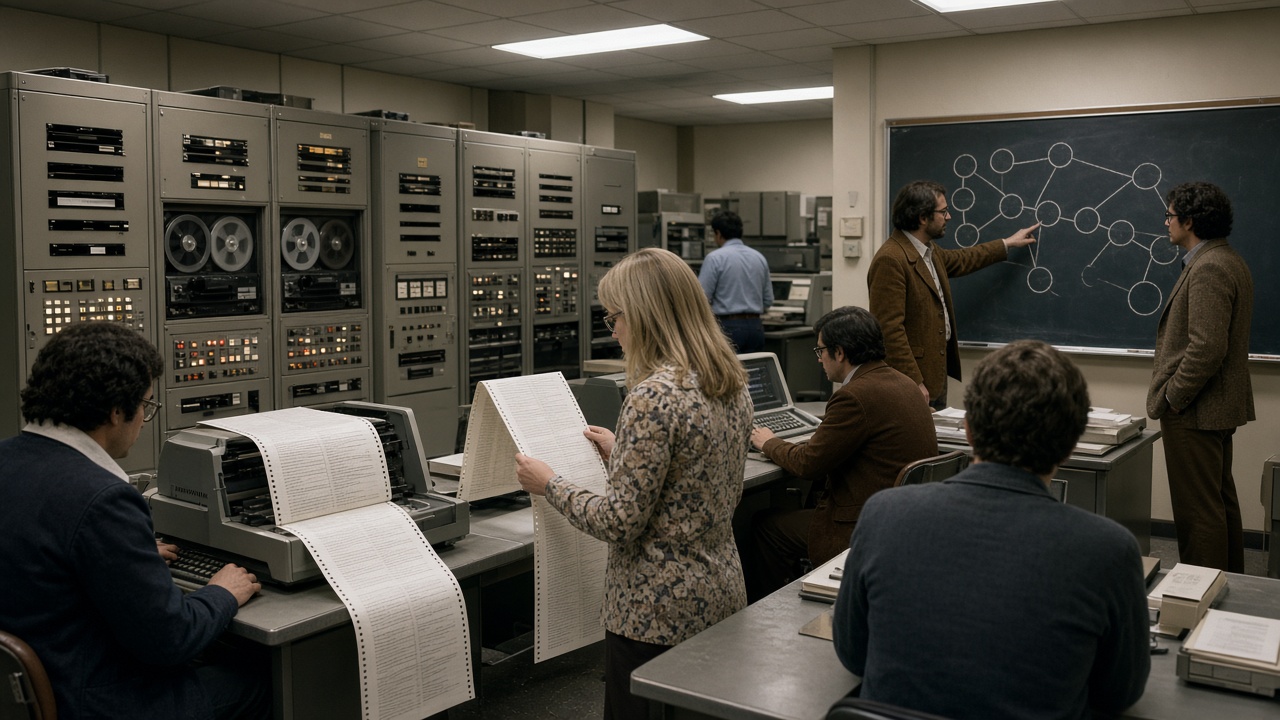
The US ARPANET began in 1969 and soon reached across the Atlantic. Meanwhile, other countries built their own networks — France’s Minitel, Britain’s JANET, Japan’s JUNET, and research networks in Europe, Australia, and India. In the 1980s these separate networks began to join the shared internet, and country codes such as .uk and .in gave nations their own place online.
Researchers sketch a network map in a 1970s university computer room (artistic illustration).
1969–1973: The ARPANET sends its first message between two US universities (29 October 1969), and in 1973 makes its first international links, to NORSAR in Norway and University College London.
1976–1984: Public data networks spread in Europe and beyond, France launches Minitel nationwide (1982), the ARPANET switches to the TCP/IP protocols (1 January 1983), and Japan’s JUNET and the worldwide FidoNet begin (1984).
1985–1986: The first country-code domains, such as .us, .uk, and .il, are created (1985), India launches ERNET to link universities and research institutes (1986), and the US NSFNET backbone opens to universities (1986).
1988–1989: Networks in Europe, Canada, Australia, and Asia join the NSFNET, the first commercial internet service providers appear (1989), and Tim Berners-Lee proposes the World Wide Web at CERN (March 1989).
Technology
TCP/IP: A common language for networks.
Country-code domains: .uk, .in, .jp, and more.
Videotex terminals: France’s Minitel.
Features
Research first: Universities lead the way.
National networks: Each country builds its own.
Joining up: A network of networks.
🌐 The Web Goes Global1990 – 1999
The Web Goes Global
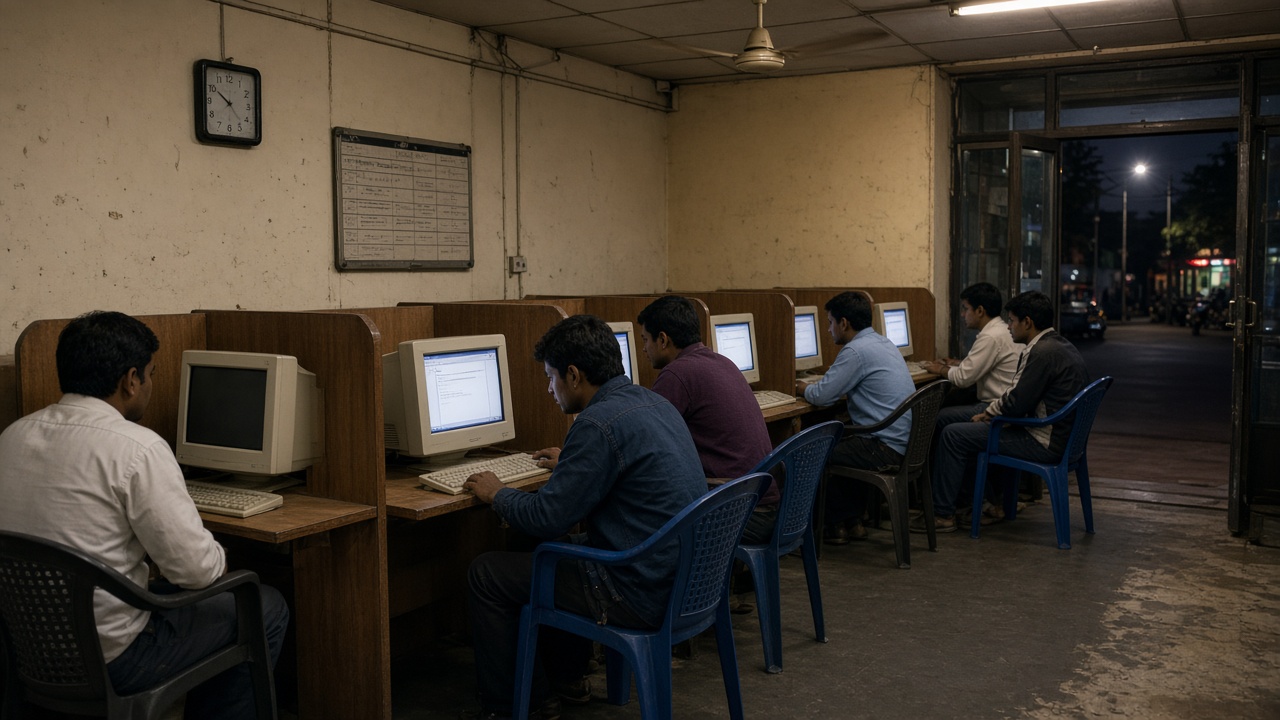
The World Wide Web, created at CERN in Europe and given freely to the world, made the internet easy to use. In just a few years, South Africa, China, Russia, India, and dozens of other countries made their first full connections, and cyber cafés opened from Lagos to Lima to Lucknow. New fibre-optic cables circled the globe, and a new body, ICANN, was set up to coordinate internet names and addresses.
Students and workers go online at a city cyber café in the late 1990s (artistic illustration).
1991–1993: The web is opened to the public (1991), South Africa makes its first internet connection (1991), and CERN releases the web’s software into the public domain (30 April 1993), letting anyone use it free.
1994–1995: China makes its first full internet connection (20 April 1994), Russia gets the .ru domain (1994), and India’s state-owned VSNL launches public internet access on 15 August 1995.
1996–1997: Estonia’s Tiger Leap programme begins connecting all its schools (1996), and the FLAG fibre-optic cable links Britain to Japan through the Middle East and Mumbai (1997).
1998–1999: ICANN is founded to manage domain names and internet addresses (1998), private internet service providers are allowed in India (1998), and fears of the “Y2K” computer bug spread worldwide (1999).
Technology
Web browsers: Pictures and links for everyone.
Fibre-optic cables: Huge capacity across oceans.
Dial-up modems: Home access over phone lines.
Features
Free web: Released to the public domain.
Countries connect: From Johannesburg to Beijing.
Cyber cafés: Shared public access.
⚖️ Digital Divide2000 – 2009
Digital Divide & Global Debate
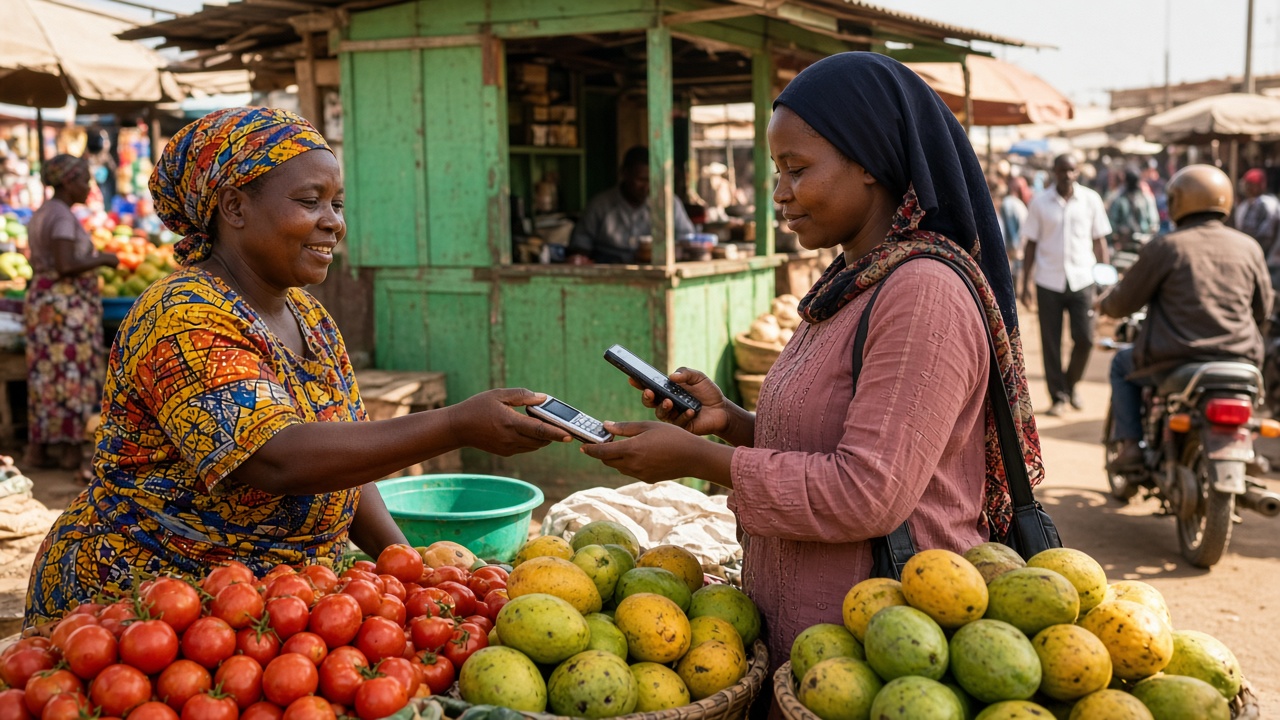
As the internet reached a billion people, the world began to worry about those left behind. UN summits debated the “digital divide” and who should govern the internet. Some governments built systems to censor it, and cyberattacks showed how it could be used as a weapon. At the same time, mobile phones began to leapfrog fixed lines in Africa and Asia, and Kenya’s mobile money showed what was possible.
A market trader receives a mobile-money payment on a basic phone in East Africa (artistic illustration).
2000–2003: The dot-com crash hits technology companies (2000), India passes its Information Technology Act (2000), and the first UN World Summit on the Information Society meets in Geneva (2003).
2005–2006: Internet users pass about one billion (around 2005), the second world summit in Tunis calls for a global forum, and the UN Internet Governance Forum holds its first meeting in Athens (2006).
2007–2008: Kenya launches M-Pesa mobile money (2007), cyberattacks hit Estonia’s government and banks (2007), and China overtakes the United States as the country with the most internet users (2008).
2009: The SEACOM undersea cable brings broadband to East Africa’s coast, joining new cables that end many African countries’ dependence on slow, costly satellite links.
Technology
Broadband: Always-on, faster connections.
SMS-based services: Mobile money on basic phones.
Content filtering: National censorship systems.
Features
Digital divide: Rich and poor, city and village.
Global governance: UN summits and forums.
Leapfrogging: Mobile before fixed lines.
📱 Mobile Planet2010 – 2019
Mobile Planet
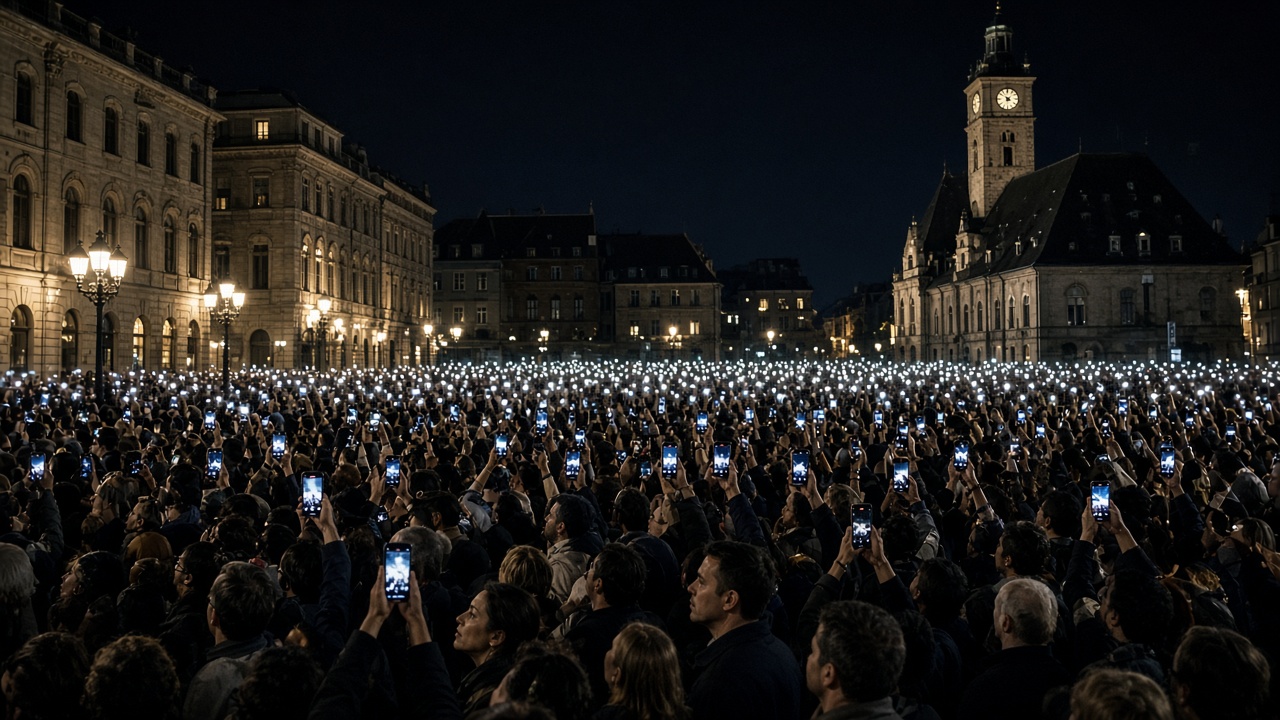
Cheap smartphones and mobile data brought billions online, mostly in Asia and Africa. Social media helped organise protests, from the Arab Spring onwards, but also spread misinformation, and revelations about mass surveillance alarmed the world. India saw a mobile data revolution, a landmark net neutrality decision, and a new digital payments system, and by the end of 2018 more than half of humanity was online.
Thousands of smartphones light up a city square as a connected generation shares the moment (artistic illustration).
2010–2013: Internet users reach about two billion (2010), social media plays a role in the Arab Spring protests (2010–2011), the UN Human Rights Council affirms the same rights online as offline (2012), and leaks reveal mass internet surveillance (2013).
2015–2016: India launches Digital India (2015), the regulator TRAI rules for net neutrality, barring differential data pricing (February 2016), UPI instant payments begin (2016), and a new 4G network sets off a price war that makes mobile data very cheap (September 2016).
2016–2018: The US government hands oversight of key internet address functions to the global ICANN community (1 October 2016), and Europe’s General Data Protection Regulation (GDPR) comes into force (25 May 2018).
2018–2019: More than half the world’s population is online by the end of 2018, according to the ITU, while governments in several countries increasingly order regional internet shutdowns.
Technology
4G networks: Fast mobile data.
Affordable smartphones: The main way to go online.
Instant payments: UPI and mobile wallets.
Features
Half the world online: A milestone in 2018.
Privacy and rights: GDPR and net neutrality.
Power of social media: Protest and misinformation.
🛰️ Connecting Everyone2020 – Today
Connecting Everyone
The COVID-19 pandemic made the internet essential for school, work, and healthcare, and exposed how many people were still cut off. New undersea cables, 5G networks, and low-orbit satellite constellations are extending coverage, while countries write new laws on data and artificial intelligence. The UN’s goal is universal, meaningful connectivity — affordable, safe internet for every person on Earth.
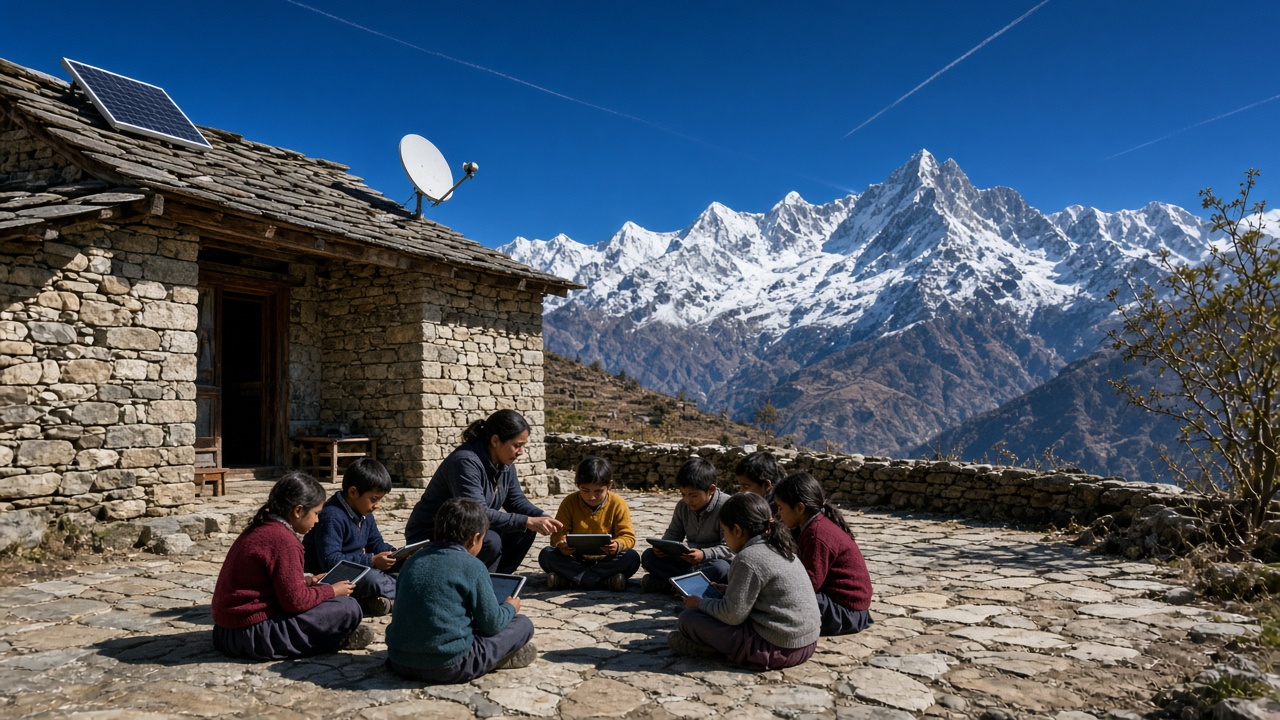
Children in a remote mountain village learn online through a satellite link (artistic illustration).
2020–2021: The COVID-19 pandemic moves schools, offices, and doctors’ appointments online worldwide, while millions of children without connections fall behind.
2022–2023: India launches 5G services (1 October 2022), artificial-intelligence chatbots reach hundreds of millions of users, India passes the Digital Personal Data Protection Act (2023), and users pass about 5.4 billion (2023).
2024: About 5.5 billion people — roughly 68 percent of the world — are online, according to the ITU, and the UN adopts the Global Digital Compact to promote an open, safe, and inclusive internet.
Today: Low-orbit satellite constellations and new undersea cables reach remote islands and villages, but about 2.6 billion people remain offline, most in low-income countries and rural areas.
Technology
5G: Faster, lower-delay mobile networks.
Satellite constellations: Thousands of low-orbit satellites.
AI services: Chatbots and translation online.
Features
Essential service: School, work, and health online.
Data laws: Protecting personal information.
Universal access: Connecting the last 2.6 billion.
Global Internet Users Over Time
Approximate figures based on International Telecommunication Union (ITU) estimates; early numbers are less certain.
Year
Internet users
Share of world population
1995
About 16 million
Under 1%
2000
About 400 million
About 7%
2005
About 1 billion
About 16%
2010
About 2 billion
About 29%
2015
About 3.2 billion
About 43%
2018
About 3.9 billion
Just over 50%
2023
About 5.4 billion
About 67%
2024
About 5.5 billion
About 68%
When Countries Joined the Network
Country
Milestone
Year
United States
ARPANET sends its first message
1969
Norway and Britain
First international ARPANET connections
1973
France
Minitel national online service launched
1982
Japan
JUNET university network begins
1984
India
ERNET research network; public internet through VSNL
1986; 1995
Australia
AARNet links universities to the internet
1989
South Africa
First internet connection, at a university
1991
China
First full internet connection
1994
Estonia
Tiger Leap programme connects schools; later a pioneer of e-government
1996
Kenya
M-Pesa mobile money launched
2007
Who Carries and Coordinates the Internet
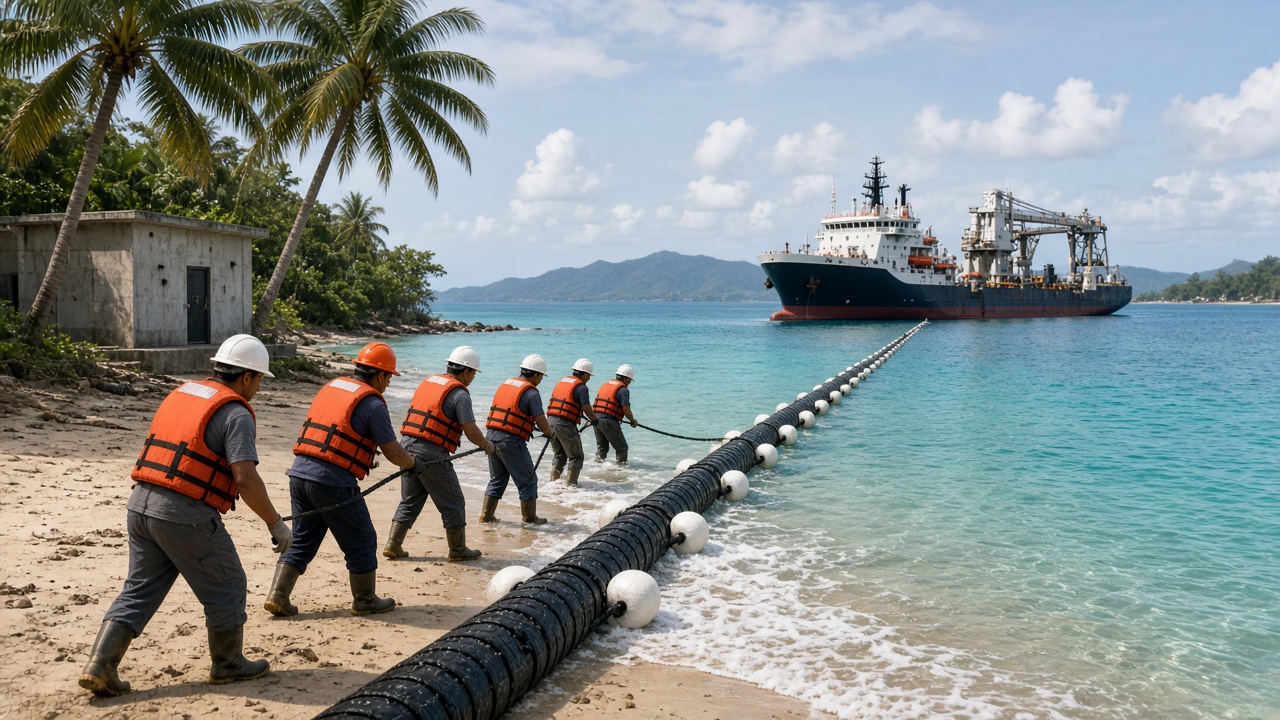
Workers haul a new undersea fibre-optic cable ashore to a landing station (artistic illustration).
Part of the system
Since
Role
Undersea fibre-optic cables
1988 (first transatlantic fibre)
Carry most data between continents
Communication satellites
1960s
Reach ships, aircraft, and remote areas
Internet exchange points and data centres
1990s
Where networks meet and data is stored
Internet Engineering Task Force (IETF)
1986
Develops technical standards
World Wide Web Consortium (W3C)
1994
Develops web standards
ICANN
1998
Coordinates domain names and internet addresses
Regional internet registries
1992–2005
Five bodies hand out addresses for Europe, Asia-Pacific, North America, Latin America, and Africa
International Telecommunication Union (ITU)
1865
UN agency for telecommunications; measures global connectivity
Internet Governance Forum
2006
UN meeting place for governments, companies, and citizens
India on the Global Internet
Year
Milestone
1870
Direct undersea telegraph cable links Bombay with Britain
1986
ERNET links Indian universities and research institutes
15 August 1995
VSNL launches public internet access
1997
The FLAG fibre-optic cable lands in Mumbai
1998
Private internet service providers allowed
2000
Information Technology Act passed
2015
Digital India programme launched
2016
TRAI net neutrality ruling, UPI payments, and the cheap-data revolution
2022
5G services launched
2023
Digital Personal Data Protection Act passed
Today
The world’s second-largest internet population and a global leader in real-time digital payments
The Digital Divide and Society
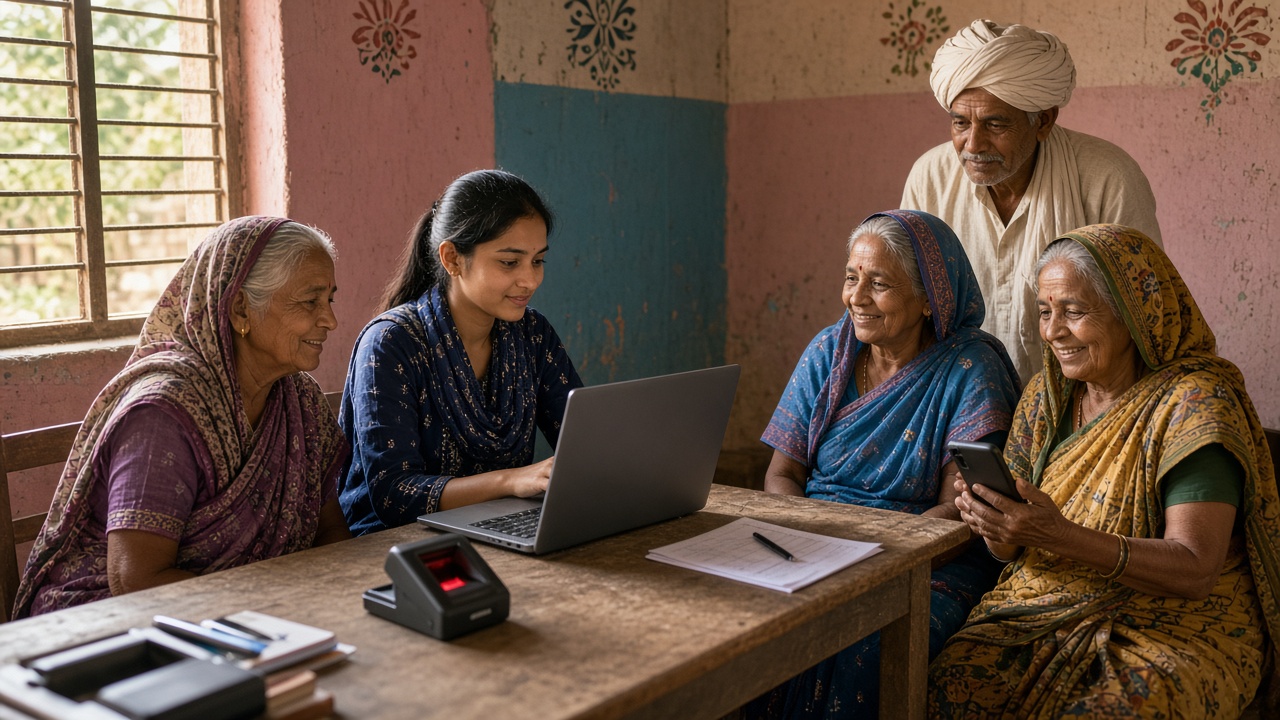
A village digital centre operator helps elderly residents use online services (artistic illustration).
Issue
What it means
Rich and poor countries
Most people in high-income countries are online, but only a minority in the poorest countries
Cities and villages
Urban areas are far better connected than rural ones
Women and men
Fewer women than men use the internet worldwide, especially in low-income countries
Cost
Devices and data are still unaffordable for many families
Skills and language
Digital skills and content in local languages are needed to benefit fully
Censorship and shutdowns
Some governments block sites or switch off access during protests and unrest
Misinformation
False stories can spread quickly on social media and messaging apps
Cybersecurity and privacy
Scams, hacking, and data misuse affect individuals and governments
Digital public services
Online IDs, payments, and government services can widen access when designed for everyone
Global Internet Timeline Summary
Date
Milestone
1866
Lasting transatlantic telegraph cable
1870
Undersea telegraph cable links Britain and Bombay
1956
First transatlantic telephone cable
1965
First commercial communication satellite
29 October 1969
First ARPANET message
1973
First international links, to Norway and Britain
1982
Minitel launched across France
1985
First country-code domains
1986
India’s ERNET
1989
World Wide Web proposed at CERN
30 April 1993
Web software released free to the world
20 April 1994
China’s first full internet connection
15 August 1995
Public internet in India
1998
ICANN founded
2003 and 2005
World Summits on the Information Society
About 2005
One billion internet users
2007
M-Pesa mobile money in Kenya
2010–2011
Arab Spring
2016
Net neutrality ruling, UPI, and cheap data in India
25 May 2018
GDPR in force in Europe
End of 2018
Half the world online
2020
Pandemic moves life online
1 October 2022
5G launched in India
2024
About 5.5 billion users; Global Digital Compact
Test Your Knowledge
20 quick questions from the global internet timeline. Click each question to reveal the answer.
Answer: 1866.
Answer: Bombay (Mumbai).
Answer: Packet switching.
Answer: Norway and Britain.
Answer: Minitel.
Answer: ERNET (Education and Research Network).
Answer: CERN, near Geneva.
Answer: It released it into the public domain, free for anyone to use.
Answer: 1994.
Answer: 15 August 1995, through VSNL.
Answer: ICANN.
Answer: The digital divide.
Answer: Kenya.
Answer: China.
Answer: The Arab Spring.
Answer: TRAI, the Telecom Regulatory Authority of India.
Answer: The General Data Protection Regulation (GDPR).
Answer: 2018.
Answer: About 5.5 billion, around 68 percent of the world.
Answer: Undersea fibre-optic cables.
Classroom activity
Students Tasks
Use these prompts for discussion or projects on the global internet.
Make a timeline poster: 1866 transatlantic cable, 1973 first international links, 1993 web free for all, 1995 internet in India, 2007 mobile money, 2018 half the world online, and 2024 about 5.5 billion users.
On a world map, draw major undersea cable routes and mark where cables land in India.
Turn the global internet users table into a line graph and describe what it shows.
Interview a grandparent or older neighbour about the first time they used the internet or a mobile phone.
Make a fact card on how mobile money and UPI changed everyday payments.
List five reasons why some people are still offline and suggest a solution for each.
Compare how the internet arrived in India, China, and Kenya.
Create a poster on staying safe online: passwords, scams, and checking facts before sharing.
Explain what net neutrality means, using an example from India in 2016.
Debate: “Internet access should be a basic right for everyone.”
Continue exploring
The global internet is built on networking technology, mobile phones, and centuries of long-distance communication. Explore these connected timelines next.
Click any panel to expand and explore the visual mood.
The global internet in pictures — laying a telegraph cable, a 1970s computer room, a cyber café, mobile money at a market, a smartphone crowd, an undersea cable coming ashore, a village digital centre, a satellite-connected school, and going online then versus now.
Wiring the World
1866
First Networks
1970s
Cyber Café
Late 1990s
Mobile Money
Kenya, 2007
Mobile Planet
2010s
Undersea Cables
500+ today
Village Online
Closing the divide
Connecting Everyone
Today
Then vs Now
Dial-up to video calls
Explore all world history timelines
Jump to any other world history timeline on WorldTimelineHub.
Disclaimer: This content is AI-generated for educational purposes and may contain errors or outdated details. For correct and authoritative information, please refer to official and reliable sources such as government publications, manufacturers, museums, and academic references.