Communication Timeline of India: Letters → Landlines → Mobiles → Smartphones → Video Calls
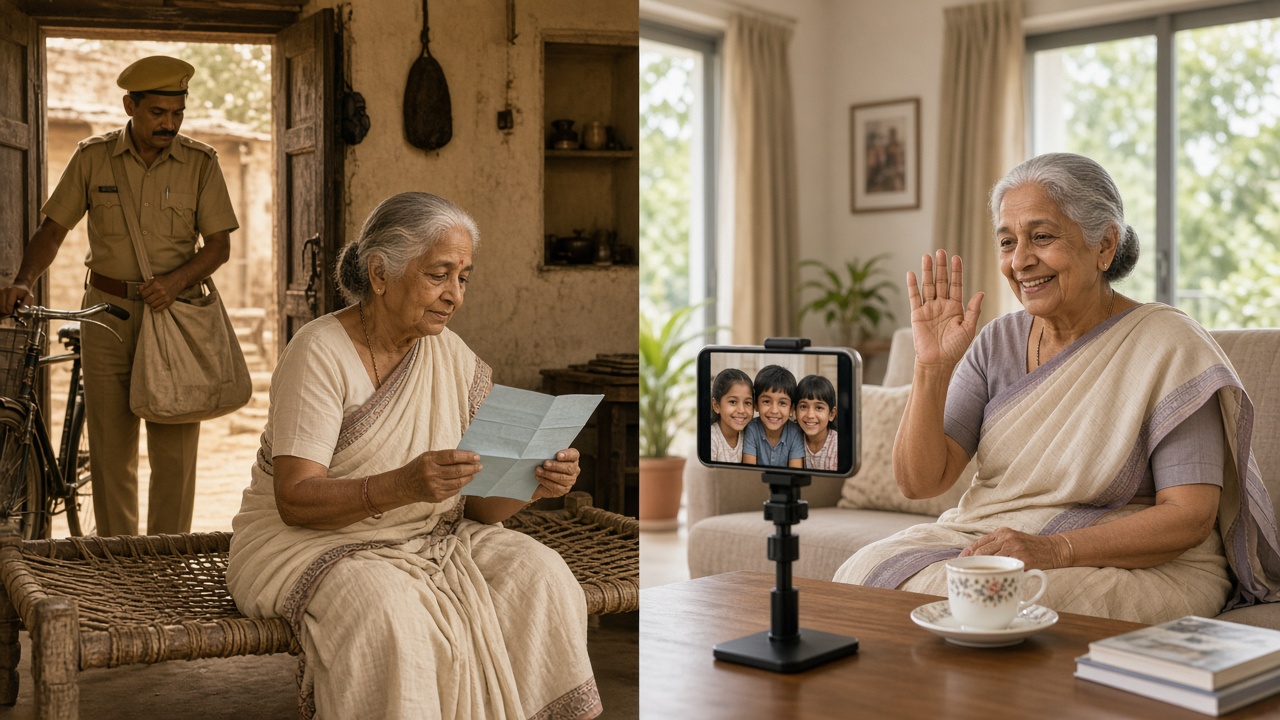
In the 1950s families waited days for the postman and feared the arrival of a telegram. Home landlines and yellow STD booths connected towns in the 1980s, India made its first mobile call
in 1995, cheap smartphones and 4G data put the internet in every pocket in the 2010s, and in the 2020s grandparents video-call their grandchildren over 5G.
This timeline covers dak runners, India Post and the telegraph, postcards, inland letters and money orders, trunk calls and STD, PIN codes, C-DOT exchanges and PCO booths, pagers,
the first mobile call, SMS and missed calls, 3G and 4G, the end of the telegram, cheap data, WhatsApp and UPI, lockdown video calls, 5G, and the road to 6G.
How we keep in touch shapes family life, work, migration, and democracy. In just seventy years India went from waiting weeks for a letter to having more than a billion phone
connections and some of the cheapest mobile data in the world. The story shows how technology, policy, and competition brought people closer across a vast country.
Big picture
India’s communication journey in one view
For centuries messages travelled by runners and horse posts. India Post and the telegraph linked the country in the 1850s, and after independence letters and telegrams carried
family news while telephones stayed rare. Indian-made exchanges and STD booths spread phones in the 1980s, mobiles arrived in 1995, cheap smartphones and data transformed the
2010s, and the 2020s brought video calls and 5G for everyone. Related timelines:
postal services,
telecom in India,
mobile phones.
1854
India Post becomes one department
1995
India’s first mobile phone call
2016
Cheap 4G data revolution
2022
5G services launched
From waiting for the postman to a video call with the grandchildren (artistic illustration).
Communication Then vs Now at a Glance
Feature
Then
Now
Main way to stay in touch
Letters and postcards
Messaging apps and video calls
Urgent news
Telegram, charged per word
Instant call or message
Speed
Days to weeks
Seconds
Long-distance call
Book a trunk call and wait hours
Dial directly, often free
Phone at home
Rare; years-long waiting list
A phone in almost every pocket
Public phones
Post office and STD booths
Almost disappeared
Seeing each other
Photos sent by post
Live HD video calls
Sending money
Money order by post
UPI in seconds
Address system
Name and village; PIN code from 1972
Phone number and live location
Languages
Letters written by scribes for many
Voice notes and AI translation
📜 Post & TelegraphAncient – 1946
Messengers, Post & Telegraph
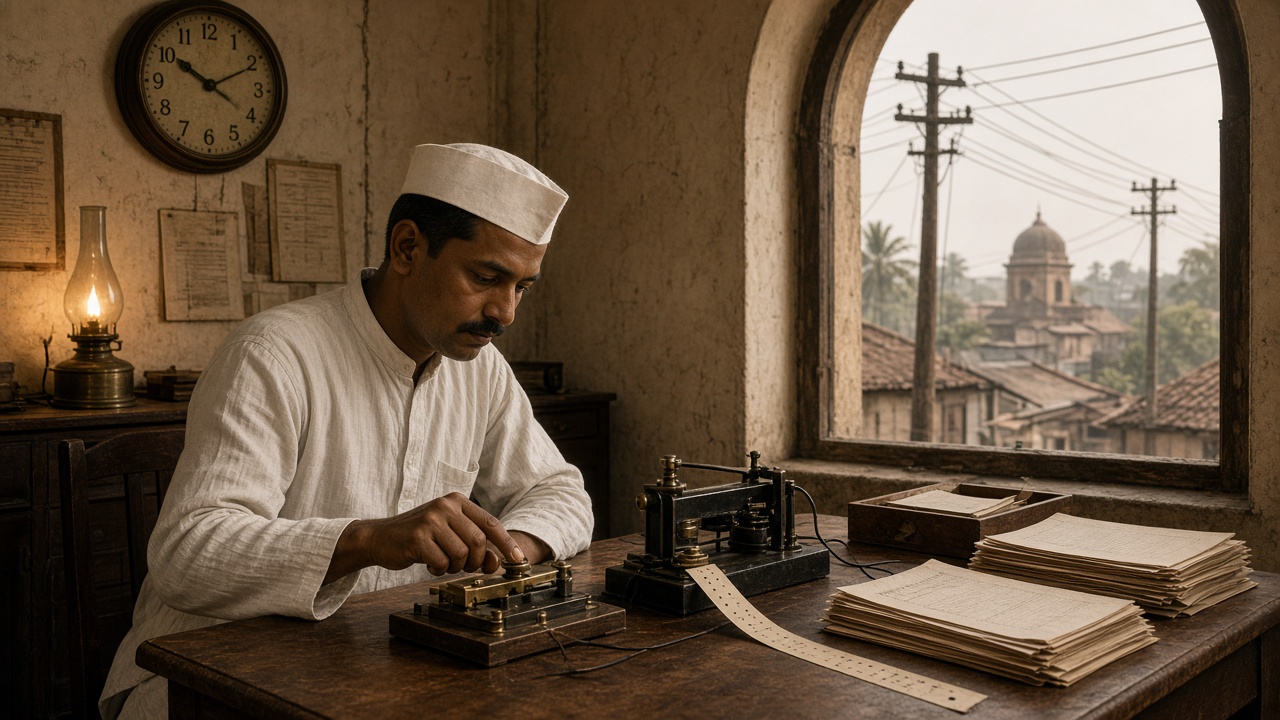
For centuries rulers sent messages with runners and horse riders along highways. In the 1850s the electric telegraph and a unified India Post began to link the whole country, and the first telephone exchanges opened in the big port cities in 1882.
A telegraph clerk taps out a message in Morse code (artistic illustration).
Medieval era: Rulers such as Sher Shah Suri (1540s) keep horse riders and runners (the dak) at rest houses along the Grand Trunk Road to carry royal messages.
1851: The first experimental electric telegraph line in India links Calcutta and Diamond Harbour; a national telegraph network follows within a few years.
1854: India Post is organised as one all-India department with uniform postage and the first all-India stamps; the postcard follows in 1879.
1882: The first telephone exchanges open in Calcutta, Bombay, and Madras, used mainly by businesses and officials.
Technology
Dak runners: Relay messengers.
Morse telegraph: Messages over wires.
Postage stamps: Prepaid post.
Features
Royal and official: Few private users.
Postcards: Cheap for everyone.
City phones: Only the elite.
✉️ Letters1947 – 1979
Letters & Telegrams
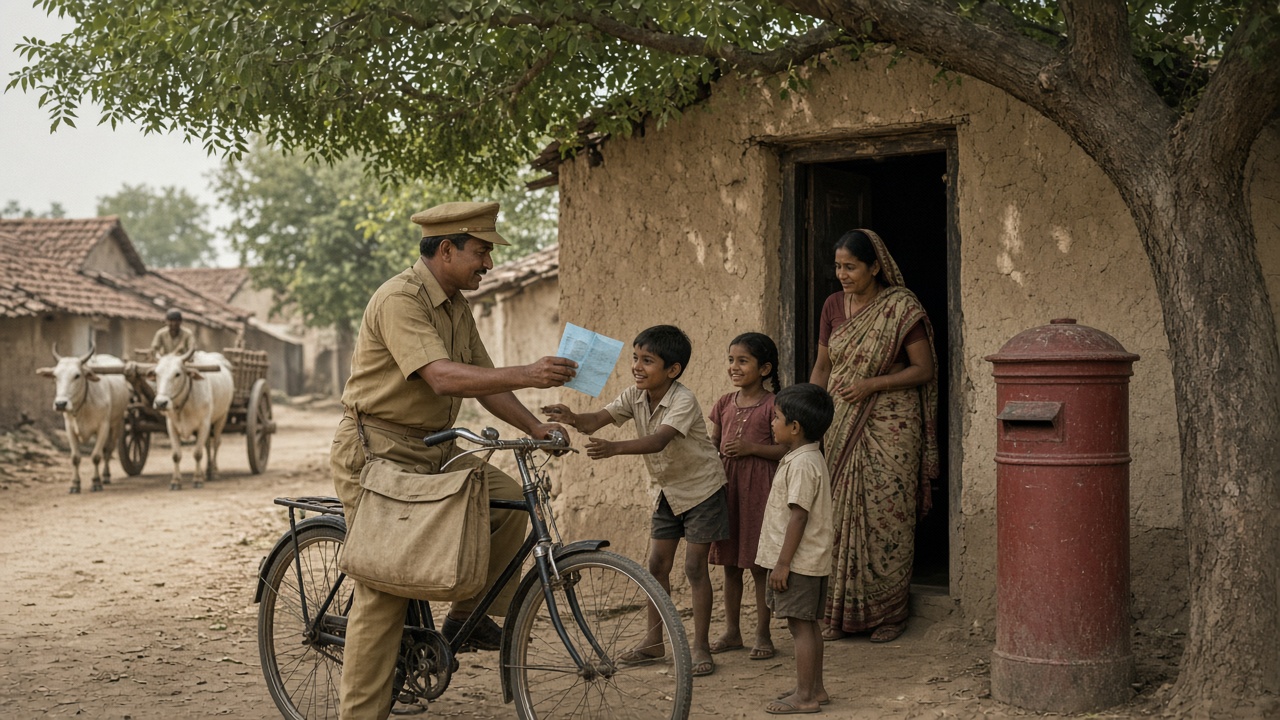
In the 1950s the postman was the most awaited visitor. Postcards and inland letters carried family news, money orders supported villages, and a telegram meant something urgent. A home telephone was rare, and long-distance calls had to be booked through an operator.
The postman brings an inland letter to a village home (artistic illustration).
1947: Independent India issues its first postage stamp, the “Jai Hind” stamp, on 21 November 1947.
1950s: Postcards, inland letter cards, and money orders link migrant workers with their villages; telegrams carry births, deaths, exam results, and job offers.
1960: India’s first Subscriber Trunk Dialling (STD) route opens between Kanpur and Lucknow, letting callers dial long distance without an operator.
1972: The six-digit PIN (Postal Index Number) code is introduced on 15 August to speed up mail sorting.
Technology
Manual exchanges: Operators connect calls.
Trunk calls: Booked and waited for.
Railway mail service: Sorting on trains.
Features
Postman: A trusted friend.
Telegram fear: Usually urgent news.
Pen friends: Letters across India.
☎️ Landlines1980 – 1994
Landlines & STD Booths
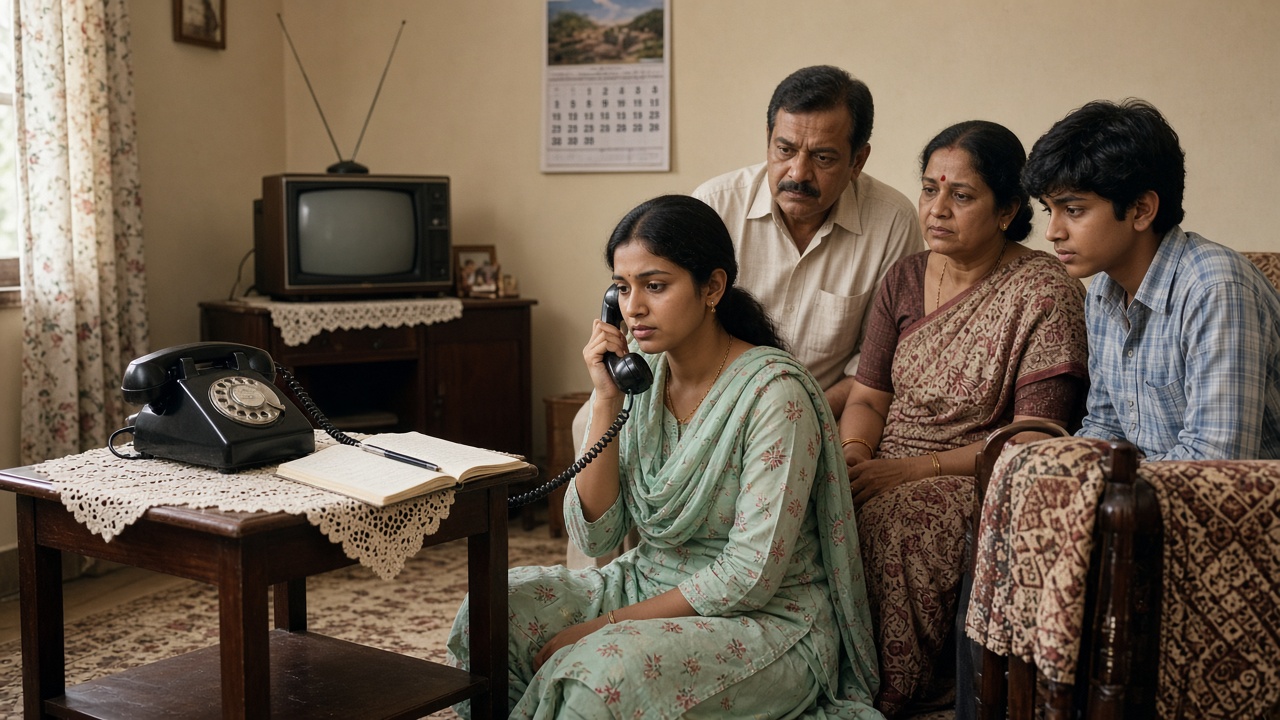
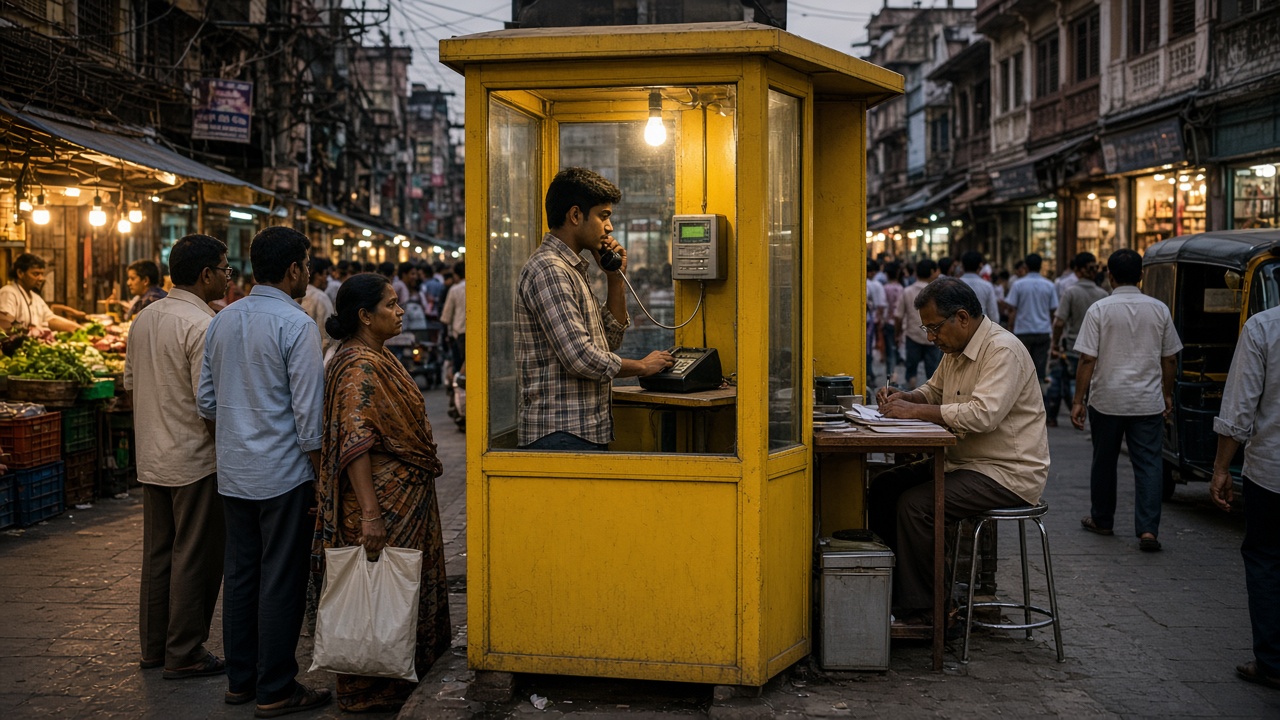
In the 1980s India decided to build its own telephone technology. Indian-designed digital exchanges reached small towns, and yellow STD/ISD/PCO booths let anyone make a long-distance call. A black rotary phone at home became a proud family possession — and neighbours came over to use it.
The whole family gathers round the rotary landline (artistic illustration).
1984: The Centre for Development of Telematics (C-DOT) is set up, led by Sam Pitroda, to design Indian digital exchanges suited to rural areas.
1985–1986: The Department of Telecommunications is separated from Posts, and MTNL (Delhi and Mumbai) and VSNL (international calls) are formed in 1986; Speed Post also starts in 1986.
Late 1980s: Yellow STD/ISD/PCO booths run by local entrepreneurs spread across towns and villages, creating jobs and bringing phones within reach of all.
Early 1990s: Push-button phones and fax machines appear in offices; people wait for late-night lower rates to make long STD calls.
Technology
C-DOT exchanges: Made in India.
STD and ISD: Direct dialling.
Fax machines: Documents by phone.
Features
PCO booths: Phones for everyone.
Phone diary: Handwritten numbers.
Shared phone: Neighbours’ calls too.
📱 Mobiles1995 – 2007
Mobiles, Pagers & SMS
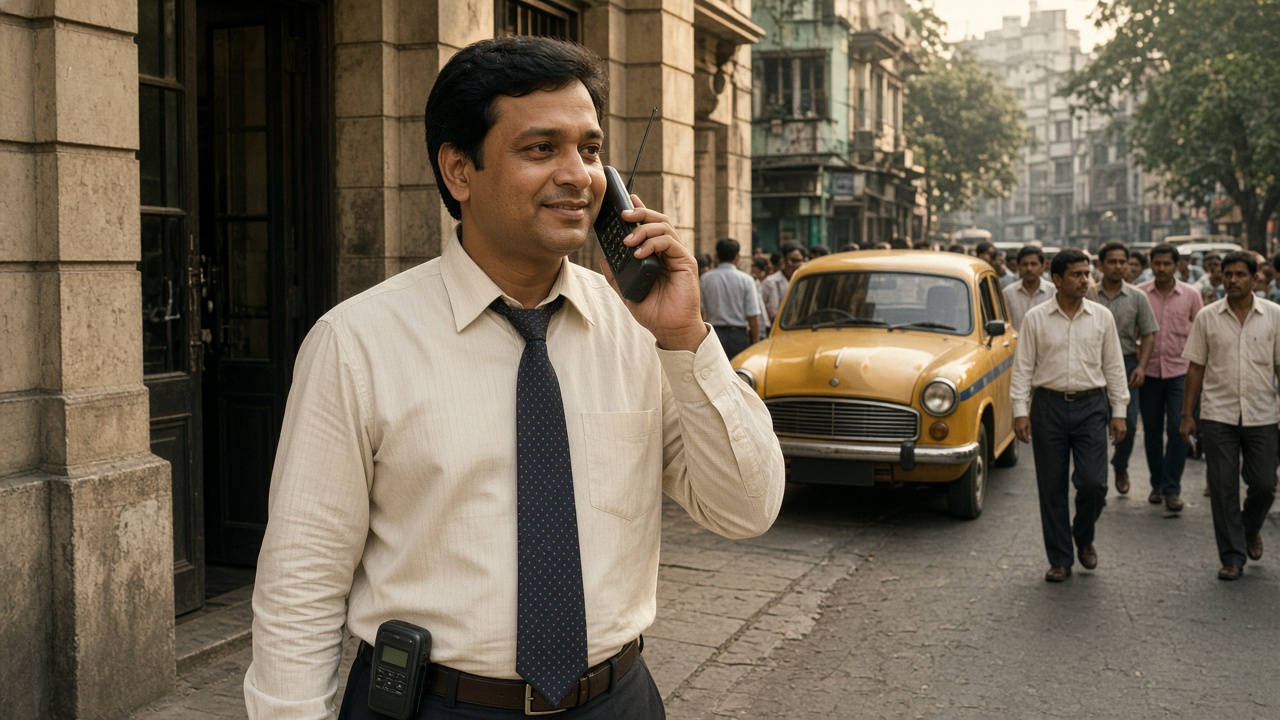
India’s first mobile call in 1995 began a revolution. Early calls were so costly that even incoming calls were charged, but free incoming calls, prepaid cards, SMS, and cheap handsets soon made the mobile phone a tool for shopkeepers, drivers, farmers, and students.
A bulky early mobile and a pager — status symbols of the late 1990s (artistic illustration).
31 July 1995: West Bengal Chief Minister Jyoti Basu makes India’s first mobile call, from Kolkata to Telecom Minister Sukh Ram in Delhi, on the Modi Telstra network using a Nokia phone.
15 August 1995: VSNL launches public internet access; email and cyber cafés follow, while pagers are popular for a few years.
2000: BSNL is formed on 1 October to run telephone services outside Delhi and Mumbai.
2003: “Calling Party Pays” makes incoming calls free; prepaid recharges, SMS, and missed calls spread, and mobiles soon outnumber landlines.
Technology
2G GSM and CDMA: Voice and SMS.
Prepaid SIMs: Recharge as you go.
Pagers: One-way messages.
Features
SMS lingo: Short, cheap texts.
Missed calls: Free signals.
Snake game: Fun on the phone.
📲 Smartphones2008 – 2019
Smartphones & Cheap Data
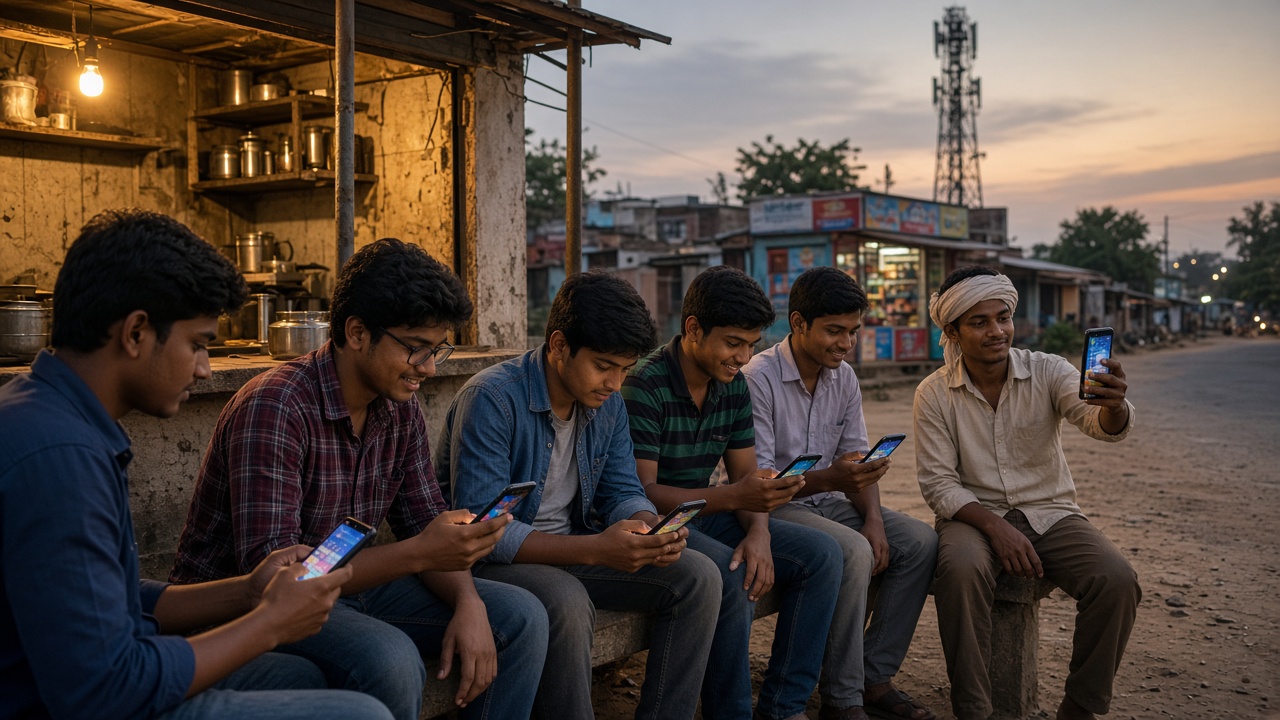
3G and then 4G turned the phone into a pocket computer. Budget Android smartphones, messaging apps, and — from 2016 — extremely cheap data brought hundreds of millions of Indians online for the first time, while the 163-year-old telegram quietly retired.
Budget smartphones and cheap data reach small towns (artistic illustration).
2008–2010: MTNL launches India’s first 3G service in December 2008, and 3G spectrum is auctioned in 2010; mobile number portability follows in 2011.
2012: Airtel launches India’s first 4G service in Kolkata in April; budget Android phones make smartphones affordable.
15 July 2013: BSNL sends the last telegrams and ends India’s telegram service.
2016: Reliance Jio launches with free voice calls and very cheap 4G data; messaging apps, voice notes, and video calls become part of daily life, and UPI payments begin.
Technology
3G and 4G: Mobile internet.
Android phones: Low-cost smartphones.
Messaging apps: Chats, groups, voice notes.
Features
Family groups: Good-morning forwards.
Selfies: Photos shared instantly.
Regional languages: Keyboards and voice.
🎥 Video Calls2020s – Future
5G & Video Calls
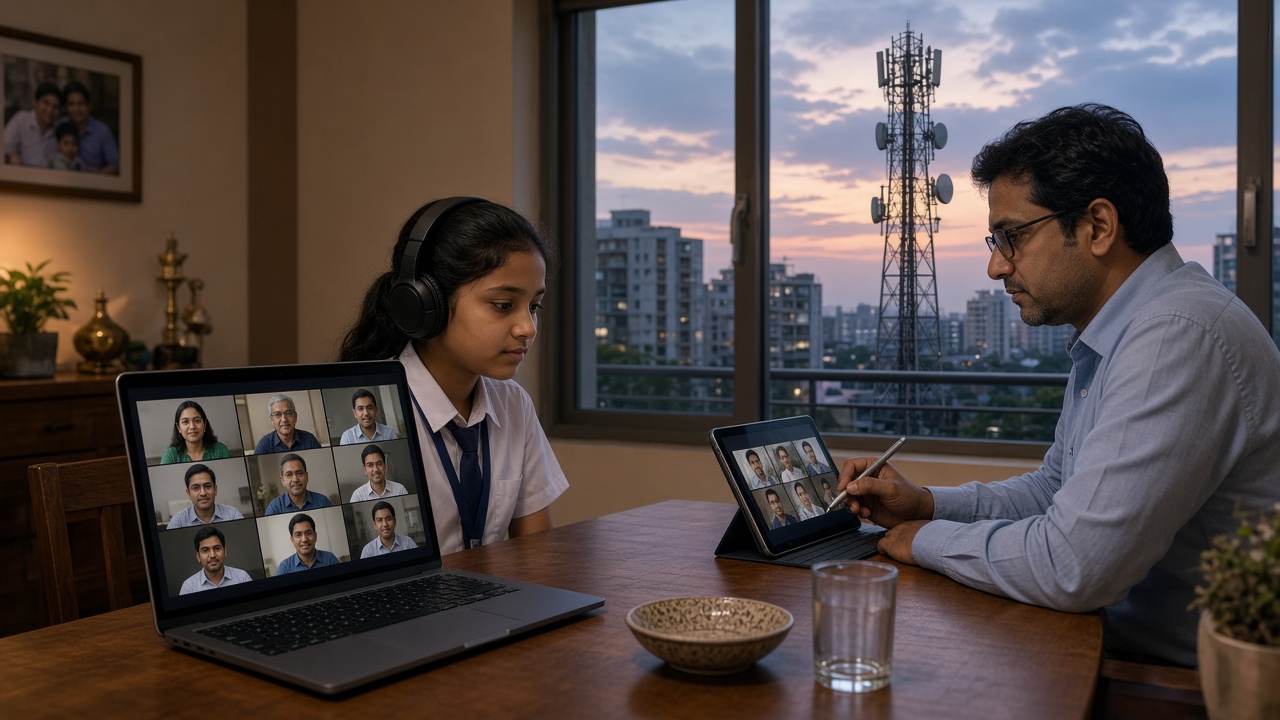
The 2020 lockdowns made video calls part of everyday life — for school, office, doctors, and family. 5G arrived in 2022 with faster speeds, a new telecom law replaced the colonial-era telegraph act, and India is now working on 6G, satellite internet, and AI translation between Indian languages.
School and office on video calls at the same dining table (artistic illustration).
2020: COVID-19 lockdowns move school classes, office meetings, doctor consultations, and even weddings onto video calls; many elders learn smartphones.
2022: The Prime Minister launches 5G services on 1 October at the India Mobile Congress in New Delhi; the Bhashini AI language-translation mission also starts.
2023: The Bharat 6G Vision aims for 6G by 2030, and the Telecommunications Act replaces the Indian Telegraph Act of 1885.
2020s–Future: With more than a billion phone connections, satellite internet, real-time translation, and holographic calls point to the next chapter.
Technology
5G: Very fast, low delay.
HD video calls: Face to face anywhere.
AI translation: Across Indian languages.
Features
Work and study: From home.
Family calls: Across continents.
Digital safety: Scam awareness.
Ways to Send a Message: Speed & Cost
Method
Common in
Speed
Cost to user
Letter or postcard
1950s–1980s
Days to weeks
Very cheap
Telegram
1950s–1990s
Same day
Charged per word
Trunk call via operator
1950s–1970s
Hours of waiting
Expensive
STD call from a PCO booth
1980s–2000s
Instant
Metered per minute, cheaper at night
Pager
Late 1990s
Minutes (one-way)
Monthly fee
SMS
2000s
Seconds
Per message or packs
App message or voice note
2010s–now
Seconds
Uses mobile data
Video call
2010s–now
Live
Uses mobile data
Mobile Network Generations in India
Generation
Arrived in India
What it made possible
2G
1995
Digital voice calls and SMS (India skipped 1G)
3G
2008
Mobile internet, email, basic video calls
4G
2012
HD video, streaming, apps, UPI everywhere
5G
2022
Very high speed and low delay; smart factories and cities
6G
Target around 2030
Ultra-fast networks, holographic and AI-driven services
Words & Habits of Every Era
Watching the meter at a yellow STD/PCO booth (artistic illustration).
Word or habit
Era
What it meant
Pen friend
1950s–1980s
A friend you knew only through letters
“Telegram aaya hai”
1950s–1980s
Urgent news — often feared
Trunk call
1950s–1970s
A booked long-distance call, often shouted over a bad line
STD booth after 11 pm
1980s–1990s
Waiting for lower night rates
Missed call
2000s
A free signal: “I reached” or “call me back”
SMS lingo
2000s
“gud n8”, “tc” — saving characters
Good-morning forwards
2010s
Greetings shared in family groups
Voice notes
2010s–now
Speaking instead of typing, in any language
Video call with grandparents
2020s
Seeing family across cities and countries
Communication Timeline Summary
Year / Era
Milestone
1540s
Horse and runner post on the Grand Trunk Road
1851
First experimental telegraph line
1854
India Post becomes one department
1879
Postcard introduced
1882
First telephone exchanges
1947
“Jai Hind” stamp of independent India
1960
First STD route, Kanpur–Lucknow
1972
PIN code introduced
1984
C-DOT set up
1986
MTNL, VSNL, and Speed Post
Late 1980s
STD/PCO booths spread
1995
First mobile call; public internet
2000
BSNL formed
2003
Incoming calls become free
2008
First 3G service
2012
First 4G service
2013
Telegram service ends
2016
Cheap 4G data revolution
2020
Lockdown video calls
2022
5G launched
2023
Bharat 6G Vision; new Telecommunications Act
Test Your Knowledge
20 quick questions from the communication timeline. Click each question to reveal the answer.
Answer: A relay post of runners and horse riders carrying messages.
Answer: Calcutta and Diamond Harbour.
Answer: 1854.
Answer: 1879.
Answer: 1882.
Answer: The “Jai Hind” stamp (1947).
Answer: They usually carried urgent news, such as illness or death.
Answer: Subscriber Trunk Dialling.
Answer: Kanpur–Lucknow (1960).
Answer: Six.
Answer: Sam Pitroda.
Answer: Yellow.
Answer: Jyoti Basu, calling Sukh Ram.
Answer: Incoming calls became free.
Answer: A free signal, such as “I have reached” or “call me back”.
Answer: Kolkata.
Answer: 15 July 2013.
Answer: The launch of Reliance Jio and the price competition that followed.
Answer: 1 October 2022.
Answer: The Indian Telegraph Act of 1885.
Classroom activity
Students Tasks
Use these prompts for discussion or projects on how Indians kept in touch over time.
Timeline understandingScience and technologySocial changeOral history
Write a real letter or postcard to a relative and post it; compare the experience with sending a message.
Make a timeline poster: letters (1950s), landlines (1980s), mobiles (1995), smartphones (2010s), and video calls (2020s).
Ask your grandparents about their first phone call and the last telegram they received.
Find your area’s PIN code and explain what each digit stands for.
Learn to write your name in Morse code.
Interview a postman or a former STD booth owner about how their work changed.
Compare 2G, 3G, 4G, and 5G in a simple chart of what each allowed people to do.
Discuss how cheap mobile data changed education, farming, and small businesses.
Make a list of rules for safe and polite video calls and messaging.
Debate: “A handwritten letter means more than a video call.”
Continue exploring
Personal communication grew with India’s postal network, telecom services, mobile phones, and the internet. Explore these connected timelines next.
Click any panel to expand and explore the visual mood.
India’s communication journey in pictures — the telegraph office, the 1950s postman, the family landline, the STD booth, early mobiles, smartphones, video calls, and then versus now.
Telegraph Office
Messages in Morse
1950s Letters
The awaited postman
1980s Landline
Rotary dial at home
STD Booth
Watch the meter
1990s Mobile
Bricks and pagers
Smartphones
Cheap data for all
Video Calls
School and office at home
Then vs Now
Letters to video calls
Explore all daily life timelines
Jump to any other daily life timeline on WorldTimelineHub.
Disclaimer: This content is AI-generated for educational purposes and may contain errors or outdated details. For correct and authoritative information, please refer to official and reliable sources such as government publications, manufacturers, museums, and academic references.