Second World War Timeline: Road to War → Blitzkrieg → Global War → Turning the Tide → Victory → Aftermath
Barely twenty years after the First World War, the world went to war again — and this time the fighting reached almost every continent and ocean. From 1939 to 1945, armies, navies, and air forces clashed from the Arctic to the
Pacific, cities were bombed, and millions of civilians were murdered or starved. India sent about 2.5 million soldiers, and the war’s end helped bring independence in 1947 and a new world order built around the United Nations.
This timeline covers the Great Depression, the rise of dictators, Munich, the invasion of Poland, Dunkirk, the Battle of Britain, the Blitz, Keren, Operation Barbarossa, Pearl Harbor, the fall of Singapore, Midway, Quit India,
El Alamein, Stalingrad, the Holocaust, the Bengal famine, Monte Cassino, Imphal and Kohima, D-Day, VE Day, Hiroshima and Nagasaki, Japan’s surrender, the United Nations, Nuremberg, and Indian independence.
1 Sept 1939 Poland invaded → 3 Sept 1939 India declared at war7 Dec 1941 Pearl Harbor → 6 June 1944 D-Day8 May 1945 VE Day → 2 Sept 1945 Japan surrenders
Why the Second World War Matters
The Second World War was the deadliest conflict in human history, killing an estimated 70 to 85 million people — most of them civilians. It included the Holocaust, the first and only use of atomic weapons in war, and battles
on a scale never seen before. Its end created the United Nations, divided Europe in the Cold War, and weakened the old empires so much that India and dozens of other nations won their independence within a few decades.
Big picture
The Second World War in one view
The Depression and the rise of dictators led to war in 1939, Germany conquered much of Europe by 1940, the war became global in 1941 when Germany invaded the Soviet Union and Japan attacked Pearl Harbor, the tide turned at
Midway, El Alamein, and Stalingrad, the Allies closed in from every side in 1944–1945, and the peace brought the United Nations, the Cold War, and independence for India. Related timelines:
computers,
pharma industry,
news.
6 years
From 1 September 1939 to 2 September 1945
70–85 million
Deaths worldwide, soldiers and civilians (estimate)
~2.5 million
Indian Army at its peak, all volunteers
51
Founding members of the United Nations, including India
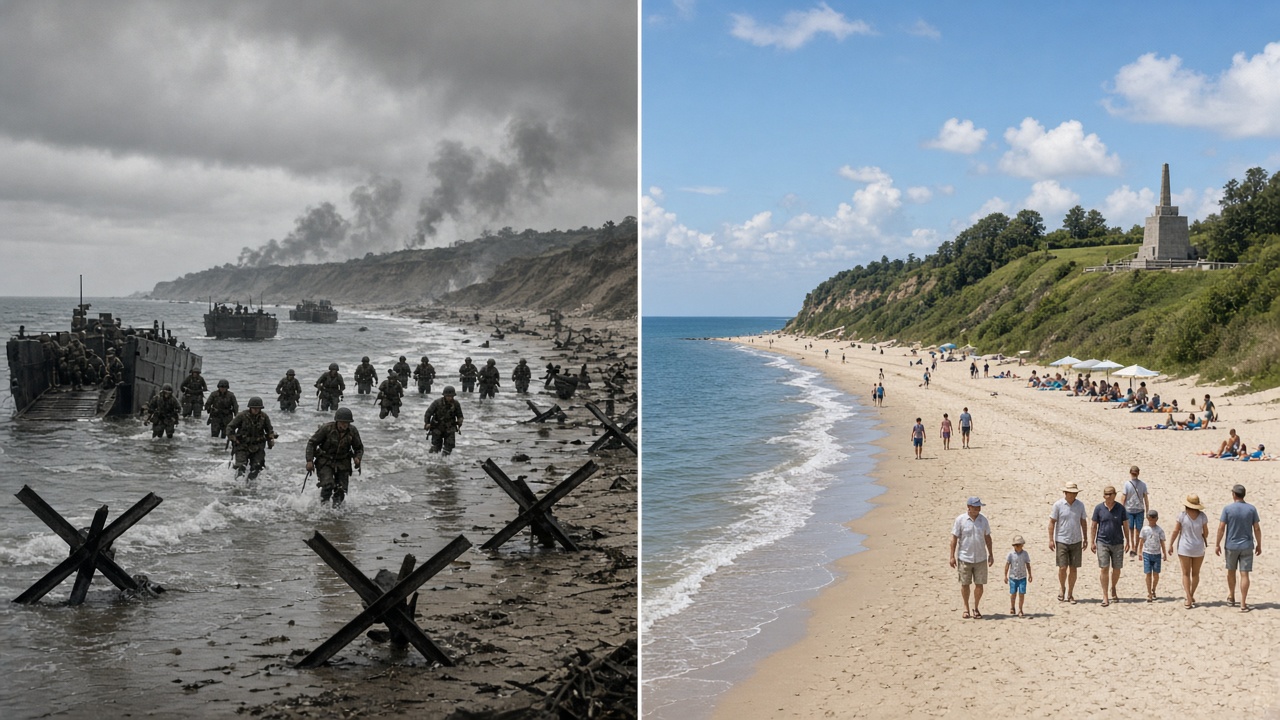
A Normandy beach on D-Day in 1944 and the same shore as a peaceful holiday beach today (artistic illustration).
War and the World Then vs Now
Feature
1939–1945
Today
World body for peace
The League of Nations, which failed to stop aggression
The United Nations, with 193 member states
India
A British colony declared at war by the Viceroy
An independent republic and a major UN peacekeeping contributor
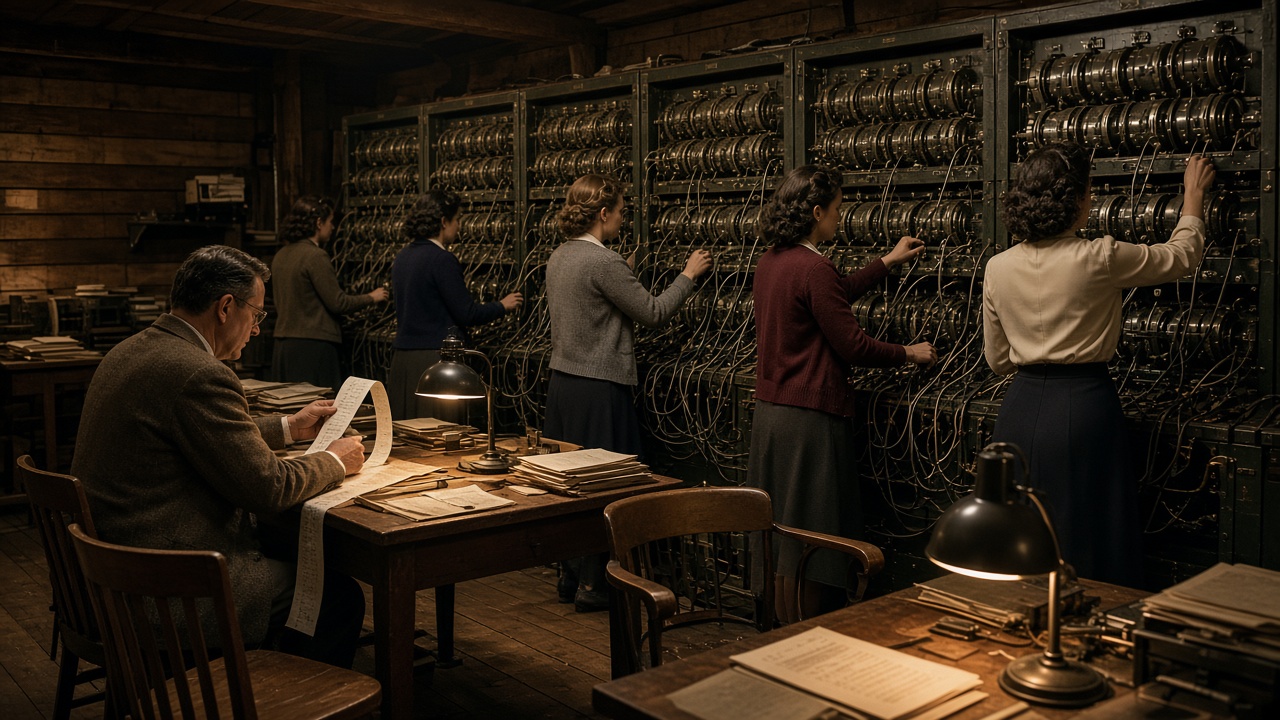
Secret codes
Rotor cipher machines and electromechanical codebreakers
Digital encryption on every phone and computer
Computers
The first electronic computers, built for codebreaking and gunnery tables
Billions of computers, smartphones, and AI systems
Aircraft
Propeller fighters and bombers; the first jets appear in 1944
Stealth jets, drones, and satellites
Nuclear weapons
First built and used in 1945
Limited by the Non-Proliferation Treaty (1968) and arms-control treaties
Medicine
Penicillin was new and scarce
Antibiotics and vaccines widely available
News
Radio bulletins, newspapers, and cinema newsreels
Live streaming and social media
Human rights
No universal declaration of rights
Universal Declaration of Human Rights (1948) and international courts
Europe
Divided by war and occupation
Former enemies cooperate in the European Union
🧭 Road to War1919 – 1939
Road to War
The peace of 1919 left many Germans bitter, and the Great Depression after 1929 brought mass unemployment and despair. Dictators promising national glory took power in Italy and Germany, and military leaders gained control of Japan’s government. Each tested the world with acts of aggression, while Britain and France, hoping to avoid another war, followed a policy of appeasement.
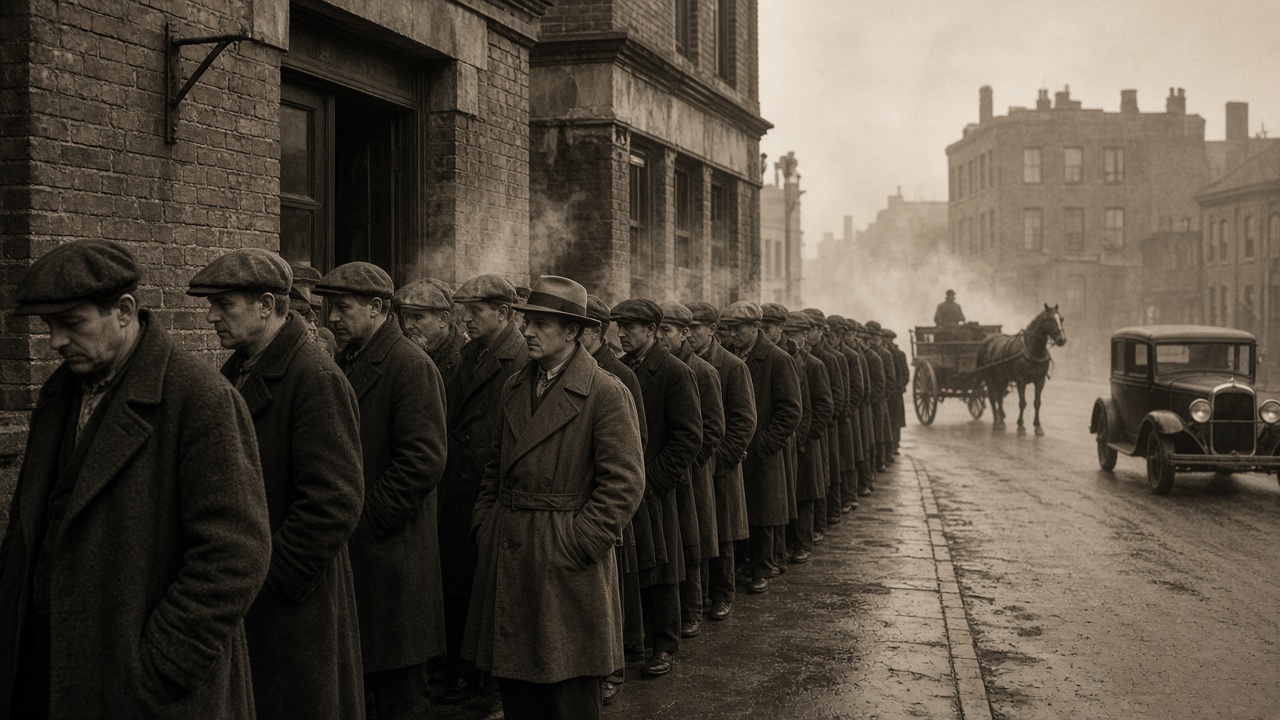
Unemployed men queue for food during the Great Depression of the early 1930s (artistic illustration).
1919–1929: The Treaty of Versailles punishes Germany (1919), Benito Mussolini’s Fascists take power in Italy after the March on Rome (1922), and the Wall Street Crash (October 1929) starts the Great Depression.
1931–1935: Japan seizes Manchuria (1931), Adolf Hitler becomes chancellor of Germany (30 January 1933) and builds a Nazi dictatorship, and Italy invades Ethiopia (1935) as the League of Nations fails to act.
1936–1938: Germany marches into the Rhineland (1936), the Spanish Civil War begins (1936), Japan launches full-scale war on China (July 1937), and Germany annexes Austria (March 1938).
September 1938–August 1939: The Munich Agreement hands part of Czechoslovakia to Germany (September 1938), Germany occupies the rest (March 1939), and the Nazi–Soviet Pact (23 August 1939) clears the way to invade Poland.
Technology
Radar: Britain builds a coastal warning chain.
Monoplane fighters: Faster all-metal aircraft.
Radio propaganda: Broadcasts reach every home.
Features
Depression: Mass unemployment.
Dictators: Fascism and Nazism.
Appeasement: Giving in to avoid war.
⚡ Blitzkrieg1939 – 1940
Blitzkrieg & Britain Alone
Germany’s “lightning war” combined tanks, aircraft, and fast-moving infantry. Poland fell in weeks, and in the spring of 1940 Germany overran Denmark, Norway, the Low Countries, and France. Britain and its empire fought on alone, rescuing their army at Dunkirk and winning the Battle of Britain in the air. In India, the Viceroy’s declaration of war without consulting Indian leaders caused a political crisis.
Soldiers wade out to small boats during the evacuation from Dunkirk in 1940 (artistic illustration).
1–17 September 1939: Germany invades Poland (1 September), Britain and France declare war (3 September), the Viceroy declares India at war the same day, and the Soviet Union invades eastern Poland (17 September).
October 1939–April 1940: Congress ministries in the provinces resign in protest (October–November 1939), the quiet “Phoney War” settles on the Western Front, and Germany invades Denmark and Norway (April 1940).
May–June 1940: Germany attacks the Netherlands, Belgium, and France (10 May), Winston Churchill becomes British prime minister, about 338,000 troops are evacuated from Dunkirk, Italy joins Germany, and France signs an armistice (22 June).
July 1940–May 1941: The Royal Air Force wins the Battle of Britain (July–October), German bombers strike British cities in the Blitz, and Germany, Italy, and Japan sign the Tripartite Pact (27 September 1940).
Technology
Tanks and dive-bombers: Fast, combined attacks.
Radar network: Early warning of raids.
Cipher machines: Coded radio orders.
Features
Lightning war: Rapid German conquests.
Dunkirk: An army rescued by sea.
Battle of Britain: Invasion called off.
🌏 Global War1941 – 1942
A Global War
In 1941 the war spread across the world. Germany invaded the Soviet Union in the largest land attack in history, and Japan’s surprise attacks on Pearl Harbor and European colonies in Asia brought the United States into the war. Japan swept through Southeast Asia to the borders of India, and in August 1942 the Quit India Movement demanded an immediate end to British rule.
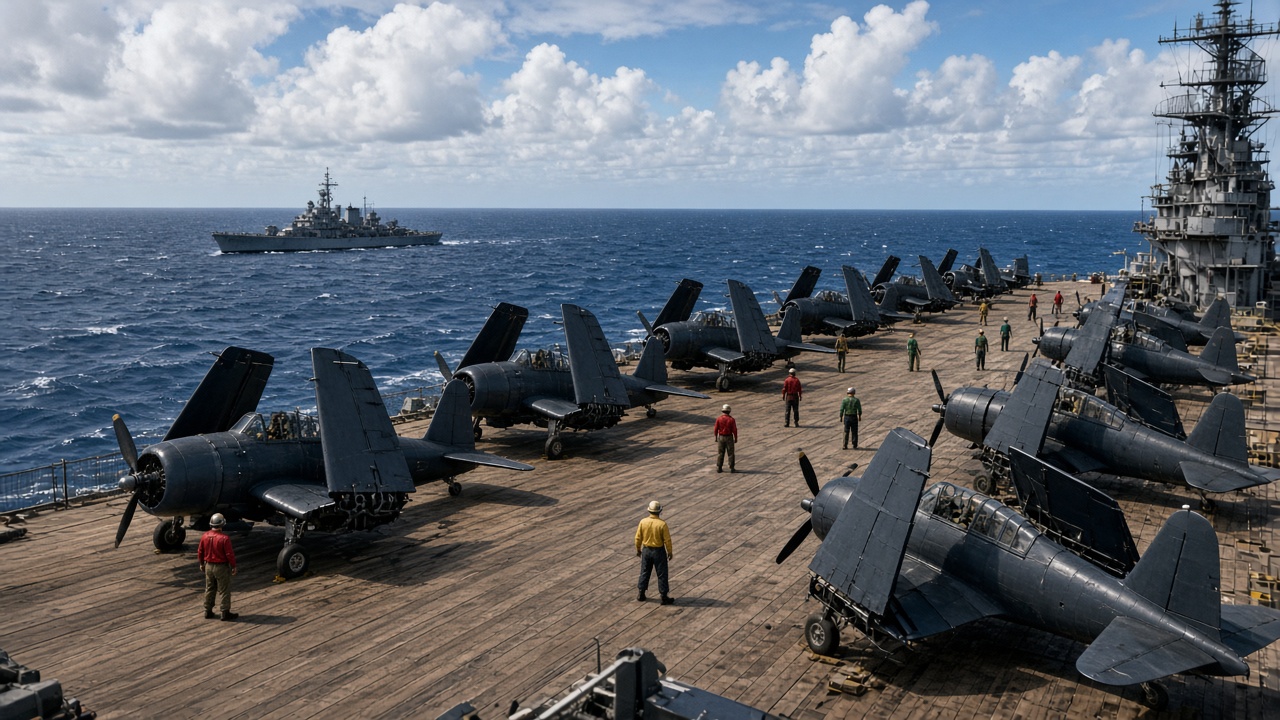
Navy aircraft ready on a carrier deck, as at the Battle of Midway in 1942 (artistic illustration).
February–June 1941: Indian divisions help win the Battle of Keren in East Africa (February–March), the United States begins Lend-Lease aid to Britain (March), and Germany invades the Soviet Union on 22 June.
September–December 1941: The siege of Leningrad begins (September), the Soviet army stops the Germans before Moscow (December), and Japan attacks Pearl Harbor and Malaya (7–8 December), bringing the United States into the war.
February–April 1942: Singapore surrenders (15 February) and tens of thousands of Indian soldiers become prisoners, Japan conquers Burma as refugees trek to India, and the Cripps Mission fails to win Indian support (March–April).
June–August 1942: The US Navy sinks four Japanese carriers at Midway (4–7 June), and the Congress launches the Quit India Movement in Bombay (8 August), after which Gandhi and other leaders are arrested.
Technology
Aircraft carriers: Air power at sea.
Sonar: Hunting submarines.
Codebreaking: Reading enemy signals.
Features
Eastern Front: Germany against the Soviet Union.
Pacific War: Japan against the Allies.
Quit India: “Do or die”.
🔄 Turning the Tide1942 – 1943
Turning the Tide
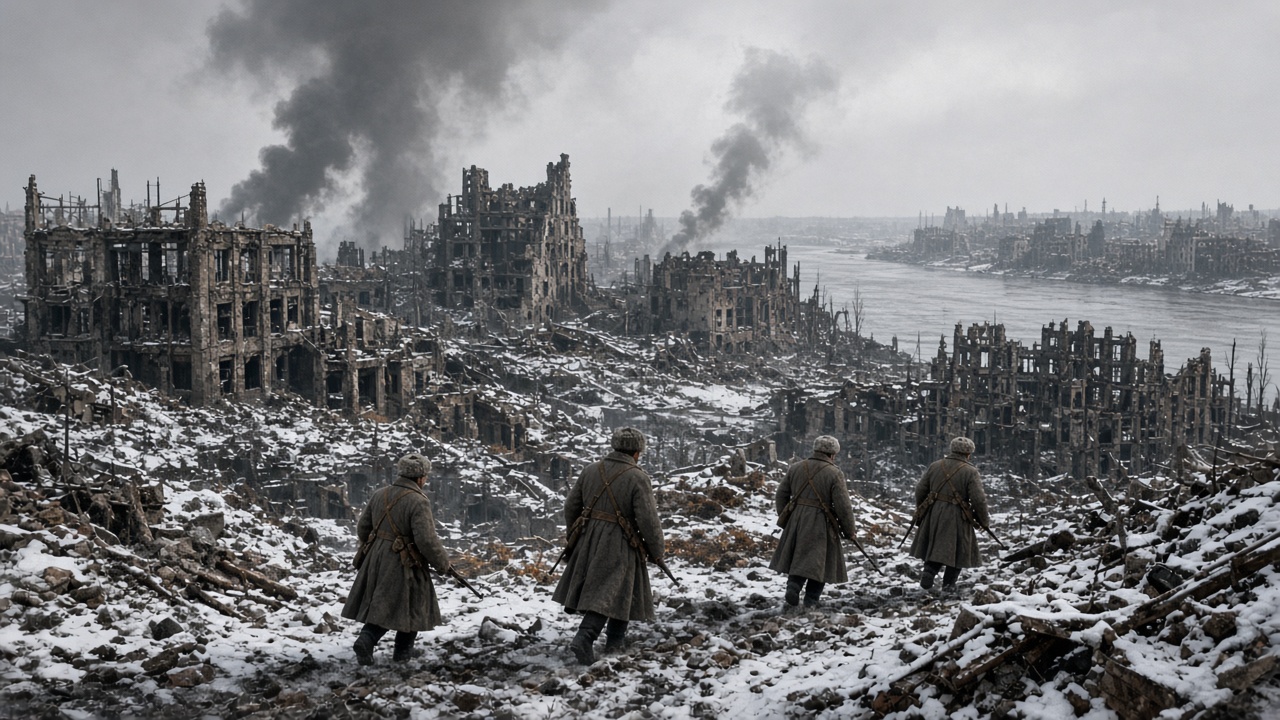
Between late 1942 and 1943 the Axis advance was stopped on every front. The Allies won in North Africa, the Soviet army destroyed a German army at Stalingrad, and Italy surrendered. Behind the lines, Nazi Germany carried out the Holocaust. In India, the Bengal famine killed millions, and Subhas Chandra Bose led the Indian National Army with Japanese support.
Soviet soldiers move through the snowy ruins of Stalingrad on the Volga (artistic illustration).
1941–1945: Mass shootings begin in the occupied Soviet Union in 1941, and after the Wannsee Conference (20 January 1942) coordinates the “Final Solution”, Nazi Germany murders about six million Jews in the Holocaust, along with Roma, disabled people, and others, in ghettos, mass shootings, and death camps.
October 1942–February 1943: British, Commonwealth, and Indian troops win the Second Battle of El Alamein (October–November), Allied forces land in North Africa (8 November), and the German Sixth Army surrenders at Stalingrad (2 February 1943).
May–September 1943: Axis forces in North Africa surrender (May), the Soviets win the huge tank battle of Kursk (July–August), the Allies invade Sicily (July), and Italy surrenders (8 September).
1943: The Bengal famine kills an estimated 2 to 3 million people, Subhas Chandra Bose proclaims the Provisional Government of Free India in Singapore (21 October), and Allied leaders meet at Tehran (November).
Technology
Long-range patrol aircraft: Closing the Atlantic gap.
Centimetric radar: Spotting U-boats.
Penicillin: Mass production begins.
Features
Stalingrad: Turning point in the east.
Holocaust: Genocide of Europe’s Jews.
Bengal famine: Disaster in India.
🏁 Victory1944 – 1945
Road to Victory
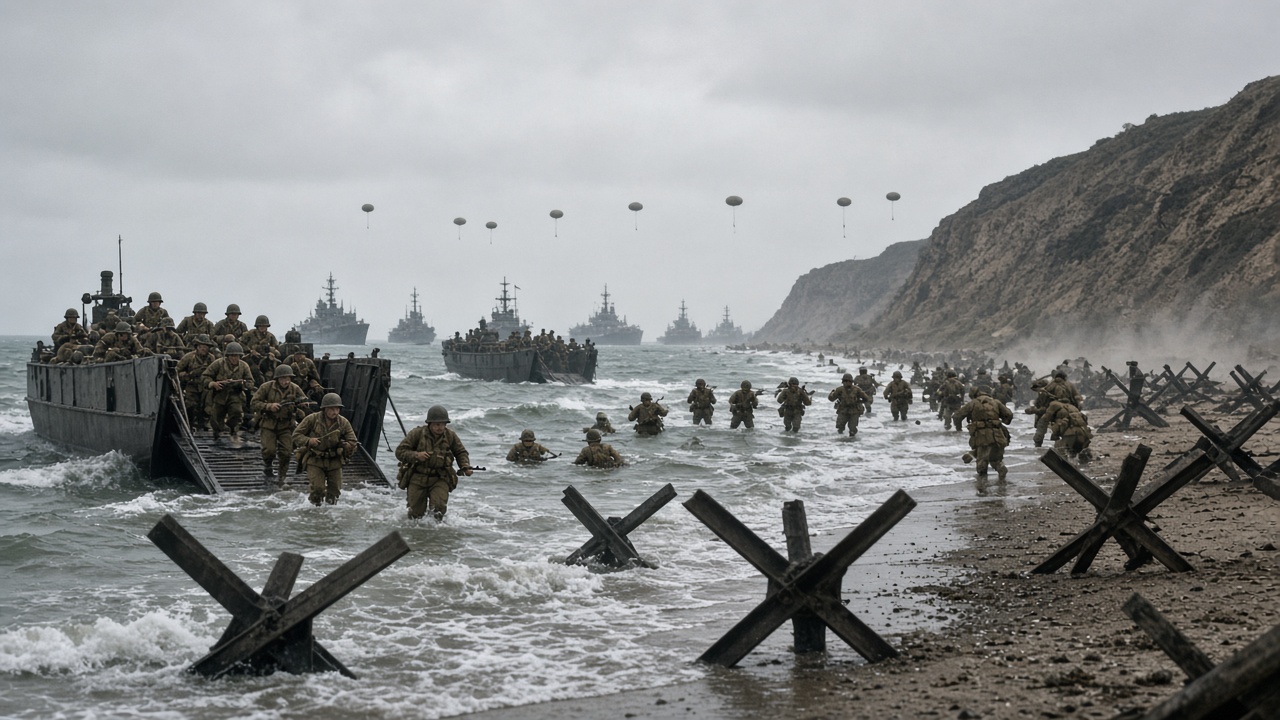
In 1944 the Allies closed in from every side. Indian and British troops defeated the Japanese invasion of India at Imphal and Kohima, the Allies landed in Normandy, and the Soviet army drove west towards Berlin. Germany surrendered in May 1945, and after atomic bombs destroyed Hiroshima and Nagasaki and the Soviet Union entered the Pacific war, Japan surrendered in August.
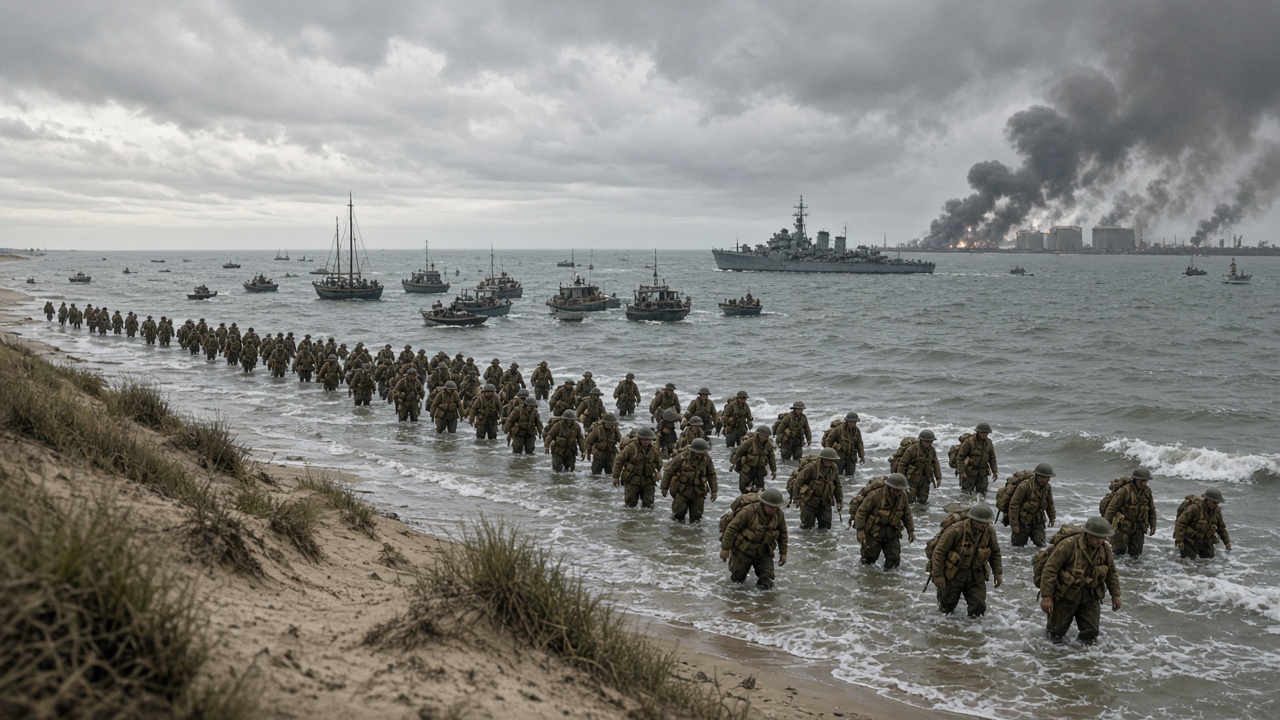
Allied troops wade ashore on the beaches of Normandy on D-Day (artistic illustration).
January–July 1944: Indian divisions fight at Monte Cassino in Italy (January–May), the Japanese invasion of India is defeated at Imphal and Kohima (March–July), and the Allies land in Normandy on D-Day (6 June).
August 1944–January 1945: Paris is liberated (25 August), Germany’s last great attack fails in the Battle of the Bulge (December–January), and Soviet troops liberate Auschwitz (27 January 1945).
February–May 1945: Allied leaders meet at Yalta (February), Hitler dies by suicide in Berlin (30 April), Indian and British troops retake Rangoon (May), and Germany surrenders unconditionally — VE Day, 8 May.
August–September 1945: The United States drops atomic bombs on Hiroshima (6 August) and Nagasaki (9 August), the Soviet Union declares war on Japan (8 August), and Japan surrenders (15 August), signing on 2 September.
Technology
Jet aircraft: First jet fighters in combat.
V-2 rockets: First long-range ballistic missiles.
Atomic bomb: Nuclear weapons first used.
Features
Second front: D-Day landings.
India defended: Imphal and Kohima.
Surrender: VE Day and VJ Day.
🕊️ Aftermath1945 – Today
Aftermath & Remembrance
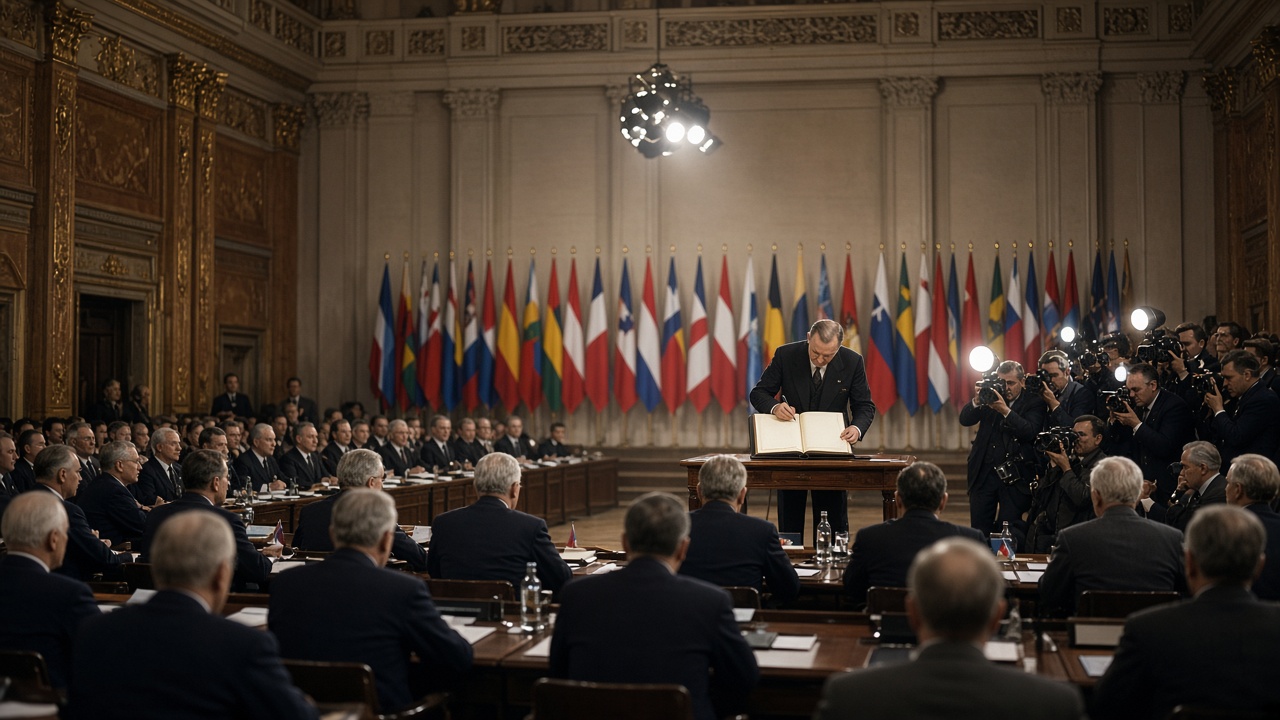
The victors set up the United Nations to keep the peace and put Nazi and Japanese leaders on trial for war crimes. Europe was divided between the Western powers and the Soviet Union in the Cold War. Exhausted by war, Britain could no longer hold India, which won independence in 1947, and a wave of decolonisation followed across Asia and Africa.
A delegate signs a founding charter as nations gather to build a lasting peace in 1945 (artistic illustration).
1945–1946: Fifty nations, including India, sign the United Nations Charter in San Francisco (26 June 1945), the Nuremberg trials begin (November 1945), and the trials of Indian National Army officers at the Red Fort spark protests across India.
1946–1949: The Royal Indian Navy mutiny (February 1946) shakes British rule, India and Pakistan become independent (August 1947), and the Universal Declaration of Human Rights (1948) and new Geneva Conventions (1949) are adopted.
1947–1991: The Marshall Plan rebuilds Western Europe, the Cold War divides the world, Germany is split until 1990, and dozens of colonies in Asia and Africa become independent nations.
Today: War cemeteries at Kohima, Imphal, and Delhi honour the fallen, VE Day and VJ Day are marked each year, and Auschwitz and Hiroshima’s Peace Memorial stand as warnings for the future.
Technology
Electronic computers: From codebreaking to business.
Jet airliners: From wartime jet engines.
Nuclear power: Peaceful uses of atomic energy.
Features
United Nations: A new world body.
Cold War: East against West.
Independence: India and decolonisation.
Allies and Axis
Country
Side
Entered the war
Notes
China
Allies
July 1937
Fought Japan for eight years
Poland
Allies
September 1939
Invaded by Germany and the Soviet Union
Britain and its empire
Allies
September 1939
Including India, Canada, Australia, New Zealand, and South Africa
France
Allies
September 1939
Defeated in 1940; the Free French fought on
Soviet Union
Allies
June 1941
Invaded by Germany; suffered the greatest losses
United States
Allies
December 1941
Huge industrial power; fought in Europe and the Pacific
Germany
Axis
September 1939
Conquered most of Europe by 1942
Italy
Axis
June 1940
Surrendered in 1943 and then joined the Allies
Japan
Axis
1937 (China), December 1941
Conquered much of East and Southeast Asia
Hungary, Romania, Bulgaria
Axis
1940–1941
Changed sides or were occupied in 1944–1945
Major Battles and Campaigns
Battle
Date
Front
Why it matters
Battle of Britain
July–October 1940
Air, Britain
Stopped German plans to invade Britain
Keren
February–March 1941
East Africa
Indian divisions led the defeat of Italy in Eritrea
Moscow
October 1941–January 1942
Eastern
First major defeat of the German army
Pearl Harbor
7 December 1941
Pacific
Brought the United States into the war
Singapore
February 1942
Southeast Asia
Largest British surrender in history
Midway
June 1942
Pacific
Turning point of the war at sea
Second El Alamein
October–November 1942
North Africa
Turned back the Axis advance on Egypt
Stalingrad
August 1942–February 1943
Eastern
Destruction of a whole German army
Kursk
July–August 1943
Eastern
One of the largest tank battles in history
Imphal and Kohima
March–July 1944
India–Burma
Ended the Japanese invasion of India
D-Day and Normandy
June–August 1944
Western
Opened the second front in Europe
Berlin
April–May 1945
Eastern
Final battle in Europe
India in the Second World War
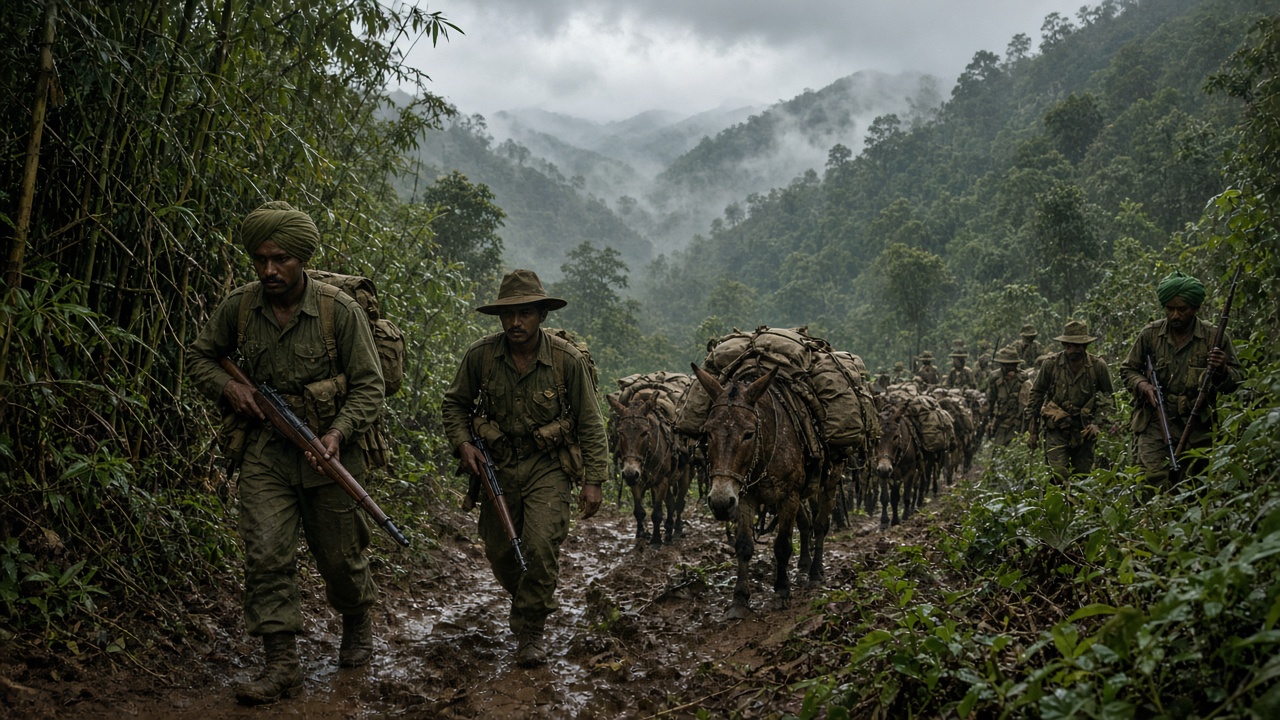
Indian soldiers and supply mules on a jungle track on the India–Burma front (artistic illustration).
Topic
Details
Soldiers
About 2.5 million, often called the largest volunteer army in history
Deaths
About 87,000 Indian servicemen died
Fronts
East Africa, North Africa, the Middle East, Italy, Malaya, Burma, and the defence of India
Bravery awards
Around 30 Victoria Crosses (31 is often cited), including Sepoy Kamal Ram in Italy (1944)
Navy and air force
The Royal Indian Navy grew rapidly, and the Indian Air Force flew in Burma and was given the “Royal” title in 1945
Politics
Declared at war without consultation (1939), Congress ministries resign, the Cripps Mission (1942), and Quit India (1942)
Indian National Army
Formed from prisoners of war with Japanese support; led by Subhas Chandra Bose from 1943; tried at the Red Fort in 1945
Home front
War industries, shortages, rising prices, and the Bengal famine of 1943
Supply routes
Airlifts over the Himalayan “Hump” and the Ledo Road from Assam supplied China
Memorials
Kohima War Cemetery, Imphal War Cemetery, Delhi War Cemetery, and the INA memorial at Moirang
Science, Codes, and Weapons
Codebreakers operate electromechanical machines to crack enemy ciphers (artistic illustration).
Invention or use
Date
Impact
Radar
From 1939
Warned of air raids and found ships and submarines
Codebreaking at Bletchley Park
From 1939
Allies read many German Enigma messages
Colossus
1944
One of the first programmable electronic computers
Aircraft carriers
1941–1945
Became the most powerful warships
Penicillin
Mass-produced from 1943–1944
Saved many wounded soldiers from infection
Jet aircraft
1944
First jet fighters used in combat
V-2 rocket
1944
First long-range ballistic missile; led to space rockets
Landing craft and floating harbours
1944
Made the D-Day landings possible
Atomic bomb
1945
Built by the Manhattan Project; began the nuclear age
Electronic computers
1945
ENIAC, built for artillery tables, finished just after the war
Life on the Home Front
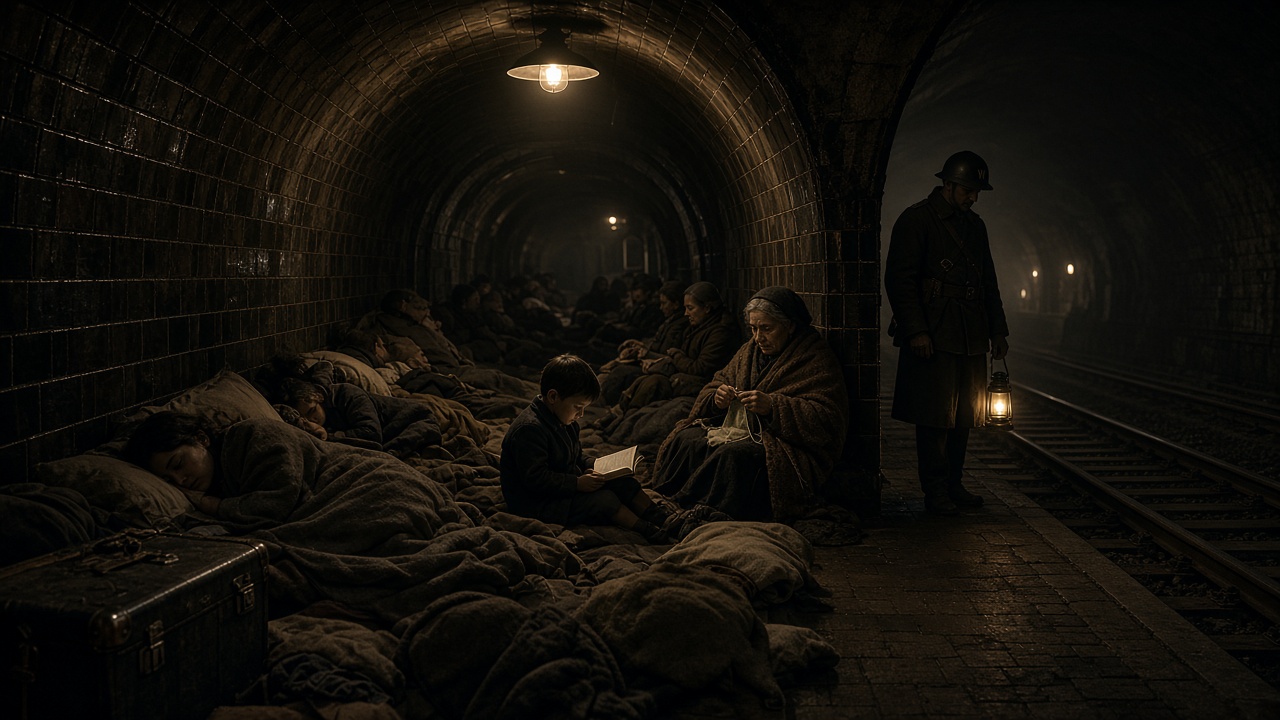
Families shelter overnight in an underground station during the Blitz (artistic illustration).
Topic
Life at home during the war
Air raids
Bombing of cities such as London, Coventry, Hamburg, Dresden, and Tokyo
Blackouts
Lights hidden at night so bombers could not find targets
Evacuation
Millions of British children sent from cities to the countryside in 1939
Rationing
Food, clothing, and fuel rationed; in Britain some rationing lasted until 1954
Women at work
Women worked in factories, farms, and the auxiliary armed services
Radio and newsreels
News and propaganda broadcast to every home and cinema
Internment
Japanese Americans and many “enemy aliens” were held in camps
Occupation and resistance
Occupied countries faced hunger and terror; resistance groups fought back
India
Rising prices, shortages, war factories, Allied troops and airfields in the east, and famine in Bengal
Second World War Timeline Summary
Date
Milestone
October 1929
Wall Street Crash begins the Great Depression
30 January 1933
Hitler becomes chancellor of Germany
July 1937
Japan launches full-scale war on China
September 1938
Munich Agreement
1 September 1939
Germany invades Poland
3 September 1939
Britain and France declare war; India declared at war
May–June 1940
Fall of France and evacuation from Dunkirk
July–October 1940
Battle of Britain
22 June 1941
Germany invades the Soviet Union
7 December 1941
Japan attacks Pearl Harbor
15 February 1942
Fall of Singapore
June 1942
Battle of Midway
8 August 1942
Quit India Movement launched
November 1942
Second Battle of El Alamein won
2 February 1943
German surrender at Stalingrad
1943
Bengal famine
March–July 1944
Battles of Imphal and Kohima
6 June 1944
D-Day landings in Normandy
27 January 1945
Liberation of Auschwitz
8 May 1945
VE Day: Germany surrenders
26 June 1945
United Nations Charter signed
6 and 9 August 1945
Atomic bombs on Hiroshima and Nagasaki
2 September 1945
Japan formally surrenders
15 August 1947
India becomes independent
Test Your Knowledge
20 quick questions from the Second World War timeline. Click each question to reveal the answer.
Answer: The Great Depression.
Answer: The Munich Agreement.
Answer: Poland.
Answer: The Viceroy had declared India at war without consulting Indian leaders.
Answer: Lightning war.
Answer: Dunkirk.
Answer: The Battle of Britain.
Answer: 22 June 1941.
Answer: Japan’s attack on Pearl Harbor.
Answer: Singapore.
Answer: The Battle of Midway.
Answer: The Quit India Movement.
Answer: Stalingrad.
Answer: The Holocaust.
Answer: Subhas Chandra Bose.
Answer: Imphal and Kohima.
Answer: 6 June 1944.
Answer: Victory in Europe Day.
Answer: Hiroshima and Nagasaki.
Answer: The United Nations.
Classroom activity
Students Tasks
Use these prompts for discussion or projects on the Second World War.
Timeline understandingWorld historyMap skillsCause and effect
Make a timeline poster: 1 September 1939 Poland, 1940 Dunkirk, 7 December 1941 Pearl Harbor, 1943 Stalingrad, 1944 Imphal–Kohima and D-Day, 8 May 1945 VE Day, and 2 September 1945 Japan’s surrender.
On a world map, shade the Allied and Axis countries and mark Dunkirk, Stalingrad, El Alamein, Pearl Harbor, Singapore, Imphal, Kohima, and Normandy.
Draw a cause-and-effect chain from the Treaty of Versailles and the Great Depression to the invasion of Poland.
Write a diary entry as a child sheltering from air raids during the Blitz in 1940.
Make a fact card on the Battles of Imphal and Kohima and why they mattered for India.
Compare how the Quit India Movement and the Indian National Army each tried to win India’s freedom.
Find out how wartime codebreaking helped lead to modern computers, and present your findings.
Research the Bengal famine of 1943 and explain its causes and effects.
Design a remembrance display about the Holocaust, using survivors’ stories from a trusted museum website.
Debate: “The United Nations has been more successful than the League of Nations.”
Continue exploring
The Second World War sped up the development of computers, penicillin and other medicines, radio news, and shipping. Explore these connected timelines next.
Click any panel to expand and explore the visual mood.
The Second World War in pictures — the evacuation from Dunkirk, a Blitz shelter, a Pacific aircraft carrier, the ruins of Stalingrad, Indian soldiers on the Burma front, wartime codebreakers, D-Day, the founding of the United Nations, and a Normandy beach then versus now.
Dunkirk
May–June 1940
The Blitz
1940–1941
Pacific War
Midway, 1942
Stalingrad
1942–1943
Imphal & Kohima
1944
Codebreakers
The secret war
D-Day
6 June 1944
United Nations
June 1945
Then vs Now
War to peace
Explore all world history timelines
Jump to any other world history timeline on WorldTimelineHub.
Disclaimer: This content is AI-generated for educational purposes and may contain errors or outdated details. For correct and authoritative information, please refer to official and reliable sources such as government publications, manufacturers, museums, and academic references.