In the 1950s most Indian homes were lit at night by a smoky kerosene wick lamp or a hurricane lantern. Electric bulbs spread in the 1970s, tube lights and CFLs followed,
the UJALA programme put crores of LED bulbs into homes from 2015, and in the 2020s smart bulbs can be switched on, dimmed, and coloured from a phone.
This timeline covers clay diyas and brass lamps, the first electric light in Calcutta, hurricane lanterns and Petromax lamps, 1950s kerosene, 1970s incandescent bulbs and
tube lights, CFLs and solar lanterns, village electrification, UJALA LEDs and LED street lights (2015), and smart bulbs and smart street lights in the 2020s.
1950s Kerosene → 1970s Bulbs2015 LED Distribution2020s Smart Bulbs
Why the Lighting Story Matters
Good light after sunset lets children study, shops stay open, women work safely, and families live fuller lives. Moving from smoky kerosene lamps to electric light has
improved health and education across India, and moving from old bulbs to LEDs has saved huge amounts of electricity and money. The story of lighting is also the story of
India’s electricity network reaching every village.
Big picture
India’s lighting journey in one view
Oil diyas lit India for thousands of years. Kerosene arrived in the late 1800s and ruled village nights well into the 1950s and beyond, while electric bulbs lit city homes.
Rural electrification spread bulbs and tube lights from the 1970s, CFLs and solar lanterns came in the 2000s, and from 2015 UJALA made LEDs cheap for everyone. All villages
were electrified by 2018, and smart bulbs now arrive in city homes. Related timelines:
electricity in India,
Digital India,
the internet.
36 crore+
LED bulbs under UJALA
~1.3 crore
LED street lights installed
43% → 31%
Homes lit by kerosene, 2001 → 2011
2018
All villages electrified
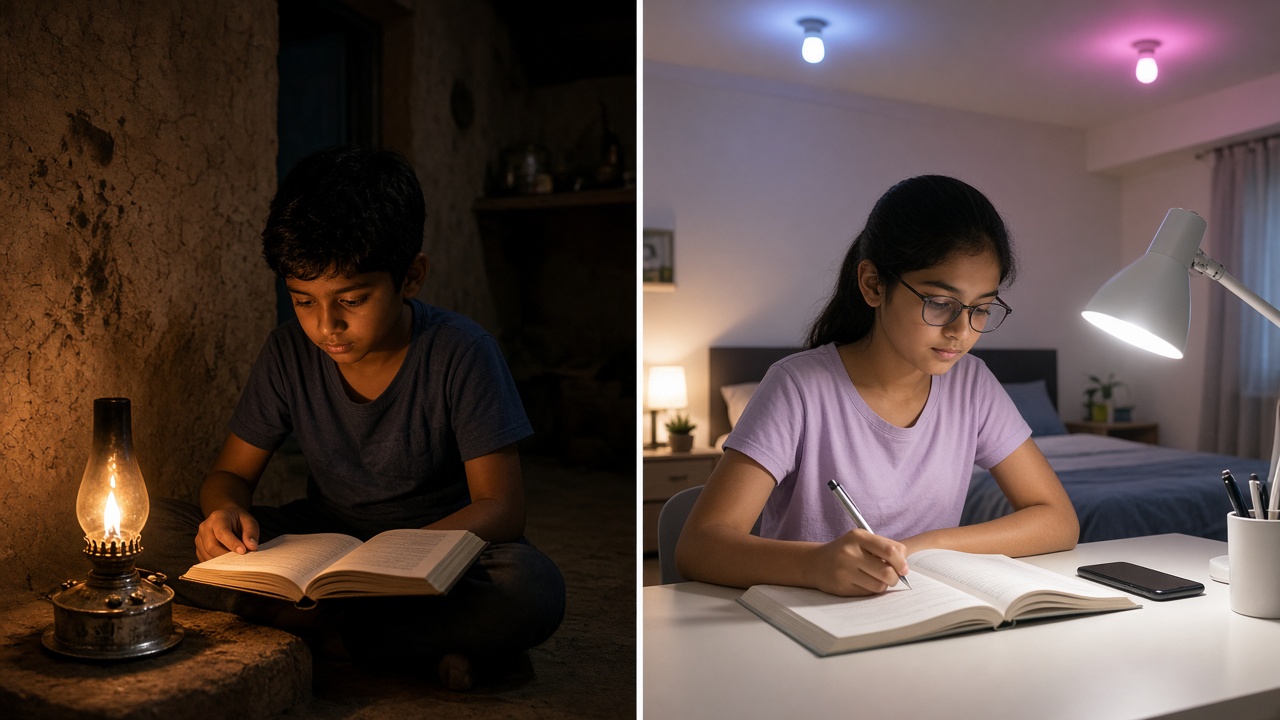
From homework by a kerosene flame to LED desk lamps and smart bulbs (artistic illustration).
Lighting Then vs Now at a Glance
Feature
Then
Now
Light source
Oil diyas, kerosene lamps, lanterns
LED bulbs, tube lights, smart bulbs
Fuel or power
Oil and kerosene bought in small amounts
Grid electricity and rooftop solar
Brightness
Dim, flickering flame
Bright, steady white or coloured light
Health
Smoke, soot, eye strain
No smoke; less eye strain
Safety
Fires and burns
Much safer; wiring and switches
Daily work
Filling fuel, trimming wicks, cleaning glass
Flick a switch or use an app
Energy use
60–100 W bulbs in the bulb era
7–12 W LEDs for similar light
Lifespan
Wicks and mantles; bulbs ~1,000 hours
LEDs ~15,000–25,000 hours
Power cuts
Candles and lanterns kept ready
Inverters, rechargeable and solar lights
Street lighting
Oil and gas lamps, then yellow sodium lights
LED and solar street lights, some remotely controlled
🪔 DiyasAncient – 1878
Diyas, Oil Lamps & Torches
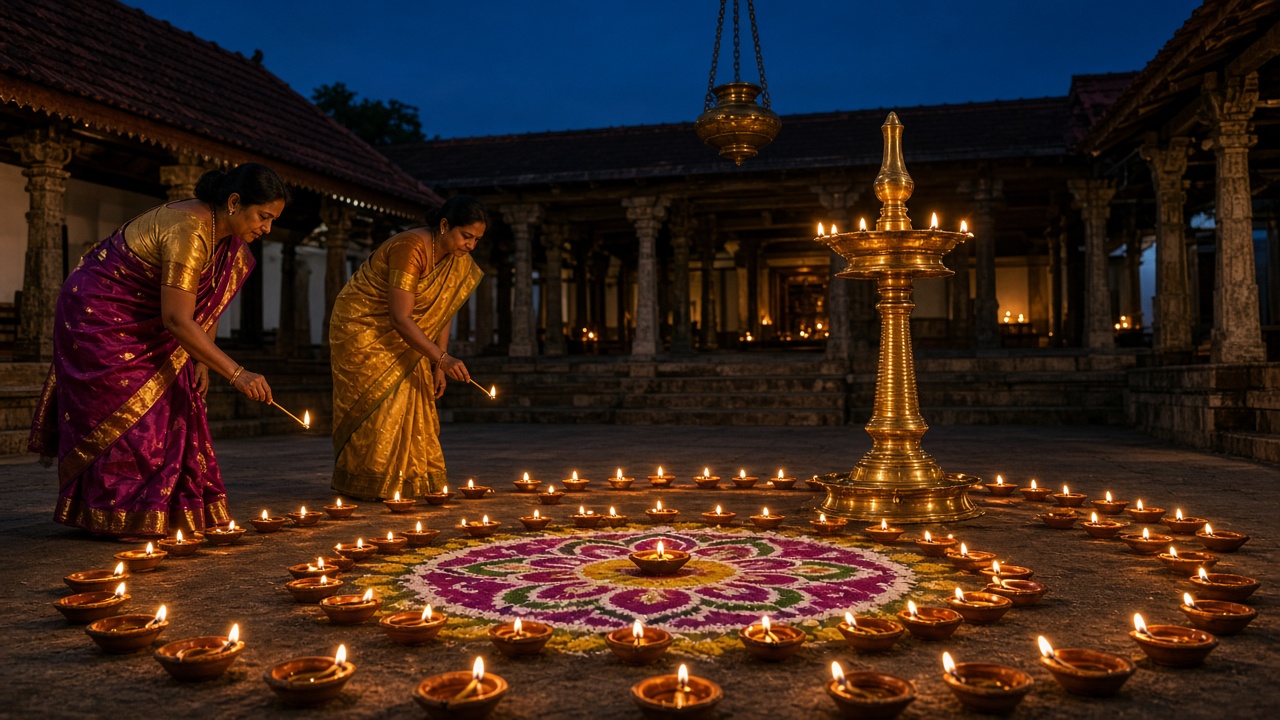
For thousands of years Indians lit their homes and temples with clay diyas and brass lamps burning vegetable oils and ghee. Lamps became a sacred symbol — Deepavali means “a row of lamps” — and torches lit streets and processions. In the late 1800s cheap kerosene began to arrive.
Clay diyas and brass lamps — India’s oldest lights, still lit every Deepavali (artistic illustration).
Ancient times: Clay lamps burning sesame, mustard, castor, or coconut oil and ghee with cotton wicks light homes; the lamp becomes a symbol of knowledge and good fortune.
Medieval period: Temples keep lamps burning day and night; bronze lamp-bearer figures (deepalakshmi) and tall brass lamps such as Kerala’s nilavilakku are made.
Mughal and later courts: Candles, lanterns, and glass chandeliers light palaces; mashalchis carry flaming torches for processions and travellers.
Late 1800s: Imported kerosene, cheaper than vegetable oil, spreads with tin wick lamps; oil is found at Digboi in Assam in 1889.
Technology
Clay diyas: Oil and cotton wick.
Brass lamps: Many wicks, brighter light.
Torches: Cloth soaked in oil.
Features
Sacred light: Puja and festivals.
Early nights: Life followed the sun.
Costly oil: Used carefully.
💡 First Electricity1879 – 1946
First Electric Lights & Lanterns
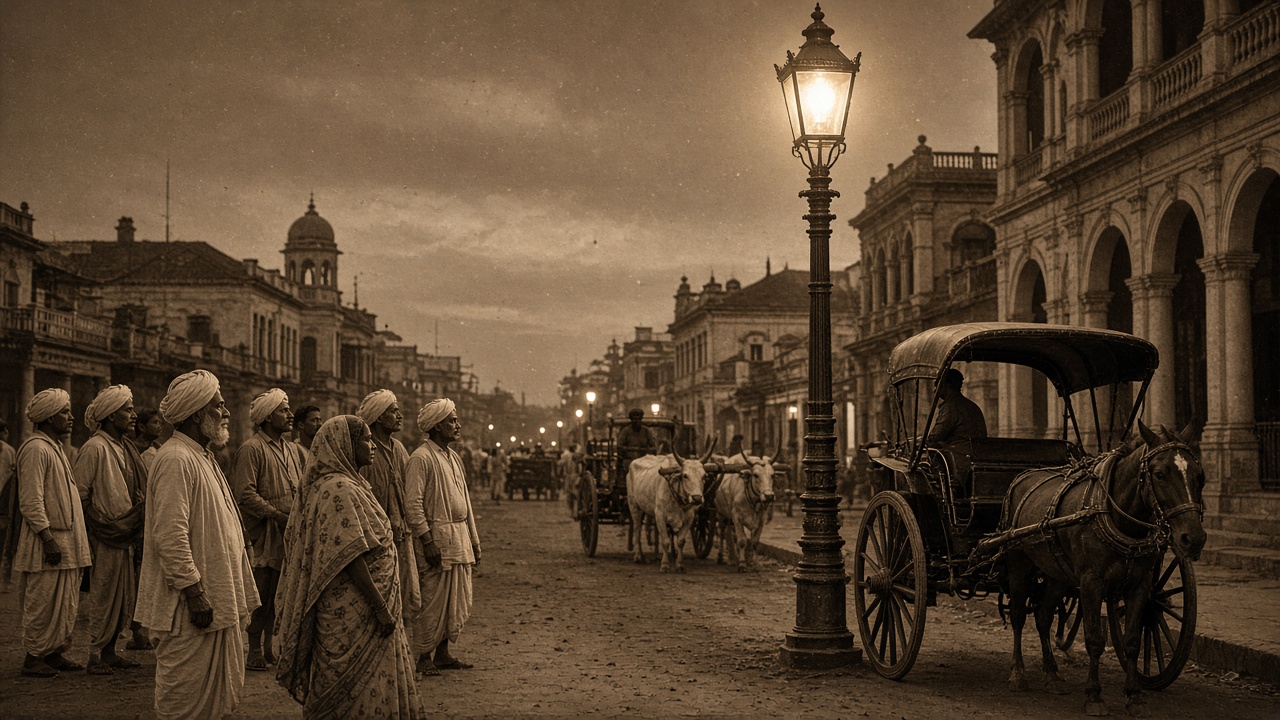
Electric light reached India only a few years after it was invented. Cities such as Calcutta, Darjeeling, Bangalore, and Bombay got their first power supplies and electric street lamps, but electricity stayed mostly in rich homes, offices, and cinemas, while kerosene lanterns lit the rest of the country.
Crowds gathered to marvel at the first electric street lamps (artistic illustration).
1879: Electric light is demonstrated for the first time in India, in Calcutta.
1897–1902: A hydroelectric station supplies Darjeeling (1897); Calcutta gets a public electricity supply (1899); the Shivanasamudra hydro plant in Mysore State starts (1902).
1905: Bangalore lights its streets with electric lamps, one of the earliest cities in Asia to do so.
1910s–1940s: Hurricane lanterns and bright Petromax pressure lamps spread for homes, shops, and weddings; companies such as Radio Lamp Works (1938, later Bajaj Electricals) sell electric goods.
Technology
Carbon and tungsten bulbs: First electric lamps.
Hurricane lantern: Wind-proof glass chimney.
Petromax: Pressurised kerosene and a glowing mantle.
Features
City privilege: Electricity for few.
Street lamps: Safer city nights.
Kerosene rules: In villages.
🏮 Kerosene1947 – 1969
Kerosene Lamps & Lanterns
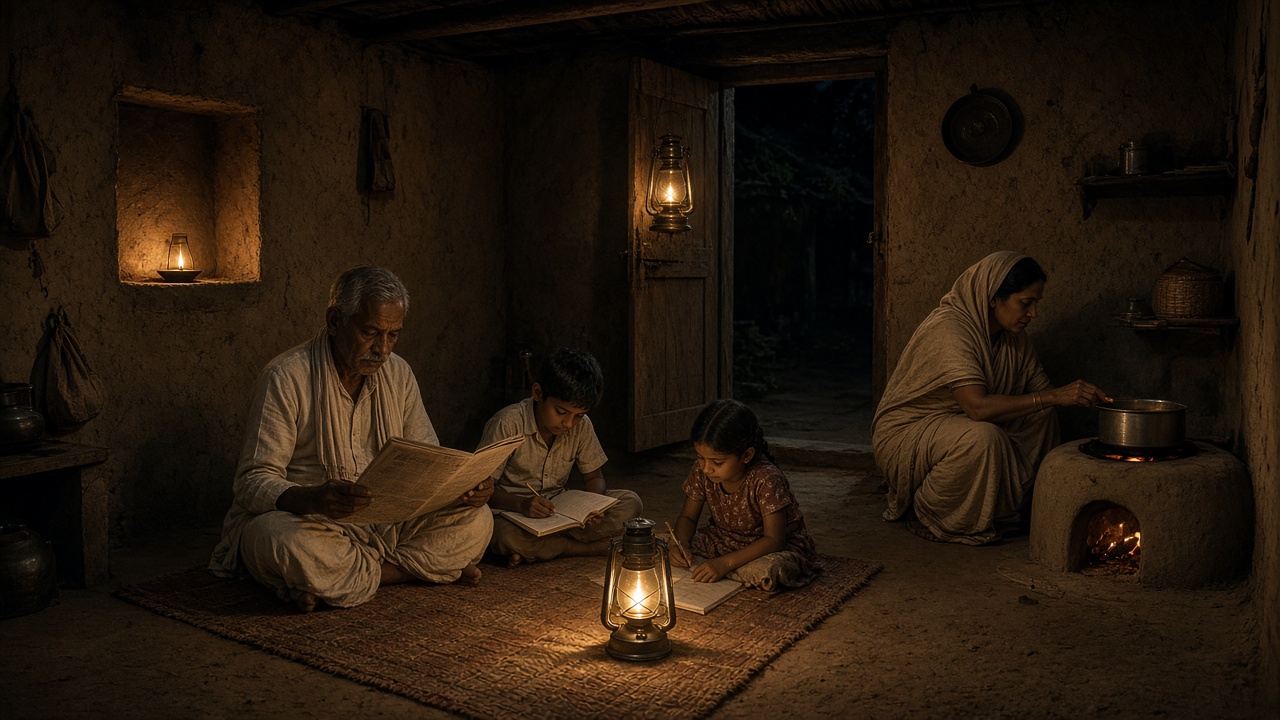
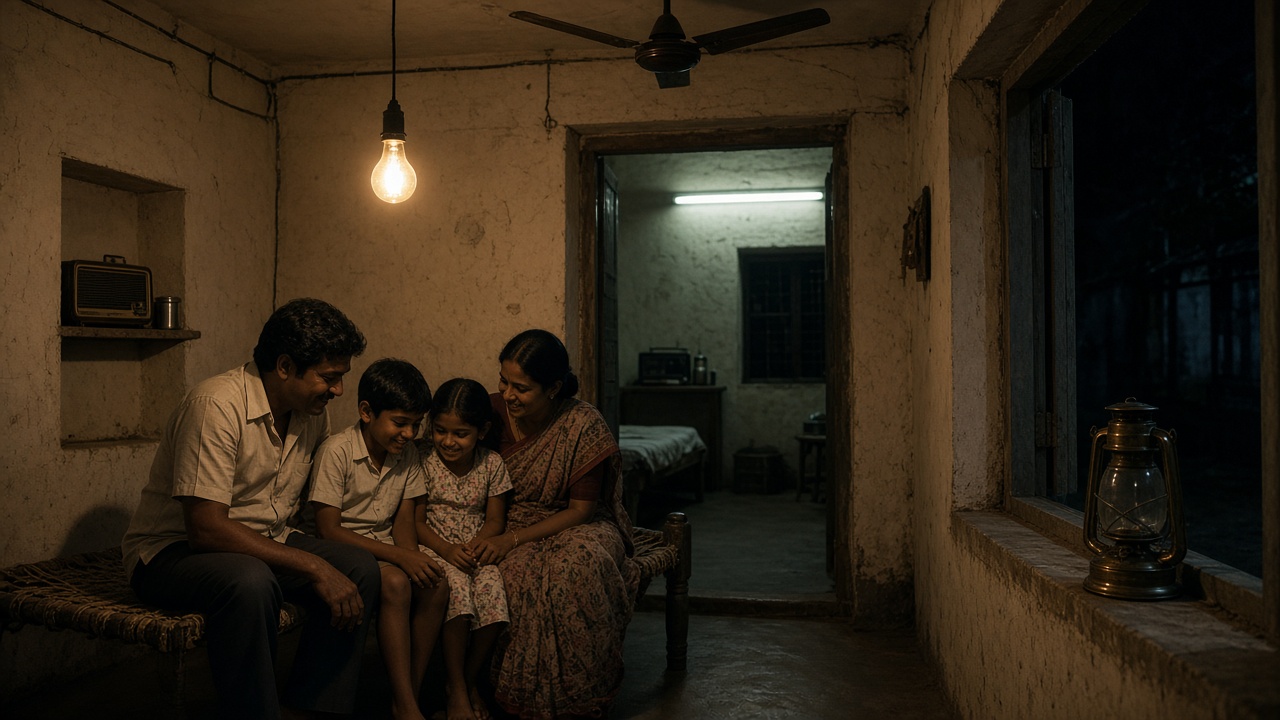
In the 1950s almost every village home was lit by kerosene. A small tin wick lamp or a hurricane lantern gave a dim, smoky light for cooking, eating, and homework. Kerosene was sold cheaply through ration shops, and new laws and boards began the long work of bringing electricity to villages.
In the 1950s the hurricane lantern and wick lamp lit village nights (artistic illustration).
1948: The Electricity (Supply) Act sets up State Electricity Boards to generate and supply power across each state.
1950s: Only about 3,000 of India’s nearly 5.6 lakh villages have electricity; most families use kerosene wick lamps (dhibri, chimni) and lanterns (lalten).
1950s–1960s: Subsidised kerosene is sold through ration shops; Petromax lamps light weddings, fairs, night markets, and roadside stalls.
1969: The Rural Electrification Corporation (REC) is set up to fund power lines to villages and pump sets for farmers.
Technology
Wick lamp: Cheap tin lamp.
Hurricane lantern: Carried outdoors.
Pressure lamp: Bright for events.
Features
Smoke and soot: Harmful to health.
Fire risk: Burns and house fires.
Ration kerosene: Subsidised fuel.
💡 Bulbs1970 – 1999
Incandescent Bulbs & Tube Lights
From the 1970s, rural electrification brought power lines to many more villages, and a single yellow bulb hanging from a wire became a sign of progress. Tube lights lit offices and middle-class homes, but frequent power cuts meant the kerosene lantern was always kept ready.
A bare bulb and a tube light — with a lantern kept ready for power cuts (artistic illustration).
1970s: Rural electrification spreads; incandescent bulbs of 40, 60, and 100 watts become common, and Indian companies make bulbs and tube lights in large numbers.
1970s–1980s: Fluorescent tube lights with chokes and starters light offices, shops, and homes; frequent power cuts keep candles and lanterns in use.
1988–1989: The Kutir Jyoti scheme gives poor households a free single-point light connection.
1991: The Census finds that about 42% of households use electricity as their main source of lighting.
Technology
Incandescent bulb: Glowing tungsten filament.
Tube light: Brighter, cheaper to run.
Emergency lamps: Rechargeable backup.
Features
One-bulb homes: Many villages.
Power cuts: A daily problem.
Wasteful bulbs: Most energy lost as heat.
🔆 LEDs2000 – 2019
CFLs, Solar Lanterns & UJALA LEDs
Energy-saving CFLs and solar lanterns arrived in the 2000s. Then, from 2015, the UJALA programme bought LED bulbs in bulk and sold them cheaply, making India one of the world’s biggest LED markets. By 2018 every village was electrified, and kerosene lamps faded from most homes.
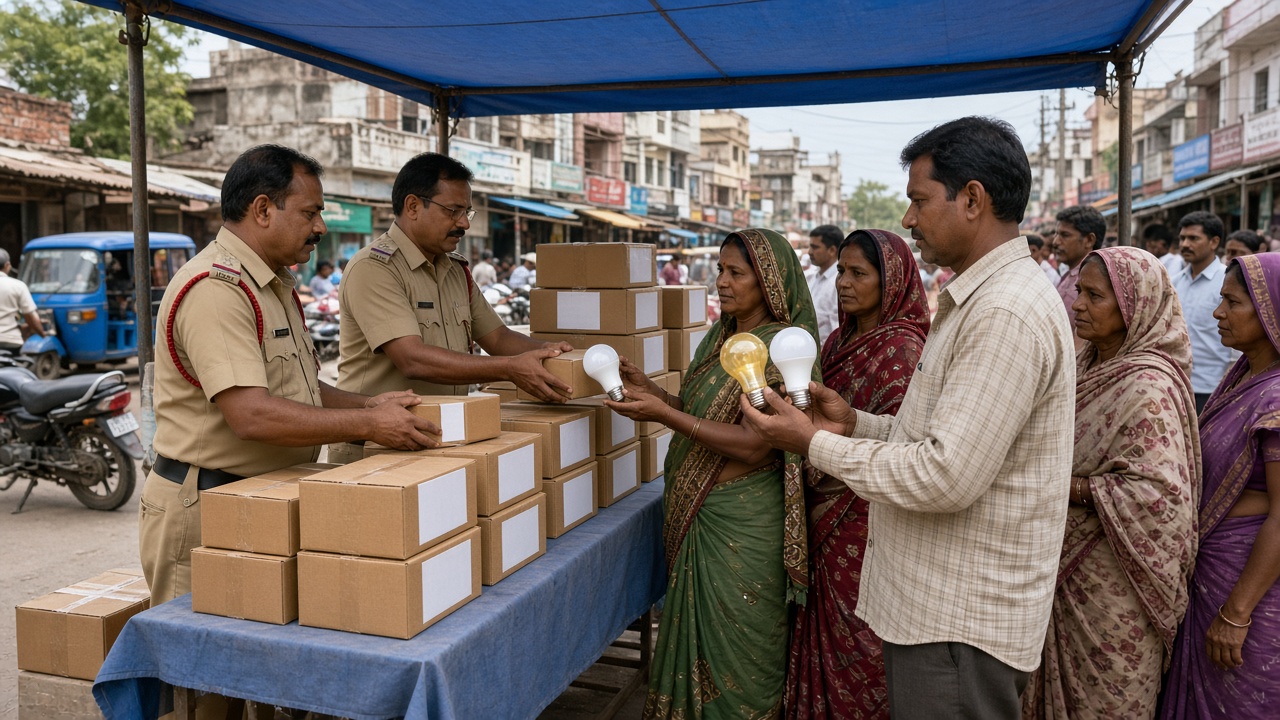
From 2015, low-cost LED bulbs replaced old bulbs in crores of homes (artistic illustration).
2005–2009: The Rajiv Gandhi Grameen Vidyutikaran Yojana (2005) extends village electrification; solar lanterns spread through programmes such as Lighting a Billion Lives (2008); the Bachat Lamp Yojana (2009) offers cheap CFLs.
2011–2012: The Census finds about 67% of households lit by electricity and 31% by kerosene; a huge blackout in July 2012 affects over 60 crore people.
2015: UJALA (January 2015) distributes low-cost LED bulbs, and the Street Lighting National Programme begins replacing street lights with LEDs; bulk buying cuts LED prices sharply.
2017–2019: All inhabited villages are declared electrified (28 April 2018), and the Saubhagya scheme connects about 2.8 crore households.
Technology
CFL: Compact fluorescent bulb.
LED: Light from a semiconductor chip.
Solar lanterns: Off-grid light.
Features
Energy saving: Up to 90% less power.
Cheap LEDs: Bulk buying.
Every village: Electrified by 2018.
📱 Smart Lighting2020s – Future
Smart Bulbs & Smart Street Lights
In the 2020s smart LED bulbs became affordable in India. They can be switched on, dimmed, scheduled, or changed in colour from a phone or by voice. Cities added smart and solar street lights, and kerosene lighting almost disappeared — while clay diyas still glow at every festival.
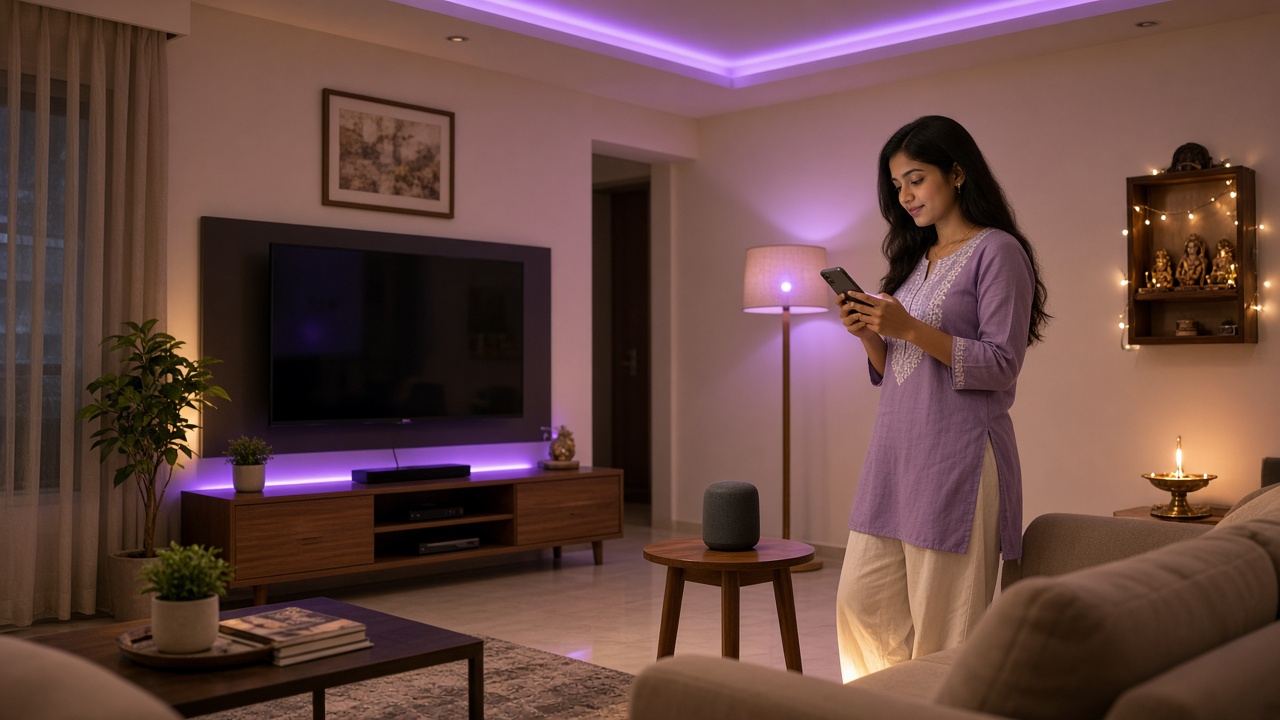
Smart bulbs change colour from a phone, while a brass diya still glows at the puja shelf (artistic illustration).
2020s: Wi-Fi and Bluetooth smart bulbs, LED strips, and voice assistants become common in city homes; lights can be scheduled and dimmed from phones.
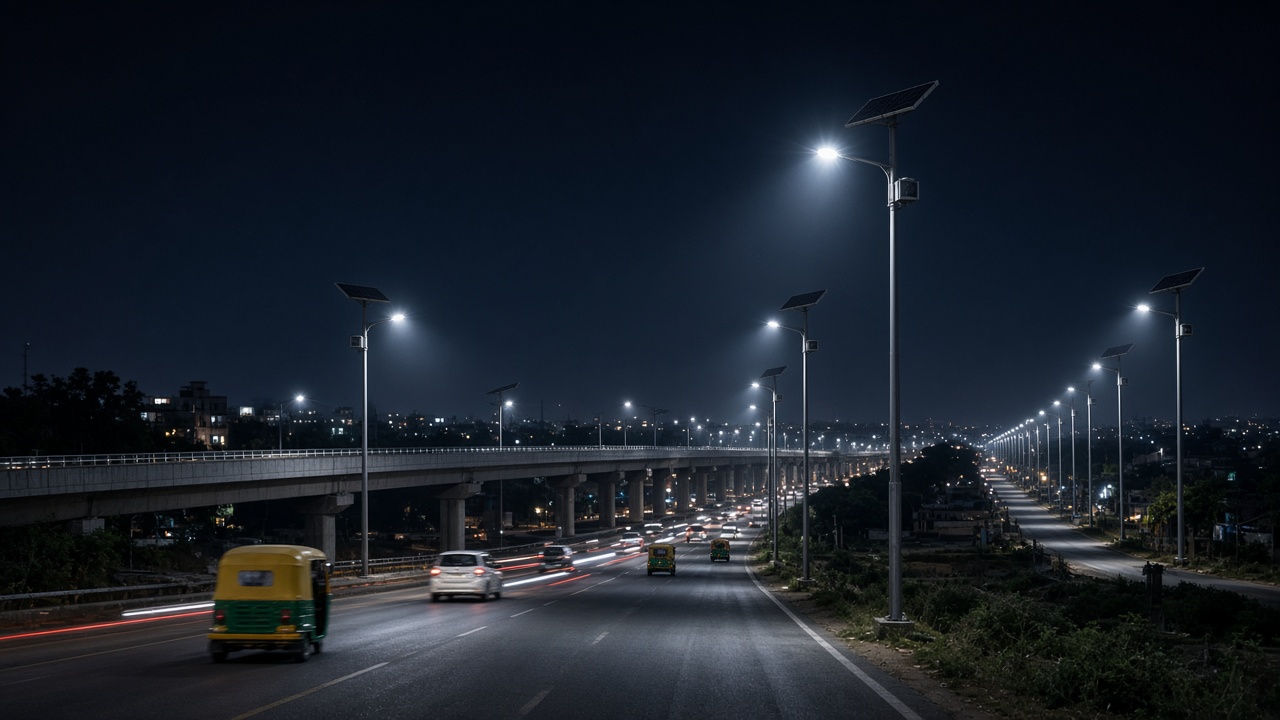
2020s: Smart cities install LED street lights that can be monitored and dimmed from control rooms; solar LED street lights light village roads.
2020s: Kerosene for lighting nearly disappears as subsidised supplies are cut and many states become kerosene-free; rooftop solar grows with schemes such as PM Surya Ghar (2024).
Future: Light-based data (Li-Fi), lighting that changes through the day for better sleep, and efforts to reduce light pollution in cities.
Technology
Smart bulbs: App and voice control.
Smart street lights: Remote monitoring.
Solar LEDs: Clean off-grid light.
Features
Mood lighting: Millions of colours.
Automation: Schedules and sensors.
Tradition stays: Diyas at festivals.
Types of Lights Compared
Light
How it works
Power for similar light
Typical life
Oil diya
Burns oil through a cotton wick
Fuel, not electricity
A few hours per filling
Kerosene wick lamp
Burns kerosene; smoky flame
Fuel, not electricity
Wick trimmed and replaced
Hurricane lantern
Wick inside a glass chimney
Fuel, not electricity
Wicks and glass replaced
Petromax lamp
Pressurised kerosene heats a glowing mantle
Fuel, not electricity
Mantles replaced often
Incandescent bulb
Electric current heats a tungsten filament
About 60 W
About 1,000 hours
Tube light
Gas glows and a coating turns it into light
About 36–40 W
About 6,000–10,000 hours
CFL
A compact, folded fluorescent tube
About 14–15 W
About 6,000–8,000 hours
LED bulb
A semiconductor chip gives off light
About 8–9 W
About 15,000–25,000 hours
Smart LED bulb
LED plus a Wi-Fi or Bluetooth chip
About 9 W
Like an LED; controlled by app
Wattages and lifetimes are typical values; actual figures vary by brand and quality.
Lighting India in Numbers
LED and solar street lights replaced old yellow lamps on roads across India (artistic illustration).
Year / survey
What it found
1950
About 3,000 villages electrified out of nearly 5.6 lakh
Census 1991
About 42% of households lit mainly by electricity
Census 2001
About 56% lit by electricity, 43% by kerosene
Census 2011
About 67% lit by electricity, 31% by kerosene
2015
UJALA and the Street Lighting National Programme begin
April 2018
All inhabited villages declared electrified
2019
About 2.8 crore households connected under Saubhagya
2020s
More than 36 crore UJALA LED bulbs and about 1.3 crore LED street lights
Figures are rounded. A village counts as electrified when public places and a share of homes are connected, so some households got power later.
Traditional Lamps of India
Lamp
Region
Use
Diya
All India
Small clay oil lamp for puja and Deepavali
Nilavilakku
Kerala
Tall brass lamp lit at dusk and at ceremonies
Kuthuvilakku
Tamil Nadu
Brass standing lamp with several wicks
Samai
Maharashtra
Brass lamp for home shrines
Deepalakshmi (pavai vilakku)
South India
Lamp held by a bronze female figure
Thooku vilakku
South India
Hanging brass chain lamp
Akash kandil
Maharashtra
Paper sky lantern hung at Diwali
Mashaal
North India
Flaming torch for processions
Lalten
All India
Kerosene hurricane lantern
Petromax
All India
Bright pressure lamp for weddings and markets
Lighting Timeline Summary
Year / Era
Milestone
Ancient times
Clay diyas with oil and ghee
Medieval period
Temple lamps, brass lamps, torches
Late 1800s
Kerosene wick lamps spread
1879
First electric light shown in Calcutta
1897–1899
Power supply in Darjeeling and Calcutta
1905
Electric street lights in Bangalore
1948
State Electricity Boards set up
1950s
Kerosene lamps light most homes
1969
Rural Electrification Corporation
1970s
Incandescent bulbs spread
1970s–1980s
Tube lights in offices and homes
1988–1989
Kutir Jyoti single-point connections
2005
Rajiv Gandhi Grameen Vidyutikaran Yojana
2009
Bachat Lamp Yojana CFLs
2011
31% of homes still lit by kerosene
2015
UJALA LED distribution and LED street lights
2018
All villages electrified
2019
Saubhagya household connections
2020s
Smart bulbs and smart street lights
Test Your Knowledge
20 quick questions from the lighting timeline. Click each question to reveal the answer.
Answer: A row of lamps.
Answer: Any two of sesame, mustard, castor, or coconut oil, or ghee.
Answer: A tall traditional brass lamp from Kerala.
Answer: Torch-bearers who carried flaming torches for processions and travellers.
Answer: 1879, in Calcutta.
Answer: Bangalore.
Answer: Pressurised kerosene heats a mantle until it glows brightly.
Answer: Kerosene wick lamps and hurricane lanterns.
Answer: About 3,000.
Answer: Smoke that harms the lungs and eyes, or burns and fires.
Answer: The Rural Electrification Corporation (REC).
Answer: The tungsten filament.
Answer: A free single-point light connection for poor households.
Answer: Compact fluorescent lamp.
Answer: About 31%.
Answer: Unnat Jyoti by Affordable LEDs for All.
Answer: About 8–9 watts.
Answer: 28 April 2018.
Answer: With a phone app or a voice assistant, over Wi-Fi or Bluetooth.
Answer: A technology that sends data using light instead of radio waves.
Classroom activity
Students Tasks
Use these prompts for discussion or projects on how India’s lighting changed over time.
Timeline understandingEnergy savingScience of lightOral history
Ask your grandparents how their homes were lit when they were children and what they did during power cuts.
Make a timeline poster: kerosene lamps (1950s), bulbs (1970s), LED distribution (2015), smart bulbs (2020s).
Count all the lights in your home and note whether each is an LED, CFL, tube light, or ordinary bulb.
Calculate how many units of electricity a family saves in a month by replacing five 60 W bulbs with 9 W LEDs used 5 hours a day.
Explain how an incandescent bulb and an LED make light, and why the LED wastes less energy.
Discuss how electric light helps children study and women stay safe after dark.
Make a simple paper akash kandil or decorate a clay diya.
Find out when your village, town, or colony first got electricity.
Observe the night sky in a city and a village, and discuss light pollution.
Debate: “Every home should switch to smart lighting.”
Continue exploring
Lighting changed with the power grid, digital services, the internet, and mobile phones. Explore these connected timelines next.
Click any panel to expand and explore the visual mood.
India’s lighting journey in pictures — Deepavali diyas, early electric street lamps, 1950s kerosene lanterns, 1970s bulbs, LED distribution, smart homes, LED street lights, and then versus now.
Diyas
India’s oldest light
First Street Lights
Electric wonder
1950s Kerosene
Lantern nights
1970s Bulb
Bulbs and tube lights
2015 LEDs
UJALA distribution
Smart Bulbs
Lights by app
LED Street Lights
Solar and smart
Then vs Now
Flame to LED
Explore all daily life timelines
Jump to any other daily life timeline on WorldTimelineHub.
Disclaimer: This content is AI-generated for educational purposes and may contain errors or outdated details. For correct and authoritative information, please refer to official and reliable sources such as government publications, manufacturers, museums, and academic references.