News Consumption Timeline of India: Newspapers → Radio → TV → Internet → Social Media → Podcasts
In the 1950s one newspaper was read aloud to a whole tea stall. In the 1960s villages gathered round a transistor for the radio news, in the 1980s families waited for the Doordarshan
bulletin, in the 2000s 24x7 channels and websites never stopped, and in the 2020s news arrives on phones through social media, X, YouTube, and podcasts — every minute of the day.
This timeline covers Ashoka’s edicts and Mughal newswriters, Hicky’s Bengal Gazette, language newspapers and the freedom struggle, All India Radio and transistors, the Emergency,
Doordarshan and colour TV, cable and satellite channels, 24x7 news, e-papers and news portals, Mann Ki Baat, WhatsApp forwards and fact-checking, X, YouTube news, podcasts, and AI news anchors.
1950s Newspapers → 1960s Radio1980s TV → 2000s Internet2020s Social Media, X & Podcasts
Why the News Story Matters
News shapes what a democracy knows, discusses, and decides. India has one of the world’s largest newspaper markets, a public broadcaster that reaches almost every corner, hundreds of TV
news channels, and hundreds of millions of people reading news on phones. How Indians get their news reflects changes in literacy, technology, freedom of the press, and trust.
Big picture
India’s news journey in one view
Rulers once spread news through edicts and court newswriters. Printed newspapers began in 1780 and became weapons of the freedom struggle. After independence newspapers and All India
Radio informed the nation, Doordarshan brought news pictures into homes, satellite TV and 24x7 channels arrived in the 1990s and 2000s, and today smartphones deliver news through apps,
social media, X, YouTube, and podcasts. Related timelines:
printing,
radio,
television.
1780
India’s first newspaper
1959
Doordarshan begins in Delhi
2000
24-hour Hindi news channel
2023
AI news anchors appear
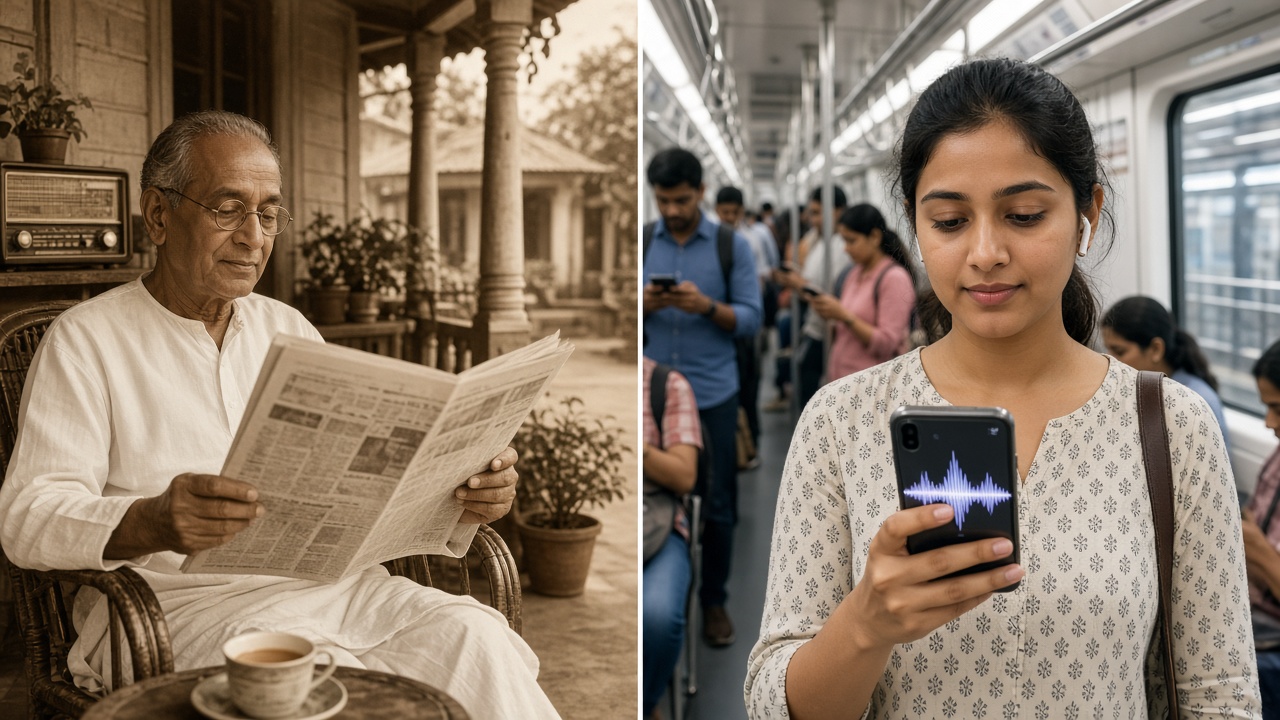
From the morning newspaper on the verandah to a news podcast on the metro (artistic illustration).
News Then vs Now at a Glance
Feature
Then
Now
Main source
Newspaper and radio
Smartphone apps, TV, social media
Speed
Next morning’s paper
Live, every second
How often
A few bulletins a day
Non-stop 24x7 feeds
Who makes news
Professional journalists
Journalists, creators, and citizens
Sharing
Reading aloud, passing the paper
Forwards, reposts, links
Choice
One or two papers, one TV channel
Hundreds of channels and apps
Format
Print and audio
Video, short clips, podcasts, threads
Language
English and major languages
Almost every Indian language
Personalisation
Same paper for everyone
Algorithms choose your feed
Biggest risk
Censorship and limited reach
Fake news and deepfakes
📜 Early PressAncient – 1946
Edicts, Akhbars & the Early Press
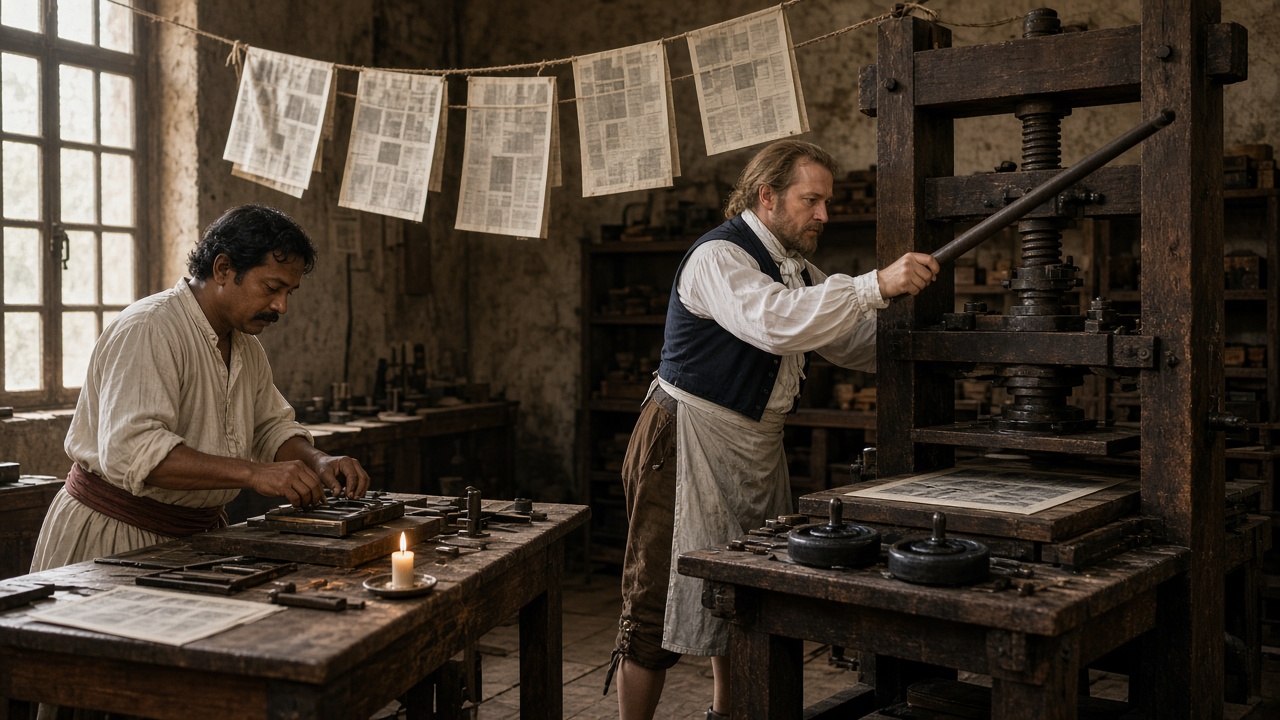
Long before printing, rulers carved messages on rocks and kept newswriters at court. Printed newspapers began in Calcutta in 1780, Indian-language papers followed, and during the freedom struggle newspapers and radio became powerful voices for the nation.
Early newspapers were set by hand and printed one sheet at a time (artistic illustration).
3rd century BCE: Emperor Ashoka’s edicts on rocks and pillars carry his messages to people across the empire; later, Mughal courts employ newswriters who send handwritten akhbarat (newsletters).
1780: James Augustus Hicky starts Hicky’s Bengal Gazette in Calcutta, India’s first newspaper.
1822–1878:Bombay Samachar (1822), the first Hindi paper Udant Martand (1826), The Times of India (1838), and The Hindu (1878) are founded.
1881–1936: Papers such as Tilak’s Kesari and Gandhi’s Young India spread the freedom movement; radio broadcasting starts in 1927 and is named All India Radio in 1936.
Technology
Hand press: Sheet-by-sheet printing.
Telegraph: Faster news from afar.
Valve radio: Voices over the air.
Features
Few readers: Low literacy.
Language press: Regional voices.
Freedom struggle: Papers as protest.
📰 Newspapers1947 – 1959
Newspapers of a New Nation
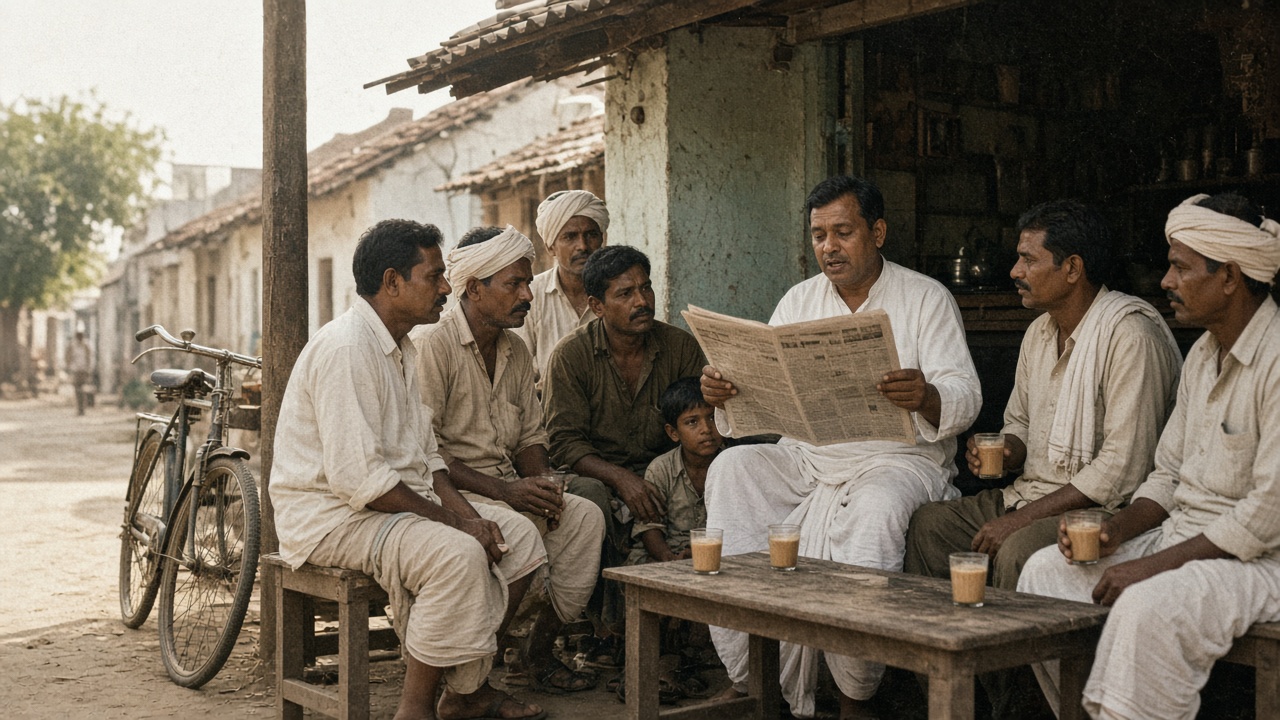
In the 1950s the morning newspaper was the main window on the world. With low literacy, one literate person often read the paper aloud at a tea stall or village square, while All India Radio and cinema newsreels carried news to those who could not read.
One newspaper, read aloud to the whole tea stall (artistic illustration).
14–15 August 1947: Jawaharlal Nehru’s “Tryst with Destiny” speech is broadcast on All India Radio as India becomes independent.
1948–1949: Films Division begins producing newsreels shown in cinemas, and the Press Trust of India (PTI) starts its news agency service in 1949.
1956: Following the First Press Commission, the Registrar of Newspapers for India is set up to register newspapers.
1957–1959: AIR launches Vividh Bharati in 1957, and Doordarshan begins as an experimental TV service in Delhi on 15 September 1959.
Technology
Rotary presses: Faster printing.
Teleprinters: Agency news by wire.
Newsreels: News on the cinema screen.
Features
Reading aloud: Shared news.
Reading rooms: Free papers.
Nation building: Plans and elections.
📻 Radio1960 – 1981
Radio Bulletins
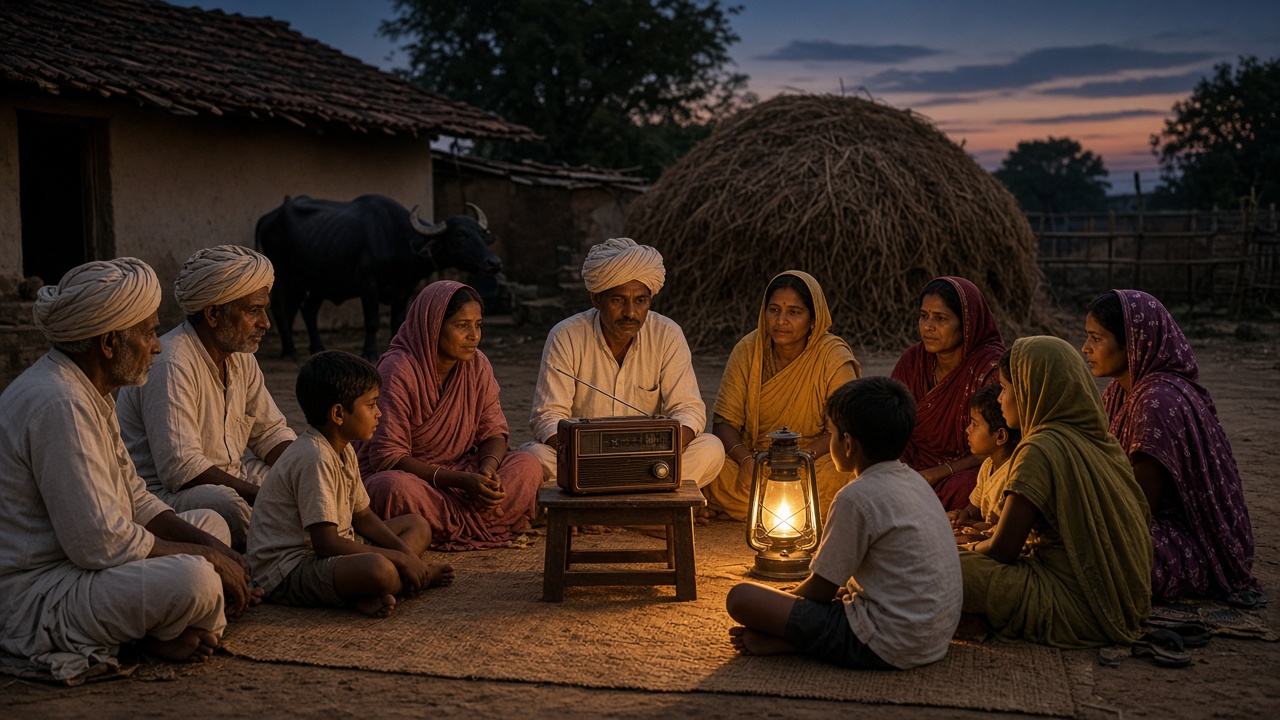
Cheap transistor radios made the 1960s and 1970s the golden age of radio news. Farmers, soldiers’ families, and students tuned in to AIR bulletins at fixed times, and during the Emergency, when newspapers were censored, many listened to foreign radio for news.
The whole village gathers for the evening radio news (artistic illustration).
1960s: Low-cost transistor radios spread to towns and villages; AIR news bulletins in Hindi, English, and regional languages become part of daily routine, especially during the 1962, 1965, and 1971 wars.
1965–1967: Doordarshan starts a daily news bulletin in Delhi in 1965, and Vividh Bharati begins carrying advertisements in 1967.
1975–1977: During the Emergency the press is censored; some newspapers print blank spaces in protest, and the SITE satellite experiment takes TV to about 2,400 villages.
1976: Doordarshan becomes separate from All India Radio; press freedom is restored after the Emergency ends in 1977.
Technology
Transistor radios: Portable and cheap.
Short and medium wave: Long-distance reach.
Satellite TV test: SITE in villages.
Features
Fixed bulletins: News at set times.
Community listening: Village sets.
Censorship: The Emergency test.
📺 Television1982 – 1999
Doordarshan & Satellite TV
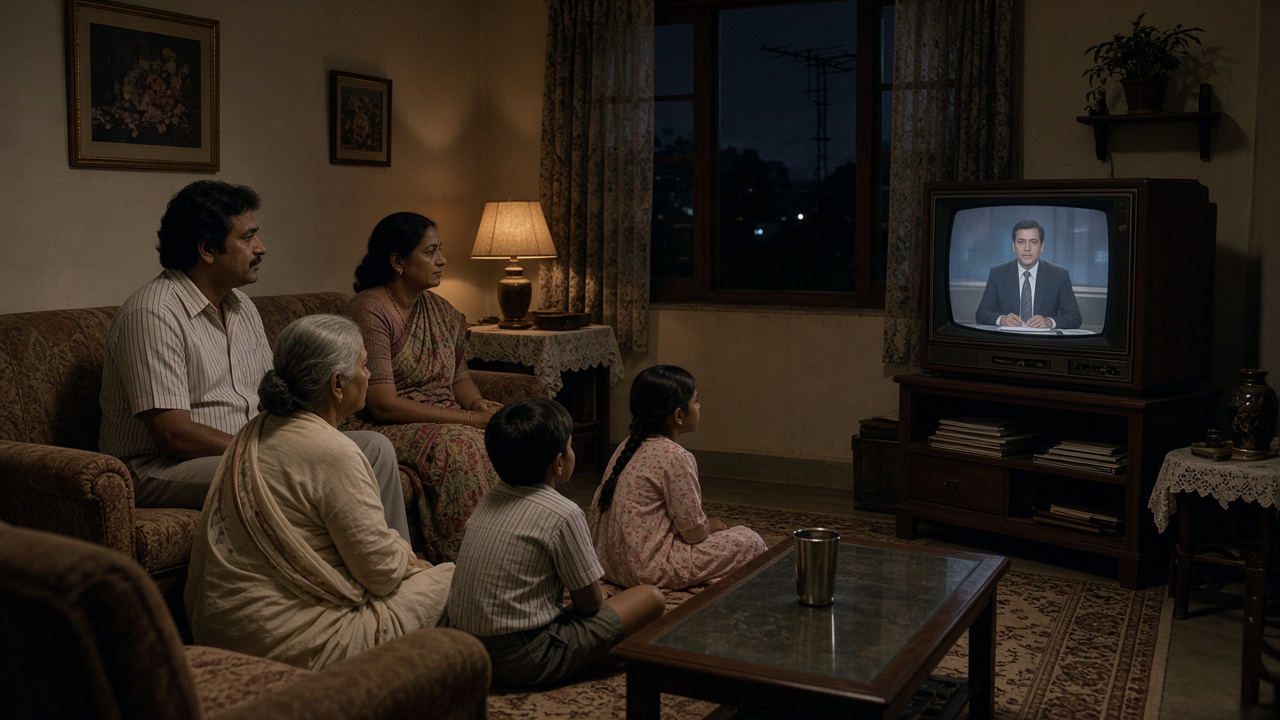
Colour television and the 1982 Asian Games turned Doordarshan into a national habit, and the evening news became family viewing. In the 1990s satellite dishes and cable operators brought private channels, live coverage of world events, and the first independent TV news programmes.
The evening Doordarshan news becomes family viewing (artistic illustration).
1982: Colour broadcasts and a national programme via the INSAT-1A satellite begin around the Asian Games in Delhi; TV transmitters spread rapidly through the decade.
1988: Independent news programmes appear, such as The World This Week on Doordarshan and the Newstrack video news magazine.
1991–1995: Satellite and cable TV arrive with live coverage of the Gulf War; in 1995 the Supreme Court rules that airwaves are public property, and Aaj Tak begins as a daily news slot on DD Metro.
1997–1998: Prasar Bharati becomes the autonomous parent of AIR and Doordarshan, and Star News becomes a 24-hour news channel.
Technology
Colour TV: News in colour.
INSAT satellites: Nationwide reach.
Cable and dish: Many channels.
Features
Seeing the news: Pictures at home.
Family viewing: Evening bulletin.
Private news: Beyond Doordarshan.
🌐 Internet2000 – 2014
Internet & 24x7 News
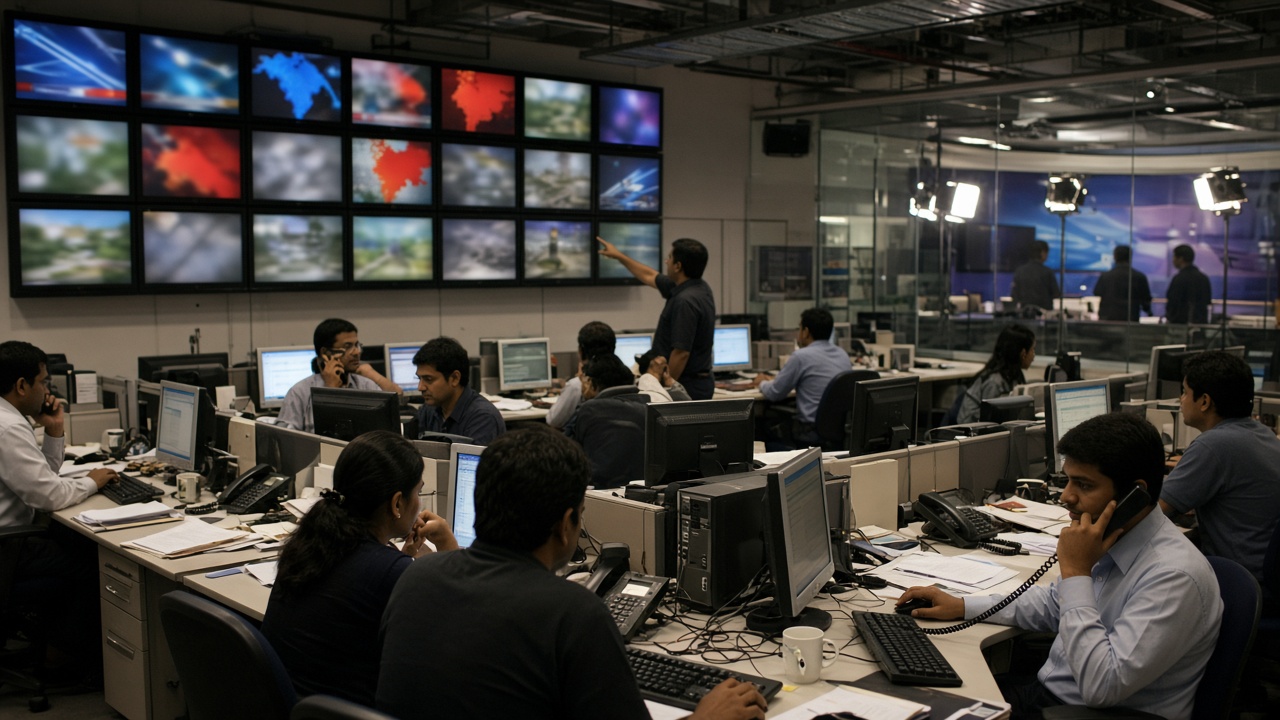
News never stopped in the 2000s. Round-the-clock channels in every major language competed for “breaking news”, newspapers went online with websites and e-papers, and SMS alerts and early social media began to carry headlines straight to phones.
A 24x7 newsroom chasing breaking news (artistic illustration).
2000:Aaj Tak becomes a 24-hour Hindi news channel on 31 December; many more national and regional 24x7 channels follow through the decade.
2000s: Newspapers launch websites and e-papers, news portals and SMS news alerts grow, and private FM radio expands — though only AIR may produce radio news.
2008: The 26/11 Mumbai attacks are covered live for nearly three days, leading to debates and new self-regulation by news broadcasters.
2014: The general election is called India’s first “social media election”, and the Prime Minister’s Mann Ki Baat radio programme begins on 3 October.
Technology
News websites: Updated all day.
E-papers: Newspapers on screen.
SMS alerts: Headlines on phones.
Features
Breaking news: Non-stop tickers.
Language channels: Every state.
Debate shows: Prime-time panels.
🎙️ Podcasts & X2015 – Future
Social Media, Podcasts & X
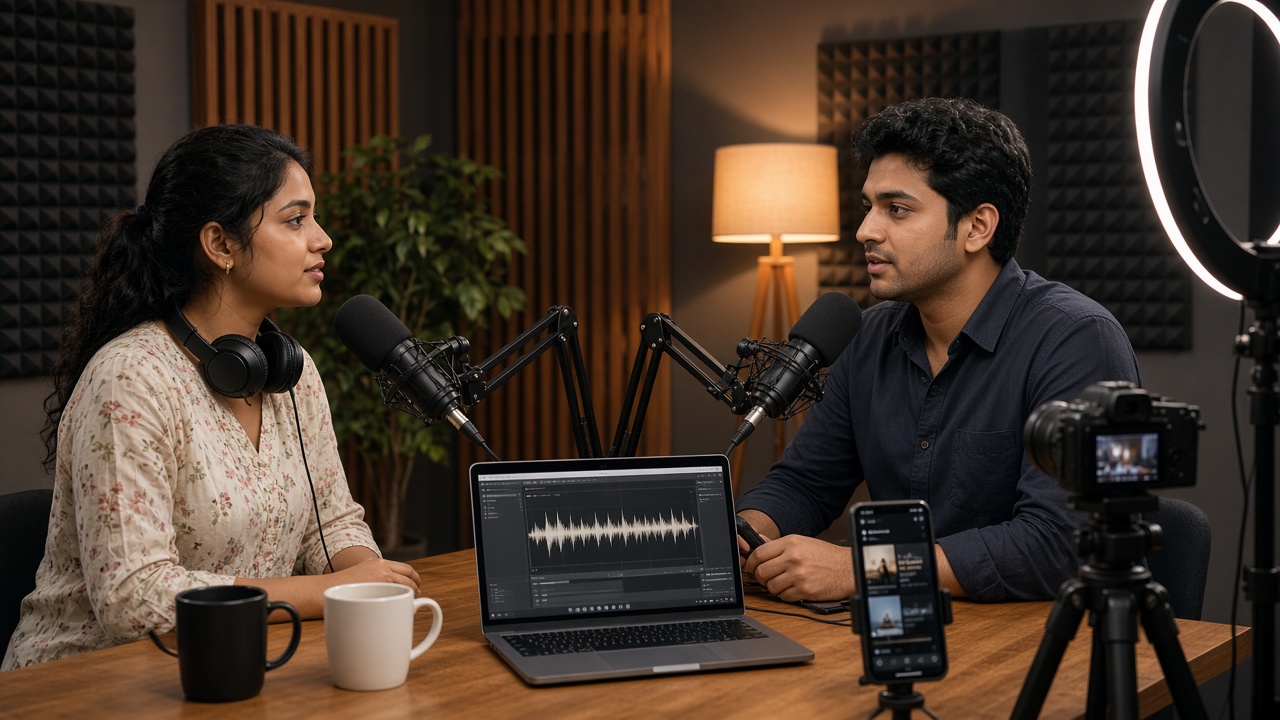
Cheap smartphones and data made the phone the main news source for millions. News now comes as YouTube videos, short clips, posts on X, messaging-app forwards, newsletters, and podcasts — and with it came a new challenge: fake news, deepfakes, and the need to check before sharing.
Two hosts record a news podcast for phones and smart speakers (artistic illustration).
2016–2017: Very cheap 4G data makes YouTube news, messaging-app forwards, and news apps hugely popular; independent fact-checking sites emerge to counter false stories.
2019: The government’s PIB Fact Check unit is set up, and global audio apps launching in India help podcasts grow in Hindi, English, and regional languages.
2021–2023: The IT Rules (2021) add a code of ethics for digital news publishers; Twitter is renamed X in 2023, and Indian channels introduce AI-generated news anchors.
Future: AI summaries, voice news on smart speakers, regional-language audio, and deepfake detection tools are shaping how news is made and trusted.
Technology
Algorithms: Personalised feeds.
Podcasts: News to listen to.
AI tools: Anchors and summaries.
Features
Anyone can publish: Creators and citizens.
Short formats: Clips and threads.
Fact-checking: Verify before sharing.
Landmark Indian Newspapers
Newspaper
Founded
Language
Note
Hicky’s Bengal Gazette
1780, Calcutta
English
India’s first newspaper
Bombay Samachar
1822, Bombay
Gujarati
Among Asia’s oldest newspapers still published
Udant Martand
1826, Calcutta
Hindi
First Hindi newspaper
The Times of India
1838, Bombay
English
Began as The Bombay Times and Journal of Commerce
Amrita Bazar Patrika
1868, Bengal
Bengali, later English
Outspoken nationalist paper
The Hindu
1878, Madras
English
Started as a weekly
Kesari
1881, Pune
Marathi
Associated with Bal Gangadhar Tilak
Malayala Manorama
1890, Kottayam
Malayalam
One of the most-read language dailies
Anandabazar Patrika
1922, Calcutta
Bengali
Leading Bengali daily
Hindustan Times
1924, Delhi
English
Born during the freedom movement
Eenadu
1974, Visakhapatnam
Telugu
Major Telugu daily
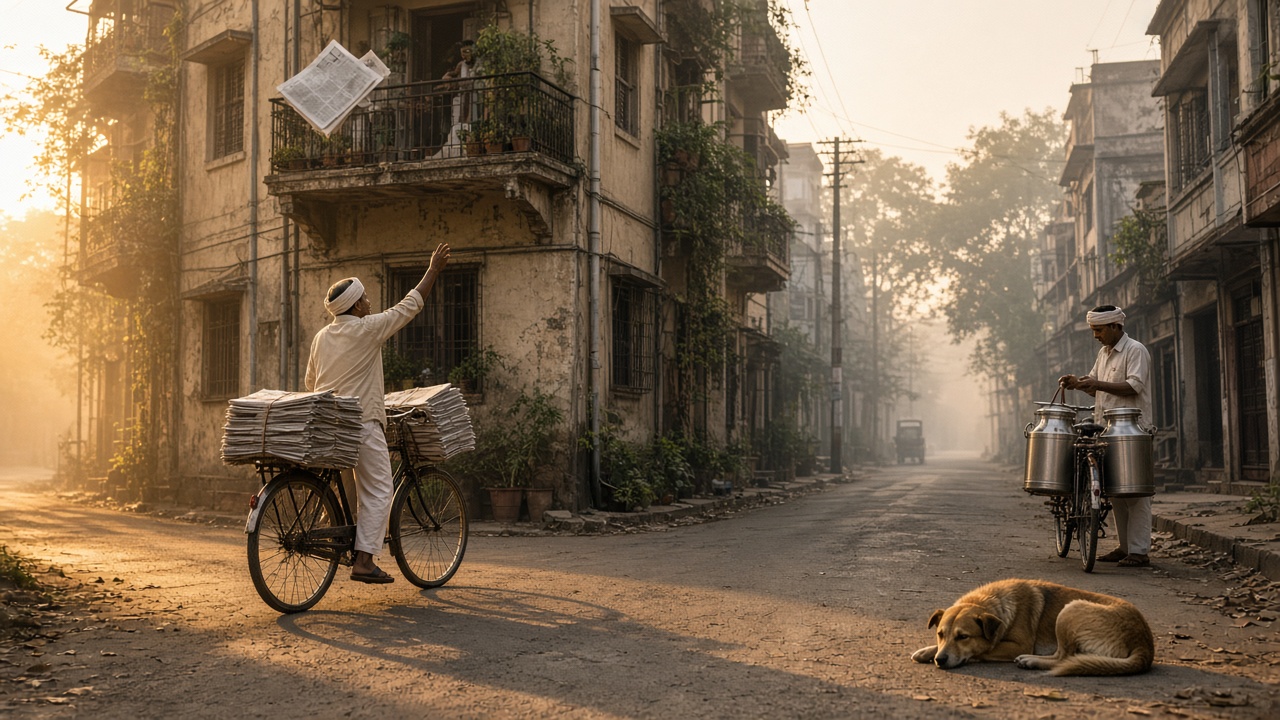
How News Reached People
The hawker’s dawn toss — still how millions get their morning paper (artistic illustration).
Channel
Common in
How it worked
Munadi (drum announcement)
Centuries old
A crier beat a drum and announced news in the village
Newspaper hawker
1900s–now
Papers delivered to homes at dawn
Reading room
1920s–1980s
Free newspapers in libraries and panchayat halls
Community radio set
1950s–1970s
Villagers listened together to AIR
Rooftop antenna
1980s
Doordarshan news on the family TV
Cable operator
1990s
Local cable brought many satellite channels
SMS alerts
2000s
Headlines texted to mobile phones
News apps and notifications
2010s–now
Personalised updates on smartphones
Messaging-app forwards
2010s–now
News shared in family and community groups
Podcasts and smart speakers
2020s
News to listen to on demand
How to Check News Before You Share
Step
What to do
Why it helps
Check the source
See who published it
Unknown sources are often unreliable
Read beyond the headline
Open and read the full story
Headlines can mislead
Check the date
Look for when it happened
Old stories are often re-shared as new
Reverse-search images
Search the photo online
Photos are often from other places or years
Cross-check
Compare with two or three trusted outlets
Real news is reported widely
Watch the tone
Be careful with “forward to everyone now!”
Urgency and anger spread fake news
Spot deepfakes
Look for odd lip movement or voice
AI can fake videos and audio
Use fact-checkers
Search PIB Fact Check or independent fact-checkers
Experts may have checked it already
News Consumption Timeline Summary
Year / Era
Milestone
3rd century BCE
Ashoka’s edicts
Mughal era
Court newswriters and akhbarat
1780
Hicky’s Bengal Gazette
1826
First Hindi newspaper, Udant Martand
1838–1878
The Times of India and The Hindu founded
1927
Radio broadcasting begins
1936
All India Radio named
1947
“Tryst with Destiny” on AIR
1949
Press Trust of India begins
1959
Doordarshan begins in Delhi
1960s
Transistor radio boom
1965
Daily TV news bulletin
1975–1977
Emergency press censorship
1982
Colour TV and national broadcasts
1991
Satellite and cable TV arrive
1995
Airwaves ruled public property; Aaj Tak slot
1997
Prasar Bharati
2000
24-hour Hindi news channel
2008
26/11 live coverage
2014
Social media election; Mann Ki Baat
2016–2017
Cheap data, YouTube news, fact-checkers
2019
PIB Fact Check; podcast growth
2023
Twitter becomes X; AI news anchors
Test Your Knowledge
20 quick questions from the news consumption timeline. Click each question to reveal the answer.
Answer: Ashoka.
Answer: Handwritten newsletters sent by Mughal court newswriters.
Answer:Hicky’s Bengal Gazette (1780).
Answer:Udant Martand (1826).
Answer:Kesari.
Answer: 1936.
Answer: Nehru’s “Tryst with Destiny”.
Answer: Press Trust of India.
Answer: Many people could not read, so one person read for the group.
Answer: 15 September 1959, in Delhi.
Answer: The transistor radio.
Answer: By printing blank spaces or blank editorials.
Answer: The Asian Games in Delhi.
Answer: That airwaves are public property.
Answer: The autonomous public broadcaster that runs AIR and Doordarshan.
Answer:Aaj Tak.
Answer: No — radio news is produced by All India Radio.
Answer: 3 October 2014.
Answer: X.
Answer: Do a reverse image search.
Classroom activity
Students Tasks
Use these prompts for discussion or projects on how Indians followed the news over time.
Timeline understandingMedia literacyDemocracy and citizenshipOral history
Ask your grandparents how they heard about big events like the 1983 Cricket World Cup win or a general election result.
Make a timeline poster: newspapers (1950s), radio (1960s), TV (1980s), internet (2000s), and social media and podcasts (2020s).
Compare how one news story is covered by a newspaper, a TV channel, and a social media post.
Keep a news diary for a week, noting where each piece of news reached you.
Find a forwarded message and check it using the steps in the fact-checking table.
Record a two-minute school news podcast in your own language.
Research the role of newspapers in the freedom struggle.
Discuss why a free press matters in a democracy, using the Emergency as an example.
Make a classroom newspaper with headlines, a photo, an editorial, and a weather report.
Debate: “Social media has made people better informed.”
Continue exploring
The way Indians get news grew with radio, television, the internet, and printing. Explore these connected timelines next.
Click any panel to expand and explore the visual mood.
India’s news journey in pictures — the early printing press, the tea-stall newspaper, village radio, Doordarshan evenings, the 24x7 newsroom, the dawn hawker, podcasts, and then versus now.
Early Press
Hand-printed news
1950s Newspapers
Read aloud
1960s Radio
Village bulletin
1980s TV
Doordarshan evenings
24x7 Newsroom
Breaking news
Dawn Hawker
The morning toss
Podcasts
News to listen to
Then vs Now
Newspapers to podcasts
Explore all daily life timelines
Jump to any other daily life timeline on WorldTimelineHub.
Disclaimer: This content is AI-generated for educational purposes and may contain errors or outdated details. For correct and authoritative information, please refer to official and reliable sources such as government publications, manufacturers, museums, and academic references.