Pharma Industry Timeline of India: Imported Medicines → Swadeshi Works → Indian Firms → Patents Act 1970 → Liberalisation → Global Generic Leader
A century ago almost every modern medicine used in India came from abroad. In the 1890s the chemist Prafulla Chandra Ray started Bengal Chemical in Calcutta, Indian firms such as Cipla and Ranbaxy followed in the 1930s and
1940s, the Patents Act of 1970 let Indian companies make cheaper versions of patented drugs, liberalisation in the 1990s opened world markets, and by the 2010s India had become the world’s leading supplier of generic medicines.
This timeline covers imported medicines, Bengal Chemical, Haffkine’s vaccines, Alembic and Zandu, Cipla, Ranbaxy, and Unichem, the Drugs Act of 1940, Hindustan Antibiotics and IDPL, the Patents Act of 1970 and price control,
reverse engineering, Sun Pharma and Dr. Reddy’s, liberalisation and the WTO, the one-dollar-a-day AIDS drug, product patents in 2005, Jan Aushadhi, the Novartis judgment, COVID-19 vaccines, and PLI for bulk drugs.
Medicines save lives only if people can afford them. At independence India depended on foreign companies and imported medicines, and prices were among the highest in the world. Through swadeshi pioneers, public-sector
factories, a bold patent law, skilled chemists, and global ambition, India became a country that makes affordable medicines and vaccines for itself and for patients in around 200 countries.
Big picture
India’s pharma industry in one view
Swadeshi works of the 1890s made the first Indian medicines, Indian firms were founded in the 1930s and 1940s, public-sector plants made penicillin from the 1950s, the Patents Act of 1970 allowed only process patents on
medicines, liberalisation and the WTO opened world markets in the 1990s, product patents returned in 2005, and India became the world’s biggest supplier of generics. Related timelines:
research and innovation,
the rupee,
shipping and water transport.
1893
Bengal Chemical works begins
1970
Patents Act allows process patents only
~20%
Of world generic supply by volume
200+
Countries receive Indian medicines
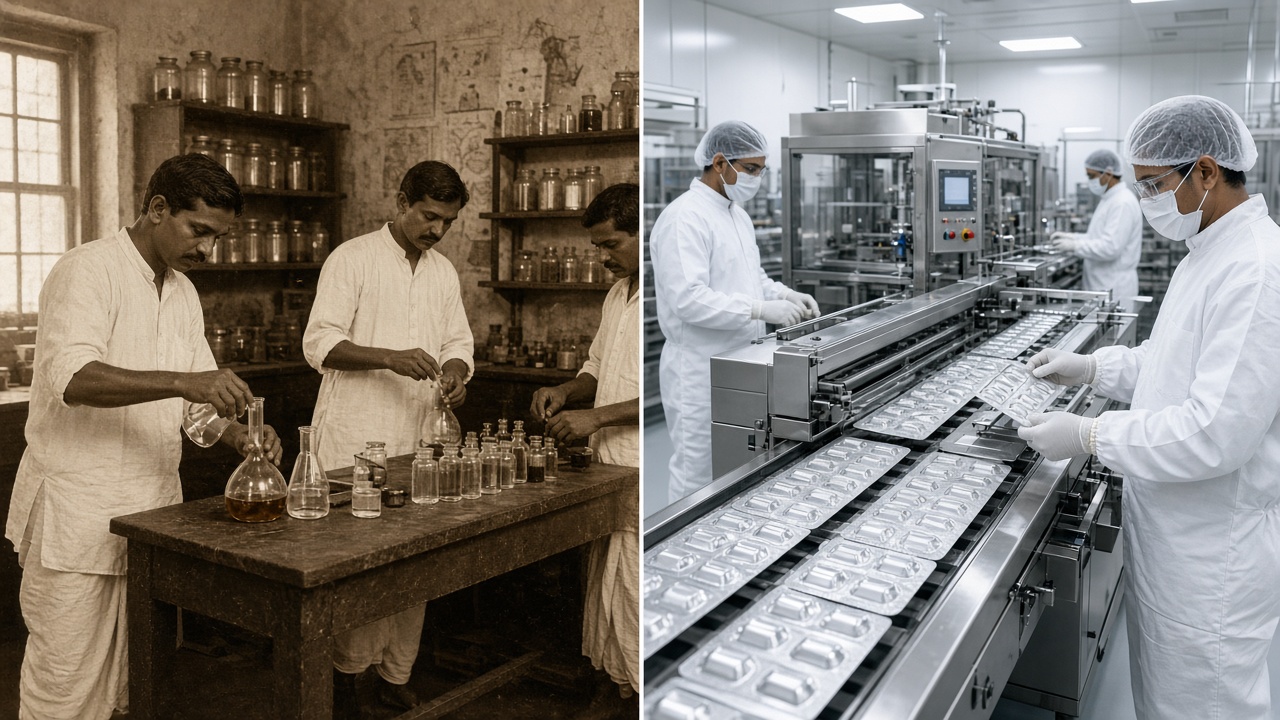
From glass flasks on a wooden table to automated blister-packing lines (artistic illustration).
Indian Pharma Then vs Now at a Glance
Feature
Around 1947
Now
Where medicines came from
Mostly imported or made by foreign firms
Mostly made in India by Indian companies
Market leaders
Foreign multinationals
Indian companies hold most of the market
Prices
Among the highest in the world
Among the lowest in the world
Patent law
Colonial law with strong product patents
Product patents with Section 3(d) safeguards
Exports
Very small
Around US$28 billion a year (FY2023–24)
Antibiotics
Imported
Made in India since the 1950s
Vaccines
A few government institutes
One of the world’s largest vaccine producers
Quality rules
Drugs Act of 1940, weakly enforced
GMP under Schedule M and many US FDA-approved plants
Research
Almost none
New formulations, biosimilars, and some new drugs
Weak point
Almost everything imported
Many raw materials (APIs and KSMs) imported, mainly from China
⚗️ SwadeshiBefore 1930
Imported Medicines & Swadeshi Beginnings
In colonial India modern medicines were made in Europe and sold through British trading houses, while most people relied on Ayurveda, Unani, and home remedies. Inspired by the swadeshi spirit, Indian chemists and entrepreneurs began making medicines and chemicals at home, and government laboratories started producing vaccines.
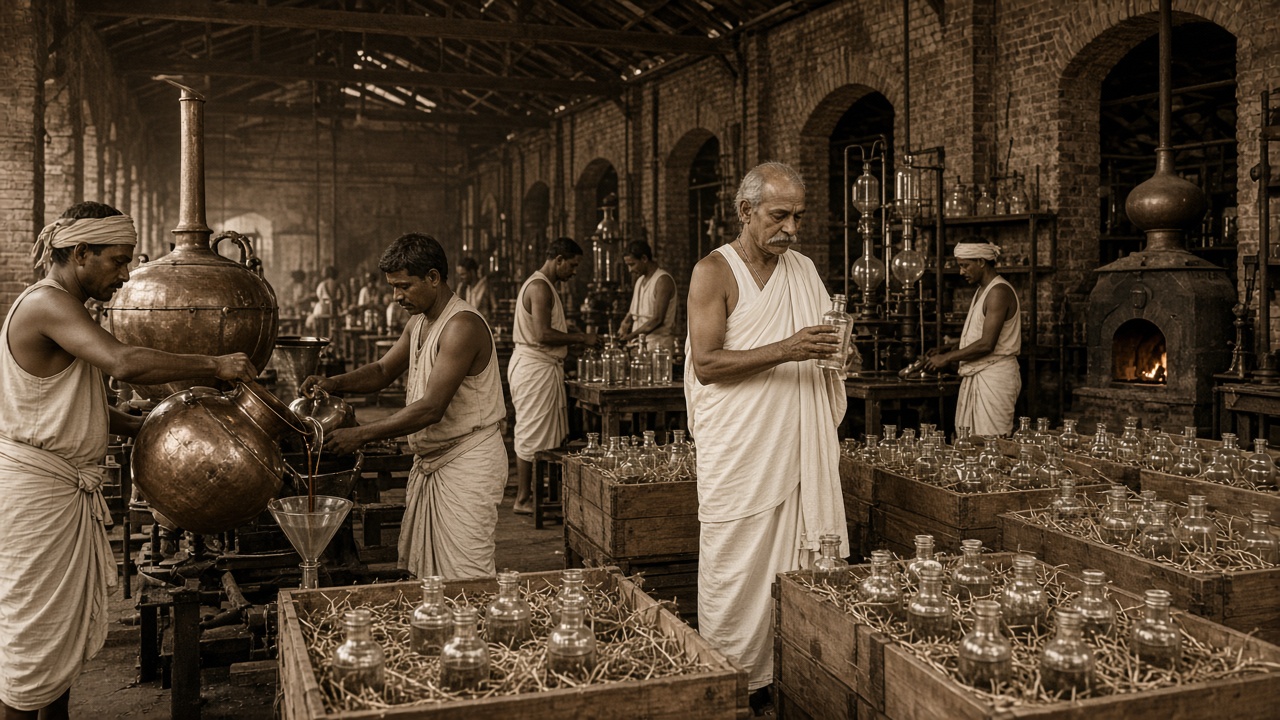
Workers bottle medicines in an early swadeshi chemical works (artistic illustration).
1800s: Modern medicines such as quinine and patent tonics are imported from Europe, and British firms in Calcutta and Bombay dominate the trade.
1892–1901: Chemist Prafulla Chandra Ray starts Bengal Chemical Works in Calcutta with a few hundred rupees (about 1892–93), and it becomes Bengal Chemical and Pharmaceutical Works Ltd in 1901.
1893–1899: Waldemar Haffkine tests a cholera vaccine in India (1893) and develops a plague vaccine in Bombay (1897), and the Plague Research Laboratory opens in 1899, later the Haffkine Institute.
1905–1910: The Central Research Institute at Kasauli makes vaccines (1905), Alembic Chemical Works is founded in Baroda (1907), and Zandu Pharmaceutical Works starts in Bombay (1910).
Technology
Distillation: Copper stills and flasks.
Tinctures and syrups: Bottled by hand.
Vaccine labs: Cholera and plague.
Features
Import dependence: Medicines from Europe.
Swadeshi spirit: Make it in India.
Small workshops: Few trained chemists.
🧪 Founders1930 – 1947
Indian Drug Firms Are Founded
In the 1930s and 1940s Indian scientists and businessmen founded companies that still lead the industry today. A government committee exposed fake and poor-quality medicines, leading to India’s first national drug law, and the Second World War cut off imports, forcing India to make more of its own medicines.
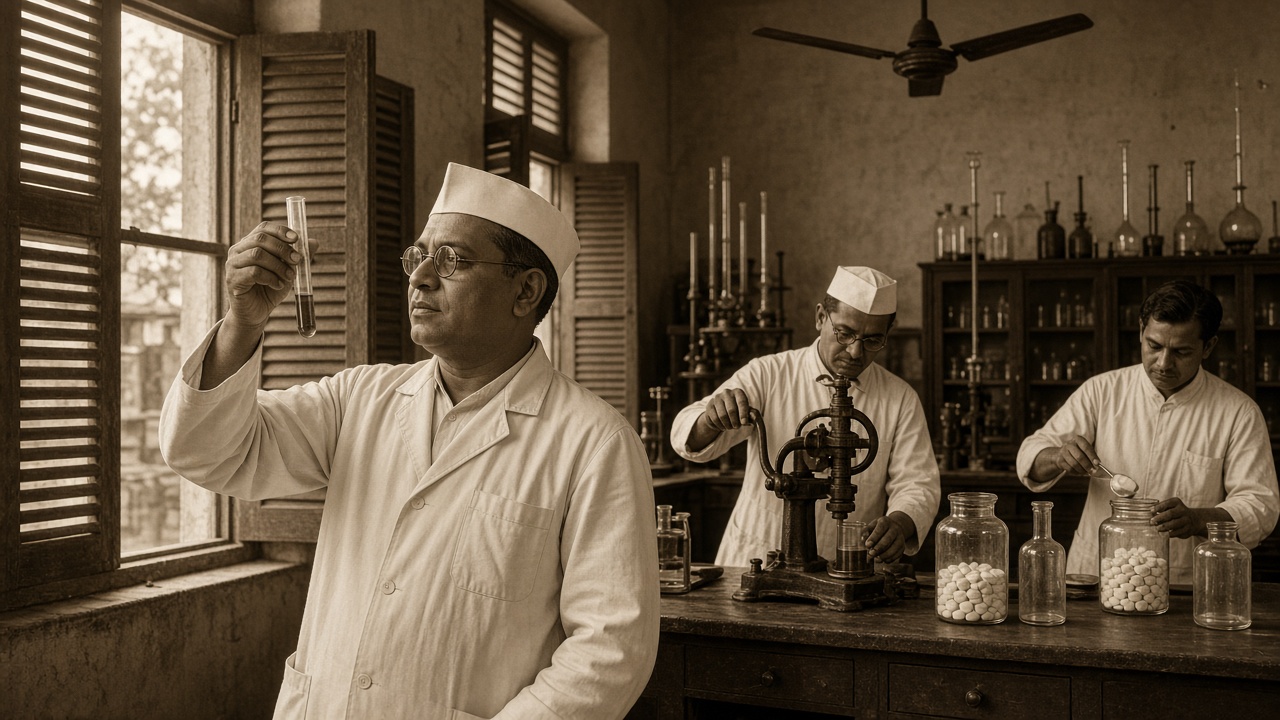
Chemists test samples and press tablets in an early Indian drug laboratory (artistic illustration).
1930–1931: The Drugs Enquiry Committee led by Col. R. N. Chopra finds widespread fake and substandard medicines and recommends a national drug law.
1935–1937: Chemist Khwaja Abdul Hamied founds Cipla in Bombay (1935), and Ranbaxy begins in Amritsar in 1937 as a distributor of imported medicines.
1939–1945: The Second World War cuts imports, Indian firms step up production of basic medicines, and Unichem Laboratories is founded in Bombay (1944).
1940–1947: The Drugs Act of 1940 and the Drugs Rules of 1945 set the first national rules for making and selling medicines, but foreign companies still dominate the market at independence.
Technology
Tablet presses: Hand-operated machines.
Sulpha drugs: Early antibacterials.
Testing labs: Checking purity.
Features
Indian founders: Cipla, Ranbaxy, Unichem.
First drug law: Drugs Act, 1940.
Wartime demand: Local production grows.
🏭 Public Sector1948 – 1969
Public Sector Antibiotics & Early Growth
Newly independent India built government factories to make antibiotics and basic drugs, and national laboratories to research new medicines. These plants trained a generation of Indian chemists and engineers, but foreign companies still controlled most of the market, and medicine prices stayed very high.
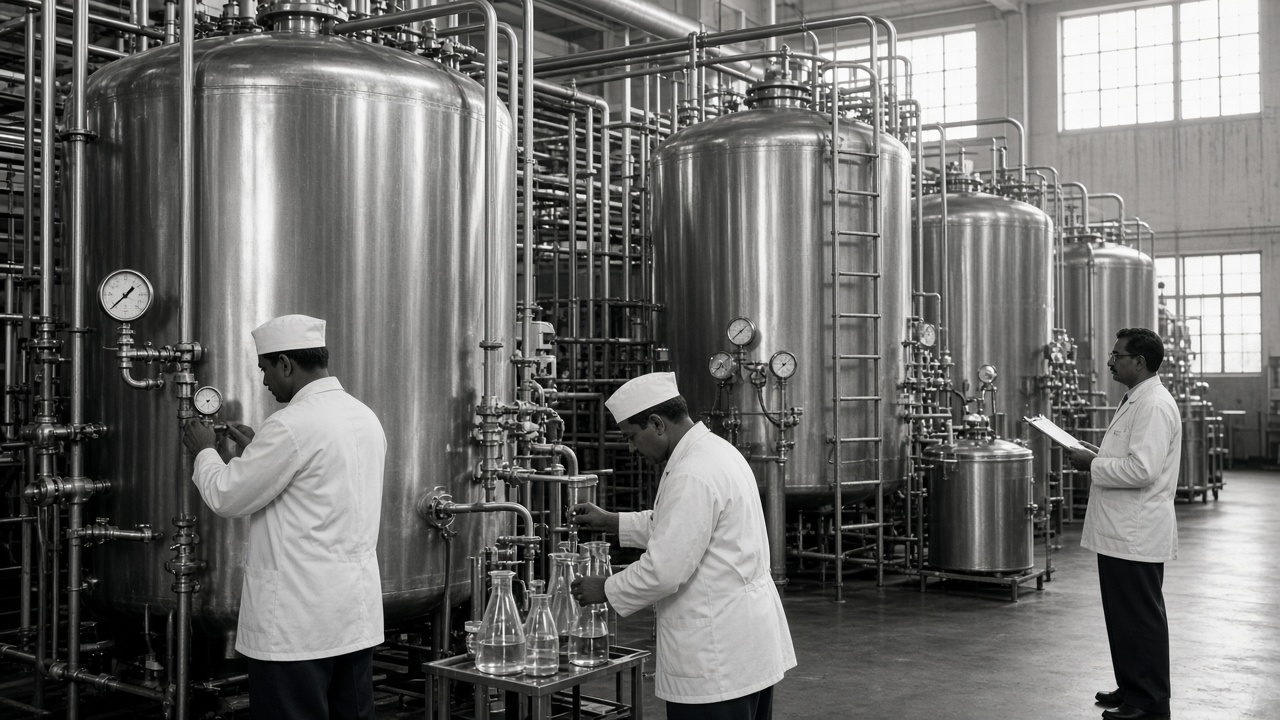
Technicians tend fermentation tanks in a public-sector antibiotics plant (artistic illustration).
1948–1951: The Pharmacy Act of 1948 regulates pharmacists, and the Central Drug Research Institute opens in Lucknow (1951) to research new medicines.
1954–1955: Hindustan Antibiotics Limited is set up at Pimpri near Pune (1954) with help from the WHO and UNICEF, and begins making penicillin in 1955.
1959–1961: The Ayyangar Committee (1959) finds Indian drug prices among the highest in the world and recommends reforming patent law, and Indian Drugs and Pharmaceuticals Limited (IDPL) is founded in 1961 with Soviet help.
1964–1968: The Drugs Act is renamed the Drugs and Cosmetics Act (1964), the Serum Institute of India is founded in Pune (1966), and Lupin begins in 1968.
Technology
Fermentation: Penicillin and streptomycin.
Synthetic drugs: IDPL plants.
National labs: CDRI and others.
Features
Public sector: HAL and IDPL.
Training ground: Future founders.
High prices: Patents held abroad.
⚖️ Patents Act1970 – 1990
Patents Act 1970 & Self-Reliance
The Patents Act of 1970 changed everything. By allowing patents only on the process of making a medicine, not on the medicine itself, it let Indian chemists legally make cheaper versions of patented drugs by finding new routes to make them. Price controls and new policies favoured Indian companies, and a wave of new firms was born.
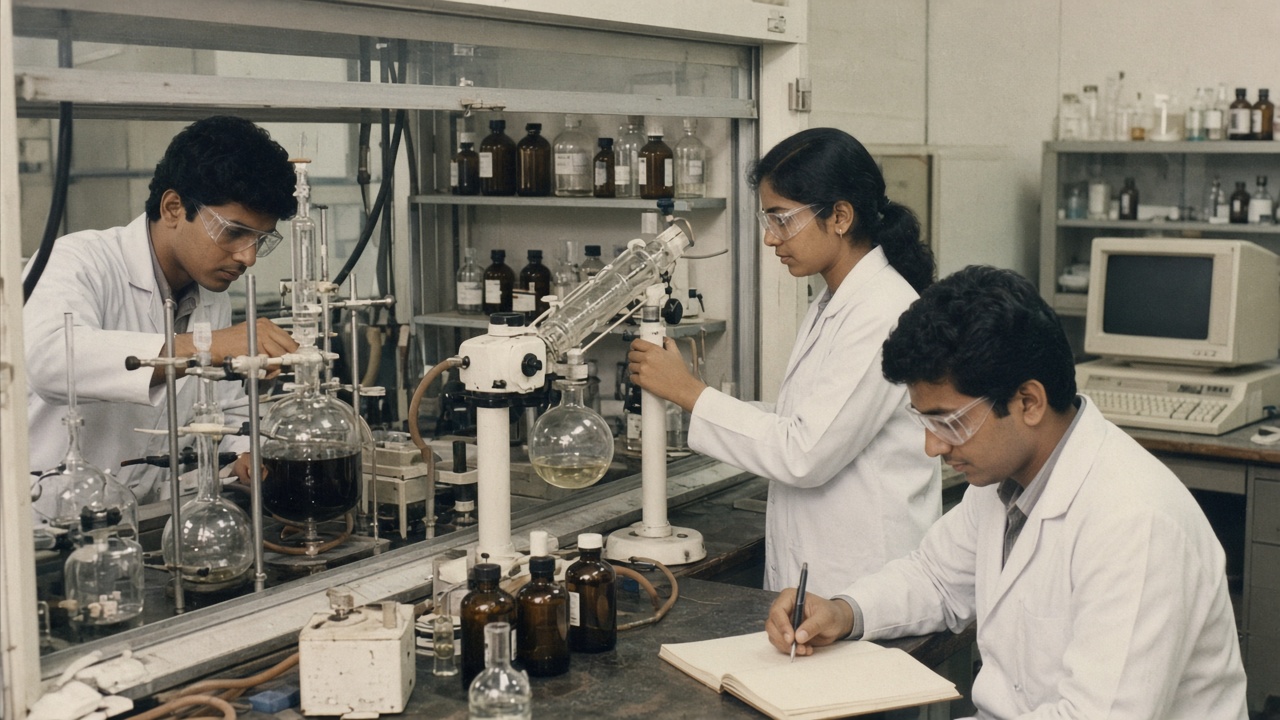
Young chemists work out new ways to make known medicines (artistic illustration).
1970–1972: Parliament passes the Patents Act (1970), which comes into force in April 1972 with only process patents for medicines and short patent terms, and the first Drug Prices Control Order is issued (1970).
1973–1978: Foreign exchange rules push foreign firms to reduce their shareholding, the Hathi Committee (1975) calls for self-reliance in medicines, and a new Drug Policy follows in 1978.
1977–1986: Glenmark (1977), Biocon (1978), Sun Pharma (1983), Dr. Reddy’s (1984), and Aurobindo (1986) are founded, many by former public-sector scientists.
1980s: Reverse engineering makes India self-reliant in most medicines, Hyderabad grows into a bulk drug hub, Indian companies start exporting, and GMP rules (Schedule M) are added in 1988.
Technology
Process chemistry: New routes to known drugs.
Bulk drugs: APIs made in India.
Lab computers: Early data work.
Features
Process patents: No product patents.
Price control: DPCO.
Self-reliance: Indian firms rise.
🌍 Liberalisation1991 – 2005
Liberalisation, WTO & Affordable AIDS Drugs
Economic reforms opened India to the world, and Indian companies set their sights on the huge generic markets of the United States and Europe. Joining the WTO meant India had to bring back product patents, but in the meantime Indian generics transformed the global fight against HIV/AIDS.
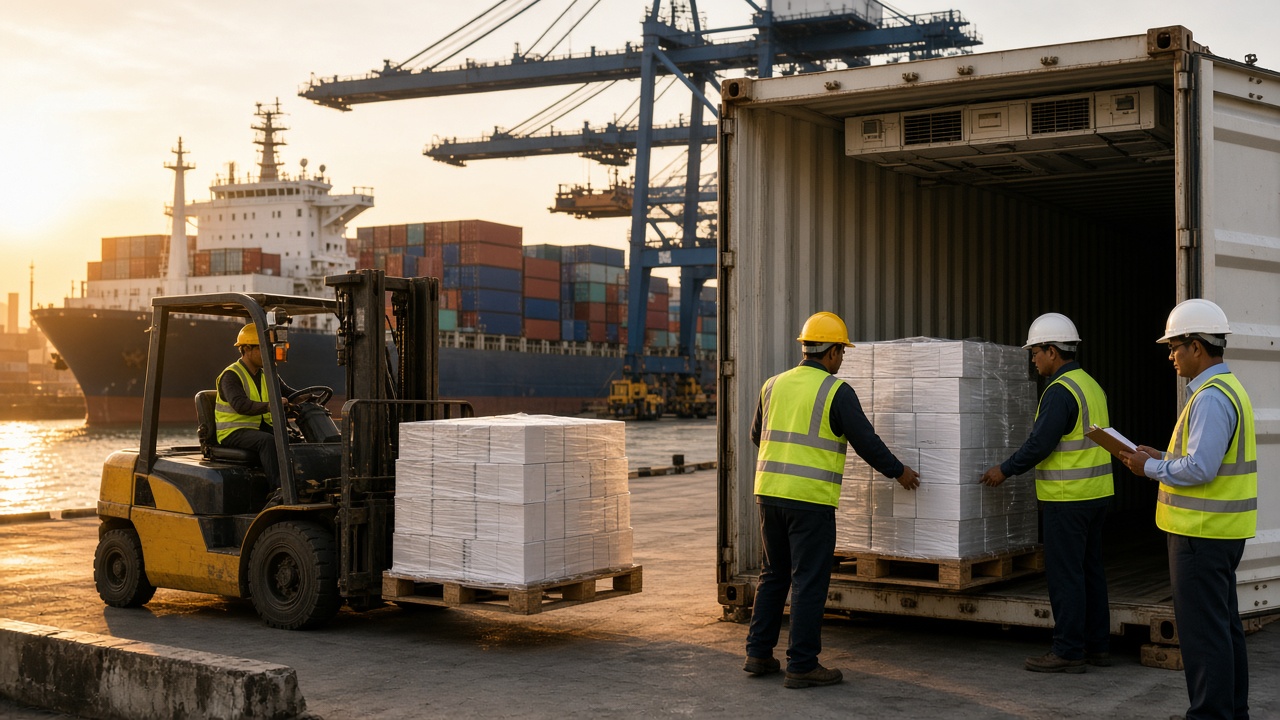
Pallets of medicines are loaded into a refrigerated container for export (artistic illustration).
1991–1994: Economic reforms end most industrial licensing and allow more foreign investment, and a new drug policy (1994) reduces price controls.
1995–1999: India joins the WTO and accepts the TRIPS agreement, with ten years to introduce product patents, and a 1999 amendment starts accepting “mailbox” patent applications.
2001: Cipla offers a three-drug HIV/AIDS combination for under one US dollar a day, the WTO’s Doha Declaration backs access to medicines, and Dr. Reddy’s lists on the New York Stock Exchange.
2002–2005: Patent terms are raised to 20 years (2002), and from 1 January 2005 India grants product patents for medicines, with Section 3(d) blocking patents on minor changes to known drugs.
Technology
US FDA-approved plants: World-class GMP.
Fixed-dose combinations: One pill, three drugs.
Bioequivalence studies: Proving generics work.
Features
Open economy: Global markets.
TRIPS: Product patents return.
Affordable AIDS drugs: Millions treated.
💊 Global Leader2006 – Future
Global Generic Leader & Pharmacy of the World
By the 2010s India was the world’s largest supplier of generic medicines by volume, and its vaccine makers supplied much of the world. Courts defended affordable access, cheap generic pharmacies spread at home, and during COVID-19 India produced vaccines at huge scale, while new schemes aimed to cut dependence on imported raw materials and raise quality.
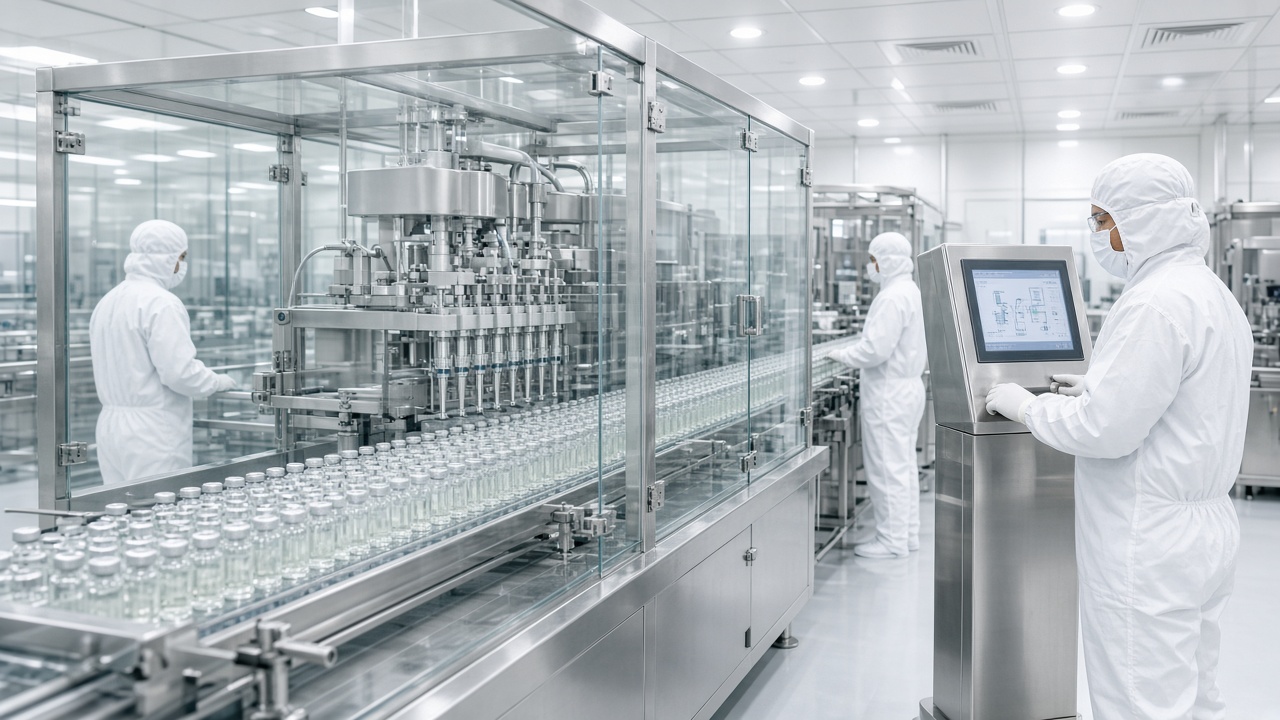
Vaccine vials are filled on an automated line in a clean room (artistic illustration).
2008: The Department of Pharmaceuticals is created, and the Jan Aushadhi scheme launches pharmacies selling low-cost generic medicines (expanded as PMBJP from 2015).
2012–2015: India grants its first compulsory licence to Natco for a cancer drug (2012), the Supreme Court rejects Novartis’s patent claim on Glivec (2013), a new DPCO caps prices of essential medicines (2013), and Sun Pharma acquires Ranbaxy (2015).
2020–2021: PLI schemes and bulk drug parks aim to make key raw materials in India (2020), Covishield and Covaxin are approved, and Vaccine Maitri sends vaccines to many countries (2021).
2023–Future: Export cough syrups must be tested (2023), revised Schedule M raises GMP standards (2023), and India aims to grow in biosimilars, new drug discovery, and pharma exports.
Make a timeline poster: 1893 Bengal Chemical, 1935 Cipla, 1954 Hindustan Antibiotics, 1970 Patents Act, 1991 liberalisation, 2005 product patents, and 2021 Vaccine Maitri.
Read about Acharya Prafulla Chandra Ray and explain how he linked science with the swadeshi movement.
Look at a medicine strip at home (with an adult) and find the name of the active ingredient and the company that made it.
Visit or research a Jan Aushadhi Kendra and compare the price of one generic medicine with a branded version.
Explain in your own words the difference between a process patent and a product patent.
Mark on a world map ten countries that buy medicines or vaccines from India.
Draw a flow chart showing how a raw material becomes an API and then a finished tablet.
Research how affordable Indian medicines changed HIV/AIDS treatment in Africa.
List three reasons why India imports many APIs and suggest ways to make more of them at home.
Debate: “Cheap medicines for everyone matter more than strong patents.”
Continue exploring
India’s pharma story is linked to research and innovation, the economy and the rupee, shipping and exports, and higher education in science. Explore these connected timelines next.
Click any panel to expand and explore the visual mood.
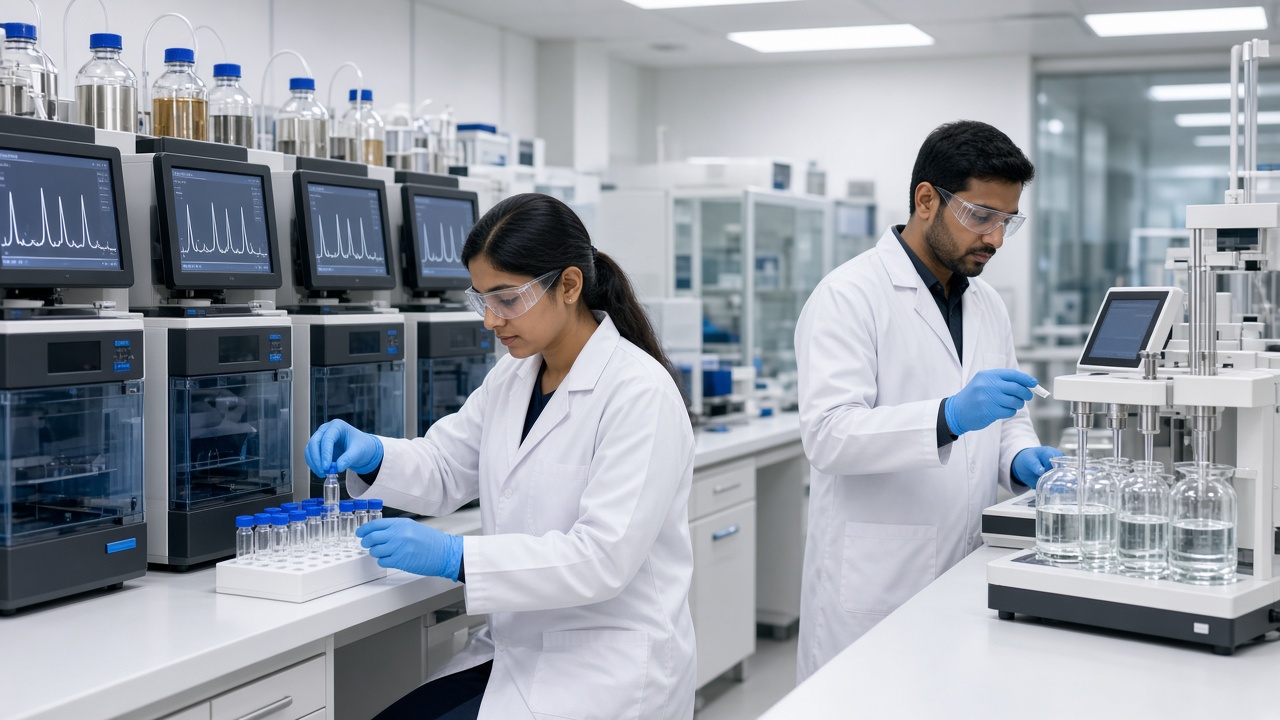
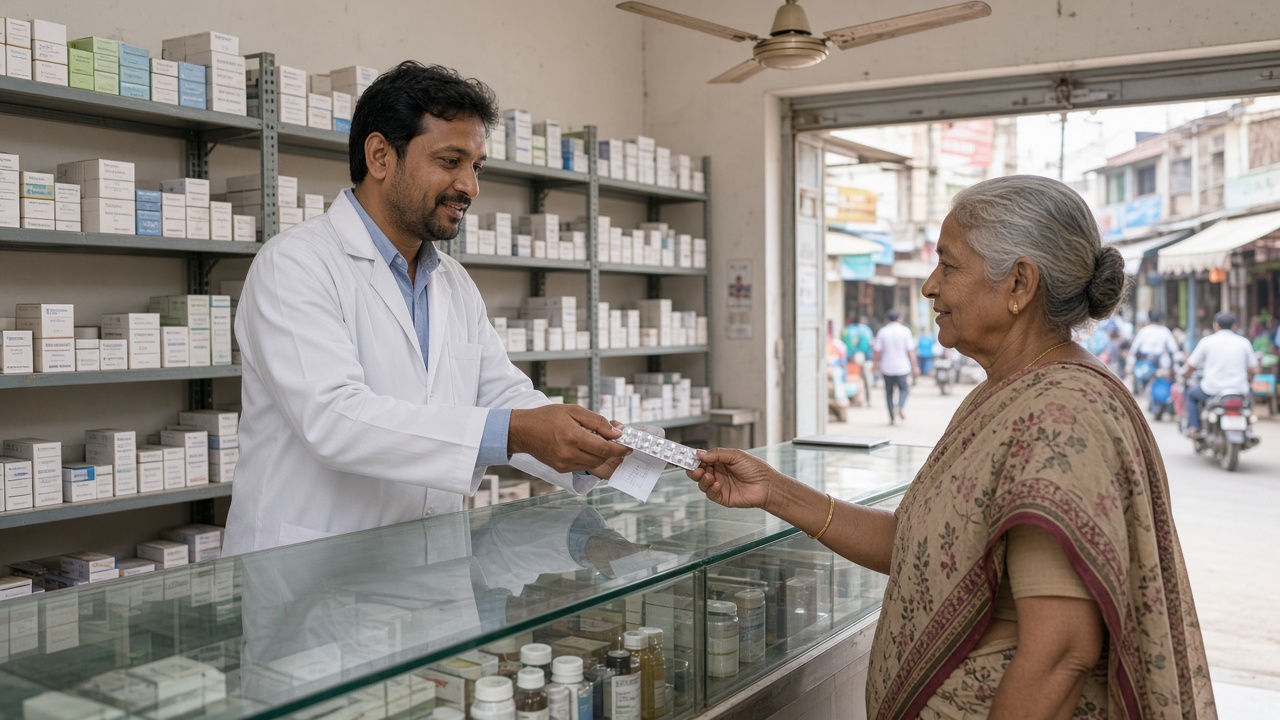
India’s pharma industry in pictures — a swadeshi chemical works, an early drug laboratory, penicillin tanks, process chemists, medicine exports, a vaccine line, a quality lab, a local pharmacy, and then versus now.
Swadeshi Works
1890s beginnings
Early Lab
Indian firms, 1930s
Penicillin Plant
Public sector, 1950s
Process Chemists
After the 1970 Act
Exports
To the world
Vaccines
Clean-room scale
Quality Lab
Testing every batch
Local Pharmacy
Affordable generics
Then vs Now
Flasks to automation
Explore all health timelines
Jump to any other health timeline on WorldTimelineHub.
Disclaimer: This content is AI-generated for educational purposes and may contain errors or outdated details. For correct and authoritative information, please refer to official and reliable sources such as government publications, manufacturers, museums, and academic references.