From risky tika inoculation and Jenner’s cowpox scratch to Pasteur’s lab vaccines, polio drops, smallpox’s last cases, India’s Universal Immunization Programme,
and COVID-era platforms — vaccines turned fear of epidemics into one of public health’s greatest tools.
This timeline covers variolation, Jenner (1796), Pasteur and rabies, diphtheria–tetanus–pertussis and BCG, Salk and Sabin polio vaccines,
smallpox eradication, EPI/UIP in India, and COVID-19 vaccination — with deep dives on
smallpox
and
polio
eradication in India.
Vaccines teach the body to recognise a germ without causing the full disease. That protects the person — and, when enough people are immunised, slows community spread (herd protection).
This page is educational history — not medical advice. India’s story runs from traditional tika and the 1802 arrival of cowpox vaccine to Pulse Polio booths and COVID centres. For disease-by-disease campaigns, open
Smallpox Eradication
and
Polio Eradication.
Big picture
Vaccines in one view
Risky inoculation gives way to Jenner’s safer cowpox method; labs invent vaccines for many germs; mid-century campaigns beat polio and wipe out smallpox;
routine childhood schedules expand; COVID proves how fast platforms and logistics can scale.
1796
Jenner’s cowpox trial
1980
Smallpox declared eradicated
2014
India certified polio-free
2020s
COVID vaccine rollout
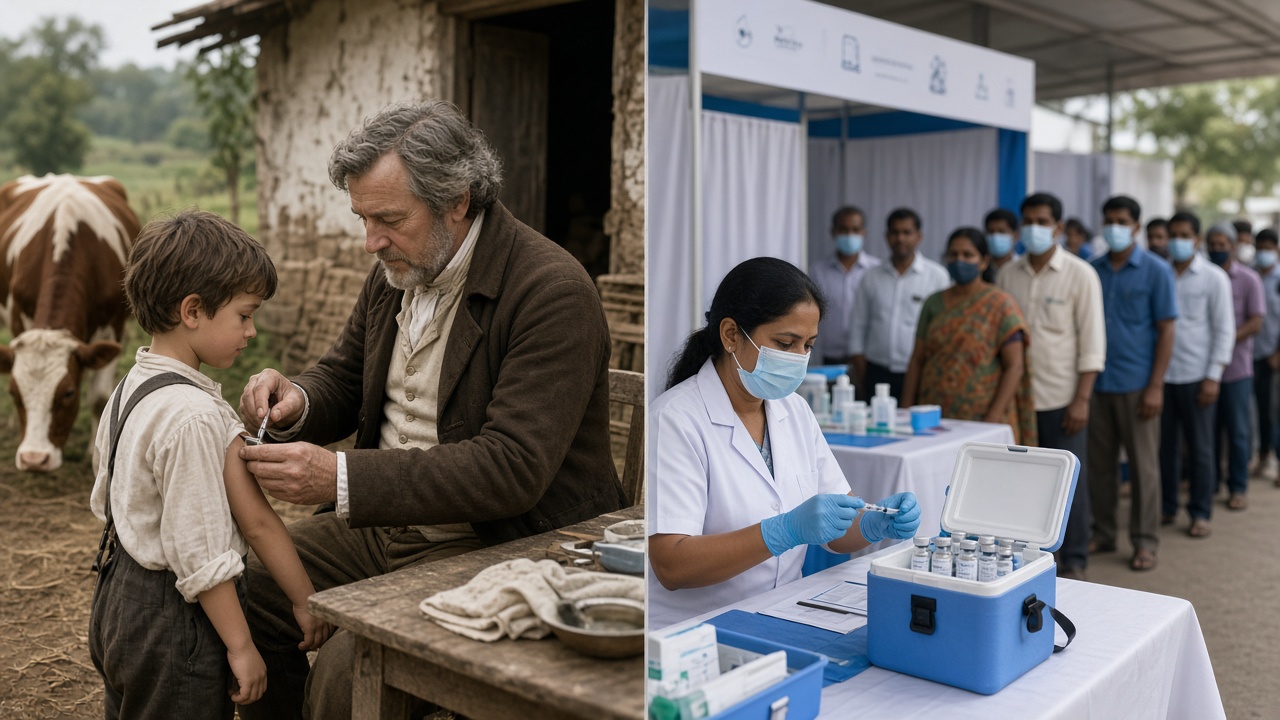
Cottage garden experiments to cold-chain booths — two centuries of immunisation (artistic illustration).
🌿 Before the Vaccineto 1796
Variolation & Tika
Long before laboratories, people noticed that survivors of smallpox rarely got it again. Inoculators placed a little blister material into a cut on the skin —
variolation in Europe and West Asia, tika practices in India — usually milder than natural smallpox, but still dangerous.
Folk immunity: Communities observed that one bout of smallpox often protected for life.
Tika / tikadars: Travelling inoculators in parts of India offered seasonal protection (see the smallpox timeline).
Lady Mary Wortley Montagu: Helped popularise variolation in Britain after seeing it in the Ottoman world.
Limits: Could kill, scar, or start outbreaks — the world needed something safer.
Tools
Skin incision: Small cut or scratch for material.
Human virus: Used real smallpox — not cowpox.
Seasonal campaigns: Timed around local custom and disease seasons.
Features
Early immunology: Immunity understood by experience.
High risk: Not a modern vaccine.
Sets the stage: Jenner improves on this idea.
🐄 Cowpox Insight1796 – 1880s
Jenner & the First Vaccine
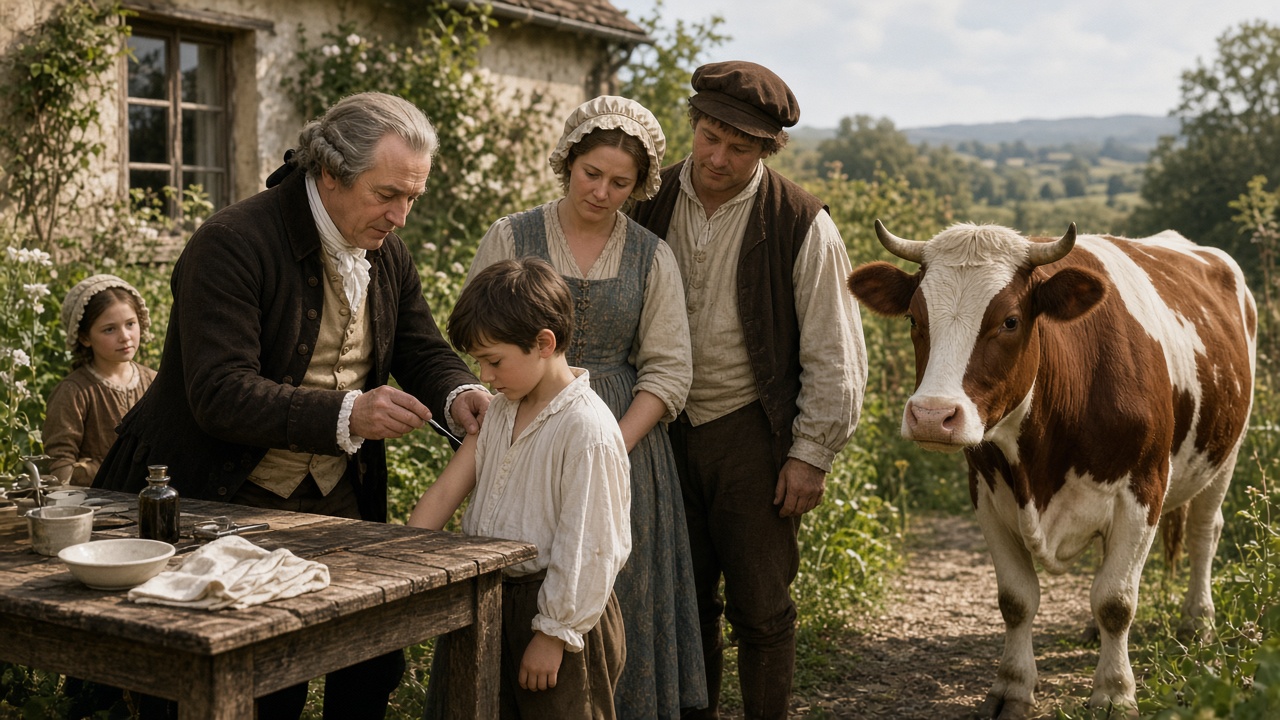
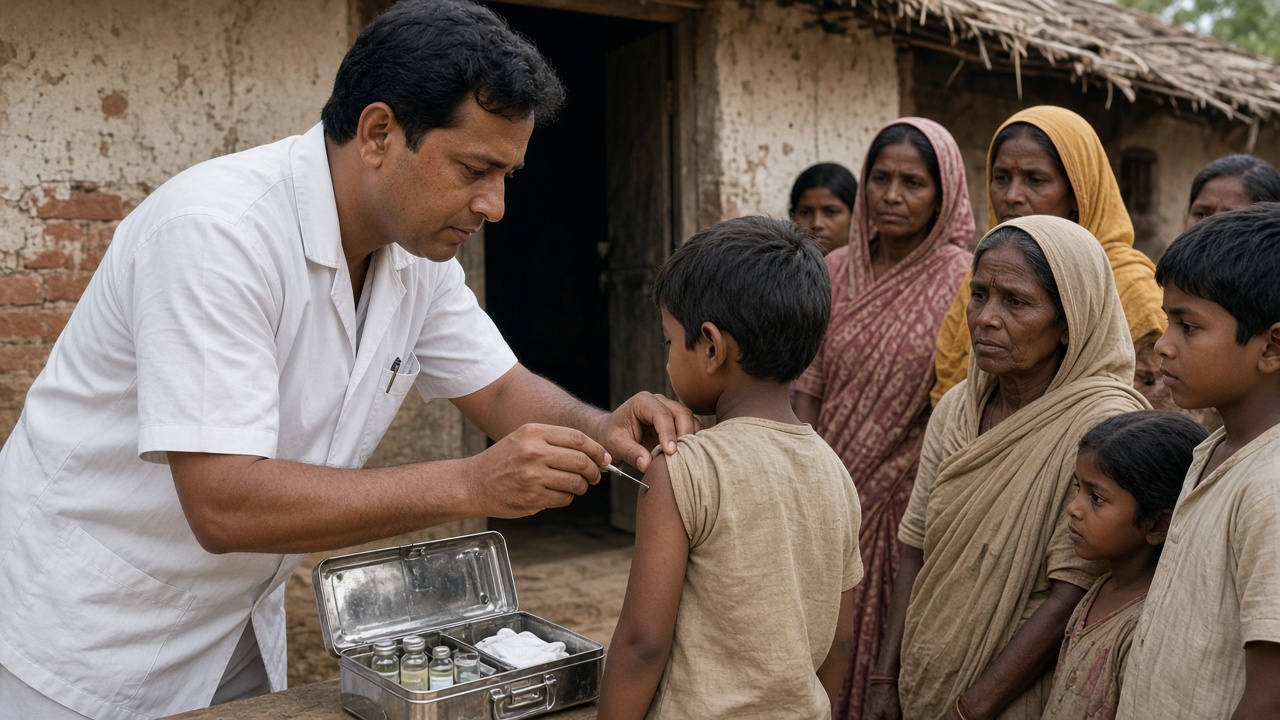
In 1796 Edward Jenner showed that cowpox could protect against smallpox. The word vaccine comes from Latin vacca (cow).
The method spreads globally — including to Bombay in 1802 — replacing much of the older variolation practice over time.
Cowpox material offered protection without full smallpox (artistic illustration).
1796: Jenner’s famous demonstration with James Phipps and later smallpox challenge.
Arm-to-arm chains: Early vaccine kept alive by transferring blister fluid between children.
1802 India: First recorded vaccination in Bombay — start of India’s vaccine story.
Laws & institutes: 19th-century vaccination acts and later calf-lymph production improve supply.
Tools
Cowpox / vaccinia: Related virus that confers cross-protection.
Scratch method: Material into the skin of the upper arm.
Lymph production: Later grown on calves in institutes.
Features
Safer than variolation: Does not use full smallpox.
Scalable idea: Becomes a public health programme.
Name origin: “Vaccine” enters the language.
🔬 Germ Theory Labs1880s – 1940s
Pasteur & Lab Vaccines
Once germs were understood, scientists could attenuate or kill them on purpose. Pasteur’s anthrax and rabies work opened a century of diphtheria antitoxin and toxoids,
tetanus, pertussis, BCG against tuberculosis, yellow fever, influenza, and more.
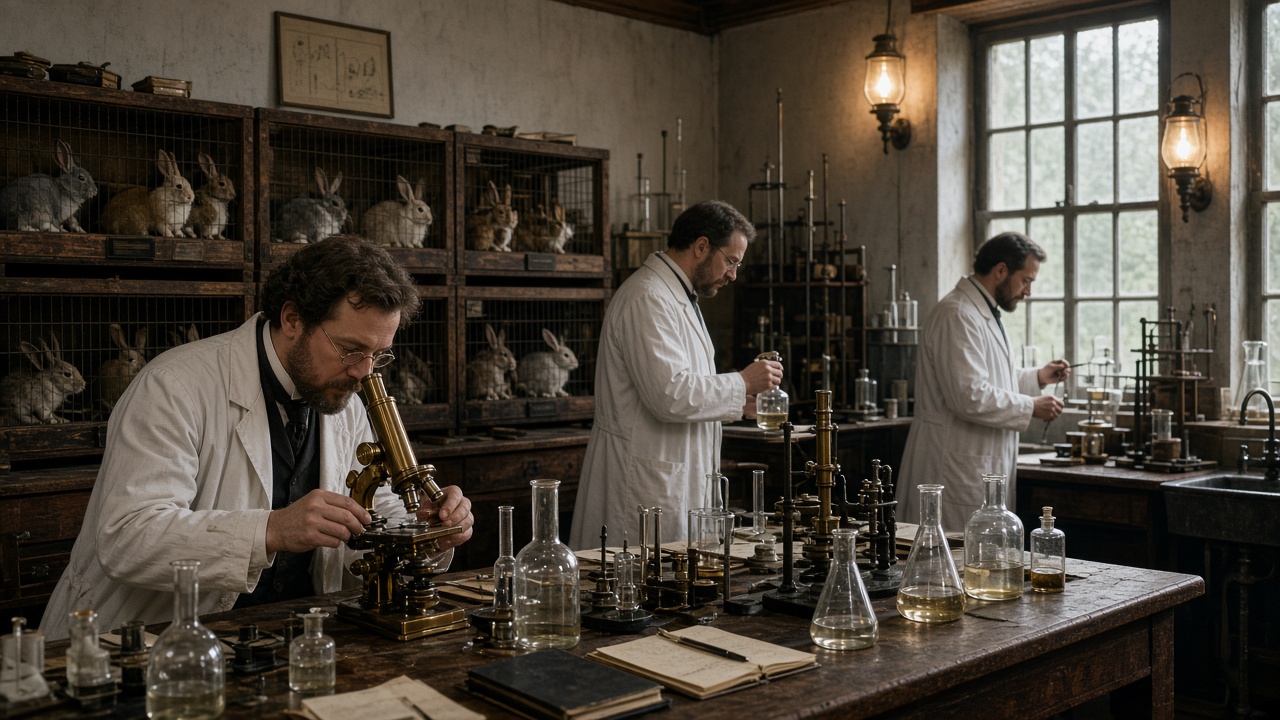
Laboratories turned vaccination from a farm insight into a science (artistic illustration).
Mid-century science delivered polio vaccines; WHO and national programmes organised the greatest eradication drive in history against smallpox.
India’s house-to-house search teams and Pulse Polio booths belong to this mass-campaign tradition — told in full on dedicated pages.
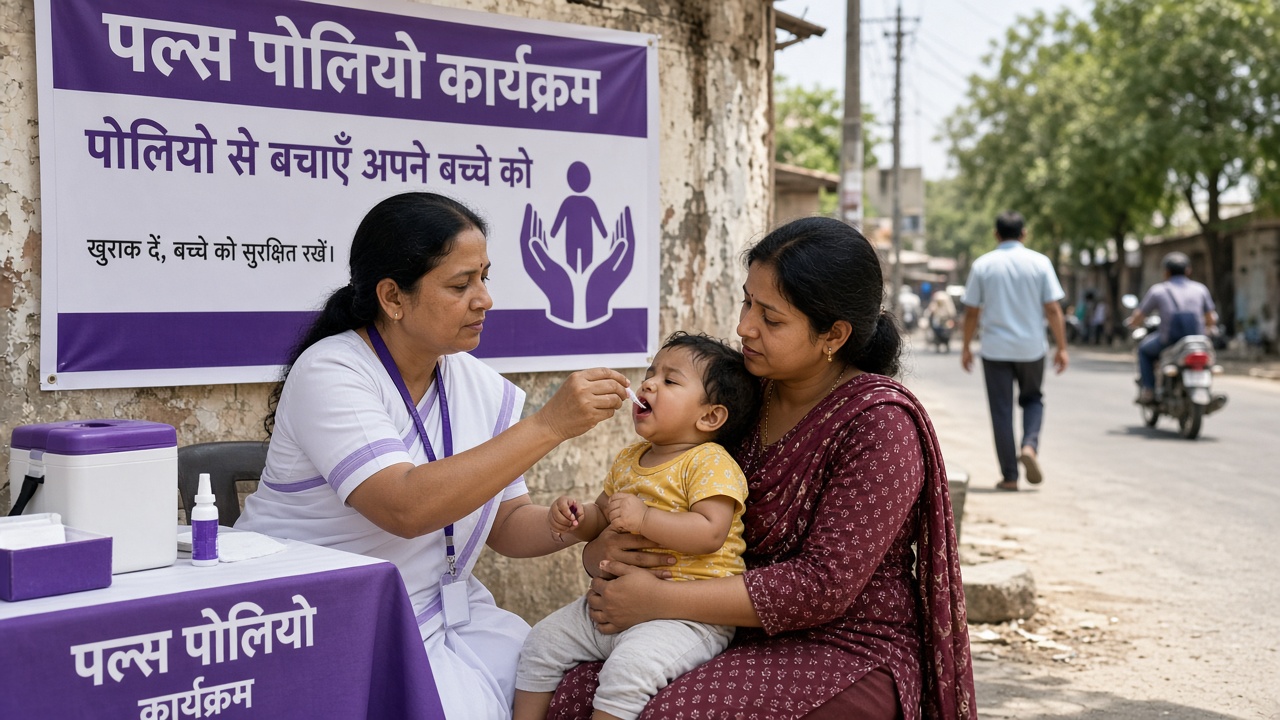
Oral drops made polio vaccination fast enough for national booth days (artistic illustration).The bifurcated needle used tiny doses and little training (artistic illustration).
1955 / early 1960s: Salk injectable IPV and Sabin oral OPV transform polio control.
Smallpox endgame: Search-and-containment plus vaccination; world declared free in 1980.
Lesson: Vaccines need logistics, trust, and surveillance — not vials alone.
Tools
IPV / OPV: Injectable and oral polio vaccines.
Bifurcated needle: Efficient smallpox delivery.
Case finding: Outbreak maps and ring vaccination.
Features
Eradication possible: Smallpox proves it.
Community mobilisation: Booths, volunteers, ink marks.
Cold chain begins: Keeping doses potent on the move.
📅 Routine Shots1974 – 2019
EPI, UIP & Childhood Schedules
WHO’s Expanded Programme on Immunization (1974) and India’s EPI (1978) / Universal Immunization Programme (1985) put vaccines on a calendar:
BCG, DPT, polio, measles, and later hepatitis B, Hib, rotavirus, PCV, and others — delivered by ANMs, ASHAs, and cold-chain workers.
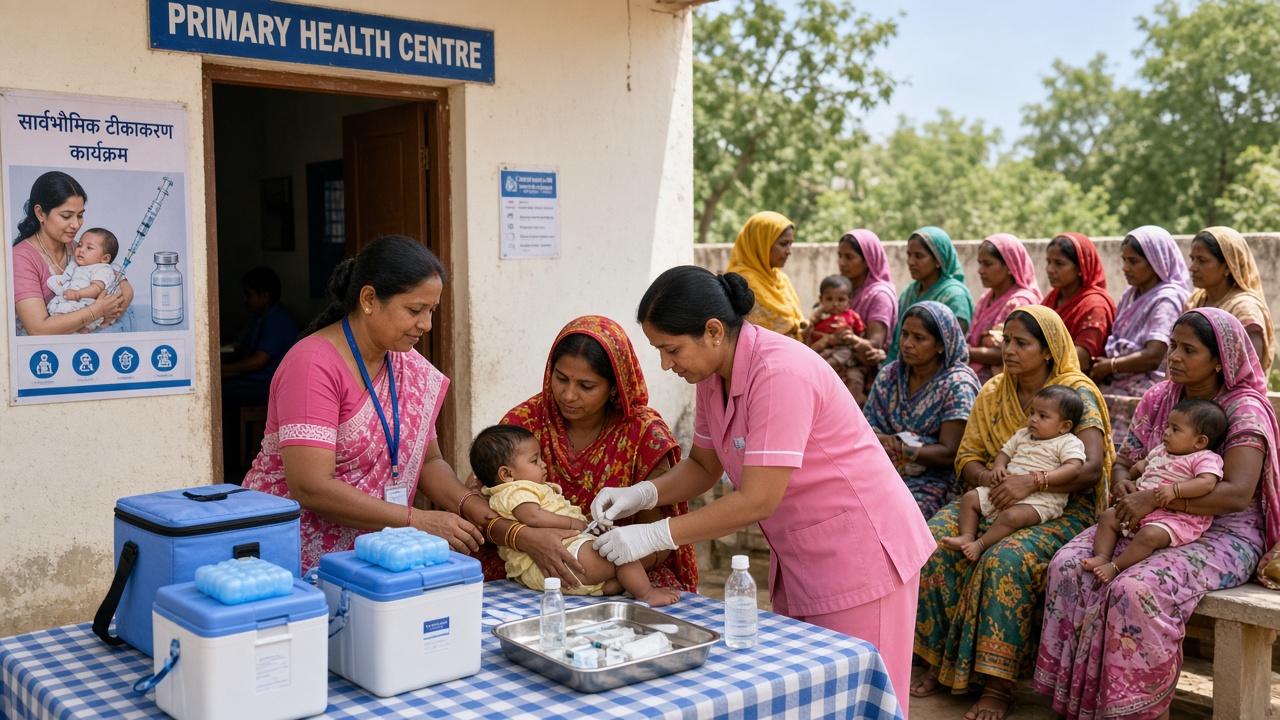
Session days and vaccine carriers make routine immunisation a village habit (artistic illustration).
1978 / 1985: India builds EPI then strengthens UIP for free childhood vaccines.
Pulse Polio (from 1995): National booth days drive OPV coverage (details on the polio page).
New introductions: Hep B, pentavalent, measles-rubella, rotavirus, pneumococcal, and more join the schedule.
Mission Indradhanush: Special drives to reach under-vaccinated children and pregnant women.
Tools
Vaccine carriers & ILRs: Ice-lined refrigerators and cold boxes.
MCP / eVIN: Cards and later digital stock tracking.
Open vial policy: Rules that reduce wastage safely.
Features
Free at public facilities: Equity goal of UIP.
Frontline workers: ANM and ASHA trust networks.
Coverage gaps: Urban migrants and remote areas need extra focus.
⚡ Pandemic Speed2020 – Present
COVID & New Platforms
COVID-19 compressed vaccine science, trials, manufacturing, and rollout into months. mRNA and viral-vector platforms joined inactivated vaccines;
India ran one of the world’s largest campaigns, with digital registration, workplace and hospital centres, and huge domestic production.
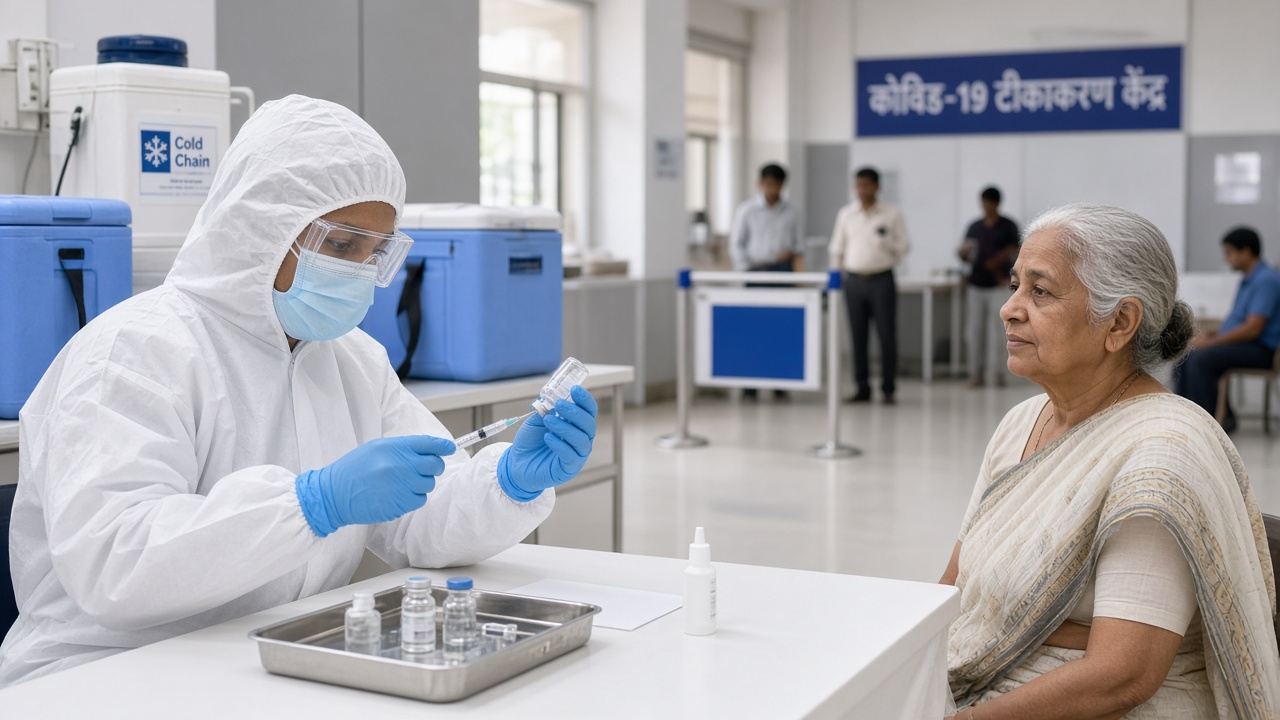
PPE, vials, and cold boxes marked the COVID vaccination era (artistic illustration).
2020–21: Emergency authorisations; India begins large-scale adult vaccination in 2021.
Platforms: Inactivated, viral-vector, protein, and mRNA approaches all play roles worldwide.
Logistics: Ultra-cold needs for some products; digital certificates and appointment systems.
Ongoing: Boosters, updated strains, vaccine equity debates, and prep for the next pandemic.
Tools
mRNA / vectors: Genetic instructions or harmless carriers.
Fill-finish plants: Scaling vials at industrial speed.
Digital public health: Registration, certificates, dashboards.
Features
Speed: Years of R&D compressed by global urgency.
Adult focus: Beyond the childhood UIP calendar.
Trust & rumour: Communication becomes as critical as supply.
Types of Vaccines (Simple Map)
Type
Idea
Examples
Live attenuated
Weakened living germ
Oral polio (Sabin), BCG, measles
Inactivated / killed
Dead germ that still teaches
Salk IPV, some COVID / flu shots
Toxoid
Harmless toxin form
Diphtheria, tetanus
Subunit / conjugate
Pieces of the germ
Hep B, Hib, PCV
Viral vector / mRNA
Instructions or carrier
Some COVID platforms
Then vs Now
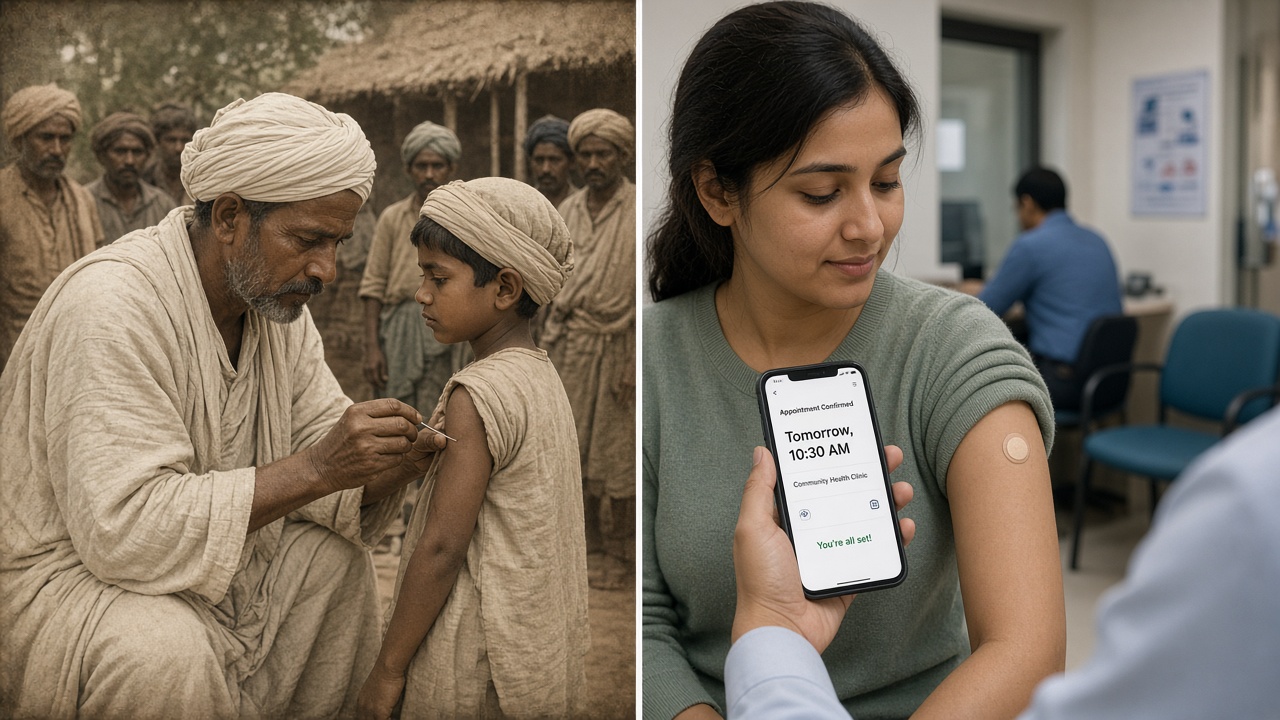
From arm-to-arm chains to appointments and bandages (artistic illustration).
Then
Variolation risk and arm-to-arm chains
Few diseases with any vaccine
Paper records and village vaccinators
Epidemics accepted as fate
Now
Schedules for many childhood diseases
Cold chain, eVIN, digital certificates
Eradication wins (smallpox) and near-wins (polio)
Platforms that can pivot in a pandemic
India spotlight
India’s vaccine journey
India imported Jenner’s method in 1802, built vaccine institutes, ran the world’s toughest smallpox endgame, used Pulse Polio to protect every child,
expanded UIP, and became a major vaccine manufacturer for COVID and routine antigens.
1802
First vaccination
Cowpox vaccine reaches Bombay; arm-to-arm chains carry it inland.
1962–77
Smallpox endgame
National programme, search teams, last case 1975, certification 1977 — full story on the smallpox page.
1978–2014
UIP & polio-free
EPI/UIP expand routine shots; Pulse Polio ends wild poliovirus — see the polio page.
2021+
COVID scale
Mass adult vaccination and manufacturing capacity on global display.
Vaccine Milestones
Year
Milestone
What changed
Pre-1796
Variolation / tika
Risky deliberate smallpox exposure
1796
Jenner
Cowpox vaccination begins modern era
1802
India’s first vaccination
Jennerian method in Bombay
1880s
Pasteur vaccines
Lab-made vaccines beyond smallpox
1955 / 1960s
Polio IPV & OPV
Tools for mass polio control
1977 / 1980
Smallpox-free India / world
First disease eradicated
1978 / 1985
EPI / UIP in India
Routine childhood immunisation
1995+
Pulse Polio
National OPV booth campaigns
2014
India polio-free
WHO SEAR certification
2020–21
COVID vaccines
New platforms + mega rollout
Timeline Summary
Era
Headline
Before Jenner
Variolation and tika — imperfect protection
Jenner
Cowpox vaccine names the field
Pasteur labs
Many vaccines from germ science
Mass campaigns
Polio tools; smallpox eradicated
UIP schedules
Routine childhood immunisation
COVID
Pandemic platforms and adult campaigns
Test Your Knowledge
20 quick questions from the vaccines timeline. Click each question to reveal the answer.
Answer: Recognise a germ (or part of it) safely so it can fight the real infection later.
Answer: Deliberately giving smallpox material through the skin to create immunity — riskier than cowpox vaccine.
Answer: Edward Jenner.
Answer:Vacca (cow).
Answer: 1802, in Bombay.
Answer: Anthrax or rabies vaccines (among others).
Answer: Jonas Salk.
Answer: Albert Sabin.
Answer: 1980 (World Health Assembly).
Answer: The bifurcated needle.
Answer: Expanded Programme on Immunization and Universal Immunization Programme.
Answer: 1985 (building on EPI from 1978).
Answer: National campaigns giving oral polio drops to children on booth days.
Answer: 2014.
Answer: mRNA or viral-vector vaccines (among others).
Answer: When enough people are immune that a germ struggles to spread, protecting the community.
Answer: Many vaccines spoil if they get too warm (or, for some, too warm after thawing) — potency depends on proper temperature.
Answer: health/smallpox-eradication-timeline.html on WorldTimelineHub.
Answer: health/polio-eradication.html on WorldTimelineHub.
Click any panel to expand and explore the visual mood.
Vaccines in pictures — Jenner, labs, polio drops, smallpox needles, UIP camps, COVID centres, and then vs now.
Overview
Jenner to booth
Jenner
1796
Lab Vaccines
Pasteur era
Polio Drops
Pulse Polio
Smallpox
Bifurcated needle
UIP
Routine shots
COVID
New platforms
Then & Now
Arm-to-arm → apps
Explore all health timelines
Jump to any other health timeline on WorldTimelineHub.
Disclaimer: This content is AI-generated for educational purposes and may contain errors or outdated details. For correct and authoritative information, please refer to official and reliable sources such as government publications, manufacturers, museums, and academic references.