Malaria Control Timeline of India: Quinine → DDT Spraying → Urban Malaria Scheme → Modified Plan → Bed Nets & Rapid Tests → Elimination Targets
Malaria has been one of India’s oldest and biggest killers. The mosquito link was proved in Secunderabad in 1897, DDT spraying nearly wiped out the disease by 1965, and then it roared back. India responded with the Urban
Malaria Scheme in 1971, a new plan in 1977, and later rapid tests, bed nets, and village health workers — and since 2016 it has followed a national framework to eliminate malaria by 2030.
This timeline covers vishama jwara in Ayurveda, cinchona plantations, post-office quinine, Ronald Ross, the Malaria Institute of India, DDT spraying, NMCP and NMEP, resistance and resurgence, the Urban Malaria Scheme,
larva-eating fish, the Modified Plan of Operation, NVBDCP, ASHAs, rapid diagnostic tests, artemisinin combination therapy, long-lasting bed nets, Odisha’s DAMaN, and the National Framework for Malaria Elimination 2016–2030.
Unlike smallpox or polio, malaria cannot be stopped with a single vaccine campaign. It depends on mosquitoes, water, weather, housing, forests, and the movement of people, so India has had to change its strategy again and
again. Its story shows how science, insecticides, medicines, health workers, and clean surroundings together can push back a disease that once infected crores of Indians every year.
Big picture
India’s fight against malaria in one view
Quinine was the only defence until Ross proved the mosquito link in 1897. DDT spraying from 1953 nearly eradicated malaria by 1965, resistance brought it back in the 1970s, the Urban Malaria Scheme and Modified Plan
targeted cities and high-risk areas, rapid tests and bed nets reached villages after 2003, and the 2016 framework set the goal of a malaria-free India by 2030. Related timelines:
water facility,
irrigation,
research in India.
1897
Mosquito link proved in Secunderabad
7.5 crore
Estimated yearly cases at independence
1971
Urban Malaria Scheme begins
2030
Target for a malaria-free India
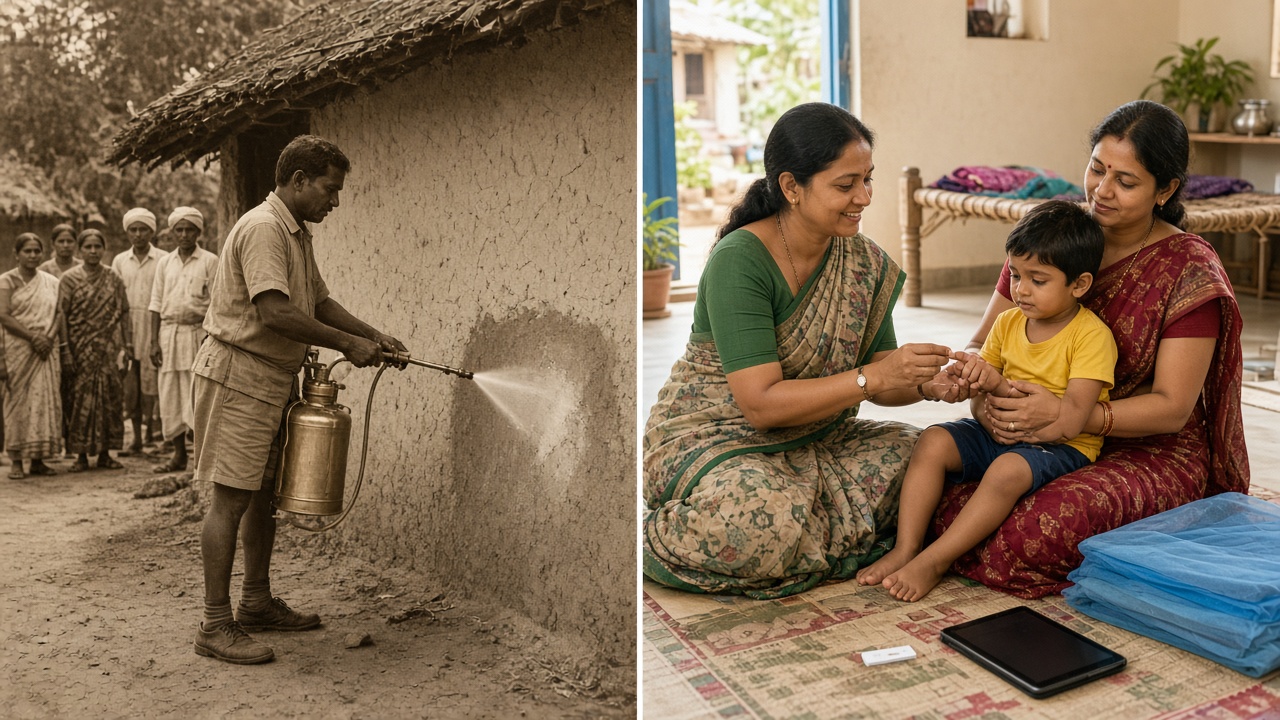
From spraying mud walls with DDT to a rapid finger-prick test at home (artistic illustration).
Malaria Control in India Then vs Now at a Glance
Feature
Then
Now
Scale
Crores of cases a year
A few lakh reported cases a year
Medicine
Bitter quinine powder
Chloroquine, primaquine, and artemisinin combinations
Diagnosis
Guessing from fever and chills
Rapid test in minutes and microscopy
Mosquito control
Oil on ponds, then DDT on walls
Targeted spraying, larvicides, and fish
At night
Cotton nets for a few; smoke for most
Free long-lasting insecticidal nets in high-risk areas
Cities
Few special measures
Urban Malaria Scheme and building bye-laws
Who helps
Doctors in towns
ASHAs, multipurpose workers, and village volunteers
Records
Paper registers
Digital case reporting and mapping
Goal
Reduce illness
Zero indigenous cases and certification
Research
A few colonial labs
National institutes and Indian vaccine research
🌿 QuinineBefore 1947
Fevers, Quinine & Ross’s Discovery
For centuries Indians suffered from recurring fevers with chills, blamed on “bad air” from marshes. Quinine from cinchona bark became the main medicine, and plantations grew it in the hills. In 1897 an army doctor in Secunderabad proved that mosquitoes spread malaria, opening the door to fighting the insect as well as the fever.
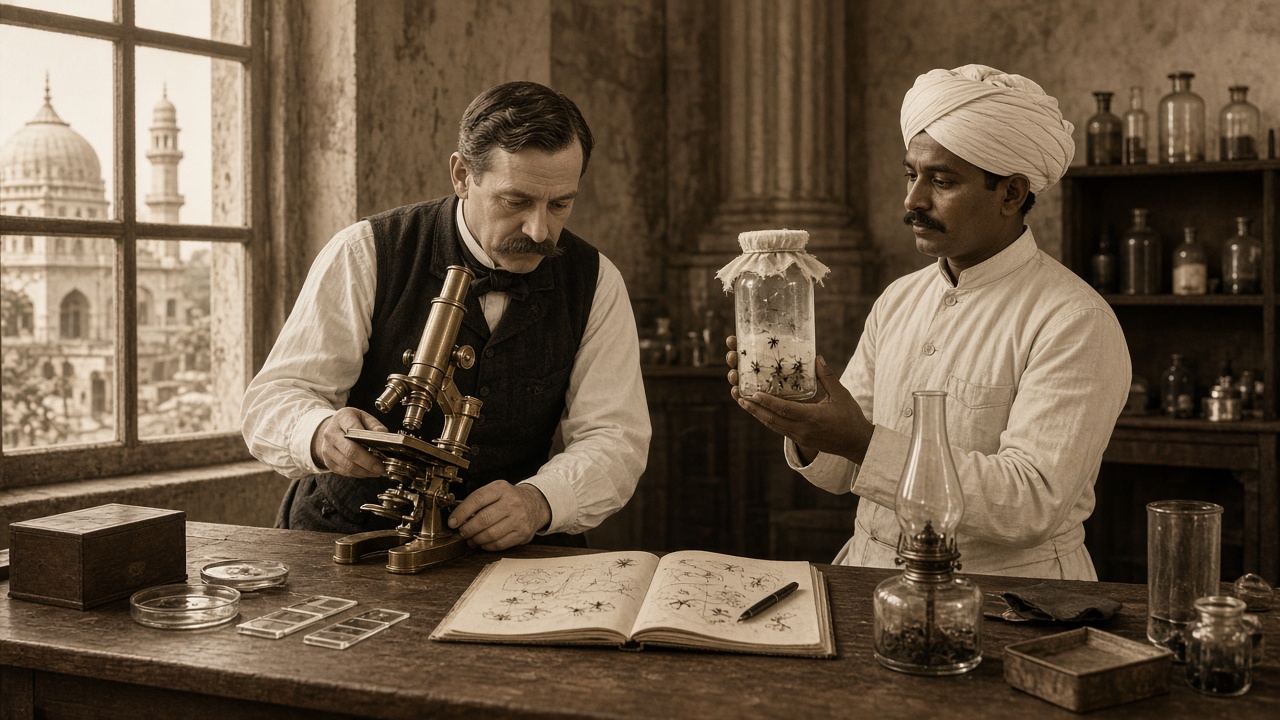
An army doctor and his assistant study mosquitoes in a Secunderabad laboratory (artistic illustration).
Ancient India: The Charaka Samhita and other Ayurvedic texts describe vishama jwara, irregular fevers with chills, and link some fevers to seasons and marshy areas.
1860s–1890s: Cinchona plantations are started in the Nilgiris and near Darjeeling, and from the 1890s cheap packets of quinine are sold through post offices in villages.
20 August 1897: Ronald Ross finds malaria parasites in an Anopheles mosquito in Secunderabad, proving mosquitoes spread malaria, and wins the Nobel Prize in 1902.
1909–1938: A malaria conference is held at Shimla (1909), the Malaria Survey of India is formed (1927), and it becomes the Malaria Institute of India (1938); at independence India has an estimated 7.5 crore cases a year.
Technology
Quinine: From cinchona bark.
Microscope: Parasites in blood and mosquitoes.
Oil and drainage: Early larva control.
Features
Post-office quinine: Medicine for villages.
Mosquito link: A world first in India.
Huge burden: Lakhs of deaths a year.
🧴 DDT1947 – 1965
DDT Spraying & the Eradication Dream
After independence, India attacked malaria with DDT, an insecticide that kept killing mosquitoes for months after being sprayed on house walls. Spray teams covered the whole country, surveillance workers took blood smears from fever cases, and within about a decade malaria fell to a tiny fraction of its old level.
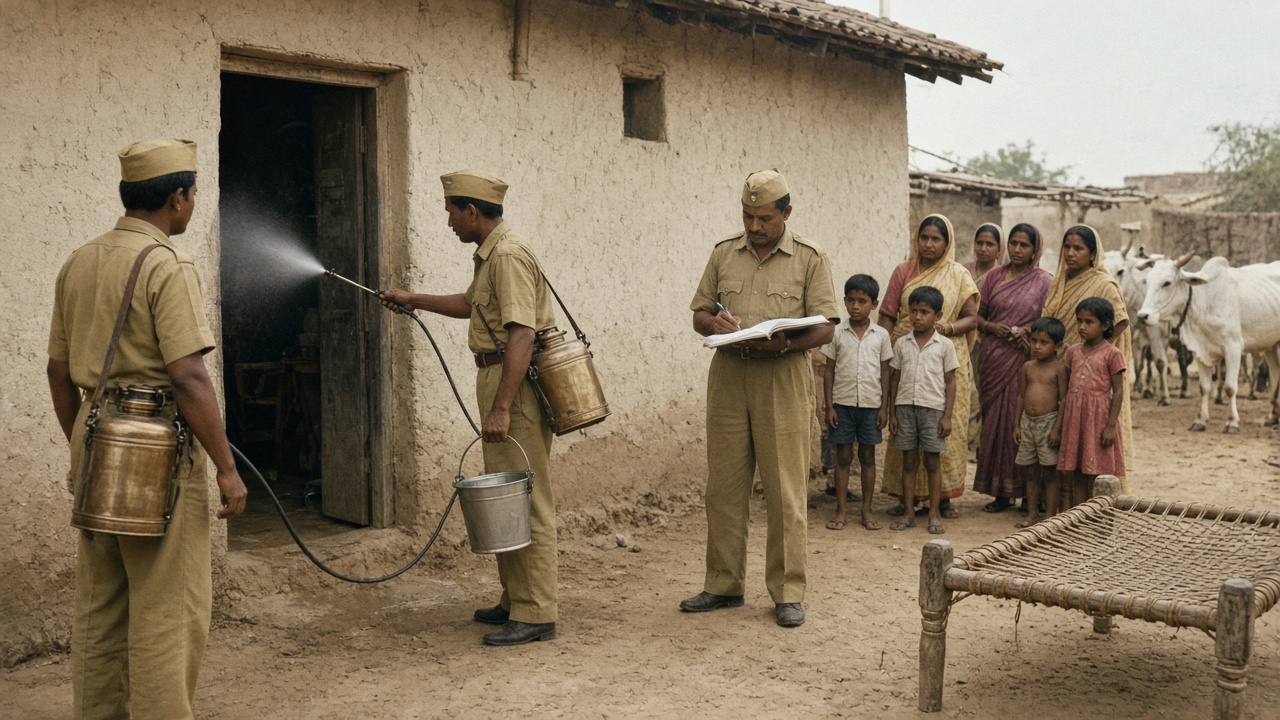
A spray team treats house walls with DDT while villagers watch (artistic illustration).
1946–1952: Trials show that spraying DDT inside houses sharply reduces malaria, and India begins planning a national programme.
1953: The National Malaria Control Programme (NMCP) begins, with teams spraying DDT inside homes across the malaria-affected areas of the country.
1958: The programme becomes the National Malaria Eradication Programme (NMEP), with house-to-house surveillance and blood smears from every fever case.
1965: Reported cases fall to about one lakh a year with no reported deaths, and many people believe malaria will soon disappear from India.
Technology
DDT: Long-lasting indoor spray.
Stirrup pumps: Hand-operated sprayers.
Blood smears: Glass slides for testing.
Features
National spraying: Every affected village.
Fever surveillance: House-to-house visits.
Dramatic fall: Near eradication by 1965.
🏙️ Urban1966 – 1976
Resurgence & the Urban Malaria Scheme
Malaria came back. Mosquitoes became resistant to DDT, insecticide and money ran short, and fast-growing cities offered new breeding places in water tanks, wells, and building sites. In 1971 India launched the Urban Malaria Scheme to fight the city-dwelling Anopheles stephensi mosquito by attacking its larvae in water.
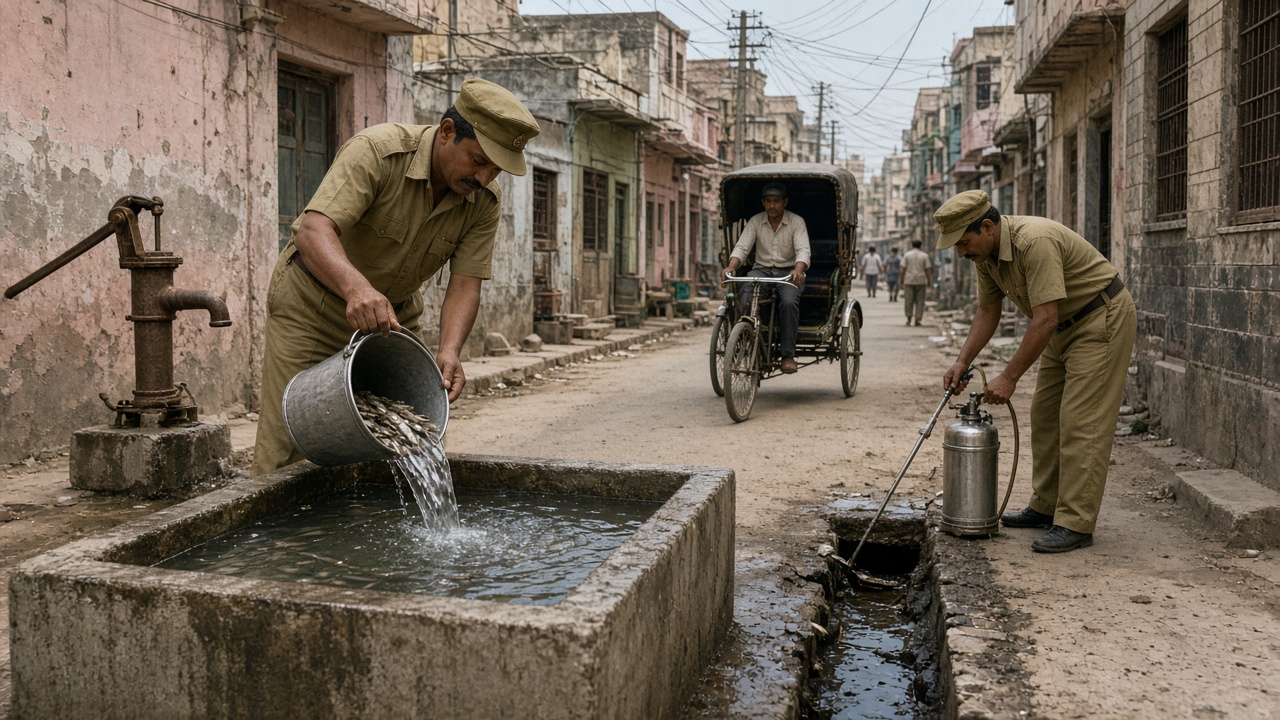
Municipal workers release larva-eating fish and treat drains in a city lane (artistic illustration).
Late 1960s: Cases start rising again as DDT resistance spreads, spraying rounds are missed, and surveillance weakens in many states.
1971: The Urban Malaria Scheme (UMS) begins in towns and cities, using larvicides, larva-eating fish such as Gambusia and guppy, and removal of stagnant water instead of house spraying.
Early 1970s: Chloroquine-resistant falciparum malaria is detected in the North-East (1973), and new irrigation and construction projects create more breeding sites.
1976: Reported cases climb to about 64 lakh, one of the highest numbers since the start of the national programme.
Technology
Larvicides: Chemicals for water.
Larva-eating fish: Gambusia and guppy.
Bye-laws: Covered tanks and drains.
Features
City focus: Wells, tanks, and sites.
Resistance: DDT and chloroquine.
Resurgence: Lakhs of cases again.
📋 Plan1977 – 2002
Modified Plan & Targeted Control
India changed its goal from eradication to control. Spraying was focused on high-risk areas, medicines were placed in every village through volunteers, and special projects tackled the deadly falciparum malaria of forests and tribal areas. Cases fell quickly, though malaria remained stubborn in the North-East, Odisha, and central India.
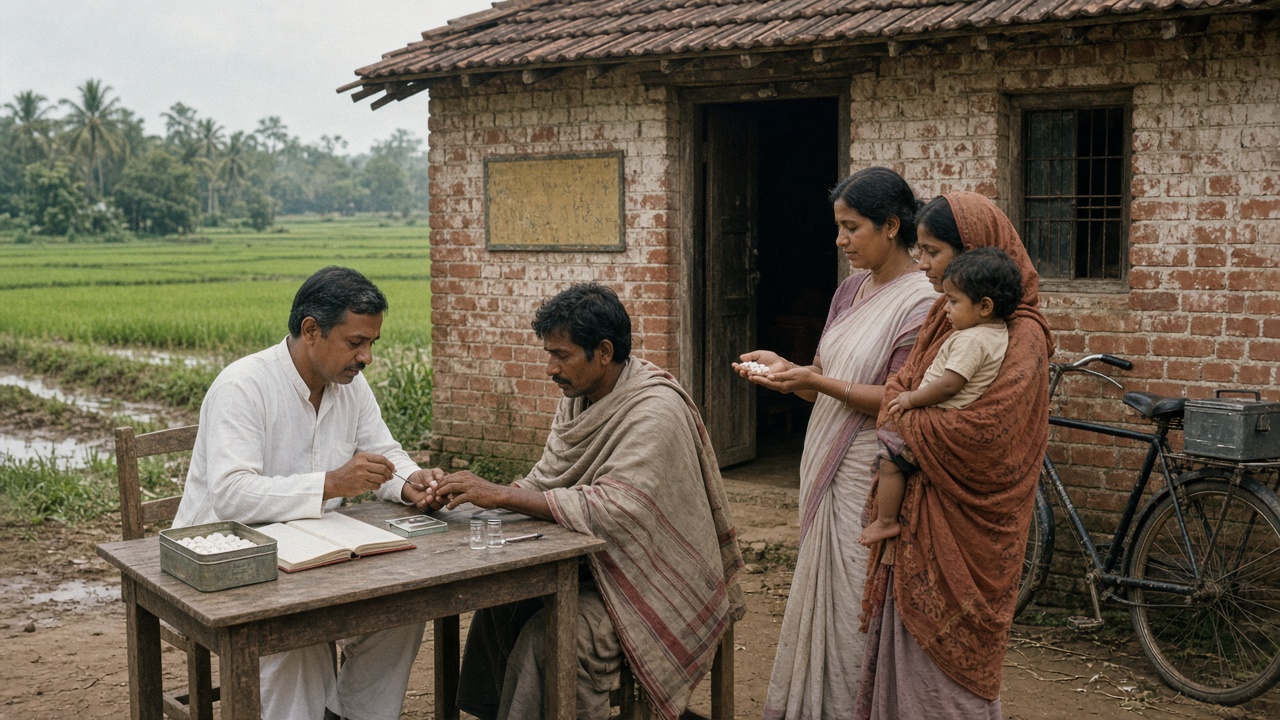
A village volunteer takes a blood smear and gives tablets at a fever treatment depot (artistic illustration).
April 1977: The Modified Plan of Operation (MPO) sets up drug distribution centres and fever treatment depots in villages, targets spraying by risk, and cuts cases to about 20 lakh by the mid-1980s.
1977: The P. falciparum Containment Programme begins in the North-East and other falciparum-heavy areas to slow the spread of drug-resistant malaria.
1994–1997: Deadly outbreaks in Rajasthan and elsewhere lead to the Malaria Action Programme (1995) and the World Bank–supported Enhanced Malaria Control Project (1997) for tribal districts.
1999: NMEP is renamed the National Anti-Malaria Programme (NAMP), reflecting the shift from eradication to control.
Technology
New insecticides: Malathion and pyrethroids.
Treated nets: Early pilots.
Drug depots: Chloroquine in villages.
Features
Control, not eradication: Realistic goals.
Risk-based spraying: High-burden areas first.
Tribal focus: Forest malaria.
🧪 Tests2003 – 2015
NVBDCP, ASHAs, Rapid Tests & Bed Nets
India combined its programmes against mosquito- and sandfly-borne diseases and brought testing and treatment to the doorstep. Village health workers used rapid diagnostic tests that give a result in about 15 minutes, started effective artemisinin-based medicines on the spot, and handed out long-lasting insecticidal bed nets in high-risk areas.
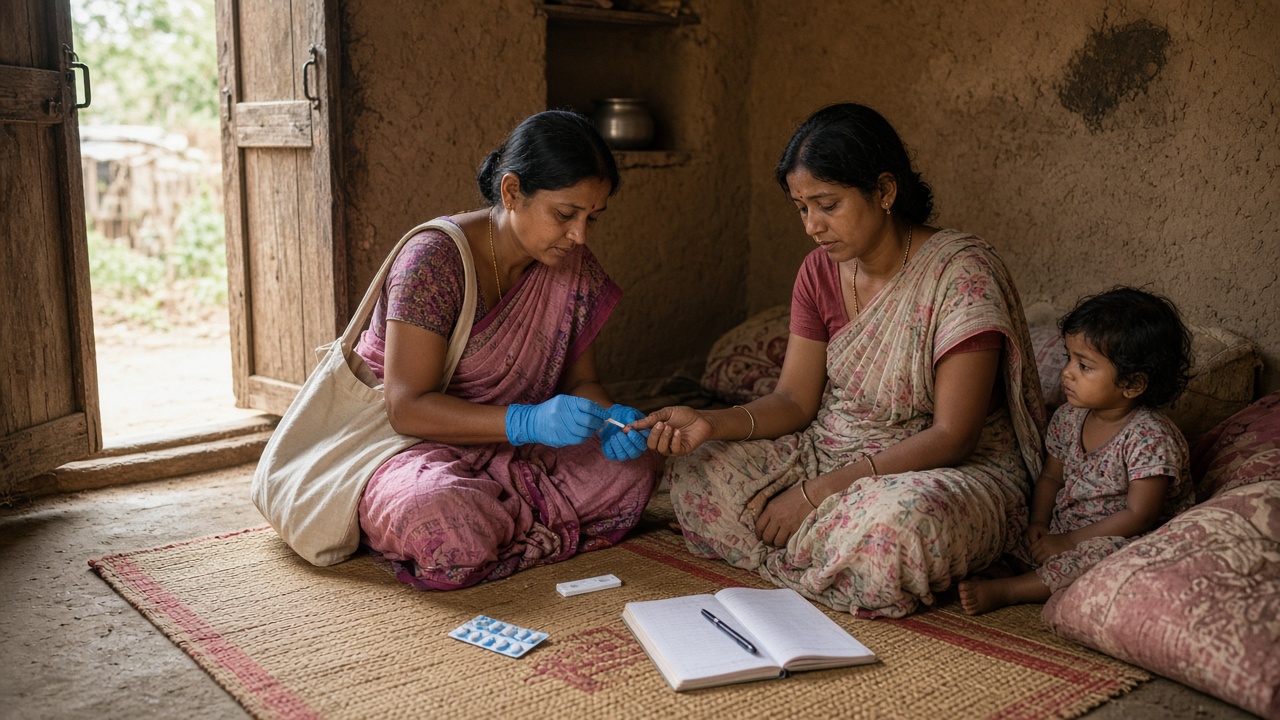
A village health worker tests a fever patient with a rapid diagnostic kit (artistic illustration).
2003–2004: The National Vector Borne Disease Control Programme (NVBDCP) brings malaria, dengue, Japanese encephalitis, filariasis, and kala-azar (and later chikungunya) under one programme.
2005–2010: The National Rural Health Mission creates ASHA workers, rapid diagnostic tests reach villages, and artemisinin combination therapy (ACT) becomes the treatment for falciparum malaria.
2009–2013: Long-lasting insecticidal nets are distributed in high-burden districts, and bivalent rapid tests that detect both vivax and falciparum are introduced (2013).
2015: India commits at the East Asia Summit to eliminate malaria by 2030, with about 11.7 lakh reported cases that year.
Technology
Rapid tests: Result in minutes.
ACT medicines: Artemisinin combinations.
LLINs: Insecticide lasts years.
Features
Doorstep testing: ASHAs in villages.
Test before treat: No guessing.
One programme: Six vector diseases.
🎯 Elimination2016 – Future
Elimination Targets 2016–2030
In 2016 India moved from controlling malaria to eliminating it. A national framework grouped states by burden and set deadlines, crores of bed nets reached forest and tribal villages, and states like Odisha ran special campaigns in hard-to-reach areas. Reported cases fell steeply, and the focus is now on finding and stopping every last local infection.
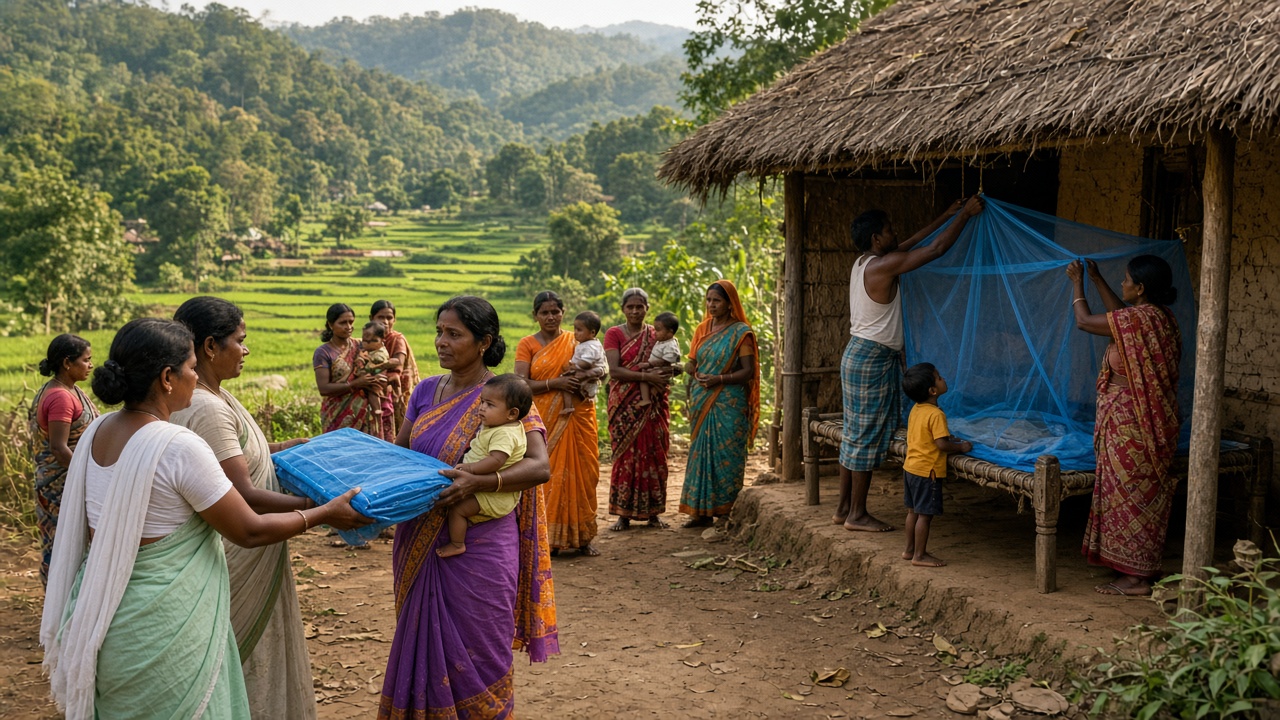
Families in a forest village receive and hang long-lasting insecticidal nets (artistic illustration).
11 February 2016: The National Framework for Malaria Elimination (NFME) 2016–2030 is launched, aiming for zero indigenous cases across India by 2027 and certification by 2030.
2017: The National Strategic Plan for Malaria Elimination 2017–2022 is released, and Odisha starts DAMaN (Durgama Anchalare Malaria Nirakaran) to test and treat people in remote villages.
2018–2022: India joins WHO’s High Burden to High Impact approach, and reported cases fall from about 11.7 lakh in 2015 to under 2 lakh a year by 2020–2022.
2023–2030: A new National Strategic Plan (2023–2027) targets the remaining hotspots, while vaccines, better surveillance, and heat and climate planning prepare for the 2030 goal.
Technology
Case mapping: Digital surveillance.
Malaria vaccines: New tools emerging.
Mass nets: Crores distributed.
Features
State categories: Targets by burden.
Hotspot focus: Forest and tribal areas.
2030 goal: Malaria-free India.
India’s Malaria Programmes at a Glance
Programme
Year
Main focus
Malaria Institute of India
1938
Research and training
National Malaria Control Programme (NMCP)
1953
DDT spraying inside homes
National Malaria Eradication Programme (NMEP)
1958
Spraying plus house-to-house surveillance
Urban Malaria Scheme (UMS)
1971
Anti-larval work in towns and cities
Modified Plan of Operation (MPO)
1977
Control, village drug depots, risk-based spraying
P. falciparum Containment Programme
1977
Falciparum and drug resistance in the North-East
Malaria Action Programme
1995
High-risk areas after outbreaks
Enhanced Malaria Control Project
1997
Tribal and high-burden districts
National Anti-Malaria Programme (NAMP)
1999
New name for the national programme
National Vector Borne Disease Control Programme
2003–04
Malaria with five other vector-borne diseases
National Framework for Malaria Elimination
2016
Elimination by 2030
National Strategic Plans
2017 and 2023
Step-by-step elimination targets
Malaria Cases in India Over the Years
Approximate figures from national reports and historical estimates. Reported cases are lower than the true number of infections, and figures in different sources can vary.
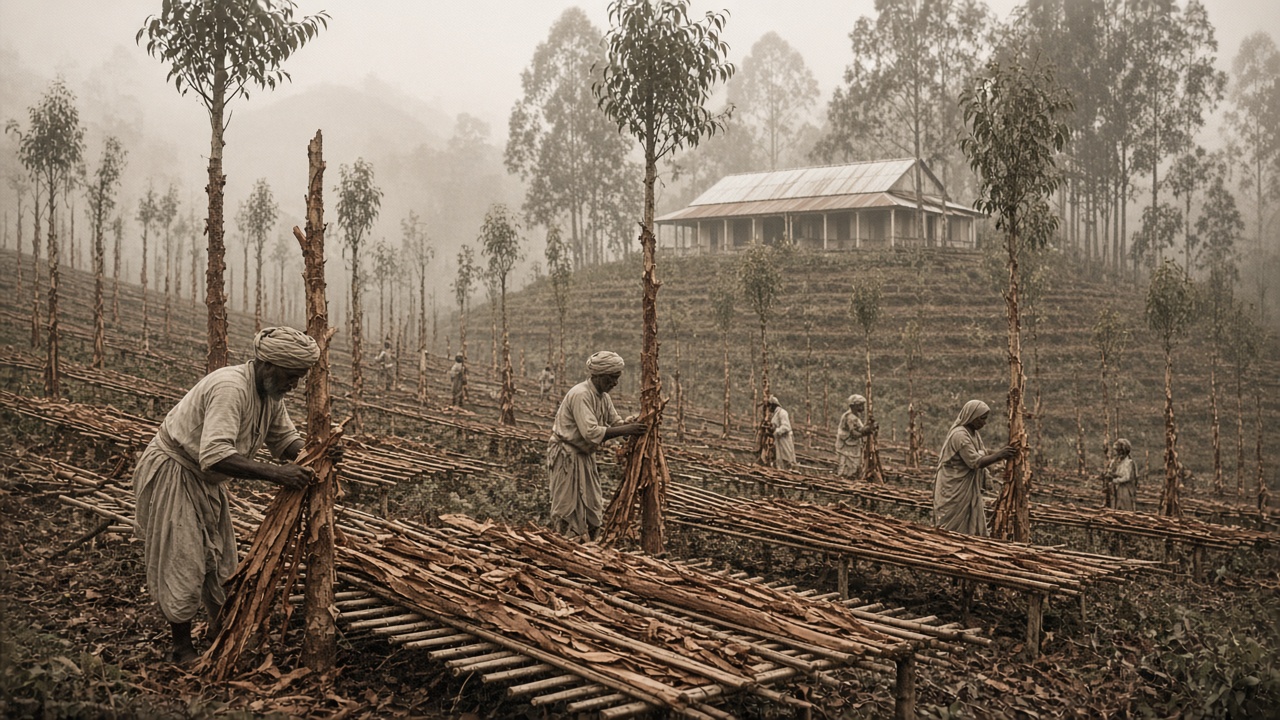
Cinchona bark dries on a hill plantation — quinine was India’s main defence when cases ran into crores (artistic illustration).
Year
Cases
What was happening
Around 1947
About 7.5 crore (estimate)
Around 8 lakh deaths a year estimated
1965
About 1 lakh
Near eradication; no reported deaths
1976
About 64 lakh
Peak of the resurgence
Mid-1980s
About 20 lakh
Modified Plan brings cases down
2015
About 11.7 lakh
Elimination commitment made
2018
About 4.3 lakh
Bed nets and Odisha’s DAMaN
2020–2022
Under 2 lakh a year
Steep fall continues
National Framework for Malaria Elimination 2016–2030
The framework measures malaria with the annual parasite incidence (API) — confirmed cases per 1,000 people per year — and groups states and union territories into categories with different targets.
Category / Target
Meaning
Category 0
No local transmission — prevent malaria from returning
Category 1
API below 1 in the state and all its districts — elimination phase
Category 2
API below 1 in the state but 1 or more in some districts — pre-elimination
Category 3
API of 1 or more — intensified control
By 2027
Zero indigenous cases across India
By 2030
Prevent re-establishment and seek malaria-free certification
Tools Used to Fight Malaria in India
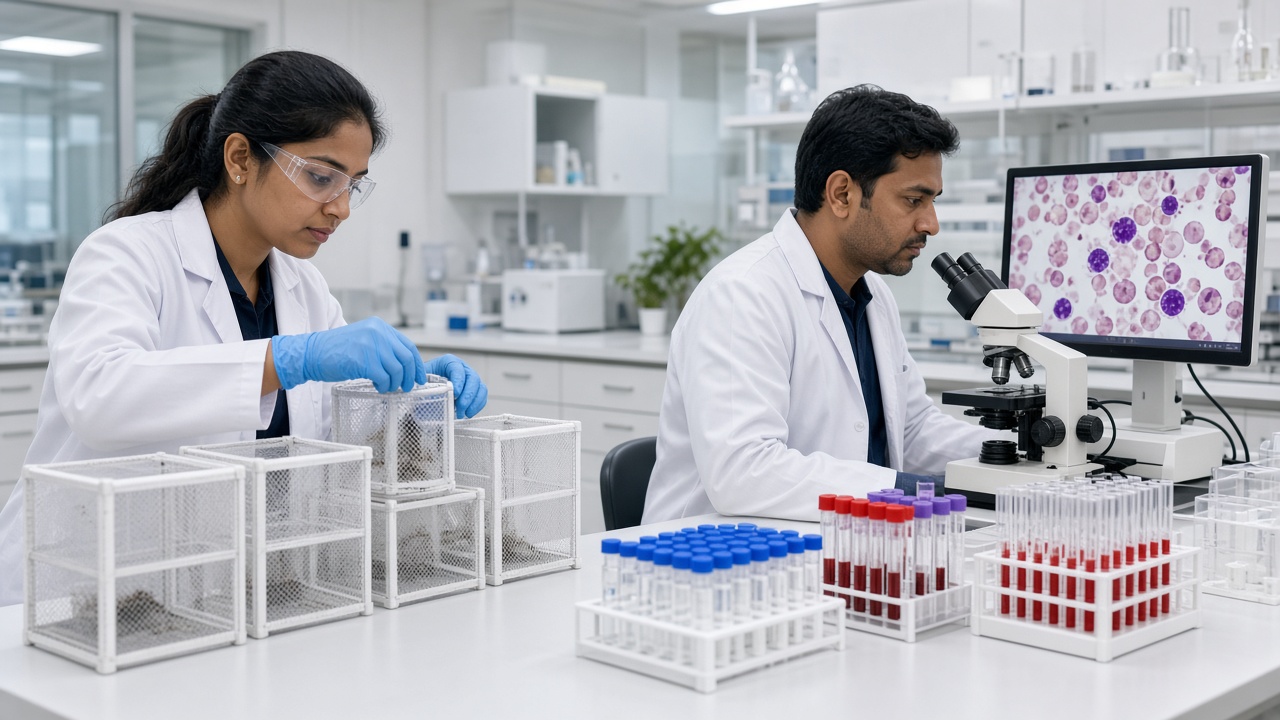
Scientists study mosquitoes and malaria parasites in a modern laboratory (artistic illustration).
Tool
Type
What it does
Indoor residual spraying
Vector control
Insecticide on walls kills resting mosquitoes
Long-lasting insecticidal nets
Vector control
Protect sleepers and kill mosquitoes
Larvicides
Vector control
Kill larvae in water that cannot be emptied
Gambusia and guppy fish
Biological control
Eat mosquito larvae in tanks and ponds
Source reduction
Community action
Empty coolers and cover tanks every week
Microscopy
Diagnosis
Blood smear shows the parasite type
Rapid diagnostic test
Diagnosis
Finger-prick result in about 15 minutes
Chloroquine and primaquine
Treatment
Treat vivax malaria and prevent relapse
Artemisinin combination therapy
Treatment
Treats falciparum malaria
Surveillance
Tracking
Finds, reports, and investigates every case
Malaria vaccines
Prevention
New vaccines and Indian vaccine research
Malaria Control in India Timeline Summary
Year / Era
Milestone
Ancient India
Vishama jwara in Ayurvedic texts
1860s
Cinchona plantations in the Nilgiris and near Darjeeling
1890s
Quinine sold through post offices
1897
Ross proves the mosquito link (20 August)
1927
Malaria Survey of India
1938
Malaria Institute of India
1953
National Malaria Control Programme
1958
National Malaria Eradication Programme
1965
About one lakh cases; no reported deaths
1971
Urban Malaria Scheme
1976
Resurgence to about 64 lakh cases
1977
Modified Plan of Operation
1997
Enhanced Malaria Control Project
1999
National Anti-Malaria Programme
2003–04
NVBDCP formed
2005
ASHAs under the National Rural Health Mission
2013
Bivalent rapid diagnostic tests
2016
National Framework for Malaria Elimination (February)
2017
National Strategic Plan; Odisha’s DAMaN
2023
National Strategic Plan 2023–2027
2027
Target: zero indigenous cases
2030
Target: malaria-free India
Test Your Knowledge
20 quick questions from the malaria control timeline. Click each question to reveal the answer.
Answer: The female Anopheles mosquito.
Answer: Plasmodium vivax and Plasmodium falciparum.
Answer: The cinchona tree.
Answer: Secunderabad, on 20 August 1897.
Answer: 20 August.
Answer: 1902.
Answer: 1953.
Answer: DDT.
Answer: About one lakh, with no reported deaths.
Answer: Mosquito resistance to DDT (also funding shortages, weaker surveillance, and drug resistance).
Answer: 1971.
Answer: Anopheles stephensi.
Answer: Gambusia (or guppy).
Answer: It shifted the goal from eradication to control, with village drug depots and risk-based spraying.
Answer: National Vector Borne Disease Control Programme.
Answer: A rapid diagnostic test that detects malaria from a finger-prick drop of blood in about 15 minutes.
Answer: Long-lasting insecticidal net.
Answer: February 2016.
Answer: Odisha.
Answer: 2030 (with zero indigenous cases by 2027).
Classroom activity
Students Tasks
Use these prompts for discussion or projects on how India has fought malaria.
Click any panel to expand and explore the visual mood.
India’s fight against malaria in pictures — the mosquito laboratory, the cinchona plantation, the DDT spray team, city anti-larval work, the village fever depot, the rapid test at home, bed nets in a forest village, modern research, and then versus now.
Mosquito Link
Secunderabad, 1897
Cinchona
Bark for quinine
DDT Spraying
House walls
Urban Scheme
Fish and larvicides
Fever Depot
Tablets in villages
Rapid Test
Result in minutes
Bed Nets
Forest villages
Research
Towards 2030
Then vs Now
Spray to test
Explore all health timelines
Jump to any other health timeline on WorldTimelineHub.
Disclaimer: This content is AI-generated for educational purposes and may contain errors or outdated details. For correct and authoritative information, please refer to official and reliable sources such as government publications, manufacturers, museums, and academic references.