Yoga in Daily Life Timeline of India: Ancient Roots → Yoga Schools → Dawn Routines → Mass Camps → Yoga Day → Apps
For most of its history yoga was a quiet path of meditation taught by a guru to a few students in an ashram. In the 20th century Indian teachers opened yoga schools, families began their mornings with sun
salutations and pranayama, television and park groups brought yoga to millions, mass camps filled open grounds, and since 2015 the whole world marks International Day of Yoga — with today’s classes streamed to phones and office screens.
This timeline covers the Upanishads, the Bhagavad Gita, Patanjali’s Yoga Sutras, the Hatha Yoga Pradipika, the first modern yoga institutes, Mysore Palace classes, Rishikesh ashrams, Light on Yoga, Doordarshan yoga,
laughter clubs, breathing courses, mass yoga camps, AYUSH, International Day of Yoga, UNESCO heritage status, online classes, office yoga, and the Y-Break app.
Ancient Ashrams → 1920s Yoga Schools1960s Dawn Routines → 1990s Parks2015 Yoga Day → 2020s Apps
Why the Story of Yoga in Daily Life Matters
Yoga is one of India’s oldest living traditions and one of its best-known gifts to the world. Following how it moved from forest ashrams to school assemblies, rooftops, parks, TV screens, giant camps, and
smartphone apps shows how Indians have balanced body, breath, and mind across generations — and how an ancient practice adapted to modern stress, cities, and technology.
Big picture
Yoga in Indian daily life in one view
Ancient sages taught yoga as a path to a calm mind. Modern yoga institutes opened from 1918, families adopted dawn routines after independence, TV yoga, breathing courses, and laughter clubs spread in the
1980s and 1990s, mass camps and AYUSH followed in the 2000s, and International Day of Yoga and online classes took it worldwide. Related timelines:
television,
internet,
education history.
1918
First modern yoga institute
175
Countries co-sponsored Yoga Day
35,985
People at the first Yoga Day, Rajpath
2016
UNESCO heritage status
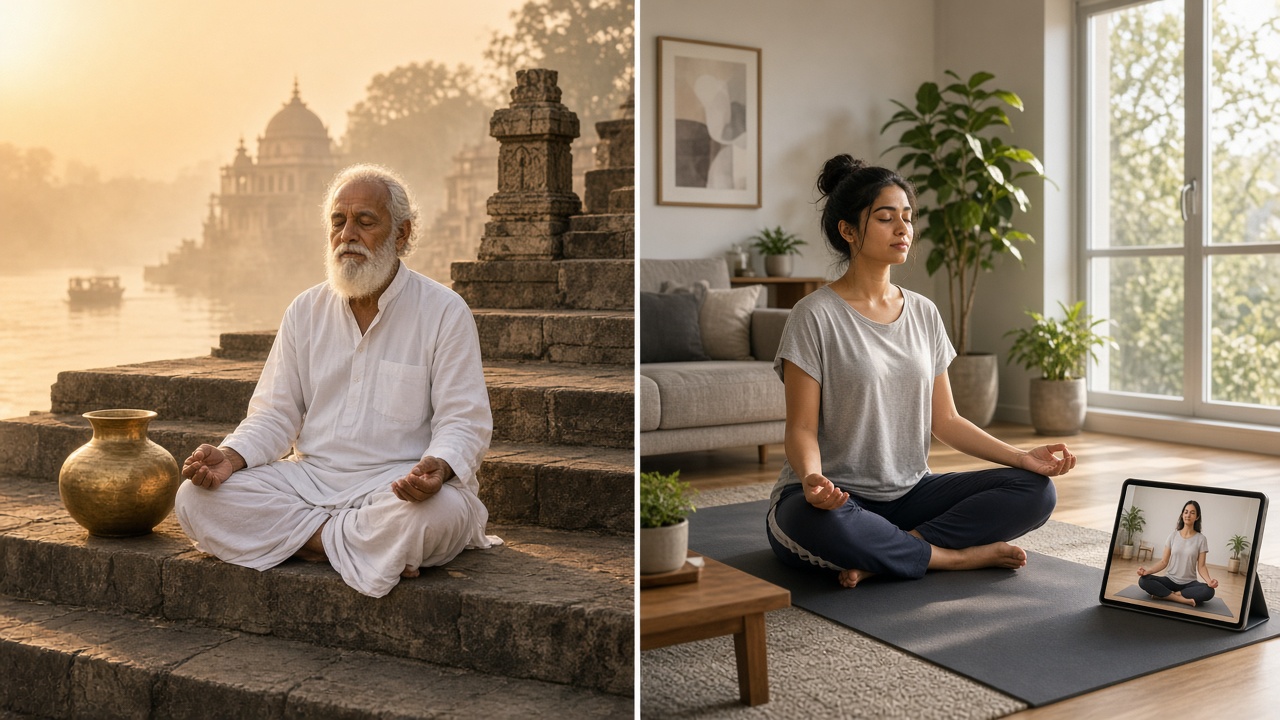
From dawn meditation on the ghats to yoga with a teacher on a tablet (artistic illustration).
Yoga Then vs Now at a Glance
Feature
Then
Now
Where
Ashrams, riverbanks, and rooftops
Homes, parks, studios, offices, and online
Teacher
A guru in person
Certified teachers, videos, and apps
Learning source
Oral teaching and palm-leaf texts
Books, TV, YouTube, and apps
Main focus
Meditation and spiritual growth
Health, flexibility, and stress relief
Mat
Grass mat, deer skin, or durrie
Rubber and eco-friendly yoga mats
Who practised
Mostly monks, sages, and a few householders
Children, adults, seniors, and patients
Time
Before sunrise
Any time, including short office breaks
Community
Guru and small group of students
Park groups, camps, and online classes
Recognition
A private spiritual tradition
Yoga Day, UNESCO heritage, and a ministry
Tracking
The teacher’s eye
Apps, smartwatches, and AI posture feedback
🕉️ RootsAncient – 1900
Vedas, Upanishads & Patanjali
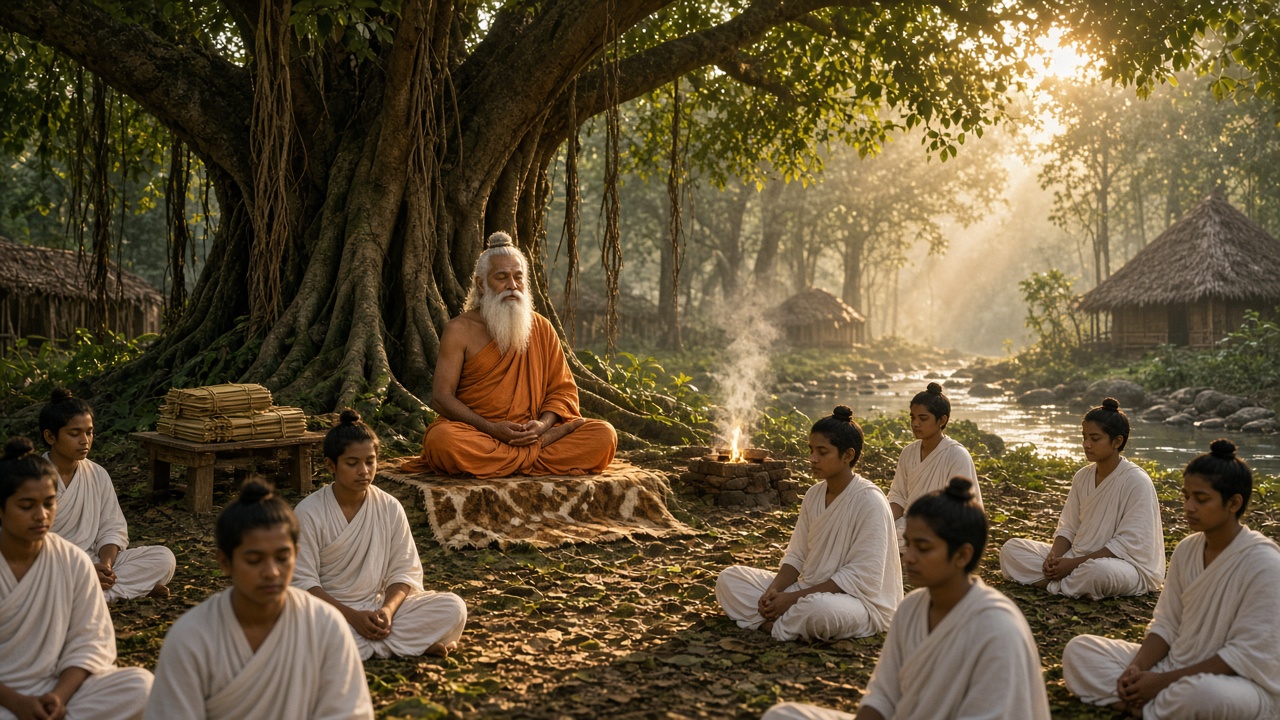
Yoga grew from India’s ancient search for a steady, peaceful mind. Sages taught meditation, breath control, and ethical living to small groups of students in forest ashrams, Patanjali organised it into eight limbs, and medieval Hatha yogis added the physical postures and breathing practices that most people know today.
A guru and students meditate under a banyan tree in a forest ashram (artistic illustration).
c. 2500 BCE: Some Indus Valley seals show a figure seated in a cross-legged posture, often linked to early yoga, though historians still debate the meaning.
Vedic and Upanishadic period: The Katha Upanishad describes yoga as the firm control of the senses, and the Bhagavad Gita teaches karma, bhakti, and jnana yoga.
c. 2nd century BCE–4th century CE: Patanjali’s Yoga Sutras set out the eight limbs of yoga, from ethical rules and posture to breath control and meditation.
15th–19th century: Svatmarama’s Hatha Yoga Pradipika describes asanas and pranayama, and Swami Vivekananda’s 1893 Chicago speech and his book Raja Yoga (1896) introduce yoga to the West.
Technology
Yoga Sutras: Short verses on the mind.
Hatha texts: Postures and breathing.
Guru-shishya: Teaching by mouth.
Features
Meditation first: Few postures.
Ashram life: Simple and disciplined.
Ethics: Yama and niyama.
🏫 Schools1900 – 1946
Yoga Schools & Scientific Study
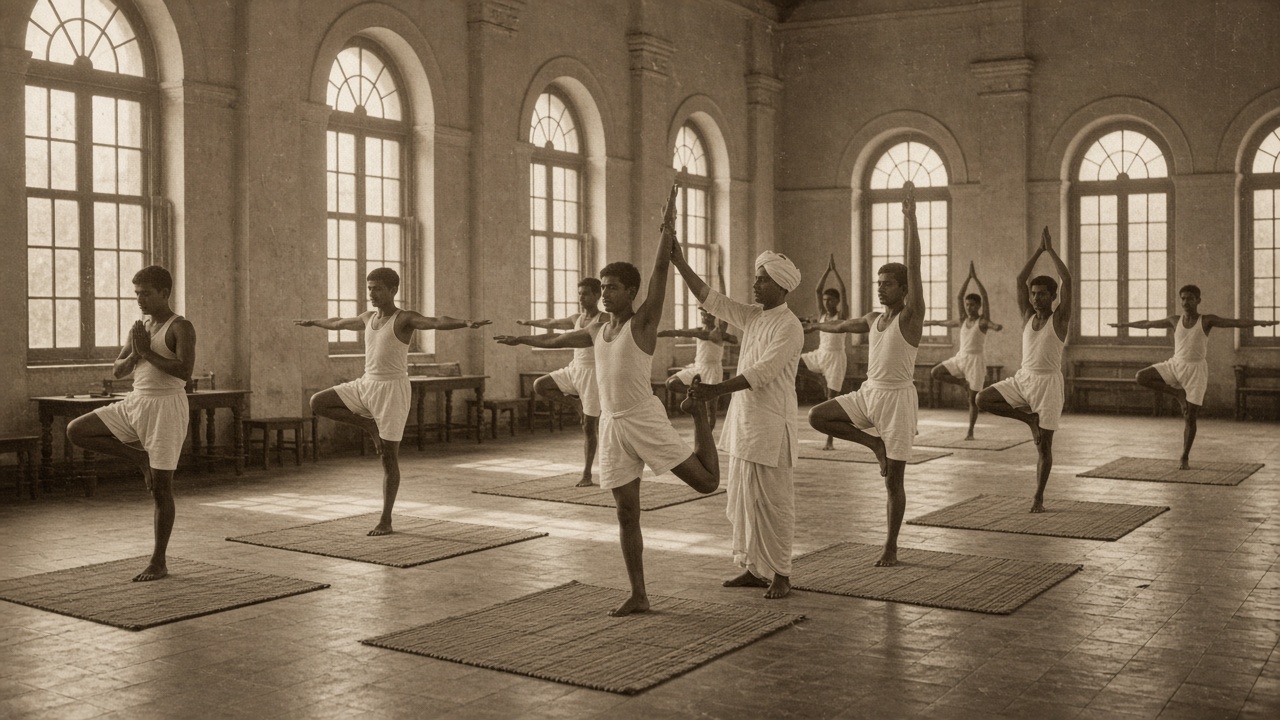
In the early 20th century Indian teachers took yoga out of the ashram and into classrooms for ordinary householders. They opened the first yoga institutes, tested yoga with laboratory instruments, published books and journals, and developed the posture sequences that shaped modern yoga.
Students practise balancing poses in an early yoga institute (artistic illustration).
1918: Shri Yogendra founds The Yoga Institute in Santacruz, Mumbai, often described as the oldest organised yoga centre in the world, teaching yoga to householders.
1924: Swami Kuvalayananda founds Kaivalyadhama in Lonavala, studies yoga scientifically, and publishes the research journal Yoga Mimamsa.
1930s: T. Krishnamacharya teaches at the Mysore Palace yogashala, developing flowing posture sequences, and his students include B.K.S. Iyengar and K. Pattabhi Jois.
1936–1946: Swami Sivananda founds the Divine Life Society in Rishikesh (1936), and Paramahansa Yogananda’s Autobiography of a Yogi (1946) inspires readers worldwide.
Technology
Laboratory tests: Breath and body studies.
Printed books: Illustrated postures.
Journals: Yoga research shared.
Features
Classes: Open to householders.
Sequences: Postures linked with breath.
Health focus: Yoga as therapy.
🌅 Dawn1947 – 1979
Ashrams, Books & Dawn Routines
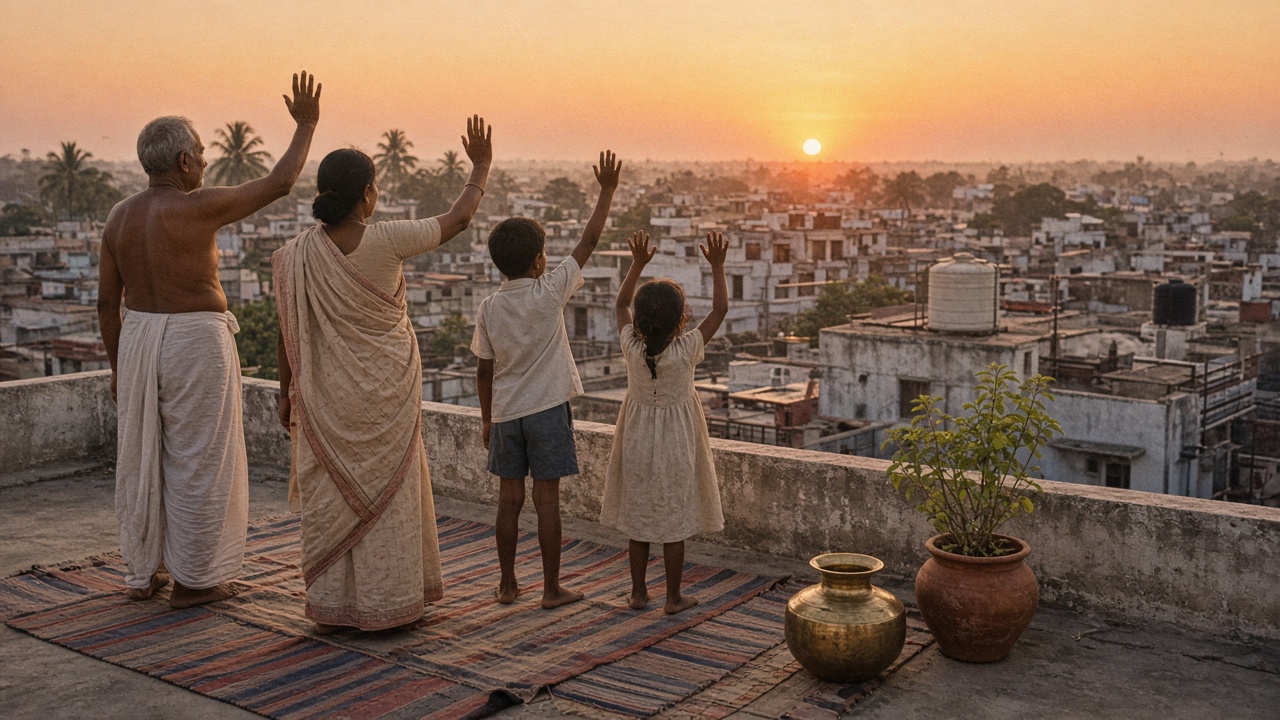
After independence many Indian families began the day with sun salutations, pranayama, and a few minutes of meditation on terraces, riverbanks, and in school assemblies. Ashrams in Rishikesh and new yoga schools trained teachers, and landmark books carried Indian yoga to the world.
Three generations greet the sun on the terrace at dawn (artistic illustration).
1950s–1960s: Sun salutations, pranayama, and meditation become part of morning routines in many homes, and simple asanas appear in school physical education.
1964: Swami Satyananda Saraswati founds the Bihar School of Yoga in Munger, which trains teachers and publishes widely used yoga books.
1966–1968: B.K.S. Iyengar publishes Light on Yoga (1966), and a 1968 visit by a famous British band to a Rishikesh ashram draws global attention to Indian meditation.
1970s: Foreign students travel to Mysore to learn ashtanga vinyasa from K. Pattabhi Jois, and Iyengar opens his institute in Pune (1975).
Technology
Illustrated manuals: Hundreds of poses.
Props: Belts, blocks, and ropes.
Teacher training: Structured courses.
Features
Morning ritual: Before school and work.
Elders teach: Passed in families.
Global interest: Visitors to India.
📺 TV & Parks1980 – 1999
TV Yoga, Parks & Laughter Clubs
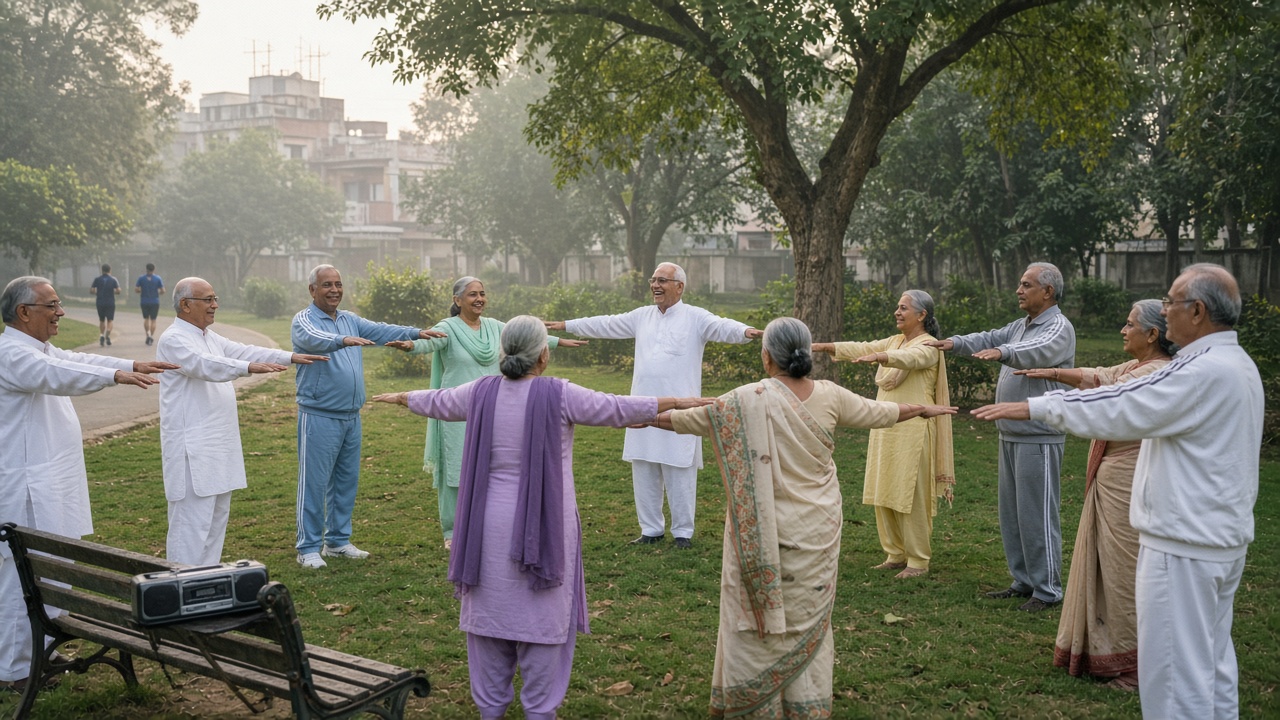
Doordarshan brought morning yoga lessons into living rooms, city parks filled with walking groups, breathing circles, and laughter clubs for senior citizens, and new organisations taught breathing and meditation courses to office workers and students. The government began to support yoga through its own department and institute.
Senior citizens breathe and laugh together in a morning park group (artistic illustration).
1980s: Doordarshan broadcasts yoga lessons, and families follow asanas and pranayama in front of the television.
1981–1992: The Art of Living (1981) spreads its Sudarshan Kriya breathing course, and the Isha Foundation (1992) is founded near Coimbatore, drawing young urban followers.
1995: Dr Madan Kataria starts the first laughter yoga club in a Mumbai park, and the government sets up a Department of Indian Systems of Medicine and Homoeopathy.
1998: The Morarji Desai National Institute of Yoga is established in New Delhi to promote, teach, and research yoga.
Technology
Television: Yoga lessons at home.
Cassettes and VCDs: Guided practice.
Breathing courses: Taught in batches.
Features
Park groups: Neighbours together.
Laughter clubs: Joy for seniors.
Stress relief: For busy city life.
🧘 Camps2000 – 2014
Mass Yoga Camps & AYUSH
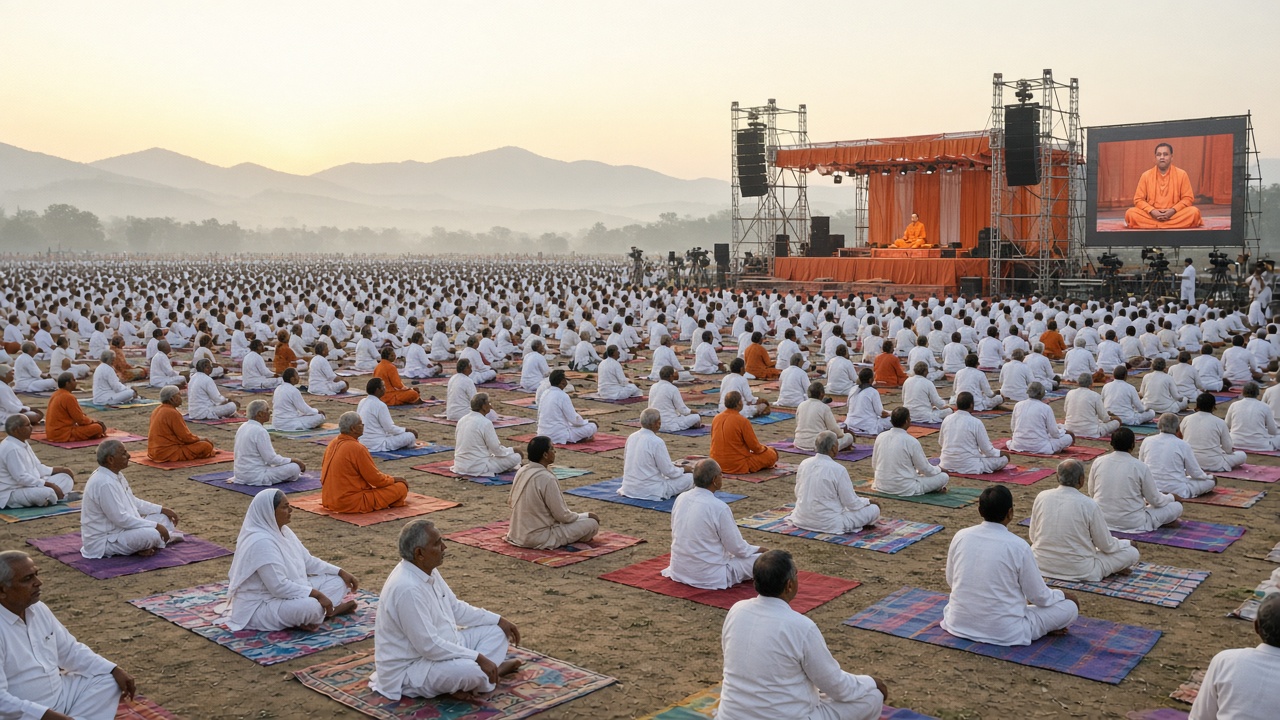
Spiritual TV channels broadcast yoga every morning, and giant open-air camps drew thousands of people to practise pranayama such as kapalbhati and anulom-vilom together. Yoga studios, power yoga, and corporate classes spread in cities, and the government gave yoga its own ministry.
Thousands practise breathing together at an open-air yoga camp (artistic illustration).
2000s: Spiritual TV channels broadcast morning yoga, and mass camps popularise pranayama such as kapalbhati and anulom-vilom in homes across India.
2003: The government department is renamed AYUSH, standing for Ayurveda, Yoga and Naturopathy, Unani, Siddha, and Homoeopathy.
2000s–2010s: Yoga studios, power yoga, prenatal yoga, and corporate classes spread in cities, and universities start diploma and degree courses in yoga.
2014: The Ministry of AYUSH is formed (November), and the UN General Assembly declares 21 June as International Day of Yoga (11 December), with 175 co-sponsoring countries.
Technology
Satellite TV: Daily yoga shows.
Big screens: Camps for thousands.
DVDs: Home practice.
Features
Pranayama boom: Breathing at home.
Studios: Yoga as a career.
Government support: AYUSH ministry.
🌍 Global2015 – Future
Yoga Day, Online Classes & Apps
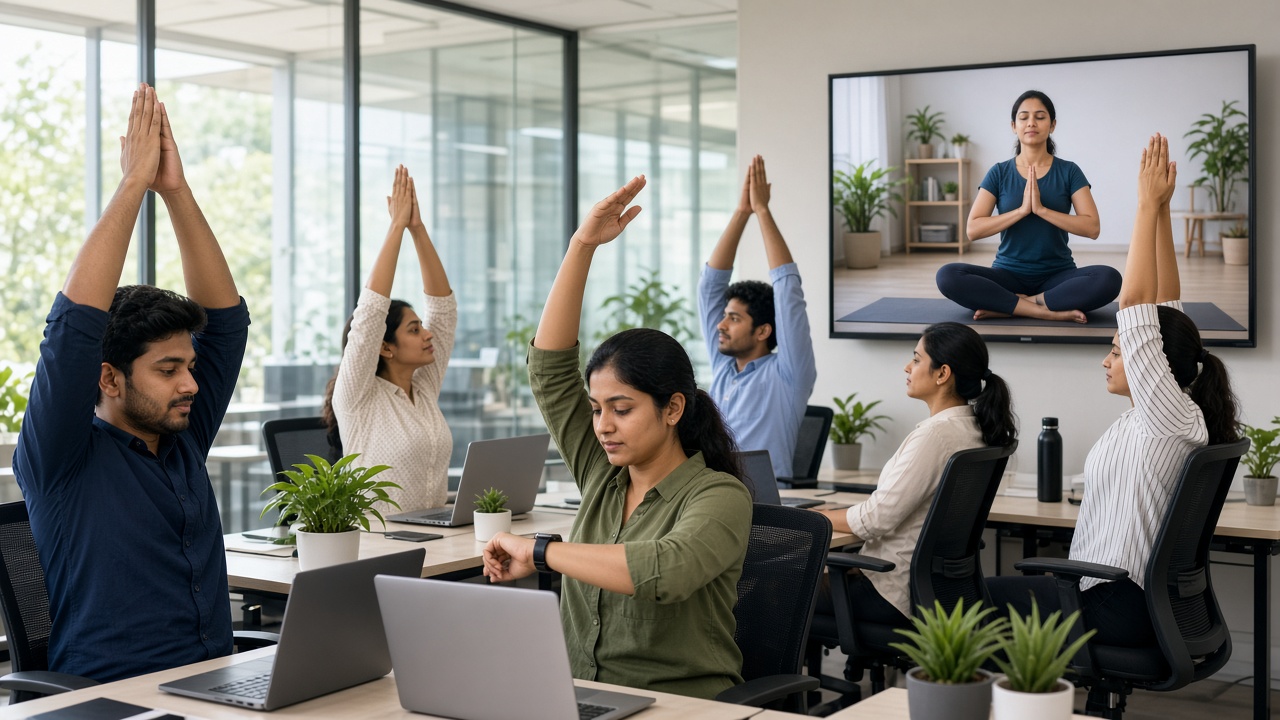
Every 21 June millions of people in India and abroad now practise yoga together on International Day of Yoga. UNESCO recognised yoga as world heritage, the COVID-19 lockdowns moved classes onto video calls, and apps and short office routines fit yoga into busy workdays.
Employees follow an online teacher for a short yoga break at work (artistic illustration).
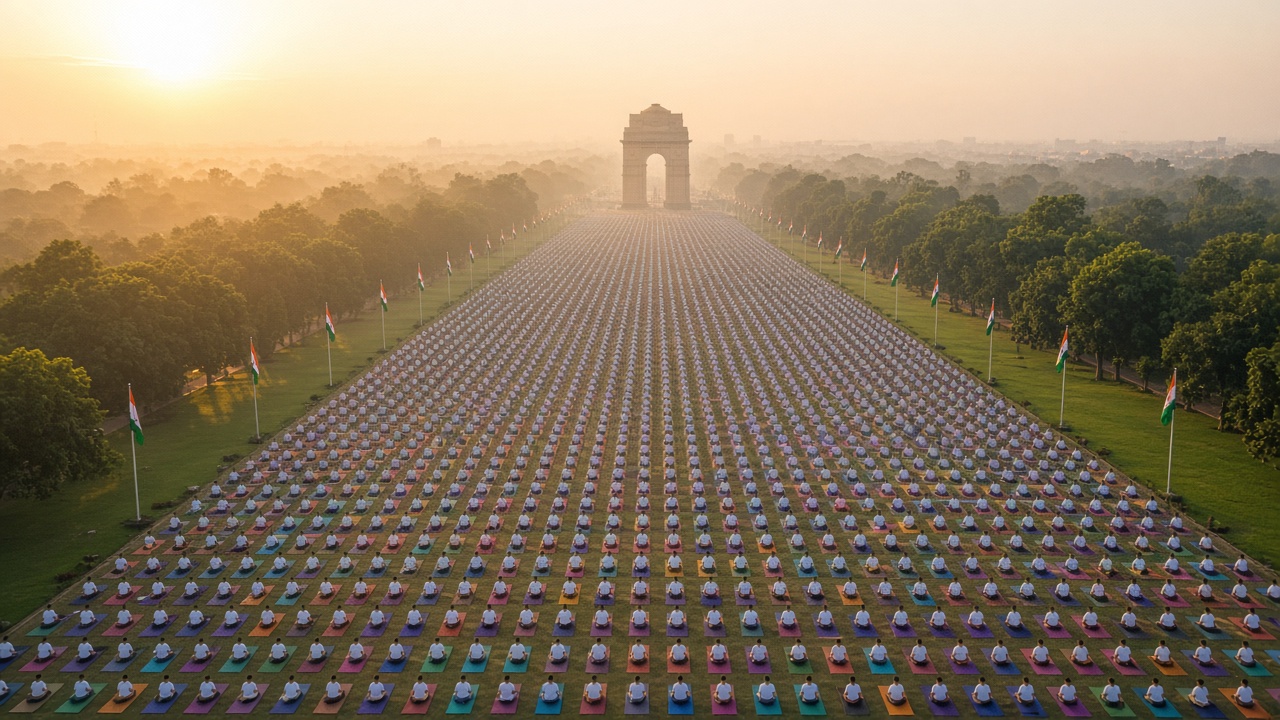
2015: The first International Day of Yoga on 21 June at Rajpath, New Delhi, sets Guinness World Records for the largest yoga session (35,985 people) and the most nationalities (84).
2016: UNESCO inscribes yoga on the Representative List of the Intangible Cultural Heritage of Humanity (December).
2020–2021: COVID-19 lockdowns move yoga classes to video calls, Yoga Day 2020 is celebrated at home, and the Y-Break app (September 2021) offers a five-minute workplace routine.
Future: AI posture feedback, smart mats, yoga therapy in hospitals, and more research on yoga for mental health and chronic illness.
Technology
Video classes: Live teachers online.
Yoga apps: Guided routines.
AI feedback: Posture correction.
Features
Yoga Day: Every 21 June.
Office yoga: Short breaks at work.
World heritage: UNESCO listing.
Everyday Yoga Practices in Indian Homes
These are some of the most common practices in daily Indian routines. Learn them from a trained teacher, and consult a doctor first if you are pregnant or have high blood pressure, heart problems, back or joint pain, or any other medical condition.
Practice
Type
Traditionally done for
Surya namaskar (sun salutation)
Posture sequence
Warming up the whole body in the morning
Tadasana (mountain pose)
Standing posture
Posture and balance
Vrikshasana (tree pose)
Balancing posture
Balance and concentration
Bhujangasana (cobra pose)
Back bend
Stretching the spine and chest
Vajrasana (thunderbolt pose)
Sitting posture
Sitting calmly after meals
Shavasana (corpse pose)
Relaxation
Deep rest at the end of practice
Anulom-vilom
Pranayama
Alternate-nostril breathing for calm
Kapalbhati
Pranayama
Energising breath, not for everyone
Bhramari
Pranayama
Humming breath for relaxation
Dhyana
Meditation
Focus and a quiet mind
Landmark Yoga Institutes and Movements in India
Institute or movement
Year
Place
Known for
The Yoga Institute
1918
Mumbai
Yoga for householders
Kaivalyadhama
1924
Lonavala
Scientific yoga research
Mysore Palace yogashala
1930s
Mysuru
Flowing posture sequences
Divine Life Society
1936
Rishikesh
Ashram training and books
Ashtanga Yoga Research Institute
1948
Mysuru
Ashtanga vinyasa
Bihar School of Yoga
1964
Munger
Teacher training and publications
Iyengar Yoga Institute
1975
Pune
Precise alignment and props
Art of Living
1981
Bengaluru
Breathing and meditation courses
Laughter yoga clubs
1995
Mumbai
Laughter with yogic breathing
Morarji Desai National Institute of Yoga
1998
New Delhi
Government yoga education
International Day of Yoga Through the Years
Tens of thousands practise together in New Delhi on International Day of Yoga (artistic illustration).
Year
Main national event
Theme
2015
Rajpath, New Delhi
Yoga for Harmony and Peace
2016
Chandigarh
Connect the Youth
2017
Lucknow
Yoga for Health
2018
Dehradun
Yoga for Peace
2019
Ranchi
Climate Action
2020
At home (pandemic)
Yoga at Home, Yoga with Family
2021
At home (pandemic)
Yoga for Wellness
2022
Mysuru
Yoga for Humanity
2023
UN Headquarters, New York, and Jabalpur
Yoga for Vasudhaiva Kutumbakam
2024
Srinagar
Yoga for Self and Society
2025
Visakhapatnam
Yoga for One Earth, One Health
Yoga in Daily Life Timeline Summary
Year / Era
Milestone
c. 2500 BCE
Indus seals with a cross-legged figure
Vedic period
Upanishads and the Bhagavad Gita
c. 2nd century BCE–4th century CE
Patanjali’s Yoga Sutras
15th century
Hatha Yoga Pradipika
1893
Vivekananda’s Chicago speech
1918
The Yoga Institute, Mumbai
1924
Kaivalyadhama, Lonavala
1930s
Mysore Palace yogashala
1936
Divine Life Society, Rishikesh
1950s–1960s
Dawn yoga routines at home
1964
Bihar School of Yoga
1966
Light on Yoga published
1980s
Yoga on Doordarshan
1981
Art of Living founded
1995
First laughter yoga club
1998
Morarji Desai National Institute of Yoga
2003
Department renamed AYUSH
2014
Ministry of AYUSH; UN declares Yoga Day
2015
First International Day of Yoga
2016
UNESCO heritage listing
2020
Yoga moves online
2021
Y-Break app
Future
AI posture feedback and yoga therapy
Test Your Knowledge
20 quick questions from the yoga in daily life timeline. Click each question to reveal the answer.
Answer: Patanjali.
Answer: Eight (ashtanga).
Answer: Control of the breath.
Answer: The Bhagavad Gita.
Answer: Svatmarama, around the 15th century.
Answer: 1893.
Answer: The Yoga Institute, founded by Shri Yogendra.
Answer: Lonavala, Maharashtra.
Answer: T. Krishnamacharya.
Answer: Rishikesh.
Answer: B.K.S. Iyengar, in 1966.
Answer: Munger, Bihar.
Answer: Mumbai, in 1995.
Answer: Yoga (and Naturopathy).
Answer: Alternate-nostril breathing.
Answer: 21 June.
Answer: 175.
Answer: Rajpath, New Delhi.
Answer: 2016.
Answer: A short five-minute yoga routine at the workplace.
Classroom activity
Students Tasks
Use these prompts for discussion or projects on how yoga has been part of Indian daily life over time.
Click any panel to expand and explore the visual mood.
Yoga in Indian daily life in pictures — the forest ashram, the early yoga school, the family at dawn, the park group, the mass camp, Yoga Day, office yoga, and then versus now.
Forest Ashram
Guru and students
Yoga School
Classes for all
Dawn Routine
Greeting the sun
Park Group
Breathe and laugh
Mass Camp
Thousands together
Yoga Day
Every 21 June
Office Yoga
Online teacher
Then vs Now
Ghat to tablet
Explore all health timelines
Jump to any other health timeline on WorldTimelineHub.
Disclaimer: This content is AI-generated for educational purposes and may contain errors or outdated details. For correct and authoritative information, please refer to official and reliable sources such as government publications, manufacturers, museums, and academic references.