Smallpox Eradication Timeline of India: Tika Inoculation → Vaccination Push → Vaccine Institutes → National Programme → Search & Containment → Smallpox-Free
For centuries smallpox, the disease many Indians linked with the goddess Sitala, killed and scarred millions. Villagers protected themselves with risky tika inoculation until cowpox vaccine arrived in 1802, and through the
19th century vaccinators carried it from arm to arm across the country. Vaccine institutes, a national programme from 1962, and finally house-to-house search teams stopped the virus — India’s last case came in 1975, and it was certified smallpox-free in 1977.
This timeline covers masurika in Ayurvedic texts, Sitala shrines, tikadars, Jenner’s vaccine, the first vaccination in Bombay, arm-to-arm chains, the ban on variolation, the 1880 Vaccination Act, calf-lymph institutes,
freeze-dried vaccine, the National Smallpox Eradication Programme, bifurcated needles, search and containment, the 1974 epidemic, cash rewards, the last case in Assam, certification, and the world’s victory in 1980.
Tika Inoculation → 1802 First Vaccination1962 National Programme → 1973 Search Teams1975 Last Case → 1977 Smallpox-Free
Why the Story of Smallpox Eradication Matters
Smallpox is the only human disease ever wiped off the face of the Earth, and India — once home to a large share of the world’s cases — was one of the hardest places to win that fight. The story shows how science,
patient health workers, respect for local beliefs, and a smart change of strategy defeated a virus that had killed people for thousands of years, and it laid the foundation for India’s later vaccination programmes.
Big picture
India’s fight against smallpox in one view
Traditional tika inoculation gave risky protection for centuries. Jenner’s vaccine reached Bombay in 1802, the 19th century saw a big vaccination push and new laws, vaccine institutes grew calf lymph from 1899, the
national programme of 1962 vaccinated millions, and search-and-containment teams from 1973 tracked down the last cases, leading to certification in 1977. Related timelines:
research in India,
radio,
news.
1802
First vaccination in India (Bombay)
1962
National eradication programme
1.8 lakh+
Cases reported in the 1974 epidemic
1977
Certified smallpox-free
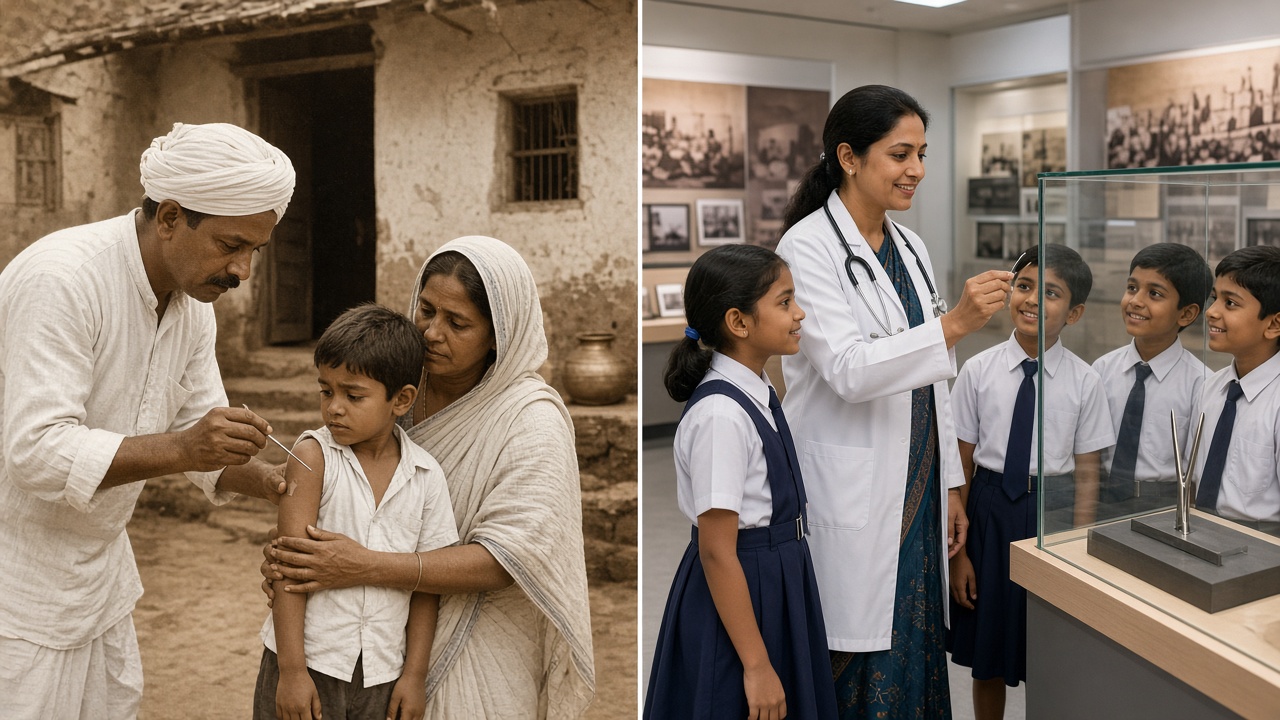
From a village vaccinator’s lancet to a needle in a museum case (artistic illustration).
Smallpox in India Then vs Now at a Glance
Feature
Then
Now
Disease
Outbreaks almost every year
Eradicated — no case since 1975 in India
Protection
Risky tika inoculation
No longer needed for the public
Belief
Prayers at Sitala shrines
Festival traditions continue; science explains the virus
Vaccine source
Child to child, arm to arm
Freeze-dried vaccine kept only for emergencies
Tool
Lancet and scratch
Bifurcated needle, now a museum piece
Scars
Pockmarked faces were common
Only older people carry scars or vaccine marks
Finding cases
Waiting for reports
Lessons used for disease surveillance today
Workers
A few vaccinators per district
Health network used for polio and other vaccines
Deaths
Lakhs of deaths over the decades
None
Status
One of the world’s worst-hit countries
Certified smallpox-free since 1977
🪔 TikaBefore 1800
Sitala, Tika & Traditional Inoculation
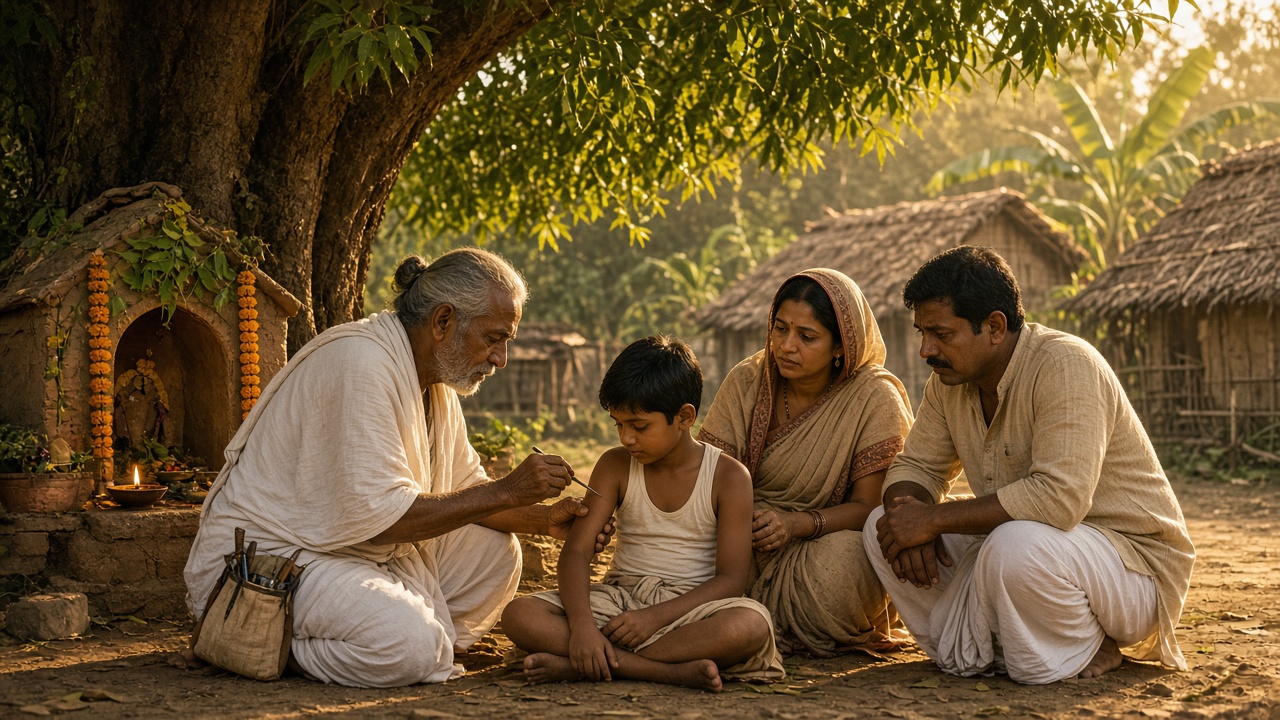
Smallpox returned season after season, killing many children and leaving survivors scarred or blind. Families prayed to Sitala Mata, cooled patients with neem leaves, and in many regions turned to traditional inoculators who deliberately gave healthy children a mild dose of the disease to protect them for life.
A traditional inoculator gives a boy the tika beside a village shrine (artistic illustration).
Ancient and medieval India: Ayurvedic writings describe a pox disease called masurika, and smallpox is feared across the subcontinent as one of the deadliest diseases of childhood.
Centuries of belief: Sitala, “the cool one”, is worshipped in north and east India as the goddess of smallpox, and families make offerings at her shrines when the disease strikes.
18th century: Traditional inoculators called tikadars travel through Bengal and other regions each spring, practising variolation, which British observers describe in the 1760s.
1796–1798: In England, Edward Jenner shows that cowpox protects against smallpox and publishes his results, giving the world a much safer method called vaccination.
Technology
Variolation: Smallpox material in a small cut.
Simple tools: Needle or small blade.
Neem leaves: Traditional comfort care.
Features
Seasonal fear: Outbreaks every year.
Risky protection: Could spread the disease.
Faith and ritual: Sitala worship.
💉 Vaccination1800 – 1899
The 19th-Century Vaccination Push
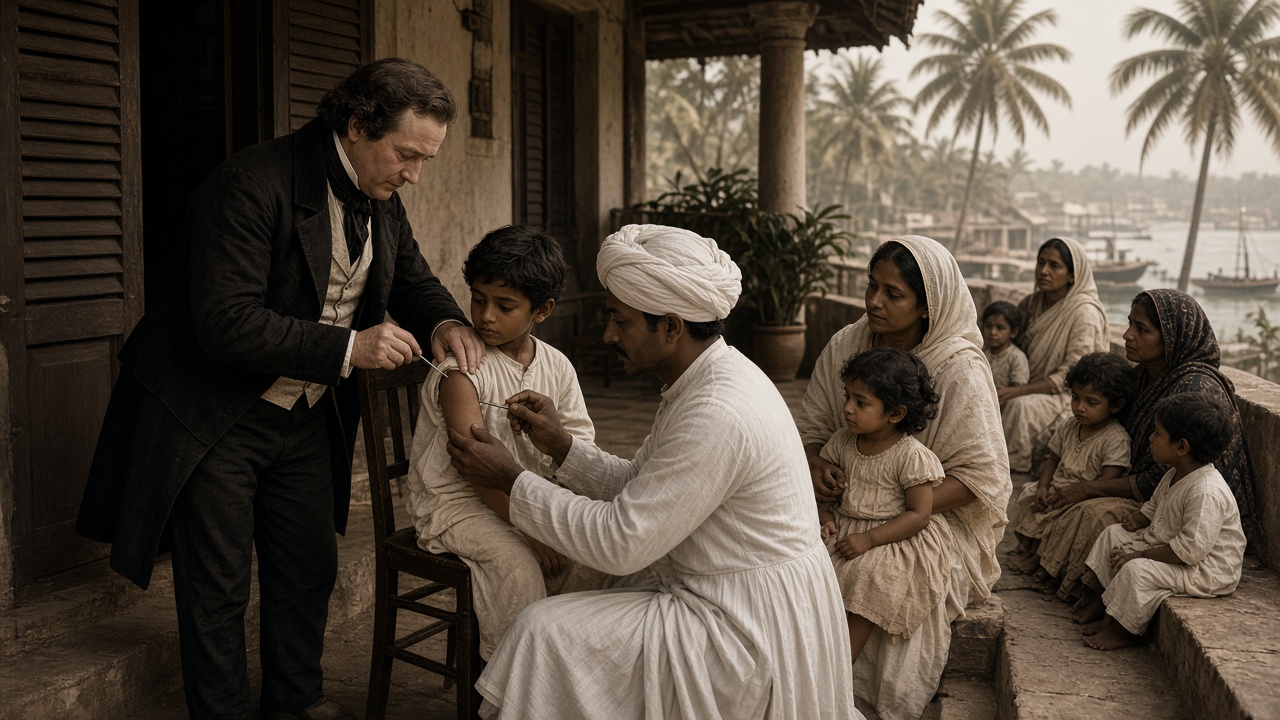
Cowpox vaccine arrived in India in 1802 and was kept alive by passing it from one child’s arm to the next. Through the 19th century the government appointed vaccinators, banned the older practice of variolation in cities, and passed laws that allowed compulsory vaccination of infants, though many families feared the new method.
A surgeon and his assistant vaccinate children in early 19th-century Bombay (artistic illustration).
14 June 1802: A three-year-old girl in Bombay receives the first recorded successful smallpox vaccination in India, using vaccine that travelled overland from Europe via Baghdad and Basra.
1802–1810s: Arm-to-arm chains carry the vaccine to Madras, Calcutta, and inland towns, and the East India Company appoints superintendents of vaccination and paid vaccinators.
1860s: Laws begin banning variolation, starting with Calcutta in 1865, because inoculated people could spread smallpox to others.
1880–1890s: The Vaccination Act of 1880 lets municipalities make infant vaccination compulsory, and vaccine lymph grown on calves starts replacing arm-to-arm vaccination.
Technology
Cowpox vaccine: Safer than variolation.
Arm-to-arm chains: Children carried the vaccine.
Calf lymph: Vaccine grown on calves.
Features
Paid vaccinators: Town and district posts.
New laws: Compulsory in municipalities.
Public fear: Many families resisted.
🧪 Institutes1900 – 1961
Vaccine Institutes & Village Vaccinators
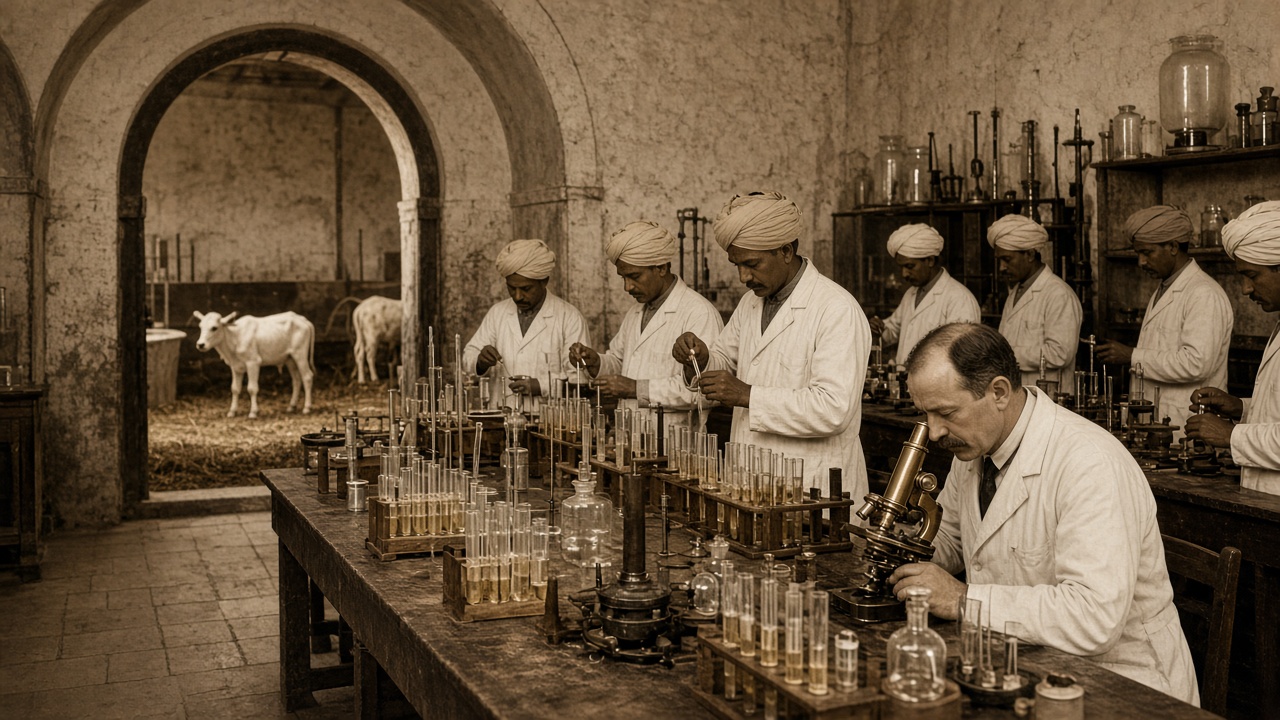
Indian vaccine institutes began producing large amounts of calf lymph, and glycerine helped it last longer on the journey to villages. Vaccinators went from village to village with lancets and registers, but hot weather spoiled much of the vaccine, and smallpox still killed tens of thousands of Indians every year when the country became independent.
Laboratory workers prepare tubes of calf-lymph vaccine in an early institute (artistic illustration).
1899–1904: Vaccine institutes are set up to make calf lymph, including the King Institute at Guindy, Madras (1899), and the Vaccine Institute at Belgaum (1904).
1900s–1940s: Government vaccinators travel village to village, vaccinating infants and recording each child in a register, using glycerinated lymph that keeps longer.
1947–1950s: Smallpox is still a major killer in independent India, and liquid vaccine often loses its strength in the heat before it reaches remote villages.
1950s–1959: Scientists develop a heat-stable freeze-dried vaccine, and in 1959 the World Health Assembly resolves to eradicate smallpox from the world.
Technology
Glycerinated lymph: Lasted longer.
Glass tubes: Vaccine sent by post and rail.
Freeze-drying: Heat-stable powder.
Features
Village rounds: Vaccinators on foot.
Registers: Records of each child.
Spoiled vaccine: Heat was the enemy.
🏫 NSEP1962 – 1972
National Smallpox Eradication Programme
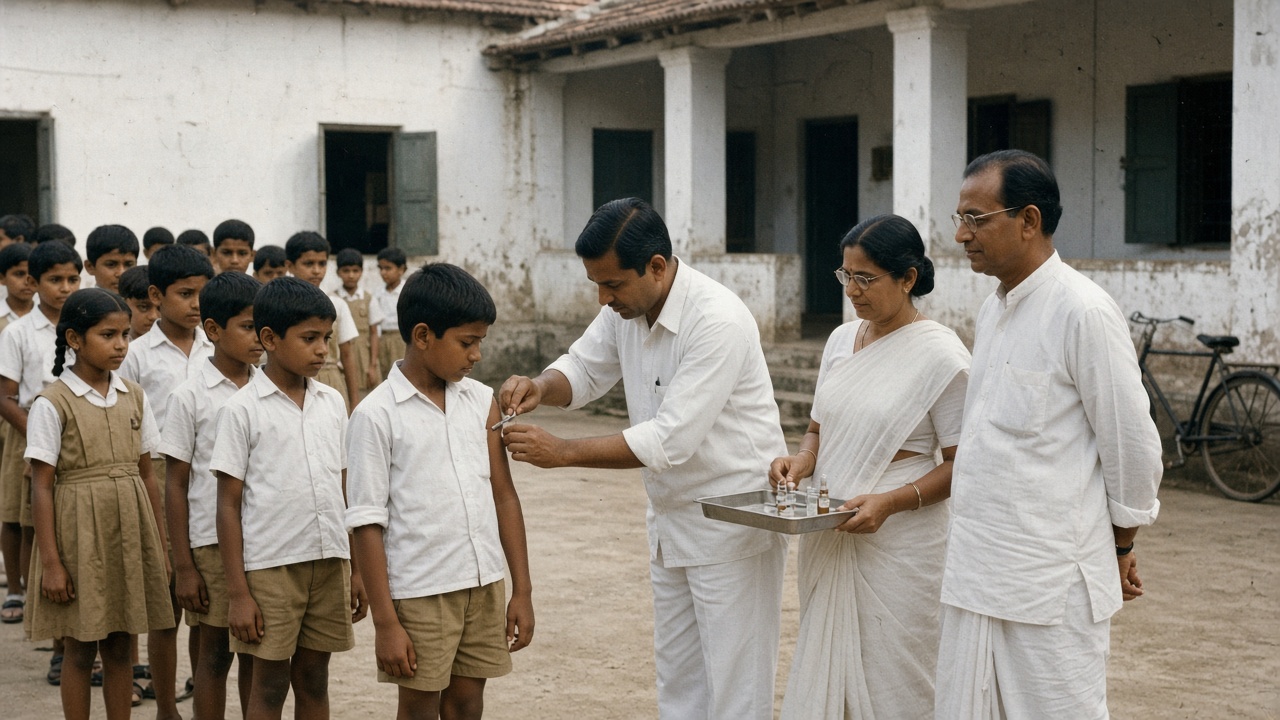
India launched a national programme to vaccinate as much of its population as possible. Teams vaccinated millions of people in schools, markets, and villages, and Indian institutes began producing freeze-dried vaccine, but crowded cities, migration, and missed and unreported cases kept the virus alive.
Schoolchildren line up for smallpox vaccination during the national programme (artistic illustration).
1962: India launches the National Smallpox Eradication Programme (NSEP), aiming to vaccinate the great majority of its people within a few years.
1960s: Indian vaccine institutes start producing freeze-dried vaccine, and vaccinators use rotary lancets in mass campaigns in schools, villages, and fairs.
1967: WHO begins its Intensified Smallpox Eradication Programme, when India is still one of the countries with the most smallpox cases in the world.
Late 1960s–early 1970s: The simple bifurcated needle arrives, but mass vaccination alone keeps missing slums, migrants, and newborns, and many outbreaks are never reported.
Technology
Freeze-dried vaccine: Made in India.
Rotary lancet: Early mass tool.
Bifurcated needle: Simple and cheap.
Features
Mass campaigns: Millions vaccinated.
Targets: Counting vaccinations.
Hidden cases: Many not reported.
🔍 Search1973 – 1975
Search & Containment: The Final Battle
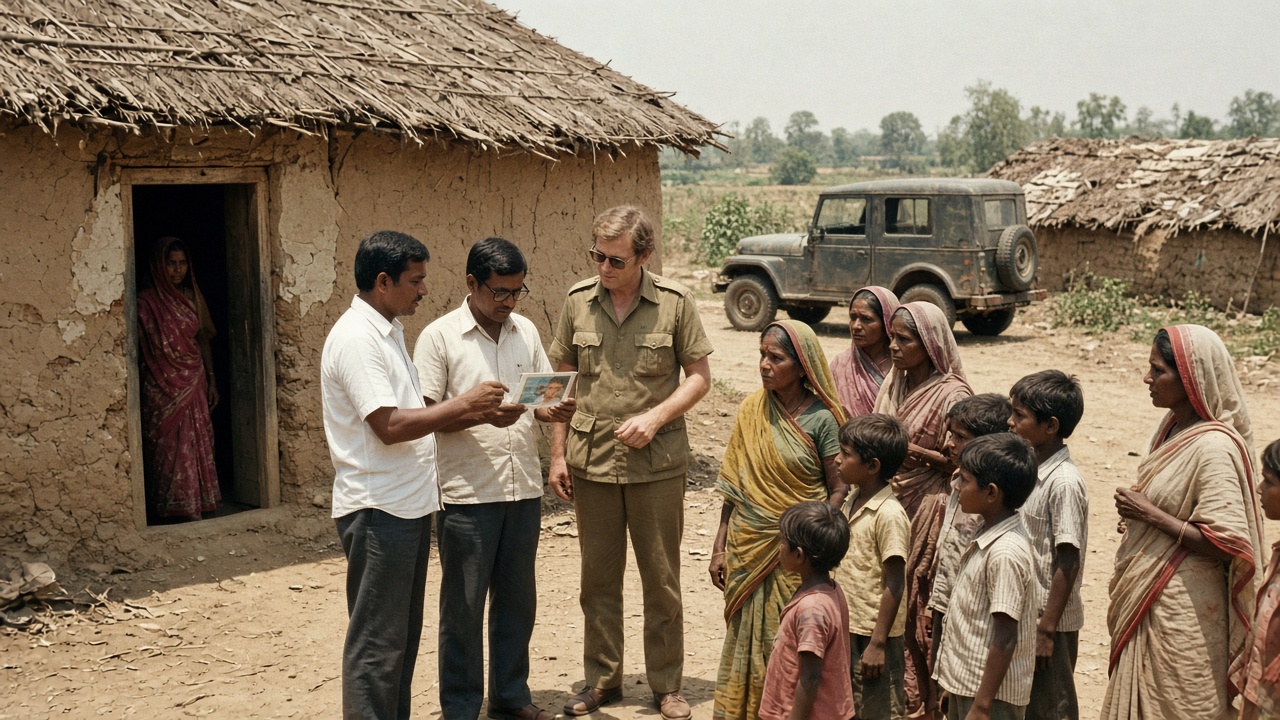
India and WHO changed strategy. Instead of counting vaccinations, huge teams searched every house for cases, isolated each patient with a watchguard at the door, and vaccinated everyone nearby to build a ring of immunity. Even a terrible epidemic in 1974 could not stop the campaign, and the last case came in 1975.
A search team shows villagers a recognition card to help find hidden cases (artistic illustration).
1973: India and WHO launch an intensified campaign with nationwide house-to-house searches, in which teams visit every village and every house over a few days.
1974: A severe epidemic, worst in Bihar, Uttar Pradesh, West Bengal, and Odisha, produces more than 1.8 lakh reported cases — but the searches find and contain outbreaks faster than ever.
1974–1975: Recognition cards with a picture of a smallpox patient, cash rewards for reporting a case, watchguards, and ring vaccination help tens of thousands of health workers close in on the virus.
May 1975: India’s last case of smallpox is reported in Karimganj district, Assam, and the search teams keep looking to make sure no case is hidden.
Technology
Recognition cards: Picture of the rash.
Outbreak maps: Charts in every district.
Jeeps and bicycles: Teams on the move.
Features
House-to-house: Every home searched.
Watchguards: Patient isolated.
Rewards: Cash for reporting cases.
🏅 Smallpox-Free1976 – Future
Smallpox-Free India & a Smallpox-Free World
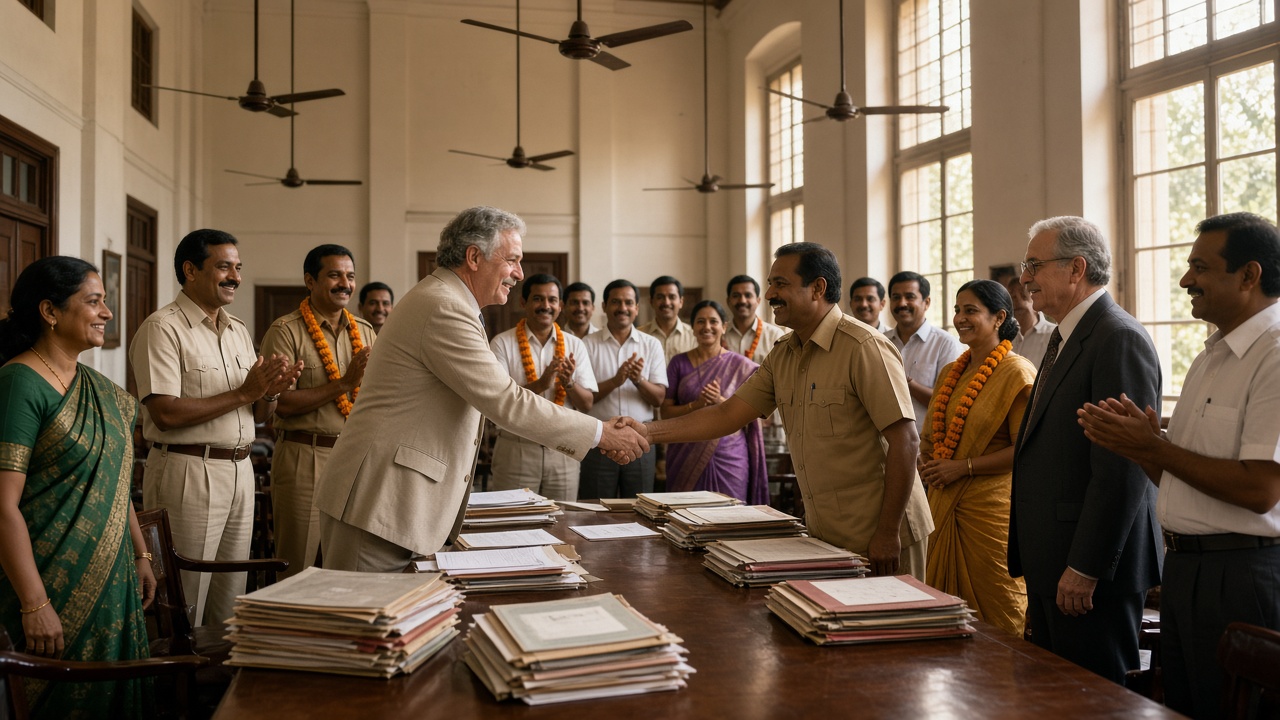
After two years of searching with no new cases, an international commission certified India smallpox-free. The world followed, and in 1980 smallpox became the first human disease ever eradicated. Routine smallpox vaccination stopped, and India’s trained health workers and surveillance methods moved on to fight other diseases.
Health officials and international experts celebrate a smallpox-free India (artistic illustration).
1975–1977: Search teams keep visiting every house and offer growing cash rewards for reporting any case of fever with rash, but no smallpox is found.
April 1977: An International Commission certifies India free of smallpox, less than three years after the country’s worst epidemic in decades.
1977–1980: The world’s last natural case occurs in Somalia in October 1977, and on 8 May 1980 the World Health Assembly declares the world free of smallpox.
Legacy and future: Routine smallpox vaccination ends, its lessons shape India’s immunisation and polio campaigns, and the remaining virus samples are kept only in two high-security laboratories abroad.
Technology
Surveillance: Fever-with-rash reporting.
Vaccine stockpiles: Kept for emergencies.
Lab security: Virus samples locked away.
Features
Certification: 1977 for India.
World victory: 1980 declaration.
Lasting lessons: For polio and beyond.
How Indians Were Protected Against Smallpox
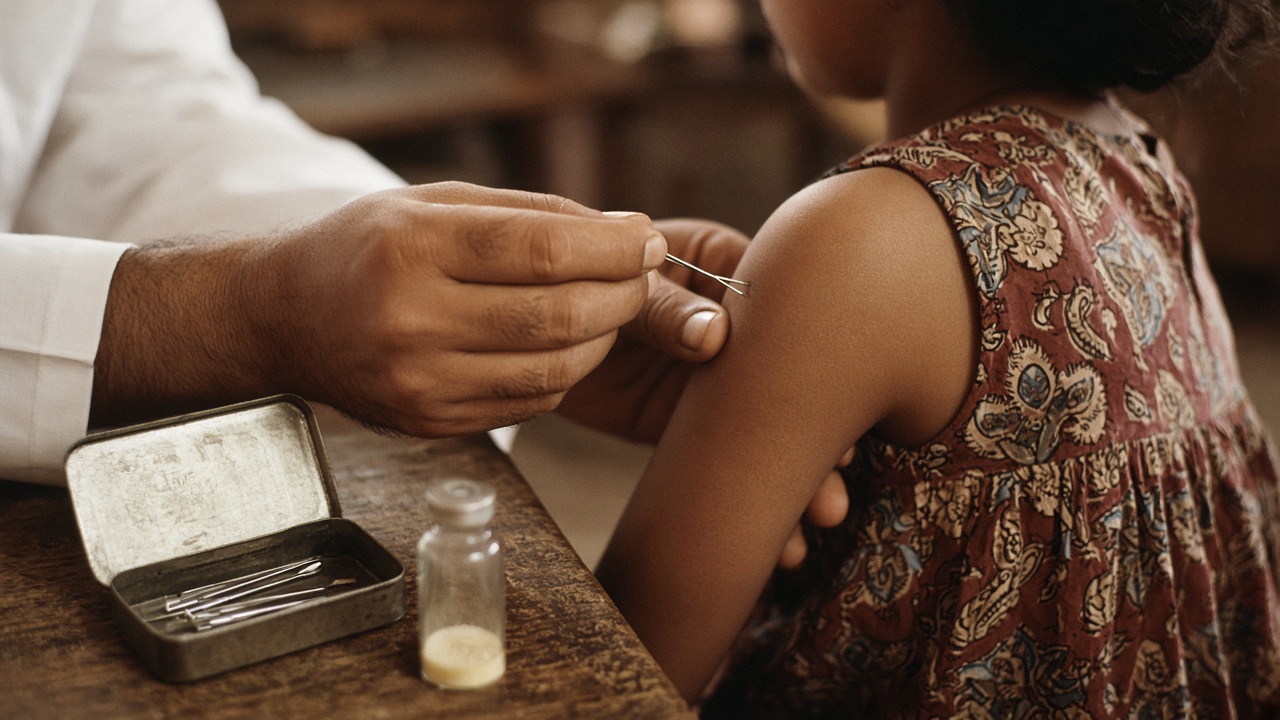
A vaccinator uses a two-pronged bifurcated needle (artistic illustration).
Method
Period in India
How it worked
Drawback
Variolation (tika)
Before 1800 to 1860s
Smallpox material put in a small cut
Could kill or start outbreaks
Arm-to-arm vaccination
1802 to 1890s
Cowpox passed from child to child
Chains broke; could spread other infections
Calf lymph
1890s onward
Vaccine grown on calves in institutes
Spoiled quickly in heat
Glycerinated lymph
Early 1900s onward
Glycerine helped vaccine keep longer
Still needed cool storage
Freeze-dried vaccine
1960s onward
Powder mixed with liquid before use
Needed reliable production
Rotary lancet
1960s
Rotating scratch through a drop of vaccine
Painful and left bigger wounds
Bifurcated needle
Late 1960s–1970s
Two prongs held one exact dose
Few — easy, cheap, and reusable
Mass Vaccination vs Search and Containment
The change of strategy in 1973 was the turning point. Instead of trying to vaccinate every one of India’s hundreds of millions of people, teams hunted down every outbreak and surrounded it with immunity.
Feature
Mass vaccination (1962–1972)
Search and containment (1973–1975)
Main goal
Vaccinate as many people as possible
Find and stop every outbreak
Measure of success
Number of vaccinations
Number of outbreaks contained
Finding cases
Waiting for reports
Active searches of every house
Patient
Often left at home without control
Isolated with a watchguard at the door
Who got vaccinated
Everyone in reach
Family, neighbours, and visitors around each case
Public help
Limited
Cash rewards and recognition cards
Data
Monthly totals
Outbreak maps updated constantly
Result
Smallpox continued
Last case in May 1975
Smallpox Eradication in India Timeline Summary
Year / Era
Milestone
Ancient and medieval
Masurika in Ayurvedic writings; Sitala worship
18th century
Tikadars practise variolation
1796
Jenner’s cowpox vaccination in England
1802
First vaccination in India, Bombay (14 June)
1802–1810s
Arm-to-arm chains spread the vaccine
1865
Variolation banned in Calcutta
1880
Vaccination Act
1890s
Calf lymph replaces arm-to-arm
1899
King Institute, Guindy
1904
Vaccine Institute, Belgaum
1959
World Health Assembly resolves to eradicate smallpox
1962
National Smallpox Eradication Programme
1967
WHO Intensified Eradication Programme
1973
Search and containment campaign
1974
Severe epidemic, over 1.8 lakh cases
1975
Last case in India (May, Assam)
1977
India certified smallpox-free (April)
1977
World’s last natural case, Somalia (October)
1980
World declared smallpox-free (8 May)
Future
Lessons for other eradication campaigns
Test Your Knowledge
20 quick questions from the smallpox eradication timeline. Click each question to reveal the answer.
Answer: The variola virus.
Answer: Sitala Mata.
Answer: Tikadars.
Answer: Placing material from a smallpox blister into a small cut to cause a milder illness and immunity.
Answer: Edward Jenner, in 1796.
Answer: Bombay (Mumbai), on 14 June 1802.
Answer: By arm-to-arm vaccination, passing it from one child to the next.
Answer: Because inoculated people could catch real smallpox and spread it to others.
Answer: The Vaccination Act of 1880.
Answer: Smallpox vaccine grown on calves in vaccine institutes.
Answer: The King Institute.
Answer: 1959.
Answer: 1962.
Answer: It stayed effective in hot weather much longer than liquid vaccine.
Answer: Its two prongs held exactly one dose, it was easy to use, and it could be boiled and reused.
Answer: Search and containment — house-to-house searches, isolation, and ring vaccination.
Answer: Bihar.
Answer: Karimganj district, Assam, in May 1975.
Answer: April 1977.
Answer: 8 May 1980, by the World Health Assembly.
Classroom activity
Students Tasks
Use these prompts for discussion or projects on how India defeated smallpox.
Ask a grandparent whether they have a smallpox vaccination mark on their upper arm and what they remember about vaccinators.
Make a timeline poster: tika inoculation, 1802 first vaccination, 1880 Vaccination Act, 1962 national programme, 1973 search teams, and 1977 certification.
Explain in your own words the difference between variolation and vaccination.
Draw how an arm-to-arm vaccine chain carried the vaccine from one town to another.
Compare mass vaccination with search and containment, and explain why the second strategy worked better.
Design a recognition card and a poster that a 1970s search team could use in your area, in your own language.
Find out how the Sitala Ashtami festival is observed today and how health workers respected local beliefs.
Role-play a search team visiting a village in 1974 and persuading a worried family to report a case.
Research why smallpox could be eradicated but many other diseases cannot.
Debate: “The last samples of the smallpox virus should be destroyed.”
Continue exploring
India’s victory over smallpox drew on science, radio and newspaper campaigns, and deep-rooted traditions. Explore these connected timelines next.
Click any panel to expand and explore the visual mood.
India’s fight against smallpox in pictures — the tika inoculator, early vaccination in Bombay, the vaccine institute, the school vaccination drive, the search team, the bifurcated needle, the 1977 celebration, and then versus now.
Tika Inoculation
Village inoculator
First Vaccinations
Bombay, 1802
Vaccine Institute
Calf lymph
National Programme
Mass vaccination
Search Team
Every house checked
Bifurcated Needle
One exact dose
Smallpox-Free
Certified in 1977
Then vs Now
Lancet to museum
Explore all health timelines
Jump to any other health timeline on WorldTimelineHub.
Disclaimer: This content is AI-generated for educational purposes and may contain errors or outdated details. For correct and authoritative information, please refer to official and reliable sources such as government publications, manufacturers, museums, and academic references.