Ayurveda — “knowledge of life” — is one of the world’s oldest continuous medical traditions. From early healers and classical Sanskrit samhitas to palm-leaf commentaries,
colonial-era colleges, AYUSH institutions, and today’s wellness resorts, it has adapted without losing its core ideas of balance, diet, and herbs.
This timeline covers early roots, Charaka and Sushruta, medieval manuscript culture, the colonial encounter, BAMS colleges and AYUSH,
and the global wellness boom — with links to
yoga,
home healthcare,
and
medical education.
Ayurveda is a system of health knowledge that grew in India over many centuries. It looks at diet, daily routine, herbs, therapies, and mental balance —
often framed through ideas such as the three doshas (vata, pitta, kapha). This page is educational history — not medical advice. For serious illness, use qualified modern care;
for household remedy culture, see also
Healthcare at Home.
Big picture
Ayurveda in one view
Oral and early textual healing → classical medical and surgical samhitas → medieval copying and regional practice → print and colonial colleges →
independent India’s regulation and AYUSH → spas, research, and global brands.
Samhitas
Charaka & Sushruta
Herbs
Pharmacy & diet
BAMS
Modern degree path
AYUSH
Ministry & systems
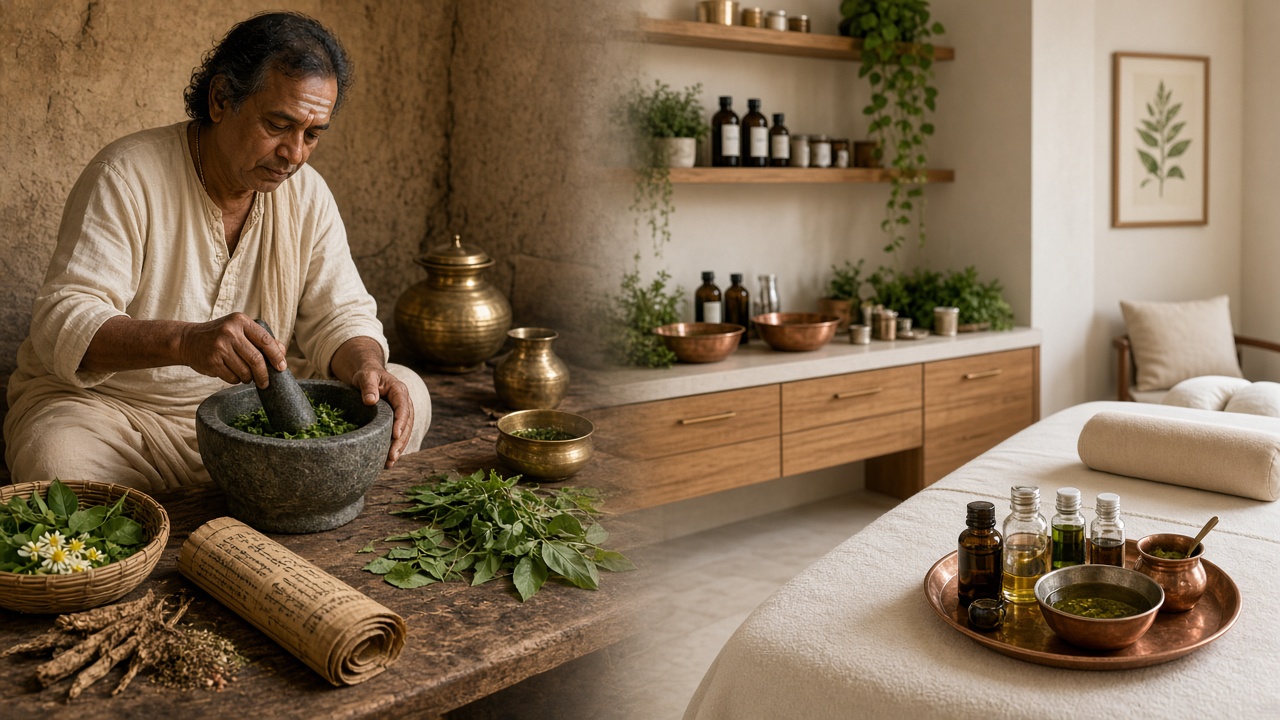
Mortar and manuscript to clinic oils — Ayurveda’s long arc (artistic illustration).
🌳 Living Knowledgeto c. 500 BCE
Roots & Early Healing
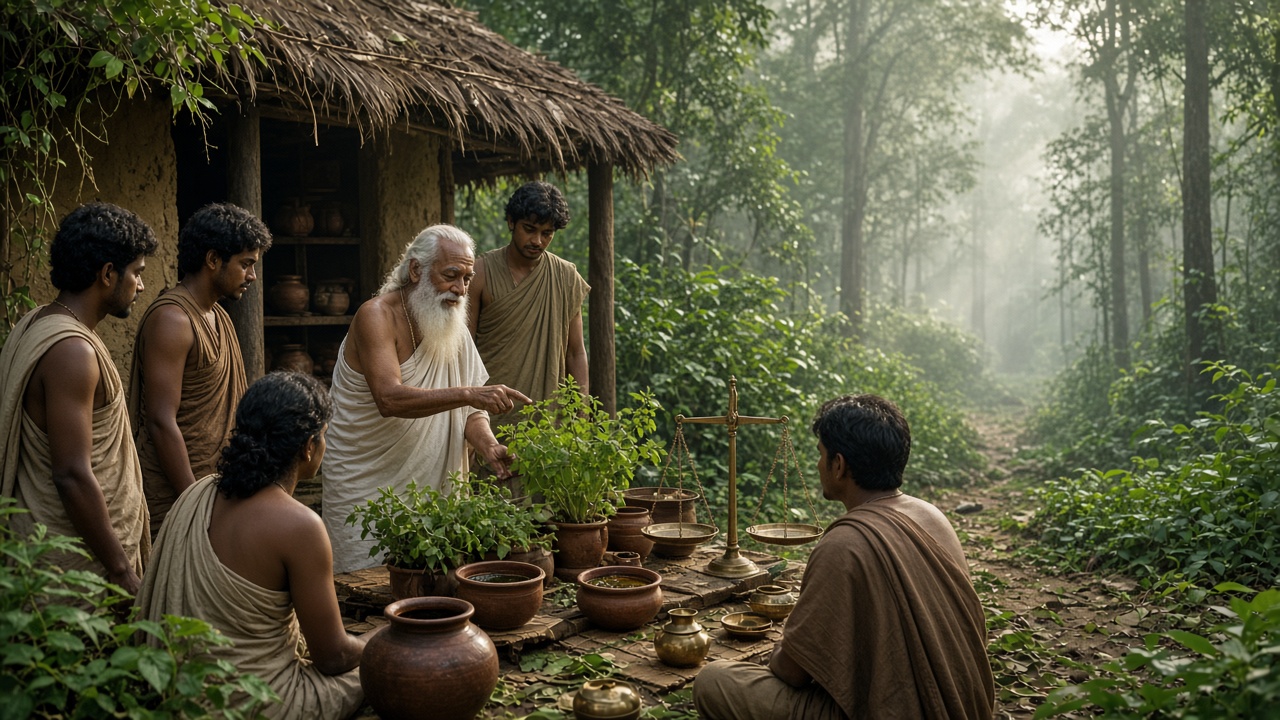
Before the great samhitas were fixed in the form we know, Indian communities practised plant medicine, surgery-like craft, and ritual healing.
Vedic and Atharvavedic layers preserve charms and remedies; teachers passed knowledge in forests and courts long before printed books.
Observation: Pulse, tongue, urine, and season noted.
Features
Practical: Aimed at daily survival and care.
Local: Varied by ecology and community.
Foundation: Feeds the classical medical corpus.
📜 Great Textsc. 200 BCE – 600 CE
Classical Samhitas
The Charaka Samhita organised internal medicine; the Sushruta Samhita recorded surgical instruments and procedures; later Vagbhata’s Ashtanga Hridaya synthesised the field.
These works define classical Ayurveda’s language of doshas, treatments, and ethics of the physician.
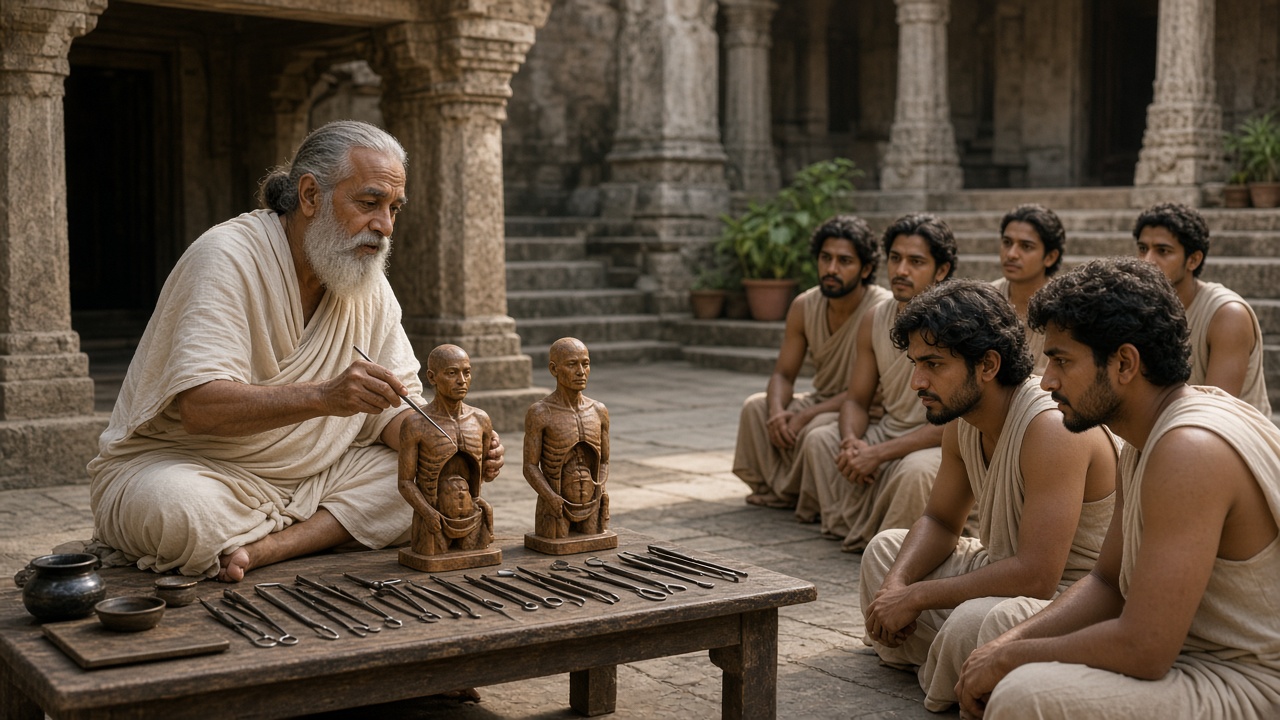
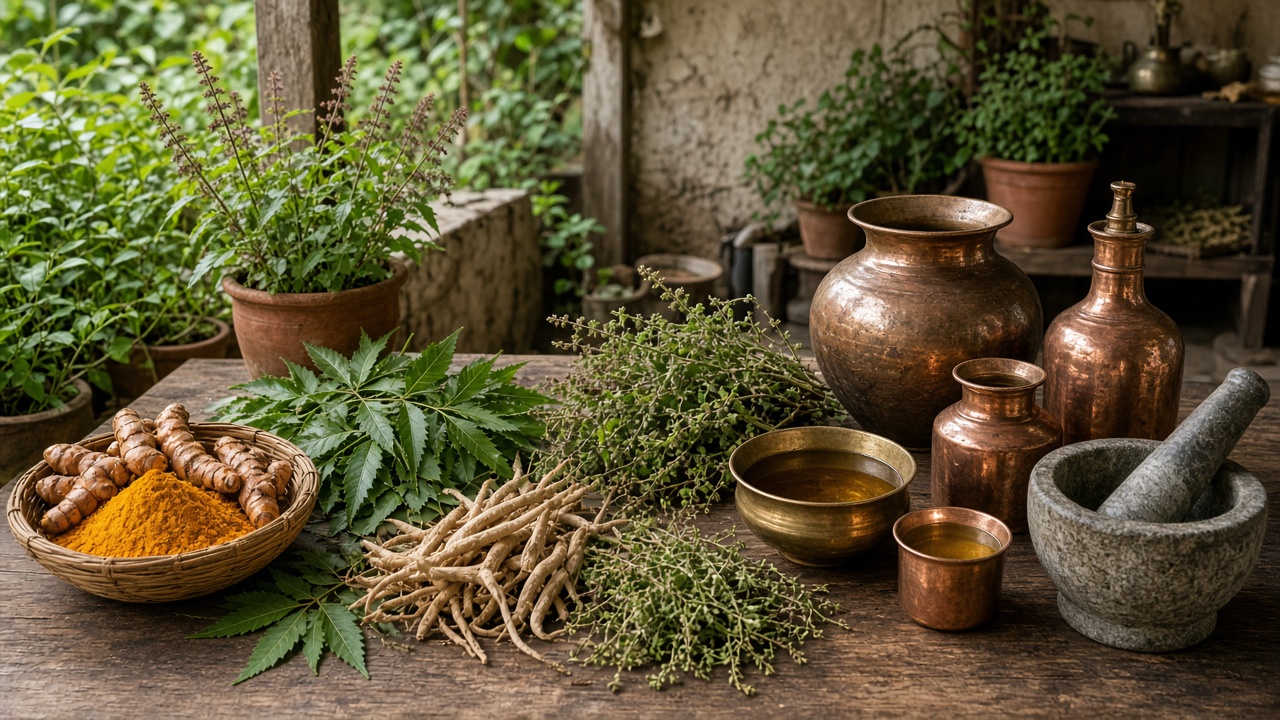
Sushruta’s tradition is famous for surgery and instruments (artistic illustration).Diet and materia medica sit at the heart of classical practice (artistic illustration).
Charaka: Diagnosis, epidemics, rejuvenation, and physician conduct.
Sushruta: Surgery, anatomy teaching, wound care, and famous reconstructive traditions.
Eight branches (Ashtanga): Internal medicine, surgery, ENT/eye, pediatrics, toxicology, and more.
Same era culture: Overlaps the classical centuries of
Maurya–Gupta India.
Tools
Samhita learning: Memorise, comment, debate.
Surgical kit: Forceps, knives, probes described in text.
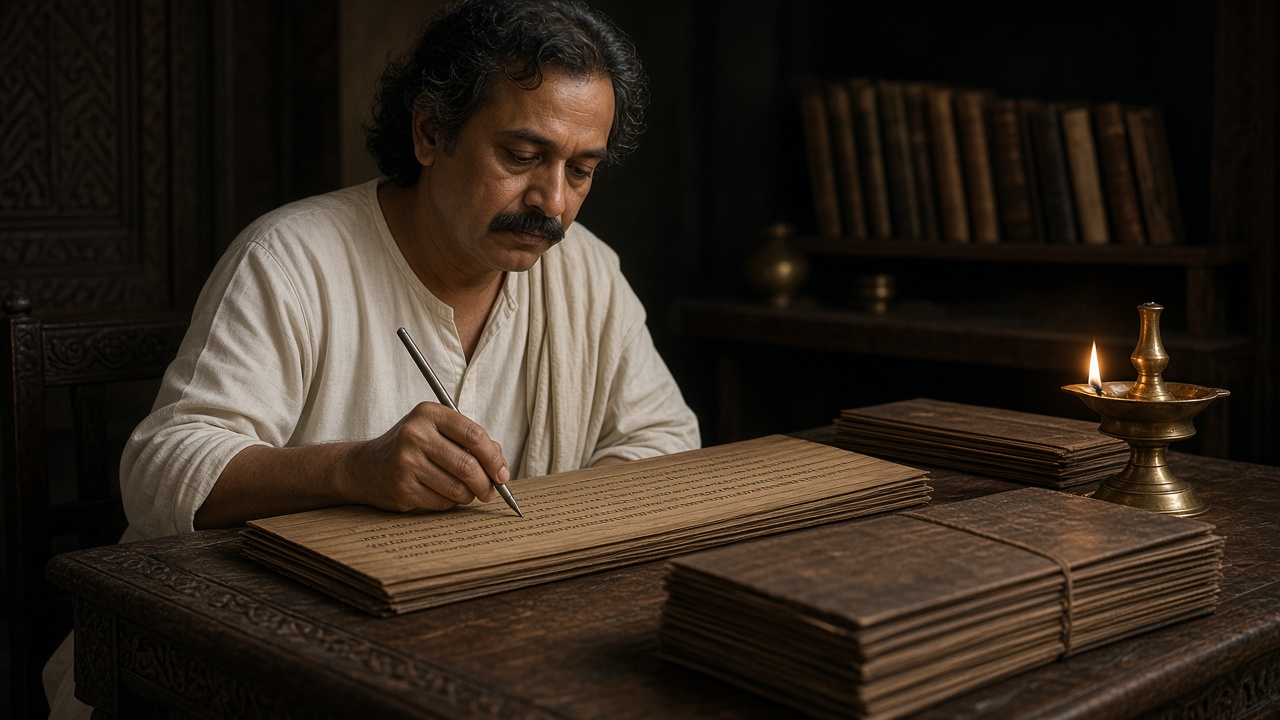
Scholars copied palm-leaf and paper manuscripts, wrote commentaries, and taught in courts and maths.
Regional schools flourished; Ayurveda lived beside Unani and folk practice in a plural medical marketplace.
Manuscript culture kept classical knowledge alive across centuries (artistic illustration).
Commentarial tradition: Difficult sutras explained for students.
Rasashastra growth: Mineral and metallic preparations develop specialised pharmacy.
Pluralism: Patients often chose among Ayurvedic vaidyas, Unani hakims, and local healers.
Court patronage: Kings supported physicians and botanical knowledge.
Tools
Palm leaf / paper: Texts recopied by hand.
Family lineages: Vaidya households as clinics.
Pharmacy shops: Urban centres for classical formulas.
Features
Continuity: Classical core preserved.
Adaptation: Local plants and recipes added.
Competition: Multiple medical systems coexist.
🖨️ Print & Pressurec. 1750 – 1947
Colonial Encounter & Print
Colonial rule privileged Western medicine in hospitals and medical colleges, yet Ayurveda did not disappear.
Printing spread samhitas; reformers founded Ayurvedic schools; debates over legitimacy and “scientific” standards intensified.
Print boom: Sanskrit and vernacular editions reach wider readers.
Institutional push: Early Ayurvedic colleges and associations appear in the late 19th–early 20th centuries.
Parallel systems: Allopathy dominates official public health; Ayurveda remains popular for many households.
Nationalism: Swadeshi-era pride boosts interest in indigenous medicine (see also
medical education).
Journals: Ayurvedic periodicals argue for recognition.
Features
Modernisation debates: Tradition vs laboratory science.
Survival: Practice continues outside elite hospitals.
Setup for BAMS: Degree model germinates.
🎓 Recognised System1947 – 2014
Colleges, Boards & AYUSH
Independent India built regulatory boards, undergraduate BAMS degrees, postgraduate institutes, and research councils.
Ayurveda became a state-recognised medical system; the later Ministry of AYUSH grouped Ayurveda with Yoga, Unani, Siddha, and Homoeopathy.
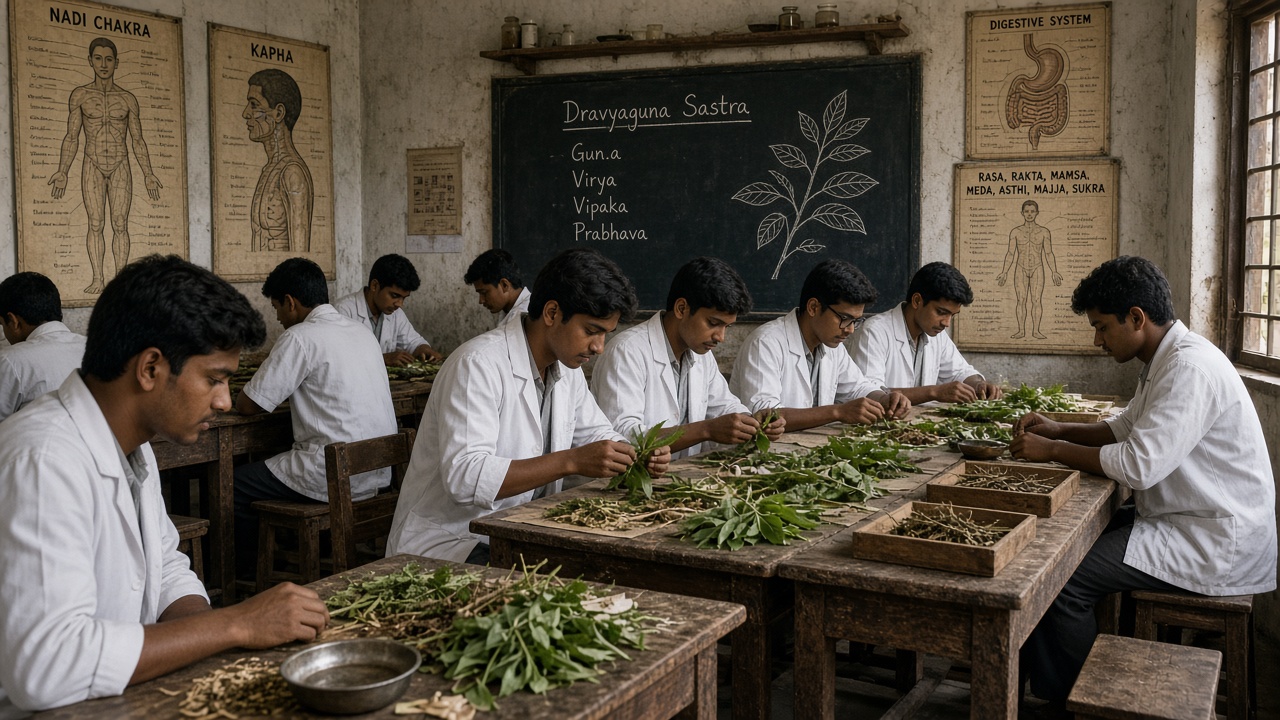
Classroom degrees brought Ayurveda into the modern university model (artistic illustration).
BAMS pathway: Structured curriculum combining classical texts with basic modern biomedical subjects.
Hospitals & pharmacies: Teaching hospitals and licensed manufacturing expand access.
Research bodies: Councils study drugs, clinical protocols, and pharmacognosy.
AYUSH framework: Policy umbrella for multiple traditional systems under one ministry.
Tools
Degree colleges: Uniform syllabi and exams.
Drug standards: Pharmacopoeias and quality rules.
Public clinics: AYUSH facilities in health systems.
Features
Legal recognition: Practitioners licensed by law.
Dual literacy: Texts + some modern sciences.
Integration debates: How to work with allopathy safely.
🌏 Wellness World2014 – Present
Global Wellness & Today
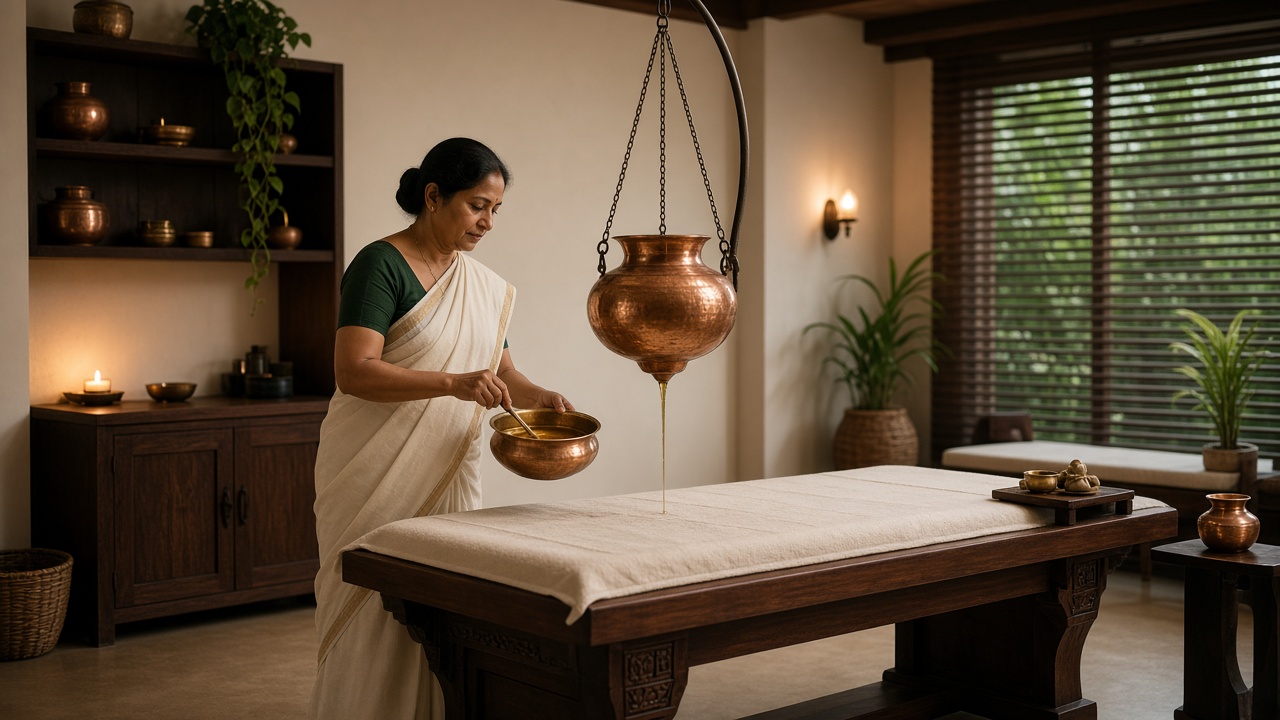
Kerala-style therapies, wellness tourism, packaged nutraceuticals, and yoga–Ayurveda packages take Indian traditions global.
Apps and e-pharmacies sell classical ideas in new wrappers — while researchers and regulators argue over evidence, quality, and safe use.
Wellness tourism made panchakarma-style care a global brand of India (artistic illustration).
Tourism & spas: Retreats market detox, oils, and lifestyle resets.
Industry: Large Ayurvedic brands and exports (links to
pharma).
Digital Ayurveda: Tele-consults, herb apps, and online courses.
Responsibility: Quality control, herb sustainability, and not delaying emergency care.
Critical literacy: Students learn to ask for evidence.
Core Ideas at a Glance
Idea
Simple meaning
Note
Doshas (Vata, Pitta, Kapha)
Functional principles of constitution & imbalance
Conceptual — not lab blood types
Agni
Digestive / metabolic “fire”
Central to diet advice
Dinacharya
Daily routine
Sleep, meals, hygiene rhythms
Panchakarma
Set of purification therapies
Clinical / wellness contexts
Dravya / aushadha
Medicinal substances
Herbs, minerals, formulations
Then vs Now
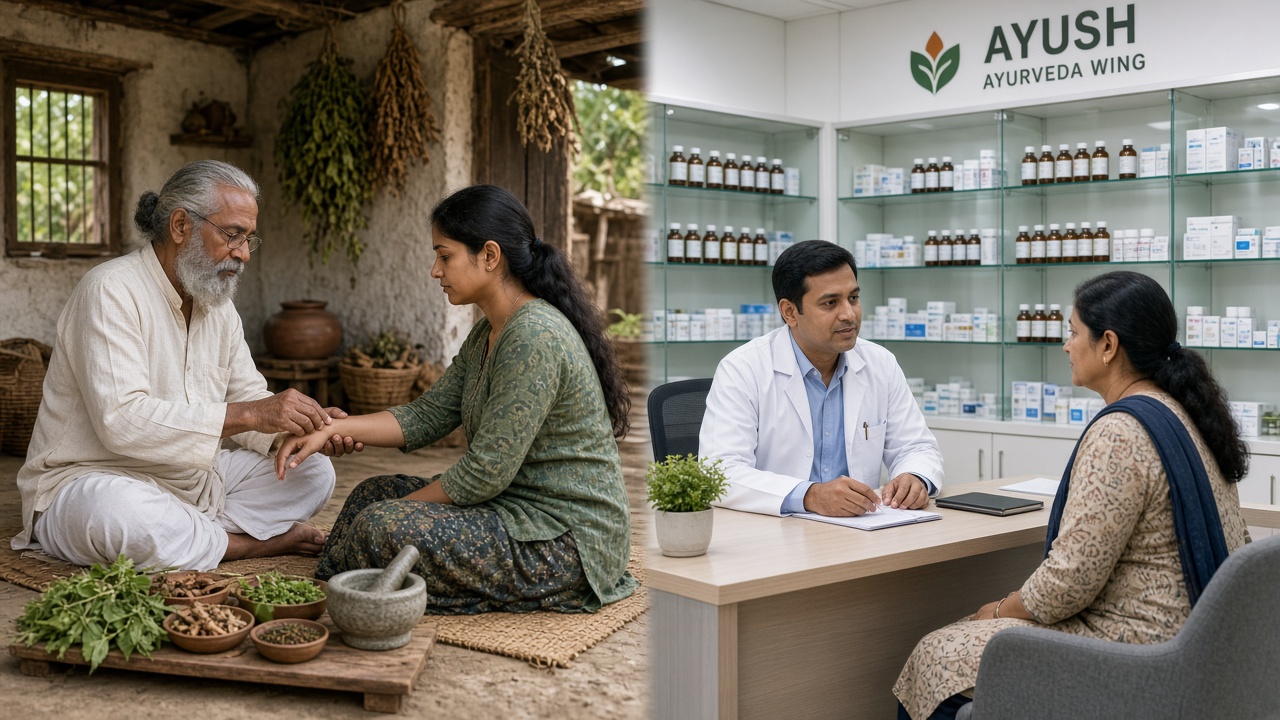
Village vaidya to AYUSH clinic — continuity with new institutions (artistic illustration).
Then
Palm-leaf texts and apprentices
Family vaidyas and local herbs
Surgery traditions in classical manuals
Plural healers in every town
Now
BAMS degrees and teaching hospitals
Licensed pharmacies and GMP factories
Wellness tourism and global brands
AYUSH policy beside modern medicine
India spotlight
Ayurveda as living Indian heritage
From kitchen turmeric milk to BAMS hospitals, Ayurveda remains woven into Indian daily life — and is now also a diplomatic and economic soft-power story through AYUSH and wellness tourism.
Classical
Samhita canon
Charaka, Sushruta, and later digests set the intellectual core still taught today.
Colonial → freedom
Print & colleges
Reformers fight for recognition while Western medicine runs state hospitals.
Republic
Regulation
Degrees, councils, and research formalise practice under Indian law.
AYUSH era
Global brand
Ministry frameworks, exports, and wellness circuits take Ayurveda worldwide — often paired with yoga.
Milestones
Era
Milestone
What changed
Early
Plant & oral healing
Foundations of later theory
Classical
Charaka & Sushruta traditions
Systematised medicine & surgery
Later classical
Ashtanga Hridaya
Widely used synthesis
Medieval
Manuscripts & rasashastra
Commentaries and specialised pharmacy
Colonial
Print & early colleges
Modern institutional beginnings
Republic
BAMS & councils
Legal degree pathway
21st century
AYUSH & wellness boom
Policy + global market presence
Timeline Summary
Era
Headline
Roots
Early healers and plant knowledge
Classical
Samhitas define Ayurveda
Medieval
Manuscripts and plural practice
Colonial
Print, pressure, and reform colleges
AYUSH build-up
Degrees, boards, research
Today
Wellness, exports, and digital Ayurveda
Test Your Knowledge
20 quick questions from the Ayurveda timeline. Click each question to reveal the answer.
Answer: Knowledge (or science) of life.
Answer: Charaka Samhita and Sushruta Samhita (also Ashtanga Hridaya).
Answer: The Sushruta Samhita.
Answer: Vata, pitta, and kapha.
Answer: Daily routine guidance for healthy living.
Answer: A set of classical purification / therapeutic procedures used in Ayurvedic care and wellness.
Answer: Vagbhata.
Answer: Through handwritten manuscripts and teacher–student lineages.
Answer: Unani (among others, plus folk healers).
Answer: Western medicine was privileged in official hospitals and colleges, while Ayurveda sought recognition and reform.
Answer: Bachelor of Ayurvedic Medicine and Surgery.
Answer: Ayurveda, Yoga & Naturopathy, Unani, Siddha, and Homoeopathy.
Answer: Wellness tourism, packaged products/exports, or online courses/apps.
Answer: It includes classical texts, formal training, pharmacy, and clinical systems beyond kitchen nuskhas.
Answer: The Yoga in Daily Life timeline.
Answer: False — it is educational history, not medical advice.
Answer: Specialised pharmacy involving minerals/metals and related preparations in Ayurvedic tradition.
Answer: Global demand can overharvest wild plants; quality and ecology both need care.
Click any panel to expand and explore the visual mood.
Ayurveda in pictures — hermitage teaching, surgery tradition, herbs, manuscripts, colleges, wellness, and then vs now.
Overview
Past to clinic
Early Roots
Teaching by plants
Classical
Sushruta tradition
Herbs
Materia medica
Manuscripts
Medieval copyists
Colleges
BAMS era
Wellness
Global boom
Then & Now
Vaidya to AYUSH
Explore all health timelines
Jump to any other health timeline on WorldTimelineHub.
Disclaimer: This content is AI-generated for educational purposes and may contain errors or outdated details. For correct and authoritative information, please refer to official and reliable sources such as government publications, manufacturers, museums, and academic references.