For decades polio left thousands of Indian children every year with weak or paralysed legs, and calipers and crutches were a common sight. India began routine vaccination in 1978, spread it to every district from 1985, and in 1995
launched Pulse Polio — two drops for every child under five on a single day. After years of house-to-house visits, transit teams, and huge setbacks, India recorded its last case in January 2011 and was certified polio-free in 2014.
This timeline covers the Salk and Sabin vaccines, the Expanded Programme on Immunization, the Universal Immunization Programme, the cold chain, Pulse Polio and “Do Boond Zindagi Ki”, polio surveillance, finger and house
marking, transit and mobile teams, the 2002 and 2009 outbreaks, the last case in Howrah, WHO certification, IPV, the 2016 vaccine switch, and how India stays polio-free.
Many experts once believed India would be the last place on Earth to get rid of polio, because of its huge population, crowded cities, poor sanitation, and constant migration. Its success showed that a well-organised
public health campaign — millions of health workers, volunteers, scientists, and parents working together — can defeat a disease even in the hardest conditions, and the same network now helps with other vaccines.
Big picture
India’s fight against polio in one view
Polio was endemic across India until the 1970s. Routine vaccination began with EPI in 1978, the Universal Immunization Programme reached every district by about 1990, Pulse Polio campaigns from 1995 vaccinated every
child under five again and again, and the last wild polio case was recorded in 2011, leading to WHO certification in 2014. Related timelines:
television,
railways,
research in India.
1995
First Pulse Polio round
741
Cases in 2009, the world’s highest
2011
Last wild polio case (Howrah)
2014
Certified polio-free by WHO
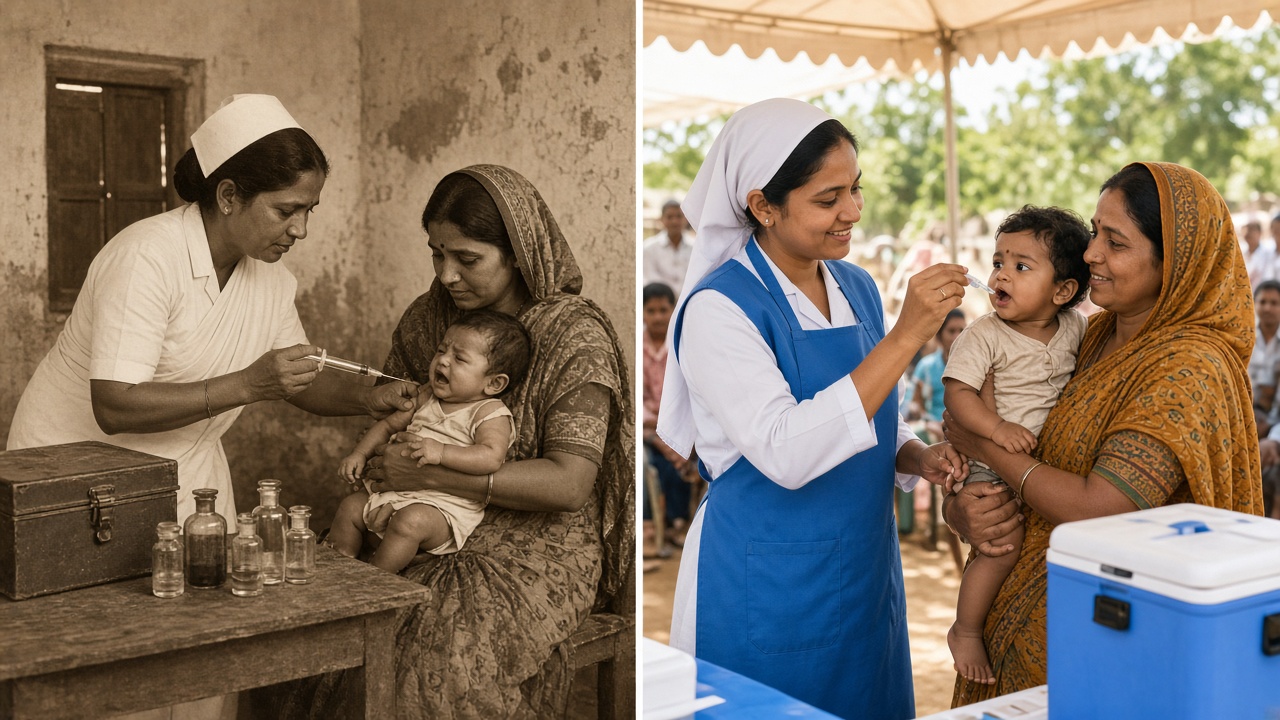
From glass syringes in a village clinic to two drops at a Pulse Polio booth (artistic illustration).
Polio in India Then vs Now at a Glance
Feature
Then (1970s)
Now
Disease
Common in every state
No wild polio case since January 2011
Vaccine
Few children vaccinated
Free oral drops and injections for every child
Where vaccinated
Hospitals in towns
Booths, homes, trains, bus stands, and borders
Vaccine storage
Ice in metal boxes
Cold chain, vial monitors, and digital stock tracking
Records
Paper cards, often lost
Mother and child protection cards and digital records
Tracking cases
Few cases reported
Every case of sudden weakness tested in a lab
Awareness
Word of mouth
Radio, TV, film stars, and religious leaders
Workers
Doctors and nurses in clinics
Lakhs of vaccinators, ASHAs, anganwadi workers, and volunteers
Children paralysed
Thousands every year
No new wild polio paralysis
Status
Polio-endemic country
Certified polio-free since 2014
🦽 EndemicBefore 1978
Polio Everywhere: Calipers & Crutches
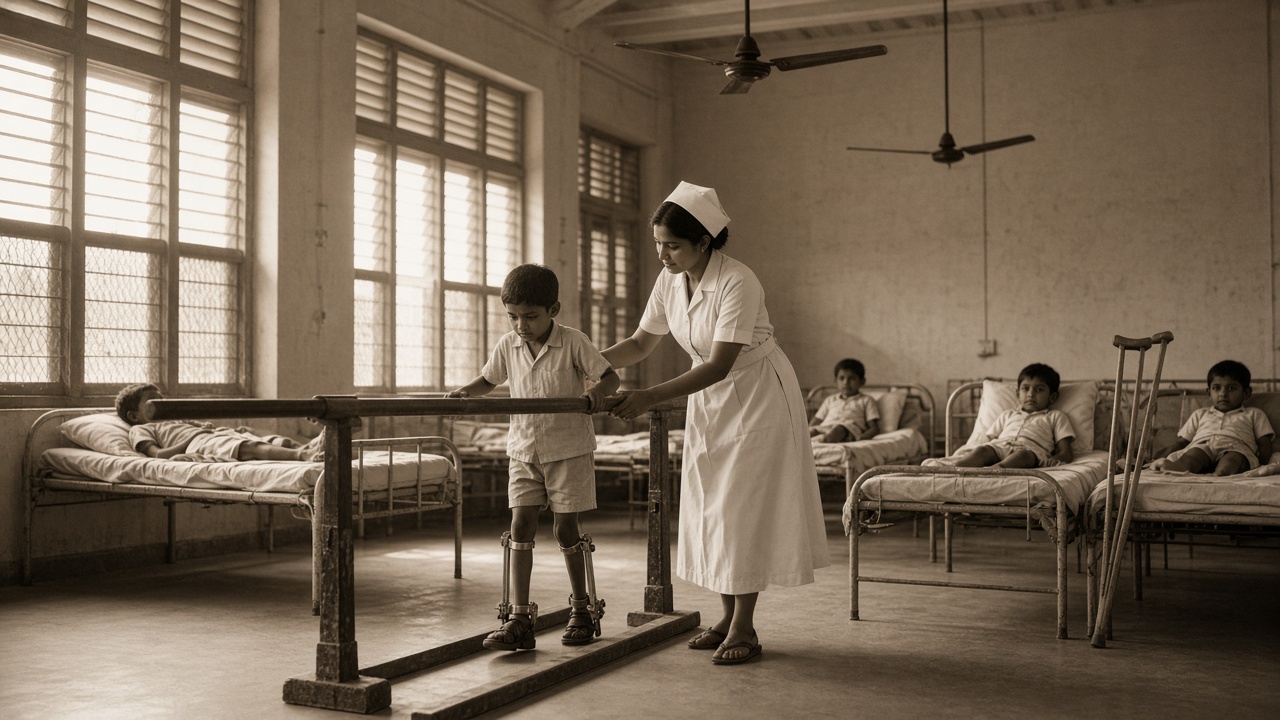
Before routine vaccination, the poliovirus spread freely through contaminated water and hands in crowded towns and villages. Most infected children had only a mild fever, but some woke up unable to move a leg, and families turned to hospitals, physiotherapy, calipers, and crutches. Vaccines existed abroad but reached very few Indian children.
A nurse helps a boy with leg calipers learn to walk again (artistic illustration).
1908–1955: Scientists identify the poliovirus (1908), and the injected inactivated polio vaccine (IPV) developed by Jonas Salk is licensed in the United States in 1955.
Early 1960s: Albert Sabin’s oral polio vaccine (OPV) — cheap drops that need no needle and also protect the gut — comes into use and is soon tried in a few Indian cities.
1960s–1970s: Polio is common in every Indian state, and hospitals and rehabilitation centres treat children with paralysed legs using physiotherapy, calipers, crutches, and surgery.
1974: The World Health Assembly launches the global Expanded Programme on Immunization (EPI) to protect children against six diseases, including polio.
Technology
Salk vaccine: Injected, killed virus.
Sabin vaccine: Oral drops, weakened virus.
Calipers: Metal leg supports.
Features
No routine vaccination: Few children protected.
Monsoon outbreaks: Cases rise in wet months.
Lifelong disability: No cure for paralysis.
💉 EPI1978 – 1984
Expanded Programme on Immunization
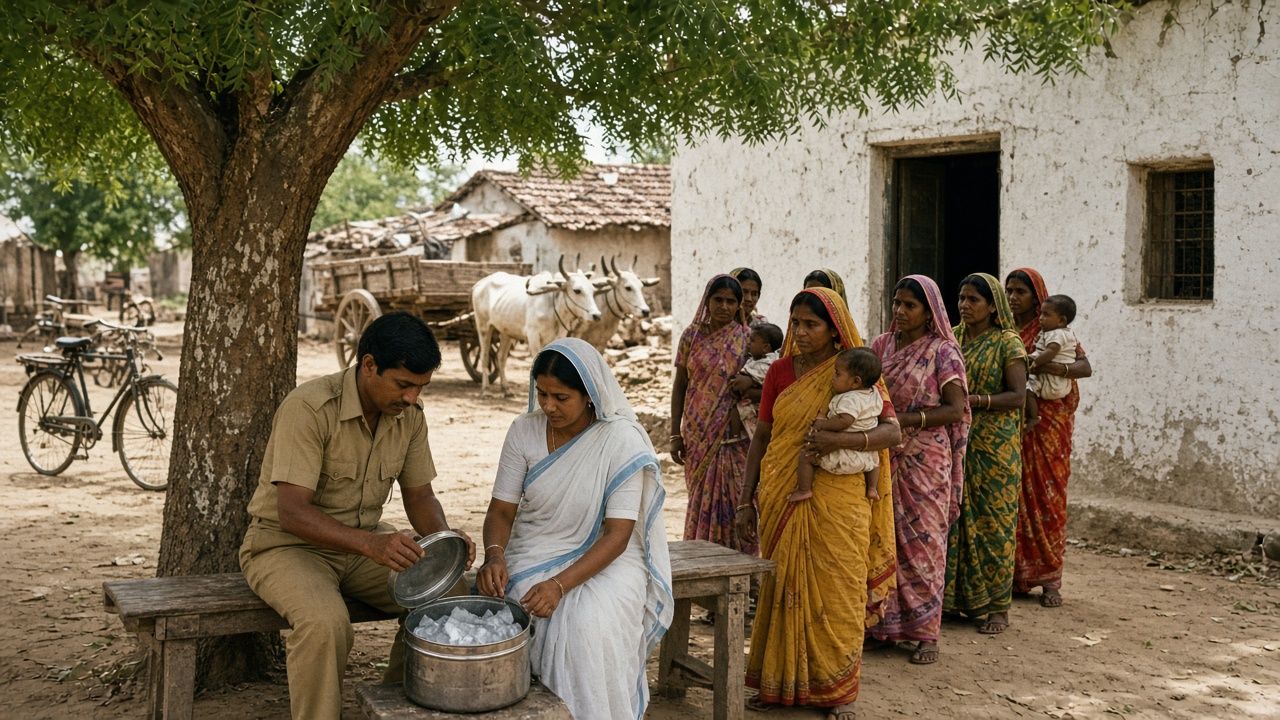
In 1978 India started its first national programme of routine childhood vaccination. Health centres began offering a set of free vaccines, including oral polio drops, but coverage stayed low, especially in villages, because vaccines lost their strength without proper refrigeration and many parents had never heard of them.
Health workers open an ice-packed vaccine carrier for waiting mothers (artistic illustration).
1978: India launches the Expanded Programme on Immunization (EPI), offering BCG, DPT, oral polio vaccine, and typhoid vaccine to infants and young children, mainly through hospitals and health centres.
Late 1970s–early 1980s: Coverage stays low in rural areas, and many doses lose their strength because the vaccine must be kept cold from the factory to the child.
1983: India’s first National Health Policy sets goals for universal immunisation of children.
Early 1980s: Surveys of lameness in schools and villages show that polio is still paralysing a very large number of Indian children every year.
Technology
Vaccine carriers: Boxes packed with ice.
Refrigerators: Only at bigger centres.
Paper cards: Dose records.
Features
Fixed clinics: Parents had to travel.
Free vaccines: A basic set.
Low coverage: Many villages missed.
🏥 UIP1985 – 1994
Universal Immunization Programme
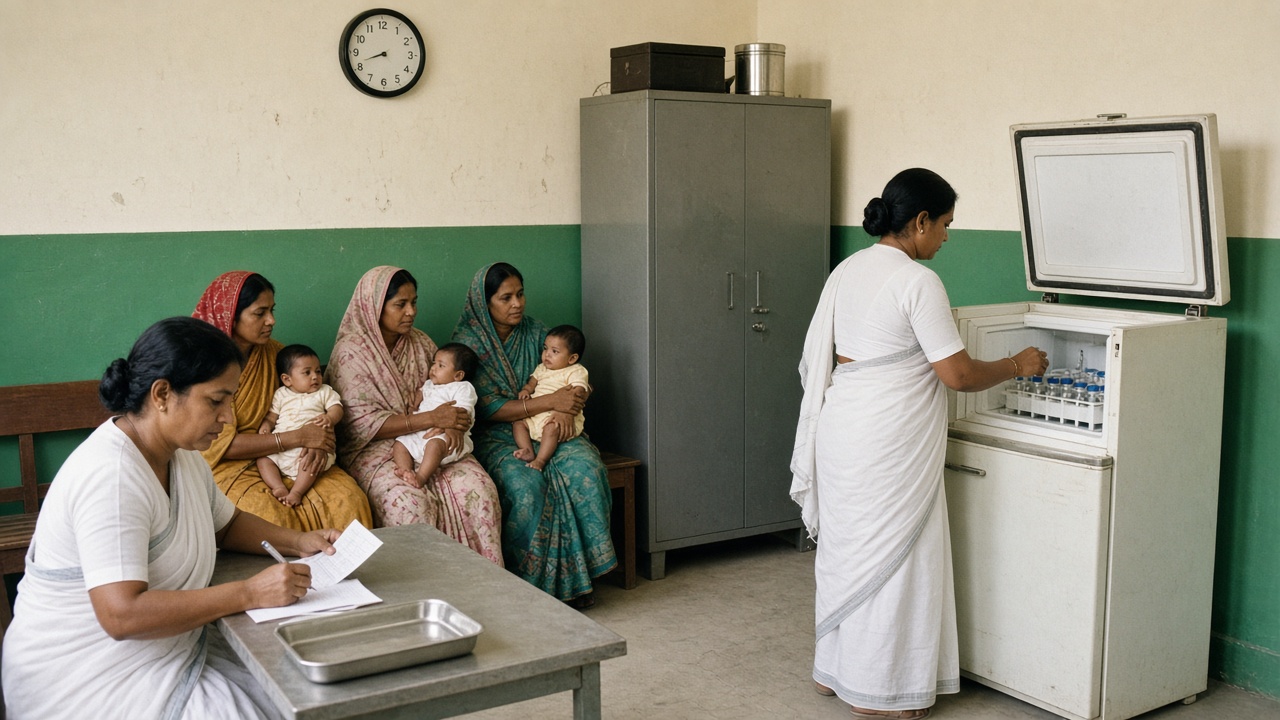
The Universal Immunization Programme aimed to vaccinate every infant and pregnant woman in every district. It added the measles vaccine, trained health workers to hold regular immunisation sessions, and built a national cold chain of ice-lined refrigerators and deep freezers, while the world set itself the goal of wiping out polio.
Nurses record doses and take vaccines from the cold chain on immunisation day (artistic illustration).
19 November 1985: The Universal Immunization Programme (UIP) begins in 30 districts, adding the measles vaccine and aiming to protect every infant and pregnant woman.
1986: Immunisation becomes one of the National Technology Missions, which strengthens the cold chain with ice-lined refrigerators, deep freezers, and trained cold chain handlers.
1988: The World Health Assembly launches the Global Polio Eradication Initiative, when polio is paralysing about 350,000 children a year in 125 countries.
1990–1992: UIP reaches all districts of India by about 1990, and in 1992 it becomes part of the Child Survival and Safe Motherhood programme.
Technology
Ice-lined refrigerators: Keep vaccines cold.
Deep freezers: Store OPV and ice packs.
Cold chain: Factory to village.
Features
Every district: National reach.
Session days: Regular schedule.
Measles added: Six diseases covered.
💧 Pulse Polio1995 – 2004
Pulse Polio: Do Boond Zindagi Ki
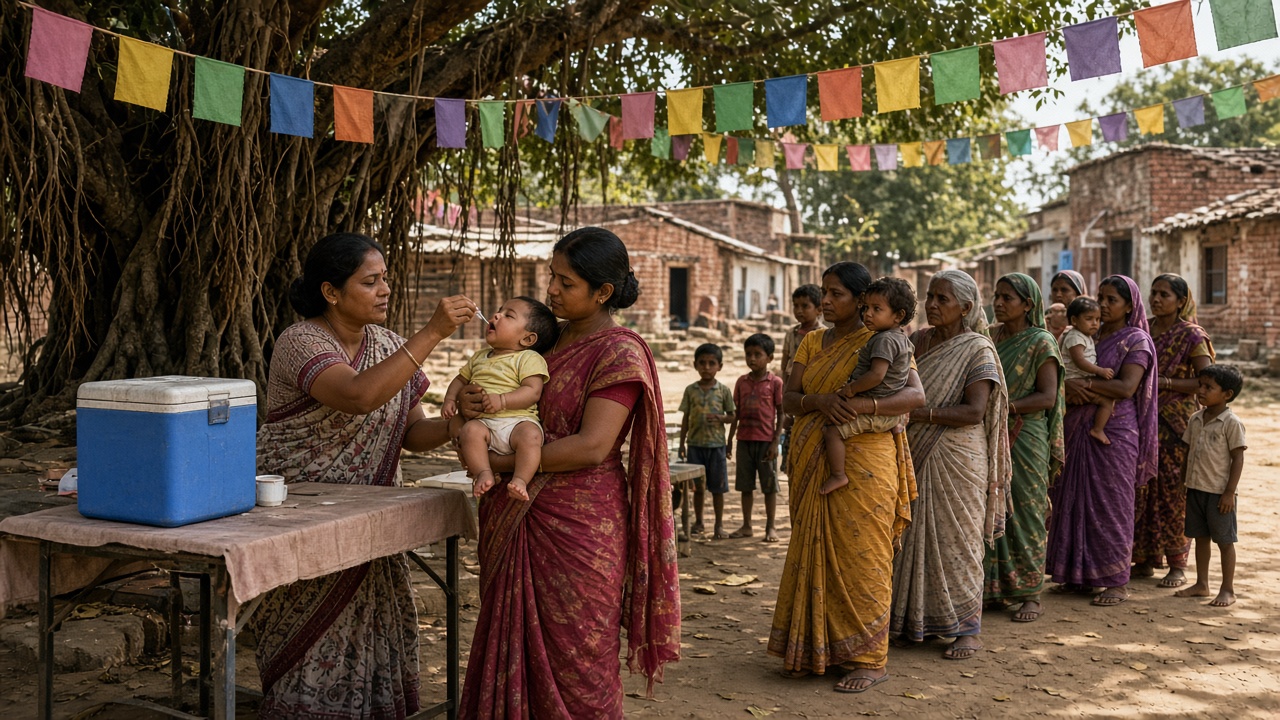
Routine vaccination alone could not stop polio, so India began national immunisation days. On a single Sunday, lakhs of booths gave two drops of oral polio vaccine to every young child, even those already vaccinated, and teams later went house to house to find children who were missed. A national surveillance network checked every case of sudden weakness.
Mothers queue for two drops of polio vaccine on booth day (artistic illustration).
9 December 1995: The first Pulse Polio round gives oral polio drops to about 8.7 crore children under three on a single day, with a second round in January 1996; later rounds cover all children under five.
1997: The National Polio Surveillance Project, run with WHO, starts reporting every case of acute flaccid paralysis (sudden floppy weakness) in children and testing stool samples in a network of laboratories.
1999: Vaccinators begin visiting every house after booth day, and the world’s last case of wild poliovirus type 2 is found in Aligarh, Uttar Pradesh.
2002: A large outbreak of about 1,600 cases, mostly in Uttar Pradesh and Bihar, shows the virus surviving among crowded, poor communities with weak immunity.
Technology
OPV vials: Two drops per child.
Vial monitors: Labels that change colour with heat.
Lab network: Stool tests for the virus.
Features
Booth Sunday: All children, one day.
Finger marking: Ink on the little finger.
House-to-house: No child missed.
🚆 Last Mile2005 – 2011
The Last Mile: Transit Teams to the Last Case
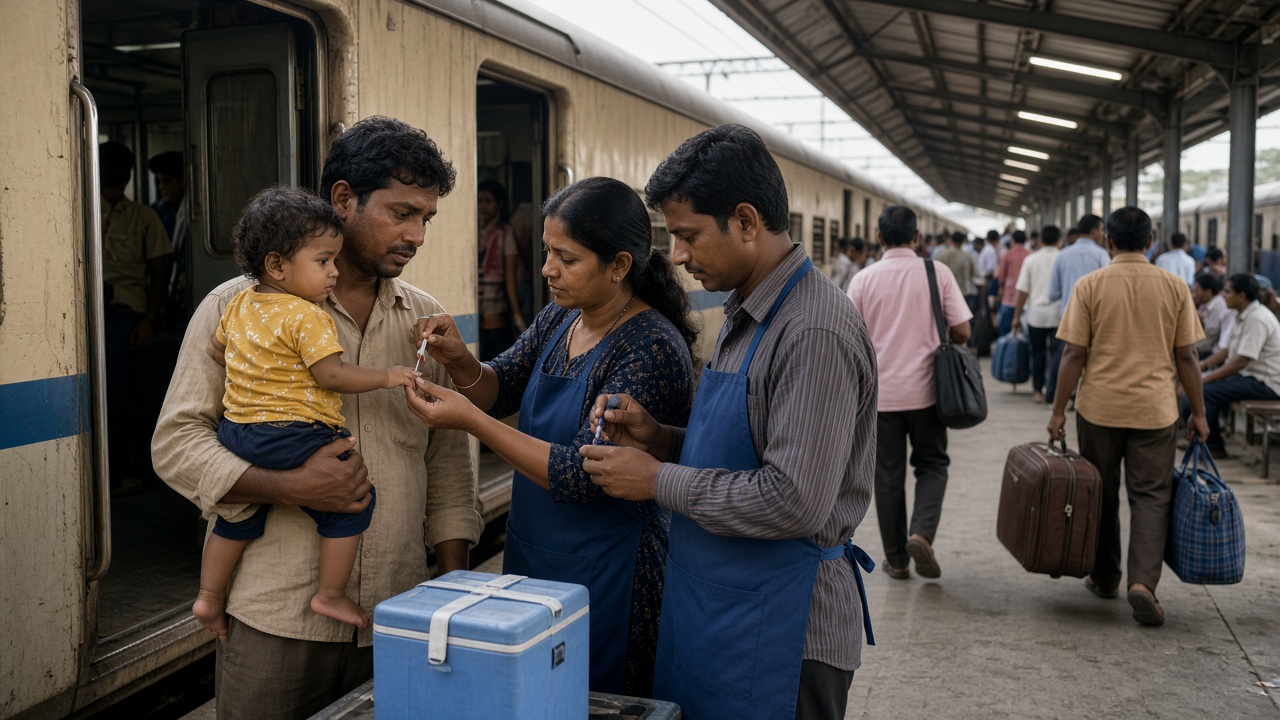
The virus held on in western Uttar Pradesh and central Bihar, where crowding, floods, diarrhoea, and poor sanitation weakened the vaccine’s effect. India answered with stronger vaccines, more frequent rounds, teams at railway stations and bus stands, mobile teams for migrant families, and community leaders who won the trust of doubtful parents.
A transit team vaccinates a travelling child at a railway station (artistic illustration).
2005: Monovalent oral polio vaccine type 1 (mOPV1), which gives stronger protection against the most common strain, is introduced in high-risk areas, followed by type 3 vaccine (mOPV3) from 2007.
2006–2009: Cases rise again — 676 in 2006, 874 in 2007, 559 in 2008, and 741 in 2009 — concentrated in about 107 high-risk blocks of Uttar Pradesh and Bihar.
2000s: Transit teams vaccinate children on trains and at stations and bus stands, mobile teams reach brick kilns, building sites, and flood-hit Kosi villages, and religious leaders and film stars encourage parents.
2010–2011: Bivalent OPV (types 1 and 3) is introduced in January 2010, cases fall to 42, and India’s last wild polio case is an 18-month-old girl in Howrah, West Bengal, on 13 January 2011.
Technology
mOPV and bOPV: Targeted vaccines.
Sewage testing: Virus found in drains.
Microplans: Maps of every house.
Features
Transit teams: Children on the move.
Mobile teams: Migrant families.
Community trust: Local mobilisers.
🏅 Polio-Free2012 – Future
Polio-Free, Certified & Staying Safe
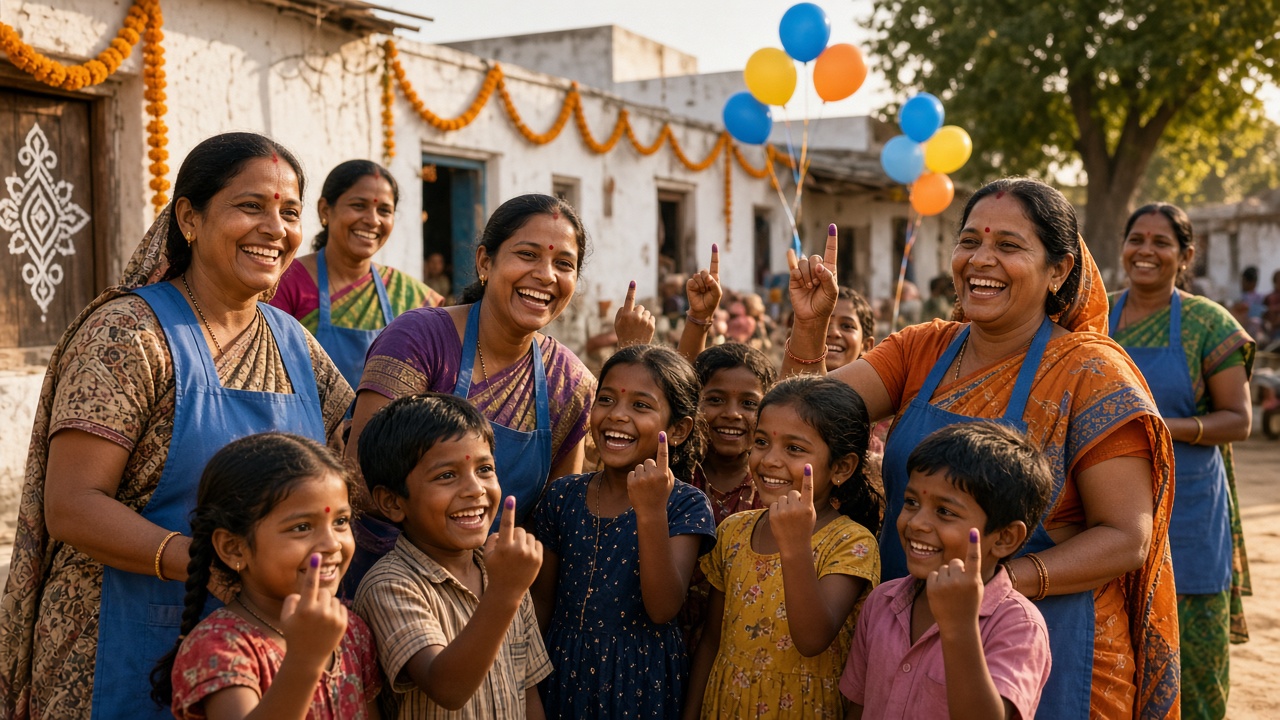
After a full year without a case, India was removed from the list of polio-endemic countries, and after three years it was certified polio-free along with the rest of WHO’s South-East Asia Region. India still vaccinates every child, tests sewage, and screens travellers, because polio anywhere is a risk everywhere.
Health workers and children celebrate a polio-free India (artistic illustration).
24 February 2012: WHO removes India from the list of polio-endemic countries after a full year with no wild polio case.
27 March 2014: WHO certifies India and the South-East Asia Region polio-free, and India begins requiring polio vaccination for travellers from polio-affected countries.
2015–2016: Injectable IPV joins routine immunisation (November 2015), and on 25 April 2016 India, along with the rest of the world, switches from trivalent to bivalent oral polio vaccine.
Today and future: Fractional-dose IPV, Mission Indradhanush catch-up drives, yearly Pulse Polio rounds, sewage surveillance, border vaccination, and the global goal of ending polio everywhere.
Technology
IPV injections: No live virus.
Environmental surveillance: Sewage sampling.
Digital records: Vaccine stock and doses online.
Features
Polio-free status: Since 2014.
Border posts: Children vaccinated.
Routine schedule: OPV plus IPV.
Wild Polio Cases in India, 1998–2012
Reported cases of wild poliovirus from national surveillance. Figures in different reports can vary slightly, and the true number of infections was always much higher, because most infected children never become paralysed.
Year
Reported cases
What was happening
1998
1,934
Surveillance begins finding hidden cases
1999
1,126
House-to-house visits begin
2000
265
Sharp fall after intensive rounds
2002
About 1,600
Big outbreak in Uttar Pradesh and Bihar
2004
134
Cases fall again
2005
66
mOPV1 introduced
2006
676
Type 1 outbreak in western Uttar Pradesh
2007
874
Type 3 cases rise; mOPV3 used
2009
741
World’s highest; 107 high-risk blocks targeted
2010
42
Bivalent OPV introduced
2011
1
Last case, Howrah (13 January)
2012
0
Removed from the endemic list
Polio Vaccines Used in India
Vaccine
How it is given
Protects against
Use in India
Trivalent OPV (tOPV)
Oral drops
Types 1, 2, and 3
Routine and campaigns until April 2016
Monovalent OPV type 1 (mOPV1)
Oral drops
Type 1
High-risk campaigns from 2005
Monovalent OPV type 3 (mOPV3)
Oral drops
Type 3
Targeted campaigns from 2007
Bivalent OPV (bOPV)
Oral drops
Types 1 and 3
Campaigns from 2010; routine from 2016
Inactivated polio vaccine (IPV)
Injection in the thigh or arm
Types 1, 2, and 3
Routine immunisation from November 2015
Fractional IPV (fIPV)
Small injection into the skin
Types 1, 2, and 3
Dose-saving schedule in routine immunisation
How India Reached Every Child
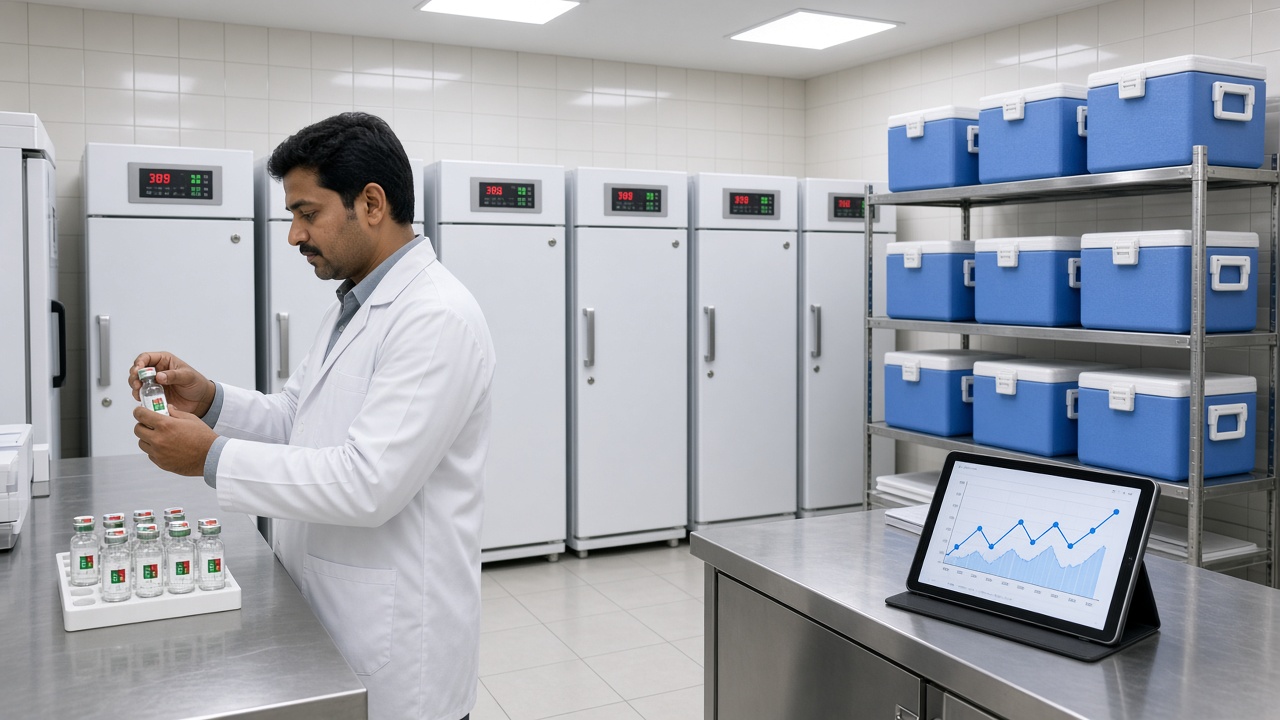
A pharmacist checks vaccine vials in a district cold chain store (artistic illustration).
Tool or strategy
What it did
Cold chain
Kept vaccines cold from factory to village
Vaccine vial monitor
A label that changes colour if a vial gets too warm
Booth day
Vaccinated every child under five on one day
Finger marking
Ink on the left little finger showed a child was vaccinated
House marking
Chalk marks on doors showed visited houses and missed children
Microplans
Maps and lists of every house, team, and route
Transit teams
Vaccinated children at stations, bus stands, and on trains
Mobile teams
Reached brick kilns, building sites, and nomadic families
Paralysis surveillance
Every case of sudden weakness in children tested
Sewage surveillance
Found the virus in drains before children fell ill
Social mobilisation
Local mobilisers, religious leaders, and celebrities built trust
Polio Eradication in India Timeline Summary
Year / Era
Milestone
1908
Poliovirus identified
1955
Salk’s injected vaccine licensed
Early 1960s
Sabin’s oral vaccine comes into use
1974
WHO launches global EPI
1978
India launches EPI
1983
National Health Policy sets immunisation goals
1985
Universal Immunization Programme (19 November)
1986
Technology Mission on immunisation
1988
Global Polio Eradication Initiative
1995
First Pulse Polio round (9 December)
1997
National Polio Surveillance Project
1999
House-to-house visits; last wild type 2 case
2002
Outbreak of about 1,600 cases
2005
mOPV1 introduced
2009
741 cases, the world’s highest
2010
Bivalent OPV introduced
2011
Last wild polio case (13 January)
2012
Removed from the endemic list (24 February)
2014
Certified polio-free (27 March)
2015
IPV in routine immunisation
2016
Switch from trivalent to bivalent OPV (25 April)
Future
A polio-free world
Test Your Knowledge
20 quick questions from the polio eradication timeline. Click each question to reveal the answer.
Answer: Mostly the legs, by damaging nerves in the spinal cord.
Answer: Through contaminated water, food, and hands.
Answer: Jonas Salk.
Answer: Albert Sabin.
Answer: 1978.
Answer: 19 November 1985.
Answer: The measles vaccine.
Answer: The system of refrigerators, freezers, and carriers that keeps vaccines cold from the factory to the child.
Answer: 1988.
Answer: 9 December 1995.
Answer: Two drops of life.
Answer: The left little finger.
Answer: Acute flaccid paralysis — any sudden floppy weakness in a child — which is then tested for poliovirus.
Answer: Aligarh, Uttar Pradesh.
Answer: Vaccinated children at railway stations, bus stands, and on trains.
Answer: 741, the highest in the world that year.
Answer: Howrah district, West Bengal, on 13 January 2011.
Answer: 24 February 2012.
Answer: 27 March 2014, with WHO’s South-East Asia Region.
Answer: India and the world switched from trivalent to bivalent oral polio vaccine.
Classroom activity
Students Tasks
Use these prompts for discussion or projects on how India defeated polio.
Click any panel to expand and explore the visual mood.
India’s fight against polio in pictures — the rehabilitation ward, the village vaccine carrier, the health centre cold chain, the Pulse Polio booth, the railway transit team, the polio-free celebration, the modern vaccine store, and then versus now.
Endemic Polio
Calipers and care
EPI Launched
Vaccines on ice
Universal Immunization
Every district
Pulse Polio
Two drops of life
Transit Team
Children on the move
Polio-Free
Certified in 2014
Cold Chain
Vaccines kept cold
Then vs Now
Syringe to drops
Explore all health timelines
Jump to any other health timeline on WorldTimelineHub.
Disclaimer: This content is AI-generated for educational purposes and may contain errors or outdated details. For correct and authoritative information, please refer to official and reliable sources such as government publications, manufacturers, museums, and academic references.