Medical Devices Timeline of India: Imported Instruments → First Indian Makers → Heart Valves & First Rules → AiMeD → 100% FDI & Make in India → Atmanirbhar MedTech
For most of its history India imported its surgical instruments, X-ray machines, and hospital equipment. Indian makers of syringes, latex products, artificial limbs, and heart valves slowly emerged, Indian manufacturers came
together as AiMeD in 2002, 100% foreign investment was allowed in 2014, research-based companies formed MTaI in 2015, and the Make in India push, COVID-19, PLI, and device parks set out to make India a medical device maker.
This timeline covers imported instruments, early X-rays, Hindustan Syringes, CSIO, HLL, the Jaipur Foot, Sree Chitra and the TTK-Chitra heart valve, Aurolab lenses, device notifications from 1989 and 2005, AiMeD, Stanford-India
Biodesign, Make in India, 100% FDI, MTaI, AMTZ, stent and knee price caps, the Medical Devices Rules 2017, COVID-era PPE and ventilators, PLI, medical device parks, and the National Medical Devices Policy 2023.
1969 Jaipur Foot → 1990 Chitra Heart Valve2002 AiMeD → 2014 100% FDI → 2015 MTaI2020 PLI & Device Parks → 2023 National Policy
Why the Story of Medical Devices Matters
Doctors and medicines cannot work without devices — a syringe for a vaccine, a thermometer for a fever, an X-ray for a broken bone, a stent for a blocked artery, or a ventilator in intensive care. When these devices are
imported, they are costly and can run short in a crisis. The story of India’s medical devices is the story of trying to make safe, affordable devices at home for every hospital and health centre.
Big picture
Indian medical devices in one view
Imported instruments filled colonial hospitals, Indian firms began making syringes, latex goods, and artificial limbs after independence, research institutes created heart valves and blood bags, the first device rules came
in 1989, AiMeD was formed in 2002, 100% FDI arrived in 2014, MTaI in 2015, and since 2020 PLI, device parks, and a national policy have pushed domestic manufacturing. Related timelines:
research and innovation,
Digital India,
artificial intelligence.
2002
AiMeD formed by Indian makers
100%
FDI allowed from 2014
~70%
Of devices still imported (estimate)
4
Medical device parks approved
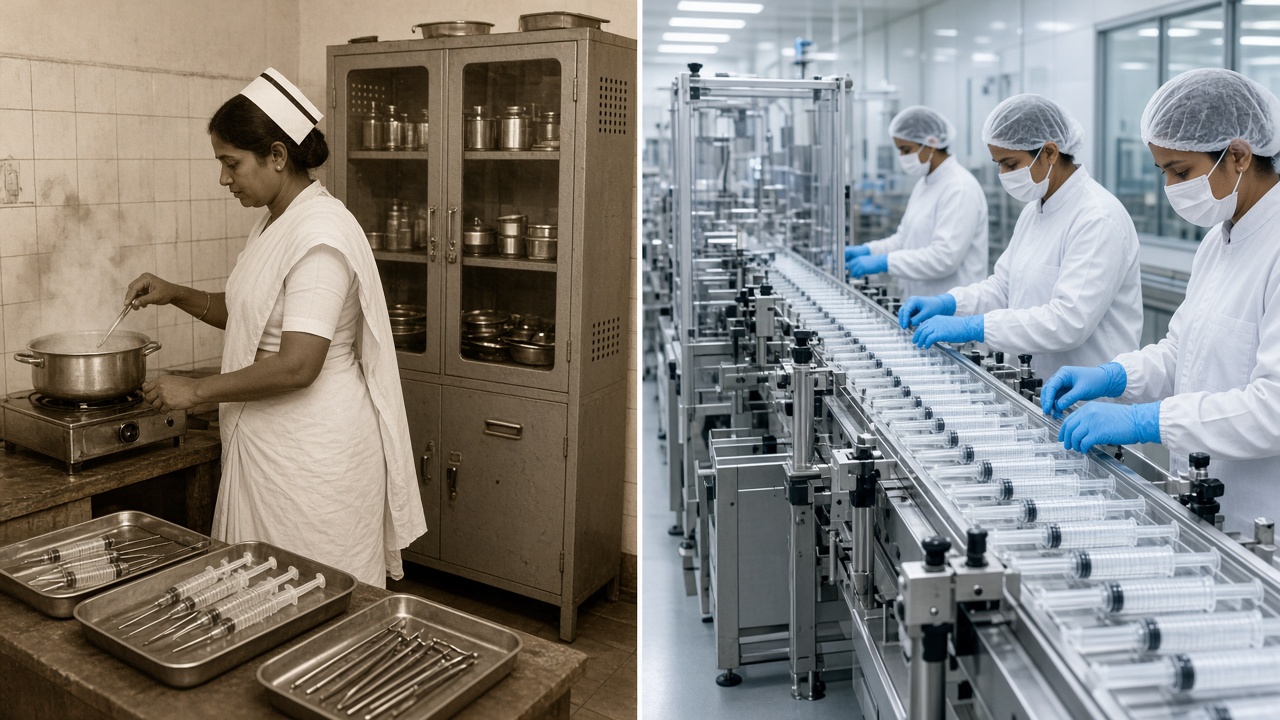
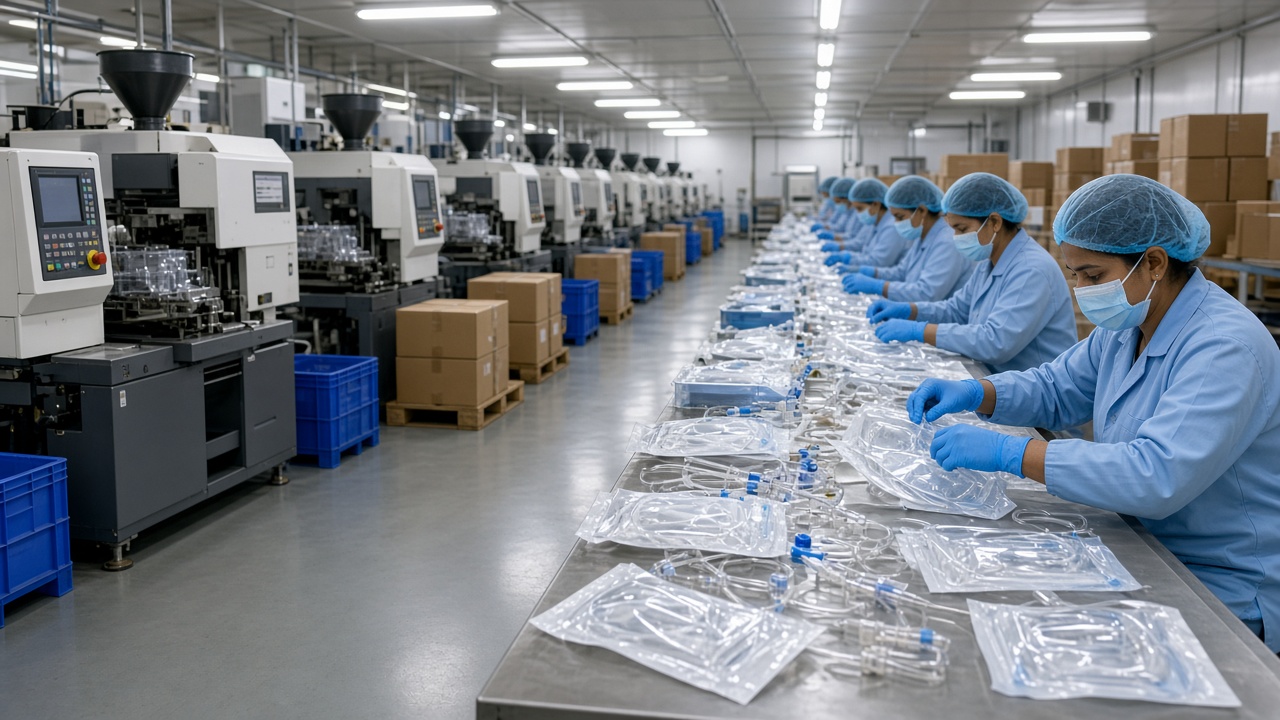
From boiling reusable glass syringes to automated lines making disposable ones (artistic illustration).
Medical Devices in India Then vs Now at a Glance
Feature
Around 1947
Now
Where devices came from
Almost all imported
Many made in India, but most high-end devices still imported
Syringes
Reusable glass, boiled between uses
Single-use plastic syringes made in India in billions
Imaging
A few imported X-ray machines
X-ray, ultrasound, CT, and MRI across the country
Implants
Very rare
Stents, heart valves, lenses, and joints, many made in India
Regulation
No device-specific rules
Risk-based Medical Devices Rules 2017
Industry voice
None
AiMeD, MTaI, and chamber forums
Foreign investment
Restricted later under licence rules
100% FDI through the automatic route
Prices of key devices
Unaffordable for most
Price caps on stents and knee implants
Manufacturing hubs
None
AMTZ and four medical device parks planned
Innovation
Almost none
Start-ups, biodesign programmes, and low-cost devices
📦 ImportsBefore 1947
Imported Instruments & Early X-rays
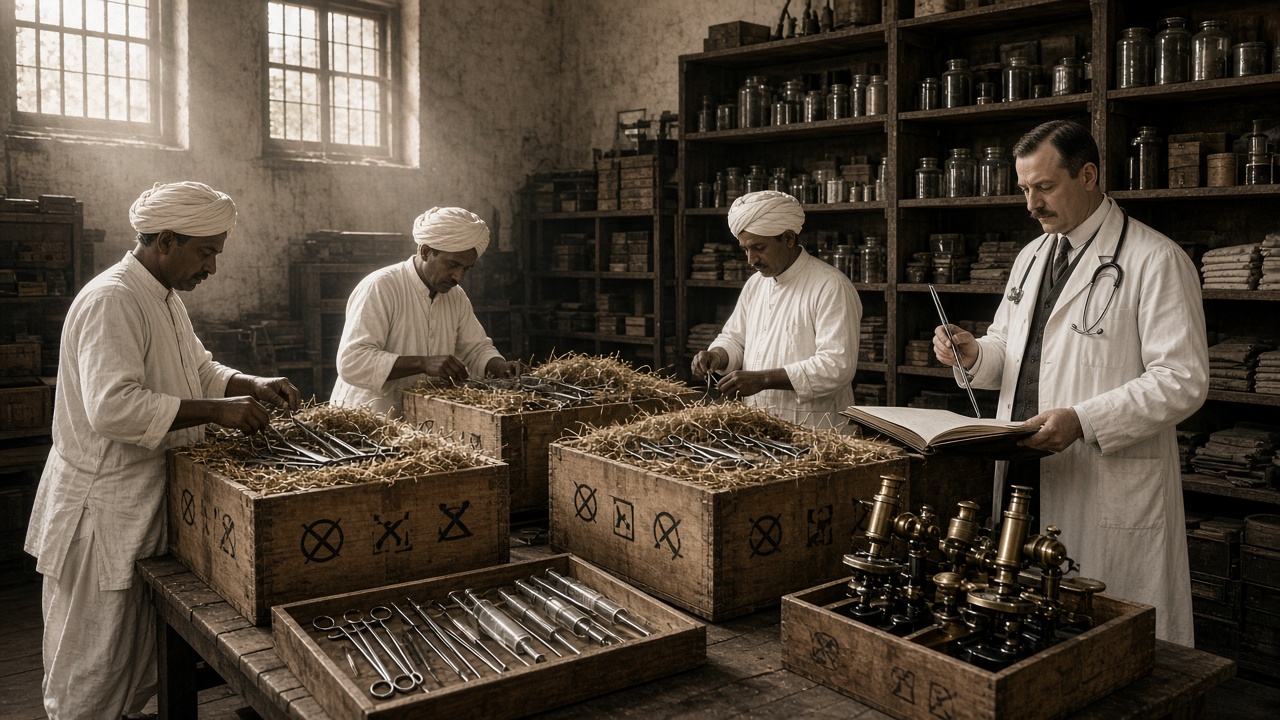
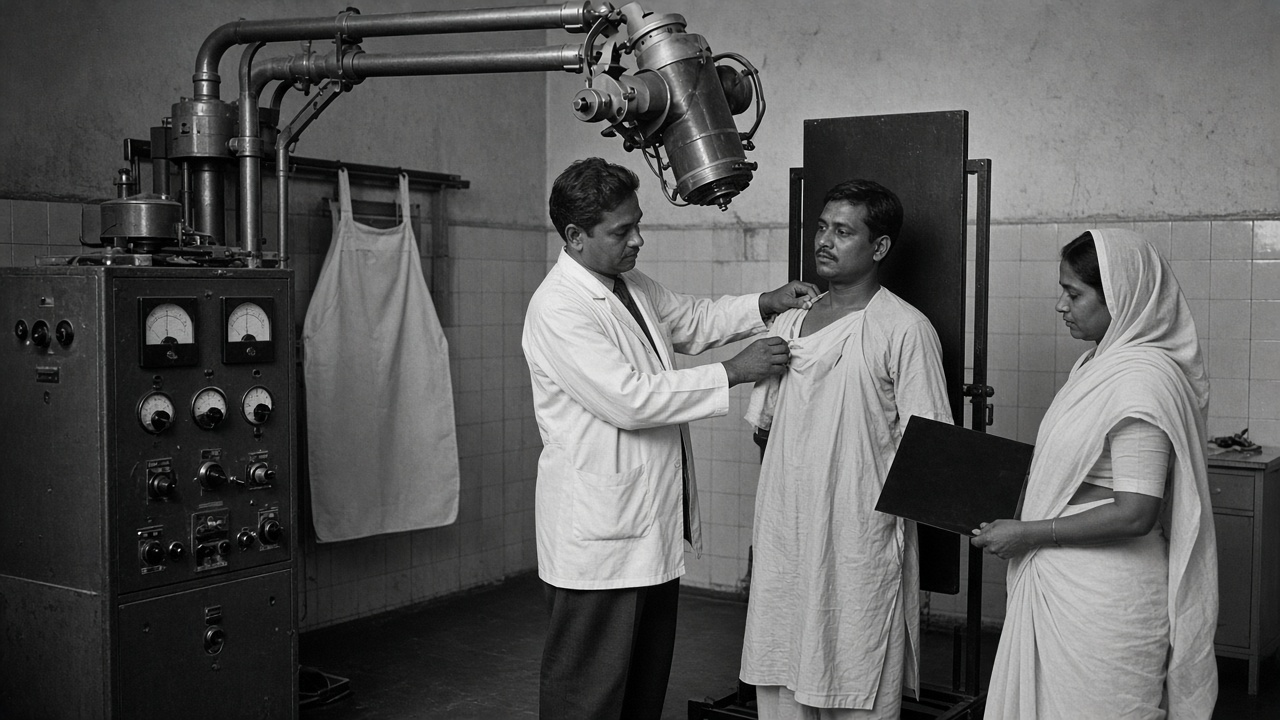
Colonial hospitals and medical colleges depended on instruments, microscopes, and machines shipped from Britain and Europe. X-rays reached India within a few years of their discovery, but equipment was scarce and costly, and most people never saw a modern device outside a big city hospital.
Crates of imported instruments and microscopes are unpacked at a colonial hospital (artistic illustration).
1800s: Surgical instruments, stethoscopes, thermometers, and microscopes for Indian hospitals are imported from Britain and Europe.
1896–1900: Soon after Röntgen’s discovery of X-rays (1895), X-ray demonstrations and the first X-ray apparatus appear in Calcutta and other cities, and Jagadish Chandra Bose experiments with X-rays.
1900–1939: Big city hospitals set up X-ray departments with imported machines, and small workshops in undivided Punjab begin making simple steel surgical instruments.
1939–1947: The Second World War cuts supplies and raises demand for dressings, splints, and instruments, and the Bhore Committee (1946) notes India’s severe shortage of medical equipment.
Technology
Steel instruments: Forceps and scalpels.
Glass syringes: Boiled and reused.
X-ray tubes: Early imaging.
Features
Import dependence: Nearly total.
City hospitals: Where devices were.
Small workshops: Simple instruments.
🛠️ Makers1947 – 1988
First Indian Makers
After independence Indian companies and public-sector units began making basic medical products, national laboratories started designing instruments, and Indian doctors and craftsmen created low-cost devices suited to Indian lives. Advanced equipment, however, still came from abroad.
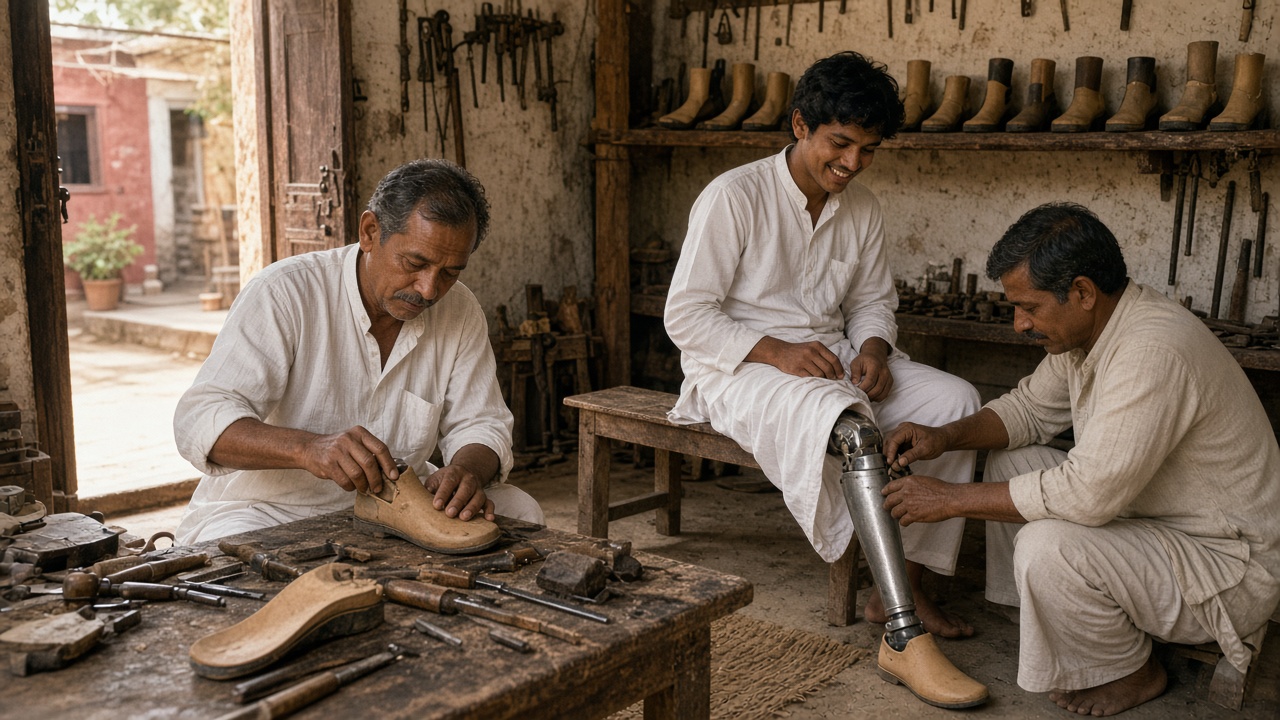
Craftsmen shape and fit a low-cost artificial foot and leg (artistic illustration).
1957–1959: Hindustan Syringes and Medical Devices is founded in Faridabad (1957), and the Central Scientific Instruments Organisation opens in Chandigarh (1959), later developing medical instruments.
1960s: IDPL sets up a surgical instruments plant in Madras, and Hindustan Latex (now HLL Lifecare) is set up in Thiruvananthapuram in 1966.
1969–1976: Dr. P. K. Sethi and craftsman Ram Chandra Sharma develop the low-cost Jaipur Foot (1969), BMVSS is formed to fit it free (1975), and the Sree Chitra Tirunal Institute begins biomedical technology work (1976).
1977–1988: Indian firms start making diagnostic kits, ECG machines, and patient monitors, and Sree Chitra’s blood bag technology is transferred to industry in the late 1980s.
Technology
Rubber and wood: Jaipur Foot.
Latex products: Gloves and more.
Electronics: Early ECG machines.
Features
Public sector: HLL and IDPL.
Frugal design: Suited to Indian lives.
High-end imports: Still needed.
❤️ Valves & Rules1989 – 2001
Heart Valves, Liberalisation & the First Device Rules
India’s first device rules covered simple products such as syringes and needles, which were treated as “drugs” under the Drugs and Cosmetics Act. Indian scientists produced a home-grown heart valve, low-cost eye lenses transformed cataract surgery, and liberalisation in 1991 brought foreign joint ventures and more imports of advanced equipment.
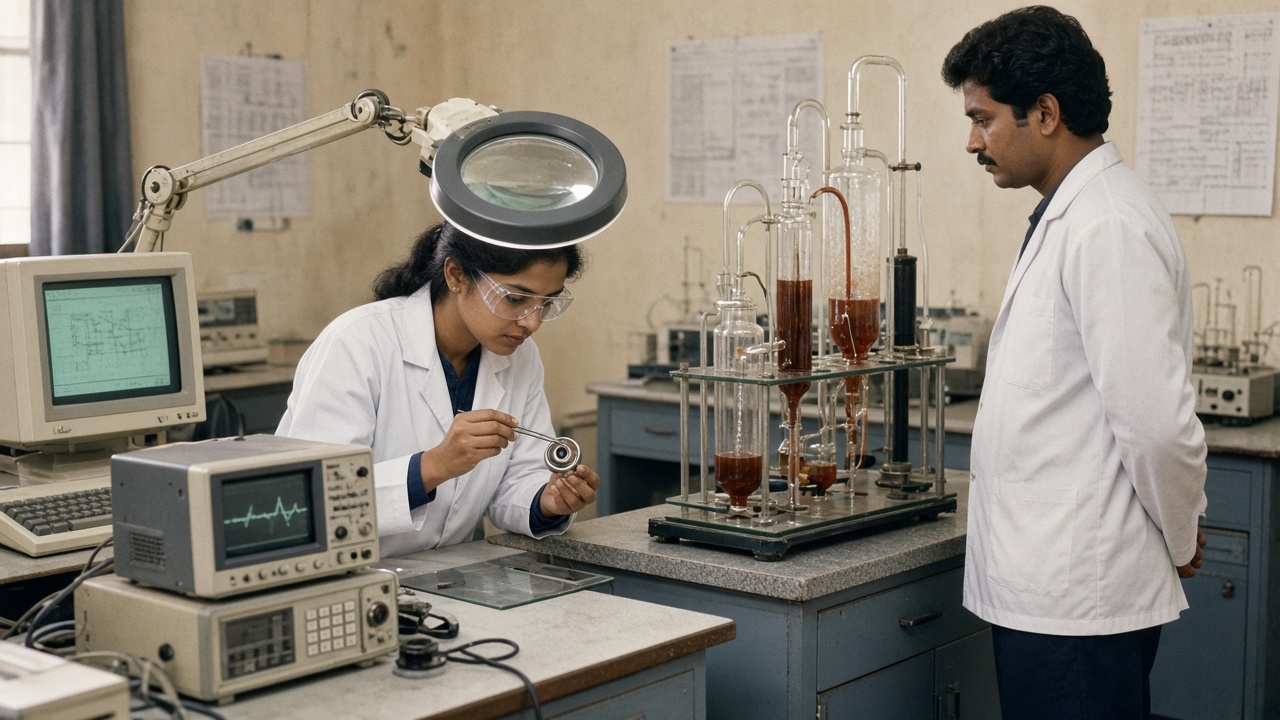
Engineers inspect and test a mechanical heart valve (artistic illustration).
1989: Disposable syringes, needles, and perfusion sets are notified as “drugs”, the first medical devices regulated in India.
1990: The TTK-Chitra tilting disc heart valve, developed at Sree Chitra Tirunal Institute, is launched commercially at a fraction of the cost of imported valves.
1991–1992: Economic reforms open the door to joint ventures in medical equipment, and Aurolab in Madurai begins making low-cost intraocular lenses for cataract surgery (1992).
1990s: Indian firms expand into disposables, diagnostics, and early coronary stents, while CT scanners, MRI machines, and most implants are still imported.
Technology
Heart valves: Tilting disc design.
Intraocular lenses: For cataract surgery.
Disposables: Single-use syringes.
Features
First rules: Devices as “drugs”.
Indian innovation: Valves and lenses.
Open economy: Joint ventures.
🤝 AiMeD2002 – 2013
AiMeD & Notified Devices
Indian manufacturers came together to speak with one voice, the government extended regulation to high-risk implants, and new programmes began training engineers and doctors to invent devices for Indian needs. Domestic factories grew in disposables and consumables, but imports still dominated high-technology equipment.
2002: Indian medical device manufacturers form AiMeD, the Association of Indian Medical Device Industry, to press for policies that support domestic manufacturing.
2005–2006: Stents, heart valves, intraocular lenses, catheters, orthopaedic implants, bone cements, and IV cannulae are notified as “drugs” and regulated by CDSCO.
Mid-2000s: BARC develops Bhabhatron, an Indian cobalt-60 cancer therapy machine, offering a cheaper alternative to imported units.
2008–2012: The Stanford-India Biodesign programme begins at AIIMS and IIT Delhi (2008), and BIRAC is set up (2012) to fund biotech and medtech start-ups.
Technology
Injection moulding: Plastic disposables.
Cobalt therapy: Bhabhatron.
Drug-eluting stents: Indian makers enter.
Features
Industry voice: AiMeD.
Implants regulated: From 2006.
Biodesign: Inventing for India.
🏗️ Make in India2014 – 2019
100% FDI, MTaI & Make in India
Medical devices became a focus of the Make in India campaign, foreign companies were allowed to own device factories fully, and the first dedicated medtech zone was built. Price caps made stents and knee implants affordable, and a separate, risk-based set of rules for medical devices finally arrived.
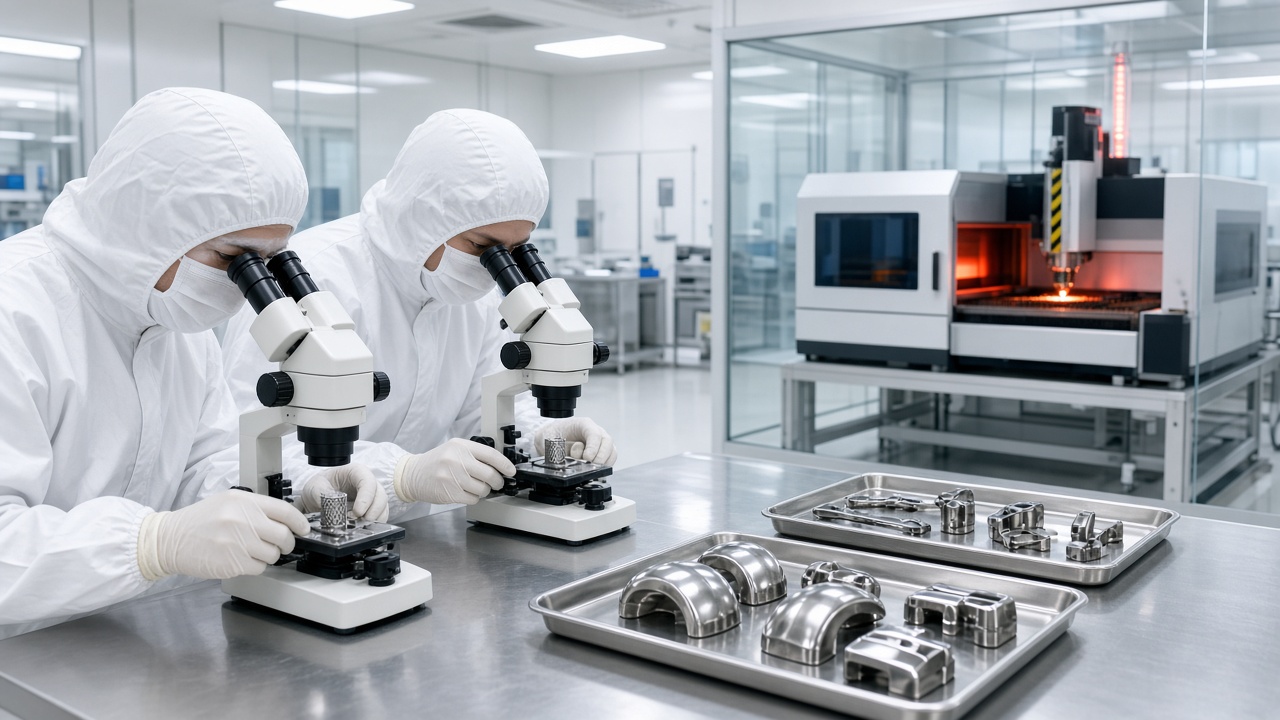
Engineers inspect stents and implant parts in a clean room (artistic illustration).
2014: Make in India is launched (September) with medical devices as a focus sector, and in December the government allows 100% FDI in medical device manufacturing through the automatic route.
2015–2016: Research-based medtech companies form MTaI, the Medical Technology Association of India (2015), and Andhra Pradesh launches AMTZ, a dedicated medtech zone in Visakhapatnam (2016).
2017: NPPA caps coronary stent prices (February) and knee implant prices (August), cutting many stent prices by around 70–85%.
2018–2019: The Medical Devices Rules 2017 come into force on 1 January 2018 with Classes A to D, and Ayushman Bharat PM-JAY (2018) raises demand for affordable devices.
Technology
Laser cutting: Precision stents.
Orthopaedic implants: Knees and hips.
Clean rooms: Sterile production.
Features
100% FDI: Automatic route.
Price caps: Stents and knees.
Risk classes: A to D.
🇮🇳 Atmanirbhar2020 – Future
Atmanirbhar MedTech, PLI & Device Parks
The COVID-19 pandemic showed the danger of depending on imports. Indian companies rapidly began making PPE, test kits, and ventilators, and the government launched incentives, device parks, full regulation of all devices, and a national policy to turn India into a medical device manufacturing hub.
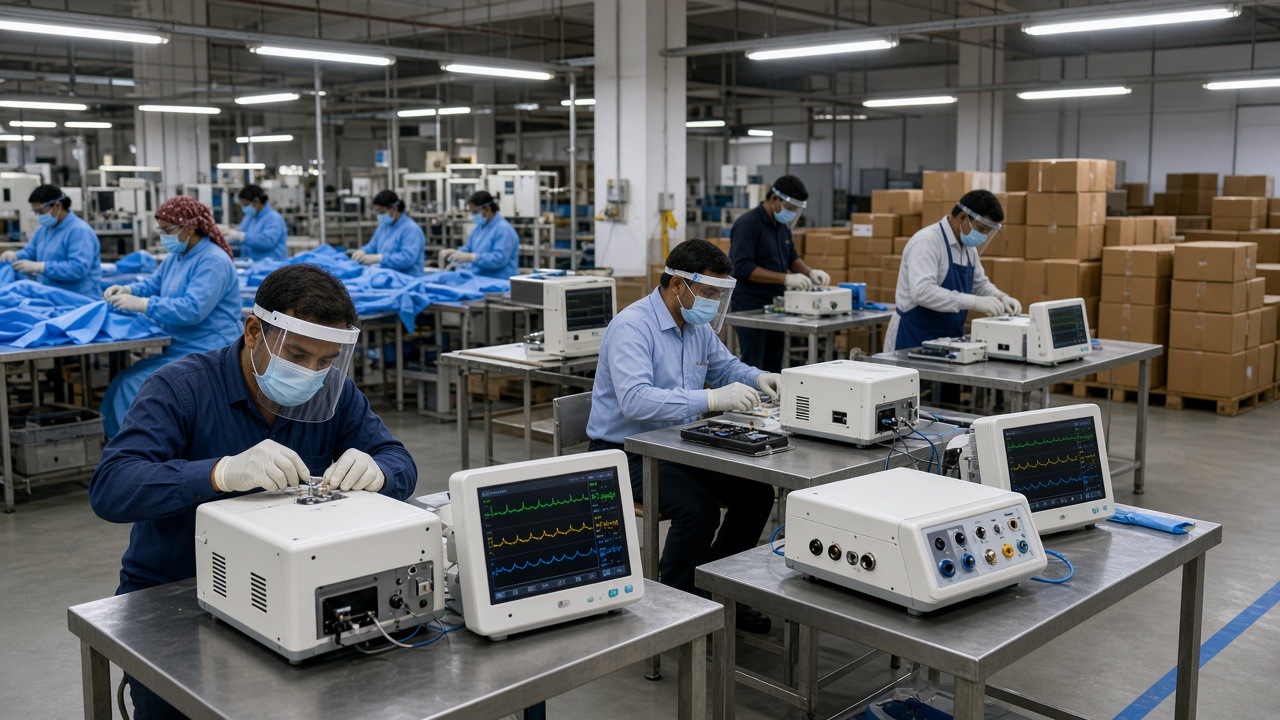
Workers assemble ventilators and PPE during the pandemic (artistic illustration).
2020: India goes from making almost no PPE kits to producing them in lakhs a day, launches indigenous RT-PCR test kits, and scales up ventilator production.
2020–2021: All medical devices are brought under regulation from April 2020, and PLI schemes and support for four medical device parks in Himachal Pradesh, Madhya Pradesh, Tamil Nadu, and Uttar Pradesh are approved.
2022–2023: Licensing becomes compulsory for Class A and B devices (October 2022) and Class C and D devices (October 2023), and the National Medical Devices Policy is approved (April 2023).
2024–Future: New schemes support components, skills, testing, and exports, with the aim of cutting import dependence and growing the sector to about US$50 billion by 2030.
Technology
Ventilators: Made in India.
RT-PCR kits: Indigenous tests.
AI and imaging: Smart diagnostics.
Features
PLI: Incentives to manufacture.
Device parks: Shared facilities.
National policy: 2023.
Key Institutions, Makers, and Industry Bodies
Name
Year
Role
Hindustan Syringes and Medical Devices
1957
Early Indian syringe maker, Faridabad
Central Scientific Instruments Organisation
1959
CSIR lab developing scientific and medical instruments
HLL Lifecare (Hindustan Latex)
1966
Public-sector maker of latex and health products
BMVSS (Jaipur Foot)
1975
Free artificial limbs for people in need
Sree Chitra Tirunal Institute
1976
Heart valve, blood bag, and other device technologies
Aurolab
1992
Low-cost intraocular lenses and eye-care products
NPPA
1997
Price regulator for medicines and notified devices
COVID-19 PPE and ventilators; PLI and device parks
2022–2023
Licensing for all device classes
2023
National Medical Devices Policy
Future
Fewer imports and a US$50 billion sector goal
Test Your Knowledge
20 quick questions from the medical devices timeline. Click each question to reveal the answer.
Answer: They were imported from Britain and Europe.
Answer: Jagadish Chandra Bose.
Answer: Hindustan Syringes and Medical Devices.
Answer: Central Scientific Instruments Organisation.
Answer: Hindustan Latex Limited.
Answer: Dr. P. K. Sethi and craftsman Ram Chandra Sharma.
Answer: Sree Chitra Tirunal Institute for Medical Sciences and Technology, Thiruvananthapuram.
Answer: Disposable syringes, needles, and perfusion sets.
Answer: Intraocular lenses for cataract surgery.
Answer: Association of Indian Medical Device Industry.
Answer: 2002.
Answer: Bhabhatron, a cobalt-60 teletherapy machine.
Answer: 100% through the automatic route.
Answer: Medical Technology Association of India, formed in 2015.
Answer: Visakhapatnam, Andhra Pradesh.
Answer: Coronary stents and knee implants.
Answer: 1 January 2018.
Answer: Class D.
Answer: Four.
Answer: 2023.
Classroom activity
Students Tasks
Use these prompts for discussion or projects on how India is building its medical device industry.
Timeline understandingScience & engineeringMake in IndiaCivic awareness
Make a timeline poster: 1969 Jaipur Foot, 1989 first device rules, 1990 Chitra heart valve, 2002 AiMeD, 2014 100% FDI, 2015 MTaI, and 2023 National Medical Devices Policy.
List ten medical devices found in your home or school first-aid kit and group them into risk Classes A to D.
Read about the Jaipur Foot and explain why it suits the way many Indians sit, squat, and walk.
Visit a clinic or pharmacy (with an adult) and find out which devices are made in India and which are imported.
Explain in your own words what “100% FDI through the automatic route” means.
Compare the roles of AiMeD and MTaI and discuss why they sometimes hold different views.
Design a simple, low-cost device to solve a health problem in your village or town, and draw it with labels.
Research how Indian companies made PPE kits and ventilators during the COVID-19 pandemic.
Find out how the 2017 stent price cap changed the cost of heart treatment for patients.
Debate: “India should make all its medical devices at home, even if some cost more at first.”
Continue exploring
India’s medical device story is linked to research and innovation, Digital India, artificial intelligence, and higher education in science and engineering. Explore these connected timelines next.
Click any panel to expand and explore the visual mood.
Indian medical devices in pictures — imported instruments, an early X-ray room, a low-cost artificial limb, a heart valve lab, a disposables factory, a stent clean room, pandemic ventilators, rural diagnostics, and then versus now.
Imported Instruments
Colonial hospitals
Early X-ray
Imported machines
Artificial Limbs
Frugal design
Heart Valve
Made in India, 1990
Disposables
Factory scale
Stents & Implants
Clean-room precision
Ventilators
COVID-19, 2020
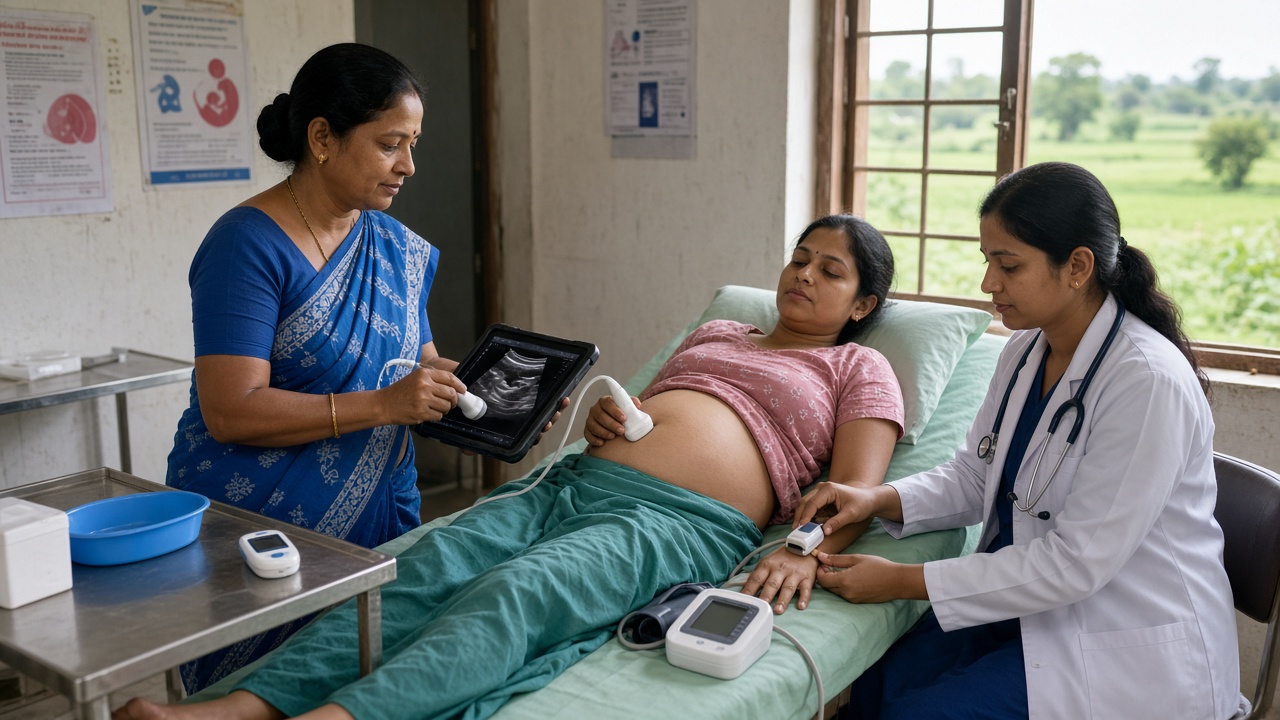
Rural Diagnostics
Portable devices
Then vs Now
Glass to disposable
Explore all health timelines
Jump to any other health timeline on WorldTimelineHub.
Disclaimer: This content is AI-generated for educational purposes and may contain errors or outdated details. For correct and authoritative information, please refer to official and reliable sources such as government publications, manufacturers, museums, and academic references.