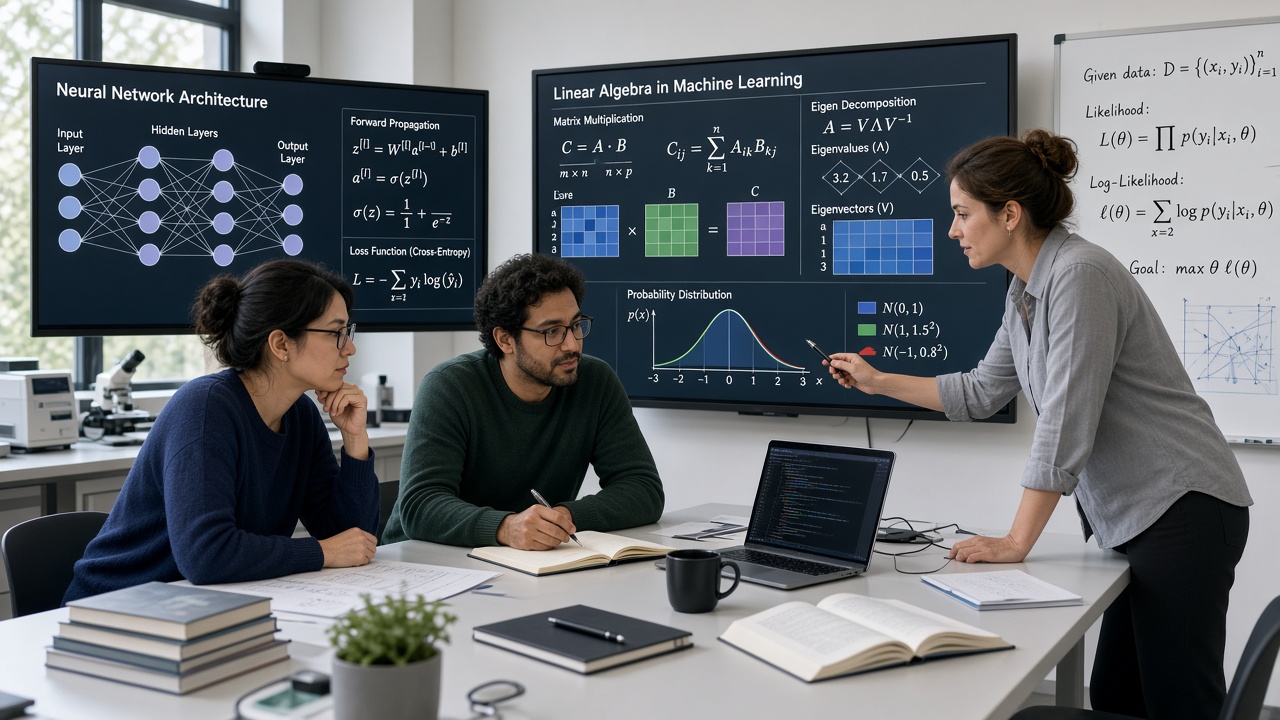
From Vedanga Jyotisha and Aryabhata, through zero and algebra, to calculus, computers, and the mathematics powering AI.
Vedic astronomy -> ZeroAlgebra & calculusComputers & AI
Why Mathematics Matters
Mathematics is the language of patterns, measurement, and prediction. From ritual calendars to machine learning, each leap enlarges what humans can calculate, prove, and build.
This timeline follows Vedanga Jyotisha, Aryabhata, zero, algebra, calculus, computers, and AI math as linked turning points.
Big picture
Mathematics in one view
Sky calendars, Aryabhata’s models, the power of zero, symbolic equations, rates of change, electronic computation, and the linear algebra of neural nets.
Vedanga Jyotisha is among the earliest Indian texts linking mathematics to astronomy for calendars and ritual timing. Counting days, tracking the moon and sun, and organizing years required numerical skill—showing math as a practical science of the heavens long before modern textbooks.
Jyotisha era: measure the sky to organise time.
Calendrical rules for months, solstices, and rituals.
Early arithmetic applied to astronomy.
Roots Indian scientific literature in observation + number.
Classical Synthesisc. 500 CE
Aryabhata
Aryabhata’s Aryabhatiya wove arithmetic, algebra, trigonometry ideas, and planetary models into a compact Sanskrit treatise. His work became a cornerstone for later Indian and Islamic astronomers—and a symbol of India’s classical mathematical creativity.
Aryabhata era: math that models the cosmos.
Place-value arithmetic and algebraic techniques.
Sine-related tables and astronomical algorithms.
Influence travels along scholarly networks for centuries.
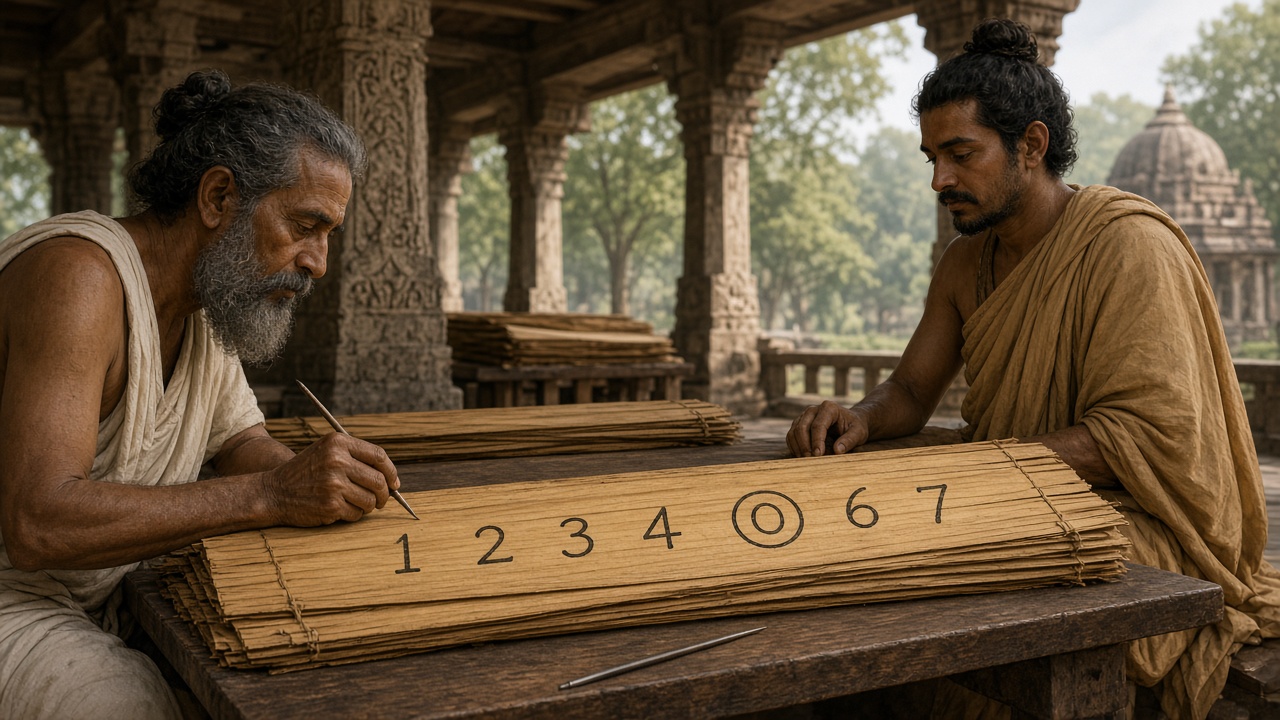
Nothing That Changed EverythingClassical
Zero
Zero as a digit and placeholder made the decimal place-value system complete. Indian mathematicians treated zero as a number with rules—unlocking efficient calculation that later spread through Islamic scholarship into Europe and the modern world.
Zero era: a circle that powers place value.
Placeholder zero enables large numbers efficiently.
Rules for operating with zero refine arithmetic.
Global transmission remakes commerce and science.
Equations & UnknownsMedieval+
Algebra
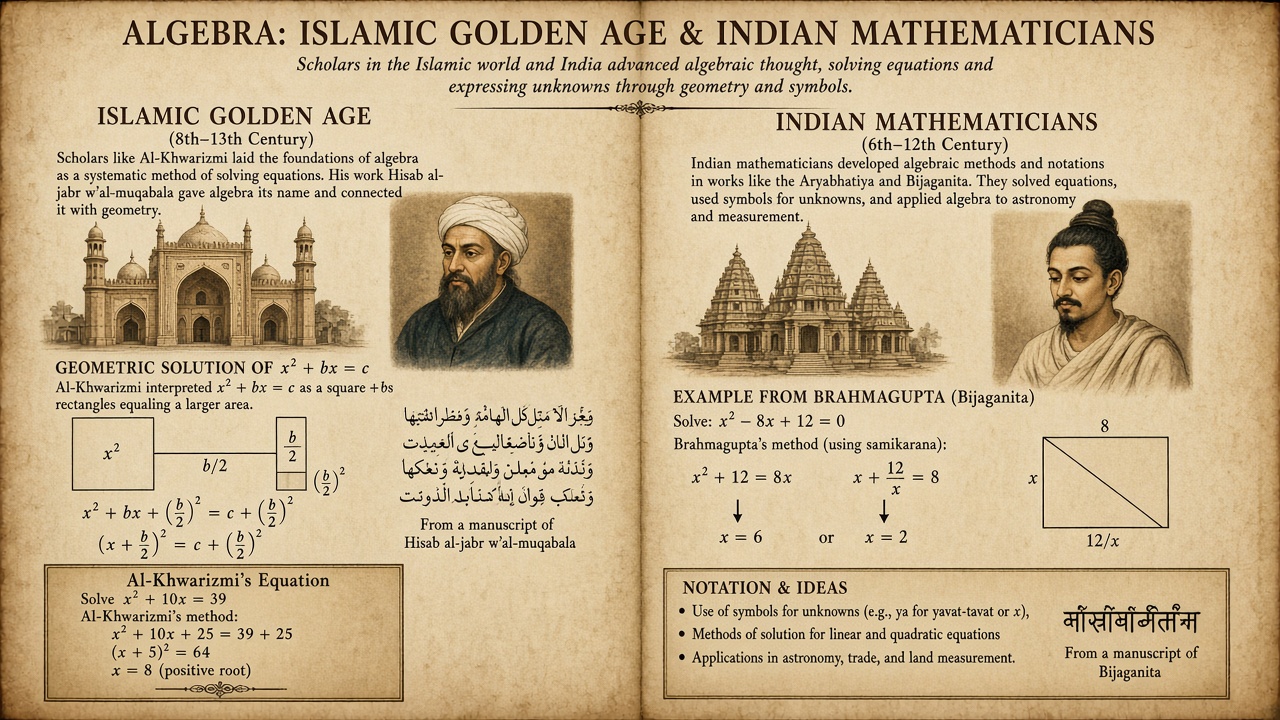
Algebra grew as a systematic way to solve for unknowns—from Indian bijaganita and Greek geometry roots to Islamic al-jabr and later symbolic European algebra. Letters replaced words; equations became a universal toolkit for science and engineering.
Algebra era: find the unknown by rule.
Quadratic methods and equation classification advance.
Symbolic notation accelerates later science.
School algebra inherits this long global story.
Change & Accumulation1600s
Calculus
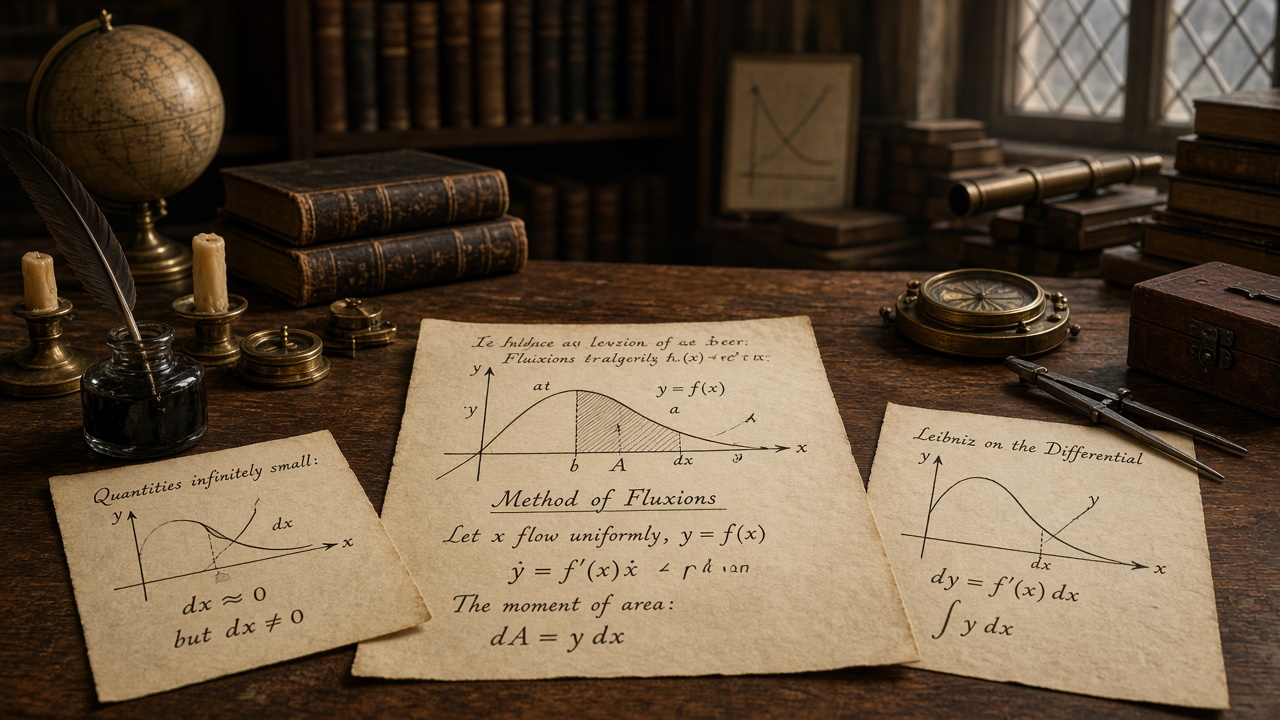
Calculus formalised derivatives (rates of change) and integrals (accumulated quantity). Newton and Leibniz independently shaped the classical European framework; earlier infinite-series insights also appear in traditions such as the Kerala school. Physics, engineering, and economics still run on these ideas.
Calculus era: mathematics of motion and area.
Limits, derivatives, and integrals become standard tools.
Enables classical mechanics and modern engineering.
India’s Kerala school contributes early series methods.
Machine Calculation1900s
Computers
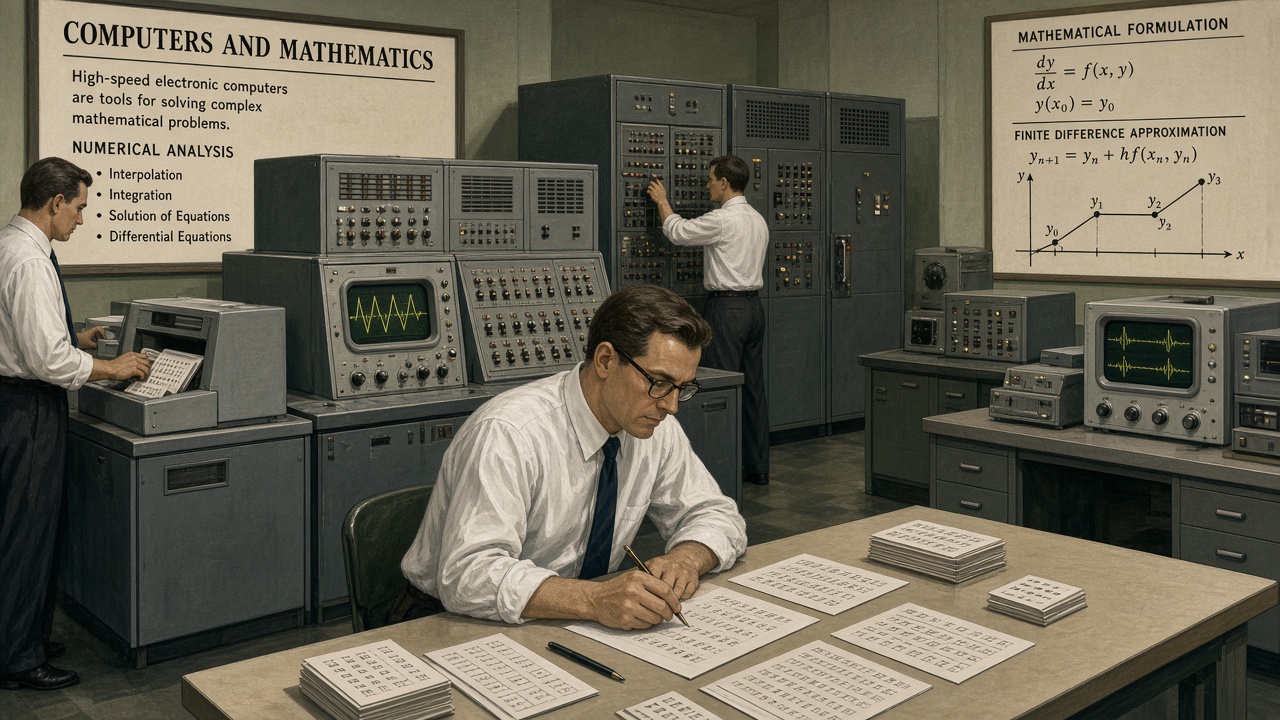
Electronic computers turned mathematics into high-speed computation: numerical methods, simulations, cryptography, and computer-assisted proofs. Algorithms became as important as closed-form formulas—and India’s IT and education systems embraced computational math at scale.
Computer era: when calculation became electronic.
Numerical analysis and scientific computing expand.
Discrete math underpins programming and networks.
Classrooms add calculators, then coding, to math.
Learning from DataToday
AI Math
Artificial intelligence rests on mathematics: vectors and matrices, probability, optimization, and calculus for training. Neural networks are equations that adjust themselves against data—making linear algebra and statistics the new literacy of the AI age.
AI era: matrices, probability, and optimisation at scale.
Gradient descent and loss functions train models.
Linear algebra + probability dominate ML courses.
Math remains the backbone of trustworthy AI.
Key Milestones
Milestone
When
Why it matters
Vedanga Jyotisha
Vedic period
Calendar math meets astronomy.
Aryabhatiya
c. 499/500 CE
Classical Indian math–astronomy synthesis.
Place-value zero
Classical India+
Decimal calculation goes global.
Algebraic methods
Medieval–early modern
Systematic equation solving.
Calculus formalised
17th century
Math of change for science.
Electronic computers
20th century
Computation at machine speed.
ML / AI mathematics
21st century
Learning systems built from math.
Ideas at a Glance
Idea
Core question
Modern echo
Jyotisha math
How to time the sky?
Calendars, astronomy apps
Aryabhata
How do planets move?
Models & algorithms
Zero
How to write “nothing”?
All digital numbers
Algebra
How to find unknowns?
Equations in every STEM field
Calculus
How does change accumulate?
Physics, finance, ML gradients
Computers
How to calculate faster?
Simulation & cryptography
AI math
How to learn from data?
Neural nets & statistics
Then vs Now
From palm-leaf algorithms to GPU training runs.
Metric
Then
Now
Tools
Manuscripts, tables, abacus
Computers, CAS, GPUs
Focus
Astronomy & commerce
Also data, crypto, AI
Zero
Breakthrough idea
Taken for granted in binary
Proof style
Verse & commentary
Formal + computational proofs
Classroom
Guru–shishya & pathshala
Boards, coding, online tutors
Future Predictions
AI tutors: Personalised math practice becomes common in schools.
Proof assistants: Formal verification grows in research and industry.
Data literacy: Probability and linear algebra join core curricula earlier.
India: Strong olympiad + computing pipeline feeds AI and space research.
India spotlight
Mathematics & India
India’s mathematical story runs from Vedanga Jyotisha and Aryabhata through zero and Kerala series, into modern IITs, olympiads, software, and AI research—a continuous thread from classical texts to code.
India spotlight: classical genius to computational India.
Vedic
Jyotisha
Calendar mathematics guides ritual time.
Classical
Aryabhata & zero
Treatises and place value reshape calculation.
Medieval
Algebra & series
Schools advance equations and infinite series.
Modern
Universities & IITs
Formal math education and research expand.
Today
Computing & AI
Software and ML put Indian math talent on the world stage.
Strength: Deep classical heritage and large STEM pipeline.
Need: Stronger school foundations beyond exam drilling.
Debate: Rote vs reasoning; calculators vs first principles.
Test Your Knowledge
20 questions on Vedanga Jyotisha through AI math. Click to reveal answers.
Answer: Calendrical astronomy / timing using the sky.
Answer: The Aryabhatiya.
Answer: Around the 5th–6th century CE.
Answer: As digit/placeholder it completes place-value arithmetic.
Answer: Unknowns / equations.
Answer: Newton and Leibniz.
Answer: Rate of change.
Answer: Accumulation / area under a curve (broadly).
Answer: Early infinite series / calculus-like methods.
Answer: Fast numerical calculation and simulation.
Answer: Linear algebra, probability, optimisation, calculus.
Answer: Adjusts parameters to reduce a loss function.
Answer: Digits including zero as placeholder.
Answer: Indian algebraic mathematics.
Answer: Algebra (Islamic mathematical tradition).
Answer: Astronomy / planetary models.
Answer: The concept of zero/one place values.
Answer: Numbers in matrices/vectors adjusted during training.
Answer: Shows ideas are human inventions with cultural roots.
Answer: From sky calendars and zero to calculus, computers, and AI math.
Classroom activity
Students Tasks
Ten prompts from Vedanga Jyotisha to AI math for projects and debate.
Jump to any other science timeline on WorldTimelineHub.
Disclaimer: This content is AI-generated for educational purposes and may contain errors or outdated details. For correct and authoritative information, please refer to official and reliable sources such as government publications, manufacturers, museums, and academic references.