A scientific revolution is more than a discovery—it replaces a worldview. Moving Earth from the centre, explaining species without fixed design, warping spacetime, and editing genomes each changed what humans believe is possible.
This timeline follows Copernicus, Galileo, Newton, Darwin, Einstein, quantum physics, and CRISPR as linked turning points.
Big picture
Revolutions in one view
Sun-centred skies, telescopes and trials, mathematical gravity, evolving life, relative spacetime, quantized reality, and DNA rewritten on demand—evidence overturning inherited maps of nature.
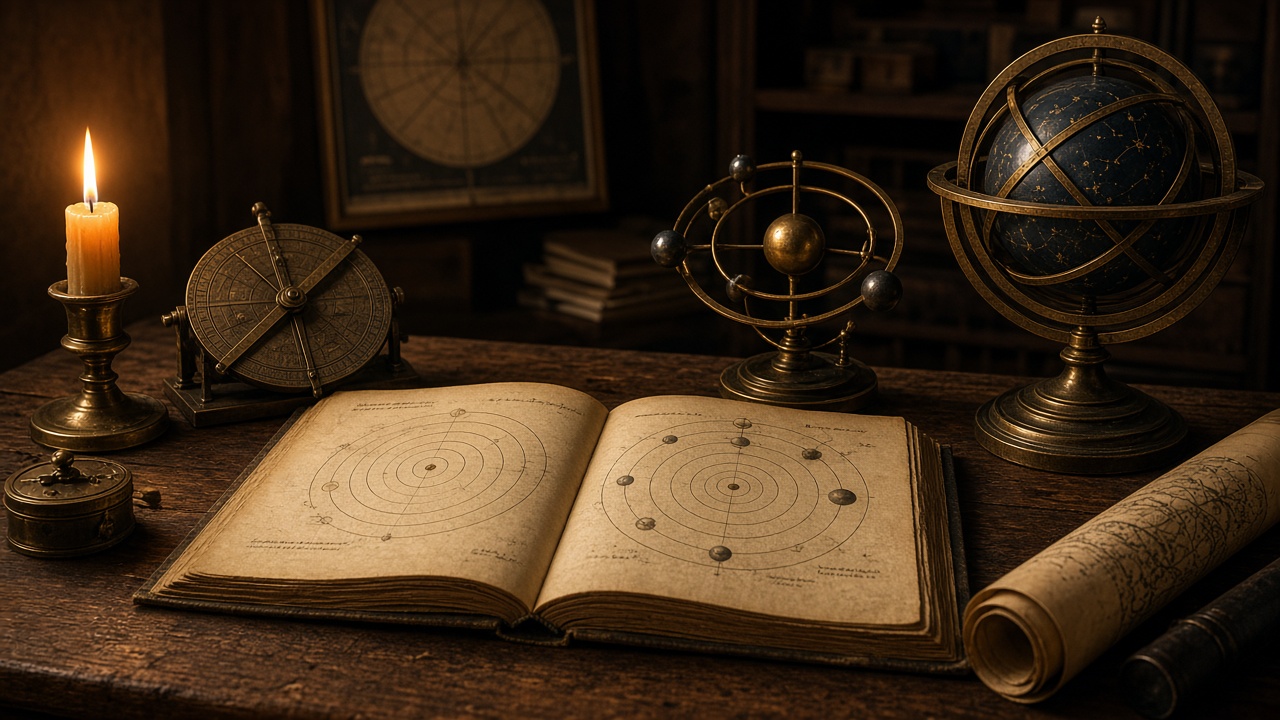
Nicolaus Copernicus argued that Earth is a planet orbiting the Sun. De revolutionibus orbium coelestium (1543) did not instantly convert Europe, but it cracked the geocentric consensus and set the stage for a new astronomy.
Copernicus era: Earth moves; the sky is redesigned.
Heliocentric model simplifies planetary motions (in principle).
Builds on earlier ideas and tables, not a sudden solo invention.
Opens a century of debate, observation, and conflict.
Mathematical models: Circles and epicycles refined.
Printed books: Spread the new cosmology.
Features
Worldview shift: Humans leave the cosmic centre.
Incomplete: Still used circular orbits; Kepler later refined.
Legacy: Anchor of the Scientific Revolution narrative.
Telescope & Trialearly 1600s
Galileo
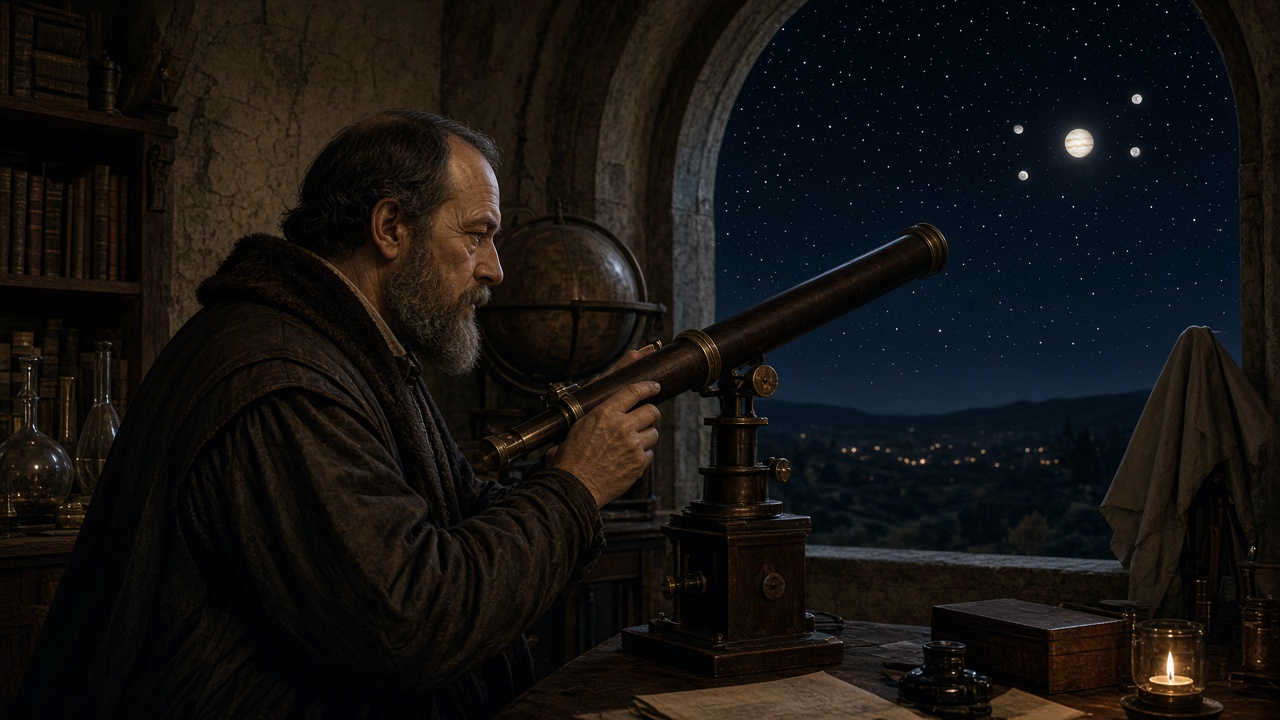
Galileo Galilei turned the telescope on the heavens—seeing moons of Jupiter, phases of Venus, and a imperfect Moon. Observation backed Copernicus; politics and theology pushed back. His style of experiment and maths helped define modern science.
Galileo era: instruments make the cosmos empirical.
Conflict with Church authority becomes a lasting symbol.
Mechanics and falling-body experiments reshape physics habits.
Technology Used
Refracting telescopes: Magnify celestial detail.
Inclined planes: Controlled motion experiments.
Published dialogues: Argue for new world systems.
Features
Evidence culture: See for yourself.
Public science: Debate reaches courts and books.
Risk: New knowledge can threaten power.
Universal Laws1687
Newton
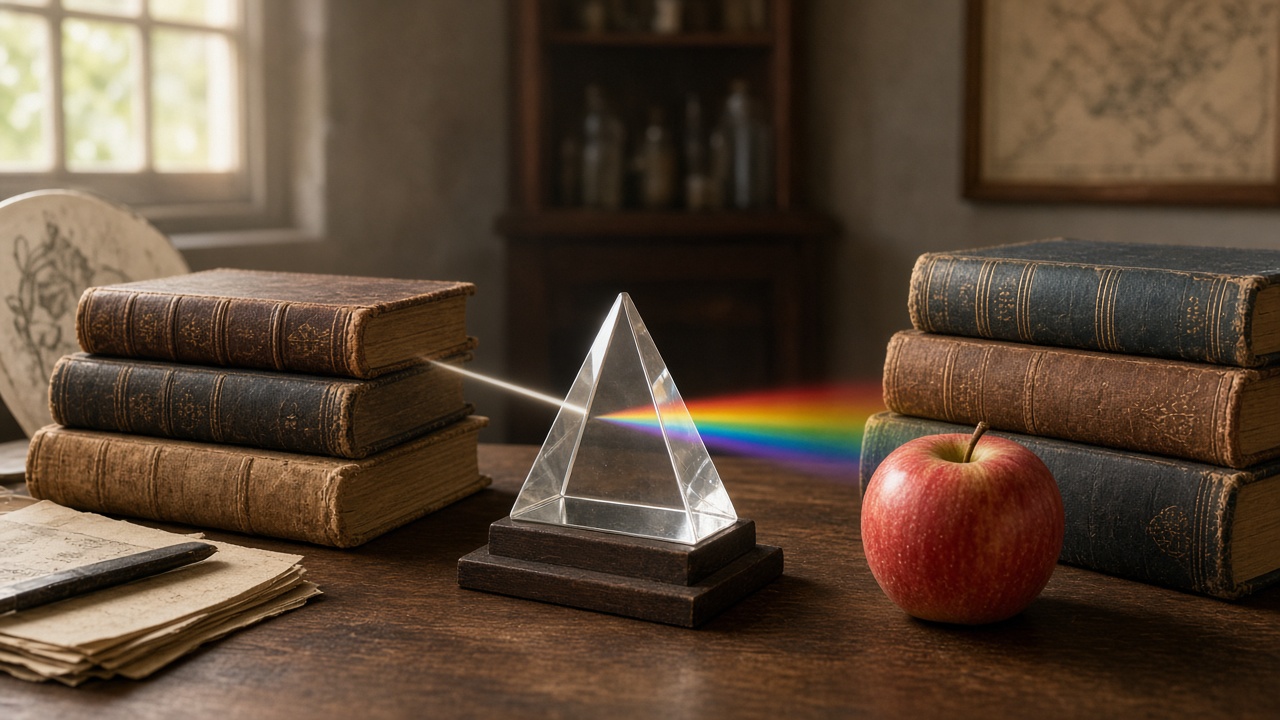
Isaac Newton’s Principia (1687) gave laws of motion and universal gravitation. The same mathematics that dropped apples also steered planets—a synthesis that made classical physics the template for “hard” science for two centuries.
Newton era: one gravity for Earth and sky.
Calculus (with Leibniz) becomes a language of change.
Unification: Terrestrial and celestial physics join.
Predictive power: Orbits and tides become calculable.
Later limit: Relativity and quantum revise the frame.
Life Evolves1859
Darwin
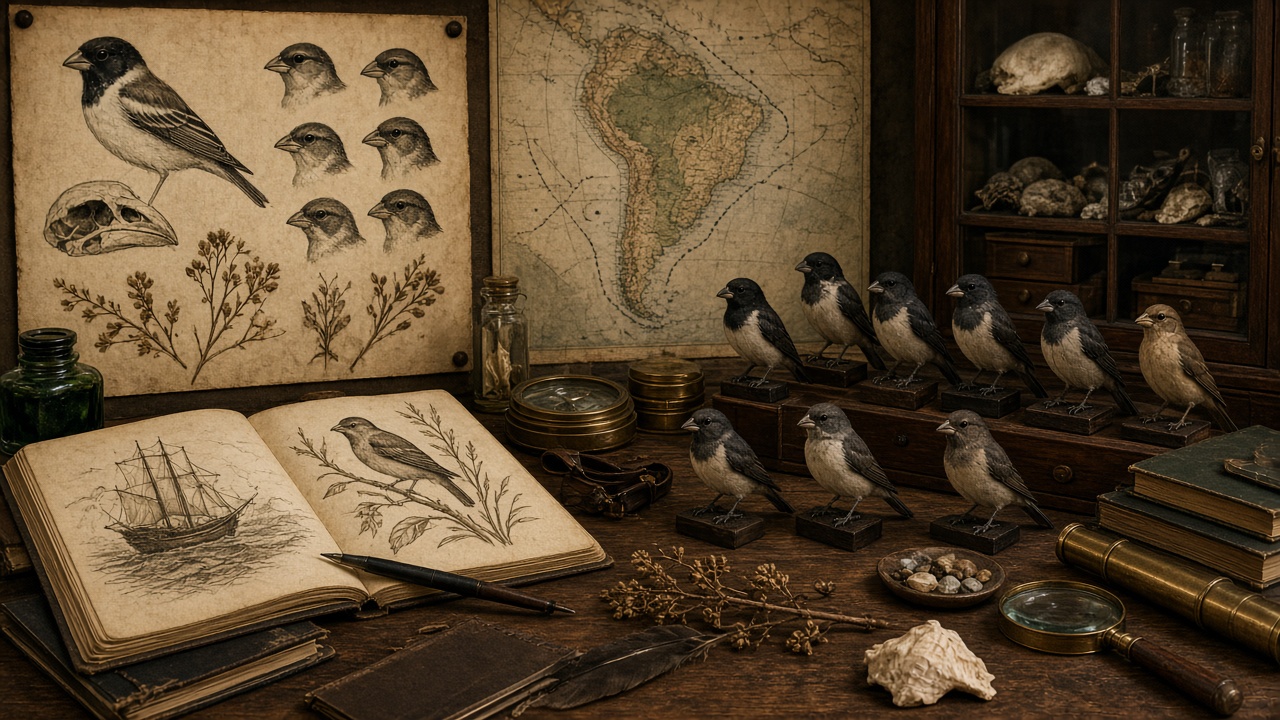
Charles Darwin’s On the Origin of Species (1859) argued that species change through natural selection. Biology gained a historical engine—descent with modification—reshaping medicine, ecology, and how humans see themselves in nature.
Darwin era: selection writes the tree of life.
Voyage evidence and breeding analogies support the argument.
Wallace independently reaches similar ideas; joint announcement 1858.
Genetics later supplies the mechanism Darwin lacked.
Technology Used
Field collection & taxonomy: Compare variation.
Geology & deep time: Earth old enough for change.
Print culture: Mass debate beyond academies.
Features
Unity of life: Common ancestry.
No foresight needed: Selection filters variation.
Cultural storm: Religion, race, and education debates follow.
Spacetime Remade1905 - 1915
Einstein
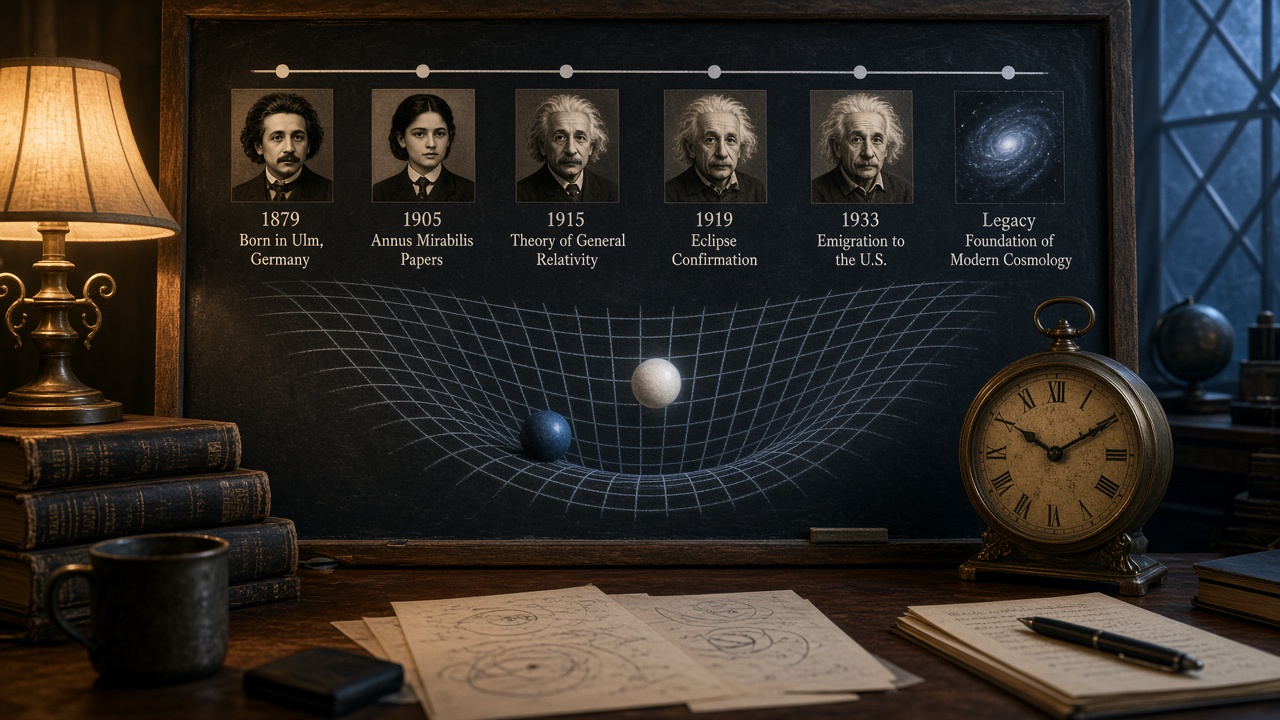
Albert Einstein’s special relativity (1905) and general relativity (1915) rebuilt space, time, and gravity. Light’s speed becomes a cosmic speed limit; mass curves spacetime. His photoelectric work also helped launch quantum theory.
Einstein era: gravity as geometry, not just a force.
E=mc² links mass and energy in public imagination.
1919 eclipse tests boost worldwide fame.
GPS and cosmology later depend on relativistic corrections.
Technology Used
Thought experiments: Trains, elevators, light clocks.
Limits of Newton: High speed / strong gravity regimes.
Cosmic scale: Expanding universes become thinkable.
Public icon: Science as celebrity culture.
Quantized Reality1900s - Present
Quantum
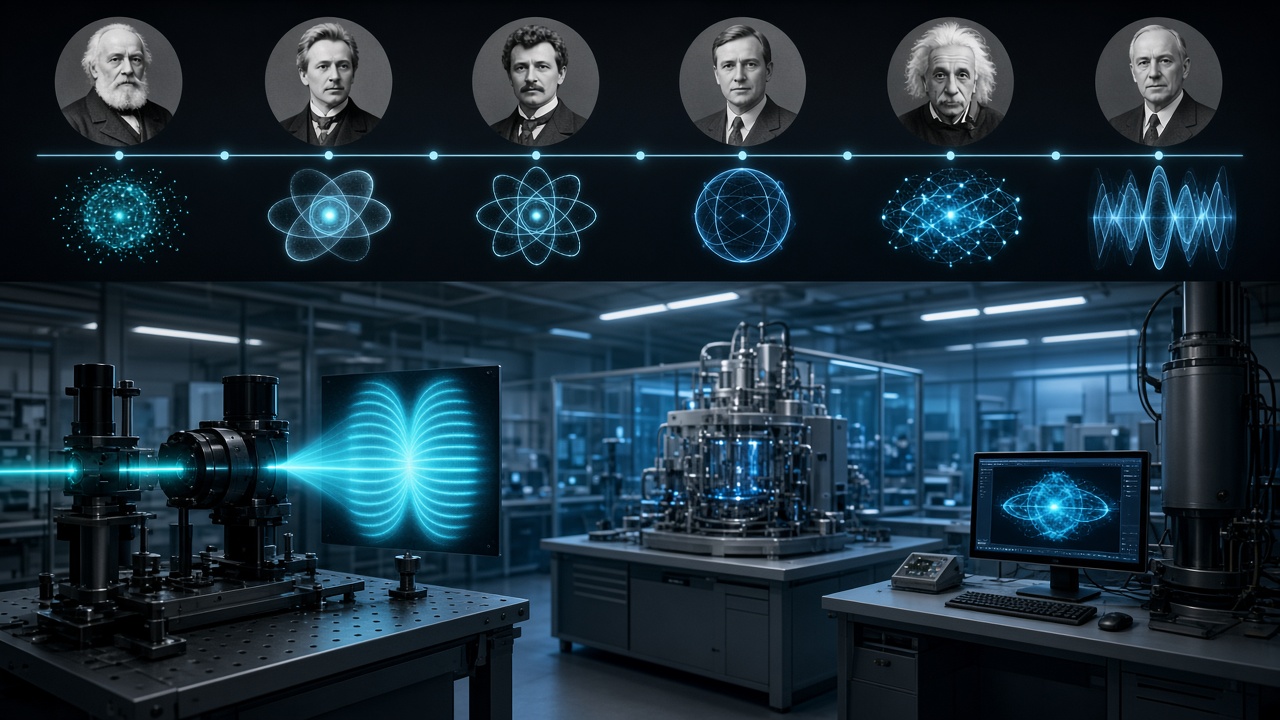
Planck, Einstein, Bohr, Heisenberg, Schrödinger and others built quantum theory: energy comes in packets; particles act like waves; measurement is probabilistic. The strangest physics became the most useful—chips, lasers, MRI, and quantum computing research.
Quantum era: probability rules the very small.
Blackbody, photoelectric, and atomic spectra force quantization.
Wave–particle duality and uncertainty rewrite intuition.
Engineering harvests quantum rules for modern devices.
Technology Used
Spectroscopy: Atomic fingerprints.
Semiconductors: Band theory to transistors.
Lasers & MRI: Quantum applications at scale.
Features
Counterintuitive: Classical pictures fail.
Precise: Predictions match experiment extremely well.
Frontier: Quantum info and computing next wave.
Edit the Code2010s - Present
CRISPR
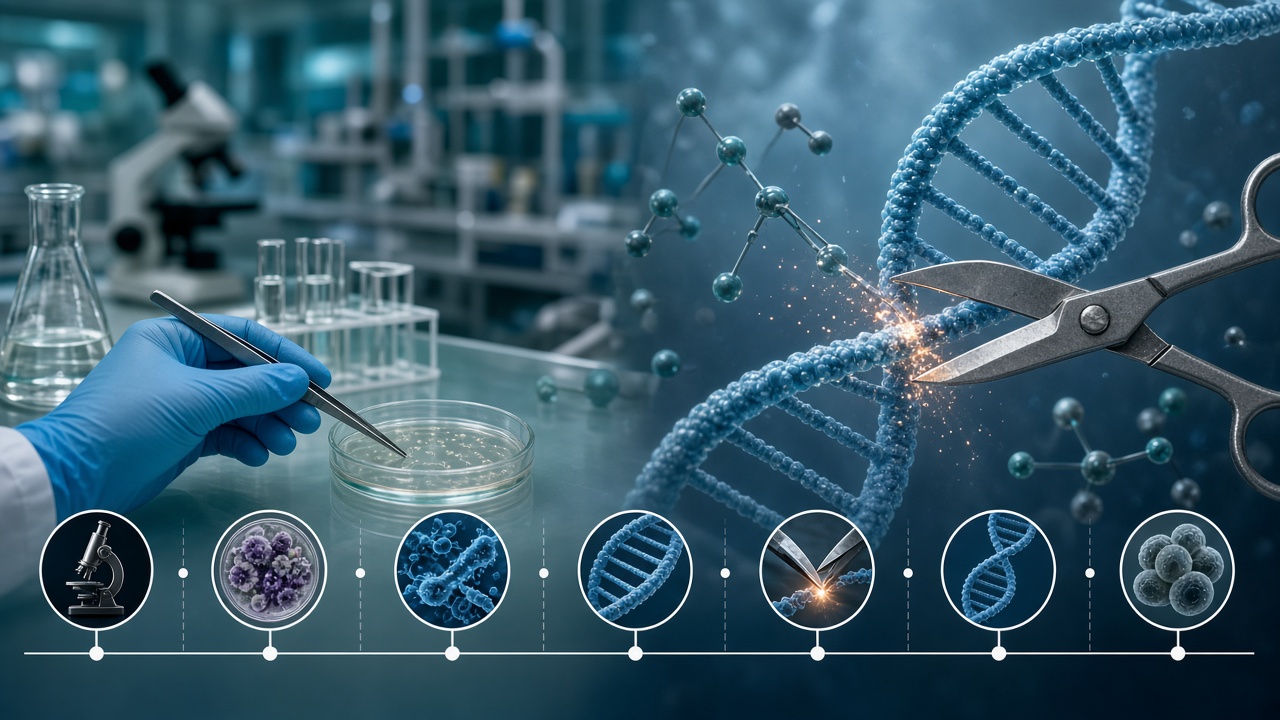
CRISPR-Cas systems turned bacterial immune tricks into programmable gene editors. Suddenly labs could cut DNA at chosen sites cheaply—accelerating research and therapies, and forcing hard ethics on germline editing and equity of access.
CRISPR era: biology becomes editable technology.
2012– papers make Cas9 a household research tool.
Clinical gene therapies begin for select diseases.
Governance struggles with heritable edits and dual use.
Technology Used
Guide RNA + Cas enzymes: Targeted DNA cuts.
Delivery systems: Viruses, LNPs, electroporation.
Sequencing: Verify edits and off-targets.
Features
Speed & cost: Democratises editing vs older tools.
Therapy hope: Genetic disease interventions.
Ethics: Who may rewrite heritable DNA?
Scientific Revolutions Summary
Era
Milestone
Why it matters
1543
Copernicus
Heliocentric cosmos.
early 1600s
Galileo
Telescope + experiment.
1687
Newton
Universal gravitation.
1859
Darwin
Natural selection.
1905–15
Einstein
Relativity of spacetime.
1900s–
Quantum
Probabilistic microphysics.
2010s–
CRISPR
Programmable gene editing.
Key Historical Events
Event
Year
Significance
De revolutionibus published
1543
Copernican heliocentrism in print.
Galileo’s telescopic discoveries
1609–10
Observational support for new astronomy.
Principia Mathematica
1687
Newtonian mechanics established.
Origin of Species
1859
Evolution by natural selection.
Annus mirabilis papers
1905
Special relativity & quantum seeds.
General relativity
1915
Gravity as spacetime curvature.
Quantum mechanics crystallises
1920s
Matrix/wave mechanics mature.
CRISPR-Cas9 editing boom
2012–
Gene editing becomes routine tool.
Revolution Types at a Glance
Revolution
Domain
Old idea overturned
Copernicus
Astronomy
Earth-centred cosmos
Galileo
Method / astronomy
Authority over observation
Newton
Physics
Separate Earth vs sky physics
Darwin
Biology
Fixed, unchanging species
Einstein
Physics
Absolute space & time
Quantum
Physics
Continuous classical particles
CRISPR
Biology / biotech
Hard-to-edit genomes
Then vs Now
From celestial charts to labs that rewrite DNA.
Metric
Then
Now
Cosmos
Earth-centred / imperfect tools
Relativity + deep surveys
Method
Authority + philosophy
Experiment + peer review
Life
Fixed kinds
Evolving + editable genomes
Matter
Continuous classical
Quantum + engineered devices
Pace
Books over decades
Global labs in months
Future Predictions
Physics: Quantum technologies and possible beyond-Standard-Model surprises.
Biology: Safer, more precise editors and wider gene therapies.
Ethics: Stronger global norms on germline editing.
Education: Revolutions taught as methods, not only hero names.
India spotlight
Science Revolutions & India
India’s story includes ancient astronomy and mathematics, colonial and postcolonial labs, and modern strengths in space, physics institutes, and biotech. Scientific revolutions are global—and India both absorbs and contributes to them.
India spotlight: from classical astronomy to modern labs.
Classical
Astronomy & maths
Aryabhata and others model celestial cycles long before Europe’s revolution.
Modern
Institutes rise
IISc, TIFR, and universities join global research networks.
Physics
Relativity & quantum era
Indian scientists contribute to 20th-century physics and maths.
Space
ISRO age
Applied science inherits Newtonian and relativistic engineering.
Biotech
Genomics & CRISPR
Labs and startups enter the gene-editing century.
Strength: Talent + mission-driven institutions.
Need: Broader research funding and science literacy.
Ethics: Same CRISPR debates as everywhere else.
Test Your Knowledge
20 questions on Copernicus through CRISPR. Click to reveal answers.
Answer: The Sun (heliocentrism).
Answer: 1543.
Answer: The telescope.
Answer: Not everything orbits Earth.
Answer: 1687.
Answer: Same gravity law for Earth and celestial bodies.
Answer: On the Origin of Species.
Answer: Differential survival/reproduction of heritable variants.
Answer: 1905.
Answer: Curvature of spacetime.
Answer: Energy/matter behave in discrete, probabilistic ways at small scales.
Answer: Transistors, lasers, MRI, LEDs, etc.
Answer: Cuts DNA at guided sites for gene editing.
Answer: Changes can be inherited by future generations.
Answer: Kepler (elliptical orbits).
Answer: Independently developed natural selection ideas with Darwin.
Answer: Mass and energy.
Answer: Heisenberg (quantum mechanics).
Answer: A major shift in core models/methods, not just one fact.
Answer: From remapping the cosmos to remaking biology with tools.
Classroom activity
Students Tasks
Ten prompts from heliocentrism to CRISPR for projects and debate.
ScienceHistoryEthicsIndia
Poster: Copernicus → Galileo → Newton → Darwin → Einstein → Quantum → CRISPR.
Explain heliocentrism vs geocentrism with a simple diagram.
Debate: Was Galileo’s conflict mainly science or politics?
Demonstrate a prism spectrum and link it to Newton’s optics.
Write five sentences on natural selection for a younger student.
Research one GPS fact that needs Einstein’s relativity.
List three everyday technologies that rely on quantum physics.
Argue for or against heritable human gene editing.
Find one Indian scientist linked to modern physics or biotech.
Create a comic strip of one scientific revolution in 6 panels.
Continue exploring
Scientific revolutions connect biotech, quantum computing, space, and industry.
Jump to any other world history timeline on WorldTimelineHub.
Disclaimer: This content is AI-generated for educational purposes and may contain errors or outdated details. For correct and authoritative information, please refer to official and reliable sources such as government publications, manufacturers, museums, and academic references.