From Nalanda, where scholars from across Asia studied 1,500 years ago, to IITs, IIMs, and global campuses today — India has one of the
oldest traditions of higher learning and now one of the largest university systems in the world.
This timeline follows ancient centres of learning, madrasas and early colleges, the first modern universities of 1857, national institutes
built after independence, the private college boom, and today’s focus on quality, online learning, research, and NEP 2020.
c. 600 BCE → PresentNalanda → IIT → NEP 2020Universities · Institutes · Research
What Is Higher Education?
Higher education means learning after school — diplomas, undergraduate and postgraduate degrees, and research programmes offered by colleges,
universities, and specialised institutes. It trains doctors, engineers, teachers, lawyers, scientists, and leaders, and drives research and
innovation. According to AISHE 2021-22, India has over 1,100 universities, more than 45,000 colleges, and about 4.3 crore students in higher education.
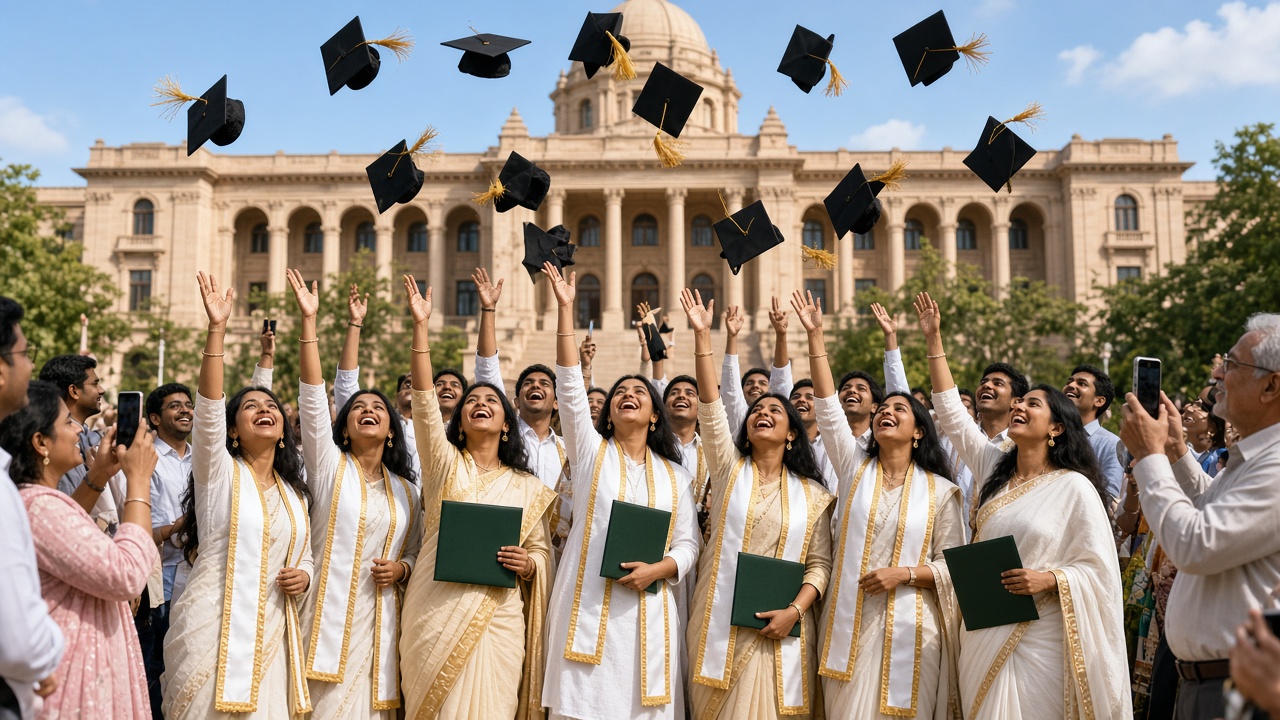
Convocation day: today women make up nearly half of India’s higher education students.
🏛️ Ancient Excellencec. 600 BCE – 1200 CE
Ancient Centres of Learning
Ancient India had famous centres of advanced study that attracted students from across Asia. Takshashila, Nalanda, Vikramashila, and Vallabhi taught philosophy, medicine, grammar, logic, astronomy, and statecraft — until invasions and loss of patronage brought their decline.
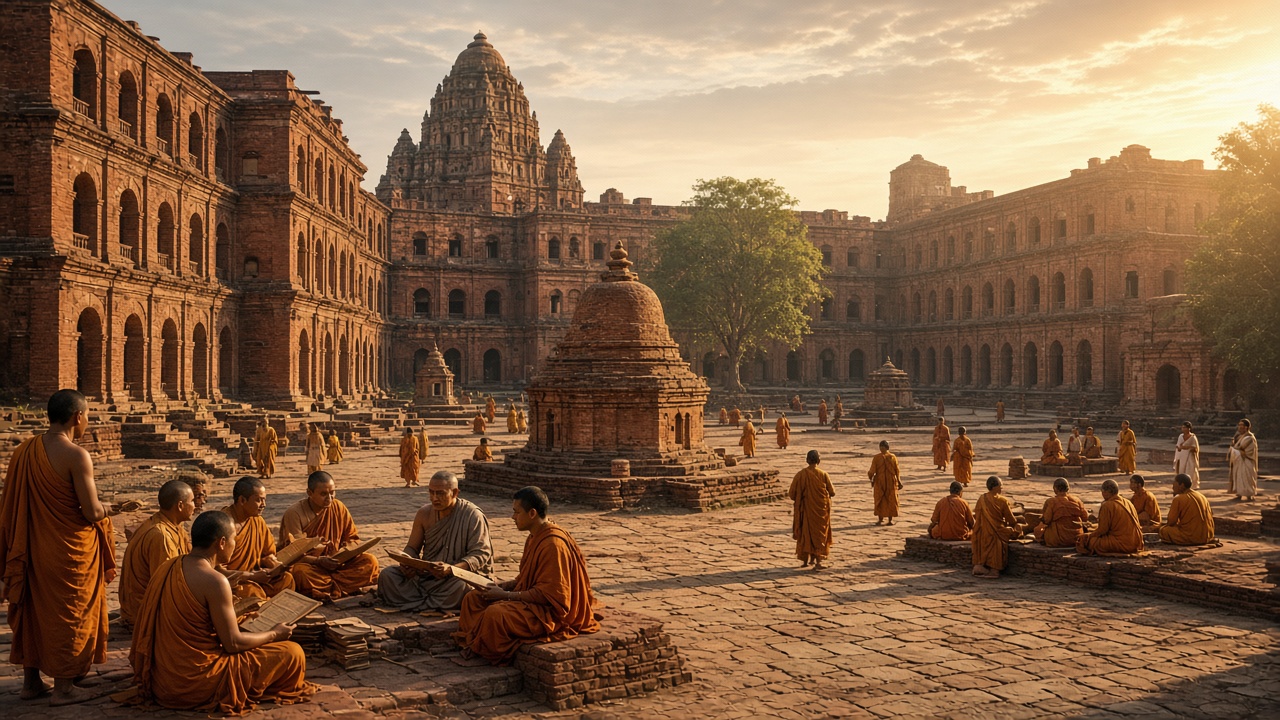
Nalanda’s courtyards, libraries, and halls hosted thousands of students and teachers (artistic reconstruction).
c. 6th–5th century BCE: Takshashila becomes a famous centre, traditionally linked with Panini, Chanakya, and Charaka.
c. 5th century CE: Nalanda is founded in Bihar under the Gupta rulers; it grows into a large residential university.
7th century / c. 800: Chinese scholar Xuanzang studies at Nalanda; Pala king Dharmapala founds Vikramashila.
c. 1193: Nalanda is destroyed by Bakhtiyar Khilji’s forces; Vikramashila also declines around this time.
How Learning Worked
Entrance debate: Gatekeeper scholars tested applicants before admission (Nalanda).
Great libraries: Palm-leaf and birch-bark manuscripts in large collections.
Debate & discussion: Logic and public debate trained sharp thinkers.
Features
International students: Scholars from China, Korea, Tibet, and Southeast Asia.
Royal support: Kings granted villages to fund teachers and students.
Free for students: Food, lodging, and teaching often provided at no cost.
📚 Colleges Take Shape1200 – 1856
Madrasas & Early Colleges
Medieval rulers built madrasas for advanced studies in Persian, Arabic, law, and sciences, while Sanskrit tols and pathshalas continued traditional learning. The East India Company and Indian reformers then founded colleges that mixed oriental and Western learning, including the first engineering and medical colleges.
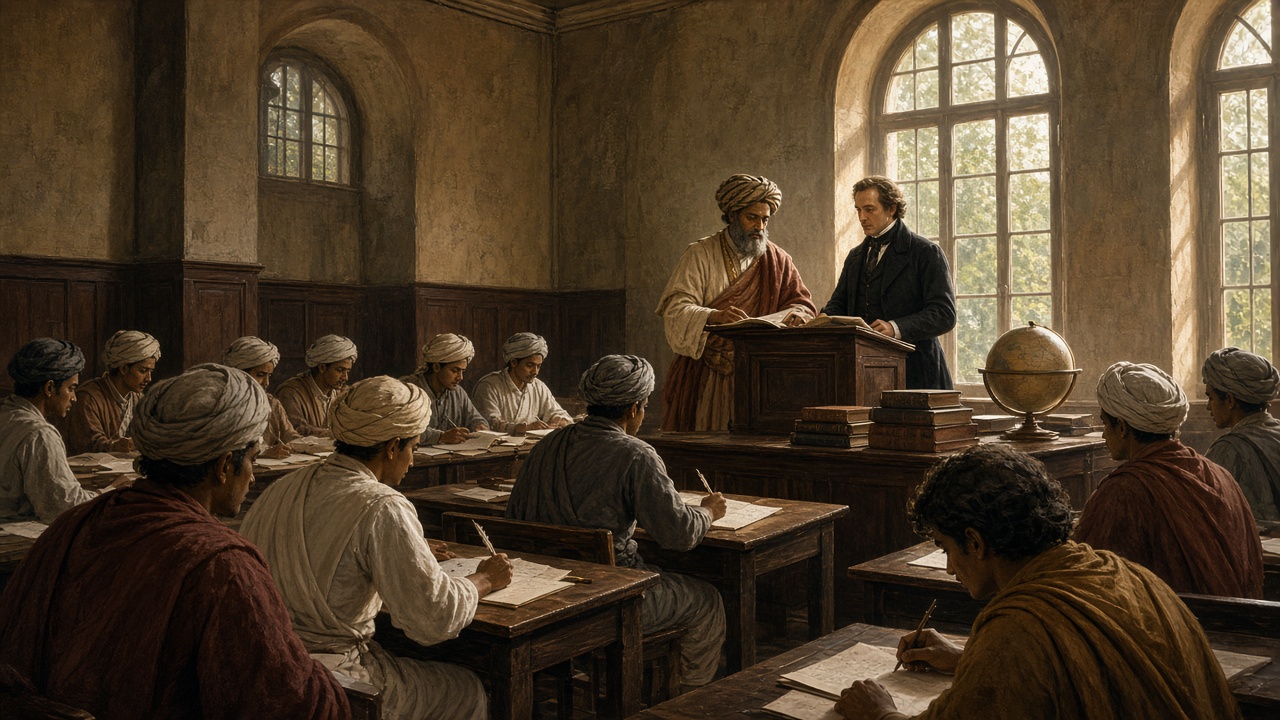
Early colleges combined Indian classical learning with Western subjects (artistic illustration).
14th–15th century: Madrasas flourish in Delhi and the Deccan, including Mahmud Gawan’s grand madrasa at Bidar (1472).
1781 / 1791: Calcutta Madrasa (Warren Hastings) and Benares Sanskrit College (Jonathan Duncan) are founded.
1817 / 1818: Hindu College, Calcutta, backed by Indian reformers; Serampore College founded by missionaries.
1835 / 1847 / 1854: Calcutta Medical College; Thomason College of Civil Engineering at Roorkee; Wood’s Despatch recommends universities.
Subjects & Methods
Oriental learning: Sanskrit, Persian, Arabic, law, and philosophy.
Western sciences: Mathematics, anatomy, surveying, and engineering.
Printed textbooks: New presses publish grammars and science books.
Features
Orientalist vs Anglicist debate: Which language and knowledge to teach.
Professional colleges: Doctors and engineers trained in India.
Urban elite: Colleges mostly in port cities and for a small group.
🎓 Universities Arrive1857 – 1946
First Modern Universities
The first universities were modelled on the University of London — they affiliated colleges and conducted exams rather than teaching. Indian leaders, princely states, and philanthropists then built universities and research institutes rooted in national pride, science, and Indian languages.
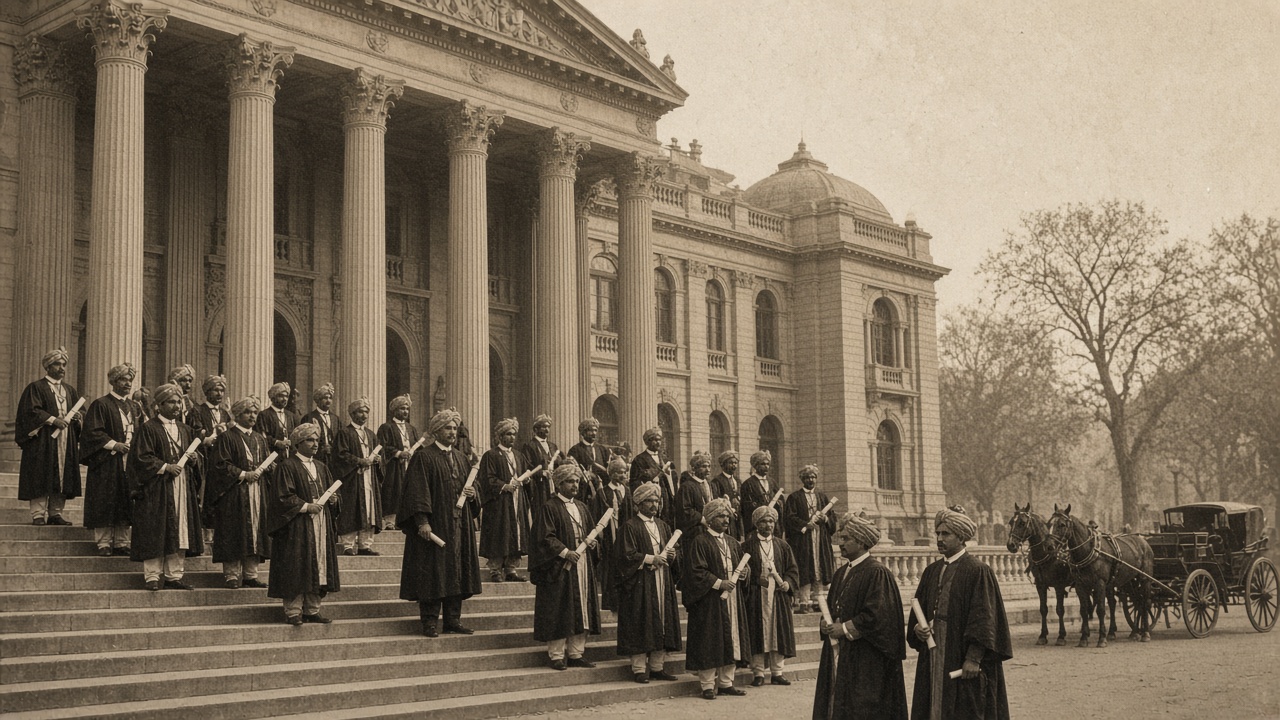
Early graduates of India’s colonial-era universities became lawyers, teachers, officials, and freedom fighters.
1857: Universities of Calcutta, Bombay, and Madras founded; Punjab (1882) and Allahabad (1887) follow.
1904 / 1909: Indian Universities Act tightens government control; Indian Institute of Science opens in Bangalore, inspired by Jamsetji Tata.
1916–1922: Banaras Hindu University (Madan Mohan Malaviya), SNDT Women’s University, Mysore, Osmania (Urdu medium), Aligarh Muslim University, Jamia Millia Islamia, Visva-Bharati, and Delhi University.
Affiliating system: One university examines many colleges.
Science research: IISc and university labs produce world-class work.
Indian languages: Osmania teaches in Urdu; Visva-Bharati blends arts and nature.
Features
Nationalist universities: Built by Indians for Indian needs.
Women’s higher education: Women’s colleges and a women’s university open.
Global recognition: Indian scientists win international honours.
🇮🇳 Temples of Learning1947 – 1985
Nation-Building Institutions
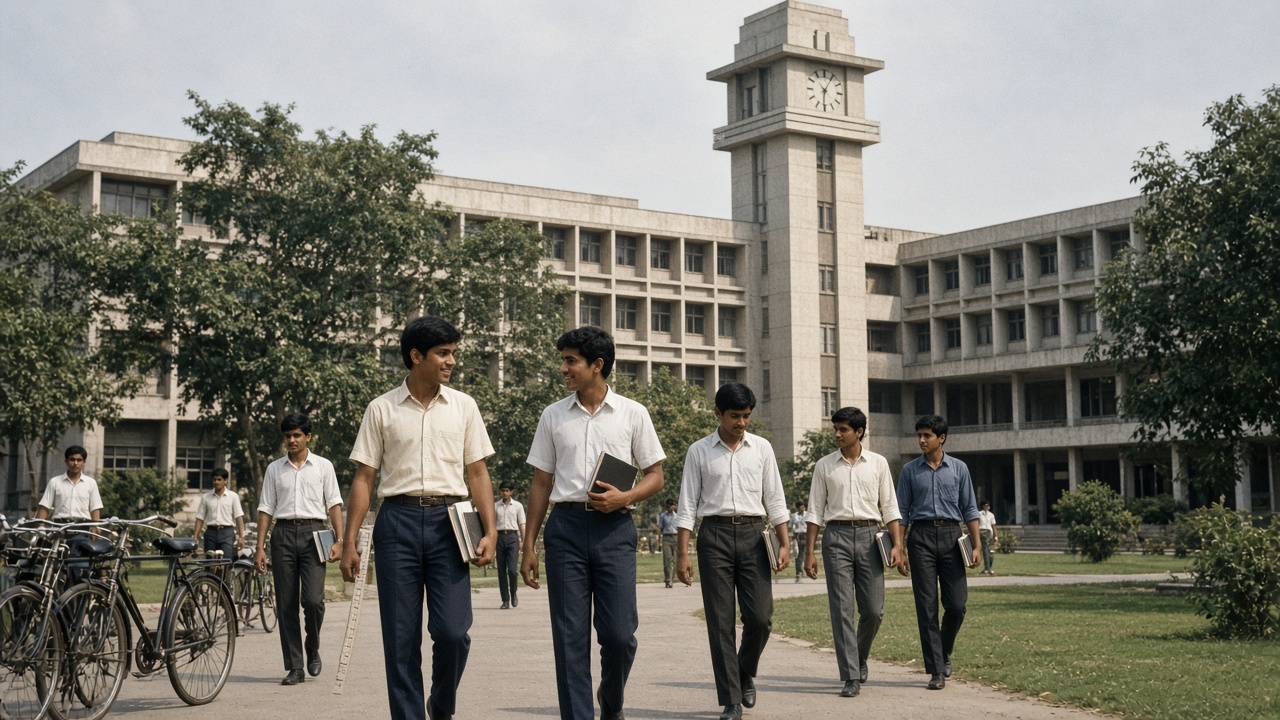
Independent India built institutions of national importance to train engineers, doctors, managers, and scientists for a developing nation. The UGC was created to fund and maintain standards, and the Radhakrishnan and Kothari Commissions shaped the university system.
IITs were built to create world-class engineers for independent India.
1948–49: Radhakrishnan (University Education) Commission sets the vision for Indian universities.
1951 / 1953–56: IIT Kharagpur, the first IIT; University Grants Commission formed and made statutory by the UGC Act, 1956.
1956–1969: AIIMS New Delhi; IITs Bombay, Madras, Kanpur, and Delhi; IIM Calcutta and Ahmedabad (1961); Kothari Commission (1964–66); JNU (1969).
1982 / 1985: Andhra Pradesh Open University, India’s first open university; IGNOU founded as a national open university.
Tools of Higher Learning
Laboratories & workshops: Hands-on engineering and science training.
Case method: Business schools teach through real company cases.
Distance education: Printed study materials, radio, and TV for remote learners.
Features
Institutions of national importance: IITs, AIIMS, and later IIMs.
Public funding: Low fees in government universities.
Reservation: Seats reserved for SC and ST students.
💻 Mass Higher Education1986 – 2012
Expansion & Private Colleges
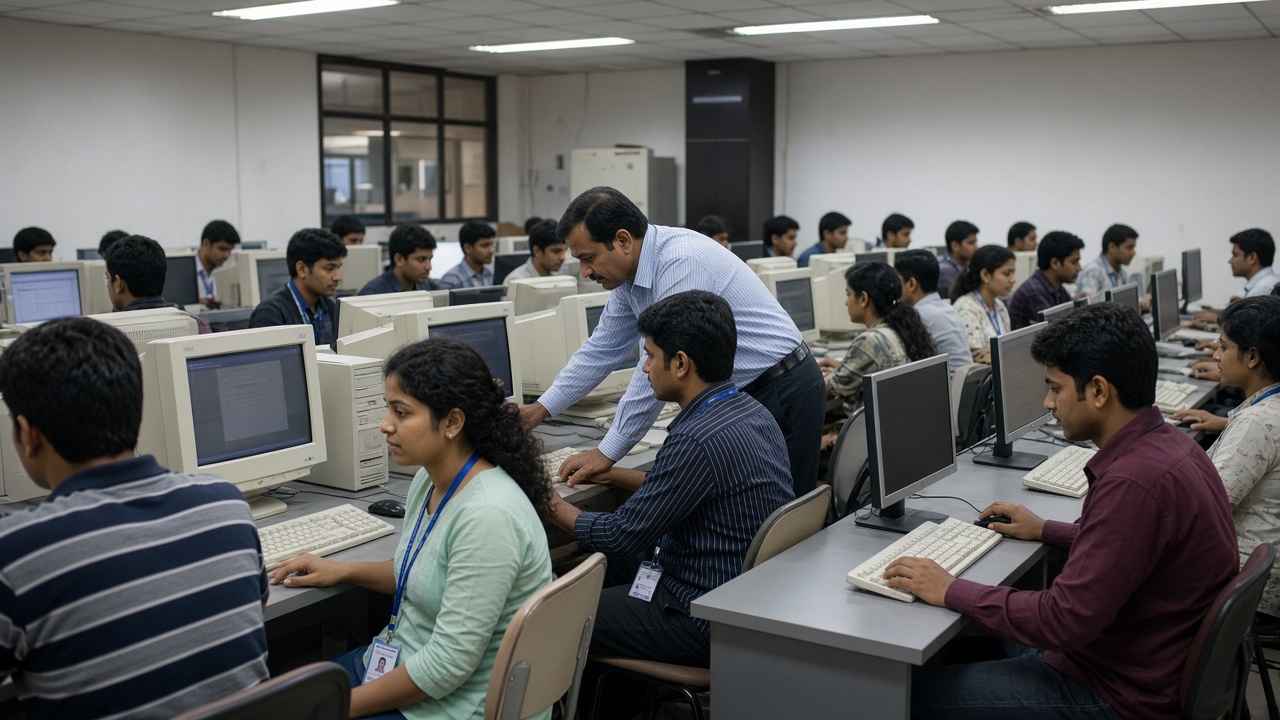
The IT boom and rising aspirations led to a huge rise in private engineering, management, and medical colleges. Accreditation bodies were set up, new IITs and research institutes opened, and reservation for OBC students was extended to central institutions.
Computer labs in private engineering colleges fed India’s IT boom.
1986 / 1987: National Policy on Education; AICTE becomes a statutory body to regulate technical education.
1990s–2000s: Self-financing private engineering and management colleges multiply, especially in southern and western India.
1994 / 2003: NAAC set up to accredit universities and colleges; NPTEL puts IIT lectures online.
2006–2012: OBC reservation in central institutions; IISERs and new IITs, NITs, and IIMs; National Knowledge Commission and Yash Pal Committee call for reforms; AISHE survey begins.
Tools of Higher Learning
Computer labs & internet: Programming and research online.
Video lectures: NPTEL courses from IIT professors.
Campus placements: IT companies recruit directly from colleges.
Features
Rapid growth: Thousands of new colleges and universities.
Quality gaps: Uneven standards and graduate employability concerns.
Brain drain: Many top graduates move abroad for study and work.
🌏 Global & Digital2013 – Present
Quality, Digital & Global Era
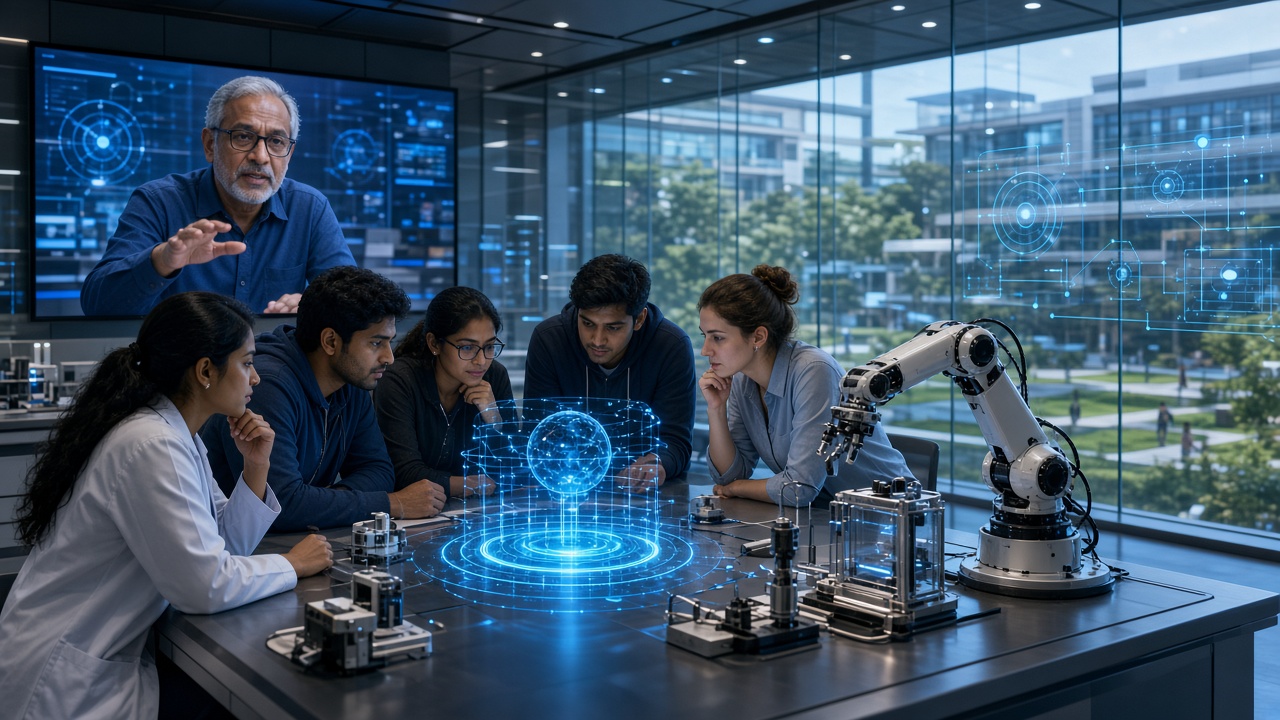
India now focuses on quality, rankings, online learning, and research. NEP 2020 aims to make higher education multidisciplinary and flexible, while Indian institutes open campuses abroad and foreign universities open campuses in India.
Research labs, online lectures, and international collaboration shape the new Indian campus.
2017 / 2018: SWAYAM free online courses; first Institutions of Eminence announced.
2020–2022: NEP 2020 sets a 50% enrolment target by 2035; Academic Bank of Credits (2021); CUET for undergraduate admissions (2022).
2023–present: UGC rules for foreign university campuses; IIT Madras in Zanzibar and IIT Delhi in Abu Dhabi; foreign campuses open at GIFT City and Gurugram; new Nalanda University campus inaugurated (2024).
Tools & Technology
SWAYAM & MOOCs: Credit-bearing online courses.
DigiLocker & ABC IDs: Digital degrees and credit records.
AI & research labs: AI, robotics, semiconductors, and climate research.
Features
Multiple entry & exit: Certificate, diploma, and degree options.
Multidisciplinary learning: Mix science, arts, and skills.
Internationalisation: Global campuses, joint degrees, and foreign students.
Landmark Institutions of Indian Higher Education
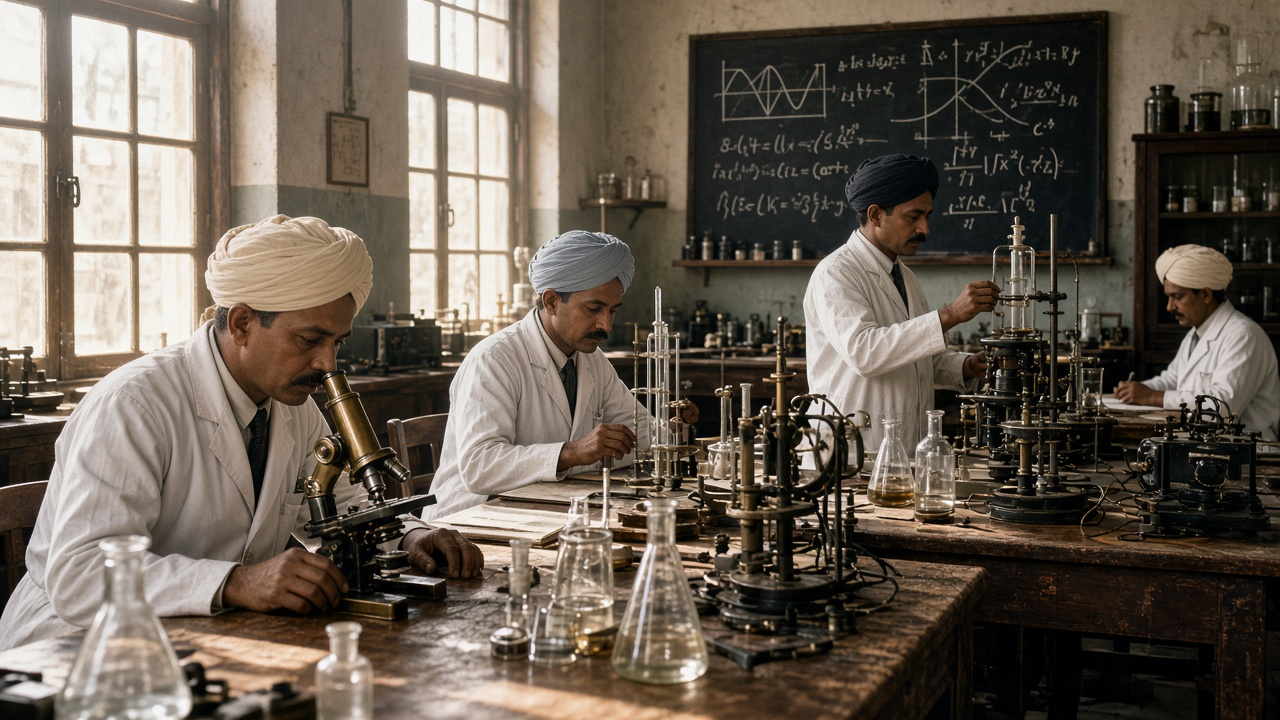
Early research institutes laid the foundation for Indian science (artistic illustration).
Institution
Place
Year
Significance
Nalanda
Bihar
c. 5th century CE
Ancient international residential university
Thomason College (now IIT Roorkee)
Roorkee
1847
First engineering college in India
University of Calcutta
Kolkata
1857
Among the first three modern universities
Indian Institute of Science
Bengaluru
1909
Pioneer of advanced scientific research
Banaras Hindu University
Varanasi
1916
Large residential university built by Indians
SNDT Women’s University
Mumbai
1916
First women’s university in India
IIT Kharagpur
West Bengal
1951
First Indian Institute of Technology
AIIMS New Delhi
New Delhi
1956
Premier medical institute
IIM Calcutta & Ahmedabad
Kolkata, Ahmedabad
1961
First Indian Institutes of Management
Jawaharlal Nehru University
New Delhi
1969
Research-focused central university
IGNOU
New Delhi
1985
National open university for distance learning
IISER Pune & Kolkata
Pune, Kolkata
2006
Integrated science education and research
Regulators & Key Bodies
These bodies fund, regulate, accredit, and rank higher education institutions in India.
Body
Set up
Role
Association of Indian Universities
1925 (as Inter-University Board)
Coordination and recognition of degrees
AICTE
1945 (statutory 1987)
Regulates technical and management education
UGC
1953 (statutory 1956)
Funds universities and sets standards
Bar Council of India
1961
Regulates legal education
NAAC
1994
Accredits universities and colleges
National Board of Accreditation
1994
Accredits technical programmes
NCTE
1995
Regulates teacher education
NIRF
2015
Annual national ranking of institutions
National Testing Agency
2017
Conducts CUET, NEET, JEE Main, and UGC-NET
National Medical Commission
2020
Regulates medical education (replaced MCI)
Types of Higher Education Institutions
India’s higher education system includes many kinds of institutions with different powers and funding.
Type
Example
Key feature
Central university
JNU, BHU, University of Hyderabad
Created by an Act of Parliament
State university
Mumbai, Anna, Osmania
Created by a state law; affiliates many colleges
Deemed-to-be university
IISc, TISS
Given university status by the central government on UGC advice
Private university
Various state private universities
Set up under state laws by private bodies
Institute of National Importance
IITs, AIIMS, NITs, IIMs
Special status by Act of Parliament
Open university
IGNOU, state open universities
Distance and online education
Affiliated college
Most arts, science, and commerce colleges
Teaches courses; degrees given by the university
Autonomous college
Many leading colleges
Designs its own syllabus and exams
Higher Education: Then vs Now
Aspect
Earlier
Now
Number of universities
Around 20 at independence
Over 1,100 universities
Who studied
A small urban, mostly male elite
About 4.3 crore students; women nearly half
Admission
Merit lists and separate college entrance tests
National tests such as CUET, JEE, and NEET
Learning mode
Lectures, notes, and libraries
Blended learning with online courses and digital libraries
Degree structure
Fixed three-year degrees
Flexible four-year degrees with multiple entry and exit
Certificates
Paper degrees collected at convocation
Digital degrees in DigiLocker
Quality checks
Few formal checks
NAAC accreditation and NIRF rankings
Global links
Students travel abroad to study
Foreign campuses in India and Indian campuses abroad
Higher Education Timeline Summary
Year / Era
Milestone
c. 6th century BCE
Takshashila becomes a centre of learning
c. 5th century CE
Nalanda founded
c. 1193
Nalanda destroyed
1781
Calcutta Madrasa
1847
Thomason College of Civil Engineering, Roorkee
1857
Universities of Calcutta, Bombay, and Madras
1909
Indian Institute of Science
1916
Banaras Hindu University and SNDT Women’s University
1948–49
Radhakrishnan Commission
1951
IIT Kharagpur
1956
UGC Act and AIIMS
1961
IIM Calcutta and IIM Ahmedabad
1985
IGNOU
1994
NAAC
2006
IISERs and OBC reservation in central institutions
2015
NIRF rankings launched
2017
SWAYAM online courses
2020
NEP 2020
2022
CUET for undergraduate admissions
2023–24
Foreign university campus rules; new Nalanda campus
Test Your Knowledge
20 quick questions from the higher education timeline. Click each question to reveal the answer.
Answer: Takshashila.
Answer: Bihar.
Answer: Xuanzang (Hiuen Tsang).
Answer: Dharmapala.
Answer: Warren Hastings.
Answer: Thomason College of Civil Engineering, Roorkee (1847), now IIT Roorkee.
Answer: Calcutta, Bombay, and Madras.
Answer: Jamsetji Tata.
Answer: Madan Mohan Malaviya (1916).
Answer: SNDT Women’s University (1916), founded by D. K. Karve.
Answer: Osmania University, Hyderabad (1918).
Answer: The University Education Commission (1948–49).
Answer: IIT Kharagpur (1951).
Answer: 1956, under the UGC Act.
Answer: IIM Calcutta and IIM Ahmedabad (1961).
Answer: Indira Gandhi National Open University (1985).
Answer: NAAC (National Assessment and Accreditation Council, 1994).
Answer: The National Institutional Ranking Framework, which ranks Indian institutions every year.
Answer: 50% gross enrolment ratio.
Answer: SWAYAM (launched 2017).
Classroom activity
Students Tasks
Use these prompts for discussion or projects on higher education in India.
Click any panel to expand and explore the visual mood.
Higher education in India in pictures — Nalanda, early colleges, colonial universities, research labs, IIT campuses, computer labs, convocations, and future campuses.
Nalanda
Ancient university
Early Colleges
East meets West
First Universities
1857 and after
Science Research
Early research institutes
IIT Campus
Nation-building institutes
IT Boom
Private engineering colleges
Convocation
Celebrating graduates
Future Campus
Research, AI, and global links
Explore all education timelines
Jump to any other education timeline on WorldTimelineHub.
Disclaimer: This content is AI-generated for educational purposes and may contain errors or outdated details. For correct and authoritative information, please refer to official and reliable sources such as government publications, manufacturers, museums, and academic references.