Books and Reading Timeline of India: Physical Books → Libraries → E-books → Audiobooks → AI Summaries
In the 1950s a new book in India usually came from a public library, a school shelf, or a railway bookstall, and newspapers were read aloud in village reading rooms. Neighbourhood lending libraries rented out comics
and novels in the 1980s, e-books and PDFs arrived on computers in the 2000s, audiobooks filled commutes in the 2010s, and in the 2020s AI tools summarise, translate, and read books aloud.
This timeline covers Nalanda’s library, Saraswati Mahal, railway bookstalls, the Baroda library movement, Ranganathan’s Five Laws, public library acts, the National Library, Chandamama, Amar Chitra Katha, Tinkle,
lending libraries, book fairs, Indian writing in English, online bookstores, e-readers, ePathshala, the National Digital Library, audiobooks, Indian-language reading apps, and AI summaries.
Reading habits shape how people learn, think, and imagine. India’s journey from manuscript libraries and village reading rooms to comics, book fairs, e-books, audiobooks, and AI summaries shows how literacy grew,
how technology changed access to books, and why libraries and a love of reading still matter in a world of screens.
Big picture
How India reads in one view
Scholars once travelled to Nalanda to read manuscripts. A library movement and new public library laws opened reading rooms after independence, comics and lending libraries fed young readers in the 1980s,
online stores and PDFs came in the 2000s, e-readers, digital libraries, and audiobooks in the 2010s, and AI summaries in the 2020s. Related timelines:
news consumption,
internet,
artificial intelligence.
1948
First public library law (Madras)
1967
Amar Chitra Katha begins
2015
ePathshala digital textbooks
2010s
Audiobook apps in Indian languages
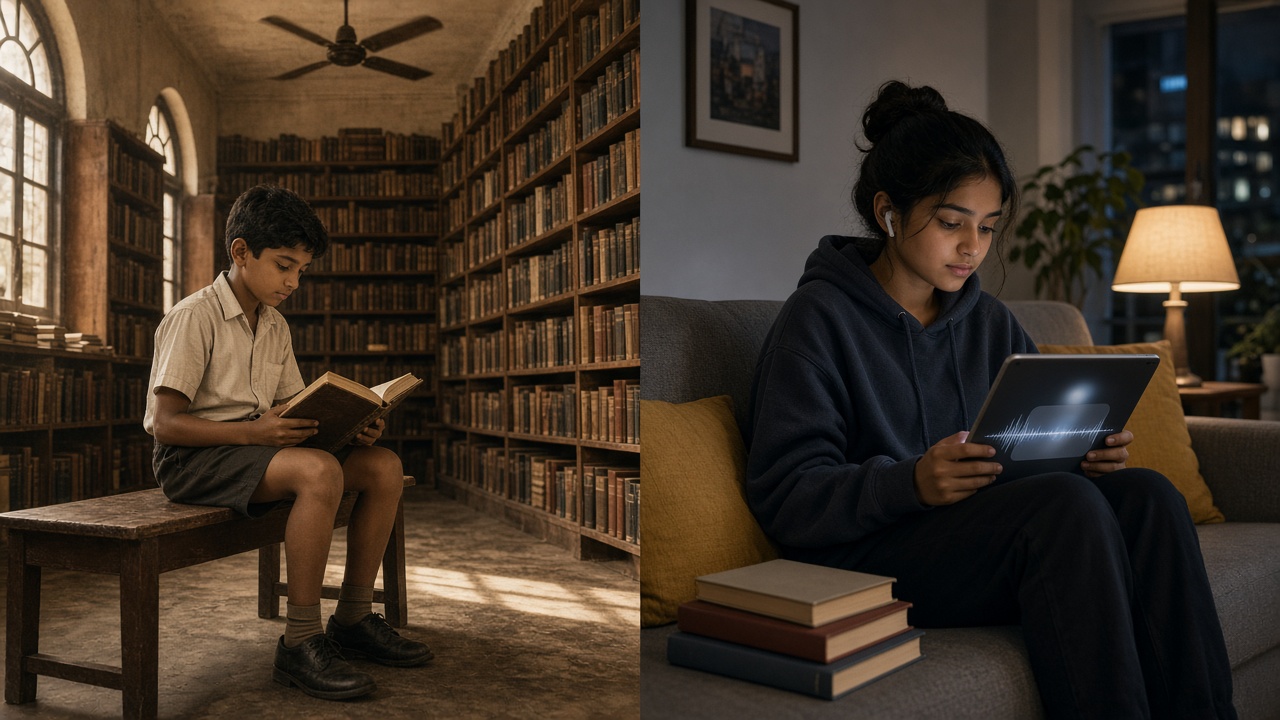
From a library bench to audiobooks and AI summaries on a tablet (artistic illustration).
Reading Then vs Now at a Glance
Feature
Then
Now
Where books came from
Libraries, school shelves, and bookstalls
Online stores, apps, and digital libraries
Format
Printed books and magazines
Print, e-books, audiobooks, and summaries
Cost
Library cards and small rental fees
Free apps, subscriptions, and discounts
Finding a book
Card catalogue and librarian’s advice
Search, reviews, and recommendations
Waiting time
Days or weeks for a copy
Instant download
Languages
Limited titles in many languages
Wide Indian-language apps and translations
Reading on the move
Paperbacks on trains
Phones, e-readers, and earphones
Children’s reading
Comics and children’s magazines
Comics, apps, and interactive books
Help with hard texts
Teacher or dictionary
Built-in dictionary and AI explanations
Community
Reading rooms and book clubs
Online reviews, book clubs, and fairs
📜 ManuscriptsAncient – 1946
Manuscript Libraries & the Library Movement
For centuries reading in India meant palm-leaf and birch-bark manuscripts kept in monasteries, temples, and royal collections. In the colonial period public and oriental libraries opened, railway bookstalls sold cheap books to travellers, and a library movement led by reformers and princely states brought free libraries to towns and villages.
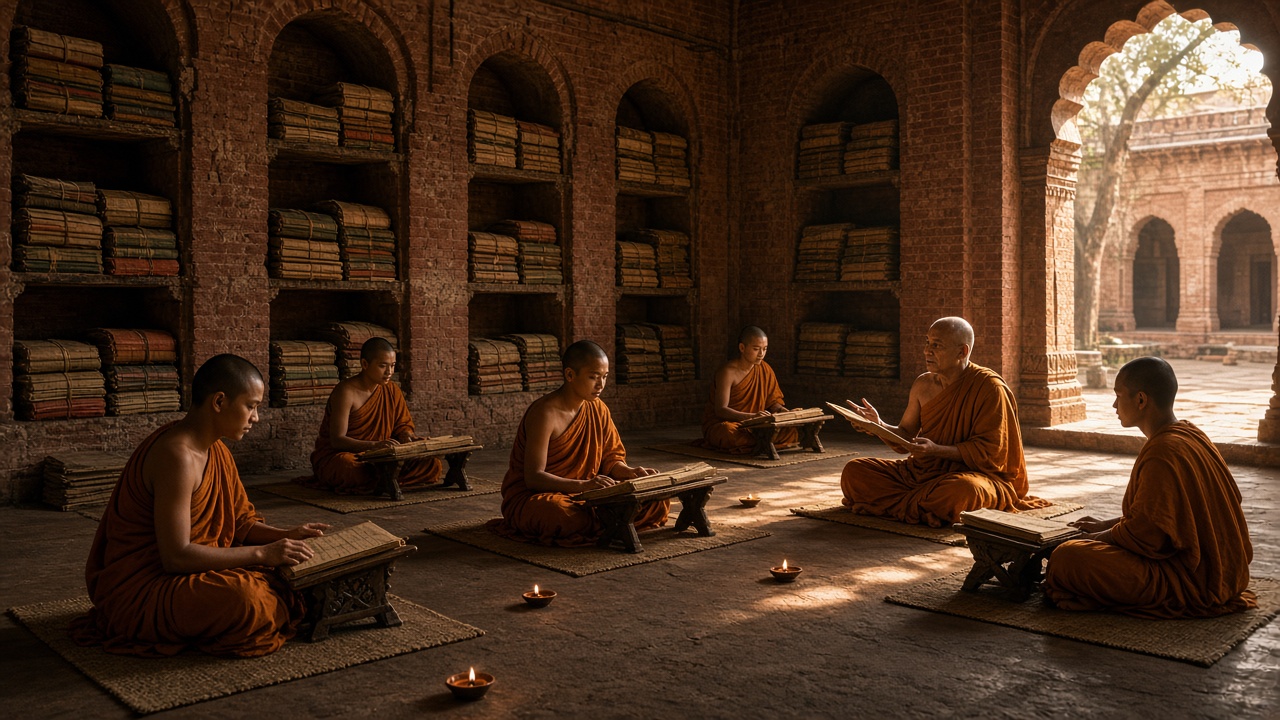
Monks study palm-leaf manuscripts in a monastery library (artistic illustration).
c. 5th–12th century: Nalanda’s great library, Dharmaganja, holds thousands of manuscripts and attracts scholars from China, Tibet, and Southeast Asia.
16th–19th century: Royal collections such as the Saraswati Mahal Library in Thanjavur and the Raza Library in Rampur (1774) preserve rare manuscripts.
1877–1903: Railway bookstalls begin selling cheap books to travellers (1877), and the Imperial Library opens in Calcutta (1903).
1910–1931: The Baroda state starts free public and travelling libraries (1910), and S. R. Ranganathan publishes the Five Laws of Library Science (1931).
Technology
Palm leaves: Handwritten pages.
Printed books: Cheaper copies.
Classification: Order on shelves.
Features
Scholars’ libraries: For the few.
Bookstalls: Reading on trains.
Free libraries: Baroda’s example.
🏛️ Libraries1947 – 1979
Public Libraries, Reading Rooms & Children’s Magazines
After independence few families could afford many books, so public libraries and village reading rooms became the heart of reading. States passed library laws, the National Library opened to the public, national book bodies were set up, and children’s magazines and comics began a lifelong reading habit for millions.
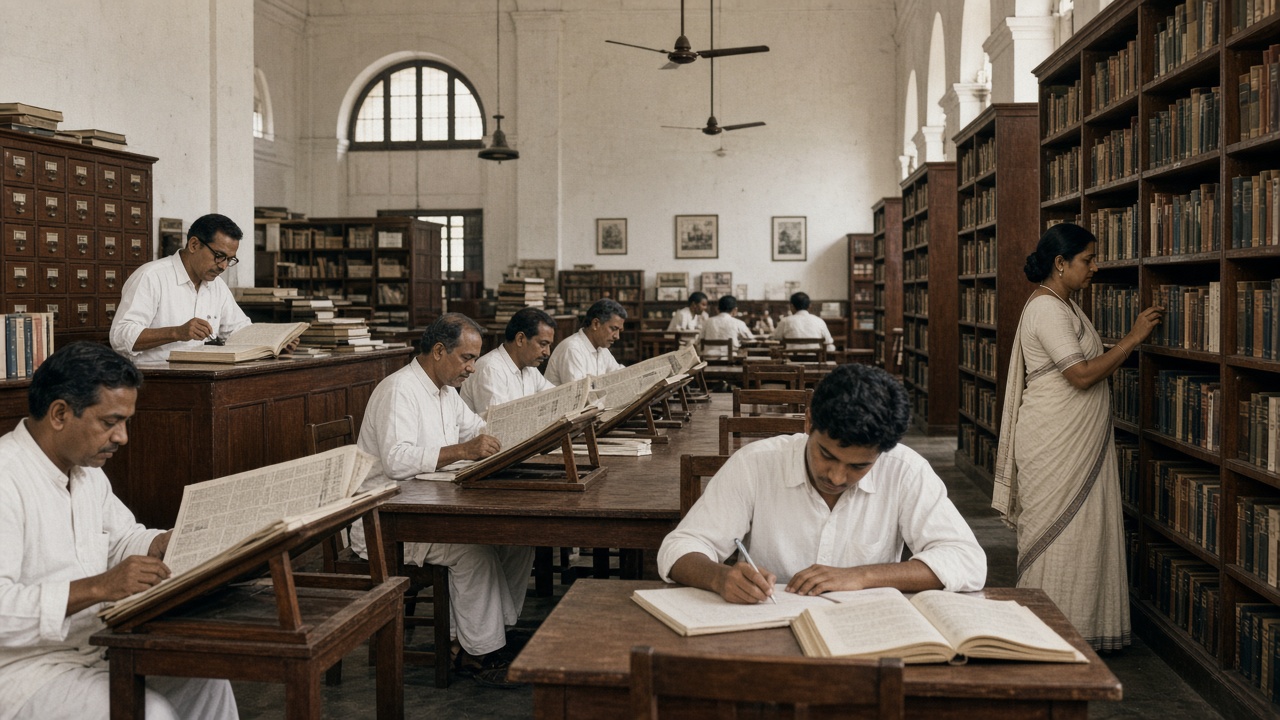
Newspapers, books, and a card catalogue in a public reading room (artistic illustration).
1947–1948: Chandamama children’s magazine begins (1947), and the Madras Public Libraries Act (1948) becomes India’s first public library law.
1951–1953: The Delhi Public Library opens as a UNESCO pilot project (1951), and the National Library in Kolkata opens to the public (1953).
1954–1957: The Sahitya Akademi is founded to promote literature in Indian languages (1954), and the National Book Trust is set up to publish affordable books (1957).
1967–1976: Amar Chitra Katha comics begin (1967), the first New Delhi World Book Fair is held (1972), and the Kolkata Book Fair starts (1976).
Technology
Card catalogues: Finding books.
Library stamps: Due-date slips.
Cheap printing: Affordable editions.
Features
Reading rooms: Newspapers for all.
Library cards: Borrow and return.
Children’s magazines: Stories every month.
📚 Lending1980 – 1999
Lending Libraries, Comics & Book Fairs
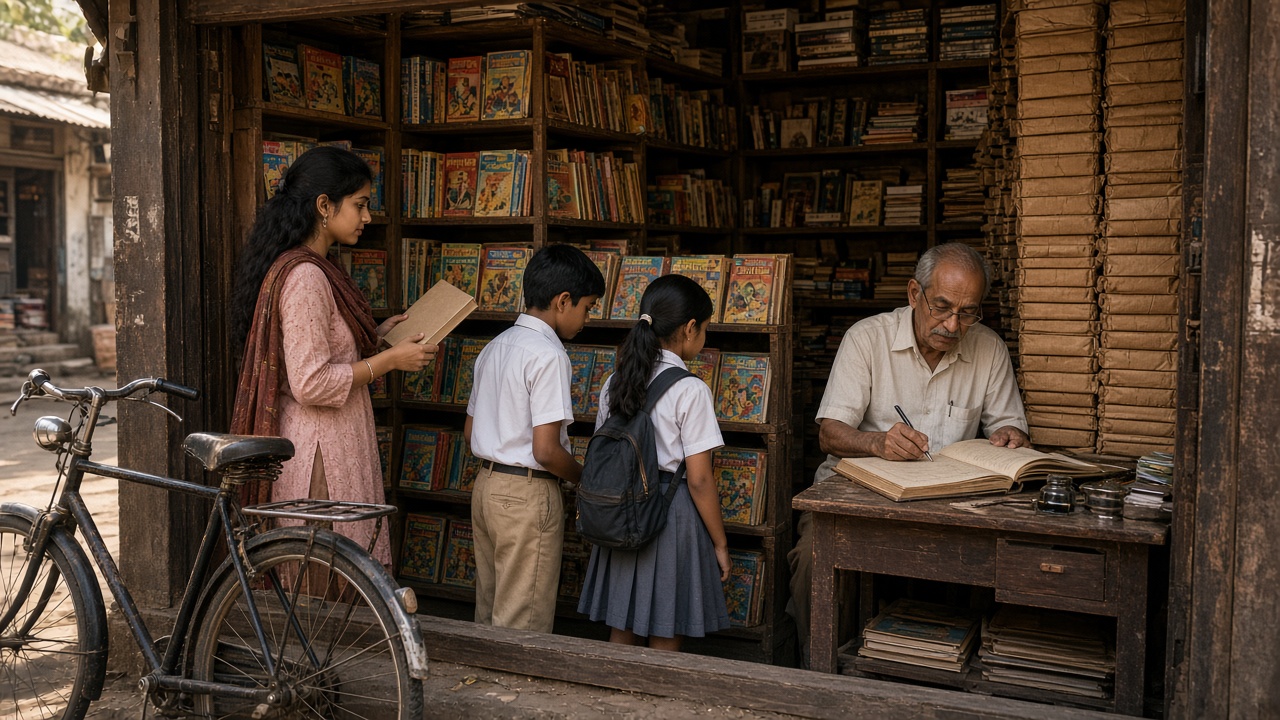
In the 1980s and 1990s neighbourhood lending libraries rented comics, magazines, and novels wrapped in brown paper for a small fee. Children swapped comics, book fairs drew huge crowds, Indian writers in English won global prizes, and Kerala’s village library network showed how reading could reach everyone.
Comics and brown-paper-covered novels at the neighbourhood lending library (artistic illustration).
1980: Tinkle children’s magazine begins, joining Chandamama and Amar Chitra Katha as childhood favourites.
1980s: Lending libraries rent comics and novels by the day, and railway and bus-stand bookstalls sell pocket-sized paperbacks in many languages.
1981–1997: Indian writing in English wins global attention, with Booker Prize wins by Salman Rushdie (1981) and Arundhati Roy (1997).
1990s: Kerala’s library movement, built on the Granthasala Sangham founded in 1945, runs thousands of village libraries, and 19 June is marked as Reading Day.
Technology
Colour comics: Cheap and bright.
Paperbacks: Pocket-sized novels.
Rental registers: Handwritten records.
Features
Comic swaps: Among friends.
Book fairs: Festivals of books.
Summer reading: Holiday ritual.
💻 E-books2000 – 2009
Online Bookstores, PDFs & E-books
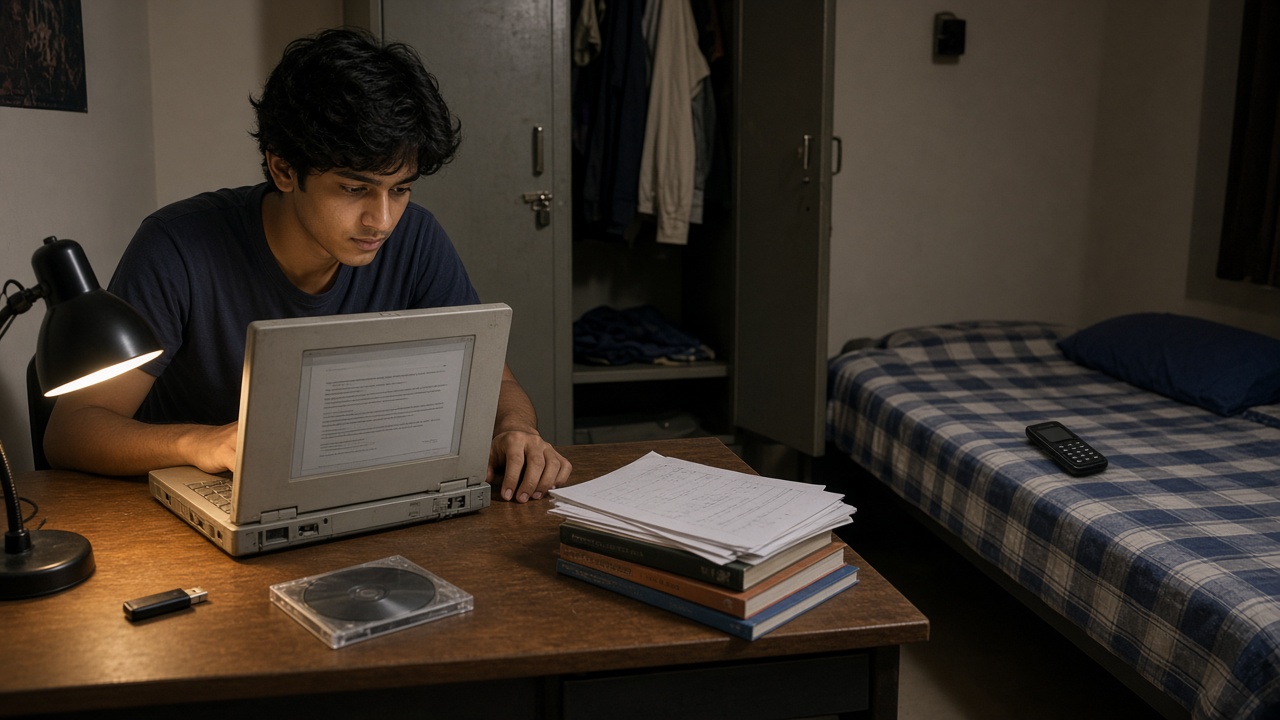
Computers and the internet brought books to screens. Students read PDFs and scanned notes, digital library projects put old books online, online bookstores delivered to small towns, and affordable Indian paperbacks created millions of new readers.
A student reads a digital book on a laptop beside photocopied notes (artistic illustration).
Early 2000s: Students share PDFs and scanned books on CDs and pen drives, and the Digital Library of India project begins scanning old books.
2004: Low-priced Indian English novels become bestsellers, drawing young first-time readers to books.
2007: Online bookstores begin delivering books across India, reaching towns without good bookshops.
Late 2000s: Textbooks and free classics become available online as e-books, and cyber cafés become reading and research spots.
Technology
PDF files: Books on screens.
Scanning: Old books digitised.
Online stores: Home delivery.
Features
Search inside: Find any word.
Free classics: Out-of-copyright books.
Small-town access: Books by post.
🎧 Audio2010 – 2019
E-readers, Digital Libraries & Audiobooks
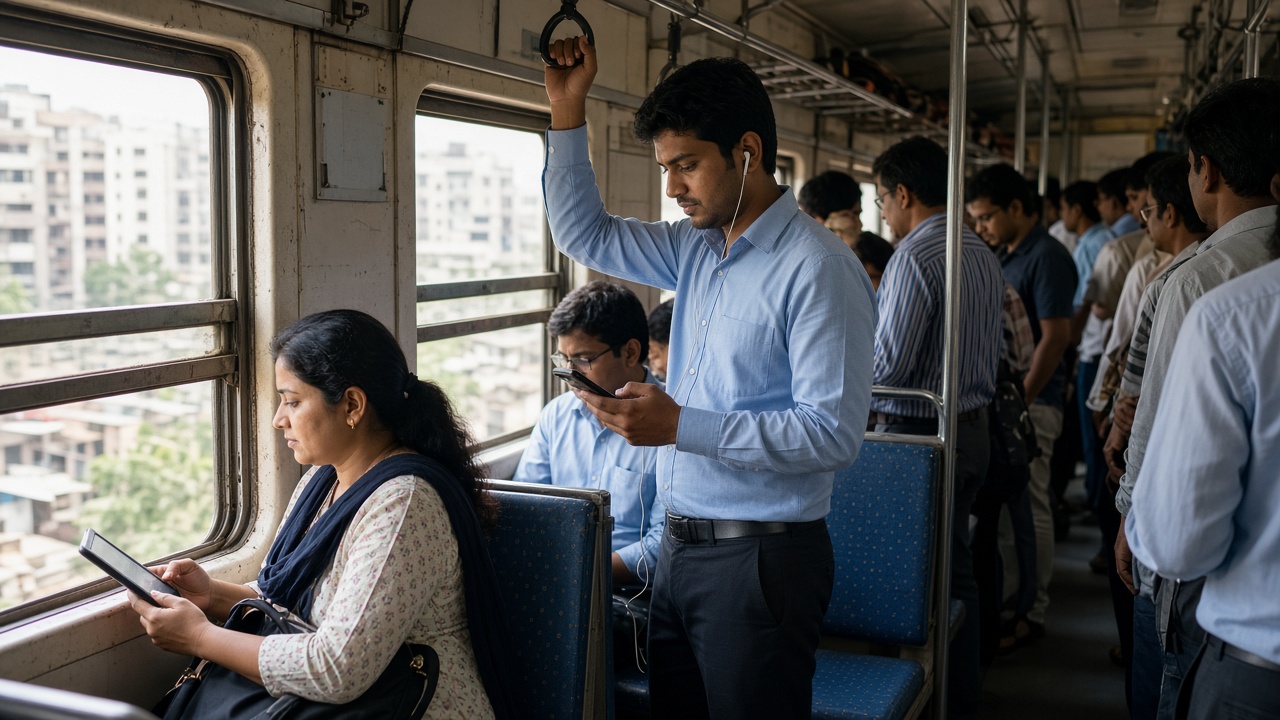
E-readers and smartphones turned commutes into reading time, and cheap mobile data made audiobooks and audio stories popular in Hindi and other Indian languages. Government platforms put school textbooks and millions of learning resources online for free.
Listening to an audiobook and reading an e-reader on the local train (artistic illustration).
2012: E-readers go on sale in India, and e-book stores offer Indian and international titles to download instantly.
2014–2015: Indian-language reading apps let writers publish stories in many languages, and NCERT’s ePathshala puts school textbooks online (2015).
2017–2018: Audiobook apps launch in India with Hindi and regional titles, and the National Digital Library of India opens millions of resources to learners.
Late 2010s: Audio-story apps and podcasts grow fast, and many readers mix printed books, e-books, and audio.
Technology
E-ink screens: Easy on the eyes.
Audiobooks: Books you hear.
Reading apps: Stories on phones.
Features
Commute reading: Trains and buses.
Indian languages: New writers online.
Free textbooks: ePathshala.
🤖 AI2020s – Future
AI Summaries & Multi-format Reading
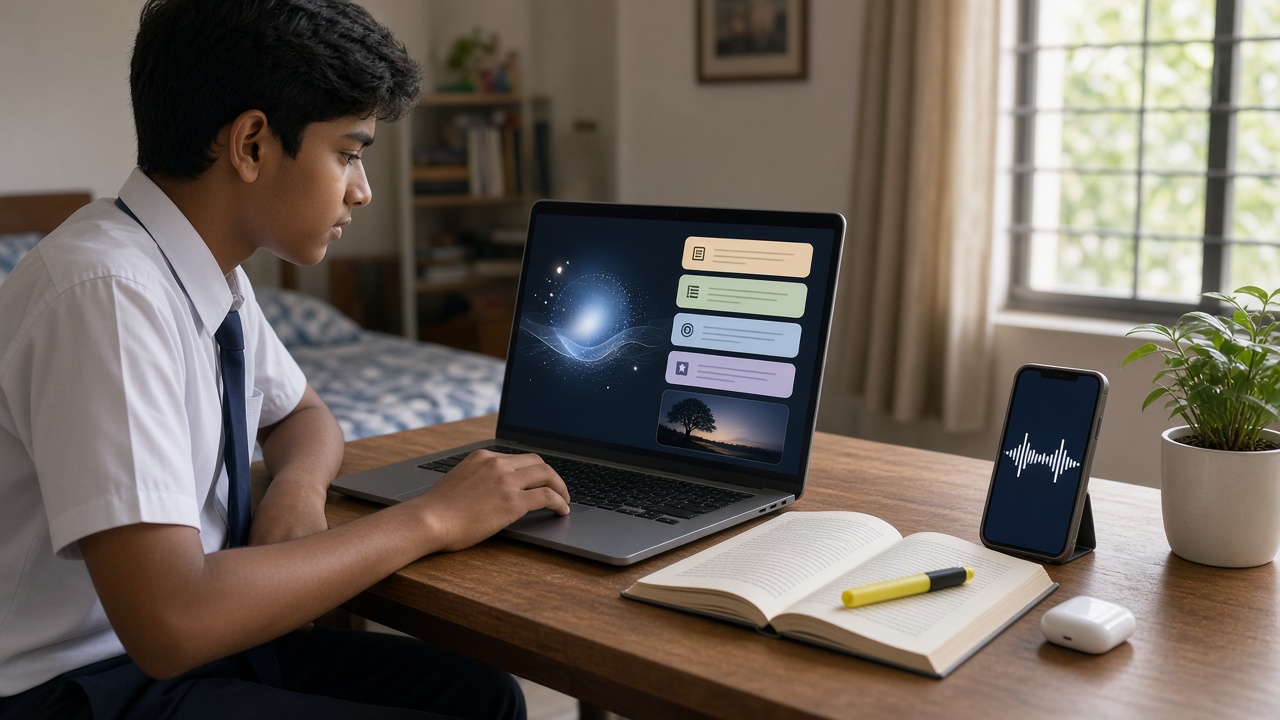
Lockdowns in 2020 sent many people back to books and onto reading apps. From late 2022 AI chatbots could summarise chapters, explain hard passages, and answer questions about books, while AI translation and text-to-speech made books available in more Indian languages — even as book fairs and printed books stayed popular.
An AI summary on the laptop beside a highlighted printed book (artistic illustration).
2020: COVID-19 lockdowns boost reading apps and e-books, and NEP 2020 stresses reading, libraries, and books in Indian languages.
2022: Geetanjali Shree’s Tomb of Sand becomes the first Hindi novel to win the International Booker Prize, and AI chatbots able to summarise books appear late in the year.
2020s: AI translation and text-to-speech bring books to more Indian languages, and digital libraries for children and young readers expand.
Future: AI reading tutors, personalised books, AR picture books, and smarter libraries that mix print, audio, and digital resources.
Technology
AI summaries: Key points in seconds.
Text-to-speech: Any book read aloud.
AI translation: Indian languages.
Features
Ask the book: Questions answered.
Mixed formats: Print, audio, digital.
Book fairs: Still crowded.
Ways of Reading Compared
Format
Main era
Strength
Weakness
Palm-leaf manuscript
Ancient–19th century
Lasting knowledge
Rare and fragile
Library book
1900s–now
Free to borrow
Wait for a copy
Comic and magazine
1950s–now
Fun for children
Short stories only
Printed paperback
1950s–now
Easy on the eyes, no battery
Heavy to carry many
E-book and PDF
2000s–now
Instant and searchable
Screen strain
E-reader
2010s–now
Thousands of books in one device
Costs money
Audiobook
2010s–now
Listen while travelling
Harder to revisit a passage
AI summary
2020s
Key points in seconds
Misses depth and can be wrong
Landmark Libraries of India
Library
Founded
Place
Known for
Nalanda (Dharmaganja)
c. 5th century
Bihar
Ancient manuscript library
Saraswati Mahal Library
16th–17th century
Thanjavur
Rare palm-leaf manuscripts
Rampur Raza Library
1774
Rampur
Persian and Arabic manuscripts
Asiatic Society Library
1784
Kolkata
Oriental research
Khuda Bakhsh Oriental Library
1891
Patna
Islamic manuscripts
Connemara Public Library
1896
Chennai
Historic public library
National Library of India
1903 (public 1953)
Kolkata
Largest library in India
Delhi Public Library
1951
Delhi
UNESCO pilot public library
National Digital Library of India
2018
Online
Millions of free resources
Book Fairs, Awards, and Reading Institutions
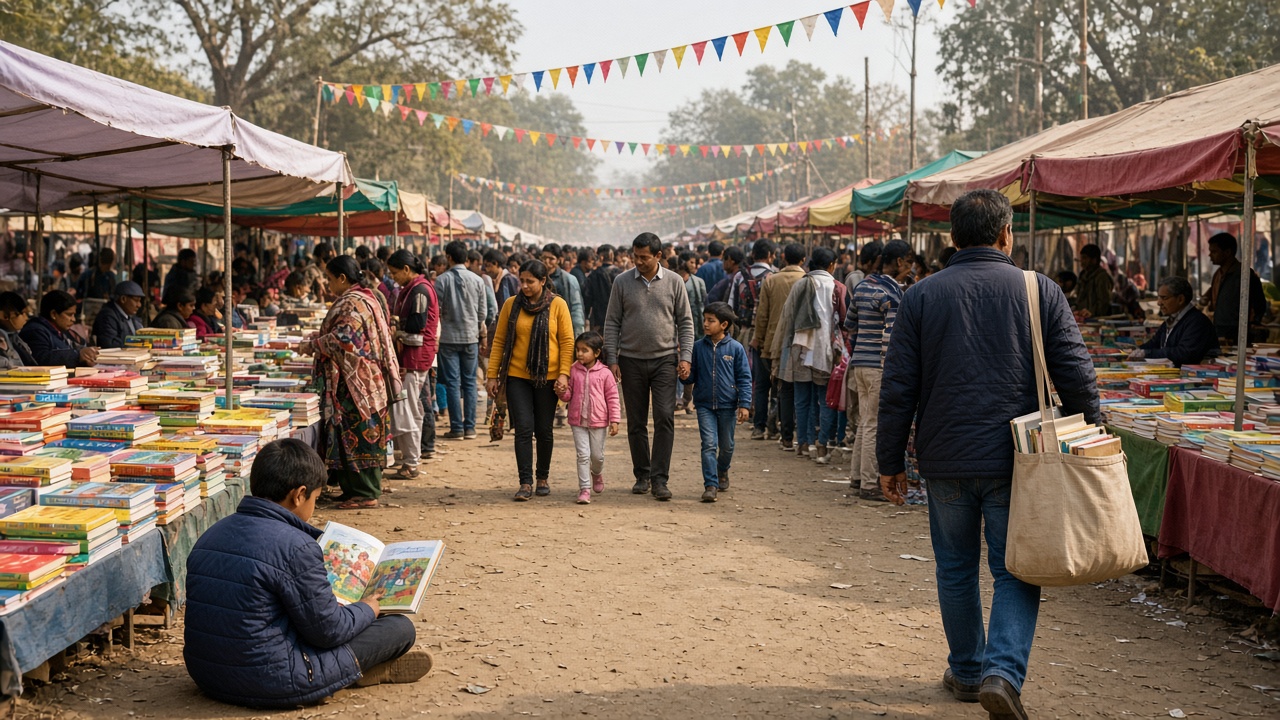
Families and students crowd the stalls at a winter book fair (artistic illustration).
Milestone
Year
Why it matters
Sahitya Akademi
1954
Awards for literature in Indian languages
National Book Trust
1957
Affordable books and book fairs
Jnanpith Award
1961 (first award 1965)
Highest Indian literary honour
New Delhi World Book Fair
1972
International book fair
Kolkata Book Fair
1976
One of the world’s most visited book fairs
Chennai Book Fair
1977
Huge Tamil and English book fair
Booker Prize to an Indian-born writer
1981
Global spotlight on Indian writing
International Booker for a Hindi novel
2022
Indian-language books go global
Books and Reading Timeline Summary
Year / Era
Milestone
c. 5th–12th century
Nalanda’s manuscript library
1774
Rampur Raza Library
1877
Railway bookstalls
1903
Imperial Library, Calcutta
1910
Baroda free and travelling libraries
1931
Ranganathan’s Five Laws
1947
Chandamama magazine
1948
Madras Public Libraries Act
1953
National Library opens to the public
1957
National Book Trust
1967
Amar Chitra Katha
1972
New Delhi World Book Fair
1976
Kolkata Book Fair
1980
Tinkle magazine
1980s
Neighbourhood lending libraries
2000s
PDFs, digital libraries, and online bookstores
2012
E-readers on sale in India
2015
ePathshala
2018
National Digital Library of India; audiobook apps
2020
Lockdown reading; NEP 2020
2022
Hindi novel wins International Booker; AI chatbots
Future
AI reading tutors and smart libraries
Test Your Knowledge
20 quick questions from the books and reading timeline. Click each question to reveal the answer.
Answer: Dharmaganja.
Answer: Thanjavur, Tamil Nadu.
Answer: 1877.
Answer: Baroda.
Answer: S. R. Ranganathan, in 1931.
Answer: 12 August, Ranganathan’s birthday.
Answer: The Madras Public Libraries Act, 1948.
Answer: The Imperial Library.
Answer: Chandamama.
Answer: 1967.
Answer: The National Book Trust.
Answer: 1976.
Answer: Rented comics, magazines, and novels for a small fee.
Answer: Arundhati Roy, for The God of Small Things.
Answer: 19 June.
Answer: NCERT’s free app and website for digital textbooks, launched in 2015.
Answer: IIT Kharagpur.
Answer: E-ink, which looks like printed paper.
Answer: Tomb of Sand by Geetanjali Shree, in 2022.
Answer: They miss depth and detail and can contain mistakes.
Classroom activity
Students Tasks
Use these prompts for discussion or projects on how reading has changed in India over time.
Click any panel to expand and explore the visual mood.
India’s reading journey in pictures — the manuscript library, the public reading room, the neighbourhood lending library, the e-book on a laptop, audiobooks on the train, AI summaries, the book fair, and then versus now.
Manuscript Library
Palm-leaf pages
Public Library
Reading room
Lending Library
Comics for rent
E-books
Books on screens
Audiobooks
Listening on the train
AI Summaries
Key points in seconds
Book Fair
A festival of books
Then vs Now
Library bench to tablet
Explore all education timelines
Jump to any other education timeline on WorldTimelineHub.
Disclaimer: This content is AI-generated for educational purposes and may contain errors or outdated details. For correct and authoritative information, please refer to official and reliable sources such as government publications, manufacturers, museums, and academic references.