From a mechanical “teaching machine” in 1924 to AI tutors that explain any topic in seconds — the dream of a personal tutor for every learner
has driven a century of experiments with machines, computers, and artificial intelligence in education.
This timeline follows teaching machines, computer-assisted instruction, intelligent tutoring systems, adaptive learning apps, AI teaching assistants,
and generative AI — along with how India is bringing AI into classrooms and the big questions about ethics, privacy, and the role of teachers.
AI in education means using computer systems that can adapt, understand language, recognise patterns, or generate content to support learning
and teaching. It includes intelligent tutors, adaptive practice apps, automatic grading, chatbots, translation tools, and learning analytics.
Used well, AI can give every student personal help and save teachers time; used carelessly, it can spread errors, bias, and shortcuts that weaken real learning.
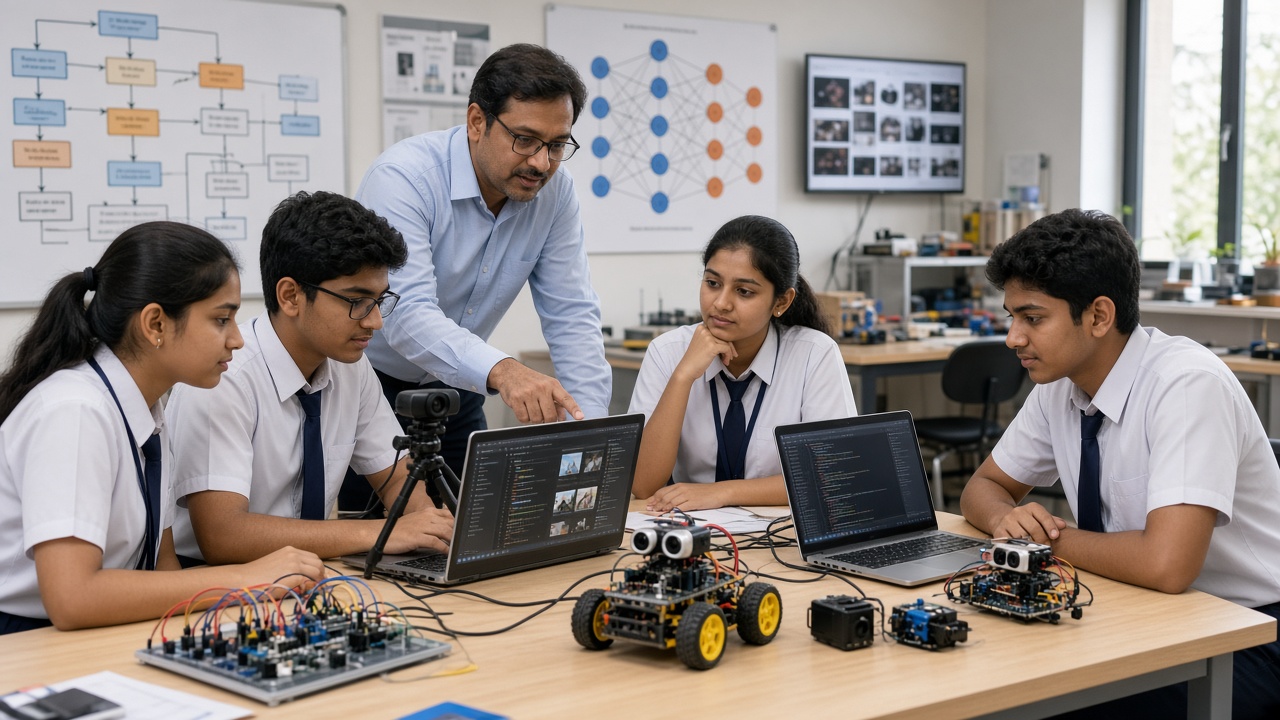
In the AI-powered classroom of the future, teachers stay at the centre while AI personalises learning.
⚙️ Machines That Teach1924 – 1959
Teaching Machines & Early AI Ideas
Psychologists built mechanical machines that asked questions and gave instant feedback, letting students learn at their own pace. At the same time, computer scientists began asking whether machines could think — the birth of artificial intelligence.
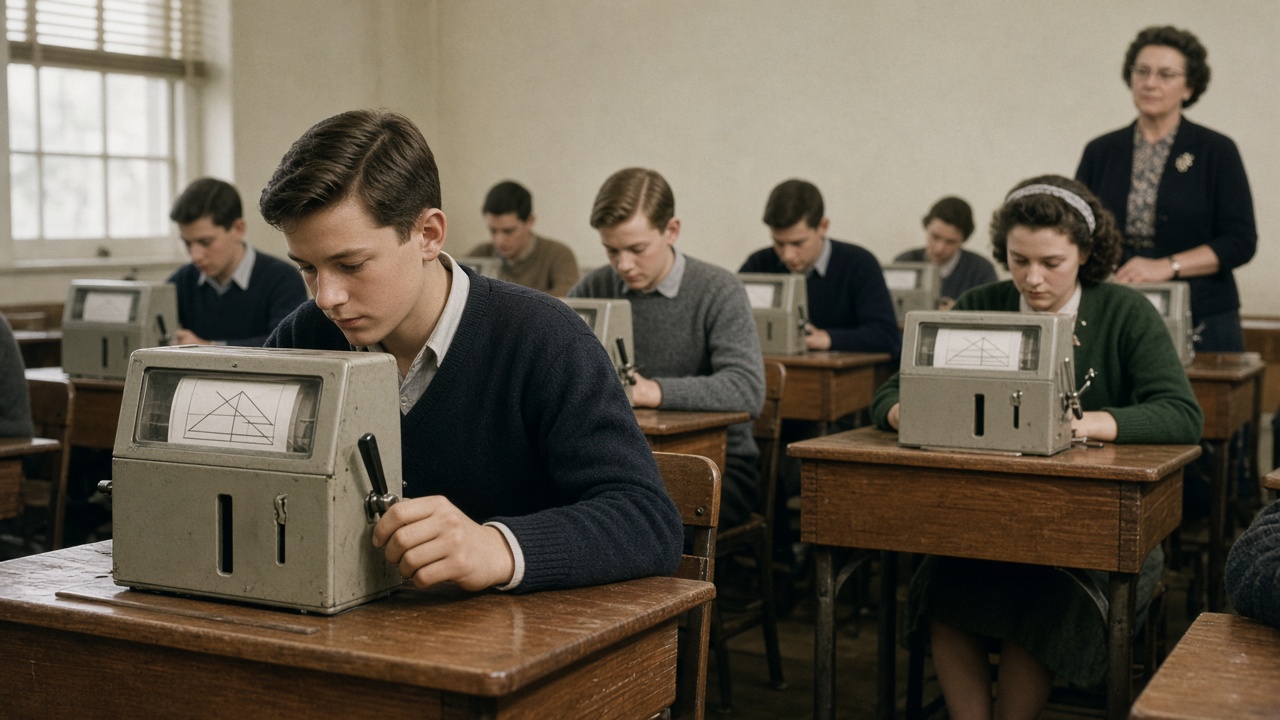
Teaching machines showed one question at a time and gave immediate feedback (artistic illustration).
1924–1926: Sidney Pressey demonstrates and describes a mechanical machine that tests students and teaches through instant feedback.
1950: Alan Turing asks “Can machines think?” in his paper on computing machinery and intelligence.
1954 / 1958: B. F. Skinner builds teaching machines and promotes “programmed instruction” in small steps.
1956: The Dartmouth workshop coins the term “artificial intelligence.”
Technology
Mechanical drums & levers: Questions on paper rolls with answer keys.
Programmed textbooks: Small steps with answers to check.
Early computers: Room-sized machines used for research.
Features
Self-paced learning: Each student moves at their own speed.
Instant feedback: Right or wrong shown immediately.
Limited intelligence: Machines followed fixed sequences.
🖥️ Computers in Class1960 – 1979
Computer-Assisted Instruction
Universities connected students to mainframe computers for drills, lessons, and simulations. PLATO introduced touch screens and online communities, LOGO let children program a turtle, and researchers built the first tutor that could hold a question-and-answer dialogue.
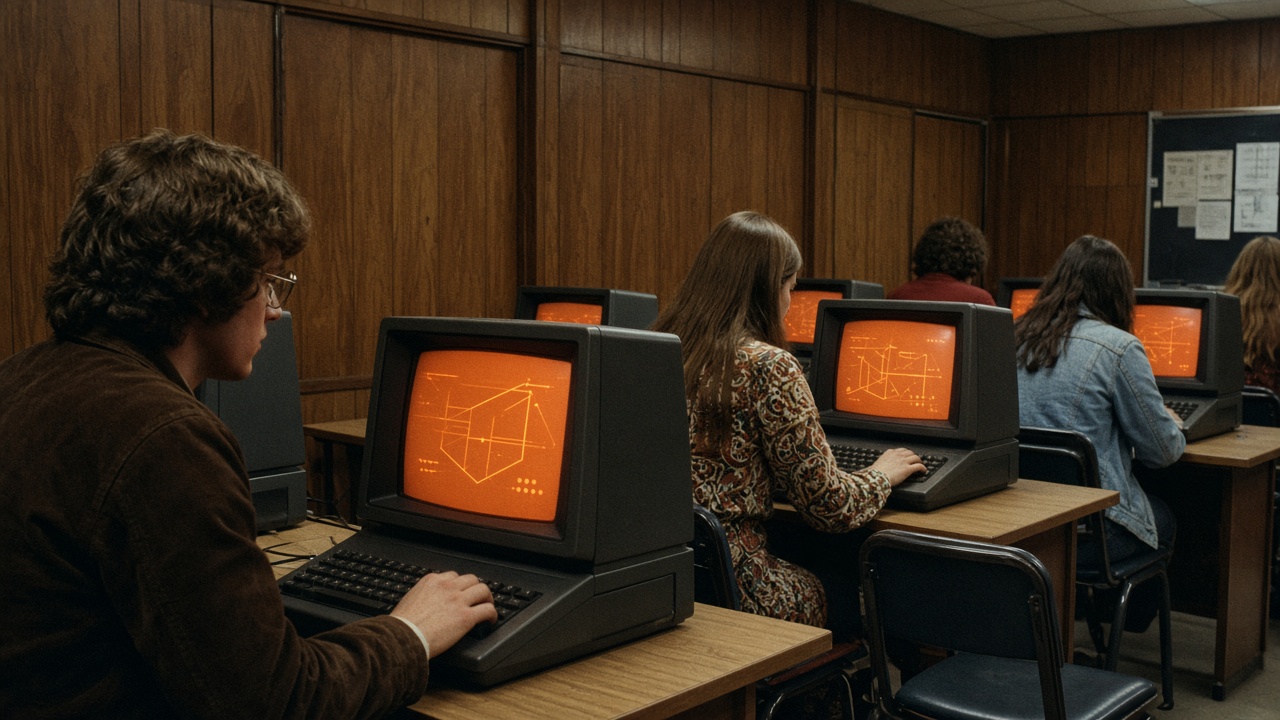
Orange plasma screens of PLATO-style terminals brought interactive lessons to students (artistic illustration).
1960: PLATO computer-based learning system begins at the University of Illinois.
1963–1966: Patrick Suppes runs computer-assisted arithmetic and reading lessons at Stanford; Joseph Weizenbaum creates the ELIZA chatbot (1966).
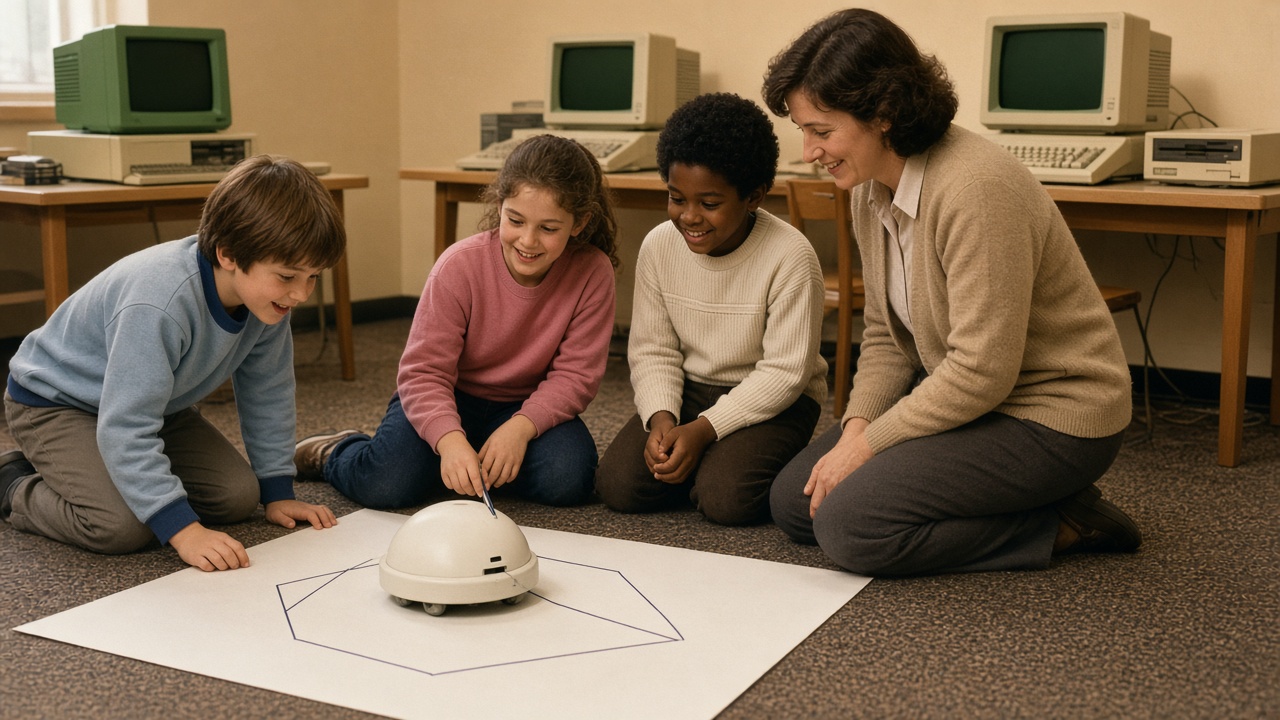
1967: Seymour Papert, Wally Feurzeig, and Cynthia Solomon create the LOGO programming language for children.
1970 / 1972: Jaime Carbonell’s SCHOLAR, often called the first intelligent tutoring system; PLATO IV adds plasma touch screens.
Technology
Mainframes & terminals: Many students share one computer.
Drill-and-practice software: Maths and reading exercises.
Natural-language dialogue: Early tutors answer typed questions.
Features
Interactive lessons: Graphics, quizzes, and simulations.
Online community: PLATO had early forums and messaging.
High cost: Only universities and research labs could afford it.
🧠 Smart Tutors1980 – 1999
Intelligent Tutoring Systems
Personal computers reached schools, and researchers built tutors that modelled how each student thinks. Bloom’s famous finding that one-to-one tutoring greatly improves results became the goal these AI tutors tried to reach.
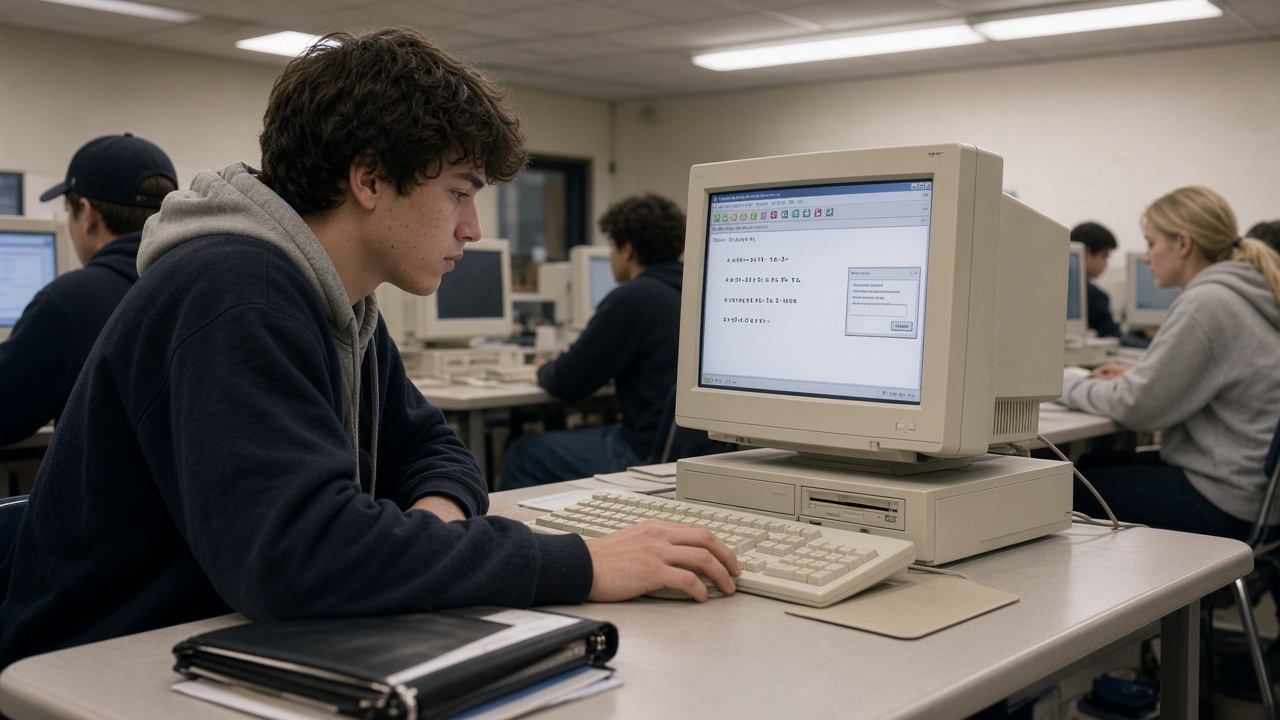
Intelligent tutors gave step-by-step hints on algebra and geometry problems.
1980: Seymour Papert’s book Mindstorms argues children should program computers, not be programmed by them.
1984: Benjamin Bloom’s “2 Sigma Problem”; India launches the CLASS project to bring computers into schools.
1980s: John Anderson’s team at Carnegie Mellon builds LISP, geometry, and algebra tutors based on how students learn.
1988–1998: First international conference on intelligent tutoring systems (1988); Cognitive Tutor algebra spreads to schools; Carnegie Learning founded (1998).
Technology
Student models: Software tracks what a learner knows.
Expert systems: Rules capture how experts solve problems.
CD-ROMs & PCs: Multimedia learning in schools and homes.
Features
Step-by-step hints: Help at the exact point of confusion.
Mastery learning: Move on only after understanding.
Narrow subjects: Each tutor covered one topic, costly to build.
📱 Learning Online2000 – 2015
Online & Adaptive Learning
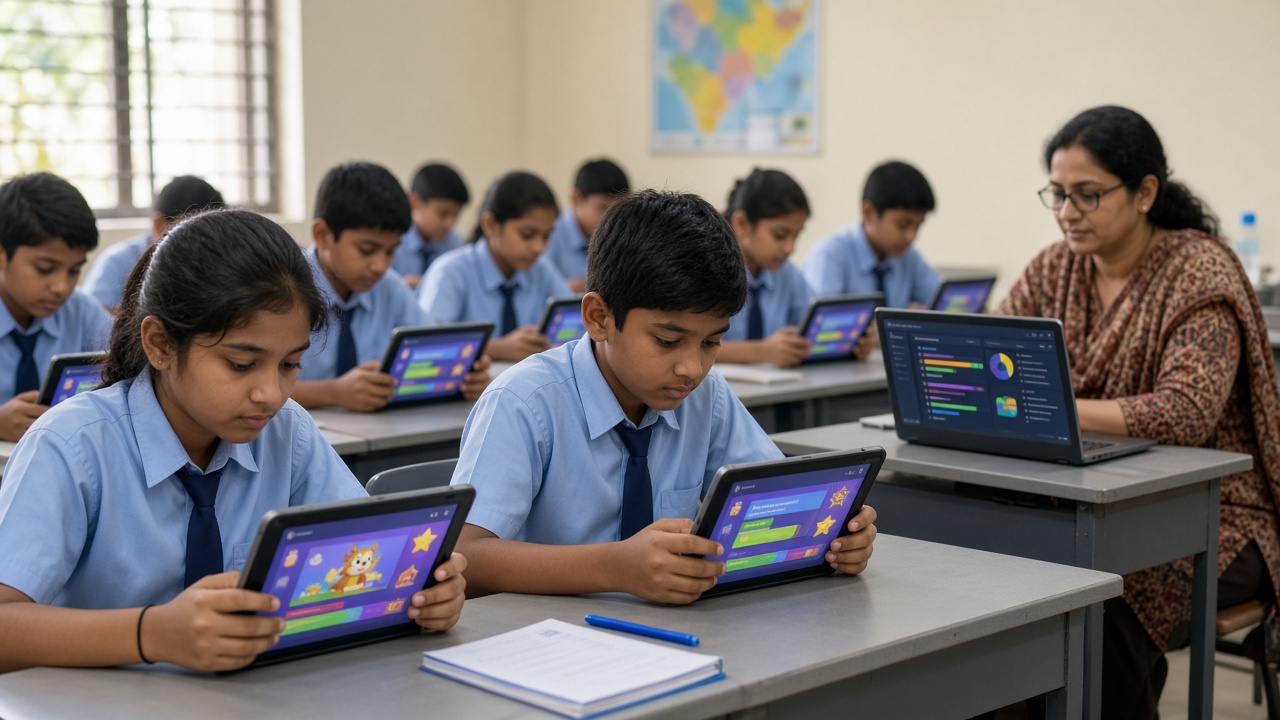
The internet and smartphones put learning apps in every pocket. Adaptive platforms used data to personalise practice, MOOCs used automated grading for huge classes, and learning analytics helped teachers spot struggling students early.
Adaptive apps adjust each question to the student while teachers track progress on dashboards.
2002 / 2008: Moodle learning management system; Khan Academy starts free video lessons and practice.
2008–2012: Adaptive learning companies grow; Duolingo gamifies language learning; the “Year of the MOOC” brings automated grading to massive classes.
2011–2012: Learning analytics becomes a research field; IBM Watson wins Jeopardy!; deep learning breakthroughs in image recognition.
2015: India’s edtech boom — adaptive and video-based learning apps reach millions of students.
Technology
Recommendation algorithms: Suggest the next best lesson.
Knowledge tracing: Predict what a student will get right.
Cloud & mobile apps: Learning anytime, anywhere.
Features
Personalised practice: Harder or easier questions based on answers.
Gamification: Points, streaks, and badges keep learners motivated.
Data concerns: Questions about student privacy and screen time.
🤖 AI Goes to School2016 – 2021
Deep Learning & AI in Schools
Deep learning made speech recognition, translation, and chatbots far better. Students began learning about AI itself, India introduced AI into the school curriculum, and the COVID-19 pandemic made digital learning part of daily life.
Indian students now build simple AI projects in school labs and tinkering labs.
2016: Georgia Tech’s AI teaching assistant “Jill Watson” answers student questions; India launches Atal Tinkering Labs in schools.
2017 / 2018: DIKSHA digital learning platform; NITI Aayog’s National Strategy for Artificial Intelligence (#AIforAll) highlights education.
2019: UNESCO’s Beijing Consensus on AI and education; CBSE introduces Artificial Intelligence as a school subject.
2020–2021: COVID-19 moves classes online; NEP 2020 calls for coding and AI awareness; Responsible AI for Youth programme; UNESCO guidance on AI for policymakers.
Technology
Neural networks: Better speech, vision, and translation.
Chatbots: Answer routine questions from students.
No-code AI tools: Students train simple models in class.
Features
AI literacy: Learning how AI works, not just using it.
Remote learning: Online classes and digital content at scale.
Ethics debates: Online proctoring and surveillance concerns.
✨ Generative AI2022 – Present
Generative AI Era
Large language models can explain concepts, write, translate, and create quizzes in seconds. Schools first worried about cheating, then began teaching students how to use AI responsibly, while governments and UNESCO issued guidance on safe, ethical AI in education.
Generative AI tutors can explain step by step at any hour — but answers still need checking.
30 November 2022: ChatGPT is released; schools and universities rethink homework and assessment.
2023: AI tutors such as Khan Academy’s Khanmigo launch; UNESCO publishes guidance on generative AI in education and research.
2024: IndiaAI Mission approved; UNESCO releases AI competency frameworks for students and teachers; EU AI Act treats many education AI uses as high-risk.
2025–present: India announces a Centre of Excellence in AI for education and plans to introduce AI and computational thinking from early school grades; AI tools support Indian-language learning.
Technology
Large language models: Conversational tutors and writing assistants.
Multimodal AI: Understands text, images, speech, and diagrams.
Indian-language AI: Translation and voice tools for many languages.
Features
24/7 personal help: Explanations, examples, and practice on demand.
Teacher co-pilots: Lesson plans, quizzes, and feedback drafts.
New risks: Hallucinations, bias, privacy, and academic dishonesty.
Types of AI Used in Education
LOGO turtles taught children to think like programmers — an early step toward AI literacy (artistic illustration).
Type
What it does
Example use
Intelligent tutoring system
Models student knowledge and gives step-by-step hints
Maths and science practice
Adaptive learning platform
Adjusts difficulty and pace for each learner
Personalised practice apps
Automated assessment
Grades objective tests and gives quick feedback
Online quizzes and coding tests
Chatbot / AI teaching assistant
Answers routine questions from students
Course forums and help desks
Generative AI tutor
Explains, writes, summarises, and creates questions
Homework help and revision
Learning analytics
Finds patterns and early warning signs in learning data
Identifying students who need help
Speech & language AI
Translation, speech-to-text, and reading assessment
Indian-language learning tools
Accessibility AI
Text-to-speech, captions, and image descriptions
Support for students with disabilities
AI & Digital Learning Milestones in India
Key steps India has taken to bring computers and AI into education.
Year
Milestone
1984
CLASS project brings computers to schools
2016
Atal Tinkering Labs for hands-on STEM and AI projects
2017
DIKSHA national digital learning platform
2018
NITI Aayog’s National Strategy for Artificial Intelligence
2019
CBSE introduces Artificial Intelligence as a school subject
2020
NEP 2020 recommends coding and AI awareness; Responsible AI for Youth
2022
Bhashini platform for Indian-language AI and translation
2024
IndiaAI Mission approved
2025
Centre of Excellence in AI for education announced
AI in Education: Opportunities vs Concerns
AI can be a powerful learning partner, but it must be used carefully, fairly, and with human judgement.
Area
Opportunity
Concern
Personalisation
Lessons matched to each learner’s level
Heavy collection of student data
Access
Help available anytime, in many languages
Digital divide for students without devices
Feedback
Instant explanations and corrections
AI can give confident but wrong answers
Teachers
Saves time on planning and grading
Risk of replacing human care and judgement
Assessment
Faster, more frequent practice tests
Cheating and loss of original thinking
Fairness
Support for students with disabilities
Bias in data can treat groups unfairly
Skills
Builds AI literacy for future jobs
Over-reliance weakens problem-solving
Learning: Before AI vs With AI
Aspect
Before AI
With AI
Doubt solving
Wait for teacher, tuition, or parents
AI tutor explains instantly, any time
Pace
Same speed for the whole class
Personalised pace for each student
Feedback
Days or weeks after submission
Immediate feedback on practice
Practice
Same worksheet for everyone
Adaptive questions for each learner
Language
Mostly one medium of instruction
Translation and voice in many languages
Teacher role
Main source of information
Mentor, guide, and checker of AI output
Key skills
Memorising facts
Critical thinking, creativity, and AI literacy
Assessment
Written exams and manual checking
Mix of AI-assisted practice and human evaluation
AI in Education Timeline Summary
Year / Era
Milestone
1924
Pressey’s teaching machine
1950
Turing asks “Can machines think?”
1954
Skinner’s teaching machines
1956
“Artificial intelligence” term coined
1960
PLATO computer-based learning
1967
LOGO programming language for children
1970
SCHOLAR, first intelligent tutoring system
1984
Bloom’s 2 Sigma Problem; India’s CLASS project
1998
Cognitive Tutor commercialised
2008
Khan Academy
2012
Year of the MOOC
2016
AI teaching assistant “Jill Watson”
2018
NITI Aayog AI strategy
2019
CBSE AI subject; UNESCO Beijing Consensus
2020
COVID-19 online learning; NEP 2020
2022
ChatGPT released
2023
AI tutors and UNESCO generative AI guidance
2024
IndiaAI Mission; UNESCO AI competency frameworks
Test Your Knowledge
20 quick questions from the AI in education timeline. Click each question to reveal the answer.
Answer: Sidney Pressey.
Answer: B. F. Skinner.
Answer: Alan Turing.
Answer: The Dartmouth workshop.
Answer: The University of Illinois.
Answer: An early chatbot created by Joseph Weizenbaum.
Click any panel to expand and explore the visual mood.
AI in education in pictures — teaching machines, PLATO terminals, LOGO turtles, intelligent tutors, adaptive apps, school AI labs, generative AI tutors, and future classrooms.
Teaching Machines
1920s–1950s
PLATO
Computer-assisted instruction
LOGO Turtle
Children learn to code
Intelligent Tutors
Step-by-step hints
Adaptive Learning
Personalised practice
AI in Schools
Students build AI
Generative AI
AI tutor on demand
Future Classroom
Teachers + AI together
Explore all education timelines
Jump to any other education timeline on WorldTimelineHub.
Disclaimer: This content is AI-generated for educational purposes and may contain errors or outdated details. For correct and authoritative information, please refer to official and reliable sources such as government publications, manufacturers, museums, and academic references.