Public Education Timeline: Free Schooling in India
From village pathshalas under banyan trees to smart classrooms in government schools — India’s journey to free schooling for every child
took more than 200 years of reformers, laws, court judgments, and national schemes.
This timeline follows how education moved from a privilege for a few to a Fundamental Right: Phule’s girls’ school, Baroda’s free compulsory schooling,
Gokhale’s bill, Article 45, midday meals, Sarva Shiksha Abhiyan, Article 21A, the Right to Education Act, and NEP 2020.
Free public education means the government runs or funds schools so that every child can study without paying fees. In India this includes
free admission, textbooks, uniforms, midday meals, and scholarships in government schools, plus reserved free seats in private schools.
Today, children aged 6 to 14 have a Fundamental Right to free and compulsory education under Article 21A and the RTE Act.
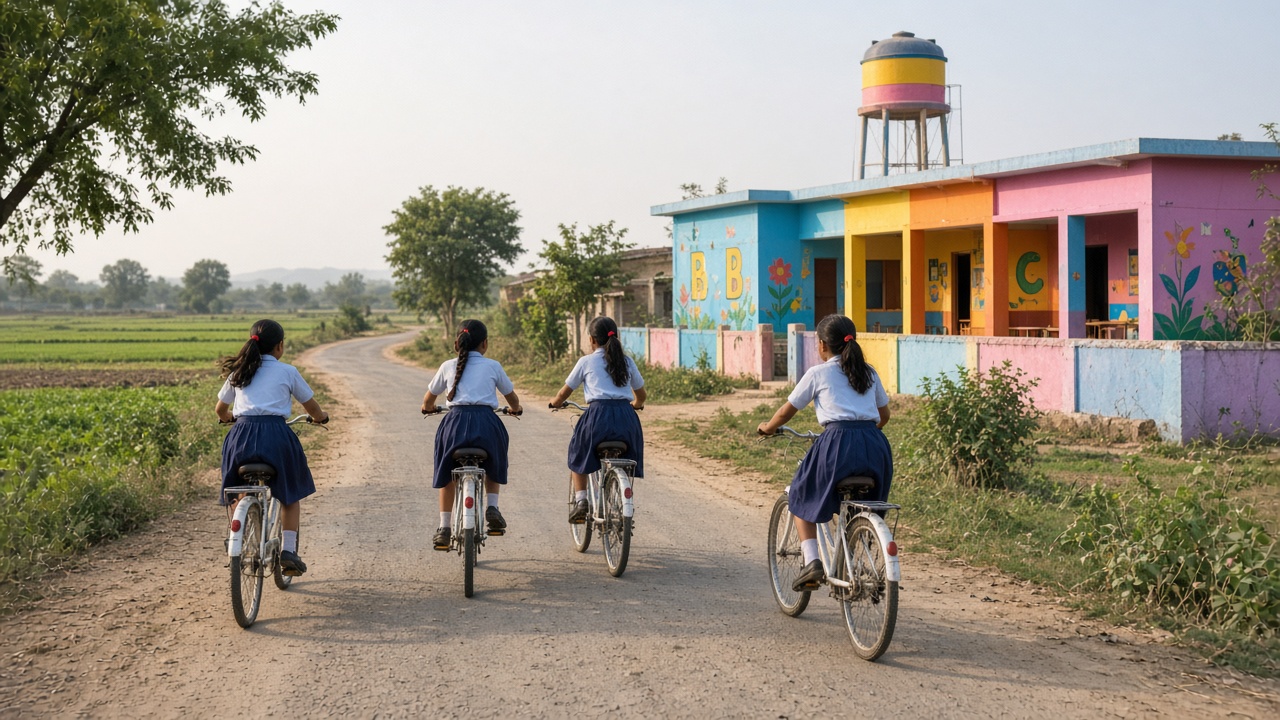
Free bicycles, new school buildings, and free schooling helped millions of rural girls stay in school.
🌳 Village LearningBefore 1813
Community Schools & Village Learning
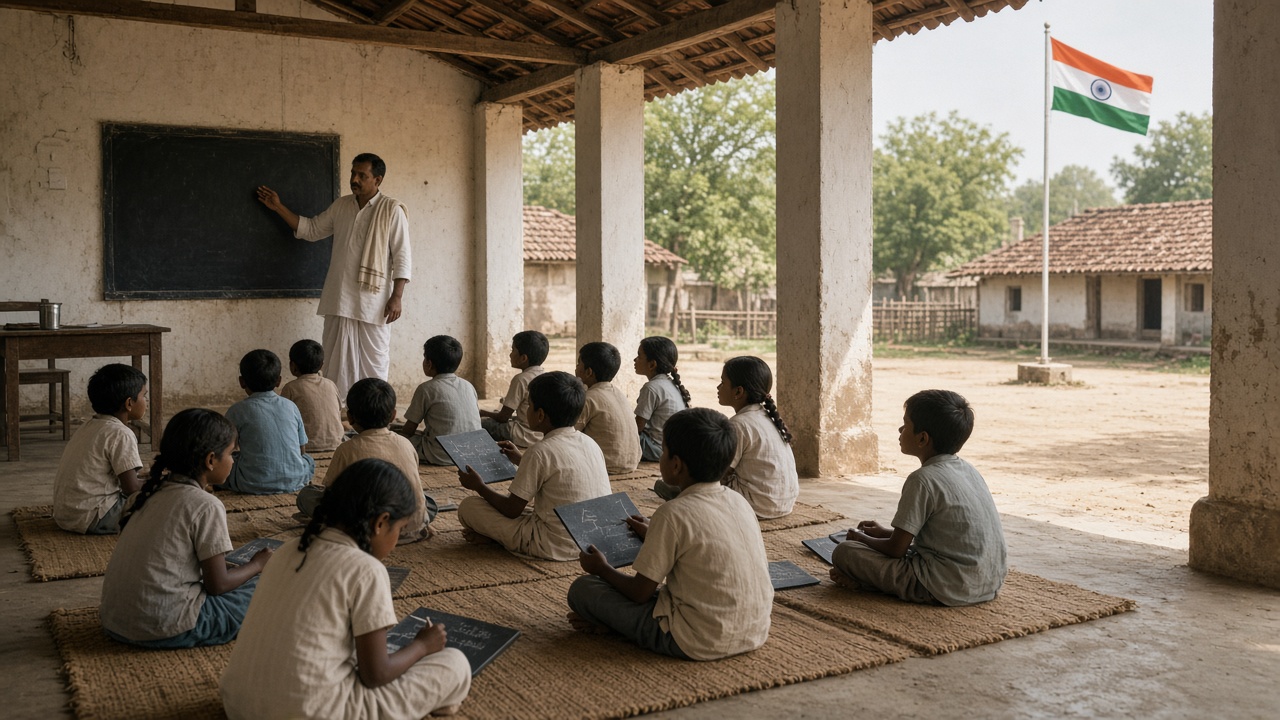
Before colonial rule, learning happened in gurukuls, pathshalas, tols, maktabs, and madrasas supported by communities, temples, mosques, and local patrons. Many village schools charged little or accepted grain and gifts, but education was uneven and largely closed to girls and to many castes.
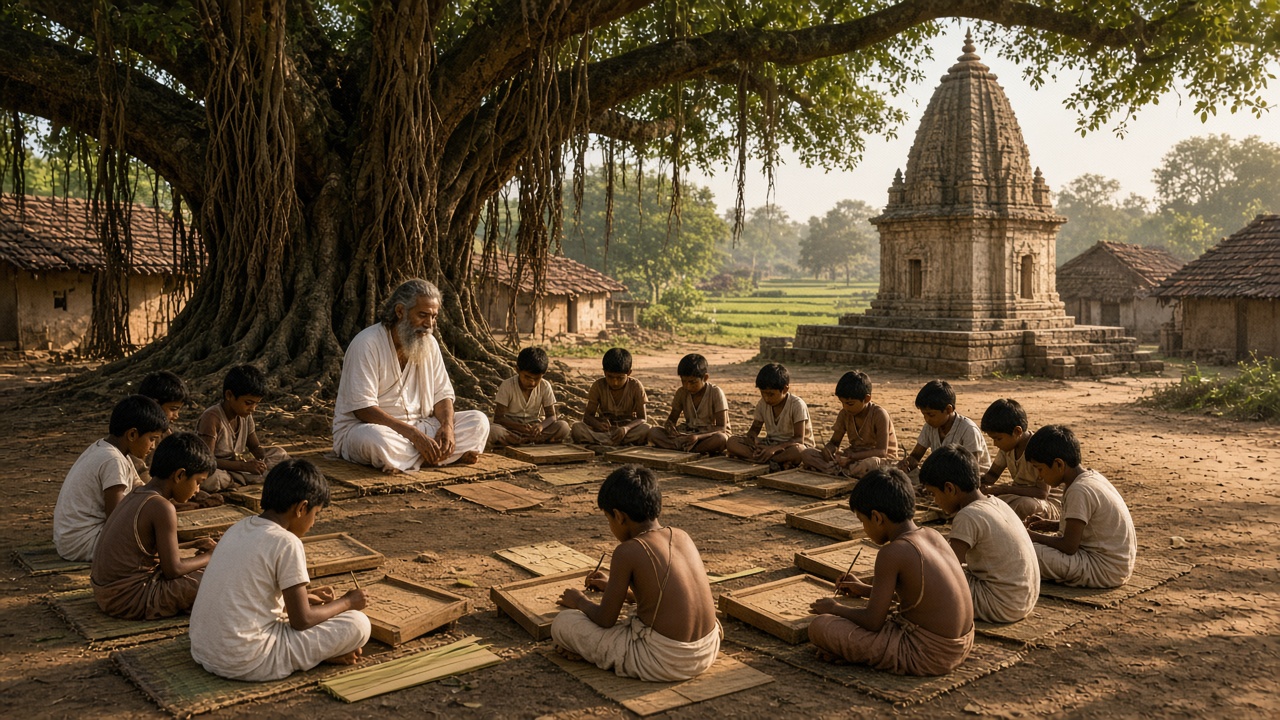
A village pathshala: children learned letters in sand and on palm leaves under a single teacher.
Ancient times: Gurukuls and centres like Takshashila and Nalanda teach selected students, often supported by kings and donations.
Medieval period: Maktabs and madrasas attached to mosques, and pathshalas and tols attached to temples, spread basic literacy.
1822–1826: Thomas Munro’s survey of the Madras Presidency records thousands of indigenous village schools.
1835–1838: William Adam’s reports estimate about one lakh village schools in Bengal and Bihar.
How Schools Were Supported
Community support: Villagers paid teachers in grain, cash, or gifts.
Religious endowments: Temples, mosques, and monasteries funded learning.
Royal patronage: Kings and nobles granted land to scholars.
Features
Practical skills: Reading, writing, arithmetic, and accounts.
Local languages: Teaching in Sanskrit, Persian, Arabic, and regional languages.
Limited access: Girls and many oppressed castes were mostly excluded.
📜 First Public Funds1813 – 1904
Colonial Education Policies
The British government slowly began funding education, but mostly to train English-educated clerks. Indian reformers such as Jyotirao and Savitribai Phule opened schools for girls and oppressed castes, and demanded that the state educate the masses.
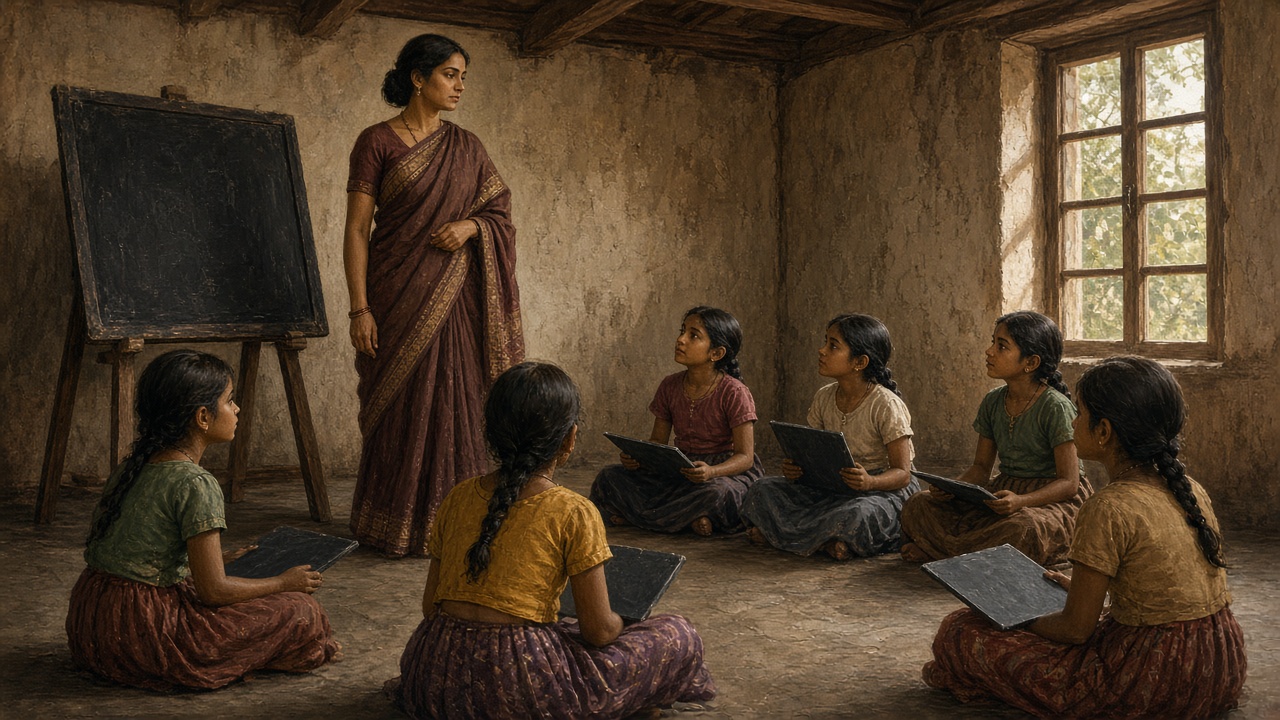
Pioneering girls’ schools opened the door to education for Indian women (artistic illustration).
1813: The Charter Act sets aside at least ₹1 lakh a year for education in India — the first public education fund.
1835: Macaulay’s Minute and the English Education Act favour English-medium higher education.
1848 / 1854: Jyotirao and Savitribai Phule open a girls’ school in Pune; Wood’s Despatch sets up education departments, grants-in-aid, and vernacular primary schools.
1882–1883: Hunter Commission hands primary education to district and municipal boards; Jyotirao Phule urges free and compulsory primary education.
Policy Tools
Grants-in-aid: Government money for private and mission schools.
Departments of Public Instruction: Inspectors and school rules in each province.
Local boards: District and municipal bodies manage primary schools.
Features
Downward filtration: Educate a small elite and hope it spreads.
Fees charged: Most schools were not free.
Reformers step in: Social reformers open schools for girls and the poor.
✊ Demand for Free Schools1893 – 1947
The Fight for Free & Compulsory Education
The princely state of Baroda showed that free and compulsory schooling was possible. Nationalist leaders then demanded the same across British India, and provinces passed their own compulsory education laws — though poor funding kept results limited.
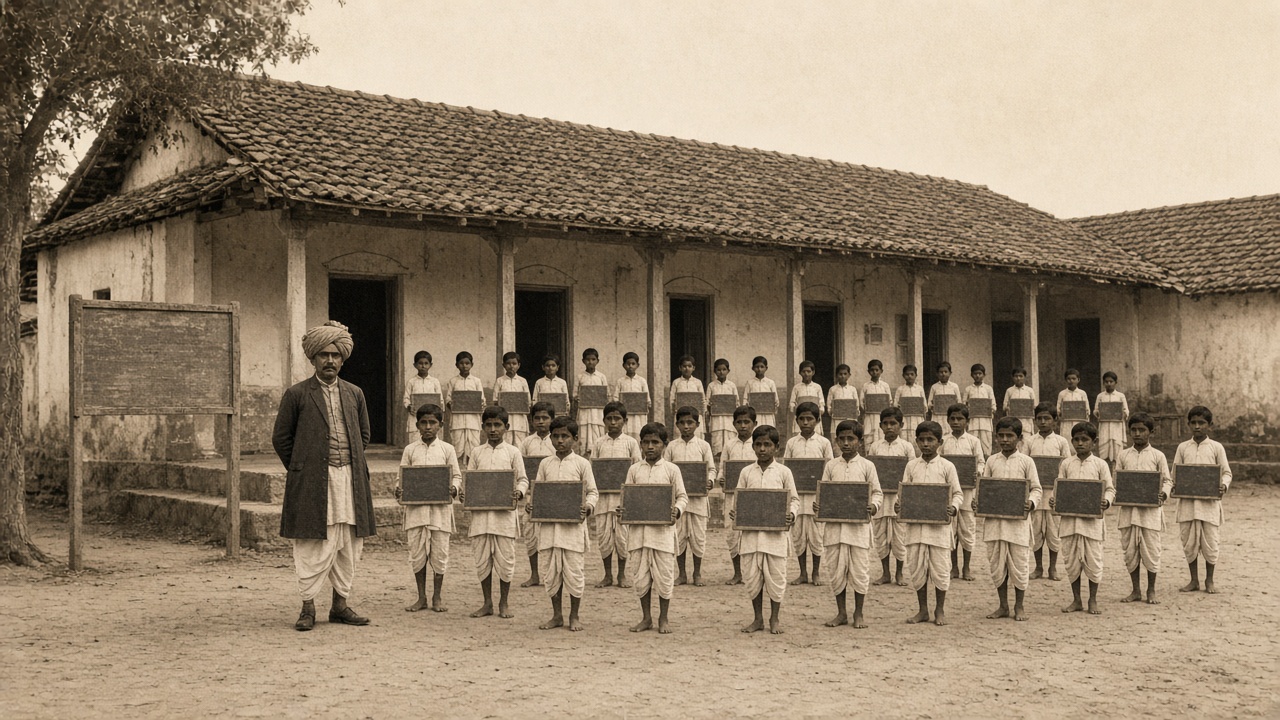
Local board primary schools spread slowly across towns and villages in the early 20th century.
1893 / 1906: Maharaja Sayajirao Gaekwad III introduces free and compulsory primary education in Amreli (Baroda) and extends it statewide.
1910–1912: Gopal Krishna Gokhale’s resolution and Elementary Education Bill for free and compulsory schooling is rejected by the Imperial Legislative Council.
1918 onward: Bombay Primary Education Act (Patel Act) — first provincial compulsory education law — followed by similar acts in other provinces.
1937 / 1944: Gandhi’s Wardha scheme (Nai Talim) proposes seven years of free, craft-based schooling; the Sargent Plan proposes free compulsory education for ages 6–14.
Key Ideas
Compulsory attendance: Parents required to send children to school.
Free primary schooling: No fees for the first years of school.
Mother tongue: Basic education in the child’s own language.
Features
Model states: Baroda and later Travancore and Mysore lead the way.
Weak enforcement: Laws existed but money and schools were scarce.
National goal: Universal education becomes part of the freedom movement.
🇮🇳 A National Promise1947 – 1985
Constitution & Expansion
Independent India promised free and compulsory education for all children up to 14 years in the Constitution. Thousands of government schools opened, free midday meals began in Tamil Nadu, and national commissions called for a common school system — but the 10-year target was missed.
After independence, simple village government schools brought boys and girls into classrooms together.
1950: Article 45 (Directive Principle) asks the State to provide free and compulsory education to all children up to 14 within ten years.
1956 onward: Chief Minister K. Kamaraj expands free midday meals in Madras State schools (first started by Madras Corporation in 1925).
1963 / 1964–66 / 1968: Kendriya Vidyalayas set up; Kothari Commission recommends a common school system; the first National Policy on Education calls for free and compulsory schooling.
1976 / 1982: 42nd Amendment moves education to the Concurrent List; Tamil Nadu launches the Nutritious Noon Meal Scheme.
What Governments Provided
Free tuition: No fees in government primary schools.
Midday meals: Food to bring poor children to school.
Scholarships: Support for SC, ST, and other disadvantaged students.
Features
Rapid expansion: Schools opened in lakhs of villages.
Not yet a right: Article 45 could not be enforced in courts.
Big gaps: Dropouts, child labour, and poor facilities remained common.
🍛 Schools for All1986 – 2009
Mass Schemes & Right to Education
National programmes built classrooms, hired teachers, and fed children, while the Supreme Court declared education a right. In 2002 Parliament made free and compulsory education for children aged 6–14 a Fundamental Right.
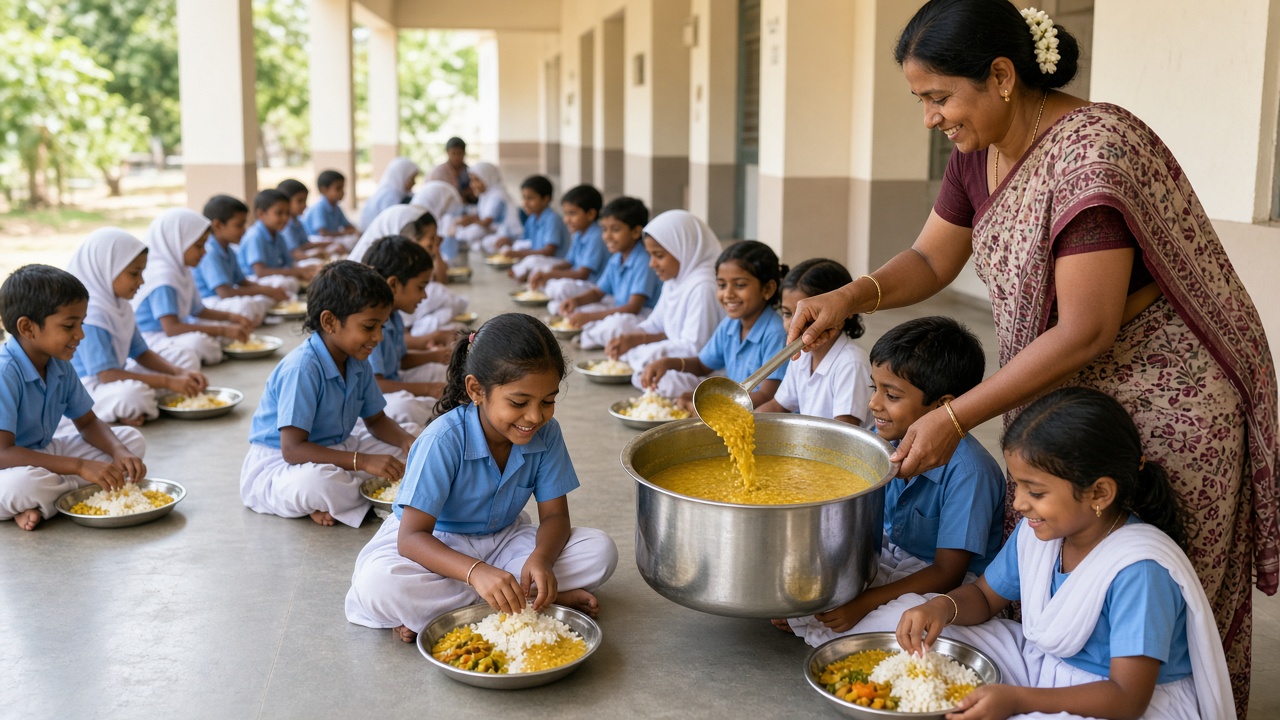
The midday meal scheme became one of the world’s largest school feeding programmes.
1986 / 1987: National Policy on Education; Jawahar Navodaya Vidyalayas (free residential schools); Operation Blackboard supplies basic classrooms and teaching aids.
1993 / 1994 / 1995: Supreme Court’s Unni Krishnan judgment links the right to education to Article 21; District Primary Education Programme; national midday meal scheme (15 August 1995).
2001: Sarva Shiksha Abhiyan launched; Supreme Court orders cooked midday meals in government primary schools.
2002 / 2004 / 2006 / 2009: 86th Amendment adds Article 21A; Kasturba Gandhi Balika Vidyalayas for girls; Bihar’s bicycle scheme for schoolgirls; Rashtriya Madhyamik Shiksha Abhiyan for secondary schools.
What Governments Provided
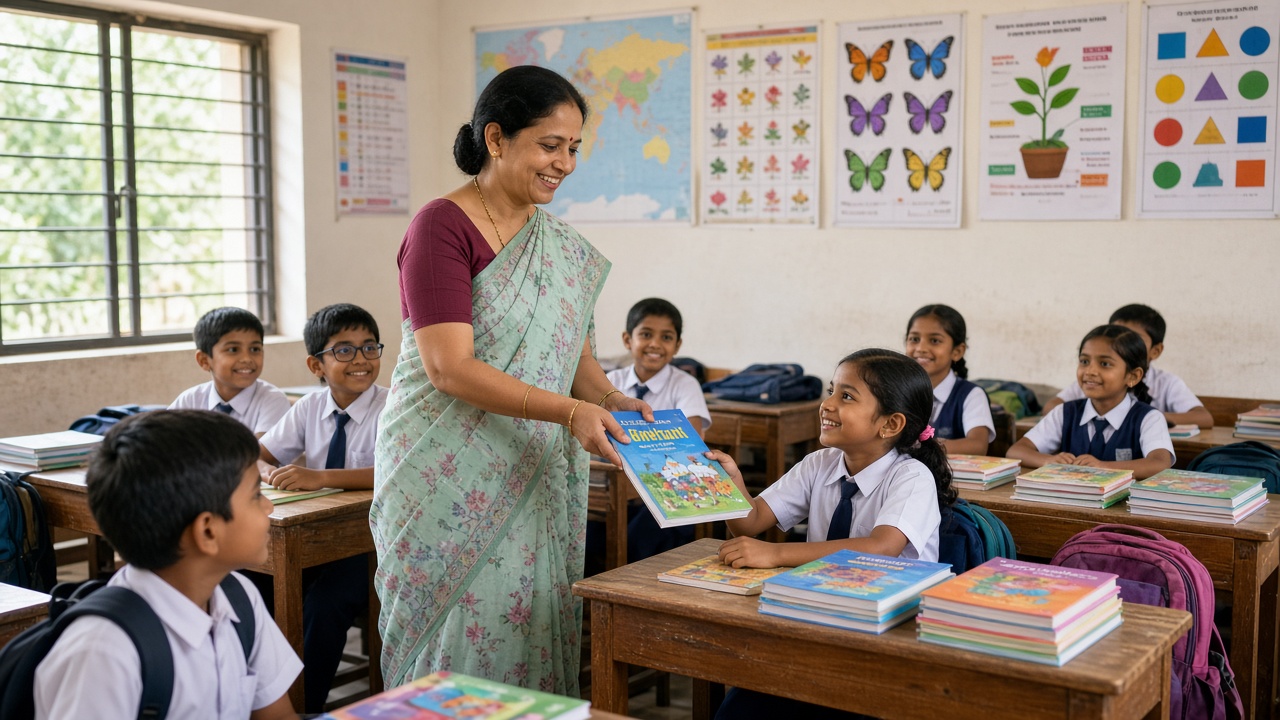
Free textbooks & uniforms: Supplied to children in government schools.
New schools & teachers: A school within walking distance of most villages.
Hot cooked meals: Daily lunch to improve attendance and nutrition.
Girls’ education: Gender gap in enrolment narrows.
Quality concerns: Many children still struggle with reading and arithmetic.
⚖️ A Legal Right2010 – Present
RTE Act, Samagra Shiksha & NEP 2020
The Right to Education Act turned free schooling into an enforceable right for every child aged 6–14. Later reforms merged school schemes, renamed the midday meal as PM POSHAN, and set a goal of universal education from pre-school to class 12 under NEP 2020.
Free textbooks, uniforms, and meals are part of the promise of free schooling today.
1 April 2010: Right of Children to Free and Compulsory Education (RTE) Act, 2009 comes into force.
2012 / 2019: Supreme Court upholds the 25% free-seat quota in private schools; RTE amendment lets states hold exams and detain students in classes 5 and 8.
2018 / 2020: Samagra Shiksha merges SSA, RMSA, and teacher education; NEP 2020 targets 100% enrolment from pre-school to secondary by 2030.
2021 / 2022 / 2024: Midday meal renamed PM POSHAN; PM SHRI scheme upgrades model government schools; Centre ends the no-detention policy for classes 5 and 8 in its schools.
Tools & Technology
UDISE+: Online data on every school, teacher, and student.
DIKSHA & PM eVIDYA: Free digital textbooks and lessons.
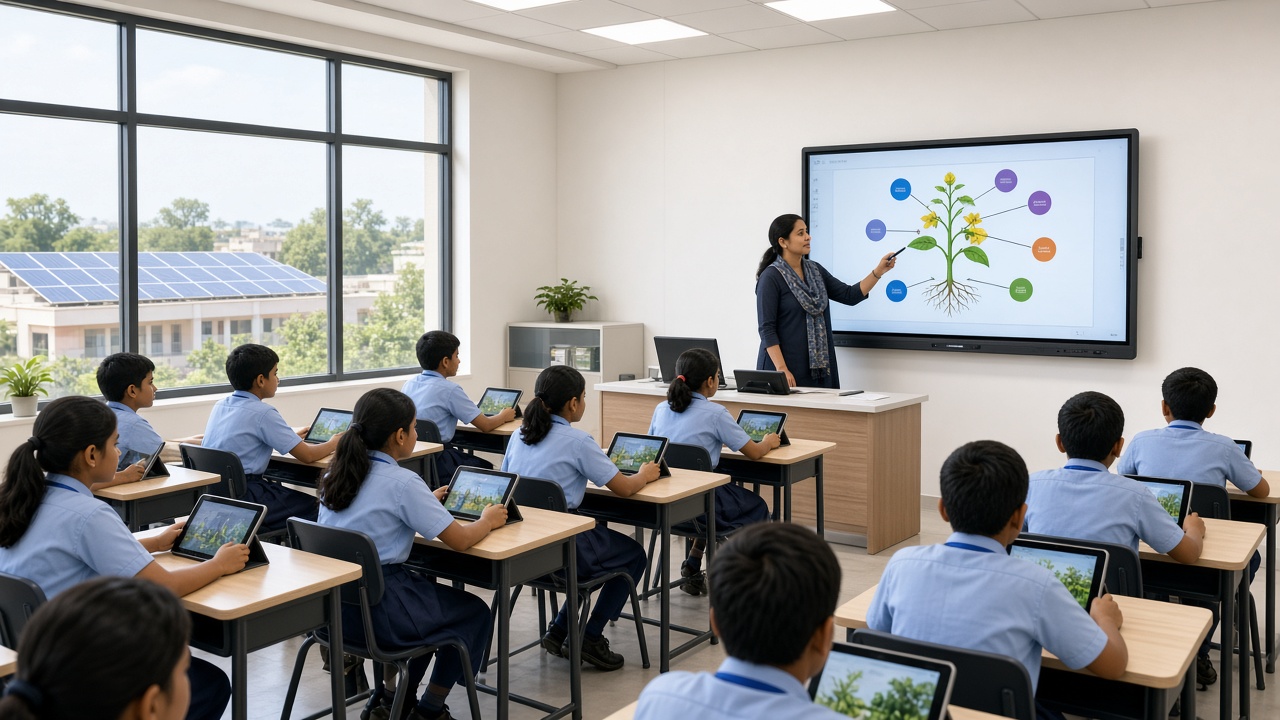
Smart classrooms: Digital boards and tablets in government schools.
Features
Enforceable right: Parents can complain if a child is denied admission.
Inclusion: Free seats in private schools and support for children with disabilities.
Focus on learning: Foundational literacy and numeracy (NIPUN Bharat).
Key Laws & Policies for Free Schooling
The main legal and policy steps that turned free schooling from an idea into a right.
Year
Law / Policy
What it did
1813
Charter Act
First government fund (₹1 lakh a year) for education in India
1854
Wood’s Despatch
Education departments, grants-in-aid, and vernacular primary schools
1906
Baroda compulsory education
Free and compulsory primary schooling across a whole state
1911
Gokhale’s Elementary Education Bill
Proposed free and compulsory schooling; rejected in 1912
1918
Bombay Primary Education Act
First provincial compulsory education law in British India
1950
Article 45
Directive to provide free and compulsory education up to age 14
1968 / 1986
National Policies on Education
Universal elementary education as a national goal
1993
Unni Krishnan judgment
Right to education up to 14 flows from the right to life
2002
86th Amendment (Article 21A)
Free and compulsory education for ages 6–14 as a Fundamental Right
2009
RTE Act
Legal framework for free schooling, school standards, and 25% free seats
2020
NEP 2020
Universal access from pre-school to class 12 by 2030
Schemes That Made Schooling Free
Free schooling is more than no fees — these schemes remove other costs that keep children out of school.
Scheme
Began
Benefit
Kendriya Vidyalayas
1963
Common central schools, especially for children of transferable employees
Jawahar Navodaya Vidyalayas
1986
Free residential schools for talented rural children
Operation Blackboard
1987
Basic classrooms, teachers, and teaching aids in primary schools
Mid-Day Meal / PM POSHAN
1995 / 2021
Free hot cooked lunch in government and aided schools
Sarva Shiksha Abhiyan
2001
New schools, teachers, free textbooks, and uniforms
Kasturba Gandhi Balika Vidyalaya
2004
Free residential upper-primary schools for disadvantaged girls
State bicycle schemes
2006 onward
Free bicycles to help girls reach secondary school
Rashtriya Madhyamik Shiksha Abhiyan
2009
Expanded access to secondary schools
Samagra Shiksha
2018
One integrated scheme from pre-school to class 12
PM SHRI Schools
2022
Upgrading government schools into model schools
RTE Act 2009: Key Provisions
What the Right of Children to Free and Compulsory Education Act guarantees for children aged 6–14.
Provision
What it means
Free education
No fees or charges that prevent a child from completing classes 1–8
Neighbourhood school
Every child can study in a school near home
25% free seats
Private unaided schools reserve entry-level seats for disadvantaged children
No screening or capitation fee
No admission tests or donations for young children
Pupil–teacher ratio
About 30:1 in primary and 35:1 in upper primary
School standards
Classrooms, toilets, drinking water, playground, and library
Trained teachers
Teachers must meet minimum qualifications
No physical punishment
Ban on physical punishment and mental harassment
School Management Committees
Parents help plan and monitor the school
Age-appropriate admission
Out-of-school children join a class suited to their age with special training
Schooling in India: Then vs Now
Many government schools now have smart boards, tablets, and solar power.
Aspect
Earlier
Now
Who could study
Mainly boys from privileged families
Every child aged 6–14 has a legal right
Fees
Paid in cash, grain, or gifts
Free in government schools up to class 8
School building
Under a tree or in a temple or verandah
Classrooms, toilets, water, and playgrounds
Books & uniforms
Bought by families, if at all
Free textbooks and uniforms for many children
Food
Children often came hungry
Free hot cooked lunch through PM POSHAN
Girls’ education
Rare and often opposed
Girls’ enrolment close to boys’ at school level
Teaching aids
Sand, palm leaves, and slates
Blackboards, digital boards, and online content
Accountability
Depended on teacher or patron
School Management Committees, data, and grievance systems
Public Education Timeline Summary
Year / Era
Milestone
1813
Charter Act creates the first education fund
1848
Phules open a girls’ school in Pune
1854
Wood’s Despatch sets up education departments
1882
Hunter Commission hands primary schools to local boards
1906
Baroda makes primary education free and compulsory statewide
1911
Gokhale’s free and compulsory education bill (rejected 1912)
1918
Bombay Primary Education Act
1937
Wardha scheme of basic education
1950
Article 45 promises free schooling up to age 14
1956
Midday meals expand in Madras State
1986
National Policy on Education and Navodaya Vidyalayas
1995
National midday meal scheme
2001
Sarva Shiksha Abhiyan
2002
Article 21A makes education a Fundamental Right
2010
RTE Act comes into force
2018
Samagra Shiksha
2020
NEP 2020
2021
PM POSHAN replaces the midday meal scheme
Test Your Knowledge
20 quick questions from the public education timeline. Click each question to reveal the answer.
Answer: The Charter Act of 1813 (₹1 lakh a year).
Answer: William Adam (1835–1838).
Answer: Jyotirao and Savitribai Phule.
Answer: Wood’s Despatch.
Answer: The Hunter Commission.
Answer: Baroda, under Maharaja Sayajirao Gaekwad III (1893 / 1906).
Answer: Gopal Krishna Gokhale.
Answer: The Bombay Primary Education Act (Patel Act).
Answer: The Wardha scheme (Nai Talim).
Answer: Article 45 (a Directive Principle).
Answer: K. Kamaraj.
Answer: The 42nd Amendment (1976).
Answer: Free residential schools for talented rural children, started in 1986.
Click any panel to expand and explore the visual mood.
Free schooling in India in pictures — village pathshalas, pioneering girls’ schools, local board schools, midday meals, bicycles, free textbooks, and smart classrooms.
Village Pathshala
Community learning
Girls’ School
Reformers open doors
Local Board School
Colonial-era primary schools
Free India School
Article 45 promise
Midday Meal
Food for learning
Cycling to School
Girls stay in school
Free Textbooks
Right to Education
Smart Classroom
Digital government schools
Explore all education timelines
Jump to any other education timeline on WorldTimelineHub.
Disclaimer: This content is AI-generated for educational purposes and may contain errors or outdated details. For correct and authoritative information, please refer to official and reliable sources such as government publications, manufacturers, museums, and academic references.